198
Neural Conversation Model Controllable by Given Dialogue Act Based on Adversarial Learning and Label-aware Objective
Seiya Kawano, Koichiro Yoshino and Satoshi Nakamura
Devision of Information Science, Graduate School of Science and Technology Nara Institute of Science and Technology, Nara 630-0192, Japan
{ kawano.seiya.kj0, koichiro, s-nakamura } @is.naist.jp
Abstract
Building a controllable neural conversation model (NCM) is an important task. In this paper, we focus on controlling the responses of NCMs by using dialogue act labels of re- sponses as conditions. We introduce an ad- versarial learning framework for the task of generating conditional responses with a new objective to a discriminator, which explicitly distinguishes sentences by using labels. This change strongly encourages the generation of label-conditioned sentences. We compared the proposed method with some existing meth- ods for generating conditional responses. The experimental results show that our proposed method has higher controllability for dialogue acts even though it has higher or comparable naturalness to existing methods.
1 Introduction
A dialogue act is defined as the intention or the function of an utterance in dialogues. Dialogue act labels are defined as unique classes to distinguish between kinds of dialogue acts (Boyer et al., 2010;
Bunt et al., 2012). Some existing studies have ex- ploited the dialogue act as a component in model- ing the dialogue strategy of dialogue systems (Me- guro et al., 2010; Yoshino and Kawahara, 2015;
Shibata et al., 2016; Keizer and Rieser, 2017).
Neural conversation models (NCMs), which learn a direct mapping between a dialogue history and a response utterance, are widely researched as a scalable approach to building non-task oriented dialogue systems (Vinyals and Le, 2015; Serban et al., 2016). However, it is difficult to control their responses on the basis of actual constraints such as dialogue act classes. Some existing studies have tackled this problem to control responses from
NCMs by using actual labels; however, these mod- els still had some limitations (Wen et al., 2015; Li et al., 2016; Sun et al., 2017; Zhao et al., 2017;
Huang et al., 2018; Zhou et al., 2018). One crucial issue was that they do not have any explicit train- ing objectives to guarantee that a generation has a discriminability for a given condition.
We extend a framework of the generative adver- sarial network for sequential generation (Yu et al., 2017) for improving the controllability of NCMs under the constraint of a given dialogue act con- dition. We propose an adversarial learning frame- work that alternatively trains between conditioned generator and a conditioned discriminator. The discriminator has a multi-class objective that ex- plicitly classifies a generated response into an ap- propriate dialogue act class. This improves the discriminability of generation.
In this paper, we first describe the task of con- ditional response generation given a dialogue act label and its existing approaches (Section 3). Sec- ond, we introduce an adversarial learning frame- work and extend its architecture and objective to fit the problem of conditional generation (Sec- tion 4). In experiments, we use metrics to evalu- ate the controllability and naturalness of responses (Section 5). The experimental results show that our proposed model achieved the best controllabil- ity score in both automatic and human subjective evaluations even if it achieves better or compara- ble naturalness to existing methods (Section 6).
2 Related Work
Dialogue systems that have dialogue management
modules determine a dialogue act or dialogue state
of a system response by using statistical meth- ods such as reinforcement learning (Young et al., 2010; Meguro et al., 2010; Yoshino and Kawahara, 2015; Keizer and Rieser, 2017). Response gen- eration modules generate responses according to these dialogue acts or dialogue states on the ba- sis of the rules, templates, agendas or other sta- tistical models (Oh and Rudnicky, 2000; Xu and Rudnicky, 2000). Recently, neural network based generation modules have been widely used.
Wen et al. (2015) proposed a conditional language model (Semantically Conditioned Long Short-Term Memory; SC-LSTM) for task-oriented systems, which generates utterances on the basis of any dialogue acts and frames in the domain of restaurant navigation dialogue by using gating mechanism. However, the training framework of SC-LSTM requires state frames that express the function and the contents of target utterances entirely. Thus, it is not realistic to apply this method to building an open-domain dialogue system. Zhao et al. (2017) proposed an NCM based on a variation of the conditional variational autoencoder (CVAE), which generates responses that have high diversity in discourse level by using latent variables as dialogue acts. However, this model has no mechanism to guarantee for generating discriminable responses for given dialogue acts.
There is another research trend in controlling NCMs with a given condition, such as speaker or emotion labels (Li et al., 2016; Sun et al., 2017;
Huang et al., 2018; Zhou et al., 2018). These NCMs are optimized by softmax cross-entropy loss (SCE-loss), which calculates a loss word- by-word. However, such existing training objec- tives do not necessarily guarantee that a gener- ated response has high discriminability to for a given class label. In other words, SCE-loss is not an appropriate objective that explicitly evaluates whether a generated response reflects the property of the given class label or not. Therefore, the gen- erated response will be biased by majority class labels.
To prevent these problems, we introduce the
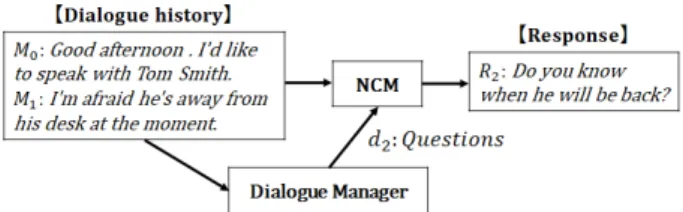
Figure 1: Task of response generation conditioned by dialogue act labels.
framework of the generative adversarial network (Yu et al., 2017; Li et al., 2017a; Tuan and Lee, 2019). This framework makes it possible to con- sider the total quality of generated sequences un- like SCE-loss, which is optimized for each token.
We extend adversarial networks to generate qual- ified and controlled sentences given a condition, especially dialogue act labels.
3 Response Generation Conditioned by Dialogue Act Label
3.1 Task Settings
The task we focus on is building a control- lable NCM with a given condition, typically dia- logue act labels. The problem is defined as gen- erating the ith response word sequence R
i= { w
1, w
2, · · · , w
T} given a dialogue history M = {M
i−1, M
i−2, . . . , M
i−n} and dialogue act label d
i. Here, n is the length of a dialogue, and T is the number of words in an utterance. As shown in Figure 1, a response R
iis required to satisfy not only the behavioral characteristic of a given dia- logue act but also the appropriateness in the dia- logue context (=history).
One of the simplest approaches to building such a conditional generation system given a class label in NCM is adding the class label to the input of a decoder (Li et al., 2016; Zhao et al., 2017; Sun et al., 2017). We describe this baseline in the fol- lowing section.
3.2 Conditional NCM with Dialogue Acts
We introduce a general conditional NCM that is conditioned by dialogue act labels as a baseline.
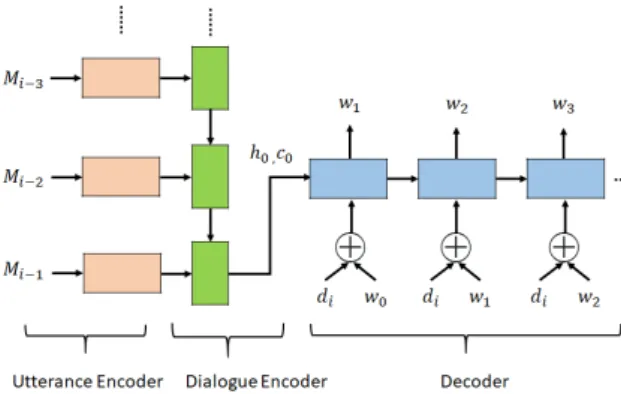
We built an NCM on the basis of a hierarchical
encoder-decoder model that explicitly gives labels
to the decoder at any of the steps of decoding as
Figure 2: Conditional-NCM with dialogue acts.
shown in Figure 2.
Recurrent neural networks (RNNs) such as long short-term memory (LSTM) are generally used to model a sequential generation of responses in NCMs (Hochreiter and Schmidhuber, 1997;
Vinyals and Le, 2015; Serban et al., 2016). The encoder receives a word at each time step by using forward RNNs to encode an utterance into a fixed length vector (utterance encoder). Utterance vec- tors of a dialogue are input to another fixed length vector according to their time sequence to encode the dialogue context (dialogue encoder). The re- sultant vector is fed into the decoder to generate a response sentence (word sequence). We used the same encoder architecture as Tian et al. (2017).
In the decoding steps of the NCMs, the decoder receives a previous hidden vector h
t−1, memory cell c
t−1, and generated word w
t−1to generate a word w
t. Here, t is an actual time-step of genera- tion. The model has been changed to receive not only the previous word w
t−1but also the dialogue act label d in conditional generation. The vector representations of d and w
tare concatenated and used as the input of the decoder at time-step t.
1The decoder itself also predicts the vector repre- sentation of words. This architecture is also the same as those of the models proposed by Zhao et al. (2017).
Softmax cross-entropy loss (SCE-loss) is widely used to train the model.
losssce=−log exp(xc)
∑|V|
k exp(xk). (1)
1wt andd are converted into vector representation and then concatenated.
Here, |V| indicates the vocabulary size, x ∈ R
|V|indicates the output of the projection layer in the decoding steps, and x
k∈ R
|V|indicates the kth element of x. x
cis the target word. SCE-loss op- timizes the prediction of words at each decoding step. However, it does not use the information of a given dialogue act label in the loss calculation dur- ing training. Thus, the resultant model often gen- erates a response that does not consider a given di- alogue act label or a biased response by using the majority dialogue act labels in the training data.
We tackle this problem by introducing an explicit training objective to generate a conditioned word sequence in adversarial learning.
4 Conditional Response Generation Based on Adversarial Learning
We introduce sequential generative adversarial networks (SeqGANs) (Yu et al., 2017; Li et al., 2017a; Tuan and Lee, 2019) to improve the con- trollability and quality of conditional response generation. SeqGAN is a prospective approach to preventing the problems caused by SCE-loss based training because it can evaluate not only the word prediction of each decoding step but also the whole quality of a generated sequence. In this section, we first describe the architecture of Se- qGAN (Section 4.1) and then propose our exten- sion of SeqGAN to realize conditional response generation by using given dialogue act labels (Sec- tion 4.2).
4.1 SeqGAN for Response Generation
The generation process in SeqGAN is formalized
as a Markov decision process (MDP) and opti-
mized with reinforcement learning (RL) (Li et al.,
2017a; Tuan and Lee, 2019). The problem of re-
sponse generation in NCMs is generating response
word sequence R = { w
1, · · · , w
T} given a dia-
logue context M. Such a word selection process
in the generation is defined as an action sequence,
which is generated by an actual policy in MDP. In
SeqGAN, the generator generates a sentence ac-
cording to the current policy. The discriminator
gives an evaluation score to the generated sentence
after the generation. The evaluation score is fed as
a reward to update the policy of the generator in RL. We use a policy gradient (Williams, 1992) to train the policy. The objective function and its gra- dient of the policy gradient are defined as follows
2.
J(θ) =∑
w1:T
Gθ(wt|w1:t−1, M)・QGDθ
ϕ((w1:t−1, M), wt) (2)
∇J(θ)≃1 T
∑T t=1
∑
wt∈V
QGDθ
ϕ((w1:t−1, M), wt)
· ∇θGθ(wt|w1:t−1, M) (3)
=1 T
∑T t=1
Ewt∼Gθ[QGDθ
ϕ((w1:t−1, M), wt)
· ∇θlogp(wt|w1:t−1, M)] (4)
Here, θ is a parameter of the policy. w
1:t−1in- dicates a word sequence, V is a vocabulary, and p is the generative probability of word w
t∈ V.
Q
GDθϕ
((w
1:t−1, M ), w
t) is an action-value function that gives an expected future reward when the system takes the action of generating word w
tgiven the state: already generated word sequence w
1:t−1and dialogue context M . ϕ is a parame- ter of the discriminator. The discriminator only outputs the reward after the whole generation of the sequence. Thus, the value of the action-value function Q
GDθϕ
((w
1:t−1, M ), w
t) for each step is calculated by using a Monte Carlo tree search (MCTS) under the current policy and its param- eter θ (Browne et al., 2012).
The discriminator is trained to classify a gener- ated sentence (fake) and sentence in training data (real). Its training objective is defined as,
min
ϕ −ER∼pdata(·|M)[logDϕ(R, M)]
−ER∼Gθ(·|M)[log(1−Dϕ(R, M))]. (5)
The generator and the discriminator are trained alternatively to train their network adversarially.
4.2 SeqGAN for Conditional Response Generation with Dialogue Acts
The generator and the discriminator in SeqGAN are extended to produce responses according to given dialogue acts. The adversarial framework is extended for jointly optimizing both networks: a generator network to produce response utterances
2Detailed derivation is shown in (Yu et al.,2017).
under specified dialogue acts, and a discriminator network to distinguish between generation (fake) and training data (real) that reflect their conditions.
As the generator network, we applied the conditional-NCM described in Section 3.2. Equa- tions (2) - (4) are changed as follows.
J(θ) =∑
w1:T
Gθ(wt|w1:t−1, M, d)·QGDθ
ϕ((w1:t−1, M, d), wt) (6)
∇J(θ)≃1 T
∑T
t=1
∑
wt∈V
QGDθ
ϕ((w1:t−1, M, d), wt)
· ∇θGθ(wt|w1:t−1, M, d) (7)
=1 T
∑T
t=1
Ewt∼Gθ[QGDθ
ϕ((w1:t−1, M, d), wt)
· ∇θlogp(wt|w1:t−1, M, d)] (8)
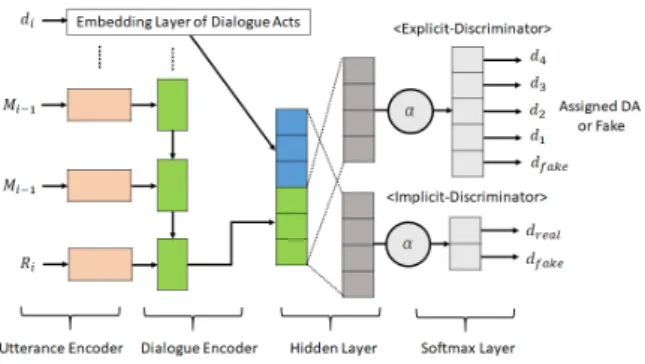
As the discriminator network, we incorporated dialogue act labels in the classification model (Fig- ure 3). In the discriminator model, the utter- ance encoder converts dialogue contexts into fixed length vectors and uses them as features of dis- crimination. We propose to use two discriminators for incorporating dialogue act label information in the discriminator: implicit and explicit. Each method is described below in respective sections.
4.2.1 Binary Objective;
Implicit-Discriminator
We built a simple extension for the discriminator that incorporates dialogue acts in the feature vec- tors of the discriminator. We call this architecture
“implicit.” This discriminator is defined as,
min
ϕ −ER∼pdata(·|M,d)[logDϕ(R, M, d)]
−ER∼Gθ(·|M,d)[log(1−Dϕ(R, M, d))]. (9)
We expect that the implicit discriminator can
use the information of dialogue acts as a fea-
ture and discriminate generated results as fakes if
they do not follow a given dialogue act (Figure 3,
lower-right). There are some works that have
similar approaches in emotional response gener-
ation (Sun et al., 2018; Kong et al., 2019). How-
ever, this discriminator is still a simple extension
of the standard discriminator, which classifies re-
sponse in two classes. In other words, the objec-
tive is not changed; thus it probably has difficulty
in distinguishing the class (dialogue act label) of
responses. We propose another discriminator to solve this problem in the next section.
Figure 3: Implicit & Explicit-Discriminator.
4.2.2 Multi-class Objective;
Explicit-Discriminator
We propose an approach extending the classifica- tion problem of the discriminator from the binary classification of fake/real to multi-class classifica- tion to distinguish target dialogue act classes (Fig- ure 3 upper-right). This discriminator has a multi- class objective for N +1 class classification. Here, N is the number of unique dialogue act classes;
another one is a fake class for categorizing the responses as generated. We call this architecture
“explicit.” Its objective function is defined as,
minϕ −
∑N
i=1
ER∼pdata(·|M,d)[logDϕ(di|R, M)]
−ER∼Gθ(·|M,d)[logDϕ(df ake|R, M)]. (10)
We used the posterior probability D
ϕ(d|R, M) es- timated by the discriminator as the reward of the generator. We expect that this discriminator will encourage training the generator to generate dis- criminative sentences with dialogue acts because generations that follow different dialogue act man- ners are penalized even if they are natural. Odena (2016) proposed a similar idea to use multi-class objective in GAN for the image generation task.
4.3 Speeding Up Adversarial Learning Using Simple Recurrent Unit
Using LSTM or GRU as an encoder and decoder is a general method for building NCMs (Vinyals and Le, 2015; Serban et al., 2016). LSTM is also of- ten used for classification problems to encode a hi- erarchical structure, such as the discriminators of
GANs (Tran et al., 2017). However, the training speed of LSTM is much slower than other types of networks, although LSTM has dominant per- formance (Lei et al., 2017). This characteristic is critical for adversarial learning, which requires a large number of iterations.
We used the policy gradient in this research to update the parameters of the generator, which is based on expected reward calculation by MCTS.
However, MCTS requires enormous calculation costs because it requires scanning the discrimina- tor and generator r × w times per one update of generator, where r is the number of rollouts and w is the number of words in a response each time step. Thus, we propose to use a simple recur- rent unit (SRU) (Lei et al., 2018) in our genera- tor and discriminator. SRU is known as an exten- sion of RNN, which has comparable performance to LSTM even if it works at significantly higher speed. SRU is defined as follows.
˜
vt=W vt (11)
ft=σ(Wfvt+bf) (12) rt=σ(Wrvt+br) (13) ct=ft⊙ct−1+ (1−ft)⊙v˜t (14) ht=rt⊙g(ct) + (1−rt)⊙vt (15)
Here, v
tis the input vector at time-step t, f
tis
the forgetting gate, r
tis the input gate, c
tis the
memory cell, and h
tis the hidden vector. The key
idea of SRU is minimizing the number of vectors
and gates affected by previous states. Under this
definition, only c
tis affected by the previous state
c
t−1. Furthermore, c
tand h
tare calculated only
by the element-wise production and summation of
a vector for easy speed up. It was reported that for-
ward and backward propagations in SRU are 10-
16 times faster than LSTM (Lei et al., 2018). SRU
leads to computational advantage compared with
another type of RNNs including GRU as well. We
expect to have a significant improvement in speed-
ing up adversarial learning by using SRU instead
of LSTM. However, applying SRU to NCM has
no track record; thus, we introduce SRU to both
the existing methods and our proposed adversarial
network; however, we also perform a comparison
with another baseline implemented by LSTM.
5 Experimental Settings 5.1 Dataset
We used the DailyDialog corpus that covers ten categories from a wide variety of topics (Li et al., 2017b). The corpus contains 13,118 dialogues, with a total of 102,979 utterances annotated with dialogue act labels: inform (46,532 utterances), questions (29,428 utterances), directives (17,295 utterances) and commissive (9,724 utterances).
We divided the corpus into training/validation/test sets with 11,118/1,000/1,000 dialogues according to the work of Li et al. (2017b). In all experiments, the vocabulary size was set to 25,000, and all the OOV words were replaced by “UNK” symbol.
5.2 Training Settings
We used the same setting for embedding: words, 256, dialogue acts, 100. The mini-batch size was 32. In the training for conditional-NCM, we set two-layers RNNs in both the encoder and the de- coder and used the Adam optimizer with a learn- ing rate of 1e-5.
In the proposed adversarial learning, we fol- lowed the training procedure proposed by Li et al.
(2017a). The training algorithm that we used is shown as follows.
Algorithm 1 Training procedure
1: fornumber of iterationsdo 2: G′←G
3: fornumber of G-stepsdo
4: sample(MG, RG, dG)from training data 5: generate responseRˆGby usingG′on(MG, dG) 6: compute rewardrRGfor(MG,RˆG, dG)by usingD 7: updateGon(MG,RˆG, dG)usingrRG
8: fornumber of D-stepsdo
9: sample(MD, RD, dD)from training data 10: generate responseRˆDby usingGon(MD, dD) 11: updateDusing(MD,RˆD, dD)and(MD, RD, dD)
In the training of SeqGAN for conditional re- sponse generation based on dialogue acts, we pre- pare well pre-trained conditional generator and a discriminator in advance. After initializing param- eters by pre-trained models, G-steps for the gen- erator G and D-steps for the discriminator D are
applied alternatively to train them. In G-steps, a generated response R ˆ
Gis sampled by using a di- alogue history M
Gand dialogue act d
G, and then the reward r
RˆG
for the generation is calculated by the discriminator D. By using the calculated re- ward r
RˆG
, parameters of G are updated. In D- steps, a real response R
D, given a dialogue history M
Dand a dialogue act label d
D, is sampled from the training data. A fake response R ˆ
Dis generated from the generator G by using the dialogue history M
Dand the dialogue act label d
D. Parameters of the discriminator D is updated by using the real sample and the fake sample.
We set the number of G-steps to 4 and D-steps to 20. In the generator, we used two-layers SRUs in both the encoder and the decoder as 1024 hid- den units. We used the Adam optimizer with a learning rate of 1e-5. For the discriminator, we used a one-layer SRU, 1024 hidden units, and the SGD optimizer with a learning rate of 1e-3. We set the number of rollout to 5 in MCTS.
5.3 Automatic Evaluation Metrics
We automatically evaluated generation results by comparing with references in the test-set. As the automatic evaluation, we used three different types of metrics: perplexity, relevance scores, and con- trollability.
Perplexity is a metric for evaluating a language model performance. Likelihoods of models for reference responses are calculated as perplexities.
Note that the perplexity score does not directly re- flect the quality of generation; dull responses also have good perplexity scores.
Relevance scores are similarities between refer-
ences and generated results. We used NIST, a vari-
ation of BLEU, which focuses on content words
more than BLEU (Doddington, 2002). How-
ever, using count-based metrics such as BLEU
and NIST are not appropriate, because they have
small correlations with human judgment score in
response generation tasks (Liu et al., 2016). Thus,
we also used three different relevance scores pro-
posed by Liu et al. (2016): embedding aver-
age (“Average”), greedy matching (“Greedy”) and
vector extrema (“Extrema”)
3. “Average” calcu- lates a cosine similarity between the reference sen- tence vector and the generated sentence vector.
Each sentence vector is calculated by an average of word embedding vectors in the sentence. “Ex- trema” also calculates a cosine similarity between sentence vectors; however, the sentence vector is constructed in a different way. Each dimension of the sentence vector is selected from the same dimension of a word embedding vector, which has the highest absolute value in the sentence.
“Greedy” calculates cosine similarities of word pairs in the reference and the generated sentence, which is paired by alignment, and then averages these similarities.
The last automatic metric we used is “controlla- bility”, which is given by the classification result of the pre-trained dialogue act classifier by using the training set. We connected our encoder for conditional-NCM (Figure 2 left side) to a multi- class softmax layer to build the classifier.
4Any generated sentences are labeled by the classifier and then compared with the given condition label to calculate the label accuracy.
5.4 Human Subjective Evaluation Metrics
The automatic evaluation scores still have a prob- lem in that they do not have high correlations with human subjective evaluation results (Liu et al., 2016). Thus, we also evaluated systems with a human subjective evaluation to confirm the natu- ralness and controllability of responses.
In the evaluation of naturalness, we used a 3- point scale score in accordance with the existing work (Li et al., 2019). Thirty generated responses were randomly selected from each dialog act (120 in total) and human annotators selected an evalua- tion for the sample in following instructions.
• 2: The response can be used as a reply and it is informative and interesting; the response is natural and can make the conversation con- tinue.
3We used fastText embeddings trained by wikipedia- dump data. The size of vectors was 300.
4The accuracy of the classifier in the test-set was 0.8303.
• 1: The response can be used as a reply, but it is too generic like I don’t know.
• 0: The response cannot be used as a reply to the given dialogue history. It is either seman- tically irrelevant or disfluent.
Each sample was evaluated by three annotators, and the final score was decided by majority voting.
If the evaluation was completely separated (0, 1 and 2), the example was evaluated as 1.
In the controllability evaluation, we requested one annotator to annotate dialogue acts for gen- erated responses, who had two years experience in dialogue act annotation. The annotator was trained by using training data of DailyDialog corpus be- fore the evaluation.
6 Experimental Results
6.1 Results of Automatic Evaluation
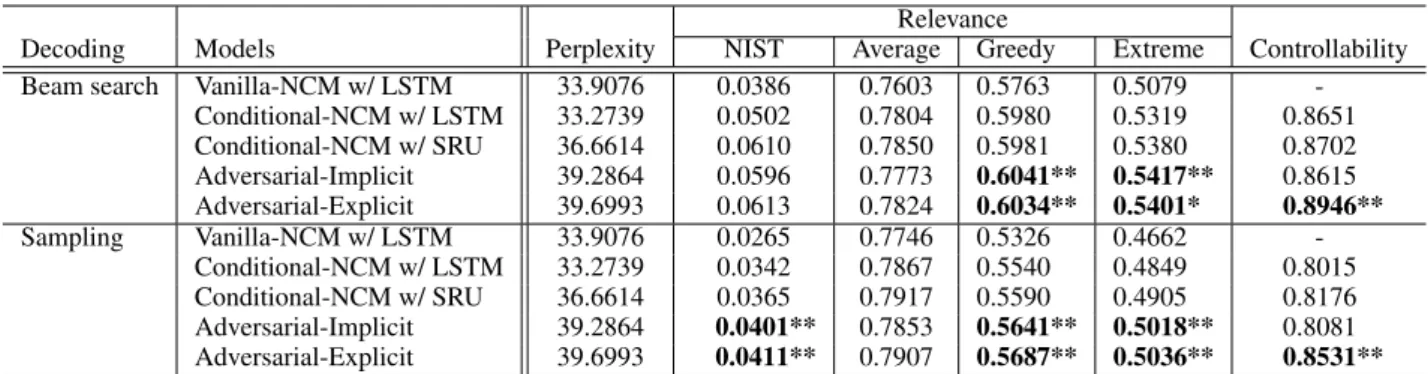
Table 1 shows the results of the automatic objective evaluation. We compared our pro- posed SeqGAN based on explicit-discriminator (Adversarial-Explicit) with the following base- lines. “Vanilla-NCM” shows performances of vanilla LSTM, which has no mechanism to receive condition labels. These scores indicate a gen- eral performance of systems in DailyDialog cor- pus. “Conditional-NCMs” show performances of NCMs that receives condition labels on its decoder as proposed by Zhao et al. (2017). We compared two variations of “Conditional-NCMs”, LSTM and SRU, to check the performance of SRU com- pared with LSTM. “Adversarial-Implicit” shows performances of SeqGAN that has implicit dis- criminator, which is proposed by Sun et al. (2018) and Kong et al. (2019). “Adversarial-Explicit” in- dicates the proposed model that has a multi-class discriminator on its SeqGAN. The table shows both results of beam search (width=5) and random sampling in the decoding process.
6.1.1 Speeding up Using SRU
The comparison between “Conditional-NCM w/
LSTM” and “Conditional-NCM w/ SRU” indi- cates that the speeding up using SRU works well;
SRU achieves higher relevance scores to LSTM.
SRU used 53,539K parameters, whereas LSTM
Relevance
Decoding Models Perplexity NIST Average Greedy Extreme Controllability
Beam search Vanilla-NCM w/ LSTM 33.9076 0.0386 0.7603 0.5763 0.5079 - Conditional-NCM w/ LSTM 33.2739 0.0502 0.7804 0.5980 0.5319 0.8651 Conditional-NCM w/ SRU 36.6614 0.0610 0.7850 0.5981 0.5380 0.8702 Adversarial-Implicit 39.2864 0.0596 0.7773 0.6041** 0.5417** 0.8615 Adversarial-Explicit 39.6993 0.0613 0.7824 0.6034** 0.5401* 0.8946**
Sampling Vanilla-NCM w/ LSTM 33.9076 0.0265 0.7746 0.5326 0.4662 -
Conditional-NCM w/ LSTM 33.2739 0.0342 0.7867 0.5540 0.4849 0.8015 Conditional-NCM w/ SRU 36.6614 0.0365 0.7917 0.5590 0.4905 0.8176 Adversarial-Implicit 39.2864 0.0401** 0.7853 0.5641** 0.5018** 0.8081 Adversarial-Explicit 39.6993 0.0411** 0.7907 0.5687** 0.5036** 0.8531**
Table 1: Results in automatic evaluation: note that results of random sampling are an average of five decoding runs, each decoding is initialized with random seed. *:p <0.05and **:p <0.001indicate results of significance tests (vs. conditional-NCM w/ SRU).
required 82,924K parameters. These results sup- port our experiments using SRU instead of LSTM.
We will mainly focus on comparisons of SRU models in the following sections.
6.1.2 Qualities of Generated Responses The “Vanilla-NCM w/ LSTM” scores show the difficulty of conversation modeling in Daily- Dialog corpus. By comparing these scores with scores of other conditional generation mod- els, “Conditional-NCM” and “Adversarial”, con- ditional generation models improved relevance scores even if they have controllability. This is probably because the dialogue act condition can be a training constrain to prevent dull responses.
Generation methods using adversarial learning im- proved relevance scores than “Conditional-NCM w/ SRU”.
6.1.3 Controllability of each Dialogue Act By comparing “Controllability” scores, the pro- posed “Adversarial-Explicit” achieved best scores in both beam-search and sampling decoding. For a detailed analysis, we show a controllability score of “Adversarial-Explicit” for each dialogue act la- bel in Table 2 and Table 3 (beam-search and sam- pling). Tables show precision, recall and their harmonic mean (F1) for each dialogue act, and the improvement from the score of “Conditional- NCM w/ SRU”, which achieved the best con- trollability in baselines (improv.). The proposed
“Adversarial-Explicit” achieved improvements for any classes, but in particular, it achieved large improvements on “Directives” and “Commissive”
Dialogue acts Prec. Recall F1 (improv.) Inform (46%) 0.8881 0.9291 0.9081 (+0.0167) Questions (30%) 0.9693 0.9982 0.9836 (+0.0060) Directives (16%) 0.9372 0.7164 0.8121 (+0.0971) Commissive (8%) 0.6285 0.6921 0.6588 (+0.0240) Weighted avg 0.8980 0.8946 0.8935 (+0.0192) Table 2: Result for beam search decoding, controlla- bility of each dialogue act (adversarial-explicit). The score in round brackets indicates the improvement from conditional-NCM w/ SRU.
Dialogue acts Prec. Recall F1 (improv.) Inform (46%) 0.8684 0.8973 0.8826 (+0.0164) Questions (30%) 0.9243 0.9738 0.9484 (+0.0281) Directives (16%) 0.7628 0.6652 0.7107 (+0.1152) Commissive (8%) 0.6338 0.5579 0.5934 (+0.0382) Weighted avg 0.8477 0.8531 0.8494 (+0.0257) Table 3: Result for random sampling, controllabil- ity of each dialogue act (adversarial-explicit). The score in round brackets indicates the improvement from conditional-NCM w/ SRU.
tags. Our model generated more discriminative sentences even if these classes have similar at- tribute.
6.2 Results of Human-Subjective Evaluation
Table 4 and Table 5 show human evaluation re- sults for naturalness and controllability, respec- tively. We used beam search (beam width of 5) for generating examples to be evaluated. Regard- ing the naturalness of responses (Table 4), mod- els used adversarial learning produced a more ac- ceptable response to the dialogue context. Regard- ing the controllability of response generation (Ta- ble 5), the adversarial-explicit model achieved the best performance among the compared models.
In summary, the proposed model based on
Models +2 +1 +0 Conditional-NCM w/ SRU 0.06 0.43 0.51 Adversarial-Implicit 0.04 0.53 0.43 Adversarial-Explicit 0.06 0.51 0.42 Table 4: Response quality of each model. This table show the distribution of scores.
Models Accuracy Weighted-F1
Conditional-NCM w/ SRU 0.7432 0.7583 Adversarial-Implicit 0.7058 0.6810 Adversarial-Explicit 0.7971 0.7868 Table 5: Controllability of response generation. Ta- ble shows filtered results of contradicted responses.
Weighted-F1 is a weighted average of F1 score of each dialogue act.
adversarial learning with multi-class objective achieved the best controllability, the main focus of this paper, even if it realized a comparable nat- uralness to existing methods.
7 Conclusion
In this paper, we introduced an extended frame- work of the generative adversarial network that is optimized by both conditioned generation and dis- crimination of dialogue act classes. Experimental results showed that our conditional response gen- eration model improved both the response quality and controllability in neural conversation genera- tion. In future works, we will examine the possi- bility of incorporating our adversarial framework in various generation approaches (Serban et al., 2017; Shen et al., 2017; Zhou and Wang, 2018) to build a more generalized conditional response generation model. We will also focus on different types of labels to be used as conditions.
Acknowledgements
This research and development work was sup- ported by the JST PRESTO (JPMJPR165B) and JST CREST (JPMJCR1513).
References
Kristy Elizabeth Boyer, Eun Young Ha, Robert Phillips, Michael D Wallis, Mladen A Vouk, and James C Lester. 2010. Dialogue act modeling in a complex task-oriented domain. In Proc. of SIG- DIAL, pages 297–305.
Cameron B Browne, Edward Powley, Daniel White- house, Simon M Lucas, Peter I Cowling, Philipp Rohlfshagen, Stephen Tavener, Diego Perez, Spyri- don Samothrakis, and Simon Colton. 2012. A sur- vey of monte carlo tree search methods. IEEE Transactions on Computational Intelligence and AI in games, 4(1):1–43.
Harry Bunt, Jan Alexandersson, Jae-Woong Choe, Alex Chengyu Fang, Koiti Hasida, Volha Petukhova, Andrei Popescu-Belis, and David R Traum. 2012.
Iso 24617-2: A semantically-based standard for dia- logue annotation. InProc. LREC, pages 430–437.
George Doddington. 2002. Automatic evaluation of machine translation quality using n-gram co- occurrence statistics. InProceedings of the second international conference on Human Language Tech- nology Research, pages 138–145. Morgan Kauf- mann Publishers Inc.
Sepp Hochreiter and J¨urgen Schmidhuber. 1997.
Long short-term memory. Neural computation, 9(8):1735–1780.
Chenyang Huang, Osmar Zaiane, Amine Trabelsi, and Nouha Dziri. 2018. Automatic dialogue generation with expressed emotions. InProc. of NAACL-HLT, volume 2, pages 49–54.
Simon Keizer and Verena Rieser. 2017. Towards learn- ing transferable conversational skills using multi- dimensional dialogue modelling. InProc. of SEM- DIAL, pages 158–159.
Xiang Kong, Bohan Li, Graham Neubig, Eduard Hovy, and Yiming Yang. 2019. An adversarial approach to high-quality, sentiment-controlled neural dialogue generation. In AAAI 2019 Workshop on Reason- ing and Learning for Human-Machine Dialogues (DEEP-DIAL 2019), Honolulu, Hawaii.
Tao Lei, Yu Zhang, and Yoav Artzi. 2017. Train- ing rnns as fast as cnns. arXiv preprint arXiv:1709.02755.
Tao Lei, Yu Zhang, Sida I Wang, Hui Dai, and Yoav Artzi. 2018. Simple recurrent units for highly par- allelizable recurrence. In Proc. of EMNLP, pages 4470–4481.
Jiwei Li, Michel Galley, Chris Brockett, Georgios P.
Spithourakis, Jianfeng Gao, and William B. Dolan.
2016. A persona-based neural conversation model.
CoRR, abs/1603.06155.
Jiwei Li, Will Monroe, Tianlin Shi, S˙ebastien Jean, Alan Ritter, and Dan Jurafsky. 2017a. Adversarial learning for neural dialogue generation. InProc. of EMNLP, pages 2157–2169.
Yanran Li, Hui Su, Xiaoyu Shen, Wenjie Li, Ziqiang Cao, and Shuzi Niu. 2017b. Dailydialog: A manu- ally labelled multi-turn dialogue dataset. InProc. of IJCNLP, volume 1, pages 986–995.
Ziming Li, Julia Kiseleva, and Maarten de Rijke. 2019.
Dialogue generation: From imitation learning to in- verse reinforcement learning. InProc. of AAAI.
Chia-Wei Liu, Ryan Lowe, Iulian Serban, Mike Nose- worthy, Laurent Charlin, and Joelle Pineau. 2016.
How not to evaluate your dialogue system: An em- pirical study of unsupervised evaluation metrics for dialogue response generation. InProc. of EMNLP, pages 2122–2132.
Toyomi Meguro, Ryuichiro Higashinaka, Yasuhiro Minami, and Kohji Dohsaka. 2010. Controlling listening-oriented dialogue using partially observ- able markov decision processes. In Proc. of ACL, pages 761–769.
Augustus Odena. 2016. Semi-supervised learning with generative adversarial networks. arXiv preprint arXiv:1606.01583.
Alice H Oh and Alexander I Rudnicky. 2000. Stochas- tic language generation for spoken dialogue sys- tems. In ANLP-NAACL 2000 Workshop: Conver- sational Systems.
Iulian Vlad Serban, Alessandro Sordoni, Yoshua Ben- gio, Aaron C Courville, and Joelle Pineau. 2016.
Building end-to-end dialogue systems using gener- ative hierarchical neural network models. InProc.
of AAAI, pages 3776–3784.
Iulian Vlad Serban, Alessandro Sordoni, Ryan Lowe, Laurent Charlin, Joelle Pineau, Aaron Courville, and Yoshua Bengio. 2017. A hierarchical latent variable encoder-decoder model for generating dialogues. In Thirty-First AAAI Conference on Artificial Intelli- gence.
Xiaoyu Shen, Hui Su, Yanran Li, Wenjie Li, Shuzi Niu, Yang Zhao, Akiko Aizawa, and Guoping Long.
2017. A conditional variational framework for di- alog generation. InProc. of ACL, volume 2, pages 504–509.
Tomohide Shibata, Yusuke Egashira, and Sadao Kuro- hashi. 2016. Chat-like conversational system based on selection of reply generating module with rein- forcement learning. In Situated Dialog in Speech- Based Human-Computer Interaction, pages 63–69.
Springer.
Xiao Sun, Xinmiao Chen, Zhengmeng Pei, and Fuji Ren. 2018. Emotional human machine conversation generation based on seqgan. InProc. of ACII Asia, pages 1–6. IEEE.
Xiao Sun, Xiaoqi Peng, and Shuai Ding. 2017.
Emotional human-machine conversation generation based on long short-term memory. Cognitive Com- putation, 10:389–397.
Zhiliang Tian, Rui Yan, Lili Mou, Yiping Song, Yan- song Feng, and Dongyan Zhao. 2017. How to make context more useful? an empirical study on context- aware neural conversational models. In Proc. of ACL, volume 2, pages 231–236.
Quan Hung Tran, Ingrid Zukerman, and Gholamreza Haffari. 2017. A hierarchical neural model for learn- ing sequences of dialogue acts. In Proc. of ACL, volume 1, pages 428–437.
Yi-Lin Tuan and Hung-Yi Lee. 2019. Improving condi- tional sequence generative adversarial networks by stepwise evaluation. IEEE/ACM Transactions on Audio, Speech, and Language Processing.
Oriol Vinyals and Quoc V. Le. 2015. A neural conver- sational model. CoRR, abs/1506.05869.
Tsung-Hsien Wen, Milica Gasic, Nikola Mrkˇsi´c, Pei- Hao Su, David Vandyke, and Steve Young. 2015.
Semantically conditioned lstm-based natural lan- guage generation for spoken dialogue systems. In Proc. of EMNLP, pages 1711–1721.
Ronald J Williams. 1992. Simple statistical gradient- following algorithms for connectionist reinforce- ment learning. Machine learning, 8(3-4):229–256.
Wei Xu and Alexander I Rudnicky. 2000. Task-based dialog management using an agenda. In ANLP- NAACL 2000 Workshop: Conversational Systems.
Koichiro Yoshino and Tatsuya Kawahara. 2015. Con- versational system for information navigation based on pomdp with user focus tracking. Computer Speech & Language, 34(1):275–291.
Steve Young, Milica Gaˇsi´c, Simon Keizer, Franc¸ois Mairesse, Jost Schatzmann, Blaise Thomson, and Kai Yu. 2010. The hidden information state model:
A practical framework for pomdp-based spoken dia- logue management. Computer Speech & Language, 24(2):150–174.
Lantao Yu, Weinan Zhang, Jun Wang, and Yong Yu.
2017. Seqgan: Sequence generative adversarial nets with policy gradient. InProc. of AAAI, pages 2852–
2858.
Tiancheng Zhao, Ran Zhao, and Maxine Eskenazi.
2017. Learning discourse-level diversity for neural dialog models using conditional variational autoen- coders. InProc. of ACL, volume 1, pages 654–664.
Hao Zhou, Minlie Huang, Tianyang Zhang, Xiaoyan Zhu, and Bing Liu. 2018. Emotional chatting ma- chine: Emotional conversation generation with in- ternal and external memory. InProc. of AAAI.
Xianda Zhou and William Yang Wang. 2018. Mojitalk:
Generating emotional responses at scale. InProc.
ACL, volume 1, pages 1128–1137.