STUDY ON RELATIONSHIP BETWEEN AVERAGE DELAMINATION STRESS ON INTERFACE AND NON-DIMENSIONAL INTENSITY OF STRESS
SINGULARITY FOR BONDED STRIPS
T.Kurahashi 1 , S.Oshima 2 , K.Ibe 3 , Y.Watanabe 4 , T.Kondo 5 and H.Koguchi 6
1, 6
Department of Mechanical Engineering, Nagaoka University of Technology, Niigata 940-2188, Japan
4
Electrical and Mechanical Systems Engineering Advanced Course, Advanced Course of Nagaoka National College of Technology, Niigata 940-8532, Japan
2,3,5
Department of Mechanical Engineering, Nagaoka National College of Technology, Niigata 940-8532, Japan
We present estimation equation of average delamination stress on interface for bonded strips using non- dimensional intensity of stress singularity. Aluminum bonded strips are employed in the delamination test, and variation of delamination force with respect to adhesive layer thickness is investigated. In addition, stress analysis based on the finite element method using Akin singular element is carried out. The intensity of stress singularity is obtained by fitting for results by stress analysis. Finally, the estimation equation of average delamination stress on interface for bonded strips was derived by relationship between average delamination stress on interface and non-dimensional intensity of stress singularity.
Keywords: Intensity of stress singularity, order of singularity, delamination test, finite element method, Akin singular element
1 Introduction
In this study, we investigate relationship between average delamination stress on interface and intensity of stress singularity obtained by stress analysis for delamination test for the aluminum bonded strip. The delamination test is carried out for the specimens whose adhesive layer thickness is changed, and the delamination stress on interface is calculated by the measured delamination force and the area of the interface. In addition, the intensity of stress singularity is obtained by the stress distribution on interface by the FEM, and the relation equation between average delamination stress on interface and the intensity of stress singularity is derived. In general, exponentiation of the distance is included in the unit of the intensity of stress singularity, and the value of the exponentiation is referred to as the order of singularity. The order of singularity is determined by the material properties of both materials and shape of interface edge. Hence, in this study, non-dimensional intensity of stress singularity is derived such that the average delamination stress on interface can be estimated regardless of the combination of the bonded materials and shape of interface edge. The stress analysis is carried out based
on the finite element method, and the Akin singular element is applied to the elements including the singular point[1],[2],[3]. In addition, the Bogy’s characteristic equation is employed to calculate the order of singularity [4].
2 Delamination test
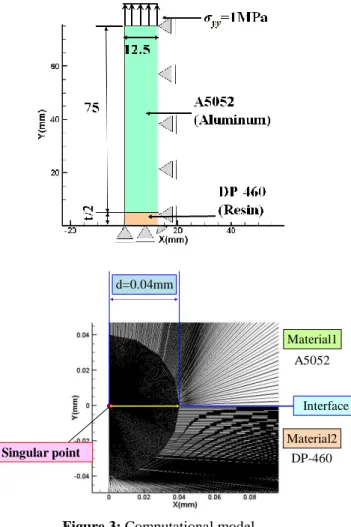
The aluminum bonded specimen shown in Fig.1 is employed. The adhesive layer thickness is set as 0.4mm,
0.7mm,1.2mm, and the delamination test is carried out four times. The variation of the obtained delamination force with respect to the adhesive layer thickness is shown in Fig.2. Consequently, it is found that the delamination force increases with decreasing the value of the adhesive layer thickness.
3 Evaluation of intensity of stress singularity
The stress analysis is carried out based on the finite
element method using Akin singular element. The
material properties and the computational model is
shown in Tab.1 and Fig.3.
Figure 1: Specimen model for tensile test
Figure 2: Relationship between delamination force and adhesive layer thickness
The order of singularity near interface edge of aluminum and resin is obtained λ=0.19329 by the Bogy’s characteristic equation. The value of the order of singularity is applied to the Akin singular element, and the stress analysis is carried out by the finite element method. The distribution of stress component σ
yyfrom singular point on interface is shown in Fig.4 in case that the adhesive layer thickness is 0.4, 0.7 and 1.2mm. In Fig.4, lines indicate the fitting result by the equation σ
yy=K
yyr
-λin case of λ=0.19329. It is seen that stress component σ
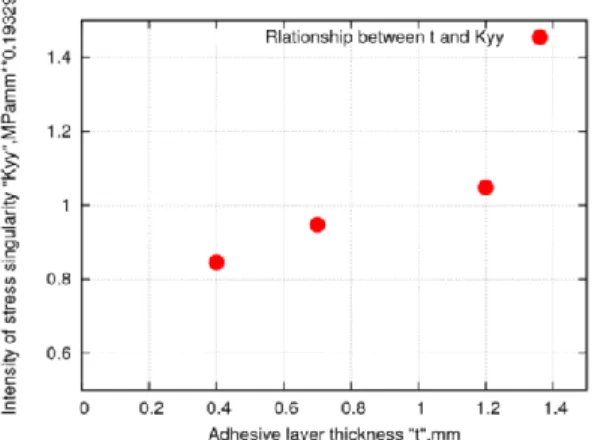
yydecreases with decreasing the value of adhesive layer thickness. Fig.5 shows the relationship between the intensity of stress singularity K
yyobtained by fitting calculation and the adhesive layer thickness.
It is found that the intensity of stress singularity K
yyincreases with increasing the value of adhesive laye thickness t.
Table 1: Material properties Young’s
modulus E(GPa)
Poisson’s ratio ν
Aluminum 70.60 0.340
Resin 1.94 0.252
Material1
Material2 Interface
Singular point
A5052
DP-460 d=0.04mm
Figure 3: Computational model (upper : computational model,
lower : finite element mesh around singular point)
Figure 4: Distribution of stress component σ
yyfrom
singular point on interface for each adhesive thickness
Figure 5: Relationship between adhesive layer thickness t and intensity of stress singularity K
yyFig.6 shows the relationship between the delaminaton force F and the intensity of stress singularity K
yyfor each case of adhesive layer thickness t. Consequently, it is seen that the relationship between the
delamination force F and the the intensity of stress singularity K
yycan be expressed by the linear equation.
Here, the non-dimensional intensities of stress singularity K
w-yyand K
t-yyare derived by the boundary condition σ
External-forceand the interfacial width w and adhesive layer thickness t (Eqs. 1 and 2). The non- dimensional intensities of stress singularity K
w-yyand K
t-yyindicate the intensity of stress singularity K
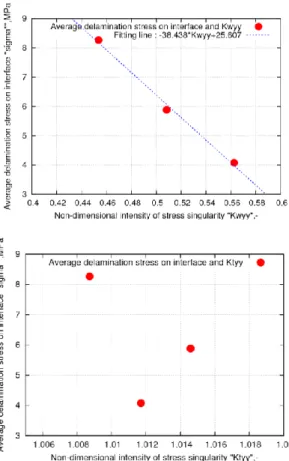
yynormalized by the interface width w and adhesive layer thickness t, respectively. Fig. 7 shows the relationships between average delamination stress on interface σ*
and non-dimensional intensity of stress singularity K
wyyand K
tyy. The average delamination stress on interface σ* indicate that the delamination force F is divided by the interfacial area. It is found that the relationships between average delamination stress on interface σ*
and non-dimensional intensity of stress singularity K
wyycan be expressed by the linear equation, i.e., σ*=- 38.438K
w-yy+25.607. On the other hand, it is seen that there is no tendency between average delamination stress on interface σ* and non-dimensional intensity of stress singularity K
tyy. The reason why these results is obtained is that the interfacial width w is constant value in this study. On the other hand adhesive layer thickness t is chanced for each result. Therefore, it appears that the constant distance parameter should be used in normalization process of the intensity of stress singularity.
Figure 6: Relationship between intensity of stress singularity K
yyand delamination force F
19329 . 0
19329 . 19329 0
. 0
0 . 25
0 . 25 0
. 1 0 . 25
K r K r
w w r
K
r w K w
K r
yy w
yy
force External
yy force External
yy force External
yy force
External yy
(1)
19329 . 0
19329 . 19329 0 . 0
0 . 1
0 . 25
t K r
t K r
t w r K
r t K t K r
yy t
yy
force External
yy force External
yy force External
yy force
External yy