INVITED PAPER
Special Section on the Architectures, Protocols, and Applications for the Future InternetNAPT-Based Mobility Service for Software Defined Networks
Shimin SUN†a), Li HAN††, Xianshu JIN†††,Nonmembers,andSunyoung HAN†††b),Member
SUMMARY For IP-based mobile networks, efficient mobility manage- ment is vital to provision seamless online service. IP address starvation and scalability issue constrain the wide deployment of existing mobility schemes, such as Mobile IP, Proxy Mobile IP, and their derivations. Most of the studies focus on the scenario of mobility among public networks.
However, most of current networks, such as home networks, sensor net- works, and enterprise networks, are deployed with private networks hard to apply mobility solutions. With the rapid development, Software De- fined Networking (SDN) offers the opportunity of innovation to support mobility in private network schemes. In this paper, a novel mobility man- agement scheme is presented to support mobile node moving from public network to private network in a seamless handover procedure. The central- ized control manner and flexible flow management in SDN are utilized to provide network-based mobility support with better QoS guarantee. Bene- fiting from SDN/OpenFlow technology, complex handover process is sim- plified with fewer message exchanges. Furthermore, handover efficiency can be improved in terms of delay and overhead reduction, scalability, and security. Analytical analysis and implementation results showed a better performance than mobile IP in terms of latency and throughput variation.
key words:software defined networking (SDN), mobility management, pri- vate networks, network address port translation (NAPT)
1. Introduction
In Internet-of-Things (IoT), most devices are expected to ac- cess Internet and may expect to provide network-accessible service even during roaming. On account of high QoS re- quirements of mobile users, it is essential to provide unin- terrupted communication even mobile node changes its net- work attachment. However, the diversity of IoT devices and mobility patterns limit the deployment of existing mobility management schemes.
Most of the current studies focus on the mobility man- agement in IPv6 networks, since it is much more facile than in IPv4 network due to abundant IPv6 addresses and its auto-configurable characteristics[1]–[3]. Although IPv6 have already been extensively used in some scenarios, a great proportion of commercial networks are still IPv4-
Manuscript received July 21, 2016.
Manuscript revised January 3, 2017.
Manuscript publicized February 13, 2017.
†The author is with School of Computer Science & Software Engineering, Tianjin Polytechnic University, Tianjin, 300387, China.
††The author is with School of Computer & Communication Engineering, Tianjin University of Technology, Tianjin, 300384, China.
†††The authors are with Department of Computer Science & En- gineering, Konkuk University, Seoul, 143–701, Korea.
a) E-mail: [email protected]
b) E-mail: [email protected] (Corresponding author) DOI: 10.1587/transinf.2016NTI0001
based networks, such as home networks, enterprise net- works, campus networks, and wireless sensor networks, which are included as the units in IoT. In those networks, the IP addresses used for communication of all local hosts with external networks are based on Network Address Transla- tion (NAT) or Network Address Port Translation (NAPT) mechanisms[4].
To provide roaming service, Mobile Node (MN) should have its own public IP address as its identifier in home and foreign networks. Most of IP mobility management ap- proaches, such as Mobile IP (MIP)[5] and Proxy Mobile IP (PMIP)[6], devote to the scenarios that all those net- works are public networks with sufficient public IP address for each host. Some approaches[7]–[9]tend to encapsulate packets with private IP address in tunnel, which degrades data transmission efficiency due to the tunneling overhead.
We try to break away from traditional mobility man- agement schemes with a new architecture evolving from Software Defined Networking (SDN)[10],[11]. All or most of the network devices (e.g., routers, switches) are Open- Flow protocol[12] supported. To support mobility in pri- vate networks, SDN controller needs to manage NAT ser- vice for terminal networks. The issue is that current ver- sion of OpenFlow protocol are still with deficiency of NAT functions. Therefore, we attempt to realize NAT service by manipulating flow tables of OpenFlow devices (e.g., Open- Flow Switches, OFSs). Two restrictions need to be solved to realize NAT service in SDN. (1) Connections can only be originated inside the NAT domain. External networks cannot connect to inside computer proactively (e.g., remote desktop). (2) IP checksum needs to be recalculated after the change of IP address. If TCP header is encrypted (for in- stance, IPSec transport mode), TCP checksum field cannot be modified. Any modification to the packet header results in the failure of authentication and abandon of the packet.
In this paper, a novel mobility management scheme is presented for the scenario that MN moves from a public net- work to a private network. The objective is to offer a univer- sal mobility support without involving the participation of MNs in handover process. This is much suitable for various IP-based IoT devices, particularly for resource-constraint MNs which may incapable to deploy mobility functions.
The rest of this paper is organized with following struc- ture: Section 2 is an overview of the literatures of mobility management. Section 3 presents the proposed architecture and NAT/NAPT realization methods. Section 4 elaborates the principles of mobility support. Prospective of perfor- Copyright c2017 The Institute of Electronics, Information and Communication Engineers
mance is evaluated by comparison with other mechanisms in Sect. 5, and conclusion is given in Sect. 6.
2. Related Work
Although various mobility management approaches have al- ready been proposed, most of them have drawbacks in dif- ferent aspects. For example, MIP requires MN to take part in mobility functions with deployed new host stack, while PMIP introduces tunneling which results in traffic overhead.
Mobile PPC[13] conceives MN’s IP layer to resolve IP address variation and notifies Corresponding Nodes (CNs) about new address. It also proposed a NAT traversal scheme on MN to support MN moves through private networks. In Mobile PPC, all the functions were put on MN with kernel modification. REBEKAH-IP server[14]was designed to in- tegrate Home Agent (HA) function and Foreign Agent (FA) function to form MIP. RPX IP-in-FQDN (REBEKAH-IP with Port Extension in Fully Qualified Domain Name) tun- neling is used to support multiple MNs with same IP address moving to the same foreign network. NTMobile (Network Traversal with Mobility)[15]creates a tunnel route between NTM terminals (between MN and CN) and applications use virtual IP addresses to achieve a continuous communication during handover. The drawback of RPX IP-in-FQDN is to deploy HA/FA and tunneling, while NTMobile needs MN to join the handover and builds tunneling.
Recently, there is a tendency to applying SDN tech- nology to mobile Internet. Some on-going researches pay attention to the deployment of SDN to cellular net- works[16], [17]. OpenRoads[18] provide a wireless ex- tension for OpenFlow to improve robustness of data deliv- ery during handover by applying multicast. The problem is that OpenRoads require MNs have multiple interfaces, so that the flows can be multicast to MN to provide lossless handover. It is impractical to have multiple interfaces for many IoT nodes, especially capacity restricted sensor nodes.
Different from OpenRoads, we prefer to realize mobility support using basic OpenFlow functions, rather than to in- troduce new features to OpenFlow protocol. Pupatwibul et al.[19]proposed to enhance MIP using OpenFlow, where OFSs just simply realize the functions of HA and FA. Latest researches[20]–[22]are inclined to extend SDN paradigm to mobility management by keeping up-to-date identifier- to-locator mapping on OFSs. Each MN need to maintain its own identifier (public IP address from its home network (HoA)) as well as a locator (address prefix of MN’s first-hop OFS of visited network). In our previous research, a secure mobility support approach was presented for IPv6 networks based on OpenFlow[23].
Most of above proposals were directed at MN with public IP address and moves among public networks. Tun- neling based approaches lead to large traffic overhead or non-optimal route. Efficient mobility management scheme is necessary for the scenario that MN moves among public networks and private networks. In this paper, we propose a novel NAPT-based mobility service using OpenFlow tech-
nology.
3. NAPT-Based Mobility Support Scheme
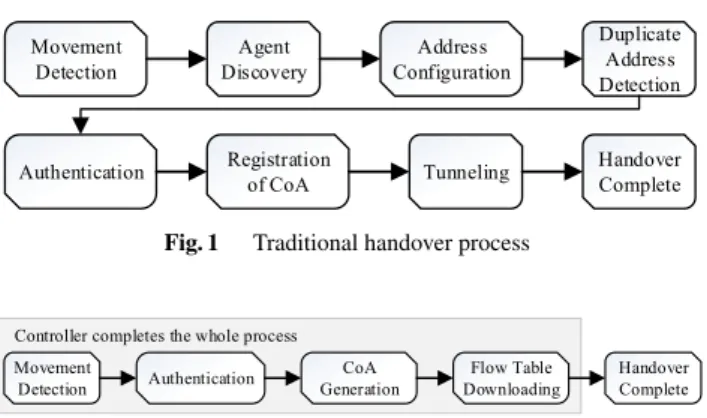
Instead of complying with traditional handover procedure, we attempt to rethink the whole process and redesign mo- bility related functions from movement detection to binding updates. Traditional handover process in Fig. 1 (e.g., MIP) is generally completed in eight steps, in whichAgent Dis- coveryis the most time-consuming step. Because MN needs to wait a random time to receive agent advertisement. The proposal try to achieve the handover within five steps with- out time-consuming step in Fig. 2.
MIP handover process is explained as follows. When MN visits a foreign network, FA assigns a CoA to MN. MN startsAgent Discovery, obtains CoA, and launchesDupli- cated Address Detectionas well asAuthenticationwith FA.
After that, MN registers its current location (CoA) with FA and HA duringRegistration. Finally, HA set up a reciprocal tunnel to the CoA to route packets to MN as it roams.
For SDN-based mobility management, three factors should be confirmed beforehand. First, SDN controller to- tally manages handover procedure on behalf of MNs. Sec- ond, movement detection is achieved by the controller re- ceiving the first packet of MN from a foreign network. The packet is encapsulated inPacket inmessage and forwarded by the OFS of visited network to the controller. MN’s MAC and Home Address (HoA) in this packet can be naturally used as the identifier for authentication. Third, ARP Table of MN should be modified to let all the outgoing packets transmitted to the visited OFS by defining automatic ARP reply mechanism.
Centralized control feature of SDN facilitates the pos- sibility to abnegate MIP architecture. The proposed mecha- nism reduces handover delay by shifting some pivotal steps, such as agent discovery and IP address configuration, which are the most time-consuming steps. Some steps in Fig. 1 can be abandoned according to the new design as in Fig. 2. MNs are not required to participant in mobility related functions, and transparent to its movement in network layer.
Fig. 1 Traditional handover process
Fig. 2 Proposed handover process in SDN
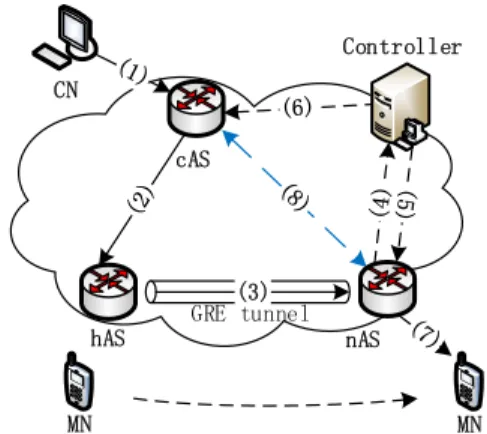
Fig. 3 Mobility management architecture
3.1 SDN-Based Mobility Management Architecture Agent or anchor based mobility schemes usually lead to non-optimal routing, traffic overhead, and requires extra agents. On the contrary, we tends to manage mobility by SDN controller manipulating OFSs with optimal routing, low traffic overhead and no agents. To support global mobil- ity, ISPs should negotiate for the coordination among their controllers to provide large-scale and heterogeneous collab- orative mobile service.
Three network entities are included in the scheme:
SDN controllers with Mobility Management Entity (MME), OFSs, and AAA server. Controller is the basement to realize network functions, such as link discovery, topology man- ager, device manager, as well as MME. OFSs are respon- sible for data forwarding and data manipulation following the rules preserved in flow tables. AAA server is deployed for the distribution and update of certifications of MNs and controllers. Mobility management architecture is illustrated in Fig. 3, where the dotted lines and solid lines indicate con- trol flow and data flow respectively. Access Switch (AS) is the OFS allocated in terminal network with wireless ser- vice. hAS is the AS in MN’s home network, while nASs is the one in foreign networks and cAS is the AS of CN’s net- work. Cross Switches (CSs) are the OFSs located in back- bone network to offer data forwarding and routing service.
In proposed scheme, functionalities of data plane is rel- atively simple. All packets are forwarded by OFSs follow- ing flow table entries that defined by controller. When MN’s movement detected, the controller downloads specific flow table entries to relative OFSs to keep continuous connec- tions between MN and CNs.
3.2 NAT/NAPT Realization Method
MN needs to use HoA all the way before and after handover to keep on-going sessions uninterrupted. The problem is that HoA cannot be used in visited networks due to the ingress
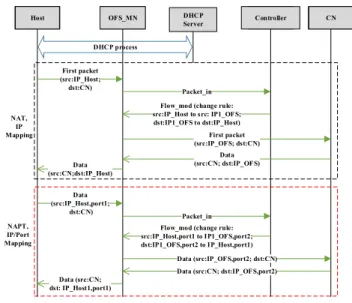
Fig. 4 NAT/NAPT realization method
filter of routers[24] on outgoing route. CoA needs to be assigned to MN as the locator for data delivery to external networks. The CoA need to be changed back to MN’s HoA before data reaches CN. The process is achieved by con- troller manipulating OFSs using pure OpenFlow functions.
Take Fig. 3 as an example, MN obtains HoA when it at the network ofhAS. Once MN visitsnAS, MN still uses HoA.
The controller assigns a CoA to MN for outgoing messages.
When messages reach cAS of CN, cAS performs the address translation for MN from CoA to HoA.
For private networks, DHCP server is assumed de- ployed for IP allocation in LAN. To ensure DHCP service works as normal, a flow table entry of OFS is added in previ- ous to forward DHCP discovery messages (from IP: 0.0.0.0 to IP: 255.255.255.255) to DHCP server.
The realization of NAT/NAPT service is depicted in Fig. 4 and explained as follows. Initially, a local host ob- tains an IP address from DHCP server. For NAT service, an IP pool is maintained by OFS MN. Source address of all packets from local host to external networks is modified to one of the OFS MN’s IP addresses, while destination ad- dress of all packets from external networks to local host is modified to host’s private IP address. For NAPT, both IP ad- dress and TCP/UDP port of on-going sessions of local host are matched to OFS MN’s IP and port. The translation of IP/port is realized by controller manipulating the flow en- tries of the OFS, which requires the controller to monitor the available TCP/UDP ports of OFS MN.
3.3 Data Structure in MME
Controllers in a federation share a MN Info. Table (MIT) (Table 1), which contains the basic information of MN, such as HoA, MAC, public key, IP of hAS, and current at- tached AS. The controller of MN’s home network (home controller) maintains a Session Table (ST) (Table 2), which contains the information of MN’s active sessions when it
Table 1 MN Info. Table (MIT) at federated controllers
Table 2 Session Table (ST) at home controller
Table 3 Session Mapping Table (SMT) at visited controller
was at home network. This information is used in fast ses- sion resumption after handover. The controller of visited network (visited controller) maintains a Session Mapping Table (SMT) (Table 3), which contains the NAPT informa- tion for MN in visited network and the IP of anchor point where to revert the packet header to original as from MN.
The anchor point is a switch on the route between MN and CN, which should be on the border or outside of access do- main of nAS to avoid router’s ingress filter problem.
4. Mobility Support Mechanism
4.1 Before Mobility Service
MN registers its basic information (IP/MAC, public key, and hAS) to controller before acquiring the provision of mobil- ity service. MIT (Table 1) need to be shared with other controllers and updated in the federation for global mobility support.
4.2 Movement Detection Method
When MN attaches to a new network (nAS), it will send packets as normal rather than launch DHCP discovery im- mediately, since it is ignorant of attachment alteration. nAS encapsulates the first packet of MN in Packet in message and transmits to controller. After received the Packet in, controller decapsulates it and checks MIT to make sure whether the source IP of the packet is in the table or not. If in, the controller launches authentication using MN’s public key. Upon the success of authentication, mobility service to MN is supplied by running NAPT and mobility support mechanism.
Fig. 5 Mobility support when data initiated from MN
Fig. 6 Mobility support when data initiated from CN
4.3 Mobility Support Mechanism
After attachment detection, visited controller retrieves MN’s ST from MN’s home controller. Then, it builds a SMT for MN as well as a tunnel between hAS and nAS for informa- tion exchange between MN and its home network. The tun- nel is for data delivery from home network to MN or from MN to home network. An intermediate CS on the path of MN and CN is selected for IP header conversion on behalf of MN. Mobility support can be completed in two phases through the operations (Fig. 5 and Fig. 6). The operation for data initiated from MN in visited network is illustrated in Fig. 5, while the data initiated from CN to MN’s home net- work is illustrated in Fig. 6 with eight steps.
In Fig. 5, when the first packet from MN reaches nAS (1), nAS encapsulates it in Packet in message and sends to its controller (2). The controller checks MIT and initiates authentication with MN if MN is in the table (3). If authen- tication succeed, the controller downloads proper flow table entries to nAS, cAS, and hAS using Flow mod messages.
For nAS, MN’s IP/Port is modified to nAS’s IP/Port (4). For cAS, nAS’s IP/Port is changed back to MN’s IP/Port (5).
For hAS, a GRE tunnel between hAS and nAS is built for message exchange (e.g. ARP, ICMP, and data from exter- nal network reaches hAS) (6). Upon receiving Flow mod
message, nAS immediately modifies IP header of packets belong to the same session and sends to CN passing by cAS (7). cAS performs header translation between MN’s IP/Port and nAS’s IP/Port according to the rules defined in Flow mod message (8).
A new session may be originated from CN to MN after MN’s handover. In this situation, data is still forwarded to hAS. The operation is depicted in Fig. 6. First, data is for- warded to hAS by cAS (1) (2). hAS forwards the data to nAS through established GRE tunnel (3). Since the data is from a new session, there is no matched flow entry in nAS.
nAS sends Packet in message to controller for further oper- ation (4). The controller inserts a SMT entry and issues flow rules to nAS and cAS (5) (6). nAS performs NAPT function for the session and sends data to MN (7). Finally, data of the session is transmitted between cAS and nAS directly (8).
4.4 Automatic Reply Messages
To let MN works as in its home network, some message exchanging through the tunnel between hAS and nAS is re- quired to keep MN online. Basically, ARP requests for MN need to be replied and ARP requests from MN to other hosts need to be sent to MN’s home network. If DHCP service is deployed in home network, DHCP request/ACK messages need to be transmitted through the tunnel. If multicast group service is deployed, IGMP messages should also be trans- mitted through the tunnel.
5. Analytical Evaluation and Implementation
5.1 Analytical Evaluation of Handover Latency
For MIP, two phases lead to the major handover delay:
movement detection and registration, which can be pre- sented by Eq. (1).
TMIP handover=Tmove detect+Treg (1)
WhereTmove detect is the delay of movement detection and Treg is MN registration delay. Treg is determined by the RTTbetween MN and HA, and normally less than 100ms in WAN. Lazy Cell Switching (LCS) and Eager Cell Switching (ECS)[25]are two major movement detection algorithms in MIP. LCS acts handover until the primary network is con- firmed unreachable (lifetime of its IP address reaches 0), while ECS initiates handover every time agent advertise- ment with new network prefix received. The drawbacks are that LCS causes high handover delay and ECS performs poor if MN moves back and forth in two networks.
HA/FA advertisement interval should be shorter than 1/3 of the lifetime and is recommended one advertisement per second in[5]. Assuming the agent advertisement life- time is 3xand interval isx, the delay caused by above two algorithms can be estimated by their mean values (Eq. (2) and Eq. (3)).
Tmove detect LCS =2.5x (2)
Tmove detect ECS =0.5x (3)
If x = 1 second, the experiments results showed that LCS causes UDP delay for about 6s and TCP for 10s, while ECS causes UDP delay for 3s and TCP for 6s[26]. The throughput of TCP traffic decreases sharply after handover due to slow start algorithm.
For proposed mobility support mechanism, the delay can be indicated by Eq. (4).
TS DN handover=Tmove detect+Tauth+Tf low mode (4) WhereTmove detectis one-way delay from MN to con- troller,Tauthis theRTTbetween controller and MN, while Tf low modeis the one-way delay between nAS and the con- troller. Because MN and nAS is one-hop connection, delay between them is small. The total delay can be estimated by two timesRTTbetween MN and controller (Eq. (5)).
TS DN handover≈2×RT TMN-controller (5) The controller should be in the same domain of nAS.
Hence, delay between the controller and nAS is also rela- tively small, not more than 100ms commonly.
Above all, the delay caused by handover in SDN-based scheme is much lower than in MIP scheme. Low delay of handover conduces to smaller throughput variation and lower packet loss.
5.2 Network Environment of Implementation
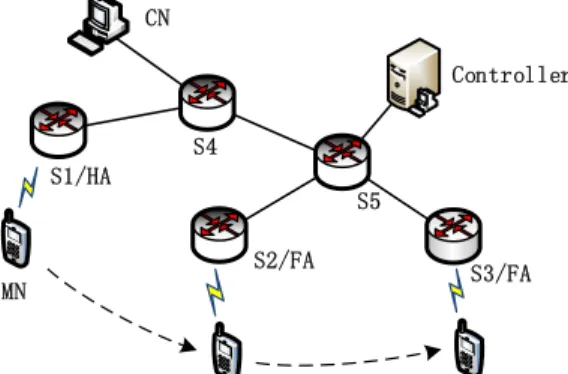
Since MIP is not supported in SDN simulation tool Mininet[27]yet, we built a testbed using several virtual ma- chines with custom topology and link status (Fig. 7) using Virtualbox. In SDN testbed, S1, S2, S3, S4 and S5 were OFSs implemented by OpenFlow vSwitch[28]. SDN con- troller was deployed by python-based programmable soft- ware Ryu[29]. MIP was implemented on the same network using the code of dynamic mobile IP[30], where S1 was replaced by HA, while S2 and S3 were replaced by FAs.
In the experiment,pingwas used for delay test between MN and CN. Test interval was set to 0.2s. Iperf[31]was used to generate TCP or UDP traffic for the test of through- put. Link status was defined by Linux traffic control tooltc.
tccan be used to set link latency and bandwidth. The delay
Fig. 7 Network environment for implementation
of each link was set to 20ms and the bandwidth was set to 10mpbs. The test time was set to 40s with two handovers executed at the time 10s and 30s.
5.3 Performance Evaluation
The objective of mobility solutions is to reduce handover de- lay and traffic overhead. For the evaluation of mobility man- agement approaches, variation of delay and throughput dur- ing handover process is the most considerable factor. Sev- eral tests are carried out based on top of the afore-presented testbed. Latency and throughput variation of MIP and pro- posed schemes are compared in the evaluation.
5.4 Comparison with MIP
The comparison between SDN-based mobility and MIP are shown in Fig. 8 and Fig. 9 in terms of throughput andRTT.
Figure 8 shows the variation of throughput for a ses- sion between MN and CN. In this experiment, 10mbps UDP traffic (packet size 1500 bytes) was transmitted during han- dover process. The result reveals that the throughput of MIP decreases sharper and recovers slower than SDN-based ap- proach. This is caused by the longer handover delay of MIP.
The degradation of traffic rate after handover results from the tunneling.
Figure 9 illustrates the variation of delay during han- dover process. RTT values of both approaches raise to a higher value rapidly when MN changes network attachment.
Proposed approach shows better restoration speed than MIP
Fig. 8 Throughput variation during handover
Fig. 9 RTT variation during handover
in same experiment scenario. After handover in MIP, the delay between MN and CN regresses to a higher level due to triangular routing of MIP. The proposed approach avoids triangle routing by changing flow entries of related OFSs to setup a new optimal path between MN and CN after han- dover. The new path follows basic Internet routing methods, such as OSPF or RIP, which are commonly used to find the optimal path.
The proposed approach also performs better than MIP In some other aspects, such as packet loss, traffic overhead and signaling cost, which is because the abnegation of tun- neling for data delivery and few messages exchange in han- dover process. Packet loss was tested during the experi- ments for throughput. For proposed approach, the number of packet loss is about 1030 for the first handover and 820 for the second handover. For MIP, the number of packet loss is about 7000 for both handover since they has same distance between FA and HA (between MN and CN) after handover.
6. Conclusion
This paper presented a SDN-based mobility management scheme for node movement through private IP networks.
The mobility functions were realized in SDN controller.
Controller manipulates OFSs to achieve mobility support without introducing new entities to network or new func- tions to OpenFlow protocol. The evaluation results indicate that the proposed scheme reveals better performance than MIP.
Although the proposal provides mobility service for IP- based devices in the specific cases, more scenarios and test environments could be considered in future work. We will focus on the mobility support for MN with private IPv4/IPv6 addresses among private/public networks as well as other network environments to offer various mobility support ser- vice.
Acknowledgments
This work was supported by Institute for Information &
communications Technology Promotion (IITP) grant funded by the Korea government (MSIP) under B0126-16-1078.
References
[1] C. Perkins, D. Johnson, and J. Arkko, “Mobility support in IPv6,”
IETF RFC 6275, July 2011.
[2] S. Lee, H. Latchman, and B. Park, “Efficient handover scheme of proxy mobile IPv6 in wireless local area networks,” Int. J. Multime- dia and Ubiquitous Engineering, vol.5, no.2, April 2010.
[3] S. Gundavelli, K. Leung, V. Devarapalli, K. Chowdhury, and B.
Patil, “Proxy mobile IPv6,” IETF RFC 5213, Aug. 2008.
[4] P. Srisuresh and K. Egevang, “Traditional IP network address trans- lator (traditional NAT),” IETF RFC 3022, Jan. 2001.
[5] C. Perkins, “IP mobility support for IPv4, revised,” IETF RFC 5944, Nov. 2010.
[6] K. Leung, G. Dommety, P. Yegani, and K. Chowdhury, “WiMAX forum/3GPP2 proxy mobile IPv4,” IETF RFC 5563, Feb. 2010.
[7] H. Levkowetz and S. Vaarala, “Mobile IP traversal of network ad- dress translation (NAT) devices,” IETF RFC 3519, April 2003.
[8] G. Montenegro, “Reverse tunneling for mobile IP, revised,” IETF RFC 3024, Jan. 2001.
[9] A. Idoue, H. Yokota, and T. Kato, “Proposal of hierarchical mobile IP supporting private addresses utilizing NAT function and its im- plementation on Unix operating system,” IEICE Trans. Commun., vol.E84-B, no.12, pp.3155–3165, Dec. 2001.
[10] ONF White Paper, “Software-defined networking: the new norm for networks,” Open Networking Foundation, April 2012.
[11] N. McKeown, T. Anderson, H. Balakrishnan, G. Parulkar, L.
Peterson, J. Rexford, S. Shenker, and J. Turner, “OpenFlow: en- abling innovation in campus networks,” ACM SIGCOMM Com- puter Communication Review, vol.38, no.2, pp.69–74, April 2008.
[12] OpenFlow Networking Foundation, “OpenFlow switch specifica- tion, version 1.5.1,” March 2015.
[13] H. Suzuki, K. Terazawa, and A. Watanabe, “Implementation of NAT traversal for mobile PPC with the principle of hole punching,” Proc.
IEEE Region 10 Conference (TENCON 2009), Singapore, pp.1–6, Jan. 2009.
[14] S. Rattananon, B. Landfeldt, A. Seneviratne, and P. Chumchu, “Mo- bility support in private networks using RPX,” Proc. IEEE Conf. Lo- cal Computer Networks 30th Anniversary (LCN ’05), Sydney, NSW, pp.729–739, Nov. 2005.
[15] K. Kamienoo, H. Suzuki, K. Naito, and A. Watanabe, “Development of mobile communication framework based on NTMobile,” Seventh Int. Conf. Mobile Computing and Ubiquitous Networking (ICMU), Singapore, pp.27–32, Jan. 2014.
[16] M. Yang, Y. Li, D. Jin, L. Zeng, X. Wu, and A.V. Vasilakos, “Soft- ware-defined and virtualized future mobile and wireless networks: a survey,” Mobile Networks and Applications, vol.20, no.1, pp.4–18, Feb. 2015.
[17] N.A. Jagadeesan and B. Krishnamachari, “Software-defined net- working paradigms in wireless networks: a survey,” ACM Comput- ing Survey, vol.47, no.2, Jan. 2015.
[18] K.-K. Yap, M. Kobayashi, R. Sherwood, T.-Y. Huang, M. Chan, N.
Handigol, and N. McKeown, “OpenRoads: empowering research in mobile networks,” ACM SIGCOMM Computer Communication Review, vol.40, no.1, pp.125–126, Jan. 2010.
[19] P. Pupatwibul, A. Banjar, A.A. Sabbagh, and R. Braun, “Developing an application based on OpenFlow to enhance mobile IP networks,”
IEEE 38th Conf. Local Computer Networks Workshop on Wireless Local Networks, Sydney, Australia, pp.936–940, Oct. 2013.
[20] Y. Wang, J. Bi, and K. Zhang, “Design and implementation of a soft- ware-defined mobility architecture for IP networks,” Mobile Net- works and Applications, vol.20, no.1, pp.40–52, Feb. 2015.
[21] Y. Wang and J. Bi, “A solution for IP mobility support in software defined networks,” 23rd Int. Conf. Computer Communication and Networks (ICCCN), Aug. 2014.
[22] S.-M. Kim, H.-Y. Choi, P.-W. Park, S.-G. Min, and Y.-H. Han,
“OpenFlow-based proxy mobile IPv6 over software defined network (SDN),” IEEE Consumer Communications and Networking Confer- ence (CCNC 2014): Mobility Management in the Networks of the Future World, Jan. 2014.
[23] S. Sun, L. Han, and S. Han, “Secure IP mobility support in soft- ware defined networks,” Mobile and Wireless Technology 2015 (ICWMT2015), Springer Berlin Heidelberg, vol.310, pp.127–136, June 2015.
[24] P. Ferguson and D. Senie, “Network ingress filtering: defeating de- nial of service attacks which employ IP source address spoofing,”
IETF RFC 2827, May 2000.
[25] Q. Zhao, L. Feng, Z.C. Li, and J. Yang, “Movement detection de- lay analysis in mobile IP,” Computer Communications, vol.28, no.5, pp.550–556, March 2005.
[26] Y. Min-hua, W. Zhe-wei, Z. Hui-min, and L. Yu, “Performance anal- ysis of TCP/UDP during mobile IP handoffs,” Proc. Int. Conf. In- fo-tech and Info-net, Beijing, China, vol.2, pp.724–729, Oct. 2001.
[27] K. Karamjeet, S. Japinder, and S.G. Navtej, “Mininet as software defined networking testing platform,” Int. Conf. Communication, Computing & Systems, pp.139–142, Ferozepur, Punjab, India, 2014.
[28] Open vSwitch (OVS), http://openvswitch.org/ [29] Ryu SDN Framework, http://osrg.github.io/ryu/ [30] Dynamics Mobile IP, http://dynamics.sourceforge.net/
[31] iPerf-The TCP, UDP and SCTP network bandwidth measurement tool, https://iperf.fr/
Shimin Sun received M.S. and Ph.D De- gree in Computer & Information Communica- tion Engineering from Konkuk University of Korea in 2009 and 2016 respectively. He is cur- rently an instructor in Tianjin Polytechnic Uni- versity, China. His research interests include Software Defined Networking, Mobility Man- agement, Wireless Sensor Networks, Informa- tion Centric Networking, and Future Internet.
Li Han received M.S. and Ph.D Degree in Computer & Information Communication En- gineering from Konkuk University of Korea in 2012 and 2016 respectively. She is currently an instructor in Tianjin University of Technol- ogy, China. Her research interests include QoS routing, Software Defined Networking, and Net- work Security.
Xianshu Jin received M.S. Degree in Com- puter & Information Communication Engineer- ing from Konkuk University of Korea in 2009.
She is currently a Ph.D. student in Dept. of Computer & Information Communication Engi- neering at Konkuk University, Korea. Her re- search interests include Internet of Things, Dis- tributed Mobility Management, Multicast, and Software Defined Networking.
Sunyoung Han received M.S. degree and Ph.D. degree in Computer Science from Korea Advance Institute of Science & Technology in 1979 and 1988 respectively. Since 1981, he has been working in Dept. of Computer Science &
Engineering in Konkuk University as a Profes- sor. His research interests include Multicasting, Wireless Sensor Networks, Internet of Things, and Future Internet.