著者(英) Kayo Yasunaka journal or
publication title
Journal for information, study and discussion of Global Resource Management, Doshisha
University
volume 4
page range 3‑14
year 2018‑03
権利(英) Organization for Advanced Research and Education, Doshisha University
URL http://doi.org/10.14988/00027516
View of Labor in the Book of Ecclesiastes:
From the Perspective of Biblical Studies
Kayo Yasunaka
Doctoral Student, Graduate School of Theology, Doshisha University (GRM QE Student)
Abstract:
Problems of slavery have not come to an end and continue as modern slavery. Labor issues including modern slavery seem to be caused by the existing system of employment: laboring with others. Should we not labor together with others? I attempt to approach the problems from the perspective of Biblical Studies. The Book of Ecclesiastes is one of the books in the Hebrew Bible / the Old Testament. Ecclesiastes is full of life’s wisdom, which provides us with clues to dealing with life challenges, and has a unique view of labor. Labor in Ecclesiastes is expressed by the word “toil” (ʻāmāl). Toil is done
“under the sun.” “Under the sun” is a place of vanity, and all toil is also essentially vanity.
Ecclesiastes describes two types of vanity: that caused by death and that caused by successor. According to another description, toil becomes vanity when it is related to four things: envy, idleness, overwork, or solitude. Toil accompanied by envy or solitude is vanity, but toil is better than idleness and overwork. Even much better is toil in collaboration. There are two conditions to make toil useful: to collaborate with others and to utilize toil for eating and drinking with fear before God. Though all things including toil are vanity, human beings “toil under the sun,” eat and drink, sometimes collaborate with each other as far as possible, and enjoy pleasure as God’s gift until death. We can collaborate with others in accordance with the view of labor in the Book of Ecclesiastes, and can enjoy pleasure by laboring and sharing the result of labor in this world.
Keywords: labor, work, vanity, collaboration, the Book of Ecclesiastes in the Hebrew Bible
Table of Contents:
I. Introduction
II. The Book of Ecclesiastes
III. Labor in Ecclesiastes: “Toil under the sun” (ʻāmāl taḥat haššāmeš) IV. Vanity of Toil
V. Utility of Toil
VI. Conclusion: View of Labor in Ecclesiastes
Main Text:
I. Introduction
Problems of slavery have not come to an end. As estimated in the latest statistics,1 45.8 million people are still living in slavery: forced labor, debt bondage, human traffic, servile marriage, and child labor. Such situation is recognized as “modern slavery.”
Several governments and organizations have been taking action against modern slavery and, in 2015, the United Kingdom enacted the Modern Slavery Act 2015. Nowadays in Japan, the government is moving forward with “work-style reforms” (Hatarakikata- kaikaku) and is aiming to improve the labor situation including death by overwork (Karoshi), bullying, harassment, and prejudice. This Japanese situation is not yet regarded as a part of modern slavery, but both situations would come from the same origin; the strong oppress and exploit the weak. There is naturally a difference in people’s power, and so it could be said that it is inevitable that one oppresses and exploits others. The problems seem to be caused by laboring with others because both UK’s Modern Slavery Act 2015 and Japan’s “work-style reforms” aim mainly to improve the relationship between laborers and companies. It might be better to quit the existing system of employment so as not to be oppressed or exploited by laboring together with others. Should we not labor together with others?
However, the problems are not so simple. There are numerous reasons and many facets: history, geography, economics, politics, nation, religion, ecology, psychology, and so on. Therefore, it is necessary to make suggestions from an interdisciplinary viewpoint in order to approach the problems. As one of these examples, I make a suggestion from the perspective of my major, Biblical Studies.
In the Hebrew Bible,2 there is a collection known as “Wisdom Literature.” This collection contains the Books of Psalms, Proverbs, Job, and Ecclesiastes. All of these examples of “Wisdom Literature” provide those who open the Bible with clues to dealing with life challenges, as if a sage is guiding people with his wisdom. The Book of Ecclesiastes is also full of life’s wisdom and, further, has many references to labor and shows a unique view of labor. According to the view of labor in the Book of Ecclesiastes, how should we labor?
1 See the Walk Free Foundation, Global Slavery Index 2016, 4, accessed November 1, 2017, https://www.globalslaveryindex.org/. According to ILO’s statistics, 40.3 million people are estimated to be in forced labor and forced marriage (see the International Labour Office, Global Estimates of Modern Slavery: Forced Labour and Forced Marriage, 9, accessed November 1, 2017, http://www.ilo.org/global/topics/forced-labour/lang--en/index.htm).
2 The term “Hebrew Bible” is a reference to the “Old Testament,” also known as the “Tanakh.”
These are different names for the same Text.
II. The Book of Ecclesiastes
The Book of Ecclesiastes is also often called the Book of Qoheleth or the Words of Qoheleth, which may be more familiar titles to you. Qoheleth ( ) is originally a Hebrew word and means a teacher or a preacher. The author of this book refers himself as Qoheleth: “The words of Teacher [Qoheleth], the son of David, king in Jerusalem”
(Ecclesiastes 1:1).3 Qoheleth is regarded as a kind of title rather than the actual author’s name. The word “Ecclesiastes” is a Latinized form of the Greek translation of Qoheleth.4
It is generally agreed that the writings that became the Book of Ecclesiastes were assembled between 300 BCE and 200 BCE.5 From the perspective of language and style, this book might have been influenced by Persia,6 Phoenicia,7 Babylonia, and Egypt.8 Therefore, many researchers consider it an important common heritage of wisdom literature of the Ancient Near East.9
3 All the translations of the Hebrew Bible in this article are quoted from the New Revised Standard Version.
4 For the title of this book, there are many further discussions (see Toshiaki Nishimura,
“Qoheleth no Kotoba” Chukai [Commentary on the Book of Qoheleth] (Tokyo: Board of Publications the United Church of Christ in Japan, 2012), 21-30; C. L. Seow, Ecclesiastes:
A New Translation with Introduction and Commentary (New York: Doubleday, 1997), 36- 38; R. N. Whybray, Ecclesiastes: Based on the Revised Standard Version (Grand Rapids;
London: Eerdmans; Marshall, 1989), 2-3), but I just refer to Qoheleth as the author and to Ecclesiastes as the title of the book in this article.
5 Ecclesiastes is alluded to in the book of Ben-Shirah, a book written around 180 BCE. See Wesley J. Fuerst, The Books of Ruth, Esther, Ecclesiastes, the Song of Songs, Lamentations:
The Five Scrolls (Cambridge: Cambridge University Press, 1975), 97. For the background to Ecclesiastes, there is another opinion that speaks of “an unprecedented era of commercial expansion rife with entrepreneurial opportunities yet overwhelmed with incalculable risks”
(William P. Brown, “‘Whatever Your Hand Finds to Do’: Qoheleth’s Work Ethic,”
Interpretation 55, no. 3 (July 2001): 272).
6 For example, the Hebrew word parḏes ( ) in Ecclesiastes 2:5, which means a park or a forest, comes from Persia (Fuerst, 97; Seow, 12). Zimmerli comments that such description might come from the ideal of the imperial culture at that time (Helmer Ringgren and Walther Zimmerli, Spruche, Prediger [Proverbs, Ecclesiastes], (Göttingen: Vandenhoeck &
Ruprecht, 1962), 158).
7 Fuerst, 97.
8 The form from Babylonia and Egypt has the feature whereby the author provides a self- introduction at the beginning and the old person passes his life-experience, often together with his office, to the next generation (Ringgren and Zimmerli, 151-152).
9 See also Seow, 305-6; William P. Brown, Ecclesiastes (Louisville: John Knox Press, 2000), 52. They point out the relationship with the Epic of Gilgamesh. However, for the relationship among places or documents, there is also a deliberate opinion that says, “The diffusion of information and materials in those days makes it impossible for us to speak of
The main theme of Ecclesiastes is “All is vanity,” which is written at the beginning of the book (Ecclesiastes 1:2). “Vanity” is translated from the Hebrew word heḇel ( ),10 and it means “worthlessness,” “lack of real value,” “hollowness,” “void,” and
“emptiness.” The theme “All is vanity” is repeatedly described together with the observations and experiences of the author himself everywhere in Ecclesiastes.
Vanity of vanities, says the Teacher, vanity of vanities! All is vanity. (1:2) I saw all the living who, moving about under the sun, follow that youth who replaced the king; there was no end to all those people whom he led. Yet those who come later will not rejoice in him. Surely this also is vanity and a chasing after wind. (4:15-16)
All this I observed, applying my mind to all that is done under the sun, while one person exercises authority over another to the other’s hurt. Then I saw the wicked buried; they used to go in and out of the holy place, and were praised in the city where they had done such things. This also is vanity. (8:9-10)
Vanity of vanities, says the Teacher; all is vanity. (12:8)
As quoted above, one theme is repeated again and again. Such repetition is expressed as “his [the author’s] thoughts returned in a pattern, first small, and then like concentric circles in a large and all-embracing arc back to his starting-point.”11 Everything is vanity, worthless, or empty in the Book of Ecclesiastes.
The book has twelve chapters as a whole. It is comparatively small among the different books of the Hebrew Bible. Although the size is small and the theme is simple, both the structure and the contents are highly complicated.12 In particular, the contents
dependence or influence unless the evidence is clearer and more plentiful” (Fuerst, 100).
10 The word heḇel has the same origin as the name of Abel, who is well known as the brother of the first murderer, Cain, in the Book of Genesis. Heḇel is also an especially important concept in Genesis.
11 Fuerst, 95.
12 Many researchers agree that the authors of 1:1-12:8 and 12:9 ff. are completely different and that 12:9 ff. is an addition to 1:1-12:8. There are various opinions about the authors of the addition. For example, Fuerst says that it is an addition by at least three authors because 12:9-10 are written in the third person, 12:11 is written in the second person, and 12:13-14 provide “a conclusion quite foreign to the primary thrusts of Ecclesiastes” (ibid., 98), whereas Loader supposes that 12:9-11 were added by a pupil of the original author of 1:1- 12:8, and that 12:12-14 were added by a critic. See J. A. Loader, Dendo no Sho: Qoheleth
have been regarded as difficult to understand. The book keeps repeating that everything is vanity, but what does vanity mean? Is it something good or bad? Happy or sad? Some interpreters state that this book expresses the distress of an old sage who was tired of living; other interpreters comment that it tells the truth of life and encourages human beings to live. It is certain that the Book of Ecclesiastes is one of the most confusing books in the Hebrew Bible. Such a complex book as this has a complex view of labor.
III. Labor in Ecclesiastes: “Toil under the sun” (ʻāmāl taḥat haššāmeš)
In the Book of Ecclesiastes, all things concerned with labor are expressed by a Hebrew word that has the letters ʻāmāl ( ) as its root. Words that have ʻāmāl as the root are also found in many other Semitic languages.13 This word ʻāmāl is translated into
“toil” in the New Revised Standard Version of the Bible. The basic meanings of ʻāmāl are “to be tired,” “to be exhausted,” “to be earning,” and so on. It is regarded as a word that covers the definition of labor in a wide range.14
The word ʻāmāl has two significant features as follows:
The first feature is to be used exclusively in the Book of Ecclesiastes. When issues related to labor are described in the Hebrew Bible, words like lā’ḵ ( ) / mĕlā’ḵâ ( ), ʻāḇaḏ ( ), and ʻāśâ ( ) are often used,15 but these words are hardly found in Ecclesiastes.16 On the other hand, the word ʻāmāl occurs 76 times in the whole Hebrew Bible. About 40% of those, 35 times, occur in Ecclesiastes.17 Regarding the rate of
no Kotoba [The Book of Ecclesiastes: The Book of Qoheleth], trans. Katano Aguri (Tokyo:
Kyobunkwan, 1994), 264.
13 G. Johannes Botterweck, Helmer Ringgren, and Heinz-Josef Fabry, eds., Theological Dictionary of the Old Testament: 10, trans. Douglas W. Stott (Grand Rapids: William B.
Eerdmans Publishing Company, 1999), 196.
14 “Work,” “effort,” “what to be gained as a result,” “pain and suffering,” “expression of human beings’ trouble and suffering,” “evil and false behavior” (for the above, see Nishimura, 67),
“labor,” “fruit of labor” (for the above, see Ringgren and Zimmerli, 162-163; Nishimura, 164), “task,” “travail” (for the above, see Fuerst, 106).
15 For the Hebrew words that are translated as “labor” or “work” in the Hebrew Bible as a whole, lā’ḵ / mĕlā’ḵâ occurs 65 times, ʻāḇaḏ occurs 26 times, and ʻāśâ occurs 11 times. If either meaning or translation is not limited, lā’ḵ / mĕlā’ḵâ occurs 166 times, ʻāḇaḏ occurs 1,239 times, and ʻāśâ occurs 2,847 times as a whole.
16 lā’ḵ / mĕlā’ḵâ never occurs, ʻāḇaḏ occurs 7 times, and ʻāśâ occurs 43 times. However, ʻāḇaḏ means “to be a slave” and ʻāśâ simply means “to do”; therefore, these meanings are beyond labor.
17 The remainder of the occurrences is as follows in ascending order: Psalms, 13 times; Job, 11 times; Proverbs, 4 times; Isaiah, 3 times; Judges, 2 times; Habakkuk, 2 times; Genesis, 1 time; Numbers, 1 time; Deuteronomy, 1 time; Jeremiah, 1 time; Jonah, 1 time; I Chronicles, 1 time.
occurrence, ʻāmāl is a kind of term for labor in the Book of Ecclesiastes.18
The second feature is to be often connected with the phrase “under the sun” (taḥat haššāmeš, ). “Under the sun” occurs 27 times in Ecclesiastes and 10 times of those occur together with ʻāmāl. The phrase “under the sun” is also found in Phoenician documents,19 but it is not found in the Hebrew Bible except in Ecclesiastes.20 Some of these examples in Ecclesiastes are as follows:
What do people gain from all the toil [ʻāmāl] at which they toil [ʻāmāl] under the sun? (1:3)
Then I considered all that my hands had done and the toil [ʻāmāl] I had spent in doing it, and again, all was vanity and a chasing after wind, and there was nothing to be gained under the sun. (2:11)
Moreover I saw under the sun that in the place of justice, wickedness was there, and in the place of righteousness, wickedness was there as well. (3:16) Again, I saw vanity under the sun: the case of solitary individuals, without sons or brothers; yet there is no end to all their toil [ʻāmāl], and their eyes are never satisfied with riches. (4:7-8)
This is an evil in all that happens under the sun, that the same fate comes to everyone. Moreover, the hearts of all are full of evil; madness is in their hearts while they live, and after that they go to the dead. (9:3)
In Ecclesiastes, “under the sun” is a place of ʻāmāl (1:3, 2:11, 2:18-22, 5:17, 8:15, 8:17), a place where all things happen, especially where evil and misfortune happen (1:9, 18 See also Nishimura, 67; Brown, “‘Whatever Your Hand Finds to Do’: Qoheleth’s Work
Ethic,” 272.
19 Fuerst, 103. In the Ancient Near East, the sun was traditionally regarded as the sun-god, the god of justice, and people had to act honestly in trade under the sun-god (see Christopher Mountfort Monroe, Scales of Fate: Trade, Tradition, and Transformation in the Eastern Mediterranean ca. 1350-1175 BCE (Münster: Ugarit Verlag, 2009), 40-47).
20 The phrase “on the ground,” an opposite expression to “under the sun,” occurs over 100 times in the whole Hebrew Bible (see Nishimura, 70), but, in Ecclesiastes, it occurs only in 5:1, 8:14, 8:16, 10:7, 11:2, 11:3, and 12:7. The phrase “under heaven” (taḥat haššāmaim, ), a similar expression to “under the sun,” occurs 18 times in the whole Hebrew Bible, just 3 times of which is in Ecclesiastes (1:13, 2:3, and 3:1). This phrase is also found in the Phoenician inscriptions and the Elam documents of the 12th century BCE (ibid., 70).
3:16, 4:1, 4:3, 4:15, 5:12, 6:1, 8:9, 9:3, 9:6, 9:11, 9:13, 10:5), and a place that symbolizes vanity (1:14, 2:17, 4:7, 6:12, 9:9).
The above is summarized as follows:
Labor in Ecclesiastes is expressed by the word “toil” (ʻāmāl). Toil is done “under the sun” and, there, iniquity such as evil or misfortune arises as well. “Under the sun” is vanity, as is “toil under the sun.”
IV. Vanity of Toil
As mentioned above, the theme of Ecclesiastes is vanity. Toil is also vanity, which is no exception to this book. The vanity of toil is described in Chapters 2 and 4 in detail.
In Chapter 2, the practice and the result of toil are relayed (verses 1-15). The author of Ecclesiastes practiced everything: he did much toil, built a mansion with large gardens, kept many servants, gathered silver and gold, and became the greatest and richest one. But the result was still vanity. There is nothing to be gained “under the sun.”
This is because the same fate befalls everyone. Whatever a person may do, whether a person be wise or not, everyone dies. Therefore, all is vanity; and, of course, toil is also vanity. Of such vanity, it is the latter half of Chapter 2 that gives a clear explanation by two causes.
For there is no enduring remembrance of the wise or of fools, seeing that in the days to come all will have been long forgotten. How can the wise die just like fools? So I hated life, because what is done under the sun was grievous to me;
for all is vanity and a chasing after wind. I hated all my toil in which I had toiled under the sun, seeing that I must leave it to those who come after me.
(Verses 16-18)
There are two types of vanity, which are caused by death (verses 16-17) and caused by successor (verses 18-23). No matter how hard a person toils, every human being dies eventually, and so loses a place to save the result of toil; it is vanity. And even if one leaves the result of toil to a successor in one’s will, the successor will not necessarily have the qualities to manage it sufficiently and, moreover, the successor dies eventually as well; so, it is vanity. Ecclesiastes repeats that all is vanity like a chasing after wind (verses 11, 17, 26). Here, this book not only refers to the vanity of life and toil, but also scorns the value of family and the prosperity of descendants. As some scholars point out, there is no reference to the value of the connection within a family or a clan.21 The other books of the Hebrew Bible often encourage human beings to make a family, and say that
21 See Ringgren and Zimmerli, 163-164.
everyone can live in perpetuity through their descendants. Also, from this point, it is clear that Ecclesiastes has a unique view.
Chapter 4 still admits that toil is essentially vanity, but it talks of vanity from another point of view.
Then I saw that all toil and all skill in work come from one person’s envy of another. This also is vanity and a chasing after wind. Fools fold their hands and consume their own flesh. Better is a handful with quiet than two handfuls with toil, and a chasing after wind. . . . the case of solitary individuals, without sons or brother; yet there is no end to all their toil, and their eyes are never satisfied with riches. “For whom am I toiling,” they ask, “and depriving myself of pleasure?” This also is vanity and an unhappy business. (Verses 4-8) Toil becomes vanity when it is related to envy (verse 4), idleness (verse 5), overwork (verse 6), or solitude (verses 7 ff.). Toil caused by envy toward others is vanity, no matter how much and how skillful. However that may be, doing no toil is vanity, too. To live in idleness without skill, that is, to make nothing, leads not only to be poor and hungry, but also finally to eat one’s own flesh, that is, “self-destruction.”22 But, still, too much toil is vanity, even though there is no idleness. No one can receive the result of toil beyond one’s hand. As described in Chapter 2, there is the vanity caused by successor, but it is vanity and unhappy to have no one to share the result of toil with.
Therefore, toil accompanied by envy or solitude is vanity, but toil is better than idleness and overwork.23
However, the preaching of Chapter 4 continues as follows:
Two are better than one, because they have a good reward for their toil. (Verse 9)
Remarkable here, in verses 9-12, are references to the utility of toil although it must be vanity. The book preaches that toil will be much better when there is collaboration with others, which is an opposite state to solitude.
V. Utility of Toil
Toil is essentially vanity in the Book of Ecclesiastes. However, such toil can escape from vanity depending on the conditions. Ecclesiastes indicates two conditions to make 22 Seow, 187.
23 Loader expresses the idea that labor loses its meaning by envy, that it is relatively superior to idleness, and that it loses its value by solitude. See Loader, 100 ff.
toil useful.
The first condition is collaboration as mentioned above. If a person collaborates with others, that person can take opportunities to engage the companions’ help (verse 10), to bring about actual profits (verse 11), and to withstand the enemy (verse 12).
For if they fall, one will lift up the other; but woe to one who is alone and falls and does not have another to help. Again, if two lie together, they keep warm;
but how can one keep warm alone? And though one might prevail against another, two will withstand one. A threefold cord is not quickly broken.
(Verses 10-12)
If toiling alone, a person will just fall when something goes wrong; if accompanying someone else, a person might easily recover from the damage with the companion’s help. Toiling together with the companion brings the necessities more quickly and efficiently than toiling alone. The more companions a person collaborates with, the more strongly and the longer they can stand against failure, damage, or their rivals’ attacks. That is to say, even vain toil produces benefits by collaborating with others. Here, this book talks about a great advantage of collaboration although human beings toil in vain and live in vain.24 Furthermore, some researchers point out that Ecclesiastes suggests here “the theological value of community,”25 that is, the value of worship, which is wrought by collaboration.
The second condition is to utilize toil for eating and drinking with fear before God.
In the Book of Ecclesiastes, it is repeatedly said that both life and toil are vanity; but, at the same time, it is often said that there is happiness in utilizing the result of toil in order to eat and drink, enjoy oneself, be satisfied, and accept these pleasures as God’s gift.
There is nothing better for mortals than to eat and drink, and find enjoyment in their toil. This also, I saw, is from the hand of God. (2:24)
I know that there is nothing better for them than to be happy and enjoy themselves as long as they live; moreover, it is God’s gift that all should eat and drink and take pleasure in all their toil. (3:12-13)
So I commend enjoyment, for there is nothing better for people under the sun than to eat, and drink, and enjoy themselves, for this will go with them in their 24 See also Loader, 106-107. He says that everyone draws common benefits from collaboration,
which is the only reason that human beings concentrate their labor.
25 Brown, Ecclesiastes, 53.
toil through the days of life that God gives them under the sun. (8:15)
Enjoy life with the wife whom you love, all the days of your vain life that are given you under the sun, because that is your portion in life and in your toil at which you toil under the sun. (9:9)
It is pleasure to utilize toil for eating and drinking together with companions while living with fear before God.26 As mentioned in the former section, when toil is related to envy, idleness, overwork, or solitude, the result is vanity. However, if toil is related to pleasure, that is, if human beings find pleasure in toil in collaboration, it will obtain utility. Ecclesiastes proposes eating and drinking as a practical measure. It is the only sure way that human beings can follow in their vain life.
The second condition for the utility of toil is described throughout the Book of Ecclesiastes, and is a kind of conclusion to the main theme “All is vanity.” Though all things including toil are vanity, it might be valuable to collaborate with other people and enjoy the pleasure of living in gratitude to God.
VI. Conclusion: View of Labor in Ecclesiastes
Should we not collaborate, that is, labor together with others? To this question arising in the introduction to this article, I have attempted to find an answer through analyzing the descriptions of Ecclesiastes. In conclusion, the following points became clear.
A. According to the Book of Ecclesiastes, collaboration is much better in the world where all is vanity.
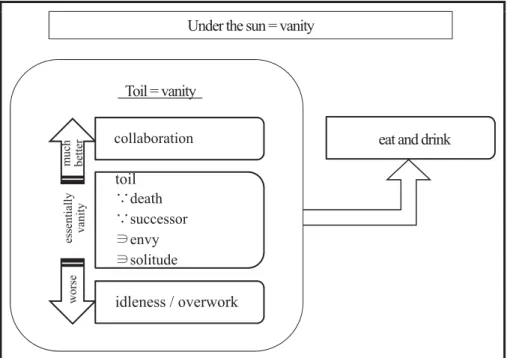
To summarize this article, the Book of Ecclesiastes shows the view of labor as follows (see also Figure 1):
Labor is toil (ʻāmāl), and toil is done “under the sun.” “Under the sun” is a place of vanity, and all toil is also essentially vanity. The result of toil is vanity because of death (2:16-17), successor (2:18-23), being related to envy (4:4), or being related to solitude (4:7-12), but such toil is better than idleness (4:5) and overwork (4:6). Even much better is toil in collaboration. There are two conditions to make toil useful: to collaborate with others and to utilize toil for eating and drinking with fear before God. Though all is vanity, human beings “toil under the sun,” eat and drink, sometimes collaborate with 26 Brown calls this place for eating and drinking “Qoheleth’s Café” (“‘Whatever Your Hand Finds to Do’: Qoheleth’s Work Ethic,” 283). He reads there an implication of the Eucharist (Ecclesiastes, 129 ff.). See also Robert Davidson, Ecclesiastes and the Song of Solomon (Philadelphia: Westminster Press; Edinburgh: Saint Andrew Press 1986), 3.
each other to the extent possible, and enjoy the pleasure as God’s gift until the end of one’s life.
Ecclesiastes grapples “from start to finish with the problem of death,”27 and indicates that toil will end with death.28 From this perspective, the view of labor in Ecclesiastes may lead to a view of life, and a view of human beings. Although it points out the vanity of toil, the book sheds light on the possibility that toil will obtain utility and the advantages of human beings collaborating with each other. Moreover, it suggests the best and most practicable solution to be the way of eating and drinking. This is a noteworthy concept of Ecclesiastes.
B. It is valuable to labor together with others in order to share the result of labor.
The Book of Ecclesiastes seems to be absurd and pessimistic at first sight. For it excessively repeats that all is vanity. However, as stated in this article, the book has a realistic view. It is a vain reality that human beings die at last. As well as this, it is also a reality that everyone lives among others and needs to eat and drink in order to live. So, to find value in collaboration with others and labor for eating and drinking is a realistic way of life. A form of collaboration is often interpreted as a community in the modern
27 Fuerst, 156.
28 Brown says, “Death, paradoxically, serves as the ultimate impulse for work.” See his
“‘Whatever Your Hand Finds to Do’: Qoheleth’s Work Ethic,” 282.
Figure 1: View of Labor in the Book of Ecclesiastes Under the sun = vanity
eat and drink Toil = vanity
much better
• collaboration
essentially vanity
•toil
• қdeath
• қsuccessor
• ѱenvy
• ѱsolitude
worse •idleness / overwork
world.29 People will enjoy pleasure by laboring and sharing the result of labor within a community.
C. We have to keep reconsidering our relationship and discussing with the balance of labor and apportionment.
Needless to say, there is room for reconsideration and discussion. For example, when the result of labor is apportioned among companions, the portions might not be appropriate. In other cases where a community falls into a dysfunctional state for political or economic reasons, the community itself might prevent the collaboration from increasing in value. In such cases, it is necessary to reconsider the relationship among members within a community and to discuss the ideal balance of labor and apportionment of each. To reconsider and discuss is the task of all of us: those who are living in this world.
Considering the above-mentioned points A to C, we can collaborate with others in accordance with the view of labor in the Book of Ecclesiastes.
29 See Brown, “‘Whatever Your Hand Finds to Do’: Qoheleth’s Work Ethic,” 283 ff.