Evol ut i onar y J our ney t hr ough St r es s f ul Spac e
and Ti m
e
著者
Fus e Yuj i , Kobayas hi M
akot o
j our nal or
publ i c at i on t i t l e
M
ol ec ul es
vol um
e
22
num
ber
3
page r ange
436
year
2017- 03
権利
( C) 2017 by t he aut hor s
Li c ens ee M
D
PI , Bas el , Sw
i t z er l and. Thi s
ar t i c l e i s an open ac c es s ar t i c l e di s t r i but ed
under t he t er m
s and c ondi t i ons of t he Cr eat i ve
Com
m
ons At t r i but i on ( CC BY) l i c ens e
( ht t p: / / c r eat i vec om
m
ons . or g/ l i c ens es / by/ 4. 0/ ) .
U
RL
ht t p: / / hdl . handl e. net / 2241/ 00151487
doi: 10.3390/molecules22030436
Cr eat i ve Commons : 表示
Review
Conservation of the Keap1-Nrf2 System:
An Evolutionary Journey through Stressful
Space and Time
Yuji Fuse1,2and Makoto Kobayashi1,*
1 Department of Molecular and Developmental Biology, Faculty of Medicine, University of Tsukuba,
Tsukuba 305-8575, Japan; [email protected]
2 Doctoral Program in Biomedical Sciences, Graduate School of Comprehensive Human Sciences,
University of Tsukuba, Tsukuba 305-8575, Japan
* Correspondence: [email protected]; Tel.: +81-29-853-8457
Academic Editors: Luciano Saso, LászlóDux, Grzegorz Wegrzyn and Tamás Csont Received: 9 February 2017; Accepted: 6 March 2017; Published: 9 March 2017
Abstract:The Keap1-Nrf2 system is an evolutionarily conserved defense mechanism against oxidative and xenobiotic stress. Its regulatory mechanisms, e.g., stress-sensing mechanism, proteasome-based regulation of Nrf2 activity and selection of target genes, have been elucidated mainly in mammals. In addition, emerging model animals, such as zebrafish, fruit fly andCaenorhabditis elegans, have been shown to have similar anti-stress systems to mammals, suggesting that analogous defense systems are widely conserved throughout the animal kingdom. Experimental evidence in lower animals provides important information beyond mere laboratory-confined utility, such as regarding how these systems transformed during evolution, which may help characterize the mammalian system in greater detail. Recent advances in genome projects of both model and non-model animals have provided a great deal of useful information toward this end. We herein review the research on Keap1-Nrf2 and its analogous systems in both mammals and lower model animals. In addition, by comparing the amino acid sequences of Nrf2 and Keap1 proteins from various species, we can deduce the evolutionary history of the anti-stress system. This combinatorial approach using both experimental and genetic data will suggest perspectives of approach for researchers studying the stress response.
Keywords:anti-stress system;DrosophilaCnc; evolutionary history;HydraNrf; Keap1; mouse; Nrf2; C. elegansSkn-1; yeast Yap1; zebrafish
1. Introduction
From birth, animals are destined to fight against a variety of stressors that disrupt their homeostasis. All animal species must cope with oxidative stress generated by their own metabolism. They were also forced to evolve detoxifying systems in case of accidental encounters with toxic chemicals in the environment. Animals could not have prospered without the anti-stress mechanisms evolved by their ancestral species.
Mammals inherited from their ancestors the Kelch-like ECH-associated protein 1 (Keap1)-NF-E2-related factor 2 (Nrf2) system, which is a defense system that confers protection against a wide spectrum of stressors, including oxidative and chemical stress. Recent advances have revealed that the system is related to a number of human diseases, such as cancer, neurodegenerative diseases and diabetes mellitus [1–3], and many researchers are investigating potential medical applications. Although the Keap1-Nrf2 system has mainly been studied using mice and human cells, increasing evidence suggests that orthologous systems exist in lower vertebrates, such as zebrafish [4], and even inDrosophila[5], which will be promising tools for accelerating the study of Nrf2.
The advantages of lower-model animals are not limited to their usefulness in the laboratory and few ethical problems. Recent improvements in genome projects have provided high-quality genomic sequences, facilitating the development of lower-model organisms and enabling us to assess specific biological functions from an evolutionary point of view. In addition to classic model animals, genomic information from non-model animal species has been increasingly accumulated. This information prompted us to track the evolutionary path of proteins of interest.
In the present review, we will highlight the evolution of the Keap1-Nrf2 system and attempt to identify the unique characteristics of the mammalian Nrf2 system by reviewing the evolutionary history of the conserved anti-stress mechanism.
2. Overview of the Keap1-Nrf2 System
2.1. Transcription Factor Nrf2 and Its Function
Nrf2 was discovered as a homolog of nuclear factor-erythroid 2 p45 (NF-E2), which plays an essential role in the transcriptional regulation of theβ-globin gene [6,7]. Unlike NF-E2, the function of this newly-discovered transcription factor was not related to hematopoiesis; Nrf2-knockout mice did not show any obvious phenotype and were normally grown and fertile with no anemia [8–10], suggesting that Nrf2 regulates a different battery of genes from NF-E2.
The function of Nrf2 was first reported by Itoh et al. [11], who noticed the similarity between the NF-E2 binding sequence and antioxidant responsive element (ARE). This regulatory sequence is usually found upstream of genes encoding phase II detoxifying enzymes and had been known to regulate the induction of these genes [12,13]. The down-regulation of the expression of phase II enzymes in Nrf2-knockout mice indicated that Nrf2 regulated the global transcription of phase II enzymes through ARE-dependent signals [11].
The main function of phase II enzymes is to detoxify the highly reactive intermediate metabolites generated by phase I reactions and accelerate the excretion of toxic xenobiotics [14]. Benzo[a]pyrene is a well-studied pro-carcinogen that forms a highly reactive intermediate after phase I metabolism and is detoxified by phase II reactions. The loss of Nrf2 was suspected to potentially weaken phase II metabolism and enhance the carcinogenicity of benzo[a]pyrene. This was experimentally demonstrated by showing the high susceptibility of Nrf2-deficient mice to benzo[a]pyrene-induced tumor formation, suggesting that Nrf2 is indispensable for intact phase II metabolism [15–17]. Later studies revealed that the Nrf2 system also regulates phase III xenobiotic transporters [18,19] as well as phase I-related genes [20,21], suggesting that Nrf2 is involved in the entire process of xenobiotic metabolism. In addition, as ARE sequences were also found upstream of antioxidative genes, such as heme oxygenase 1, Nrf2 was shown to be the master regulator of the oxidative stress response [22]. The mode of action of many toxic chemical stressors is the generation of reactive oxygen species; therefore, Nrf2 plays an important role in the defense against various chemical-derived stresses, such as diesel exhaust, peroxide, heavy metals and other electrophilic compounds [23–25]. The Nrf2-dependent induction of xenobiotic metabolism and antioxidant system likely contributed greatly to animal evolution in a rapidly changing environment.
The Nrf2 system is also activated by endogenous cues, such as endoplasmic reticulum (ER) stress, and confers defense against such stress [26,27]. This protection may be partly due to the Nrf2-dependent induction of proteasome subunits [28,29], which destroy unfolded proteins accumulated in the cell. Another endogenous Nrf2-activating signal is the disruption of autophagy [30], which implies that the Nrf2 system can be activated by disorders of protein turnover. Numerous studies have shown that these internal stresses are related to various diseases; as such, Nrf2 has attracted attention as a potential therapeutic target.
cellular metabolism, which enhances cancer cell proliferation [35,36]. These findings may support the advent of Nrf2-blocking therapy for cancer patients.
2.2. Regulatory Mechanism of Nrf2-Dependent Gene Induction
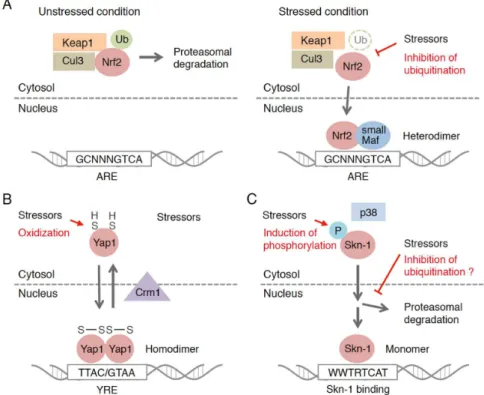
Research on the Nrf2 activation mechanism has greatly progressed since a partner protein of Nrf2, Keap1, was discovered (Figure1A). Keap1 was discovered as a protein that binds directly to Nrf2 and negatively regulates the transcriptional activity of Nrf2 [37]. As Keap1 is the adaptor protein for the ubiquitin ligase, Nrf2 is ubiquitinated in a Keap1-dependent manner and degraded by proteasome system [38–40], which keeps the Nrf2 protein level low under unstressed conditions. Nrf2-activating compounds inhibit the function of Keap1 by attacking highly reactive cysteine residues and stabilize Keap1-Nrf2 binding. De novo-synthesized and accumulated Nrf2 translocates into the nucleus and binds to ARE with its heterodimeric partner, small musculoaponeurotic fibrosarcoma (small Mafs: MafG, MafK and MafF), to induce the target genes [7,41–44]. Since Keap1 receives the redox information or environmental cues via its highly reactive cysteine residues, it is often called the “sensor” molecule that determines the responsiveness of Nrf2-dependent gene induction.
Figure 1. Regulatory mechanisms of the transcription factor-based oxidative stress response in eukaryotes.
β β
β β
Figure 1. Regulatory mechanisms of the transcription factor-based oxidative stress response in eukaryotes. The activation mechanism of: Keap1-Nrf2/Cnc system (A); Yap1 inS. cerevisiae(B); and Skn-1 system inC. elegans(C) are depicted.
In addition to the Keap1-dependent degradation, Nrf2 protein is also regulated in a Keap1-independent manner. Salazar et al. [45] revealed that glycogen synthase kinase-3β(GSK-3β) inhibits Nrf2 activity by direct phosphorylation. Phosphorylated Nrf2 then interacts withβ-transducin repeat-containing protein (β-TrCP), a substrate receptor for ubiquitin ligase complex, and is ubiquitinated [46]. Although the physiological context in which this phosphorylation pathway is modulated is unclear, Chowdhry et al. [47] reported that the inhibited GSK-3 pathway in cancer cells activates Nrf2 and confers drug resistance by upregulating anti-stress genes.
3. Overview of the Anti-Stress Systems in Lower Model Organisms
3.1. Yap inSaccharomyces cerevisiae
Studies of budding yeast, Saccharomyces cerevisiae, have shown that the transcription-based stress response stems from single-cell eukaryotes. Yap family proteins are a well-studied group of transcription factors that confer protection against oxidative and chemical stress [48]. The Yap family consists of eight paralogs of basic leucine zipper (bZip)-type transcription factors, Yap1-8. Of these members, Yap1 is the major isoform that confers protection against oxidative stress (Figure1B) [49]. Unlike Nrf2 in mammals, Yap1 forms homodimers that bind to specific sequences of DNA, Yap response element (YRE), and activate the transcription of target genes. The stress-sensing system is also unique. Yap1 has cysteine residues in its C-terminus that function as sensors. Under unstressed (reduced) conditions, Yap1 localizes in the cytosol by the action of exportin chromosomal maintenance 1 (Crm1), and the transcriptional activation is inhibited. When exposed to oxidative stress, the cysteine residues of Yap1, however, are oxidized with the assistance of glutathione peroxidase 3 (Gpx3), a thiol peroxidase, and an intramolecular disulfide bond is formed [50–53]. In this structure, Crm1 cannot approach the nuclear export signal (NES) region of Yap1, resulting in the nuclear retention of Yap1 and its target gene activation. Regarding this unique activation mechanism, the Yap1 system might stem from a different evolutionary origin from the Keap1-Nrf2 system.
3.2. Cnc inDrosophila
The fruit fly,Drosophila melanogaster, is a classic model animal with substantial advantages in the fields of developmental biology and genetics. The fly homolog of Nrf2 was discovered as an important protein in the development of the cranial portion (labral and mandibular structure) of larvae [54]. Because of its unique expression pattern, this gene was named Cap’n’collar (CNC) [55]. Despite highly conserved amino acid sequences with Nrf2, the anti-stress function of Cnc was not described until the discovery of the transcript variant, CncC, which contains N-terminal domains homologous to Nrf2 [56,57]. CncC was demonstrated to have an anti-stress function in adult flies [58]. In addition, the activity of CncC was regulated at the protein level by the direct interaction with Keap1 [58,59], and heterodimerization withDrosophilasmall Maf protein, Maf-S, was also demonstrated [60]. The target genes of fly CncC are similar to those of Nrf2 in mammals. Phase I and II enzymes, antioxidant proteins and proteasome subunits are shown to be under the regulation of CncC [58,61–63]. These analogies suggest that the Keap1-CncC system inDrosophilaevolved from a common ancestral system with the mammalian Keap1-Nrf2 system.
3.3. Skn-1 inCaenorhabditis elegans
Although the regulatory mechanism differs from that of the mammal Nrf2 system, the target genes of Skn-1 are similar to those of mammalian Nrf2. The gene expressions of phase I, II and III detoxifying enzymes, antioxidant proteins and proteasome subunits are regulated in a Skn-1-dependent manner [65,68,73]. This implies that Keap1-Nrf2/CncC and Skn-1 stem from the same ancestral system, while inC.elegans, a unique regulatory mechanism was evolved.
3.4. Nrf2 in Zebrafish
In zebrafish (Danio rerio), an emerging model animal in medical research, the Keap1-Nrf2 system is highly conserved with that of the mammalian system. Zebrafish Nrf2 and Keap1 were first cloned in 2002 and found to be structurally similar proteins to their mammalian counterparts [57]. Dimeric partners of zebrafish Nrf2 have also been identified and revealed to have conserved small Mafs, MafG (co-ortholog MafG1 and MafG2) and MafK, along with fish-specific MafT (a possible ortholog of mammalian MafF). All of these homologs can function as binding partners of zebrafish Nrf2 [74]. The function of the upstream ARE sequence was shown to be necessary for the Nrf2-dependent induction of a gene encoding phase II enzyme,gstp1[75]. The defense function against xenobiotics and oxidative stress was also demonstrated in vivo using Nrf2 mutant zebrafish strain [76,77]. Lineups of Nrf2 target genes are also conserved in zebrafish. Proteins involved in the detoxification pathway, antioxidant proteins, proteasome subunits and pentose phosphate pathway enzymes are also regulated by the Nrf2 system in zebrafish [77–80]. This experimental evidence clearly shows that vertebrates have an evolutionarily conserved Keap1-Nrf2 system.
4. Evolution of Nrf Protein
4.1. Comparison of Nrf Protein Structures
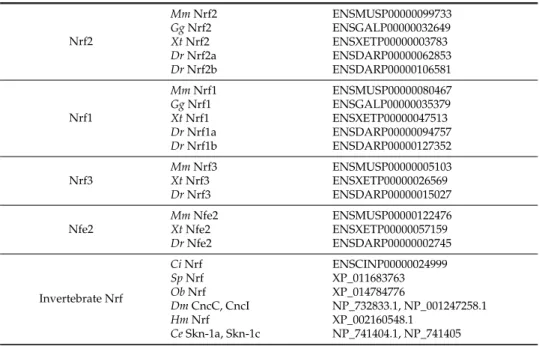
The existence of an analogous Keap1-Nrf2 system inDrosophila suggests that this system is conserved among a wide range of species throughout the animal kingdom. We attempted to trace the evolutionary path of the Keap1-Nrf2 system using genomic information from various animal species (Table1). In addition to laboratory animals, including mice, zebrafish,DrosophilaandC.elegans, the predicted protein sequences of Nrf were obtained from ascidians (Ciona intestinalis) [81], sea urchin (Strongylocentrotus purpuratus) [82], octopus (Octopus bimaculoides) [83] and the diploblastic metazoan Hydra magnipapillata[84].
Table 1.Summary of Nrf proteins.
Nrf2
MmNrf2 ENSMUSP00000099733
GgNrf2 ENSGALP00000032649
XtNrf2 ENSXETP00000003783
DrNrf2a ENSDARP00000062853
DrNrf2b ENSDARP00000106581
Nrf1
MmNrf1 ENSMUSP00000080467
GgNrf1 ENSGALP00000035379
XtNrf1 ENSXETP00000047513
DrNrf1a ENSDARP00000094757
DrNrf1b ENSDARP00000127352
Nrf3
MmNrf3 ENSMUSP00000005103
XtNrf3 ENSXETP00000026569
DrNrf3 ENSDARP00000015027
Nfe2
MmNfe2 ENSMUSP00000122476
XtNfe2 ENSXETP00000057159
DrNfe2 ENSDARP00000002745
Invertebrate Nrf
CiNrf ENSCINP00000024999
SpNrf XP_011683763
ObNrf XP_014784776
DmCncC, CncI NP_732833.1, NP_001247258.1
HmNrf XP_002160548.1
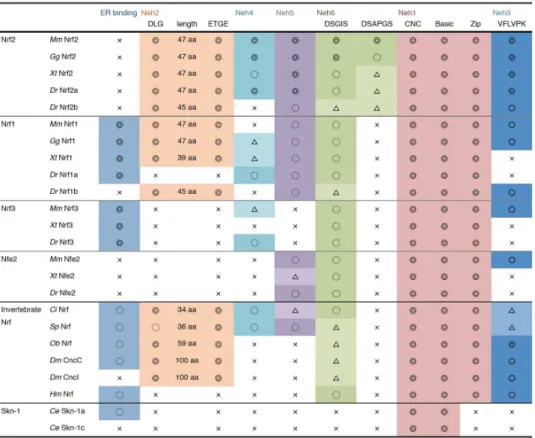
Vertebrates have 4 Nrf genes—Nrf1, Nrf2, Nrf3 and NF-E2 (Figure2A)—while lower animals (ascidians, sea urchin, octopus, fly andHydra) seem to have only 1 Nrf gene locus, implying the diversification of this protein family in vertebrate evolution. Of the Nrf family proteins in mammals, Nrf1 has the most similar domain structure to Nrf2 and is known to regulate the transcription of antioxidant and phase II enzymes through binding to ARE, forming heterodimers with small Mafs. Despite this similarity to Nrf2, the regulatory mechanism of Nrf1 differs substantially from that of the Nrf2 system, largely due to the localization to the ER membrane by its ER binding region in the N-terminal domain, while Nrf2 stays in the cytosol under unstressed conditions. In addition, activity of Nrf1 is regulated by the glycosylation/deglycosylation, not by a Keap1-dependent ubiquitination mechanism [85]. Similarly, Nrf3 is tethered to the ER membrane by its N-terminal region, and heterodimerization with small Mafs is needed for DNA binding [86,87]. Studies of the Nrf3 function are still in progress [88]. NF-E2 is specifically expressed in hematopoietic tissue and also need to make heterodimer with small Mafs for the transcriptional regulation of target genes [89,90]. Genetic studies have shown that NF-E2-knockout mice scarcely survived after the neonatal stage because of the absence of platelets and severe hemorrhaging [91], and genetic ablation of Nrf1 resulted in embryonic lethality [92,93]. In contrast, mice with Nrf2 and Nrf3 knockout were viable and fertile [8,11,94], suggesting that the functions of these four Nrf proteins have significantly diverged during vertebrate evolution. Below, we compared the amino acid sequences of the Nrf proteins from various species and four Nrf family proteins in mice (Figure2B). Based on the alignment, the specific features of each protein were extracted.
The Neh1 domain, also known as the CNC-bZip domain, is an essential region for DNA binding (CNC domain and basic region) and dimerization with small Maf proteins (leucine zipper region). The amino acid sequence of this region, especially the basic region in the middle of this domain, is highly conserved among a wide range of species, suggesting that all these proteins were derived from the same origin, and that the DNA binding ability has been inherited from ancestral species. Interestingly, Skn-1 was observed to have lost the leucine zipper, an essential region for the dimerization, which may therefore explain why Skn-1 binds to DNA as a monomer.
The Neh2 domain is characterized by its interaction with Keap1, making it an essential domain for the proteasome-dependent degradation of Nrf2 [37]. Direct interactions of two motifs (DLG at the N-terminus and ETGE at the C-terminus) with Keap1 are necessary for the normal turnover of Nrf2 protein [57,95–97]. The Neh2 domain was not found in theHydraNrf protein, but Nrf of other triploblastic animals all have this domain. Nrf1 also possess these two motifs, while NF-E2 and Nrf3 have lost the Neh2 regions. Another important point is the conservation of lysine residues between the DLG and ETGE motifs, as seven lysine residues in this region of mouse Nrf2 were shown to be ubiquitinated, which promotes proteasomal degradation [98]. Although the number of lysine residues varies among species, all Nrf2 proteins possess at least two in this area, suggesting the conservation of Nrf2 degradation through the ubiquitin proteasome system. Another important amino acid is Ser-40, which is phosphorylated by protein kinase C. Phosphorylation of this serine has been suggested to promote dissociation from Keap1 [99]. This site has only been observed in vertebrates, except for some animals such asXenopus tropicalis, fugu, medaka fish and platypus, suggesting that the regulation of the Keap1 binding affinity by phosphorylation evolved after the appearance of vertebrates, but it was subsequently lost in some species.
The Neh4 and Neh5 domains are also transcriptional activation domains, which interact with transcriptional co-activator CREB binding protein (CBP). Transcriptional adapter motif (TRAM) (FxD/ExxxL) in Neh4 is considered to be an essential motif for this interaction [101]. No homologous region of the Neh4 or Neh5 domains was found inHydraor in protostomes,Drosophilaor octopus Nrf, implying that these domains evolved only in deuterostomes. In sea urchins and ascidians, conserved Neh4 and -5 domains were found. Teleost Nrf2 proteins (amazon molly, cavefish, cod, fugu, medaka, platyfish, spotted gar, stickleback, tetraodon, tilapia and zebrafish) have complete TRAM as well as a conserved Neh5 domain, although Nrf2a in cavefish does not have a conserved Neh5 domain (http:www.ensembl.org). Regarding other Nrf family proteins in mice, TRAM was incomplete in Nrf3 and was not found in Nrf1 or NF-E2. The Neh5 domain was conserved in Nrf1 and NF-E2 but not in Nrf3.
The Neh6 domain plays a role in the phosphorylation-based regulation of Nrf2 activity. The DSGIS motif in the N-terminus of Neh6 is essential for the GSK-3β-dependent phosphorylation and subsequent ubiquitination byβ-TrCP [47]. This motif was found to be conserved inHydra; therefore, the Nrf activity might be regulated by phosphorylation-dependent degradation from common ancestors of species investigated. This motif was also conserved in other Nrf proteins in mice, suggesting that the activity of these isoforms is also modulated by phosphorylation. The Neh6 domain of mouse Nrf2 has another phosphorylation site in its C-terminus (DSAPGS motif) [47], but no conserved amino acid sequence was observed in Nrf ofHydra, fly, octopus, sea urchin or ascidian. Although this motif was found in vertebrate Nrf proteins, the conservation of the amino acid sequence was relatively weak, and the functional importance of this region is unclear.
We next searched for homologous sequences to the N-terminal ER binding region of mouse Nrf1 and its vertebrate orthologs. N-terminal homology box1 (NHB1) was shown to be important for Nrf1 tethering to the ER [102]. Nrf3 of mouse, frog and zebrafish have a highly conserved NHB1 region to Nrf1. The Nrf proteins of lower animals also have a homologous region, and the N-terminal half of this region in particular tends to be highly conserved.
The conservation of each domain is summarized in Figure3. Of the diversified Nrf proteins, only vertebrate Nrf2 has all six Neh domains. In particular, TRAM in the Neh4 domain was well conserved in the Nrf2 isoform, while it was unclear in Nrf1 and Nrf3. Nrf1 resembles Nrf2 but lacks Neh4 and the C-terminus of the Neh6 domain. Nrf proteins in ascidians and sea urchins were found to have a similar domain structure to Nrf1, including the NHB1 domain in their N-terminus. The Nrf proteins of fruit fly and octopus are also characterized by ER binding NHB1, but they lack Neh4 and Neh5 domains. Interestingly, the distance between the DLG and ETGE motifs in the Neh2 domain is highly conserved among Nrf2 proteins in vertebrates. For Nrf2 ubiquitination, these two motifs must be appropriately bound to Keap1 homodimer as a hinge and latch that bridges the two Keap1 molecules [97]; therefore, the distance between DLG and ETGE must be tightly controlled so that Nrf2 fits in the Keap1 homodimer structure. The distance between the two motifs was relatively short in ascidians and sea urchins and relatively long in octopus and fly, possibly suggesting that the binding structure of Keap1-Nrf2 varies among species.
Figure 3. A summary of the domain structure of the Nrf/Cnc transcription factors. Conservation o
◎ ○ △
Figure 3.A summary of the domain structure of the Nrf/Cnc transcription factors. Conservation of the Neh domains was evaluated as follows:⊚, highly conserved;#, relatively conserved;△, partially conserved;×, not conserved. Specific motifs were described as “highly conserved” only when the sequences were identical to mouse Nrf2. The amino acid lengths between DLG and ETGE motifs are also shown.
4.2. Possible Evolutionary Path of Nrf Proteins
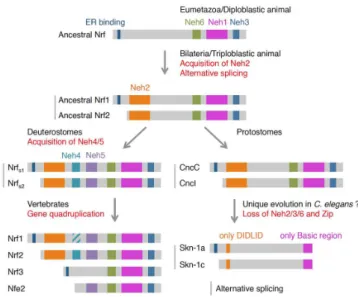
From the structural analysis above, we deduced the evolutionary history of the Nrf proteins (Figure4). Of the six domains of Nrf2 in mammals, ancestral Nrf might possess Neh1, -3 and -6 as well as the ER binding region in the N-terminus. As theHydraNrf protein lacks an Neh2 domain and possesses an ER binding domain, its activity is suspected to be regulated mainly at the binding to the ER membrane, just like Nrf1 in mammals. The rise of the Neh2 domain in triploblasts may correspond to the appearance of Keap1-dependent regulation and probably activation in response to various stressors. Data for sea urchins and ascidians have suggested that deuterostomes obtained Neh4 and -5 domains, while protostomes (fly and octopus) did not.C.elegansevolved a unique protein, Skn-1, that lacks most of the original domains, even the C-terminal half of Neh1 (leucine zipper).
The evolution of Nrf/Cnc transcription factors deduced from amino acid sequ
Figure 4.The evolution of Nrf/Cnc transcription factors deduced from amino acid sequences. Gray bars and subscripts (s1 and s2) in Deuterostomes Nrf denote products of alternative splicing.
Taken together, these findings suggest that, at the latest, the mechanism of alternative splicing and generation of varied proteins from a single Nrf locus was already present at the appearance of triploblastic animals. In vertebrates, at gene quadruplication, varied proteins are assigned to each replicated locus. For the Nrf2 locus, a transcription factor regulated by a Keap1-dependent and ER-independent mechanism is assigned.
5. Evolution of Keap1
5.1. Comparison of Keap1 Proteins
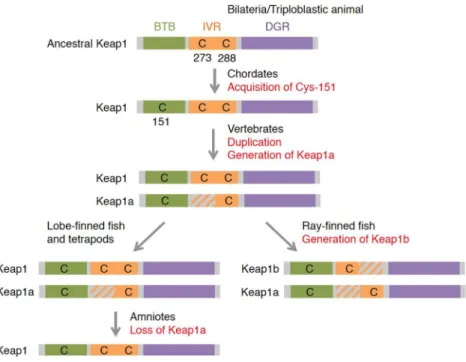
We performed a similar phylogenetic analysis of Keap1 (Table2). In zebrafish, two Keap1 co-orthologs (Keap1a and Keap1b) have been found [105]. Interestingly, teleosts, including amazon molly, cavefish, cod, fugu, medaka, platyfish, spotted gar, stickleback, tetraodon and tilapia, all have two Keap1 co-orthologs (http:www.ensembl.org). To determine the evolutionary origin of this duplication, we further consulted the genomic information of the African coelacanth (Latimeria chalumnae) [106], green anole lizard (Anolis carolinensis) [107] and Xenopus tropicalis. Two Keap1 co-orthologs were found in the coelacanth and frog but not in the lizard. The second Keap1 is suspected to have been generated at the appearance of vertebrates and lost in amniotes.
Table 2.Summary of Keap1 proteins.
Vertebrate Keap1
MmKeap1 ENSMUSP00000131029 GgKeap1 ENSGALP00000046666 AcKeap1 ENSACAP00000008820 XtKeap1 ENSXETP00000063060 LcKeap1 ENSLACP00000008916
Keap1b
DrKeap1b ENSDARP00000124228 OlKeap1b ENSORLP00000004762 TnKeap1b ENSTNIP00000007190
Keap1a
XtKeap1a ENSXETP00000049635, Xenbase(http://www.xenbase.org/) LcKeap1a ENSLACP00000018705 DrKeap1a ENSDARP00000045763 OlKeap1a ENSORLP00000017543 TnKeap1a ENSTNIP00000020338
Invertebrate Keap1
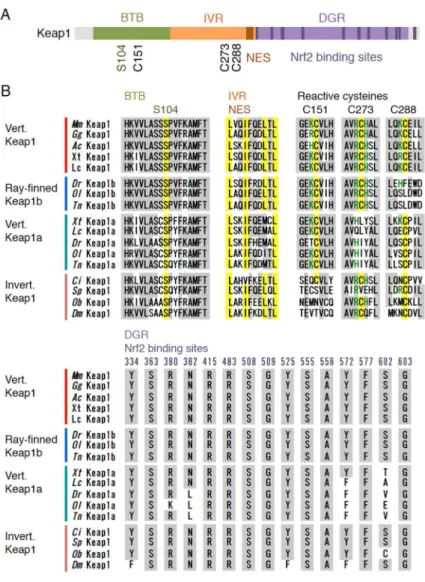
Keap1 is composed of three domains, broad complex-tramtrack-bric a brac (BTB), intervening region (IVR) and double glycine repeat (DGR) domains (Figure5A), all of which are important for the inhibition of Nrf2 activity. N-terminal BTB is the essential region for the formation of the homodimer of Keap1. Without this dimerization, Keap1 is unable to ubiquitinate Nrf2, and Ser-104 in this domain is reported to be necessary for dimer formation [108]. Of note, this serine, including the surrounding amino acids, is highly conserved in both vertebrates and invertebrates (Figure5B).
Figure 5.Figure 5. A comparison of Keap1 proteins: (A comparison of Keap1 proteins: (AA) domain structures of Keap1; and () domain structures of Keap1; and (BB) a) amino acid sequences of Keap1 proteins from mouse (Mm), chicken (Gg), anole lizard (Ac), clawed frog (Xt), coelacanth (Lc), zebrafish (Dr), medaka (Ol), green spotted puffer (Tn), ascidian (Ci), sea urchin (Sp), octopus (Ob) and fruit fly (Dm). The amino acids identical to mouse Nrf2 are shaded in gray. The serine residues essential for homodimer formation in the BTB domain, NES consensus sequence in the IVR domain and three reactive cysteine residues are shaded in yellow.
the ancestor of these animals (Figure5B). Furthermore, Ser-602 is not conserved in Keap1a of frogs and fish. We previously showed that both Keap1a and Keap1b in zebrafish were able to inhibit Nrf2 activity [105,111]. Ser-602 may not be important for binding with Nrf2. The IVR domain interacts with Cul3 protein, which comprises the E3 ligase complex together with Roc1 [41,112,113]. This domain has a consensus sequence of nuclear export signal (Lx(1–3)Lx(2–4)LxL), which is important for localization at the cytoplasm [114]. This signal sequence was also highly conserved among species, implying that there is conserved regulation of the intracellular localization of Keap1.
The notable characteristic of Keap1 is its richness in cysteine residues. Given their high reactivity, cysteines can function as “sensor” amino acids [115]. When cysteines are attacked by reactive chemicals, the function of Keap1 is hindered by structural changes, which results in Nrf2 activation [116–118]. Of the 25 cysteines in mouse Keap1, Cys-151, Cys-273 and Cys-288 were shown to have sensor functions in vivo [119–121]. Cys-273 and its surrounding region were found to be highly conserved among the animal species investigated, except for sea urchins. Cys-288 was also detected in all of the species investigated, suggesting that these two cysteines are the oldest cysteines that function in stress sensing. Of these two cysteines, Cys-273 has been lost from Keap1a in lower vertebrates, while Cys-288 has been lost from Keap1b in ray-finned fish (Actinopterygii). Cys-151 was found in Keap1 of ascidians or higher animals, while sea urchins, octopus and fruit flies had not conserved this cysteine. These differences provide important information for understanding the diversification of Keap1 proteins and their function.
Regarding other cysteines, as summarized in Figure6, Cys-77, Cys-171, Cys-196, Cys-297 and Cys-395 are well-conserved among Kelch family proteins in mice; therefore, their evolutionary origin may be older than the appearance of Keap1. Eight cysteines (Cys-226, Cys-241, Cys-319, Cys-368, Cys-406, Cys-489, Cys-583, and Cys-613) are found in either flies or octopus, suggesting that these cysteines are conserved from ancestral Keap1. Other cysteines may also have been obtained over the course of evolution; for example, sea urchins have Cys-249 and Cys-434, and ascidians have Cys-38.
Figure 6. A summary of the cysteine residues of Keap1. The conservation of each cysteine is indicate
○ △
Figure 6.A summary of the cysteine residues of Keap1. The conservation of each cysteine is indicated as follows#: conserved; △: not conserved but cysteine exists within three amino acids;×: not conserved. Sensor cysteines are shaded in red, and cysteine residues conserved among Kelch family proteins in mice are shaded in orange.
5.2. Possible Evolutionary Path of Keap1 Cysteines and Their Sensor Function
Ray-finned fish further lost Cys-288 from another Keap1 co-ortholog, resulting in two distinct types of Keap1: Cys-273-lost (Keap1a) and Cys-288-lost (Keap1b) types. However, in lobe-finned fish (Sarcopterygii) and tetrapods, there was no change in these cysteines, and amniotes lost the C273-lost type Keap1, giving them only a single Keap1 locus.
Figure 7. The evolution of Keap1 proteins deduced from amino acid sequences. Figure 7.The evolution of Keap1 proteins deduced from amino acid sequences.
Cys-151 has been determined to be an important cysteine for the detection of electrophiles, such astert-butyl hydroquinone (tBHQ), sulforaphane, diethyl maleate (DEM) and dimethyl fumarate (DMF) [111,116,120,121]. Importantly, the sensor function of this cysteine is not determined only by Cys-151 itself, but also by the surrounding amino acid. Kobayashi et al. [111], from the functional difference of two zebrafish Keap1 co-orthologs, revealed that neighboring lysine, due to its positive charge, is essential for Cys-151 to function as the sensor (see Figure5B). In ascidians, neighboring lysine is not conserved, so whether or not this cysteine has a sensor function is unclear. A possible evolutionary scenario is that Cys-151 was coincidentally obtained in chordates, and positive charged amino acids that appeared in vertebrates subsequently empowered the cysteine to be a sensor. Although fruit flies have not conserved this cysteine, the ARE reporter gene was activated by DEM treatment [5,122]. The mechanism for sensing electrophiles in flies is not fully elucidated, but other Keap1 cysteines may sense the signal, or a completely different mechanism may be involved. It was reported that nitric oxide, an endogenous gaseous transmitter, also targets Cys-151 and activates the Nrf2 system in mammals [121,123]. It will be interesting to examine whether or not an Nrf system with Keap1 that has no Cys-151 responds to this internal signal.
compounds potently induce Nrf2 and attack all three cysteines: Cys-151, Cys-273 and Cys-288 [121]. The responsiveness of the Keap1-Nrf2/Cnc system to arsenic is well-conserved in mammals [124], zebrafish [77] and flies [5,122], and all three of these species have at least one cysteine from among Cys-151, -273 or -288, which explains this conserved sensing mechanism reasonably well.
Recent progress has shown that Cys-226 and Cys-613 are necessary for the sensing of hydrogen peroxide and heavy metals such as zinc, cadmium, arsenic and selenium [123,125,126]. These cysteines are widely conserved among species, although sea urchin Keap1 does not have Cys-226, and fly Keap1 lacks both. In the zebrafish Keap1-Nrf2 system that respond to hydrogen peroxide and cadmium [76,111], these cysteines may function as sensors in a conserved manner. However, in fruit flies, although the Keap1-Cnc system responds to oxidative stressors, such as hydrogen peroxide and paraquat [58], Cys-226 and Cys-613 are not found in Keap1 (see Figure6). This indicates that there must be different sensor mechanisms for oxidative stress and heavy metals inDrosophila.
In addition to the cysteines described above, Cys-257, Cys-297 and Cys-319 were determined to have highly reactive thiols [115,127]. Cys-257 was only possessed by Keap1 in coelacanths, frogs, lizards, chickens and mice, while Keap1a isoforms do not have this cysteine, suggesting that this cysteine evolved only in Keap1 after the appearance of lobe-finned fish (Figure6). Although Cys-297 is one of the cysteines that are conserved among Kelch family proteins in mice, it was found to be highly conserved among the species examined, except for Keap1b of zebrafish (Figure6). The presence of Cys-319 varied among species, and its evolutionary origin remains unclear. Cys-434 is modified by 8-nitro-cGMP, an endogenous electrophilic compound generated after nitric oxide production [128]. This cysteine is conserved in sea urchins and among vertebrates, except for anole lizards (Figure6). The functions of these cysteine have not be determined biologically, but whether or not these chemicals activate Nrf, especially in species that do not have targeted cysteines in Keap1, will be of interest.
6. Future Directions
Similar toDrosophilaCnc andC.elegansSkn-1, which have been shown to be essential factors for embryonic development, vertebrate Nrf2 may perform functions other than those related to the stress response, even though Nrf2-knockout mice and Nrf2 mutant zebrafish develop normally [8,11,76]. Some evidence supports this notion, such as its known roles: first, Keap1-knockout mice, in which Nrf2 is constitutively active, developed hyperkeratosis in the esophagus and forestomach [129]. Second, Mitsuishi et al. showed that an active Nrf2 system in cancer cells upregulates the anabolic pathway through the transcriptional activation of pentose phosphate pathway enzymes, which enhances the cell proliferation [35]. We recently found that a gene encoding the pentose phosphate pathway enzyme phosphogluconate dehydrogenase (pgd) is also under the regulation of Nrf2 in zebrafish [80], suggesting that there is a conserved function among vertebrates. Zebrafish, in addition to mice, will prove a useful model for studying cell proliferation during normal development as well as under pathological conditions.
Growing evidence shows that endogenous stressors are involved in the pathogenicity of various diseases. Whether or not the interaction of the Keap1-Nrf system with the ER stress response and autophagy pathway are conserved in lower animals remains unclear; however, Skn-1 is known to have a close relationship with the ER stress response pathway [104]. Determining how the Keap1-Nrf system evolved its sensing mechanism against endogenous stressors will prove interesting. As we showed in this review, experimental evidence from lower model animals provides valuable information. Recently, the CRISPR-Cas9 technique has been more and more easily applied to non-model organisms [130,131], which will facilitate the accumulation of experimental evidence from various species. These data should be analyzed together with phylogenetic information, which will promote not only our understanding of the evolution of anti-stress mechanism, but also clarify its potential medical applications.
Conflicts of Interest:The authors declare no conflict of interest.
References
1. Suzuki, T.; Yamamoto, M. Molecular basis of the Keap1-Nrf2 system.Free Radic. Biol. Med.2015,88, 93–100. [CrossRef] [PubMed]
2. Suzuki, T.; Motohashi, H.; Yamamoto, M. Toward clinical application of the Keap1-Nrf2 pathway.
Trends Pharmacol. Sci.2013,34, 340–346. [CrossRef] [PubMed]
3. Yang, L.; Palliyaguru, D.L.; Kensler, T.W. Frugal chemoprevention: Targeting Nrf2 with foods rich in sulforaphane.Semin. Oncol.2016,43, 146–153. [CrossRef] [PubMed]
4. Hahn, M.E.; Timme-Laragy, A.R.; Karchner, S.I.; Stegeman, J.J. Nrf2 and Nrf2-related proteins in development and developmental toxicity: Insights from studies in zebrafish (Danio rerio).Free Radic. Biol. Med.2015,88, 275–289. [CrossRef] [PubMed]
5. Pitoniak, A.; Bohmann, D. Mechanisms and functions of Nrf2 signaling inDrosophila.Free Radic. Biol. Med. 2015,88, 302–313. [CrossRef] [PubMed]
6. Moi, P.; Chan, K.; Asunis, I.; Cao, A.; Kan, Y.W. Isolation of NF-E2-related factor 2 (Nrf2), a NF-E2-like basic leucine zipper transcriptional activator that binds to the tandem NF-E2/AP1 repeat of theβ-globin locus control region.Proc. Natl. Acad. Sci. USA1994,91, 9926–9930. [CrossRef] [PubMed]
7. Itoh, K.; Igarashi, K.; Hayashi, N.; Nishizawa, M.; Yamamoto, M. Cloning and characterization of a novel erythroid cell-derived CNC family transcription factor heterodimerizing with the small Maf family proteins.
Mol. Cell. Biol.1995,15, 4184–4193. [CrossRef] [PubMed]
8. Chan, K.; Lu, R.; Chang, J.C.; Kan, Y.W. NRF2, a member of the NFE2 family of transcription factors, is not essential for murine erythropoiesis, growth, and development. Proc. Natl. Acad. Sci. USA1996,93, 13943–13948. [CrossRef] [PubMed]
9. Kuroha, T.; Takahashi, S.; Komeno, T.; Itoh, K.; Nagasawa, T.; Yamamoto, M. Ablation of Nrf2 function does not increase the erythroid or megakaryocytic cell lineage dysfunction caused by p45 NF-E2 gene disruption.
J. Biochem.1998,123, 376–379. [CrossRef] [PubMed]
10. Martin, F.; van Deursen, J.M.; Shivdasani, R.A.; Jackson, C.W.; Troutman, A.G.; Ney, P.A. Erythroid maturation and globin gene expression in mice with combined deficiency of NF-E2 and Nrf-2. Blood 1998,91, 3459–3466. [PubMed]
11. Itoh, K.; Chiba, T.; Takahashi, S.; Ishii, T.; Igarashi, K.; Katoh, Y.; Oyake, T.; Hayashi, N.; Satoh, K.; Hatayama, I.; et al. An Nrf2/small Maf heterodimer mediates the induction of phase II detoxifying enzyme genes through antioxidant response elements.Biochem. Biophys. Res. Commun.1997,236, 313–322. [CrossRef] [PubMed]
12. Rushmore, T.H.; Pickett, C.B. Transcriptional regulation of the rat glutathione S-transferase Ya subunit gene: Characterization of a xenobiotic-responsive element controlling inducible expression by phenolic antioxidants.J. Biol. Chem.1990,265, 14648–14653. [PubMed]
13. Friling, R.S.; Bensimon, A.; Tichauer, Y.; Daniel, V. Xenobiotic-inducible expression of murine glutathione S-transferase Ya subunit gene is controlled by an electrophile-responsive element.Proc. Natl. Acad. Sci. USA 1990,87, 6258–6262. [CrossRef] [PubMed]
14. Xu, C.; Li, C.Y.T.; Kong, A.N.T. Induction of phase I, II and III drug metabolism/transport by xenobiotics.
Arch. Pharm. Res.2005,28, 249–268. [CrossRef] [PubMed]
15. Ramos-Gomez, M.; Kwak, M.K.; Dolan, P.M.; Itoh, K.; Yamamoto, M.; Talalay, P.; Kensler, T.W. Sensitivity to carcinogenesis is increased and chemoprotective efficacy of enzyme inducers is lost innrf2transcription factor-deficient mice.Proc. Natl. Acad. Sci. USA2001,98, 3410–3415. [CrossRef] [PubMed]
16. Ramos-Gomez, M.; Dolan, P.M.; Itoh, K.; Yamamoto, M.; Kensler, T.W. Interactive effects ofnrf2genotype and oltipraz on benzo[a]pyrene-DNA adducts and tumor yield in mice. Carcinogenesis2003,24, 461–467. [CrossRef] [PubMed]
18. Hayashi, A.; Suzuki, H.; Itoh, K.; Yamamoto, M.; Sugiyama, Y. Transcription factor Nrf2 is required for the constitutive and inducible expression of multidrug resistance-associated protein 1 in mouse embryo fibroblasts.Biochem. Biophys. Res. Commun.2003,310, 824–829. [CrossRef] [PubMed]
19. Vollrath, V.; Wielandt, A.M.; Iruretagoyena, M.; Chianale, J. Role of Nrf2 in the regulation of theMrp2
(ABCC2) gene.Biochem. J.2006,395, 599–609. [CrossRef] [PubMed]
20. Miao, W.; Hu, L.; Scrivens, P.J.; Batist, G. Transcriptional regulation of NF-E2 p45-related factor (NRF2) expression by the aryl hydrocarbon receptor-xenobiotic response element signaling pathway: Direct cross-talk between phase I and II drug-metabolizing enzymes. J. Biol. Chem. 2005, 280, 20340–20348. [CrossRef] [PubMed]
21. Shin, S.; Wakabayashi, N.; Misra, V.; Biswal, S.; Lee, G.H.; Agoston, E.S.; Yamamoto, M.; Kensler, T.W. NRF2 modulates aryl hydrocarbon receptor signaling: Influence on adipogenesis.Mol. Cell. Biol.2007,27, 7188–7197. [CrossRef] [PubMed]
22. Ishii, T.; Itoh, K.; Takahashi, S.; Sato, H.; Yanagawa, T.; Katoh, Y.; Bannai, S.; Yamamoto, M. Transcription factor Nrf2 coordinately regulates a group of oxidative stress-inducible genes in macrophages.J. Biol. Chem. 2000,275, 16023–16029. [CrossRef] [PubMed]
23. Enomoto, A.; Itoh, K.; Nagayoshi, E.; Haruta, J.; Kimura, T.; O’Connor, T.; Harada, T.; Yamamoto, M. High sensitivity of Nrf2 knockout mice to acetaminophen hepatotoxicity associated with decreased expression of ARE-regulated drug metabolizing enzymes and antioxidant genes.Toxicol. Sci.2001,59, 169–177. [CrossRef] [PubMed]
24. Aoki, Y.; Sato, H.; Nishimura, N.; Takahashi, S.; Itoh, K.; Yamamoto, M. Accelerated DNA adduct formation in the lung of the Nrf2 knockout mouse exposed to diesel exhaust. Toxicol. Appl. Pharmacol. 2001,173, 154–160. [CrossRef] [PubMed]
25. Higgins, L.G.; Kelleher, M.O.; Eggleston, I.M.; Itoh, K.; Yamamoto, M.; Hayes, J.D. Transcription factor Nrf2 mediates an adaptive response to sulforaphane that protects fibroblasts in vitro against the cytotoxic effects of electrophiles, peroxides and redox-cycling agents.Toxicol. Appl. Pharmacol.2009,237, 267–280. [CrossRef] [PubMed]
26. Cullinan, S.B.; Zhang, D.; Hannink, M.; Arvisais, E.; Kaufman, R.J.; Diehl, J.A. Nrf2 is a direct PERK substrate and effector of PERK-dependent cell survival.Mol. Cell. Biol.2003,23, 7198–7209. [CrossRef] [PubMed] 27. Cullinan, S.B.; Diehl, J.A. PERK-dependent activation of Nrf2 contributes to redox homeostasis and cell
survival following endoplasmic reticulum stress.J. Biol. Chem.2004,279, 20108–20117. [CrossRef] [PubMed] 28. Kwak, M.K.; Wakabayashi, N.; Greenlaw, J.L.; Yamamoto, M.; Kensler, T.W. Antioxidants enhance mammalian proteasome expression through the Keap1-Nrf2 signaling pathway.Mol. Cell. Biol. 2003,23, 8786–8794. [CrossRef] [PubMed]
29. Kwak, M.K.; Wakabayashi, N.; Itoh, K.; Motohashi, H.; Yamamoto, M.; Kensler, T.W. Modulation of gene expression by cancer chemopreventive dithiolethiones through the Keap1-Nrf2 pathway: Identification of novel gene clusters for cell survival.J. Biol. Chem.2003,278, 8135–8145. [CrossRef] [PubMed]
30. Komatsu, M.; Kurokawa, H.; Waguri, S.; Taguchi, K.; Kobayashi, A.; Ichimura, Y.; Sou, Y.S.; Ueno, I.; Sakamoto, A.; Tong, K.I.; et al. The selective autophagy substrate p62 activates the stress responsive transcription factor Nrf2 through inactivation of Keap1. Nat. Cell Biol. 2010, 12, 213–223. [CrossRef] [PubMed]
31. Singh, A.; Misra, V.; Thimmulappa, R.K.; Lee, H.; Ames, S.; Hoque, M.O.; Herman, J.G.; Baylin, S.B.; Sidransky, D.; Gabrielson, E.; et al. Dysfunctional KEAP1-NRF2 interaction in non-small-cell lung cancer.
PLoS Med.2006,3, e420. [CrossRef] [PubMed]
32. Padmanabhan, B.; Tong, K.I.; Ohta, T.; Nakamura, Y.; Scharlock, M.; Ohtsuji, M.; Kang, M.I.; Kobayashi, A.; Yokoyama, S.; Yamamoto, M. Structural basis for defects of Keap1 activity provoked by its point mutations in lung cancer.Mol. Cell2006,21, 689–700. [CrossRef] [PubMed]
33. Wang, X.J.; Sun, Z.; Villeneuve, N.F.; Zhang, S.; Zhao, F.; Li, Y.; Chen, W.; Yi, X.; Zheng, W.; Wondrak, G.T.; et al. Nrf2 enhances resistance of cancer cells to chemotherapeutic drugs, the dark side of Nrf2.Carcinogenesis 2008,29, 1235–1243. [CrossRef] [PubMed]
35. Mitsuishi, Y.; Taguchi, K.; Kawatani, Y.; Shibata, T.; Nukiwa, T.; Aburatani, H.; Yamamoto, M.; Motohashi, H. Nrf2 redirects glucose and glutamine into anabolic pathways in metabolic reprogramming.Cancer Cell2012,
22, 66–79. [CrossRef] [PubMed]
36. Yamadori, T.; Ishii, Y.; Homma, S.; Morishima, Y.; Kurishima, K.; Itoh, K.; Yamamoto, M.; Minami, Y.; Noguchi, M.; Hizawa, N. Molecular mechainsms for the regulation of Nrf2-mediated cell proliferation in non-small-cell lung cancers.Oncogene2012,31, 4768–4777. [CrossRef] [PubMed]
37. Itoh, K.; Wakabayashi, N.; Katoh, Y.; Ishii, T.; Igarashi, K.; Engel, J.D.; Yamamoto, M. Keap1 represses nuclear activation of antioxidant responsive elements by Nrf2 through binding to the amino-terminal Neh2 domain.
Genes Dev.1999,13, 76–86. [CrossRef] [PubMed]
38. Itoh, K.; Wakabayashi, N.; Katoh, Y.; Ishii, T.; O’Connor, T.; Yamamoto, M. Keap1 regulates both cytoplasmic-nuclear shuttling and degradation of Nrf2 in response to electrophiles. Genes Cells2003,8, 379–391. [CrossRef] [PubMed]
39. McMahon, M.; Itoh, K.; Yamamoto, M.; Hayes, J.D. Keap1-dependent proteasomal degradation of transcription factor Nrf2 contributes to the negative regulation of antioxidant response element-driven gene expression.J. Biol. Chem.2003,278, 21592–21600. [CrossRef] [PubMed]
40. Stewart, D.; Killeen, E.; Naquin, R.; Alam, S.; Alam, J. Degradation of transcription factor Nrf2 via the ubiquitin-proteasome pathway and stabilization by cadmium.J. Biol. Chem.2003,278, 2396–2402. [CrossRef] [PubMed]
41. Kobayashi, A.; Kang, M.I.; Okawa, H.; Ohtsuji, M.; Zenke, Y.; Chiba, T.; Igarashi, K.; Yamamoto, M. Oxidative stress sensor Keap1 functions as an adaptor for Cul3-based E3 ligase to regulate proteasomal degradation of Nrf2.Mol. Cell. Biol.2004,23, 7130–7139. [CrossRef] [PubMed]
42. Kobayashi, A.; Kang, M.I.; Watai, Y.; Tong, K.I.; Shibata, T.; Uchida, K.; Yamamoto, M. Oxidative and electrophilic stresses activate Nrf2 through inhibition of ubiquitination activity of Keap1.Mol. Cell. Biol. 2006,26, 221–229. [CrossRef] [PubMed]
43. Katsuoka, F.; Yamamoto, M. Small Maf proteins (MafF, MafG, MafK): History, structure and function.Gene 2016,586, 197–205. [CrossRef] [PubMed]
44. Katsuoka, F.; Yamazaki, H.; Yamamoto, M. Small Maf deficiency recapitulates the liver phenotypes of Nrf1- and Nrf2-deficient mice.Genes Cells2016,21, 1309–1319. [CrossRef] [PubMed]
45. Salazar, M.; Rojo, A.I.; Velasco, D.; de Sagarra, R.M.; Cuadrado, A. Glycogen synthase kinase-3βinhibits the xenobiotic and antioxidant cell response by direct phosphorylation and nuclear exclusion of the transcription factor Nrf2.J. Biol. Chem.2006,281, 14841–14851. [CrossRef] [PubMed]
46. Rada, P.; Rojo, A.I.; Chowdhry, S.; McMahon, M.; Hayes, J.D.; Cuadrado, A. SCF/β-TrCP promotes glycogen synthase kinase 3-dependent degradation of the Nrf2 transcription factor in a Keap1-independent manner.
Mol. Cell. Biol.2011,31, 1121–1133. [CrossRef] [PubMed]
47. Chowdhry, S.; Zhang, Y.; McMahon, M.; Sutherland, C.; Cuadrado, A.; Hayes, J.D. Nrf2 is controlled by two distinctβ-TrCP recognition motifs in its Neh6 domain, one of which can be modulated by GSK-3 activity.
Oncogene2013,32, 3765–3781. [CrossRef] [PubMed]
48. Rodrigues-Pousada, C.; Menezes, R.A.; Pimentel, C. The Yap family and its role in stress response.Yeast 2010,27, 245–258. [CrossRef] [PubMed]
49. Schnell, N.; Entian, K.D. Identification and characterization of aSaccharomyces cerevisiae gene (PAR1) conferring resistance to iron chelators.Eur. J. Biochem.1991,200, 487–493. [CrossRef] [PubMed]
50. Delaunay, A.; Isnard, A.D.; Toledano, M.B. H2O2sensing through oxidation of the Yap1 transcription factor.
EMBO J.2000,19, 5157–5166. [CrossRef] [PubMed]
51. Delaunay, A.; Pflieger, D.; Barrault, M.B.; Vinh, J.; Toledano, M.B. A thiol peroxidase is an H2O2receptor and redox-trasducer in gene activation.Cell2002,111, 471–481. [CrossRef]
52. Okazaki, S.; Naganuma, A.; Kuge, S. Peroxiredoxin-mediated redox regulation of the nuclear localization of Yap1, a transcription factor in budding yeast.Antioxid. Redox Signal.2005,7, 327–334. [CrossRef] [PubMed] 53. Okazaki, S.; Tachibana, T.; Naganuma, A.; Mano, N.; Kuge, S. Multistep disulfide bond formation in Yap1 is required for sensing and transduction of H2O2stress signal. Mol. Cell2007,27, 675–688. [CrossRef] [PubMed]
55. Mohler, J.; Vani, K.; Leung, S.; Epstein, A. Segmentally restricted, cephalic expression of a leucine zipper gene duringDrosophilaembryogenesis.Mech. Dev.1991,34, 3–10. [CrossRef]
56. McGinnis, N.; Ragnhildstveit, E.; Veraksa, A.; McGinnis, W. A cap‘n’collar protein isoform contains a selective Hox repressor function.Development1998,125, 4553–4564. [PubMed]
57. Kobayashi, M.; Itoh, K.; Suzuki, T.; Osanai, H.; Nishikawa, K.; Katoh, Y.; Takagi, Y.; Yamamoto, M. Identification of the interactive interface and phylogenic conservation of the Nrf2-Keap1 system.Genes Cells 2002,7, 807–820. [CrossRef] [PubMed]
58. Sykiotis, G.P.; Bohmann, D. Keap1/Nrf2 signaling regulates oxidative stress tolerance and lifespan in
Drosophila.Dev. Cell2008,14, 76–85. [CrossRef] [PubMed]
59. Jain, A.; Rusten, T.E.; Katheder, N.; Elvenes, J.; Bruun, J.A.; Sjøttem, E.; Lamark, T.; Johansen, T. p62/sequestosome-1, autophagy-related gene8, and autophagy inDrosophilaare regulated by nuclear factor erythroid 2-related factor 2 (NRF2), independent of transcription factor TFEB.J. Biol. Chem.2015,290, 14945–14962. [CrossRef] [PubMed]
60. Veraksa, A.; McGinnis, N.; Li, X.; Mohler, J.; McGinnis, W. Cap‘n’collar B cooperates with a small Maf subunit to specify pharyngeal development and suppress Deformed homeotic function in theDrosophila
head.Development2000,127, 4023–4037. [PubMed]
61. Misra, J.R.; Horner, M.A.; Lam, G.; Thummel, C.S. Transcriptional regulation of xenobiotic detoxification in
Drosophila.Genes Dev.2011,25, 1796–1806. [CrossRef] [PubMed]
62. Grimberg, K.B.; Beskow, A.; Lundin, D.; Davis, M.M.; Young, P. Basic leucine zipper protein Cnc-C is a substrate and transcriptional regulator of theDrosophila26S proteasome.Mol. Cell. Biol.2011,31, 897–909. [CrossRef] [PubMed]
63. Tsakiri, E.N.; Sykiotis, G.P.; Papassideri, I.S.; Gorgoulis, V.G.; Bohmann, D.; Trougakos, I.P. Differential regulation of proteasome functionality in reproductive vs. somatic tissues ofDrosophiladuring aging or oxidative stress.FASEB J.2013,27, 2407–2420. [CrossRef] [PubMed]
64. Bowerman, B.; Eaton, B.A.; Priess, J.R.skn-1, a maternally expressed gene required to specify the fate of ventral blastomeres in the early C. elegans embryo.Cell1992,68, 1061–1075. [CrossRef]
65. An, J.H.; Blackwell, T.K. SKN-1 linksC. elegansmesendodermal specification to a conserved oxidative stress response.Genes Dev.2003,17, 1882–1893. [CrossRef] [PubMed]
66. Kophengnavong, T.; Carroll, A.S.; Blackwell, T.K. The SKN-1 amino-terminal arm is a DNA specificity segment.Mol. Cell. Biol.1999,19, 897–909. [CrossRef]
67. Blackwell, T.K.; Steinbaugh, M.J.; Hourihan, J.M.; Ewald, C.Y.; Isik, M. SKN-1/Nrf, stress responses, and aging inCaenorhabditis elegans.Free Radic. Biol. Med.2015,88, 290–301. [CrossRef] [PubMed]
68. Choe, K.P.; Przybysz, A.J.; Strange, K. The WD40 repeat protein WDR-23 functions with the CUL4/DDB1 ubiquitin ligase to regulate nuclear abundance and activity of SKN-1 inCaenorhabditis elegans.Mol. Cell. Biol. 2009,29, 2704–2715. [CrossRef] [PubMed]
69. Inoue, H.; Hisamoto, N.; An, J.H.; Oliveira, R.P.; Nishida, E.; Blackwell, T.K.; Matsumoto, K. TheC.elegans
p38 MAPK pathway regulates nuclear localization of the transcription factor SKN-1 in oxidative stress response.Genes Dev.2005,19, 2278–2283. [CrossRef] [PubMed]
70. An, J.H.; Vranas, K.; Lucke, M.; Inoue, H.; Hisamoto, N.; Matsumoto, K.; Blackwell, T.K. Regulation of the
Caenorhabditis elegansoxidative stress defense protein SKN-1 by glycogen synthase kinase-3.Proc. Natl. Acad. Sci. USA2005,102, 16275–16280. [CrossRef] [PubMed]
71. Tullet, J.M.A.; Hertweck, M.; An, J.H.; Baker, J.; Hwang, J.Y.; Liu, S.; Oliveira, R.P.; Baumeister, R.; Blackwell, T.K. Direct inhibition of the longevity-promoting factor SKN-1 by insulin-like signaling in
C. elegans.Cell2008,132, 1025–1038. [CrossRef] [PubMed]
72. Alam, J.; Wicks, C.; Stewart, D.; Gong, P.; Touchard, C.; Otterbein, S.; Choi, A.M.K.; Burow, M.E.; Tou, J. Mechanism of heme oxygenase-1 gene activation by cadmium in MCF-7 mammary epithelial cells: Role of p38 kinase and Nrf2 transcription factor.J. Biol. Chem.2000,275, 27694–27702. [CrossRef] [PubMed] 73. Oliveira, R.P.; Abate, J.P.; Dilks, K.; Landis, J.; Ashraf, J.; Murphy, C.T.; Blackwell, K. Condition-adapted stress
and longevity gene regulation byCaenorhabditis elegansSKN-1/Nrf.Aging Cell2009,8, 524–541. [CrossRef] [PubMed]
75. Suzuki, T.; Takagi, Y.; Osanai, H.; Li, L.; Takeuchi, M.; Katoh, Y.; Kobayashi, M.; Yamamoto, M. Pi class glutathioneS-transferase genes are regulated by Nrf2 through an evolutionarily conserved regulatory element in zebrafish.Biochem. J.2005,388, 65–73. [CrossRef] [PubMed]
76. Mukaigasa, K.; Nguyen, L.T.P.; Li, L.; Nakajima, H.; Yamamoto, M.; Kobayashi, M. Genetic evidence of an evolutionarily conserved role for Nrf2 in the protection against oxidative stress.Mol. Cell. Biol. 2012,32, 4455–4461. [CrossRef] [PubMed]
77. Fuse, Y.; Nguyen, V.T.; Kobayashi, M. Nrf2-dependent protection against acute sodium arsenite toxicity in zebrafish.Toxicol. Appl. Pharmacol.2016,305, 136–142. [CrossRef] [PubMed]
78. Nakajima, H.; Nakajima-Takagi, Y.; Tsujita, T.; Akiyama, S.; Wakasa, T.; Mukaigasa, K.; Kaneko, H.; Tamaru, Y.; Yamamoto, M.; Kobayashi, M. Tissue-restricted expression of Nrf2 and its target genes in zebrafish with gene-specific variations in the induction profiles. PLoS ONE2011,6, e26884. [CrossRef] [PubMed]
79. Rousseau, M.E.; Sant, K.E.; Borden, L.R.; Franks, D.G.; Hahn, M.E.; Timme-Laragy, A.R. Regulation of Ahr signaling by Nrf2 during development: Effects of Nrf2a deficiency on PCB126 embryo toxicity in zebrafish (Danio rerio).Aquat. Toxicol.2015,167, 157–171. [CrossRef] [PubMed]
80. Nguyen, V.T.; Fuse, Y.; Tamaoki, J.; Akiyama, S.; Muratani, M.; Tamaru, Y.; Kobayashi, M. Conservation of the Nrf2-mediated gene regulation of proteasome subunits and glucose metabolism in zebrafish.Oxid. Med. Cell. Longev.2016,2016, 5720574. [CrossRef] [PubMed]
81. Dehal, P.; Satou, Y.; Campbell, R.K.; Chapman, J.; Degnan, B.; de Tomaso, A.; Davidson, B.; Di Gregorio, A.; Gelpke, M.; Goodstein, D.M.; et al. The draft genome ofCiona intestinalis: Insights into chordate and vertebrate origins.Science2002,298, 2157–2167. [CrossRef] [PubMed]
82. Sodergren, E.; Weinstock, G.M.; Davidson, E.H.; Cameron, R.A.; Gibbs, R.A.; Angerer, R.C.; Angerer, L.M.; Amone, M.I.; Burgess, D.R.; Burke, R.D.; et al. The genome of the sea urchinStrongylocentrotus purpuratus.
Science2006,314, 941–952. [PubMed]
83. Albertin, C.B.; Simakov, O.; Mitros, T.; Wang, Z.Y.; Pungor, J.R.; Edsinger-Gonzales, E.; Brenner, S.; Ragsdale, C.W.; Rokhsar, D.S. The octopus genome and the evolution of cephalopod neural and morphological novelties.Nature2015,524, 220–224. [CrossRef] [PubMed]
84. Chapman, J.A.; Kirkness, E.F.; Simakov, O.; Hampson, S.E.; Mitros, T.; Weinmaier, T.; Rattei, T.; Balasubramanian, P.G.; Borman, J.; Busam, D.; et al. The dynamic genome ofHydra. Nature2010,464, 592–596. [CrossRef] [PubMed]
85. Bugno, M.; Daniel, M.; Chepelev, N.L.; Willmore, W.G. Changing gears in Nrf1 research, from mechanisms of regulation to its role in disease and prevention.Biochim. Biophys. Acta2015,1849, 1260–1276. [CrossRef] [PubMed]
86. Kobayashi, A.; Ito, E.; Toki, T.; Kogame, K.; Takahashi, S.; Igarashi, K.; Hayashi, N.; Yamamoto, M. Molecular cloning and functional characterization of a new Cap’n’collar family transcription factor Nrf3.J. Biol. Chem. 1999,274, 6443–6452. [CrossRef] [PubMed]
87. Zhang, Y.; Kobayashi, A.; Yamamoto, M.; Hayes, J.D. The Nrf3 transcription factor is a membrane-bound glycoprotein targeted to the endoplasmic reticulum through its N-terminal homology box 1 sequence.
J. Biol. Chem.2009,284, 3195–3210. [CrossRef] [PubMed]
88. Chevillard, G.; Blank, V. NFE2L3 (NRF3): The Cinderella of the Cap’n’collar transcription factors.Cell. Mol. Life Sci.2011,68, 3337–3348. [CrossRef] [PubMed]
89. Andrews, N.C.; Erdjument-Bromage, H.; Davidson, M.B.; Tempst, P.; Orkin, S.H. Erythroid transcription factor NF-E2 is a haematopoietic-specific basic-leucine zipper protein.Nature1993,362, 722–728. [CrossRef] [PubMed]
90. Igarashi, K.; Kataoka, K.; Itoh, K.; Hayashi, N.; Nishizawa, M.; Yamamoto, M. Regulation of transcription by dimerization of erythroid factor NF-E2 p45 with small Maf proteins.Nature1994,367, 568–572. [CrossRef] [PubMed]
91. Shivdasani, R.A.; Orkin, S.H. Erythropoiesis and globin gene expression in mice lacking the transcription factor NF-E2.Proc. Natl. Acad. Sci. USA1995,92, 8690–8694. [CrossRef] [PubMed]
93. Chan, J.Y.; Kwong, M.; Lu, R.; Chang, J.; Wang, B.; Yen, T.S.B.; Kan, Y.W. Targeted disruption of the ubiquitous CNC-bZIP transcription factor, Nrf-1, results in anemia and embryonic lethality in mice.EMBO J.1998,17, 1779–1787. [CrossRef] [PubMed]
94. Derjuga, A.; Gourley, T.S.; Holm, T.M.; Heng, H.H.Q.; Shivdasani, R.A.; Ahmed, R.; Andrews, N.C.; Blank, V. Complexity of CNC transcription factors as revealed by gene targeting of theNrf3locus.Mol. Cell. Biol.2004,
24, 3286–3294. [CrossRef] [PubMed]
95. Katoh, Y.; Iida, K.; Kang, M.I.; Kobayashi, A.; Mizukami, M.; Tong, K.I.; McMahon, M.; Hayes, J.D.; Itoh, K.; Yamamoto, M. Evolutionary conserved N-terminal domain of Nrf2 is essential for the Keap1-mediated degradation of the protein by proteasome.Arch. Biochem. Biophys.2005,433, 342–350. [CrossRef] [PubMed] 96. McMahon, M.; Thomas, N.; Itoh, K.; Yamamoto, M.; Hayes, J.D. Dimerization of substrate adaptors can facilitate Cullin-mediated ubiquitylation of proteins by a “tethering” mechanism: A two-site interaction model for the Nrf2-Keap1 complex.J. Biol. Chem.2006,281, 24756–24768. [CrossRef] [PubMed]
97. Tong, K.I.; Padmanabhan, B.; Kobayashi, A.; Shang, C.; Hirotsu, Y.; Yokoyama, S.; Yamamoto, M. Different electrostatic potentials define ETGE and DLG motifs as hinge and latch in oxidative stress response.
Mol. Cell. Biol.2007,27, 7511–7521. [CrossRef] [PubMed]
98. Zhang, D.D.; Lo, S.C.; Cross, J.V.; Templeton, D.J.; Hannink, M. Keap1 is a redox-regulated substrate adaptor protein for a Cul3-dependent ubiquitin ligase complex.Mol. Cell. Biol.2004,24, 10941–10953. [CrossRef] [PubMed]
99. Huang, H.C.; Nguyen, T.; Pickett, C.B. Phosphorylation of Nrf2 at Ser-40 by protein kinase C regulates antioxidant response element-mediated transcription. J. Biol. Chem. 2002,277, 42769–42774. [CrossRef] [PubMed]
100. Nioi, P.; Nguyen, T.; Sherratt, P.J.; Pickett, C.B. The carboxy-terminal Neh3 domain of Nrf2 is required for transcriptional activation.Mol. Cell. Biol.2005,25, 10895–10906. [CrossRef] [PubMed]
101. Katoh, Y.; Itoh, K.; Yoshida, E.; Miyagishi, M.; Fukamizu, A.; Yamamoto, M. Two domains of Nrf2 cooperatively bind CBP, a CREB binding protein, and synergistically activate transcription.Genes Cells2001,
6, 857–868. [CrossRef] [PubMed]
102. Zhang, Y.; Lucocq, J.M.; Yamamoto, M.; Hayes, J.D. The NHB1 (N-terminal homology box 1) sequence in transcription factor Nrf1 is required to anchor it to the endoplasmic reticulum and also to enable its asparagine-glycosylation.Biochem. J.2007,408, 161–172. [CrossRef] [PubMed]
103. Timme-Laragy, A.R.; Karchner, S.I.; Franks, D.G.; Jenny, M.J.; Harbeitner, R.C.; Goldstone, J.V.; McArthur, A.G.; Hahn, M.E. Nrf2b, novel zebrafish paralog of oxidant-responsive transcription factor NF-E2-related factor 2 (NRF2).J. Biol. Chem.2012,287, 4609–4627. [CrossRef] [PubMed]
104. Glover-Cutter, K.M.; Lin, S.; Blackwell, T.K. Integration of the unfolded protein and oxidative stress responses through SKN-1/Nrf.PLoS Genet.2013,9, e1003701. [CrossRef] [PubMed]
105. Li, L.; Kobayashi, M.; Kaneko, H.; Nakajima-Takagi, Y.; Nakayama, Y.; Yamamoto, M. Molecular evolution of Keap1: Two Keap1 molecules with distinctive intervening region structures are conserved among fish.
J. Biol. Chem.2008,283, 3248–3255. [CrossRef] [PubMed]
106. Amemiya, C.T.; Alföldi, J.; Lee, A.P.; Fan, S.; Philippe, H.; MacCallum, I.; Braasch, I.; Manousaki, T.; Schneider, I.; Rohner, N.; et al. The African coelacanth genome provides insights into tetrapod evolution.
Nature2013,496, 311–316. [CrossRef] [PubMed]
107. Alföldi, J.; Di Palma, F.; Grabherr, M.; Williams, C.; Kong, L.; Mauceli, E.; Russell, P.; Lowe, C.B.; Glor, R.E.; Jaffe, J.D.; et al. The genome of the green anole lizard and a comparative analysis with birds and mammals.
Nature2011,477, 587–591. [CrossRef] [PubMed]
108. Zipper, L.M.; Mulcahy, R.T. The Keap1 BTB/POZ dimerization function is requited to sequester Nrf2 in cytoplasm.J. Biol. Chem.2002,277, 36544–36552. [CrossRef] [PubMed]
109. Ma, J.; Cai, H.; Wu, T.; Sobhian, B.; Huo, Y.; Alcivar, A.; Mehta, M.; Cheung, K.L.; Ganesan, S.; Kong, A.N.T.; et al. PALB2 interacts with KEAP1 to promote NRF2 nuclear accumulation and function.Mol. Cell. Biol. 2012,32, 1506–1517. [CrossRef] [PubMed]
111. Kobayashi, M.; Li, L.; Iwamoto, N.; Nakajima-Takagi, Y.; Kaneko, H.; Nakayama, Y.; Eguchi, M.; Wada, Y.; Kumagai, Y.; Yamamoto, M. The antioxidant defense system Keap1-Nrf2 comprises a multiple sensing mechanism for responding to a wide range of chemical compounds. Mol. Cell. Biol. 2009,29, 493–502. [CrossRef] [PubMed]
112. Cullinan, S.B.; Gordan, J.D.; Jin, J.; Harper, J.W.; Diehl, J.A. The Keap1-BTB protein is an adaptor that bridges Nrf2 to a Cul3-based E3 ligase: Oxidative stress sensing by a Cul3-Keap1 ligase.Mol. Cell. Biol.2004,24, 8477–8486. [CrossRef] [PubMed]
113. Furukawa, M.; Xiong, Y. BTB protein Keap1 targets antioxidant transcription factor Nrf2 for ubiquitination by the Cullin 3-Roc1 ligase.Mol. Cell. Biol.2005,25, 162–171. [CrossRef] [PubMed]
114. Velichkova, M.; Hasson, T. Keap1 regulates the oxidation-sensitive shuttling of Nrf2 into and out of the nucleus via a Crm1-dependent nuclear export mechanism.Mol. Cell. Biol.2005,25, 4501–4513. [CrossRef] [PubMed]
115. Dinkova-Kostova, A.T.; Holtzclaw, W.D.; Cole, R.N.; Itoh, K.; Wakabayashi, N.; Katoh, Y.; Yamamoto, M.; Talalay, P. Direct evidence that sulfhydryl groups of Keap1 are the sensors regulating induction of phase 2 enzymes that protect against carcinogens and oxidants.Proc. Natl. Acad. Sci. USA2002,99, 11908–11913. [CrossRef] [PubMed]
116. Zhang, D.D.; Hannink, M. Distinct cysteine residues in Keap1 are required for Keap1-dependent ubiquitination of Nrf2 and for stabilization of Nrf2 by chemopreventive agents and oxidative stress.
Mol. Cell. Biol.2003,23, 8137–8151. [CrossRef] [PubMed]
117. Levonen, A.L.; Landar, A.; Ramachandran, A.; Ceaser, E.K.; Dickinson, D.A.; Zanoni, G.; Morrow, J.D.; Darley-Usmar, V.M. Cellular mechanisms of redox cell signaling: Role of cysteine modification in controlling antioxidant defenses in response to electrophilic lipid oxidation products.Biochem. J.2004,378, 373–382. [CrossRef] [PubMed]
118. Wakabayashi, N.; Dinkova-Kostova, A.T.; Holtzclaw, W.D.; Kang, M.I.; Kobayashi, A.; Yamamoto, M.; Kensler, T.W.; Talalay, P. Protection against electrophile and oxidant stress by induction of the phase 2 response: Fate of cysteines of the Keap1 sensor modified by inducers.Proc. Natl. Acad. Sci. USA2004,101, 2040–2045. [CrossRef] [PubMed]
119. Yamamoto, T.; Suzuki, T.; Kobayashi, A.; Wakabayashi, J.; Maher, J.; Motohashi, H.; Yamamoto, M. Physiological significance of reactive cysteine residues of Keap1 in determining Nrf2 activity.Mol. Cell. Biol. 2008,28, 2758–2770. [CrossRef] [PubMed]
120. Takaya, K.; Suzuki, T.; Motohashi, H.; Onodera, K.; Satomi, S.; Kensler, T.W.; Yamamoto, M. Validation of the multiple sensor mechanism of the Keap1-Nrf2 system.Free Radic. Biol. Med.2012,53, 817–827. [CrossRef] [PubMed]
121. Saito, R.; Suzuki, T.; Hiramoto, K.; Asami, S.; Naganuma, E.; Suda, H.; Iso, T.; Yamamoto, H.; Morita, M.; Baird, L.; et al. Characterizations of three major cysteine sensors of Keap1 in stress response.Mol. Cell. Biol. 2016,36, 271–284. [CrossRef] [PubMed]
122. Chatterjee, N.; Bohmann, D. A versatileΦC31 based reporter system for measuring AP-1 and Nrf2 signaling inDrosophilaand in tissue culture.PLoS ONE2012,7, e34063. [CrossRef] [PubMed]
123. McMahon, M.; Lamont, D.J.; Beattie, K.A.; Hayes, J.D. Keap1 perceives stress via three sensors for the endogenous signaling molecules nitric oxide, zinc, and alkenals. Proc. Natl. Acad. Sci. USA2010,107, 18838–18843. [CrossRef] [PubMed]
124. Pi, J.; Qu, W.; Reece, J.M.; Kumagai, Y.; Waalkes, M.P. Transcription factor Nrf2 activation by inorganic arsenic in cultured keratinocytes: Involvement of hydrogen peroxide. Exp. Cell Res. 2003,290, 234–245. [CrossRef]
125. Fourquet, S.; Guerois, R.; Biard, D.; Toledano, M.B. Activation of NRF2 by nitrosative agents and H2O2 involves KEAP1 disulfide formation.J. Biol. Chem.2010,285, 8463–8471. [CrossRef] [PubMed]
126. Hourihan, J.M.; Kenna, J.G.; Hayes, J.D. The gasotransmitter hydrogen sulfide induces Nrf2-target genes by inactivating the Keap1 ubiquitin ligase substrate adaptor through formation of a disulfide bond between Cys-226 and Cys-613.Antioxid. Redox Signal.2013,19, 465–481. [CrossRef] [PubMed]
127. Eggler, A.L.; Liu, G.; Pezzuto, J.M.; van Breemen, R.B.; Mesecar, A.D. Modifying specific cysteines of the electrophile-sensing human Keap1 protein is insufficient to disrupt binding to the Nrf2 domain Neh2.
128. Fujii, S.; Sawa, T.; Ihara, H.; Tong, K.I.; Ida, T.; Okamoto, T.; Ahtesham, A.K.; Ishima, Y.; Motohashi, H.; Yamamoto, M.; et al. The critical role of nitric oxide signaling, via proteinS-guanylation and nitrated cyclic GMP, in the antioxidant adaptive response.J. Biol. Chem.2010,285, 23970–23984. [CrossRef] [PubMed] 129. Wakabayashi, N.; Itoh, K.; Wakabayashi, J.; Motohashi, H.; Noda, S.; Takahashi, S.; Imakado, S.; Kotsuji, T.;
Otsuka, F.; Roop, D.R.; et al. Keap1-null mutation leads to postnatal lethality due to constitutive Nrf2 activation.Nat. Genet.2003,35, 238–245. [CrossRef] [PubMed]
130. Bono, J.M.; Olesnicky, E.C.; Matzkin, L.M. Connecting genotypes, phenotypes and fitness: Harnessing the power of CRISPR/Cas9 genome editing.Mol. Ecol.2015,24, 3810–3822. [CrossRef] [PubMed]
131. Ceasar, S.A.; Rajan, V.; Prykhozhij, S.V.; Berman, J.N.; Ignacimuthu, S. Insert, remove or replace: A highly advanced genome editing system using CRISPR/Cas9. Biochim. Biophys. Acta2016, 1863, 2333–2344. [CrossRef] [PubMed]