Development of photo/excited triplets based functional materials for aqueous systems
河野, 宏徳
http://hdl.handle.net/2324/4060109
出版情報:九州大学, 2019, 博士(工学), 課程博士 バージョン:
権利関係:
based functional materials for aqueous systems
Author : Supervisor :
Hironori Kouno Nobuo Kimizuka
A thesis submitted in fulfillment of the requirements for the degree of Doctor of Philosophy
in
Department of Chemistry and Biochemistry Graduate School of Engineering Kyushu University
March 2020
© by Hironori Kouno 2020
i
Kimizuka in the Department of Chemistry and Biochemistry, Graduate School of Engineering, Kyushu University, between April 2014 and March 2020.
This thesis should be of interest due to the phenomenal properties of photo-excited triplet states, especially triplet-triplet annihilation-based photon upconversion (TTA-UC) and triplet dynamic nuclear polarization (triplet-DNP). In physics area, a lot of intriguing phenomena have been found, however, most of them are still fundamental research. To overcome this situation, molecular design from the viewpoint of molecular systems is essential to promote the functionality. I hope my research provides an important initial step towards the practical use of TTA-UC and triplet DNP.
Acknowledgements
Foremost, I would like to thank Professor Nobuo Kimizuka who guided me and continuously encouraged me in the past six years. I am grateful to him for introducing me to the wonders of scientific research and providing excellent research facilities and an outstanding research ambiance. Notably, I learned how to design molecular structures with remarkable functionality for molecular systems. I believe it is one of the original things I learned in Kimizuka Laboratory. And I warmly thank him for his precious advice, criticism and discussions on my work.
I am deeply indebted to Associate Professor Nobuhiro Yanai for providing invaluable guidance throughout my research. I got unique opportunity to learn how to set up a completely new research topic. And his diligent effort and training were the stepping stone behind each and every success I achieved, and will undoubtedly remain the prime asset for my future research.
My sincere thanks also go to Associate Professor Teppei Yamada, Associate Professor Shigenori Fujikawa and Assistant Professor Masa-aki Morikawa. They gave me a lot of advices and suggestions at every step of my research.
I express great gratitude to Dr. Tomohiro Uesaka and Dr. Kenichiro Tateishi (Cluster for Pioneering Research, RIKEN, RIKEN Nishina Center for Accelerator-Based Science) for their piercing suggestions and valuable discussions during the collaborations.
ii
in-Aid for Young Scientists (A)), JP16H06513 (Grant-in-Aid for Scientific Research on Innovative Areas: Coordination Asymmetry), JP16H00844 (Grant-in-Aid for Scientific Research on Innovative Areas: Soft Molecular Systems), JPMJPR14KE (PRESTO program on
“Molecular Technology and Creation of New Functions” from JST), The Murata Science Foundation, JPMJPR18GB (PRESTO program on“Creation of Life Science Basis by Using Quantum Technology), The Yoshida Foundation for the Promotion of Learning and Education, JP17J04506 (Grant-in-Aid for JSPS Research Fellow).
I would like to thank Technical staff Kazumi Matsuno, Ryo Maeda, Azusa Suematsu and Chihoko Fukakusa for their warm solicitudes. I sincerely appreciate Professor Yosiki Katayama and Professor Takuma Yasuda for reviewing this thesis.
The author wishes to express his gratitude to Professor Pengfei Duan (National Center for Nanoscience and Technology, China), Assistant Professor Shogo Amemori (Kanazawa University), Assistant Professor Angelo Monguzzi (Università degli Studi di Milano-Bicocca), Dr. Keita Ishiba, Dr. Joseph Ka Ho Hui, Dr. Kouta Masutani, Dr. Deepak Asthana, Dr. Rakesh Kumar Gupta, Dr. Pankaj Bharmoria, Dr. Biplab Joarder, Dr Arijit Mallick, Dr. Taku Ogawa, Dr. Kazuma Mase, Dr. Hisanori Nagatomi, Mr. Daisuke Kichise, Mr. Yuya Nagao, Dr.
Masaya Matsuki, Dr Masanori Hosoyamada, Dr. Shota Hisamitsu, Mr. Taro Wakiyama, Ms.
Rina Yoshida, Dr. Yimin Liang, Mr. Tsubasa Kashino, Mr. Kanji Shiraishi, Mr. Ryosuke Yamamoto, Mr. Keisuke Kanakogi, Mr. Yuta Kubo, Mr. Tomoya Shimono, Ms. Mariko Kozue, Mr. Keisuke Okumura, Mr. Shinya Uchino, Mr. Hirotaka Ohara, Mr. Yoichi Sasaki, Ms.
Hanyu Yang, Mr. Toshiki Eguchi, Mr. Hongyou Zhou, Mr. Yuki Nagai, Ms. Nao Hirakawa, Mr. Saiya Fujiwara, Mr. Junji Miyano, Ms. Xiaopeng Zou, Mr. Yusuke Kawashima, Ms. Fan Gao, Ms. Risa Okeda, Ms. Mika Kinoshita, Mr. Takashi Kobayashi, Mr. Tetsuro Kobayashi, Mr. Keisuke Hayashi, Ms. Rena Haruki, Mr. Koki Nishimura, Mr Hirotaka Inoue, Ms. Risa Iwami, Ms. Mone Sakata, Mr. Yuichiro Seki, Mr. Naoyuki Harada, Ms. Kana Orihashi, Ms.
Mio Koharagi, Mr. Donggyu Kwak, Mr. Issei Maruyama, Ms. Kanae Izumi, Mr. Jumpei Kondo, Mr. Kentaro Tanaka, Mr. Ryoichi Tomomatsu, Mr. Tomoyuki Hamachi, Mr.
Fumitoshi Matoba, Mr. Akio Yamauchi, Ms. Naura Fakhira Antariksa for warm supports and discussion.
iii
Mr. Tomoyuki Hamachi, was one of the important experiences in my research. I have learned so much things while working with all of you, though I'm afraid that I may have given you much trouble.
Friends and family have furthermore contributed to this publication. I thank my grandparents Yukio Ohtani and Ryoko Ohtani and my younger brother Hisashi Kouno for their continuous support and encouragement. Last but not least, I would like to pay high regards to my parents Taka Kouno and Emi Kouno for their sincere encouragement throughout my life.
Hironori Kouno Department of Chemistry and Biochemistry Graduate School of Engineering, Kyushu University March 2020
iv
1.1 Physical phenomena based on photo-excited triplet states ... 1
1.1.1 Spin configurations of triplet excited states ... 1
1.1.2 Properties of triplet excited states ... 3
1.2 Triplet-triplet annihilation-based photon upconversion (TTA-UC) ... 5
1.2.1 Basics of TTA-UC ... 5
1.2.2 Parameters of TTA-UC ... 8
1.2.3 Oxygen quenching and TTA-UC in aqueous media ... 11
1.2.4 Overview of this thesis on TTA-UC ... 14
1.3 Triplet dynamic nuclear polarization (triplet-DNP) ... 16
1.3.1 Fundamentals of nuclear magnetic resonance ... 16
1.3.2 Nuclear spin polarization ... 17
1.3.3 Basics of triplet-DNP ... 19
1.3.4 Parameters of triplet-DNP ... 20
1.3.5 Current situation of triplet-DNP ... 22
1.3.6 Overview of the study of triplet-DNP ... 23
1.4 Conclusion ... 25
References ... 26
2.1 Introduction ... 32
2.2 Experimental section ... 36
2.2.1 General methods ... 36
2.2.2 Materials ... 37
2.2.2-1 Synthesis of 10-bromodecane-1-ammonium bromide ... 38
2.2.2-2 Synthesis of DPA-2COOMe ... 38
2.2.2-3 Synthesis of DPA-2COOH ... 38
2.2.2-4 Synthesis of DPA-2amide-C10-Br ... 39
2.2.2-5 Synthesis of acceptor 1 (A1) ... 39
2.2.2-6 Synthesis of DPA-4C10-Br ... 40
v
2.3.2 TTA-UC properties of A1 in deaerated water ... 45
2.3.3 Air-stability of TTA-UC emission in aerated water ... 49
2.3.4 Oxygen-barrier ability and the effect of self-assembly ... 51
2.4 Conclusion ... 52
References ... 53
3.1 Introduction ... 56
3.2 Experimental section ... 60
3.2.1 General methods ... 60
3.2.2 Materials ... 61
3.3 Results and discussion ... 62
3.3.1 Co-assembly behavior of A2-oleate system in water ... 62
3.3.2 Comparison of TTA-UC properties between A2-PtOEP and A2-PtOEP-OL ... 66
3.3.3 TTA-UC properties of A2-PtOEP-OL ternary system ... 68
3.3.4 Oxygen-barrier efficiency of A2-PtOEP-OL ternary system ... 69
3.3.5 Effect of double bond against oxygen-barrier properties ... 73
3.3.6 Relationship of oxygen-barrier properties against mixed ratio of oleate ... 74
3.3.7 Relationship of oxygen-barrier properties against anion alkyl length ... 75
3.3.8 Relationship of oxygen-barrier properties against assembled size ... 77
3.3.9 Consideration of oxygen-barrier mechanism ... 78
3.4 Conclusion ... 79
References ... 80
4.1 Introduction ... 84
4.2 Experimental section ... 87
4.2.1 General methods ... 87
4.2.2 Materials ... 89
vi
4.2.2-4 Synthesis of dibenzo[b,i]phenazine (5,12-diazatetracene) ... 91
4.3 Results and discussion ... 92
4.3.1 Stability of diaza-substituted acenes ... 92
4.3.2 Sample preparation for triplet-DNP ... 95
4.3.3 Polarizing properties in photo-excited triplet states ... 97
4.3.4 1H hyperpolarization by triplet-DNP ... 100
4.4 Conclusion ... 103
References ... 104
5.1 Introduction ... 107
5.2 Experimental section ... 109
5.2.1 General methods ... 109
5.2.2 Materials ... 109
5.2.2-1 Synthesis of 6,11-dibromobenzo[b] phenazine ... 110
5.2.2-2 Synthesis of tetramethyl 5,5'-(benzo[b]phenazine-6,11- diyl)diisophthalate ... 111
5.2.2-3 Synthesis of 5,5'-(benzo[b]phenazine-6,11-diyl)diisophthalic acid (DAT-4COOH) ... 111
5.3 Results and discussion ... 112
5.3.1 Dispersibility of polarizing agent in ice ... 112
5.3.2 Polarizing properties in photo-excited triplet state ... 115
5.3.3 1H hyperpolarization of crystalline ice ... 117
5.3.4 Consideration ... 118
5.4 Conclusion ... 120
References ... 121
6.1 Conclusions of all the chapters... 123
6.2 Future remarks ... 124
1
Recently, the interesting properties of photo-excited triplet states have attracted much attention, e.g., triplet-triplet annihilation-based photon upconversion (TTA-UC),1-15 triplet dynamic nuclear polarization (triplet-DNP),16-21 singlet fission (SF),22,23 organic light emitting diodes (OLED),24,25 and nitrogen vacancy centers (NVC).26,27 The unique properties of triplet excited states of functional molecular materials are promising for the development of novel materials.
A state energy-level diagram (Figure 1-1) provides a model for displaying the relative energies of the ground state (S0), lowest-energy excited state (S1), and lowest energy triplet state (T1) of an organic molecule. In an energy-level diagram, the vertical coordinate represents the potential energy of the system and the horizontal coordinate has no physical meaning. In the Born-Oppenheimer approximation, nuclei are static with respect to the movement of electrons and the nuclear coordinates can be separated from the electrons. The electronic configurations of S0, S1 and T1 are shown in Figure 1-1.28 According to Kasha’s rule, the excitation of higher-energy excited states generally results in deactivation to S1 and T1 faster than any other measurable process. The lines represent the state energies of S1 and T1. For simplicity, vibrational levels were omitted from this state energy diagram. S1 and T1 are spin isomers and the difference between them is related to the electron occupancies of their highest occupied (HO) molecular orbital and lowest unoccupied (LU) molecular orbital. The Pauli exclusion principle states that no more than two electrons may occupy an orbital and the electrons must have paired spins. In other words, all of the orbitals are filled with two electrons and the two electrons in each orbital must be spin paired. In the excited states, two electrons are orbitally unpaired; that is, each electron is in a different orbital, one in a HO and the other is in a LU. The Pauli principle allows the spins of two electrons to be paired if they do not occupy the same orbital. As a result, either a singlet or a triplet excited state may result from the same electronic configuration of the two electrons in half-occupied orbitals depending on whether the electron spins are opposite or aligned, respectively.
2
Figure 1-1. State energy-level diagram for organic molecular photochemistry.
T1 is generated via intersystem crossing (ISC) from S1. ISC may occur via spin-orbit coupling of S1 to the upper vibrational levels of T1, or spin-orbit coupling of S1 to an upper Tn state followed by rapid Tn → T1 internal conversion. The spin-forbidden triplet-singlet emission of photons (T1 → S0), called phosphorescence, is characterized by rate constant kp. The spin-forbidden radiationless transitions between T1 and S0 is characterized by rate constant kTS. The rate constant of ISC, kST, depends on the energy gap between S1 and T1. or the Franck-Condon factor.28
3
One of the unique properties of triplet excited states is long lifetime. Phosphorescence is a spin-forbidden process, thus its rate is generally low. The thermal decay from T1 to S0 is also hampered because this transition is spin-forbidden. T1 often has a long lifetime compared to that of S1, extending into the microsecond or millisecond scale. In contrast to phosphorescence lifetime, fluorescence lifetime is usually of the nanosecond order. Because of the long T1 lifetime, unique phenomena based on triplet excited states, such as triplet- triplet energy transfer (TTET) and triplet-triplet annihilation (TTA), are observed.
Triplet excited states are easily quenched by molecular oxygen (O2). In photochemistry, quenching means the energy transfer from an excited molecule to O2 or a reaction with a molecule in a singlet excited state. O2 possesses a triplet ground state (T0 : 3Σg-) and singlet excited states (S1 : 1Δg and S2 : 1Σg+). The energy gap between 3Σg- and 1Δg is ~1274 nm and that of 3Σg- and 1Σg+ is ~762 nm (Figure 1-2).29,30 Generally, excitation energies of O2 are lower than those of triplet states of organic compounds. Therefore, transfer of triplet excited energy occurs from the molecules to O2. As a consequence, O2 acts as an efficient quencher for many triplet state molecules.31,32 In addition, superoxide is generated by electron transfer and this reactive oxygen species oxidizes compounds. To avoid these quenching processes, measurements involving triplet states are generally performed under deoxygenated conditions.
Figure 1-2. Electron configurations, energies and symbols for the three lowest-energy excited states of molecular oxygen.
4
Magnetism in photo-excited triplet states is another interesting property. A triplet state has a spin quantum number S = 1. If no external magnetic field is present and if there is no interaction between electrons, the three spin components designated by the magnetic quantum numbers MS = +1, 0, and -1, respectively, will be degenerate. Applying magnetic field, H, will remove this degeneracy, producing three states. The induced splitting of idealized triplet states is shown in Figure 1-3.33
Figure 1-3. Triplet energy levels of an organic compound without accounting for zero-field splitting.
The transitions between MS = +1 ↔ 0 and MS = 0 ↔ −1 are magnetic dipole allowed transitions under H. The transition between MS = 1 ↔ −1 should occur at approximately one-half the magnetic field strength of those of the MS = 1 ↔ 0 and MS = 0 ↔ −1 transitions; however, the MS = 1 ↔ −1 transition is magnetic dipole forbidden. The population of each triplet sublevel is selectively generated in applied H and spin polarization patterns depend on the generation process of triplet excited states.34 The population of triplet sublevels is not at thermal equilibrium; therefore, the polarization does not depend on temperature.
As mentioned above, triplet excited states have intriguing properties. In this thesis, we focused on TTA-UC and triplet-DNP. These phenomena are expected to be useful for biological applications; however, mainly physicists are engaged in basic research at present.
The perspective of chemists may open the way to materialization of practical applications that use triplet excited states.
5
TTA-UC is a method to convert lower energy photons into higher energy photons through a sequence of energy transfer steps. TTA-UC is technologically important for a variety of applications ranging from energy to biology. TTA-UC has a competitive advantage over the other upconversion (UC) mechanisms including two-photon absorption35,36 and multiple excitations of inorganic nanoparticles doped with lanthanide ions (Ln3+).37-39 The UC mechanisms of two-photon absorption and inorganic nanocrystals are shown in Figure 1-4.
Figure 1-4. (a) Schematic illustration of two-photon absorption with a Jablonski diagram. (b) Schematic illustration of a UC nanoparticles composed of a crystalline host and lanthanide dopant ions embedded in the host lattice (left). Energy-level diagram showing that UC luminescence primarily originates from electron transitions between energy levels of localized dopant ions (right).
(a) and (b) were adapted with permission from ref. 35 (NPG) and 39 (RSC), respectively.
Two-photon absorption is a nonlinear absorption process whereby two photons are absorbed simultaneously by a molecule and an electron is promoted from a lower energy level to a higher energy level. The total energy of the transition is equal to the sum of the two photon energies (Figure 1-4a). Two photons should be arrived at a molecule within 0.5 fs to combine their energies to excite the molecule; thus, the two-photon absorption process occurs at a focused point and high-power excitation is required.35 In contrast, UC nanoparticles generally consist of an inorganic host and Ln3+ dopant ions, such as Er3+, Tm3+, and Ho3+, embedded in the host lattice (Figure 1-4b). The strongly shielded f orbitals of the Ln3+ dopant ions retain their atomic-like properties. The Ln3+ ions commonly have multiple spectroscopically active levels in a host lattice and these active levels can facilitate multiple
6
excitations for UC processes. However, this system also suffers from the fateful flaw of requiring high excitation intensities (~10 W cm-2) because of its intrinsic low absorption.9,40
Recently, there has been remarkable development of TTA-UC with multi-chromophore systems composed of a donor (triplet sensitizer) and acceptor (emitter). Such TTA-UC systems can operate under a non-coherent and low-intensity light source (< 100 mW cm−2).1-
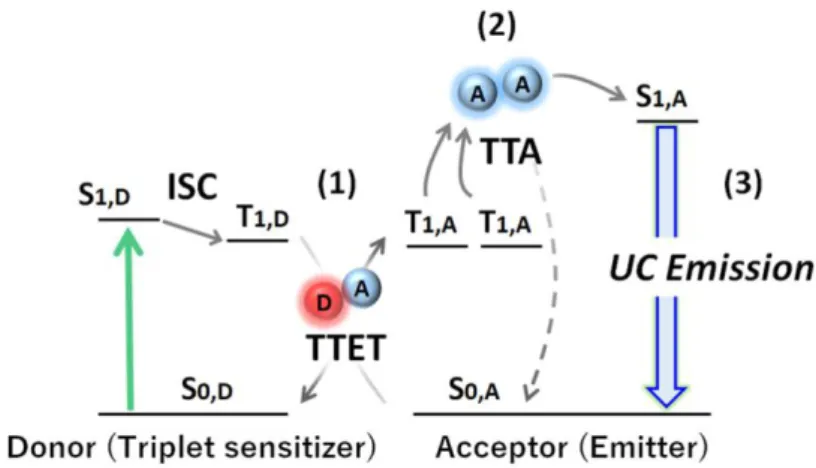
15 As illustrated in Figure 1-5, the TTA-UC mechanism starts with the generation of donor triplets (T1,D) by ISC from the photo-generated singlet state (S1,D). This triplet excited energy is transferred from donor to acceptor through TTET. Two sensitized acceptor triplets generate a higher-energy excited singlet state through TTA, which consequently produces a delayed fluorescence. The TTET and TTA processes occur by an electron-exchange (Dexter) mechanism, which requires the involved molecules to approach one another within a distance of 1 nm. The long lifetime of triplet states and relatively high absorption coefficient of the donor enable efficient energy transfer and operation under low-energy excitation light.
Figure 1-5. Schematic of the triplet-triplet annihilation-based upconversion (TTA-UC) process, showing the energy levels involved in the TTA-UC (S = singlet, T = triplet). The TTA-UC uses a pair of the donor (triplet sensitizer) with high intersystem crossing (ISC) efficiency and acceptor (emitter) with a high fluorescence quantum yield. Green and blue arrows indicate the absorption and emission processes, respectively. First, the sensitizer absorbs the low energy light to form the excited singlet state (S1,D). Second, the triplet state (T1,D) is populated through ISC. Third, triplet-triplet energy transfer (TTET) from the donor T1,D to the acceptor occurs via the Dexter mechanism. The subsequent diffusion and collision of two excited acceptor triplets (T1,A) generate a higher energy excited singlet state (S1,A) through TTA. From the excited singlet state (S1,A), the upconverted delayed fluorescence is emitted.
7
The TTA phenomenon was first observed back in the 1960s,41 but it was only recently that TTA was recognized as a deactivation process that decreases the photocurrent in organic photovoltaic devices. From the beginning of research on TTA-UC, highly efficient solution systems have been developed.1,2,4,9,42 Next, various organic donor and acceptor pairs including not only visible-to-visible but also near infrared (NIR)-to-visible or visible-to- ultraviolet (UV) TTA-UC systems have been developed.43-45 During this progresses, a novel triplet sensitization strategy was developed that has attracted much attention. This strategy aims to minimize the energy loss during ISC from S1 to T1 of triplet donor molecules, which is fatal for NIR-to-vis and vis-to-UV UC. Molecules displaying thermally activated delayed fluorescence (TADF),46-48 quantum dots and chalcogenide nanocrystals,49-54 and direct singlet- triplet (S-T) absorption metal complexes 55,56 have been employed as triplet sensitizers.57
Researchers have proposed TTA-UC-based applications (biological applications are described later). Schmidt and co-workers have reported a TTA-UC-enhanced dye-sensitized solar cell.58 A solution-based UC system is contained within an encapsulated chamber on the back of the solar cell. Hanson et al. proposed a different strategy that entailed introducing self-assembled bilayers of sensitizer and acceptor molecules on a metal oxide substrate as a step toward an electronically coupled TTA-UC solar cell.12 Castellano and colleagues revealed that it is possible to generate hydrogen using TTA-UC and Monguzzi and co- workers demonstrated enhanced performance in a photo-catalytic water-splitting cell using a TTA-UC system.59,60 In the latter case, a light upconverter was able to harvest sub-bandgap photons and inject this additional energy into the photocatalyst through efficient light UC.
In addition, Campos et al. achieved various photo-redox transformations under infrared radiation with TTA-UC materials were reported.61
As mentioned above, many triplet sensitizers and emitters have been developed and a wide variety of applications based on TTA-UC have been proposed. For practical applications, along with the conversion wavelength, excitation intensity, and quantum yield are important parameters used to characterize TTA-UC systems.
8
In general, the quantum yield is defined as the ratio of absorbed photons to emitted photons, and thus the maximum quantum yield (Φ𝑈𝐶) of the bimolecular TTA-UC process is 50%.
However, many reports multiply this value by two to set maximum efficiency at 100%. To avoid the confusion between these different definitions, the UC efficiency is written as Φ𝑈𝐶′ (= 2Φ𝑈𝐶) when its maximum is normalized to be 100%,
Φ𝑈𝐶′ = 2Φ𝑈𝐶= 𝑓Φ𝐼𝑆𝐶Φ𝑇𝑇𝐸𝑇Φ𝑇𝑇𝐴Φ𝐹,𝐴 (𝑒𝑞𝑢𝑎𝑡𝑖𝑜𝑛 1)
where Φ𝐼𝑆𝐶 , Φ𝑇𝑇𝐸𝑇 , Φ𝑇𝑇𝐴 and Φ𝐹,𝐴 represent the quantum efficiencies of donor ISC, donor-to-acceptor TTET, TTA, and acceptor fluorescence, respectively, and 𝑓 is the statistical probability of obtaining the singlet excited state after the annihilation of two triplets.2,4
The efficiency of a multi-exciton TTA process depends on the concentration of excited species; namely, the excitation intensity. From the viewpoint of practical applications, the excitation intensity is one of the most important parameters. Monguzzi and co-workers proposed a figure-of-merit parameter called the threshold excitation intensity, 𝐼𝑡ℎ, at which half of the produced triplets are used for TTA (Figure 1-6).62 𝐼𝑡ℎ is the excitation light intensity at which Φ𝑇𝑇𝐴 is 0.5, which is derived from the relationship between the UC emission intensity and the excitation light intensity.
Figure 1-6. Typical excitation intensity of upconversion in a triplet-triplet annihilation-based upconversion mechanism. (a) Upconversion emission intensity as a function of excitation intensity.
(b) Upconversion quantum yield as a function of excitation intensity.
9
At low incident light intensity, the emission from bimolecular annihilation processes exhibits quadratic dependence on the excitation intensity. In the high-energy excitation regime, the TTA process becomes dominant for emitter triplet decay, resulting in quasilinear dependence, which is derived from the following equations,62,63
𝜕𝑇𝐷
𝜕𝑡 = 𝛼𝐼𝑒𝑥𝑐− 𝑘𝐷𝑇𝑇𝐷− 𝑘𝑡𝑟𝑇𝐷 (𝑒𝑞𝑢𝑎𝑡𝑖𝑜𝑛 2 − 1)
𝜕𝑇𝐴
𝜕𝑡 = 𝑘𝑡𝑟𝑇𝐷− 𝑘𝐴𝑇𝑇𝐴− 𝛾𝑇𝑇𝐴𝑇𝐴2 (𝑒𝑞𝑢𝑎𝑡𝑖𝑜𝑛 2 − 2)
𝜕𝑆𝐴
𝜕𝑡 = 0.5𝑓𝛾𝑇𝑇𝐴𝑇𝐴2− 𝑘𝐴𝑆𝑆𝐴 (𝑒𝑞𝑢𝑎𝑡𝑖𝑜𝑛 2 − 3)
where 𝑇𝐷 and 𝑇𝐴 represents the populations of the donor (D) and acceptor (A) excited triplets, respectively, and 𝑆𝐴 is acceptor excited singlet states, 𝛼 is the absorption coefficient of the donor, and 𝐼𝑒𝑥𝑐 is excitation intensity. 𝛾𝑇𝑇𝐴 is the rate constant of the TTA, and 𝑘 is the decay rate constant, and the subscripts D and A represent donor and acceptor, respectively. At low excitation power, TTA becomes negligible with respect to the acceptor spontaneous radiative and nonradiative decay of the acceptor, which is the main triplet deactivation channel; that is, 𝑘𝐴𝑇𝑇𝐴≫ 𝛾𝑇𝑇𝐴𝑇𝐴2. (region with a blue background in Figure 1-6a).
At low excitation power, the concentration of SA in the steady state can be described as a function of the excitation intensity as follows,
𝑆𝐴= 0.2𝛾𝑇𝑇𝐴 𝑘𝐴𝑆 [
𝑘𝑡𝑟 𝑘𝐴𝑇 𝑘𝐷𝑇+ 𝑘𝑡𝑟]
2
[𝛼𝐼𝑒𝑥𝑐]2 ∝ 𝐼𝑒𝑥𝑐2 (𝑒𝑞𝑢𝑎𝑡𝑖𝑜𝑛 3)
According to equation 3, the UC emission intensity is proportional to the square of the excitation intensity; thus, the slope of their double logarithmic plots is two.
10
By contrast, in the high excitation regime, the acceptor triplet decay channel is TTA because 𝛾𝑇𝑇𝐴𝑇𝐴2 becomes larger than 𝑘𝐴𝑇𝑇𝐴 (𝛾𝑇𝑇𝐴𝑇𝐴2≫ 𝑘𝐴𝑇𝑇𝐴) (region with a red background regime in Figure 1-6a),
𝑆𝐴= 0.2 1 𝑘𝐴𝑆[ 𝑘𝑡𝑟
𝑘𝐷𝑇+ 𝑘𝑡𝑟]
2
𝛼𝐼𝑒𝑥𝑐 ∝ 𝐼𝑒𝑥𝑐 (𝑒𝑞𝑢𝑎𝑡𝑖𝑜𝑛 4)
Equation 4 shows that 𝑆𝐴 becomes proportional to the excitation intensity, that is, the slope of the double logarithmic plots becomes one. The 𝐼𝑡ℎ can be obtained from the intersection of these lines and represented by the following equation,
𝐼𝑡ℎ= 1
𝛼Φ𝑇𝑇𝐸𝑇𝛾𝑇𝑇𝐴𝜏𝐴,𝑇2 = 1
8𝜋𝑎0𝛼Φ𝑇𝑇𝐸𝑇𝐷𝑇𝜏𝐴,𝑇2 (𝑒𝑞𝑢𝑎𝑡𝑖𝑜𝑛 5)
where 𝜏𝐴 is the lifetime of the acceptor triplet and 𝛼 is the absorption coefficient of the donor. In addition, this formula can be re-expressed by replacing 𝛾𝑇𝑇𝐴 with the diffusion constant 𝐷𝑇 because 𝛾𝑇𝑇𝐴= 8𝜋𝑎0𝐷𝑇 , where 𝑎0 is the annihilation distance between emitter triplets.64 To achieve a low 𝐼𝑡ℎ value, large sensitizer absorbance, efficient TTET, fast triplet diffusion, and long emitter triplet lifetime are required.
The most efficient TTA-based UC has been achieved for donor–acceptor pairs molecularly dissolved in organic solvents because they allow fast diffusion of the excited molecules. Therefore, 𝐼𝑡ℎ with a few mW cm-2 have been achieved, which is comparable intensity to that of sunlight.
11 Oxygen quenching
There is a fatal problem in solution-state TTA-UC. As mentioned in section 1.1.2, O2 efficiently quenches triplet excited states. Consequently, traditional organic bimolecular TTA-UC systems work efficiently only in oxygen-free solutions (O2 concentration below 1 ppm).65 Quenching is mainly caused by the energy transfer between the organic molecule triplet state and ground state of O2, leading to the formation of singlet oxygen. Singlet oxygen is a highly reactive species that can oxidize the photoactive molecules, which leads to further loss of efficiency. Therefore, methods to protect triplets form O2 have been actively developed (Figure 1-7).32 There are two main types of protection strategies. One is the addition of sacrificial reducing agents (scavenger). Oleate derivatives are frequently used as an oxygen scavenger because they are common biocompatible compounds.40,66,67 Unsaturated phosphite ester,68 sulfite,69 sulfide derivatives,70 and limonene,71 have also been used as sacrificial oxygen scavengers. The second strategy is using a specific solid polymer or viscous liquid as a matrix.3,31,32 However, both approaches hinder molecular diffusion and have limited ability to improve the UC performance. (equation 5)
Figure 1-7. Chemical strategies to prevent quenching of TTA-UC by triplet or singlet oxygen. (a) Quenching of TTA-UC emission by oxygen via singlet oxygen generation. (b) Physical barrier that prevents diffusion of O2. (c) Exogeneous antioxidants quench ground-state or singlet oxygen. (d) Antioxidants are added to a nanoparticle. Adapted with permission from ref. 32, NPG.
12 TTA-UC in aqueous media
TTA-UC is a useful light conversion method for biological applications. In bioimaging, upconverted emission can be easily isolated from the excitation light and enhance the signal- to-noise ratio. In addition, deep tissue penetration is also required for imaging and phototherapy. Red or NIR light can achieve deeper tissue penetration (up to 1 cm) compared with that of green, blue or UV light (~500 μm).72 Moreover, there is a possibility that high- energy blue or UV light damages cells, whereas red and NIR are considered safer alternatives.73 In optogenetics, most proteins respond to light with a wavelength of < 500 nm.74 Considering these points, TTA-UC has great advantages because low-energy excitation with non-coherent and weak intensity can be used and higher energy light is generated.
Although most of the studies on TTA-UC have been carried out in organic media, development of TTA-UC systems that operate in aqueous media is important because such systems are expected to find interdisciplinary applications in the area of life science including bioimaging, sensing, drug delivery, and photodynamic therapy. To date, TTA-UC systems designed for use in aqueous media include polymer nanocapsules or microcapsules with an oil core,3,66,75,76 and rubbery or rigid polymer nanoparticles.65,77,78
Although the TTA-UC systems that work in aqueous media under ambient condition are limited, in vitro or in vivo demonstrations have been reported.40,66,76,79-81 Fuyou Li and co- workers demonstrated the first report of TTA-UC bioimaging in mice with singlet oxygen scavengers. They prepared nanocapsules containing reductive linoleic acid and oleic acid which have unsaturated bonds. The oxygen scavenger system enabled realization of an air- stable TTA-UC system (Figure 1-8).66
13
Figure 1-8. (a) Schematic illustration of the triplet-triplet annihilation-based upconversion (TTA-UC) process of the upconversion nanocapsules (UCNC), and chemical structures of sensitizers (PdOEP and PtTPBP) and annihilators (DPA, BODIPY derivatives). (b) a: In vivo, b: in situ, and c: ex vivo upconversion luminescence lymphatic imaging of a living mouse 30 min after injection of UCNC-G and UCNC-Y (20 μL) in fore and hind paws, respectively (λex = 635 nm, λUC = 530 ± 25 nm, excitation power density = 12.5 mW cm−2). Adapted with permission from ref. 66, ACS.
Another strategy to achieve aqueous-based TTA-UC systems is using a viscous matrix to suppress O2 diffusion. For example, Kim and co-workers have reported an UC system consisting of chromophores encapsulated in a hexadecane/polyisobutylene mixture that operates in aerated water.3,82 Monguzzi and colleagues demonstrated a micelle system loaded with hydrophobic UC dyes that worked in aerated water.83 They found that the donor concentration affected the UC efficiency. The vesicle systems reported by Bonnet et al. and König et al. were demonstrated in deaerated conditions.7,84
While these approaches allow for air-stable UC emission with reasonably high efficiency, the limited diffusion of large dye molecules in these viscous matrices is forecast to cause potential issues for further developments. Overall, these results indicated that there is currently no clear design strategy to realize efficient TTA-UC in aqueous systems.
14
The main focus of this thesis about TTA-UC is to establish air-stable aqueous TTA-UC systems and methodology to achieve oxygen tolerance in aqueous solution phase by introducing the self-assembly concept.
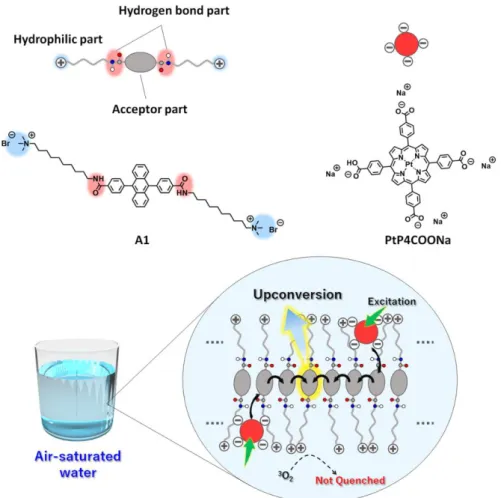
Chapter 2 describes the first example of an air-saturated aqueous triplet energy migration-based TTA-UC system. We made the assume that ordered aqueous molecular self- assemblies with extended molecular networks containing interactions such as hydrogen bonding can prevent the intrusion of O2 from the bulk water into the hydrophobic interior of the molecular assemblies. As a proof of concept, a novel amphiphilic acceptor is designed.
Co-assemblies of this acceptor with an anionic donor show efficient triplet energy migration- based TTA-UC emission in deaerated aqueous dispersions, which is largely preserved even in the air-saturated aqueous systems (Figure 1-9).
Figure 1-9. Schematic of the aqueous triplet energy migration-based TTA-UC system. The co- assembly of donor (pink) and acceptor (blue) in aerated water showed UC emission. Oxygen quenching was effectively avoided because the intermolecular hydrogen bonding networks limited oxygen diffusion in the acceptor assemblies.
15
In chapter 3, a method to avoid oxygen quenching in aqueous media is discussed (Figure 1-10). This chapter introduces a simple strategy to achieve air-stable TTA-UC in water.
Amphiphilic acceptor molecules and anions with long alkyl chains are co-assembled in water.
The assemblies with hydrophobic donor maintained 80% of their TTA-UC efficiency in aqueous dispersion compared with that under deaerated conditions. This work demonstrates the new promising potential of supramolecular chemistry to achieve photophysical and photochemical functions with oxygen-sensitive species.
Figure 1-10. Schematic illustration of the aqueous TTA-UC molecular system and its oxygen-barrier properties. Addition of anion with long alkyl chains to cationic acceptor self-assemblies produced hydrophobic ion pairs. The resultant structural transformation into dense molecular assemblies leads to interfacial supramolecular crowding, which efficiently shielded the triplet excited states from quenching by dissolved oxygen in water.
16
Since its introduction over 70 years ago,85,86 nuclear magnetic resonance (NMR) spectroscopy has established itself as one of the most widely used analytical tools in the chemical sciences, providing an element-specific and nondestructive measurement technique that is applicable to many phases. In contrast to other spectroscopic techniques, NMR experiments are performed in the MHz radio-frequency region, and the transitions between nuclear spin energy levels are quite small. Thus, the NMR experiments causes only a slight perturbation of the systems. However, the sensitivity of NMR spectroscopy is intrinsically limited by the low nuclear polarization under ambient conditions, is in accordance with Boltzmann’s law.
In the case of species with nuclear spins I = 1/2 such as 1H, 13C, 19F, and electrons, the thermal equilibrium spin polarization (𝑃𝑡ℎ) is defined by the following equation,
𝑃𝑡ℎ=𝑁 ↑ −𝑁 ↓ 𝑁 ↑ +𝑁 ↓=
𝑒𝑥𝑝 (𝛾ħ𝐵0
2𝑘𝑇) − 𝑒𝑥𝑝 (−𝛾ħ𝐵0 2𝑘𝑇) 𝑒𝑥𝑝 (𝛾ħ𝐵0
2𝑘𝑇) + 𝑒𝑥𝑝 (−𝛾ħ𝐵0
2𝑘𝑇)
= tanh (𝛾ħ𝐵0
2𝑘𝑇) (𝑒𝑞𝑢𝑎𝑡𝑖𝑜𝑛 6) where 𝑁 ↑ and 𝑁 ↓ are the populations of the eigenstates | +1
2> and | −1
2>, respectively, 𝛾 is the gyromagnetic ratio of the nuclear or electron spin, ħ is the Dirac's constant, 𝐵0 is the magnetic field, 𝑘 is the Boltzmann constant, and 𝑇 is the temperature.87
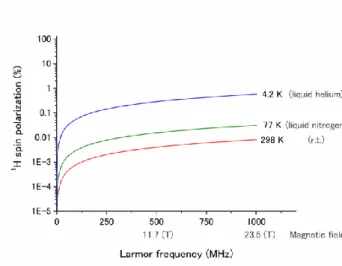
Figure 1-11. 1H spin polarization in thermal equilibrium as a function of magnetic field.
17
According to the equation 6, 1H spin polarization depends on temperature and magnetic field (Figure 1-11). We often use NMR spectroscopy to identify molecular structure at the Larmor frequency of 500 MHz (magnetic field of 11.7 T); however, 1H spin polarization value at 298 K is no more than 0.004%. Therefore, the sensitivity of NMR spectroscopy is low.
The definition of spin polarization is schematically illustrated in Figure 1-12.
Hyperpolarization means the large difference of abundance ratio between | +1
2> and | −
1
2> compared to that of the thermal equilibrium state.
Figure 1-12. Schematic illustration of the Zeeman effect and hyperpolarization.
The intensity of NMR signals can be enhanced by several orders of magnitude by using the hyperpolarization of different molecules.88 Para-hydrogen-based hyperpolarization, which is called para-hydrogen-induced polarization (PHIP) has been reported.89,90 In PHIP, the singlet order of a para-hydrogen molecule is reacted with an asymmetric unsaturated bond of a precursor molecule. Then, the symmetry of para-hydrogen is broken and observable polarization is obtained. More recently, it has been shown that para-hydrogen can be used to hyperpolarize a growing range of organic substrates by establishing of a simple and reversible interaction at a metal center. In this process, the substrate and para-hydrogen exchange freely in solution with those on the complex, and the concentration of hyperpolarized product builds up in solution as a result. This process has been termed signal amplification by reversible exchange (SABRE).91-93 Spin exchange optical pumping (SEOP) can be used to generate hyperpolarized noble gases (3He, 83Kr, and 129Xe).94,95 In particular,
129Xe is inert and easily encapsulated in cage compounds, which induces a large chemical shift. The potential of hyperpolarized noble gases as a biomarker has been demonstrated by the hyperpolarized chemical exchange saturation transfer (hyperCEST) approaches.96,97 However, this method is restricted by the limited number of substrates that can be hyperpolarized.
18
DNP is another hyperpolarization method and its basic concept was reported in 1978.98 Larsen and co-workers reported the dissolution DNP technique.99 This technique requires the presence of unpaired electrons (e.g., organic free radicals) because the thermal electron spin polarization is 660 times higher than that of 1H (equation 6). The organic free radicals are doped into a glass matrix and then polarization transfer from electrons to 1H nuclei is conducted at cryogenic temperature. Importantly, to obtain high polarization enhancement of over 660 times, very low temperature is necessary because the electron spin polarization also depends on the Boltzmann distribution. Dissolution DNP involves hyperpolarization in the solid state at around 1 K and then subsequent conversion into a liquid by rapid dissolution through heating. The development of dissolution DNP has opened up to new possibilities, such as analysis of protein by proton exchange.100-106 However, the dissolution DNP technique has intrinsic problems. One is that extremely low temperature is essential in order to generate hyperpolarization. Second, the resolution of NMR spectroscopy can be degraded by the presence of paramagnetic species.107 Finally, the spin-lattice relaxation time (T1) of a glassy matrix is generally short compared to that of crystals.108,109 However, matrix vitrification of matrix is needed to solubilize the polarizing agent and substrates.
19
A solution to these issues has been proposed that involves using thermal non-equilibrium electron spin polarization in photo-excited triplet states, which is called triplet DNP. Large electron spin polarization in the excited triplet state sublevels is produced regardless of temperature and magnetic field (Figure 1-13),110 and the paramagnetic species (triplet excited state) is deactivated on the microsecond time scale. A typical scheme of triplet DNP is shown in Figure 1-14.
Figure 1-13. Nuclear spin polarization in thermal equilibrium under a magnetic field in 11.7 T as a function of temperature. The blue line represents the thermal non-equilibrium triplet state of pentacene.
20
Figure 1-14. Typical scheme of triplet-DNP. Photo-excitation of a polarizing agent is followed by spin-selective intersystem crossing (ISC). The resulting large electron spin polarization is transferred to the nuclear spin polarization through the integrated solid effect (ISE).
A triplet polarizing agent absorbs excitation light and the subsequent spin-selective ISC generates the large electron spin polarization in the triplet excited state sublevels. This polarization is effectively transferred to the nuclear spins by the integrated solid effect (ISE), followed by polarized spin diffusion to the bulk.111,112 To induce the ISE, a field sweep and microwave irradiation near the transition frequency between the triplet sublevels are simultaneously applied. The inhomogeneously-broadened triplet spins are adiabatically swept to transfer the hyperpolarization. Finally, the signal enhancement is achieved.
Enhancement factor and spin polarization
The enhancement factor (ε) of triplet-DNP was calculated by comparing the integrated intensities of the hyperpolarized 1H NMR signal of each sample after a triplet-DNP sequence with the 1H NMR signal of reference sample in thermal equilibrium,113
ε = 𝑁𝑟𝑒𝑓 𝑁𝐷𝑁𝑃
𝑇𝐷𝑁𝑃 𝑇𝑟𝑒𝑓
𝑔𝑟𝑒𝑓 𝑔𝐷𝑁𝑃
𝐸𝐷𝑁𝑃
𝐸𝑟𝑒𝑓 (𝑒𝑞𝑢𝑎𝑡𝑖𝑜𝑛 7) where N is the number of 1H spins, 𝑇 is temperature, and 𝑔 is the receiver gain, and 𝐸 is the recorded signal voltage. The 1H spin polarization (P) was also determined by
𝑃 = ε tanh𝛾ℏ𝐵
2𝑘𝑇 (𝑒𝑞𝑢𝑎𝑡𝑖𝑜𝑛 8) where 𝛾 , ℏ , 𝐵 , 𝑘 , and 𝑇 are the gyromagnetic ratio, reduced Planck constant, magnetic field, Boltzmann constant, and temperature, respectively.
21 Buildup behavior
The buildup behavior of 1H spin polarization is shown in Figure 1-15 and given by the following equation,113
𝑑𝑃𝐻(𝑡)
𝑑𝑡 = 1
𝑇𝐵[𝑃𝑒− 𝑃𝐻(𝑡)] + 1
𝑇1[𝑃𝐻(𝑡) − 𝑃𝐻 𝑡ℎ𝑒𝑟𝑚𝑎𝑙] (𝑒𝑞𝑢𝑎𝑡𝑖𝑜𝑛 9) where 𝑃𝐻, 𝑃𝑒, 𝑃𝐻 𝑡ℎ𝑒𝑟𝑚𝑎𝑙, 𝑡, 𝑇𝐵, and 𝑇1 are the spin polarization of 1H, the spin polarization of electrons in the photo-excited triplet state, the spin polarization of 1H in the thermal equilibrium state, time, the buildup rate constant and spin-lattice relaxation time, respectively. 𝑃𝐻 𝑡ℎ𝑒𝑟𝑚𝑎𝑙 was negligible (0.0002%) at 298 K and in 0.68 T. Equation 9 was solved as
𝑃𝐻(𝑡) = 𝑃𝑓{1 − 𝑒𝑥𝑝 [− (1 𝑇𝐵+ 1
𝑇1)] 𝑡} (𝑒𝑞𝑢𝑎𝑡𝑖𝑜𝑛 10) and 𝑃𝑓 is defined by
𝑃𝑓= 1 1 +𝑇𝐵
𝑇1
𝑃𝑒 (𝑒𝑞𝑢𝑎𝑡𝑖𝑜𝑛 11)
For simplification, in some cases the buildup curve is fitted by A[1-exp(-t/T)] + B. Importantly, these equations are completed considering the fast diffusion limit condition. That is, the 1H spin diffusion rate is much faster than the feasible triplet-DNP repetition rate.87
Figure 1-15. Buildup curve of the nuclear spin polarization. The broken line is a fitting curve with the following equation, A[1-exp(-t/T)] + B.
22
Hawser and co-workers demonstrated the first triplet-DNP systems.114,115 In 1990, Wenchebach et al. published a breakthrough report with an ISE sequence at room temperature.16 They used pentacene as a triplet polarizing agent and naphthalene as a matrix and enhanced the naphthalene 1H polarization by 5500 times. Since the first report of room- temperature triplet-DNP, only pentacene and pentacene derivatives have been used as triplet polarizing agents, whereas a number of matrixes have been developed.16,18,20,21,87,113,116
Despite its potential, the application of triplet-DNP has been limited by the instability of the pentacene skeleton under the ambient conditions.117,118 Therefore, doping in an air-stable solid matrix or deoxygenated conditions is necessary at present. From the viewpoint of analysis related to biomolecules, an environment close to that of living cells is desirable;119 in other words, generation of hyperpolarization in aqueous media (pure water or buffer).
Tateishi and co-workers have been reported 1H hyperpolarization of water molecules at 90 K by employing glassy matrix composed of ethanol-d6 : water = 80:20 (v/v) doped with 0.1 mM of 6,13-diphenylpentacene.21 However, it was difficult to increase the proportion of water because of the aggregation of triplet polarizing agents. To date, triplet-DNP research has mainly focused on clarifying the basics of this phenomenon; the design and synthesis of novel triplet polarizing agents have not been reported.
23
The research presented in this thesis concentrates mainly on the development of novel triplet polarizing agents for triplet DNP as first step. Then, to establish aqueous triplet DNP systems, the molecular design of water-soluble triplet polarizing agents is discussed.
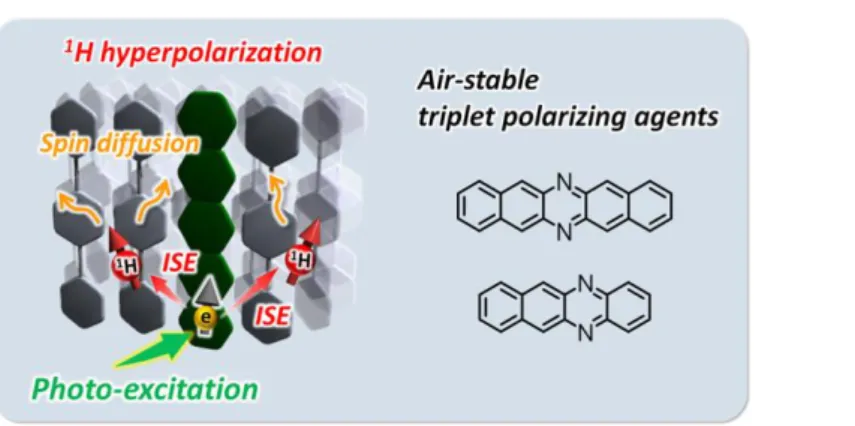
Chapter 4 describes the potential of diaza-substituted acenes as air-stable and high- performance triplet polarizing agents (Figure 1-16). The introduction of electron- withdrawing diaza substituents onto pentacene and tetracene lowers the lowest unoccupied molecular orbital level and provides much improved stability under the ambient conditions.
Importantly, the diaza-substituted pentacene and tetracene offer similar, or even slightly better, 1H NMR signal enhancement to that of pentacene in a prototypical triplet-DNP test using p-terphenyl crystals. This work removes one of the largest obstacles in the use of triplet-DNP for the hyperpolarization of biological molecules.
Figure 1-16. Schematic illustration of the triplet-DNP system and the chemical structure of triplet- DNP polarizing agents.
24
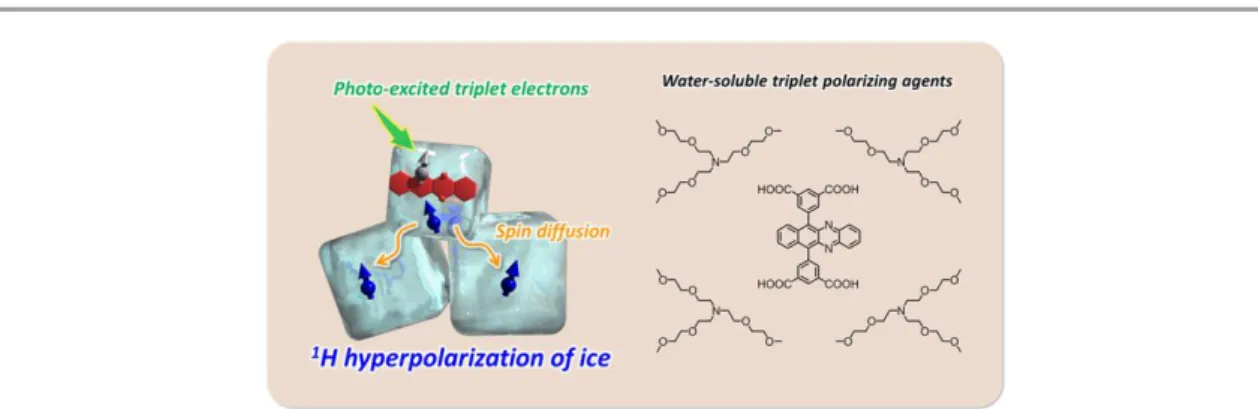
In chapter 5, we demonstrated the first example of 1H NMR signal enhancement in crystalline ice by triplet DNP with a novel water-soluble triplet polarizing agent which has carboxylic acid functionalities (Figure 1-17). The ion-pairing of a triplet polarizing agent with carboxylic acid groups and hydrophilic and bulky amine is a simple method to achieve dispersibility even in an ice matrix. This concept of hyperpolarization in ice provides an important initial step towards the hyperpolarization of various biomolecules in water and even in vivo.
Figure 1-17. Schematic illustration of hyperpolarization by triplet-DNP in a pure ice state.
25
Modern chemistry offers the advantage of enabling the design of a variety of molecular units, thus appropriate molecular design opens up possibilities to achieve materialization. And one of the most promising method to realize functions is self-assembly. In self-assembly, molecules spontaneously organize into ordered assemblies driven by non-covalent intermolecular forces.
Water has unique properties and is an excellent solvent for not only small and polar molecules but also solutes such as oxygen, amino acids, and proteins. Water participates in strong interactions, forming hydrogen bonds with other molecules including water molecules. A molecular design to suppress the strong hydrogen bonding between water molecules is necessary to expand the applications of functional materials into aqueous media.
In particular, it is important to control the interfaces between water and functional molecules to establish functional materials. In this thesis, the concept of developing self-assembled molecular systems with the ability to work in aqueous media is investigated.
26
(1) Baluschev, S.; Miteva, T.; Yakutkin, V.; Nelles, G.; Yasuda, A.; Wegner, G. Phys. Rev. Lett. 2006, 97, 143903.
(2) Singh-Rachford, T. N.; Castellano, F. N. Coord. Chem. Rev. 2010, 254, 2560-2573.
(3) Kim, J.-H.; Kim, J.-H. J. Am. Chem. Soc. 2012, 134, 17478-17481.
(4) Monguzzi, A.; Tubino, R.; Hoseinkhani, S.; Campione, M.; Meinardi, F. Phys. Chem. Chem. Phys. 2012, 14, 4322-4332.
(5) Simon, Y. C.; Weder, C. J. Mater. Chem. 2012, 22, 20817-20830.
(6) Börjesson, K.; Dzebo, D.; Albinsson, B.; Moth-Poulsen, K. J. Mater. Chem. A 2013, 1, 8521-8524.
(7) Askes, S. H. C.; Bahreman, A.; Bonnet, S. Angew. Chem. Int. Ed. 2014, 53, 1029-1033.
(8) Schulze, T. F.; Schmidt, T. W. Energy Environ. Sci. 2015, 8, 103-125.
(9) Zhou, J.; Liu, Q.; Feng, W.; Sun, Y.; Li, F. Chem. Rev. 2015, 115, 395-465.
(10) Yanai, N.; Kimizuka, N. Chem. Commun. 2016, 52, 5354-5370.
(11) Fan, C.; Wu, W.; Chruma, J. J.; Zhao, J.; Yang, C. J. Am. Chem. Soc. 2016, 138, 15405-15412.
(12) Hill, S. P.; Hanson, K. J. Am. Chem. Soc. 2017, 139, 10988-10991.
(13) Huang, Z.; Tang, M. L. J. Am. Chem. Soc. 2017, 139, 9412-9418.
(14) Han, J.; Jiang, Y.; Obolda, A.; Duan, P.; Li, F.; Liu, M. J. Phys. Chem. Lett. 2017, 8, 5865-5870.
(15) Xu, W.; Liang, W.; Wu, W.; Fan, C.; Rao, M.; Su, D.; Zhong, Z.et al. Chem. - Eur. J. 2018, 24, 16677-16685.
(16) Henstra, A.; Lin, T.-S.; Schmidt, J.; Wenckebach, W. T. Chem. Phys. Lett. 1990, 165, 6-10.
(17) Iinuma, M.; Takahashi, Y.; Shaké, I.; Oda, M.; Masaike, A.; Yabuzaki, T.; Shimizu, H. M. J. Magn. Reson. 2005, 175, 235-241.
(18) Tateishi, K.; Negoro, M.; Kagawa, A.; Kitagawa, M. Angew. Chem. Int. Ed. 2013, 52, 13307-13310.
(19) Tateishi, K.; Negoro, M.; Nishida, S.; Kagawa, A.; Morita, Y.; Kitagawa, M. Proc. Natl. Acad. Sci. USA 2014, 111, 7527-7530.
(20) Negoro, M.; Kagawa, A.; Tateishi, K.; Tanaka, Y.; Yuasa, T.; Takahashi, K.; Kitagawa, M. J. Phys. Chem. A 2018, 122, 4294- 4297.
(21) Tateishi, K.; Negoro, M.; Nonaka, H.; Kagawa, A.; Sando, S.; Wada, S.; Kitagawa, M.et al. Phys. Chem. Chem. Phys. 2019, 21, 19737-19741.
(22) Smith, M. B.; Michl, J. Chem. Rev. 2010, 110, 6891-6936.
(23) Walker, B. J.; Musser, A. J.; Beljonne, D.; Friend, R. H. Nat. Chem. 2013, 5, 1019-1024.
(24) Chen, S.; Deng, L.; Xie, J.; Peng, L.; Xie, L.; Fan, Q.; Huang, W. Adv. Mater. 2010, 22, 5227-5239.
(25) Uoyama, H.; Goushi, K.; Shizu, K.; Nomura, H.; Adachi, C. Nature 2012, 492, 234-238.
(26) Doherty, M. W.; Manson, N. B.; Delaney, P.; Jelezko, F.; Wrachtrup, J.; Hollenberg, L. C. L. Phys. Rep. 2013, 528, 1-45.
(27) Schirhagl, R.; Chang, K.; Loretz, M.; Degen, C. L. Annu. Rev. Phys. Chem. 2014, 65, 83-105.
(28) Nicholas J. Turro; Ramamurthy, V.; Scaiano, J. C. Modern Molecular Photochemistry of Organic Molecules; University Science Books, U.S.: Sausalito, California, 2010.
(29) Dam, N.; Keszthelyi, T. s.; Andersen, L. K.; Mikkelsen, K. V.; Ogilby, P. R. J. Phys. Chem. A 2002, 106, 5263-5270.
(30) Schweitzer, C.; Schmid, R. Chem. Rev. 2003, 103, 1685−1757.
(31) Filatov, M. A.; Baluschev, S.; Landfester, K. Chem. Soc. Rev. 2016, 45, 4668-4689.
27
(32) Askes, S. H. C.; Bonnet, S. Nat. Rev. Chem. 2018, 2, 437-452.
(33) S. P. McGlynn; T. Azumi; Kinoshita, M. Molecular spectroscopy of the triplet state; Prentice-Hall, U.S.: Englewood cliffs, New Jersey, 1969.
(34) Bayliss, S. L.; Kraffert, F.; Wang, R.; Zhang, C.; Bittl, R.; Behrends, J. J. Phys. Chem. Lett. 2019, 10, 1908-1913.
(35) Helmchen, F.; Denk, W. Nat. Methods 2005, 2, 932-940.
(36) Pawlicki, M.; Collins, H. A.; Denning, R. G.; Anderson, H. L. Angew. Chem. Int. Ed. 2009, 48, 3244-3266.
(37) Auzel, F. Chem. Rev. 2004, 104, 139−173.
(38) Wang, F.; Liu, X. Chem. Soc. Rev. 2009, 38, 976-989.
(39) Wang, F.; Banerjee, D.; Liu, Y.; Chen, X.; Liu, X. Analyst 2010, 135, 1839-1854.
(40) Huang, L.; Zhao, Y.; Zhang, H.; Huang, K.; Yang, J.; Han, G. Angew. Chem. Int. Ed. 2017, 56, 14400-14404.
(41) Parker, C. A.; Hatchard, C. G.; Joyce, T. A. Nature 1965, 205, 1282-1284.
(42) Zhao, J.; Ji, S.; Guo, H. RSC Adv. 2011, 1, 937-950.
(43) Yakutkin, V.; Aleshchenkov, S.; Chernov, S.; Miteva, T.; Nelles, G.; Cheprakov, A.; Baluschev, S. Chem. - Eur. J. 2008, 14, 9846-9850.
(44) Singh-Rachford, T. N.; Nayak, A.; Muro-Small, M. L.; Goeb, S.; Therien, M. J.; Castellano, F. N. J. Am. Chem. Soc. 2010, 132, 14203–14211
(45) Duan, P.; Yanai, N.; Kimizuka, N. Chem. Commun. 2014, 50, 13111-13113.
(46) Wu, T. C.; Congreve, D. N.; Baldo, M. A. Appl. Phys. Lett. 2015, 107, 031103.
(47) Yanai, N.; Kozue, M.; Amemori, S.; Kabe, R.; Adachi, C.; Kimizuka, N. J. Mater. Chem. C 2016, 4, 6447-6451.
(48) Chen, Q.; Liu, Y.; Guo, X.; Peng, J.; Garakyaraghi, S.; Papa, C. M.; Castellano, F. N.et al. J. Phys. Chem. A 2018, 122, 6673- 6682.
(49) Huang, Z.; Li, X.; Mahboub, M.; Hanson, K. M.; Nichols, V. M.; Le, H.; Tang, M. L.et al. Nano. Lett. 2015, 15, 5552-5557.
(50) Okumura, K.; Mase, K.; Yanai, N.; Kimizuka, N. Chem. - Eur. J. 2016, 22, 7721-7726.
(51) Wu, M.; Congreve, D. N.; Wilson, M. W. B.; Jean, J.; Geva, N.; Welborn, M.; Van Voorhis, T.et al. Nat. Photonics 2016, 10, 31-34.
(52) Mongin, C.; Garakyaraghi, S.; Razgoniaeva, N.; Zamkov, M.; Castellano, F. N. Science 2016, 351, 369-372.
(53) Mase, K.; Okumura, K.; Yanai, N.; Kimizuka, N. Chem. Commun. 2017, 53, 8261-8264.
(54) Nienhaus, L.; Correa-Baena, J.-P.; Wieghold, S.; Einzinger, M.; Lin, T.-A.; Shulenberger, K. E.; Klein, N. D.et al. ACS Energy Lett. 2019, 4, 888-895.
(55) Amemori, S.; Sasaki, Y.; Yanai, N.; Kimizuka, N. J. Am. Chem. Soc. 2016, 138, 8702-8705.
(56) Sasaki, Y.; Amemori, S.; Kouno, H.; Yanai, N.; Kimizuka, N. J. Mater. Chem. C 2017, 5, 5063-5067.
(57) Yanai, N.; Kimizuka, N. Acc. Chem. Res. 2017, 50, 2487-2495.
(58) Nattestad, A.; Cheng, Y. Y.; MacQueen, R. W.; Schulze, T. F.; Thompson, F. W.; Mozer, A. J.; Fückel, B.et al. J. Phys. Chem.
Lett. 2013, 4, 2073-2078.
(59) Monguzzi, A.; Oertel, A.; Braga, D.; Riedinger, A.; Kim, D. K.; Knusel, P. N.; Bianchi, A.et al. ACS Appl. Mater. Interfaces 2017, 9, 40180-40186.
28
(60) Khnayzer, R. S.; Blumhoff, J.; Harrington, J. A.; Haefele, A.; Deng, F.; Castellano, F. N. Chem. Commun. 2012, 48, 209-211.
(61) Ravetz, B. D.; Pun, A. B.; Churchill, E. M.; Congreve, D. N.; Rovis, T.; Campos, L. M. Nature 2019, 565, 343-346.
(62) Monguzzi, A.; Mezyk, J.; Scotognella, F.; Tubino, R.; Meinardi, F. Phys. Rev. B 2008, 78, 195112.
(63) Haefele, A.; Blumhoff, J.; Khnayzer, R. S.; Castellano, F. N. J. Phys. Chem. Lett. 2012, 3, 299-303.
(64) Jortner, J.; Choi, S.-i.; Katz, J. L.; Rice, S. A. Phys. Rev. Lett. 1963, 11, 323-326.
(65) Monguzzi, A.; Frigoli, M.; Larpent, C.; Tubino, R.; Meinardi, F. Adv. Funct. Mater. 2012, 22, 139-143.
(66) Liu, Q.; Yin, B.; Yang, T.; Yang, Y.; Shen, Z.; Yao, P.; Li, F. J. Am. Chem. Soc. 2013, 135, 5029-5037.
(67) Mongin, C.; Golden, J. H.; Castellano, F. N. ACS Appl. Mater. Interfaces 2016, 8, 24038-24048.
(68) Marsico, F.; Turshatov, A.; Pekoz, R.; Avlasevich, Y.; Wagner, M.; Weber, K.; Donadio, D.et al. J. Am. Chem. Soc. 2014, 136, 11057-11064.
(69) Askes, S. H. C.; Mora, N. L.; Harkes, R.; Koning, R. I.; Koster, B.; Schmidt, T.; Kros, A.et al. Chem. Commun. 2015, 51, 9137- 9140.
(70) Dzebo, D.; Moth-Poulsen, K.; Albinsson, B. Photochem. Photobiol. Sci. 2017, 16, 1327-1334.
(71) Ma, J.; Chen, S.; Ye, C.; Li, M.; Liu, T.; Wang, X.; Song, Y. Phys. Chem. Chem. Phys. 2019, 21, 14516-14520.
(72) Plaetzer, K.; Krammer, B.; Berlanda, J.; Berr, F.; Kiesslich, T. LIMS 2009, 24, 259-268.
(73) Hopkins, S. L.; Siewert, B.; Askes, S. H.; Veldhuizen, P.; Zwier, R.; Heger, M.; Bonnet, S. Photochem. Photobiol. Sci. 2016, 15, 644-653.
(74) Kim, C. K.; Adhikari, A.; Deisseroth, K. Nat. Rev. Neurosci. 2017, 18, 222-235.
(75) Kim, J.-H.; Deng, F.; Castellano, F. N.; Kim, J.-H. Chem. Mater. 2012, 24, 2250-2252.
(76) Kwon, O. S.; Song, H. S.; Conde, J.; Kim, H. I.; Artzi, N.; Kim, J. H. ACS Nano 2016, 10, 1512-1521.
(77) Simon, Y. C.; Bai, S.; Sing, M. K.; Dietsch, H.; Achermann, M.; Weder, C. Macromol. Rapid Commun. 2012, 33, 498-502.
(78) Thévenaz, D. C.; Monguzzi, A.; Vanhecke, D.; Vadrucci, R.; Meinardi, F.; Simon, Y. C.; Weder, C. Mater. Horiz. 2016, 3, 602- 607.
(79) Nagai, A.; Miller, J. B.; Kos, P.; Elkassih, S.; Xiong, H.; Siegwart, D. J. ACS Biomater. Sci. Eng. 2015, 1, 1206-1210.
(80) Askes, S. H.; Pomp, W.; Hopkins, S. L.; Kros, A.; Wu, S.; Schmidt, T.; Bonnet, S. Small 2016, 12, 5579-5590.
(81) Park, J.; Xu, M.; Li, F.; Zhou, H. C. J. Am. Chem. Soc. 2018, 140, 5493-5499.
(82) Kim, J.-H.; Deng, F.; Castellano, F. N.; Kim, J.-H. ACS Photonics 2014, 1, 382-388.
(83) Mattiello, S.; Monguzzi, A.; Pedrini, J.; Sassi, M.; Villa, C.; Torrente, Y.; Marotta, R.et al. Adv. Funct. Mater. 2016, 26, 8447- 8454.
(84) Poznik, M.; Faltermeier, U.; Dick, B.; König, B. RSC Adv. 2016, 6, 41947-41950.
(85) Carver, T. R.; Slichter, C. P. Phys. Rev. 1953, 92, 212-213.
(86) Overhauser, A. W. Phys. Rev. 1953, 92, 411-415.
(87) Takeda, K. Triplet State Dynamic Nuclear Polarization; VDM Verlag Dr. Müeller: Saarbrücken, Germany, 2009.
(88) Kovtunov, K. V.; Pokochueva, E. V.; Salnikov, O. G.; Cousin, S. F.; Kurzbach, D.; Vuichoud, B.; Jannin, S.et al. Chem. - Asian J.
2018, 13, 1857 –1871.
(89) Bowers, C. R.; Weitekamp, D. P. Phys. Rev. Lett. 1986, 57, 2645-2648.

![Figure 1-15. Buildup curve of the nuclear spin polarization. The broken line is a fitting curve with the following equation, A[1-exp(-t/T)] + B](https://thumb-ap.123doks.com/thumbv2/123deta/9810181.1885857/30.892.272.625.717.993/figure-buildup-nuclear-polarization-broken-fitting-following-equation.webp)

![Figure 2-7. (a) Chemical structure of A2. (b) Temperature-dependent absorption spectra of A2 in water ([A2] = 1 mM)](https://thumb-ap.123doks.com/thumbv2/123deta/9810181.1885857/55.892.196.701.180.568/figure-chemical-structure-temperature-dependent-absorption-spectra-water.webp)