?Immersive Exhibition? at Public Aquariums from the 19th to the 21st Century
著者 Mizoi Yuichi
journal or
publication title
關西大學文學論集
volume 66
number 3
page range 79‑122
year 2016‑12‑10
URL http://hdl.handle.net/10112/10772
from the 19 to the 21 Century
Yuichi Mizoi
Introduction
This paper aims to trace the history of the 'immersive exhibition' at public aquariums from the 19th to the 21st century, with reference to technological developments as well as the social and cultural background of these exhibits.
We also take a look at what these kinds of exhibitions might look like in the near future.
The immersive exhibition is a type of exhibition which creates a sense of immersion for viewers, making them feel as if they are standing within the aquatic world. Acrylic underwater tunnels are typical of these kinds of exhibitions: walking through the tunnel and watching sharks swimming overhead, visitors are fascinated by the simulated diving experience.
In contrast to a zoological garden, where visitors may be satisfied by just walking through the geographically distributed areas and watching the animals, the aquarium displays animals living in an aquatic world beneath the surface of the water or inhabiting a world that is regarded as quite different from ours. Thus, visitors to an aquarium expect to experience a mysterious other world without getting soaking wet.
Designers of aquariums, or aquarists, have therefore attempted to display realistic 'oceans' on land by applying the latest materials and technology.
However, these efforts comprise a combination of natural and cultural
elements, and the latter have steadily undergone changes in each historical period. The popularity of the grotto motif, the panorama or the motion picture was reflected in the design of aquariums in the 19th and 20th centuries. Today, virtual reality (VR) technology seems to be opening up new horizons for aquarium exhibitions.
In this paper, we also consider the 'reality' presented by aquarium exhibitions. The simulated seascape cannot seem 'realistic' unless it meets visitors' expectations. Therefore, aquarists have over time tried to reconstruct 'oceans' so that visitors would feel as if the exhibition were 'real'.
The first section of this paper focuses on the features of early immersive exhibitions from the 19th to the beginning of the 20th century, comparing them with other visual cultural forms, such as the panorama. The second section treats aquariums from the 20th century to the beginning of the 21st century.
We have selected here representative aquariums in Western and Eastern countries and analyse their exhibition styles. In the last section, which features the advent of new exhibitions that apply VR technology, we concisely discuss the exhibition that may appear in the near future.
1. Immersive Exhibitions at Early Aquariums
1.1. ʻThe Light of Magicʼ at the Aquarium at the Bois de Boulogne
The history of public aquariums began with the opening of the 'Fish House'
(1853), a greenhouse-like building at the London Zoo, Regent's Park. Its initiator was Philip Henry Gosse (1810-88), one of the contributors to the effort to keep saltwater fish alive and also the disseminator of the term
'aquarium' to mean fish tanks.1)
The exhibition style of the Fish House was simple: rows of tanks were installed along walls and on desks, and each one contained an underwater scene. Other English aquariums, such as the Crystal Palace Aquarium
(1871), the Brighton Aquarium (1872) and the Royal Aquarium Westminster (1876), later made use of this 'constructive simplicity'.2) While British aquarists persisted with the functional display of tanks, new styles of exhibitions were proposed mainly in France and Germany.3)
An early representative of the 'Continental exhibitions' was the aquarium at the Jardin Zoologique d'Acclimatation (1860, Fig. 1) at the Bois de Boulogne, Paris. Although it may seem to be another example of a simple exhibition with rows of tanks, lighting and the 'gurgling' of water, it
'contribute[d] to heightening the illusion and transporting us to another world'.4) According to a reporter for the Revue Britannique, the exhibition at the Fish House was 'defective' because light streamed from all directions into the tank and made it difficult to watch the animals among countless shadows.
But, he said, '[i]f you enter this long gallery [at the Jardin Zoologique d' Acclimatation] for the first time, it will make a great impression on your imagination through the fantastic mystery of the green twilight, which should be like that of the ocean'.5) In this aquarium, the light streamed into the tanks from above, through the tanks and into the dark hall. This was, we might
Fig. 1 The aquarium at the Jardin Zoologique dʼAcclimatation (Harter, Ursula.
. Heidelberg: Kehrer, 2014, p. 58)
say, the beginning of the immersive exhibition at the aquarium.
As the reporter wrote, the aquarium at the Jardin Zoologique d' Acclimatation was similar to a gallery, and scenes behind rectangular glass panels seemed like 'living pictures'.6)
These glass panels may also be described as 'windows' that show seascapes. In her study on the home aquarium, Judith Hamera considers the familiar aspects of the aquarium, that is, the picture and the window:
Anne Friedberg argues that windows served as metaphors for the rectangular frame of the picture plane; the 'modern function of the window is to frame a view'. The aquarium engaged its viewers through their familiarity with both the window and the picture. Like the window, the clear tank front functioned as a 'membrane' between inside and outside.' Isobel Armstrong observes that 'glass is an antithetical medium.
It holds contrary states within itself as barrier and medium'.7)
The comparison made here of the glass panels of tanks with pictures and windows further makes it possible to consider the scenes provided by the aquarium as simultaneously two- and three-dimensional. The inhabitants in the tanks are three-dimensional, but they can be interpreted as two- dimensional images on a glass screen. Therefore, since the 19th century, aquarium designers have sought to reduce the two-dimensionality of their exhibitions to create a sense of immersion for the viewer. Frames and walls around glass panels came to be obscured as much as possible, too, because these features detracted from the natural aspects of the aquariums, emphasizing their picture-like character and making visitors feel as if they were watching a piece of scenery rather than standing in the ocean.
Furthermore, the aquarium may be compared with the theatre, as Hamera
suggests. A person attending the theatre does not act on the stage, but he or she is a viewer as well as a part of the scene. Quoting Ann Blair's words from The Theater of Nature ‘the spectator is […] ambiguously both [the] ( observer and participant in nature’), she writes: 'The word ambiguously is the key to this description, for this spectatorial liminality […] [italics in original].' 8) Like the viewer of a dramatic work, the viewer of an aquarium or panorama, as described below, becomes part of the scene on display and experiences a sense of traveling through foreign areas.9) However, the theatre is not only comparable to a home or a public aquarium but also to the animal performance venue in the 20th century, as we argue in the second section.
1.2. The Cavern and the Panoramic Exhibition at French and German Aquariums
Although the gallery style of the aquarium at the Jardin Zoologique d' Acclimatation was adopted by the Crystal Palace Aquarium, the grotto decoration introduced by other French and German aquariums was despised by the English.10) As a writer for the Deutsche Bauzeitung observed, the artificial grotto itself was not new. It had been built from the ancient to the Renaissance periods and was also a favourite motif of the English garden in the 18th century.11) At the end of that century, as Ursula Harter notes, the natural cave was compared with a palace, temple or church and regarded as a kind of hermaphrodite of natural and artificial work. In particular, a cave which reached down into the depths of water seemed 'the appropriate stage for the spectacle of underwater fauna and flora'.12) Fingal's Cave on the island Staffa, Scotland, is representative of this kind (Fig. 2). After the botanist Joseph Banks visited it in 1772, its wildness came to be appreciated in the Romantic period and attracted people like William Wordsworth, Felix
Mendelssohn and Jules Verne.13)
The idea of decorating an aquarium with a grotto motif was substantialised by architect Wilhelm Lüer (1834-70) who constructed the aquarium in Hannover (das Egestorff'sche Aquarium, 1865). The grotto-style exhibition had the advantage of providing a natural appearance to the frames and walls.
It was also adopted by two aquariums (a freshwater aquarium and a seawater aquarium) for the International Exposition in Paris (1867).14) At the freshwater aquarium, visitors walked through the cavernous hall and
Fig. 3 The freshwater aquarium at the International Exposition in Paris (Harter 2014, p. 66)
Fig. 2 Fingalʼs Cave (Photographed by the author. July 2016)
watched fish swimming in tanks installed among rocks (Fig. 3). The saltwater aquarium included, however, something more special. After walking through a passage decorated with stalactites and stalagmites, visitors entered a huge tank on the first floor (Fig. 4).15) Here, they could see animals swimming not only on each side of them but also overhead. It is clear what the planner, named Guérand, had intended: he was attempting to
Fig. 4 The seawater aquarium at the International Exposition in Paris, 1867 ( ' . 21 September 1867, p. 604)
Fig. 5 The panorama designed by Robert Barker (Zonca, Serena. ʻVirtual Storytelling.ʼ . 2014. 19 July 2016 <http://www.autopubblicarsi.it/nuova̲
edtoria/virtual-storytelling/>)
increase the feeling of immersion, just like the panorama in the 18th and 19th centuries had done.
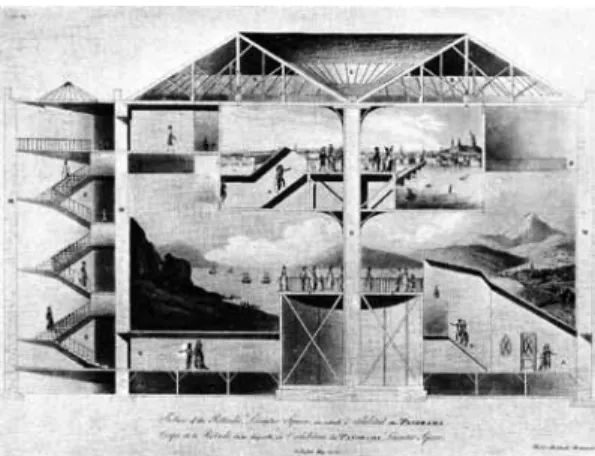
The panorama, devised by Robert Barker, provided a 360-degree view thanks to a large painting which was attached to the inside wall(s) of a cylindrical building. Following his programme, visitors came through the entrance, climbed stairs to a platform, saw a panoramic landscape lit by the sunlight streaming into the building from above and felt as if they were in another realm (Fig. 5). All elements that might distract from the illusion were carefully concealed or removed. For instance, the building's skylight was hidden by a canopy hanging above the platform.16) In Barker's building, the aim was for the 360-degree view not to contain any sort of 'frames'.17)
The saltwater aquarium at the International Exposition was an underwater version of the panorama. The glass panels functioned like the curved painting, and if they performed as (the planner) intended, visitors could feel as if they were standing in the ocean. Furthermore, the images (fish and plants) were moving!
Unfortunately, technology was not developed enough to enable this ambitious plan to be carried out. Ernst Friedel wrote about several failures.
For instance, it was very difficult to ventilate the auditorium, and not enough saltwater was supplied at the beginning, so therefore it was mixed with freshwater and this was also not filtered enough. As a result, the mortality of the animals was high. Fish on the ceiling also seemed to be uncomfortable because they could not lie on the sand, and the water was not clear.18)
Let us go back to the cavern decoration. The designer of the aquarium at the Havre International Maritime Exhibition (1868) adopted it again, and its exterior was also shaped just like Fingal's Cave (Fig. 6). A reporter for the Illustrated London News commented, '[t]his is the aquarium, where, in a series of tanks or cisterns, set amidst artificial rocks, is an extensive and
various collection of all species of fish, marine reptiles and insects, and sea plants of every kind'.19)
The Berliner Aquarium (1869, Fig. 7, 8) was pre-eminent in putting on an immersive exhibition with a grotto motif in the 19th century. It was initiated by Alfred Brehm (1829-84) and his associates, designed by the above- mentioned Lüer and built at the corner of Unter den Linden and Schadowstraße. Lüer insisted on using natural materials for the grotto (granite from Oker- und Radau-Tal, basalt from Siebengebirge, stalactites from Thüringen and so on)20) and tried to harmonize them with artificial materials.
The two-storey aquarium was inhabited by reptiles, birds, mammals and fish, and afforded visitors an opportunity to 'travel' through the terrestrial as well as the underwater world. Visitors climbed stairs at first and entered the upper floor of the aquarium, then walked along a one-way path to watch desert reptiles. After leaving this area, they came to the first grotto, which extended to the lower floor, and to the octagonal aviary. Here visitors could look at Asian, African, Australian, American and European birds that Fig. 6 The aquarium at the Havre International Maritime Exhibition (Harter 2014, p. 70)
Fig. 7 The Berliner Aquarium (F. Das Aquarium zu Berlin. Architekten-Verein zu Berlin, ed. . Vol. 3. Berlin: Kommissions Verlag, 1869, p. 232)
Fig. 8 The Berliner Aquarium (F. (Das Aquarium zu Berlin) 1869, p. 233)
represented each of these respective areas of the world. The other two grottoes, with reptiles and a cage for monkeys, surrounded the aviary. Upon leaving the terrestrial exhibition, visitors came to the freshwater tank, installed along the grotto-like path, which represented the Northern climate with less plants, and they were then led to saltwater tanks downstairs. The
'underwater' path began with the exhibit of 'Northern' fauna/flora and ended with that of 'Southern' fauna/flora. Namely, visitors walked alongside tanks filled with lives from the North Sea, the Baltic, the Atlantic and the Mediterranean. A basalt grotto was also present. Finally, visitors were fascinated by the reconstructed 'Blue Grotto' of Capri near the exit.21)
Several techniques were employed to create the illusion. First, thanks to the vertical movement from the upper to the lower floor, visitors experienced the feeling of having left land and of entering a water world.
Second, the aviary was enclosed with piano wire, thus allowing an unimpeded view of naturalistic birds' habitats.22) Third, the sunlight streaming in from above was controlled so that it illuminated only the exhibition, as with the panorama. Gas lighting was also used, but its light source was carefully concealed.23)
The structure of the Berliner Aquarium was also reminiscent of a 'moving panorama', which showed the seamless landscape unfurling a miles-long wound painting. Viewing it, '[a]udiences could be simultaneously subsumed in and masters of the scene'.24) Thanks to this new type of panorama which depicted foreign landscapes, people could satisfy their desire to travel all over the world.25) Although the landscape or the seascape of the Berliner Aquarium did not move, visitors walked along terrestrial exhibits that show every global area and then along the tanks filled with fish from several sea areas, feeling as if they were literally traveling around the world.
1.3. and the Aquarium at the Exposition Universelle (1900)
In his monumental novel Vingt mille lieues sous les mers (Twenty Thousand Leagues under the Sea(s), 1869-70), Jules Verne (1828-1905) reflected his experiences at the above-mentioned aquariums at the International Exposition (1867) and the aquarium at the Havre International Maritime Exhibition (1868).26)
The submarine Nautilus in the novel is a solid and comfortable place with air conditioning, and the characters can safely watch beautiful but sometimes dangerous fish through the vessel's windows to their satisfaction, just as if they were in an aquarium. Furthermore, the submarine sails rapidly through the Pacific Ocean, the Indian Ocean, the Mediterranean and so on, the way aquarium visitors wander along tanks containing fish from various regions.27)
And, like visitors to the Berliner Aquarium, the characters explore terrestrial as well as underwater regions.
But the importance of Twenty Thousand Leagues under the Sea also lies in the influence it had on the style of aquarium exhibitions that came after the novel appeared. Aquarium designers up through today have borrowed from the novel the motifs of the 'submarine', the 'shipwreck' or the 'sunken ruin' on the seabed. Furthermore, Verne recognised the significance of 'interaction'
with animals for the underwater experience. His characters are not only attacked by such animals but they also occasionally collect living specimens and touch them. In one scene, the character Conseil grabs a torpedo (an electric ray) and gets a shock (Fig. 9).28) Post-war aquatic exhibitions, especially those at Sea World, similarly adopted such 'diving' and 'touching'
experiences.
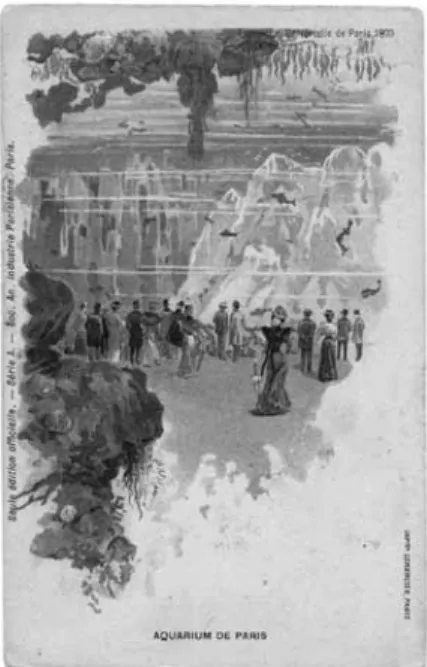
Before moving to the next section, we take a look here at the immersive exhibition presented by the aquarium at the Exposition Universelle (1900),
designed by the brothers Albert (1873-1942) and Henri Guillaumet (1868- 1929). In a 25-metre-long and 12-metre-wide elliptical aquarium hall, a realistic 'ocean' was represented using 'panorama-like spatial installations, faux terrains, different electric lighting- and projection- technologies'.29)
Harter describes this exhibition as follows:
Light-projections 'which change colours and move permanently' evoked an [image of] underwater world flooded with the variable light. Their effects were strengthened by the mirror projection of the images moving over the aquarium tanks on the huge canvas pulled taut under the ceiling. The visitor saw overhead moving shadows of sea tangles and Fig. 9 Verne, Jules. 海底二万海里 (
). Trans. Masakazu Shimizu 清水正和. Tokyo: Fukuinkan shoten 福音館 書店, 2000, p. 641.
all sorts of fish. He felt that he is surrounded by the sea [water], especially [thanks to] the almost four metres high aquarium tanks installed on the floor so that no optical boundary could be noticed.30)
Visitors could enjoy a fascinating 'diving experience' thanks to the application of modest technology (Fig. 10). Of course, such an immersive exhibition had not always been predominant in Europe. For example, the room for the freshwater tanks of the new aquarium at the Berlin Zoo (1913), built as a substitute for the closed Berliner Aquarium, was merely simple and functional, with few decorations.31) The limits of technology at the time, especially the difficulty of producing large and strong glass panels, also restricted the further development of the immersive exhibition. But some
Fig. 10 A postcard of the aquarium at the Exposition Universelle (Collection of the author)
methods - the concealment of the frame, reinforcements and walls which blocked the view of the seascape; the application of lighting or projection techniques; the construction of multistorey buildings which allowed the vertical movement of visitors - would be revived again after World War II.
2. Efforts by Aquarium Producers to Increase a Sense of Immersion from the 20th Century to the Beginning of the 21st Century
2.1. From the Documentary Film to Marine Studios
As mentioned above, the glass panel of aquariums can be compared to a window. Like a window, it functions as a barrier separating the aquatic world from the human one, and simultaneously as the medium which shows us the former. The aquatic scenery which the glass panel enables us to see is not only three-dimensional but also two-dimensional, even if the panel is formed like a tunnel or protrudes from the wall. It is a screen which shows 'moving pictures'.
This characteristic feature of the glass panel links the application of motion picture technology with the oceanarium (the term for the enormous tank) of Marine Studios (Florida, 1938).
The key figure in this experiment was William Douglas Burden (1898- 1978), the producer of a documentary film on the Komodo dragon. Supported by the American Museum of Natural History, he once organised an expedition to capture some dragons in the Dutch East Indies and brought back film of this undertaking as well as live and dead specimens to New York. He then donated the live dragons to the Bronx Zoo. But he immediately noticed that the dragons, which became inactive in captivity, could not convey their intrinsically dangerous character, and therefore the exhibition was not 'realistic'. He also realised that his diary and motion
picture might be boring for readers or audiences if he produced them without adding some suspense and a climax to the story he was telling. The documentary film edited by Burden therefore contains dramatic sequences focusing on the tyrannosaur-like Komodo dragon raising its head or devouring a boar. Burden also appears in the film as a hunter watching dragons from his hiding place.32) Gregg Mitman describes Burden's attitude as follows:
Burden sought to present an emotional reality, an expressive element that is quickly cast aside in the presentation of scientific data but is essential for capturing the interest of and motivating the lay public. […]
Burden's objective was to take the raw footage of nature - thousands of feet of film shot on the expedition - and create such an illusion of reality that the spectators experienced the event more vividly than if they had been in Java with the Komodo dragons themselves. […] Rather, Burden, like all documentary filmmakers, had to discover what the film theorist William Guynn calls 'the elements of a story in latent form within the real'.33)
In producing his film, Burden, then, had to cut tedious scenes and splice together scenes that originally were not sequential but that were dramatic through a process of filtering, upgrading and defining. 'Dramatic sequence in fact becomes an essential narrative structure in documentary behavior films, corresponding to the dramatic scenes that movie audiences had come to expect in fiction films.' 34)
Meanwhile, Merian Cooper, a famous adventurer, succeeded in filming the vivid behaviours of seemingly free terrestrial animals in a large enclosure.
Burden was stimulated by him and attempted to build an unprecedented
facility called Marine 'Studios'.35) With Ilya Tolstoy, a grandson of Leo Tolstoy, who had the skills to make documentary films, he conceived a huge steel tank. Its '[g]lass windows placed at strategic intervals would afford the motion picture studios their first ideal opportunity for documentary photographing of sharks, porpoises, manta rays, sea turtles and many smaller animals of the sea'.36)
Marine Studios consisted of two tanks. One was circular, 75 feet in diameter and 11 feet deep, and the other was rectangular, 100 feet long, 40 feet wide and 18 feet deep, and both were connected by a flume. Glass panels for battleships and submarines were installed to withstand the enormous water pressure.37) The tanks, filled with a large number of sharks, rays, porpoises and other fish, as well as real rocks and coral, could display
'realistic' underwater scenes.
This facility was also open to the public, and visitors could look through their own porthole while sitting in a comfortable dark place thanks to a curtain which separated the spectator from other portholes and visitors.38)
Mitman notes the following about this structure:
Like the natural history film produced for public consumption, Marine Studios looked to reconstruct nature through science and entertainment.
Indeed, Marine Studios is best read as a movie. […] If we stand back from the tank wall, each porthole represents a frame in the filmstrip, freezing the animal at a point in time. But as we put our faces to the glass, we become part of the undersea world. The task of Marine Studios, as of the natural history film, is to create the illusion of reality.
[…] His [Burden's] goal in the construction of Marine Studios was to make the observer feel as though he or she was a witness to the activity of life off the coast of Florida, 75 feet below the surface.39)
But like documentary films, the scenes presented here were also 'edited'.
'At Marine Studios, the visitor is unaware of all the activities taking place in the research lab and the search for and effort to display organisms with exotic behaviors. A visitor in 1938 certainly had no knowledge of the larger number of fish removed by divers each day after the tourists had gone - fish infested with the parasite Epibdella […].' 40) Like the film left in the production room, scenes of dying fish are cautiously 'cut', even today, because they interrupt the 'story' of free animals in a peaceful water world.
2.2. Introduction of New Technology to the Aquarium
While visitors to Marine Studios looked at underwater scenes through rectangular 'windows', the designers of aquariums after World War II tried to enlarge, bend or join together glass panels to make aquatic scenes appear
'more' three-dimensional.
New trends in the development of the aquarium would not be significant without the intercultural exchange of ideas. For instance, some Japanese aquariums such as the Misaki Koen Shizen Zoo Aquarium (Osaka, 1957), Suma Aquarium (Kobe, 1957) and Enoshima Marine Land (Kanagawa, 1957) adopted the idea of the oceanarium of Marine Studios.41) At the same time, Japanese aquarists also conceived unique ways of presenting exhibitions like the 'roundabout', which is a toroidal tank with an artificial current: visitors can watch fish swimming endlessly from the outside or the inside of the doughnut-shaped tank.
After building some prototypes at several aquariums, the first full-fledged roundabout was displayed at the Oita Seitai Aquarium (1964), under the direction of Tamotsu Ueda (1894-1980), the enthusiastic ex-mayor of Oita city and the initiator of the aquarium. It was an impressive moment for viewers, who could watch through strengthened Pilkington glass 2,000 fish
swimming against the current in a 3-metre-deep, 61-metre-circumference tank holding 282 tons of water.42)
While the roundabout at the Oita Seitai Aquarium could be viewed only from the outside, other aquariums like the Amakusa Kaitei Shizen Aquarium (Kumamoto, 1966), Keikyu Aburatsuno Marine Park (Kanagawa, 1968) and Shima Marine Land (Mie, 1970) introduced a tank which enabled visitors to watch fish from the inside,43) and this type could provide a more realistic
'diving experience' by surrounding visitors with water and 'mak[ing] one feel less a viewer than a vieweé'.44) In 1977, stimulated by the Japanese exhibitions, the Steinhart Aquarium installed a roundabout, and it was also adopted by the National Aquarium in Baltimore (1981).45)
The glass panel itself began to be enlarged as well. A 6-metre-deep tank with large 'windows' that reach from floor to ceiling was built at the Marine Science Museum in Shizuoka (1970). 'I cannot dispel the impression as I felt the "ocean" staying in an aquarium for the first time' 46) commented Katsumi Suzuki, who witnessed the opening ceremony.47)
Technologically speaking, the enlargement of tanks became possible thanks to the development of acrylic plastic, or Plexiglas(s). Invented by the chemist Otto Röhm in 1932, this new material was applied to the windshields of warplanes.48) But after the war, in the 1960s, the designers of aquariums attempted to use it for large tanks. The newly opened Aqua-Terrarium (1964) at the Ueno Zoo possessed the first tank made of acrylic panes in Japan.49) The glass of the tank at the Marine Science Museum mentioned above is also made of acrylic.
Acrylic can resist high water pressure and helps minimize the size of walls and the number of places that require reinforcement. It is also easy to bend and has aided in the production of new types of tanks such as the tunnel tank. The Uozu Aquarium (established in 1913, and reopened after the war,
in 1954) is regarded as the first Japanese aquarium that displayed a tunnel tank made of bent acrylic panels (1981).50) Kelly Tarlton (1937-85) also built tunnels at his Underwater World (1983) in Auckland, New Zealand, presumably based on his experiences as a diver. His tunnels are unique in their curves, and each corner provides a new underwater scene.51)
2.3. Immersive and Interactive Exhibitions at Sea World
The evolution of aquariums reflected new demands on the part of the public. Hiromasa Yoshida, an ex-curator of the Kagoshima Aquarium, writes,
'Since the 1960s, the period in which television became popular, we have lived in an information-oriented society. Strange and mysterious things have been unveiled one after another. People with abundant knowledge, which they have absorbed from films that broadcast the interesting ecology of aquatic lives, have begun to visit aquariums. Aquariums would not be attractive any more if they just exhibited several species of animals.' 52)
Furthermore, it can be said that the public would not be satisfied with just looking at the rectangular windows of tanks, which are reminiscent of a television screen.
In addition, the development of exhibition techniques has allowed aquariums to be transformed from museum-like educational institutes to asylums or cathedrals of nature, which afford people an opportunity to get away from a fast-paced and trouble-filled way of life in a period of high economic growth and intensive urbanisation.
At least, this was one of the objectives of Sea World (San Diego, 1964), a theme park that had no small impact on other aquariums. As Susan G. Davis notes, it provides 'nature', which 'is a world beyond the human that is invented out of inevitably human meanings and desires, an escape from the limited, the routine, and the mundane'. The underwater worlds in this theme
park 'can seem especially remote, deep, and endless, free of boundaries and limits. Such nature visions promise transcendence of the polluted and conflictual social world on land'.53)
Davis has thoroughly investigated Sea World, from its commercial strategies and exhibition techniques to its cultural and social background, all of which have led to the park's great success. She relates that Sea World was founded by a group of entrepreneurs, including Ed Ettinger, who had been a public relations director of Disneyland, and Kenneth Norris, a biologist and ex-curator of Marineland of the Pacific, and designed by Victor Gruen and Associates.54) The Polynesian-Japanese style architecture at Sea World helped convey the impression that visitors were in a 'faraway, antimodern, and fantastic' 55) place, although this was later altered to a functional, contemporary design. Since the 1980s, Sea World has been enriched with new exhibitions like 'Penguin Encounter', 'Forbidden Reef' and 'Rocky Point Preserve'.56)
At this park, buildings have been designed to provide a sense of immersion. Visitors often walk from the upper to the lower level, which allows them, for instance, to watch orcas at Shamu Stadium from a seat at a high level, and then view them at eye level through acrylic panels (Fig. 11, 12).57) The stadium's tank is so enormous that the scene within appears boundless. 'Here, no underwater scenery distracts us, and when viewed at eye level the orcas seem to float in space. […] The illusion of endless depth connects to the notion of another world - this time, it is an entirely foreign but peaceful one, without human culture.' 58)
Moreover, visitors can interact with animals like the characters do in Verne's novel, to heighten the illusion of traveling through the sea. 'Over and over again, Sea World's managers told me, "We are interactive," "We're participatory," "We're touchable".' 59) The facility, as mentioned, is interactive,
because it enables visitors to touch some animals like rays and sea stars in the touch pool or feed dolphins. 'Children hand smelts to dolphins and anticipate a splash in return. In a way, the splash is a form of contact across species boundaries, a kind of exchange, and children are delighted by it.' 60)
But the main attraction of the theme park is surely the performances of marine animals, especially of killer whales.61) As mentioned above, at theatres, viewers do not act onstage, but they do participate in the spectacle.
They are 'both observer and participant'. At the Sea World stadium, viewers of the orca show are a part of the spectacle, too. We are reminded here, as well, of the fights between animals and venatores (hunters) in the Roman Colosseum. Viewing these spectacles, audiences must have felt like they themselves were heroic hunters, and the victories of the hunters must also have seemed like their own.62) Likewise, in the modern aquatic stadium, shaped like a coliseum, the performers interact vicariously with 'friendly'
marine animals, accompanied by the telling of dramatic stories, so that the audience can feel as if they are also communicating with the animals. In this sense, the animal performance is also a type of 'interaction', and this might be why the orca or dolphin show has been adopted by other Western and Fig. 11, 12 The orca stadium at Sea World San Diego (Photographed by the
author. March 2014)
Eastern countries and continues today, despite receiving persistent criticism.
2.4. Peter Chermayeffʼs Aquariums
Developments in exhibitions and technology have made it possible to build a new, ambitious type of public aquarium. Examples can be seen in the aquariums designed by Peter Chermayeff (1936-) and his associates.
Chermayeff is one of the architects who have innovated the design of aquariums. He contributed an article to World Monitor entitled 'The Age of Aquariums', which introduced aquariums that he had produced, ranging from the New England Aquarium (Boston, 1969) to the Genoa Aquarium (1992).
This period from the late 1960s to the early 1990s could also be called the
'Age of Peter Chermayeff' (in the history of aquariums).
He is a son of the eminent architect Serge Chermayeff (1900-96). Serge descended from a family who settled in the Caucasus and he studied in Britain, but after the Bolshevik Revolution took a job as a ballroom dancer, and then turned to furnishing design and became a fellow of the Royal Institute of British Architects. During World War II, he decided to immigrate to the United States with his wife and sons, Ivan and Peter. Serge was invited to teach at Harvard University, where he taught 'Environmental Design', 'a socially holistic approach to design and he took the classroom as a microcosm of how real world design could be approached'.63)
Serge's holistic and interdisciplinary approach, which united architecture and urban planning as well as landscape architecture, was inherited by his sons (in their works). Peter and Ivan Chermayeff, Louis Bakanowski, Paul Dietrich, Alden Christie, Thomas Geismar and Terry Rankine, with 'diverse skills in architecture, planning, exhibit design, graphics, industrial design, and filmmaking' 64) succeeded in winning the commission to design the New England Aquarium. They founded Cambridge Seven Associates (C7A).65)
The aquariums designed by Peter Chermayeff and his C7A colleagues have particular characteristics. They are multistorey buildings in which visitors walk from the lower/upper level to the upper/lower level (this vertical movement simulates floating and diving movement). Visitors move along a one-way path reading 'stories' presented by the aquarists.
These features can be easily observed in the New England Aquarium.
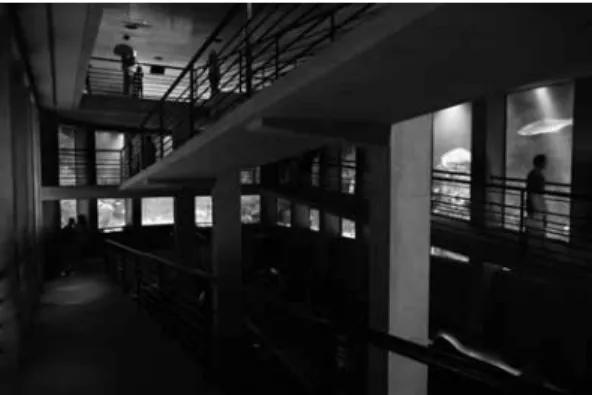
Visitors walk from the lower to the higher levels through 'a three dimensional one-way visitor path' that surrounds a big cylindrical tank in the middle, viewing several exhibits with 'an alternating ABABAB rhythm of visitor experience: large/small, dark/light, open/enclosed, wet/dry, demanding/undemanding'.66) The climax is the cylindrical 'Giant Ocean Tank'
(Fig. 13), and visitors walk around it along the spiral passage from the higher to the lower level.
With this structure, Chermayeff has attempted to provide 'the emotional encounter, the visceral response to animals, seen from bridges, ramps, and balconies, within a coherent single dark space'.67)
In planning the National Aquarium, Baltimore (1981), Chermayeff and his colleagues developed this structure. 'We made many of the exhibits larger,
Fig. 13 The ʻGiant Ocean Tankʼ at the New England Aquarium (Photographed by the author. September 2015)
more dramatic, simulating natural habitats so that visitors can feel they are entering alien realms among the animals.' 68) Visitors walk from the lower to the higher level looking at a variety of tanks and go to the terrestrial exhibition on level five, then move into the water world again along the spiral path installed in the roundabout, descending from the light, shallow water to the dark deep sea filled with sand tiger sharks (Fig. 14). Floating, landing and diving movement is clearly woven into the design.
Chermayeff's work is not limited to aquariums in the United States, however. He has participated in the building of the Kaiyukan Ring of Fire Aquarium in Osaka, Japan (1990). '[W]e went even further along a similar path', he remarked. He notes as follows,
The primary difference was organizing the entire aquarium around a single subject - a tour of one natural system, the Pacific Ocean […]. Plate tectonics and the volcanic perimeter of the ocean, known as the Ring of Fire, gave coherence to the sequence of exhibits. A biogeographical diagram of the Pacific became the building plan, from Japan at the northwest to California at the northeast to New Zealand at the
Fig. 14 The Roundabout of the National Aquarium (Photographed by the author.
September 2015)
southeast, with the open Pacific Ocean in the center of it all. […] The visitor is 'immersed' in aquatic habitats by means of a new technology using huge walls of clear acrylic.69)
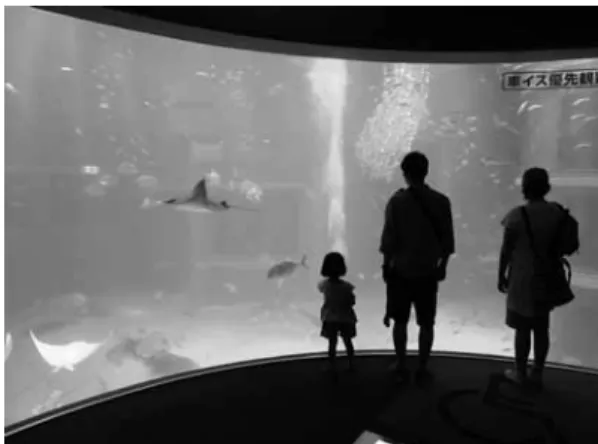
In the aquarium, visitors are brought to 'another world' through the 'Aqua Gate', a tunnel tank, and they go by escalator directly to the top level, which holds terrestrial exhibitions. Then they 'dive' into the ocean world from the higher to the lower level, watching the biogeographical exhibitions on one side and an enormous 'Pacific Ocean tank' on the other side (this tank is inhabited by whale sharks and extends through three stories, Fig. 15).
Following the Kaiyukan, the Tennessee Aquarium, which exhibits the ecosystem of inland water in the United States (Chattanooga, 1992);70) the Genoa Aquarium (1992); and the Lisbon Oceanarium (1998) were built based on the design of Chermayeff and his colleagues.
In the construction of the Genoa Aquarium, C7A and International Design for the Environment Associates (IDEA), a company led by Chermayeff, developed the interior architecture and the exhibit design as well as life-
Fig. 15 The ʻPacific Ocean tankʼ of the Kaiyukan (Photographed by the author.
July 2014)
support systems, while Renzo Piano planned its exterior shell building.71)
Based on their concept, the aquarium, as a part of the Columbus 1992 World Exposition, had a cultural-biological exhibition presenting the 'discovery of the new world' by Christopher Columbus and comparing the 'two perceptions of nature - that of the Europeans represented by Columbus; and that of the Native Americans they found in the New World'.72)
The Lisbon Oceanarium, also built as a pavilion for Expo '98, has more features which are typical of other Chermayeff aquariums, as Chermayeff notes: 'Visitors enter via a two level ramped bridge to an upper level, where coastal ocean habitats of the Atlantic, Pacific, Southern and Indian Oceans are seen first above water […]. Later, those same four ocean habitats are seen underwater.' 73)
It is worth mentioning here that Chermayeff's works are reminiscent of the Berliner Aquarium. First, the Berliner Aquarium and those in Baltimore, Osaka and Chattanooga have terrestrial as well as aquatic exhibitions and represent a whole ecological system; second, visitors' movements are not only horizontal but also vertical; and third, visitors walk along a one-way path, looking at land and sea areas as represented by their inhabitants. These similarities resulted from the endeavour to translate the diving experience into architecture, while new technology enabled post-war architects to create exhibitions on a large scale and at the same time, grotto decoration became less important.
Continual renovations have made Chermayeff's or C7A's aquariums, which are still pre-eminent in submerging visitors into the water (world). For example, C7A (Chermayeff left the company in 1998) renovated the 'Giant Ocean Tank' at the New England Aquarium by constructing a dome over the tank in the place of the luminaires that had been installed directly above the water's surface (they were now embedded in the ceiling instead, Fig. 16).
This transformation has enabled people to watch the fish comfortably from above. Furthermore, colour temperature of LEDs shift constantly like sunlight streaming through the tank, and the effect of passing clouds was also added.74)
2.5. The Monterey Bay Aquarium and the Theory of Hajime Nakamura Of course, Chermayeff's aquariums are not the only ones that provide a way of inviting people into oceans that are on display without getting wet.
For instance, the Monterey Bay Aquarium (1984) enjoys great renown for its 28-feet-deep 'Kelp Forest' exhibition. Its producers tried to 'exhibit all of the environments and microhabitats of Monterey Bay, from a living kelp forest all the way down to the meiofauna, those almost microscopic organisms living among the grains of sand'.75)
This idea derived from the investigations of people who have researched marine fauna and flora. One of them, Julie Packard, is a daughter of David Packard, the chairman and co-founder of Hewlett Packard Corporation, and he provided substantial financing of the plan. At the Packards' request, David C. Powell joined the project because he had abundant experience in designing Fig. 16 The Dome above the ʻGiant Ocean Tankʼ (Photographed by the author.
September 2015)
aquariums. Charles 'Chuck' Davis, of the firm Escherick, Homsey, Dodge, and Davis (EHDD), was in charge of its architecture.76)
The process of 'nature faking' 77) was so exhaustive that the creators made artificial rocks, submerged them in the sea and let plants or animals grow on and cover them.78) The goal of such an endeavour is 'to create for the aquarium visitor the exhilarating feeling experienced by a scuba diver
"flying" weightlessly and freely through a forest of gently swaying golden kelp plants'.79) Their aim was accomplished successfully. Visitors have been convinced that they are watching real underwater scenes through windows facing the sea,80) and the aquarist Itaru Uchida has the impression that '[t]he viewer has felt as if he were standing on the bottom of the sea and felt seasick after gazing [at the scene] for a long time'.81)
Such a feeling can be described with the term suikai, which was proposed by aquarium producer Hajime Nakamura (1956-). This is a compound word that comes from sui (水), meaning water, and kai (塊), meaning mass.
Nakamura says, '"suikai" is the sense of being-in-the-water that is produced through tanks'. Suikai encompasses the experience of 'depth, weightlessness, coolness, dynamics etc. of the sea as if we are enjoying diving'.82)
According to Nakamura's theory, tanks do not have to be huge to convey a suikai feeling. For example, skilfully installed tanks with floating jellies can also provide such a feeling. The tank 'Sunshine Lagoon' at the Sunshine Aquarium (Tokyo), which was renovated in 2011, is not enormous but provides visitors with a suikai feeling thanks to the rocks, which make the seascape seemingly unlimited through concealing corners, and the lighting, which illuminates in the front but is dimmer at the back of the tank (Fig. 17).83)
Nakamura emphasizes the importance of suikai, referencing the age distribution of zoo and aquarium visitors in Japan. While the ratio of adults to
children at zoos is 3:7, that at aquariums is 8:2. Moreover, after reviewing surveys which were conducted on the behaviour of visitors, he concluded that adults tend to come to aquariums not to be educated but just to gaze blankly into the water. 'What adults see is not animals but the underwater world itself.' 84) They 'derive comfort from experiencing the aquatic, uncommon space and are healed [of stresses]'.85) Now the question is, are they watching the water or the fish? According to Nakamura, fish are important because they are clues for feeling the 'ocean world'. 'Just like the height of the sky can be felt by a wisp of cloud, the depth of the sea is felt by swimming animals.' 86)
In the post-war period, the immersive exhibition became more widespread thanks to the intercultural exchange of techniques among the United States, European countries and Japan. It is still a combination of architecture, lighting, artificial decoration and aquatic life like the exhibitions of the 19th century and requires 'the willing suspension of the visitor's disbelief',87)
because frames, reinforcements and walls continue to block the view of the seascape even though their size has been dramatically reduced thanks to Fig. 17 The ʻSunshine Lagoonʼ at the Sunshine Aquarium (Photographed by the
author. March 2015)
new materials now available. The aquarium in the near future, however, might be able to overcome such difficulties by applying VR technology.
3. Virtual Reality and the Aquarium
3.1. The Development of Virtual Reality Technology
It is not always easy to try to predict how exhibitions at public aquariums might be presented in the future. What seems obvious is, however, that the trend of introducing VR technology to aquariums will be accelerated in the coming decade.
VR technology can provide us with an artificial three-dimensional environment. We can also step into and interact with it. The term 'virtual reality' is interchangeable with 'Virtual Environments', 'Synthetic Experience',
'Virtual Worlds', 'Artificial Worlds' or 'Artificial Reality'.88) Tomasz Mazuryk and Michael Gervautz have provided some definitions of it from scholars:
'Real-time interactive graphics with three-dimensional models, combined with a display technology that gives the user the immersion in the model world and direct manipulation' (Henry Fuchs et al. 1992); 'VR is an immersive, multi-sensory experience' (Michael Gigante 1993); 'Virtual reality refers to immersive, interactive, multi-sensory, viewer-centered, three- dimensional computer generated environments' (Caroline Cruz-Neira 1993).89) In short, the experience of VR must be immersive and interactive.
Although the term 'virtual reality' was coined by VPL company in 1989, the technology to create an artificial world had already been developed by that year. VR developers prefer to assign its origin so far to the cave paintings of Lascaux. The cave was presumably used as a place to carry out rites, and the objective of animal paintings might be to lead people out of this world and into another world. The above-mentioned panoramas created in the 18th and 19th centuries are also considered as the predecessors of VR, but
the Sensorama (1960-62), a 'multi-sensory' simulator invented by Morton Heilig, had a more direct impact.90) The viewer of a stereophonic film could also hear sounds, smell scents and feel the wind as well as vibrations at the proper time, and '[t]his was the first approach to create a virtual reality system and it had all the features of such an environment, but it was not interactive'.91)
In 1965, Ivan Sutherland conceptualised the 'ultimate display', which made it possible to see, touch, hear, smell and taste in the three-dimensional space presented by a computer, and also later invented the head-mounted display (HMD, 1968-70). With this headset, viewers can see the virtual world surrounding them by turning the head.92) In the field of art, Myron Krueger succeeded in creating Metaplay (1969). The spectator for this work was filmed, projected on a screen and could 'touch' the objects on it.93)
In the following decades, technology developed further and people could more easily visit a virtual world at theme parks. After 1990, it was possible for them to interact with virtual objects. Namco Corporation devised an attraction combining the amusement ride, the large screen and the shooting game. Scramble Training (スクランブル・トレーニング,1993), developed by special effects supervisor Douglas Trumbull and the company Sega, also enabled the rider to fire missiles in an artificial space world.94)
Such VR technology is appropriate for providing a realistic diving experience, too. Artdink Corporation attempted to bring the 'ocean' to home with a PlayStation game called Aquanaut's Holiday (Aquanaut no kyujitsu ア ク ア ノ ー ト の 休 日 . 1995, Fig. 18) and its sequels (1996, 1999, 2008). They conceptualised the adventure in the form of a three-dimensional aquatic world and interaction with marine animals, although they belong to the so-called desktop VR, 'the simplest type of virtual reality applications. It [desktop VR]
uses a conventional monitor to display the image (generally monoscopic) of
the world'.95) But Ocean Descent (2016), a game developed by London Studio for the commercial HMD PlayStation VR, features the diving experience again and is more immersive: the player can see in all directions in the virtual sea and fear the attack of a great white shark.96)
3.2. Practices Used by VR Developers and Aquarists for Reconstructing the ʻArtificial Oceanʼ
It is interesting that VR technology has developed since the 1960s, the period when the post-war aquarium began to flourish. The intentions of VR developers (including ride and game producers) and aquarium designers show some similarities, too. They have attempted to construct 'other worlds'
in urban settings, and the experiences in these worlds aim at being both Fig. 18 ʼ (Amazon Japan. 26 July 2016 <https://www.amazon.
co.jp/dp/B000069UD2/ref=pd̲lpo̲sbs̲dp̲ss̲2?pf̲rd̲p=187205609&pf̲rd̲
s = l p o-t o p-s t r i p e & p f ̲ r d ̲ t =201& p f ̲ r d ̲ i = B000069U D L & p f ̲ r d ̲ m=AN1VRQENFRJN5&pf̲rd̲r=0STQHV5S85EC008R54QD>)
immersive and interactive. People, including the author, have 'visited' oceans displayed in aquariums or on television screens.
Moreover, VR developers and aquarists have sought to abstract the elements of the real world to provide a 'realistic' experience. What we call the 'world' is one constructed from information gathered through the sensory organs from the real world.97) Based on this assumption, Susumu Tachi ensures us that the task of VR researchers is to abstract the most essential elements from the real world and provide them to people.98) If this is done successfully, one will feel the reconstructed world is 'almost real'. In short, when VR users can see the seascape, feel the current and the pressure of the water, hear sounds and interact with virtual marine animals (with the help of devises), they will feel that the virtual ocean is 'almost real'.
Meanwhile, Leighton Taylor writes about aquarists' practices: 'When we build an exhibit, we abstract a piece of nature. We literally "pull it away"
from the wild world. Some parts of a natural ecosystem, usually animals, are removed and installed in the aquarium while other parts, usually plants, rocks or coral skeletons, are replicated'. But '[m]ajor elements, by necessity, are left out'.99) Nakamura has also tried to abstract the 'suikai feeling' from real experience and display it. Exhibiting the 'typical behaviours' of animals, like the hunting of archerfish, is a kind of abstraction, too. And if all these attempts can be combined well enough, the reconstructed world will seem
'almost real'.
Of course, compared to the digital approach of VR developers, catching and displaying fish with artificial materials sounds very analogue (if we pay less attention to the fact that today's aquariums are designed with the help of computer-aided design). But the association of both technologies might enable the 'total immersive exhibition' to be created in the near future.
3.3. VR Technology Applied to Aquariums
The Tennessee Aquarium, for instance, has decided to use technology for their educational purposes. With a system developed by Tennessee Technological University and which uses the Oculus Rift VR headset, one can 'dive' into the virtual Conasauga River, watch fish and also learn about environmental problems.100)
Augmented reality (AR) technology also helps in the evolution of aquariums. AR 'allows the user to see the real world, with virtual objects superimposed upon or composited with the real world'.101) You are using AR if you find Pokémon, a virtual character, in the real world through a camera on a smartphone.
The Sea Life London Aquarium has begun presenting the exhibition
'Frozen Planet' (2016), which applies AR technology.102) The visitor is filmed and projected onto a screen where he or she can 'encounter' polar bears and orcas.
Other aquariums have adopted projection mapping, one of the spatial augmented reality techniques that changes 'the look of the physical environment with projected light'.103) Now, the appearance of opaque reinforcements and walls in the aquarium can be made to resemble water. In the near future, visitors may wander through the oceanic scenes without breaks, similar to what panoramas displayed in the 18th and 19th centuries.
In 2014, the Enoshima Aquarium added projection mapping to its exhibition 'for the first time in the world'.104) One show, The Space of Jerry Fish (海月の宇宙), presents a virtual diving experience, which constantly changes the appearance of the wall and is accompanied by a story (Fig. 19). In the following year, the Yokohama Hakkeijima Sea Paradise adopted the
'kaleido screen' for its projection-mapping show. The screen, developed by JX Nippon Oil & Energy Corporation, is transparent but also reflects
projected virtual images thanks to nanotechnology, and it can be pasted on acrylic panels.105) Thus, the viewer of the projection mapping show can enjoy the spectacle of virtual fish overlapping with real ones.
3.4. The Advent of the ʻVirtual Aquariumʼ
VR technology can also have rivals like the 'virtual aquarium', however. In 2015, Tony Christopher, the CEO of Landmark Entertainment Group, announced a project to build the L.I.V.E. Center (Landmark Interactive Virtual Experience) in China. This amusement park will also include a virtual zoo and aquarium. Christopher told Mashable (the digital media website) that 'PETA [People for the Ethical Treatment of Animals] saw an early presentation of the virtual zoo and they loved it […] I believe that it isn't politically correct to have animals in a zoo'.106) Wearing an HMD, visitors will watch virtual animals. Matt McFarland of the Washington Post says, 'He [Christopher] imagines guests pressing a button to see the animal of their choice swim by, even if it's extinct. The virtual-reality element will allow for other experiences you wouldn't get at a traditional aquarium. "Clap your Fig. 19 at the Enoshima Aquarium (Photographed by the
author. March 2015)
hands, all the fish turn to skeletons - that kind of stuff" […].' 107)
The attempt to exhibit virtual animals may be countered by the assertion that virtual animals cannot replace real ones (of the same quality). More than 15 years ago, the previously mentioned Yoshida wrote that the 'heart of the animal exhibition' is the various responses of lives that are not controlled in any way by computers.108) But traditional aquariums will probably not always prevail over the virtual aquarium with 'something like fish'. What will happen if VR technology succeeds in abstracting the 'essential elements' of animals and reconstructing them? If the virtual fish always performs the
'typical' and 'interesting' behaviours, it can present 'an emotional reality'.
Moreover, virtual animals might interact with human beings in a 'friendlier'
or 'fiercer' way, matching the expectations of visitors - we must just remind ourselves of Burden's 'komodo film'.
Conclusion
Since early times, not a few public aquarium designers have tried to provide the experience of entering the world of water, a totally different world. They have created a sense of immersion by combining architecture;
the technologies of lighting, projection and panorama; and natural elements like animals, stalactites and a picturesque land- or seascape (Fingal's Cave, for example).
The development of immersive exhibitions just prior to and after World War II suggests that the ideas of earlier aquariums survived, or more precisely, were interwoven with new ideas, technology and exhibitions.
Travel through several seas and several depths, as proposed by Verne's novel and which also materialised at earlier aquariums, has still been adopted by some designers/producers of post-war aquariums.
At the same time, aquariums, including aquatic theme parks like Sea
World, have tried to respond to the demands of the public to escape from a conflictive and polluted urban life. Whether pursuing profit or not, they present visitors with the opportunity to 'interact' with animals and gaze at
'another world' without being disturbed by other human beings. They provide an 'emotional reality' composed of 'the elements of a story in latent form within the real' that match the expectations of visitors, while disillusioning scenes are carefully 'cut'. Or, if we borrow Taylor's terms, aquarium producers have 'abstracted' elements from the real world to recreate an ideal one.
AR technology may be used more generally in the future to deepen people's knowledge of animals as well as heighten the illusion by changing the appearance of reinforcements and walls into the water. In the near future, the visitor might be fascinated by a panoramic view of a seascape filled with both real and virtual fish. There might seemingly be no boundaries: between glass panels and walls; between artificial and natural elements; between human beings and animals. Meanwhile, the virtual aquarium is likely to have no small impact on traditional aquariums by challenging the way in which animals are kept in captivity.
A variety of immersive exhibitions with more or less virtual contents will likely be introduced one after another. The beginning of the 21st century is still a period of trial and error in terms of aquatic exhibitions, and it is hard to tell what kind of exhibition will gain popularity for a long period. But what people will continue to expect is clear: that they can dive into oceans on display without getting soaked.
Acknowledgement: The author would like to express greatest gratitude to Professor Garry Marvin of the University of Roehampton for assistance during the research and would like to thank Enago (www.enago.jp) for the English language review.
Note
1)Harter, Ursula. Aquaria in Kunst, Literatur und Wissenschaft. Heidelberg: Kehrer, 2014, pp. 18-23.
2)Harter 2014, p. 23.
3)Harter 2014, pp. 23-25.
4)Das Aquarium im Bouloguer Walde bei Paris. Das Ausland: Eine Wochenschrift für Kunde des geistigen und sittlichen Lebens der Völker mit besonderer Rücksicht auf verwandte Erscheinungen in Deutschland. Vol. 35. Augsburg: Verlag der J. E. Gotta'
schen Buchhandlung, 1862, p. 64.
5)Das Aquarium im Bouloguer Walde bei Paris. 1862, p. 64.
6)Das Aquarium im Bouloguer Walde bei Paris. 1862, p. 64.
7)Hamera, Judith. Parlor Ponds: The Cultural Work of the American Home Aquarium, 1850-1970. Ann Arbor: University of Michigan Press, 2012, p. 25.
8)Hamera 2012, p. 28.
9)Hamera 2012, pp. 28-38.
10)Harter 2014, p. 25.
11)F. Das Aquarium zu Berlin. Architekten-Verein zu Berlin, ed. Deutsche Bauzeitung.
Vol. 3. Berlin: Kommissions Verlag, 1869, p. 246.
12)Harter 2014, p. 51.
13)Clare, John. A Guide to Staffa and Fingals Cave. Kilpatrick: John Clare, 2011, pp. 7-10.
14)F. (Das Aquarium zu Berlin) 1869, p. 229, Harter 2014, p. 62.
15)Harter 2014, pp. 64-65.
16)Altick, Richard D. London no misemono ロンドンの見世物 (The Shows of London).
Vol. 1. Trans. Shigeru Koike 小池滋 et al. Tokyo: Kokushokankokai 国書刊行会 , 1999, p.
344.
17)Altick Vol. 2. 1990, p. 71.
18)Friedel, Ernst. 'Ueber das Aquarium der Pariser Weltausstellung von 1867. ' Noll, F. C.
Der Zoologische Garten: Zeitschrift für Beobachtung, Pflege und Zucht der Tiere. Vol. 9.
Frankfurt a. M.: Verlag der Zoologischen Gesellschaft, 1868, pp. 188-89.
19)'The Havre International Maritime Exhibition.' Illustrated London News. 13 July 1868,