九州大学学術情報リポジトリ
Kyushu University Institutional Repository
Insulin-like growth factor Ⅱmessenger RNA- binding protein-3 is an indicator of malignant phyllodes tumor of the breast
瀧澤, 克実
https://doi.org/10.15017/1928638
出版情報:九州大学, 2017, 博士(医学), 論文博士 バージョン:
権利関係:© 2016 Elsevier Inc. All rights reserved.
Original contribution
Insulin-like growth factor II messenger RNA- binding protein-3 is an indicator of malignant phyllodes tumor of the breast ☆
Katsumi Takizawa MD
a, Hidetaka Yamamoto MD, PhD
a, Kenichi Taguchi MD, PhD
b, Shinji Ohno MD, PhD
c,d, Eriko Tokunaga MD, PhD
c,e, Nami Yamashita MD, PhD
e, Makoto Kubo MD, PhD
f, Masafumi Nakamura MD, PhD
f, Yoshinao Oda MD, PhD
a,⁎
aDepartment of Anatomic Pathology, Graduate School of Medical Sciences, Kyushu University, Fukuoka, 812-8582, Japan
bDepartment of Pathology, National Kyushu Cancer Center, Fukuoka, 811-1395, Japan
cDepartment of Breast Oncology, National Kyushu Cancer Center, Fukuoka, 811-1395, Japan
dDepartment of Breast Oncology, Cancer Institute Hospital, Tokyo, 135-8550, Japan
eDepartment of Surgery and Science, Graduate School of Medical Sciences, Kyushu University, Fukuoka, 811-8582, Japan
fDepartment of Surgery and Oncology, Graduate School of Medical Sciences, Kyushu University, Fukuoka, 811-8582, Japan
Received 15 December 2015; revised 30 March 2016; accepted 13 April 2016
Keywords:
Phyllodes tumor;
IMP3;
EGFR;
Immunohistochemistry;
Prognosis
SummaryThe aim of this study was to elucidate the clinicopathological and prognostic significance of the expressions of insulin-like growth factor II mRNA-binding protein-3 (IMP3) and epidermal growth factor receptor (EGFR) in phyllodes tumors (PTs). Immunohistochemical staining for IMP3 and EGFR was per- formed in 130 cases of primary PTs (83 benign, 28 borderline, 19 malignant), 34 recurrent/metastatic PTs, and 26fibroadenomas (FAs). Among the primary tumors, a high expression of IMP3 was significantly more frequently present in malignant PTs (17/19, 89%) than in the FAs (0/26, 0%), benign PTs (0/83, 0%) and borderline PTs (3/28, 11%). The recurrent and metastatic lesions of malignant PTs also showed high IMP3 expression (3/5 [60%] and 6/6 [100%], respectively). Most malignant PTs showed strong IMP3 ex- pression at the interductal area or more diffusely, whereas weak and focal (low) expression of IMP3 was lim- ited to the periductal area in FAs and benign PTs. EGFR overexpression was significantly correlated with tumor grade and high IMP3 expression. Overexpressions of IMP3 and EGFR were significantly associated with shorter periods of metastasis-free and disease-free survival. The results suggest that high expressions of IMP3 and EGFR with a characteristic staining pattern may be helpful for both identifying malignant PT and predicting the prognosis of these tumors.
© 2016 Elsevier Inc. All rights reserved.
1. Introduction
Phyllodes tumor (PT) is an uncommonfibroepithelial neo- plasm of the breast; it accounts forb1% of all breast lesions [1]. PTs are histologically classified into benign, borderline and malignant categories on the basis of a combination of
www.elsevier.com/locate/humpath
☆ Competing interests: All authors have no conflict of interest related to this study. There is no funding support to disclose.
⁎ Corresponding author at: Department of Anatomic Pathology, Patholog- ical Sciences, Graduate School of Medical Sciences, Kyushu University, 3-1-1 Maidashi, Higashi-ku, Fukuoka 812-8582, Japan.
E-mail address:[email protected](K. Takizawa).
http://dx.doi.org/10.1016/j.humpath.2016.04.007 0046-8177/© 2016 Elsevier Inc. All rights reserved.
histological features, including the degree of stromal hypercel- lularity, mitoses and cytological atypia, stromal overgrowth, and the nature of the tumor borders/margins[2]. The frequen- cies of local recurrence and metastasis generally correlate with the histological grade of PT, but PT is a prognostically unpre- dictable neoplasm. The average in published data suggests an overall 21% local recurrence rate, including 17%, 25% and 27% recurrence rates for benign, borderline and malignant PTs, respectively. In addition, up to 10% of PTs seemingly show distant metastases, with 0%, 4% and 22% rates for be- nign, borderline and malignant PTs, respectively[3]. Local re- currence after surgery is also strongly influenced by the width of the excision margins[4]. To date, various markers such as p53, Ki-67 and c-kit have been reported to be overexpressed in stromal cells as a potential predictor of aggressive behavior of PT (reviewed by Tse et al [1] and Jara-Lazaro and Tan [5]).
On the other hand, epithelial expression of estrogen receptor reportedly decreased along with increasing tumor grade[6].
However, the molecular mechanisms underlying the progres- sion of PTs have not been fully clarified.
Insulin-like growth factor II (IGF-II) messenger RNA (mRNA)–binding protein-3 (IMP3), which has also been re- ferred to as K homology domain containing-protein and as L523S, is a member of the IMP family composed of IMP1, IMP2, and IMP3[7]. IMP3 binds to the 5′untranslated region of the IGF-II leader-3 mRNA as a translational activator of IGF-II leader-3 mRNA, which controls cell proliferation[8].
Various recent studies showed that IMP3 is both a useful diag- nostic marker to distinguish malignancies from benign lesions, and a prognostic marker for worse prognosis in several types of neoplasms, including mesenchymal tumors[9–11]. Regard- ing breast tumors, an experimental study of triple-negative breast cancer (TNBC) revealed that epidermal growth factor re- ceptor (EGFR) signaling and the consequent activation of the mitogen-activated protein kinase pathway induced IMP3 tran- scription and protein expression, and IMP3 contributed to the migration and invasion of carcinoma cells[12]. As for PT, pre- vious studies showed that EGFR expression was higher in advanced-grade PTs, suggesting that EGFR overexpression may be involved in the progression of PTs[13,14]. Thus, we hypothesized that IMP3 and EGFR might become biomarkers of malignant PT. A very recent study on a total of 62 cases of PTs has shown that IMP3 was expressed more frequently in ma- lignant PTs than in borderline or benign PTs[15]. However, the prognostic value of IMP3 overexpression and its association with EGFR in PTs have not been fully elucidated so far.
In the present study, we examined a large series of PT to elucidate the diagnostic and prognostic significances of IMP3 and EGFR.
2. Materials and methods
We reviewed the cases of PTs that had been diagnosed at the Department of Anatomic Pathology of Kyushu University
and the Department of Pathology of the National Kyushu Cancer Center between 1983 and 2014. Our study protocol conformed to the ethical guidelines of the 1975 Declaration of Helsinki. For strict privacy protection, the identifying infor- mation for all samples was removed before our analyses. This study was approved by the institutional review boards of Kyushu University (No. 26-186) and the National Kyushu Cancer Center (No. 2015-8).
We obtained a total of 164 cases of surgically resected PTs.
The examined PTs were primary (n = 130), recurrent (n = 28) and metastatic (n = 6) tumors. PTs were classified into benign (primary, n = 83; recurrent, n = 18), borderline (primary, n = 28; recurrent, n = 5) and malignant (primary, n = 19; recur- rent, n = 5; metastasis, n = 6) on the basis of histological fea- tures according to the World Health Organization (WHO) classification (see below)[2]. Follow-up information was ob- tained by reviewing the medical records of the patients and communicating with the physicians at each facility. In this se- ries, metastasis occurred in 10 cases (see Results). Among these 10 cases, histological specimens of metastatic foci were available in six cases. As controls, 26 cases of primaryfibroa- denoma (intracanalicular type, n = 14; pericanalicular type, n = 10; juvenile type, n = 2) were also used.
2.1. Pathological review
All cases were reviewed by two pathologists (K.T., H.Y.).
Tumors were scored for stromal cellularity (score 1-3) and stromal nuclear atypia (score 1-3) (Fig. 1A, D, G). We defined stromal cellularity as follows; score 1, if the cellularity was low (stromal cells were sparsely distributed, but the cellularity was higher than that offibroadenoma); score 2, if the cellular- ity was moderate (ie, between low and high), and score 3, if the cellularity was high (stromal cells showed a back-to-back ar- rangement). When the cellularity was heterogeneous within an individual tumor, the higher score was recorded. Slightly increased cellularity only at the periductal area was acceptable for“low”cellularity.
Stromal nuclear atypia was judged as score 1 if the cells were slender spindle cells, but the nuclei were slightly larger than that offibroadenoma; score 2, if the cells were relatively uniform spindle cells with more plump nuclei than that of score 1, and the cells were morphologically similar to the spin- dle cells present in low-grade malignantfibroblastic/myofibro- blastic spindle cell tumors of soft tissue such as desmoid tumor or adult fibrosarcoma; score 3, if the stromal cells showed frankly malignant or sarcomatous appearance with nuclear pleomorphism, morphologically identical to undifferentiated pleomorphic sarcoma of soft tissue (Fig. 1A, D, G).
The stromal mitotic activity was quantified per 10 high- powerfields (HPFs) in the most mitotically active areas of the stroma. Heterologous differentiation components such as rhabdomyosarcoma, chondrosarcoma and osteosarcoma were screened by hematoxylin-eosin staining and confirmed by ad- ditional immunohistochemical stains such as myogenin, 31 IMP3 in malignant phyllodes tumor
desmin and S-100 protein. Surgical margins were not included in the histological evaluation, because the margin information was not available from the medical records in several cases.
Histological grade of PT was determined as follows: basi- cally, we classified PTs into benign, borderline and malignant, according to the low (score 1), moderate (score 2) and high (score 3) grade nuclear atypia, respectively. In addition, tumor grade was modified by cellularity and/or mitotic counts. For example, PT with moderate atypia in the very limited area was defined as benign, if cellularity was entirely low. PT with low-grade atypia and entirely high cellularity was defined as borderline. Moderately atypical cases with both ≥10 mitoses/10 HPFs and diffusely high cellularity were up- graded to malignant. Moderately atypical cases with either
≥10 mitoses/10 HPFs or diffusely high cellularity were classi- fied into borderline. Malignant, borderline and benign PTs ba- sically showed ≥10, ≤9 and ≤4 mitoses per 10 HPFs,
respectively, with a few exceptions. We didn't apply tumor size for definition of tumor grade, like WHO classification.
2.2. Immunohistochemical staining and evaluation Immunohistochemical staining was performed on 4-μm- thick formalin-fixed, paraffin-embedded tissue sections.
Immunohistochemical expression of each marker was evaluat- ed in the stromal component of PT. As for IMP3, antigen re- trieval was achieved by heating the sections in a microwave for 20 min in a target retrieval solution (Dako, Carpinteria, CA, USA). The slides were incubated with mouse monoclonal antibody against IMP3 (clone 49.1; dilution × 100; Dako) for 1 h. at room temperature and then reacted with the Envision Plus system (Dako) for 30 min at room temperature. The labeled antigens were visualized by 3,3′-diaminobenzidine tetrahydrochloride as a chromogen andfinally counterstained Fig. 1 Histological and immunohistochemistry (IHC)findings in PTs (benign, A-C, borderline, D-F; malignant, G-I) (hematoxylin-eosin stain, A, D, G, IMP3, B, E, H, EGFR, C, F, I) (original magnification × 200). A, Benign PT shows a low stromal cellularity (stromal cellularity score 1) and slender spindle-shaped nuclei (nuclear atypia score 1). B, IHC for IMP3 shows focal and weak expression only at the periductal area, judged as low expression. C, EGFR expression with moderate intensity is observed only at the periductal area, judged as positive. D, Borderline PT shows a moderate stromal cellularity (stromal cellularity score 2) and spindle-shaped plumped nuclei (nuclear atypia score 2). E, IHC for IMP3 shows focal and strong expression only at the periductal area, judged as high expression. F, EGFR expression with moderate intensity is present at the periduc- tal and interductal area, judged as positive. G, Malignant PT shows high stromal cellularity (stromal cellularity score 3) and marked stromal nuclear pleomorphism (nuclear atypia score 3). H and I, IHC for IMP3 and EGFR shows diffuse and strong expression, judged as high expression/positive.
with hematoxylin. We used the germinal center of the lymphoid follicles for an external positive control for IMP3, as described[16].
We evaluated the degree of immunohistochemical expres- sion of IMP3 according to our previous study[10]; the staining intensity for IMP3 was considered strong if cytoplasmic staining was easily observed at low-power magnification, weak if there was fuzzy staining that could not be easily observed at low-power magnification, and absent if there was no staining at all. The proportion of immunoreactive cells for IMP3 was classified as diffuse (≥50%) or focal (1%-49%).
Cases with diffuse or focal expression and strong staining intensity for IMP3 and cases with diffuse expression and weak staining intensity were judged as high-expression cases, whereas those with focal expression and weak staining intensi- ty for IMP3 or no staining for IMP3 were judged as low- expression. Regarding the intratumoral localization, IMP3 ex- pression could be classified as periductal or interductal pattern (see Results). Periductal pattern was that stromal cells only ad- jacent to the ductal/epithelial element expressed IMP3, where- as interductal pattern was that stromal cells between the ducts expressed IMP3.
For immunohistochemical staining for EGFR, we used a mouse monoclonal antibody for EGFR (31G7; dilution × 10;
Zymed, South San Francisco, CA). For the evaluation of EGFR expression, membranous and/or cytoplasmic staining of tumor cells was regarded as a consistent staining pattern.
The staining intensity was classified into weak, moderate or strong, and immunoreactivity for EGFR with a moderate to strong staining intensity in≥10% of tumor cells was judged as positive, as described previously[13].
Immunohistochemical staining for Ki-67 (mouse monoclo- nal, MIB-1, Dako), myogenin (mouse monoclonal, F5D, Dako), α-smooth muscle actin (mouse monoclonal, 1 A4, Sigma BioScience, St. Louis, MO), desmin (mouse monoclonal, D33, Dako) and S-100 protein (rabbit polyclonal, Dako) was performed to confirm the heterologous malignant component.
2.3. Statistical analyses
Statistical analyses were performed by Fisher's exact test.
Survival curves were calculated using the Kaplan-Meier meth- od, with significance assessed by the log-rank test. We esti- mated disease-free survival (DFS), which was defined as the length of time from the date of surgery to the date of afirst event (such as local recurrence or metastasis) or to the last follow-up date for censored cases. Metastasis-free survival (MFS) was defined as the length of time from the date of sur- gery to the date of thefirst distant metastasis of PT or to the last follow-up date for censored cases.
Overall survival (OS) was defined as the length of time from the date of surgery to death related to PT or to the last follow-up date for censored cases. We used univariate and multivariate regression analyses with Cox proportional hazard models. All calculations were performed using
JMP software ver. 11 (SAS Institute, Cary, NC).Pb.05 was considered significant.
3. Results
3.1. Clinicopathologicalfindings
The clinicopathological findings of the 130 cases of primary PTs are summarized inTable 1. All of the patients were women, ranging in age from 11 to 77 years (median, 45 years old). The patients' tumor size, stromal cellularity, nuclear atypia, mitotic counts and Ki-67 labeling index were essentially parallel with the histological grades of their tumors;
most of the malignant PTs showed larger tumor size (median, 9 cm), high stromal cellularity (score 3), significant nuclear atypia (score 3), increased mitoses (N10/10 HPFs) and a higher Ki-67 labeling index (median, 20%).
Heterologous malignant elements were found infive cases of malignant PT, including chondrosarcomatous component (n = 4), osteosarcomatous component (n = 3), rhabdomyosar- comatous component (n = 2), and a combination of these components (n = 3).
3.2. IMP3 expression in each grade of PT
The results of the immunohistochemistry for IMP3 are summarized inTable 2and Supplementary Table 1. In the vast majority offibroadenomas and benign PTs, IMP3 expression was absent, whereas only one of the 26fibroadenoma cases (4%) andfive of the 83 benign PT cases (6%) showed focal
Table 1 Clinicopathological characteristic of 130 cases of primary phyllodes tumors
Factors Benign
(n = 83)
Borderline (n = 28)
Malignant (n = 19)
Total (n = 130) Age (years)a 43 (11-77) 46 (26-73) 50 (17-73) 45 (11-77) Size (cm)a 4.7 (1-13.5) 7.2 (2-18) 9.0 (3-20.5) 5.2 (1-20.5) Stromal cellularity
Score 1 73 0 0 73
Score 2 10 19 2 31
Score 3 0 9 17 26
Nuclear atypia
Score 1 78 3 0 81
Score 2 5 25 1 31
Score 3 0 0 18 18
Mitosis (/10 HPFs)
0-4 82 13 0 95
5-9 1 13 3 17
≥10 0 2 16 18
Ki-67 LI (%) ⁎ 2.0 (0.2-14.2) 9.5 (1.3-28.2) 20 (5.9-79.8) 3 (0.2-79.8) Abbreviations: HPFs, high-powerfields; LI, labeling index.
a The data are shown by mean with the range in the parenthesis.
33 IMP3 in malignant phyllodes tumor
weak expression of IMP3 only at the periductal area (Fig. 1B).
Among the borderline PTs, IMP3 expression was absent (19/
28 cases, 68%), focal weak (6/28 cases, 21%) and focal strong (3/28 cases, 11%) (Fig. 1E).
Regarding the localization of IMP3,five cases of borderline PT showed the periductal expression pattern (4 weak, 1 strong), three cases showed the interductal pattern (2 weak, 1 strong), and one case showed both interductal and periductal patterns with strong intensity. Among the malignant PTs, IMP3 expression was absent (2/19 cases, 11%), focal strong (6/19 cases, 31%) and diffuse strong (11/19 cases, 58%) (Fig. 1H). Seventeen cases of malignant PT showed a strong expression of IMP3, mainly at the interductal area with or without periductal area.
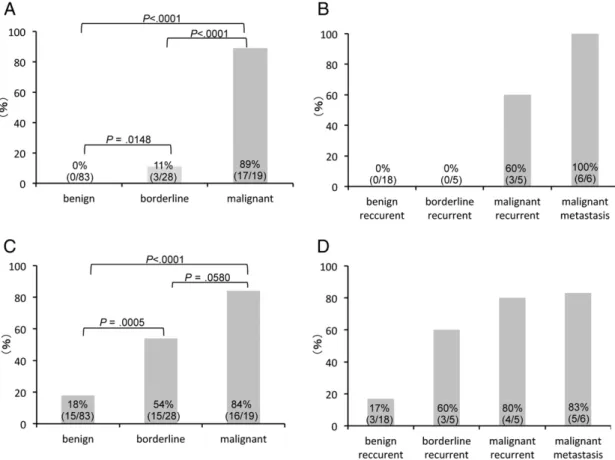
Collectively, among the primary PTs, a high expression of IMP3 was present in 0% (0/83 cases) of the benign PTs, 11%
(3/28 cases) of the borderline PTs, and 89% (17/19 cases) of the malignant PTs (Fig. 2A). The high IMP3 expression was significantly more frequent in the higher-grade tumors (Fig. 2A). In addition, in 2 cases of malignant PT with hetero- geneous components (benign and malignant components), high IMP3 expression was recognized in only the malignant component in the individual tumor. The heterologous sarco- matous elements observed infive cases of malignant PT also showed a high expression of IMP3.
Among the recurrent or metastatic tumors, 3 (60%) of 5 cases of recurrent malignant PTs and all six cases (100%) of metastatic malignant PT showed high IMP3 expression, whereas none of the recurrent lesions of benign and borderline PTs showed it (Fig. 2B).
The correlations between the IMP3 expression and clinico- pathological parameters are summarized inTable 3. The high expression of IMP3 was significantly correlated with larger tu- mor size (N5 cm, P= .0064), higher stromal cellularity (scores 2 and 3,Pb.0001) and stromal atypia (scores 2 and 3, Pb .0001), higher mitoses (5 or more/10 HPFs, Pb .0001) and higher Ki-67 labeling index (N3%, Pb.0001), but not with the patients' age.
3.3. EGFR expression
EGFR was positive in 4% (1/26 cases) offibroadenoma, 18% (15/83 cases) of benign PT, 54% (15/28 cases) of
borderline PT, and 84% (16/19 cases) of malignant PT (Fig. 2C). The prevalence of EGFR positivity was signifi- cantly higher in the advanced-grade tumors (Fig. 2C). Among the recurrent or metastatic tumors, 3/18 cases (17%) of recur- rent benign PT, 3/5 cases (60%) of recurrent borderline PT, 4/5 cases (80%) of recurrent malignant PT, and 5/6 cases (83%) of metastatic malignant PT were positive for EGFR (Fig. 2D).
EGFR overexpression was significantly correlated with a higher stromal cellularity score (Pb.0001) and a higher nu- clear atypia score (Pb .0001), higher mitoses (Pb.0001) and higher Ki-67 labeling index (Pb.0001), but it was not correlated with the patients' age or tumor size (Table 3).
EGFR overexpression was significantly correlated with high IMP3 expression (Pb.0001).
3.4. Prognostic analysis of IMP3 and EGFR
Follow-up information was available in 112 cases, in which the follow-up time ranged from 0.4 to 368.5 months (median, 36.2 months). In total, as of the last follow-up,five patients (4%) had died of the PT, 20 (18%) were alive with disease, and 87 (78%) showed no evidence of disease. Local recur- rences were present in 24 (21%) of 112 cases of all PTs, in- cluding 10 (14%) of 70 benign PTs, 5 (20%) of 25 borderline PTs, and 9/17 (53%) malignant PTs. Metastasis oc- curred in 10/112 (9%) cases, of which the primary tumor grade was benign in one (1%) case, borderline in one (4%) case and malignant in eight (47%) cases. Among these 10 patients,five died of tumor andfive were alive with metastatic disease. The first distant metastasis developed in lung (n = 5), bone (n = 4) and skin (n = 1), although multi-organ metastases eventually occurred. All 10 of the metastatic cases had initially or eventu- ally histologically malignant components; two cases of initial- ly nonmalignant PT (one case each of benign and borderline PT) transformed into malignant PTs after several episodes of local recurrence, and eventually both patients died of metasta- tic tumor. Among these 10 cases, histological specimens of metastatic foci were available in six cases including five cases that were initially malignant PT and one case that was initially borderline PT. Overexpressions of IMP3 and EGFR were present in most of these six cases (6/6 and 5/6 cases, respectively).
Table 2 IMP3 expression infibroadenomas and each grade of phyllodes tumors
IMP3 expression Fibroadenoma Benign PT Borderline PT Malignant PT
(n = 26) (n = 83) (n = 28) (n = 19)
Low expression 26 (100%) 83 (100%) 25 (89%) 2 (11%)
No 25 (96%) 78 (94%) 19 (68%) 2 (11%)
Focal weak 1 (4%) 5 (6%) 6 (21%) 0 (0%)
High expression 0 (0%) 0 (0%) 3 (11%) 17 (89%)
Focal strong 0 (0%) 0 (0%) 3 (11%) 6 (31%)
Diffuse weak 0 (0%) 0 (0%) 0 (0%) 0 (0%)
Diffuse strong 0 (0%) 0 (0%) 0 (0%) 11 (58%)
Abbreviation: PT, phyllodes tumor.
Table 3 The correlation between IMP3 and EGFR expression and clinicopathological parameters in primary PTs (n = 130)
Factors IMP3 EGFR
Low (n = 110) High (n = 20) P Negative (n = 84) Positive (n = 46) P Age (years)
≤45 61 10 .8077 45 26 .8542
N45 49 10 39 20
Size (cm)
≤5 61 4 .0064 45 20 .3592
N5 49 16 39 26
Stromal cellularity
Score 1 73 0 b.0001 60 13 b.0001
Score 2,3 37 20 24 33
Nuclear atypia
Score 1 80 1 b.0001 66 15 b.0001
Score 2,3 30 19 18 31
Mitosis (/10 HPFs)
0-4 94 1 b.0001 73 22 b.0001
≥5 16 19 11 24
Ki-67 LI(%)
≤3% 68 0 b.0001 55 13 b.0001
N3% 42 20 29 33
EGFR
Negative 83 1 b.0001 – – –
Positive 27 19 – – –
Abbreviations: HPFs, high-powerfields; LI, labeling index.
Fig. 2 The frequency of high IMP3 expression in each grade of primary PTs (A) and recurrent/metastatic PTs (B). The frequency of EGFR over- expression in each grade of primary PTs (C) and recurrent/metastatic PTs (D). High IMP3 expression (A) and EGFR overexpression (C) were each significantly more frequent in the higher-grade tumor among the primary tumors. The frequencies of high IMP3 expression (B) and EGFR over- expression (D) in the recurrent/metastatic tumors were essentially the same as those of the corresponding grades of primary tumors.
35 IMP3 in malignant phyllodes tumor
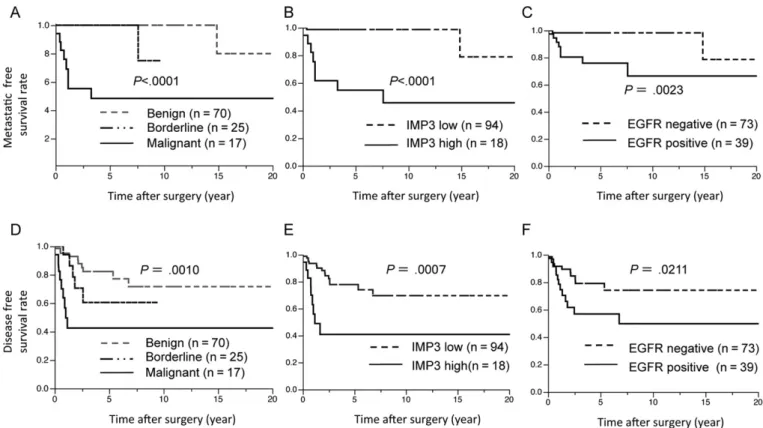
We analyzed the prognostic values of the IMP3 overex- pression, EGFR overexpression and other clinicopathological parameters. Histologically malignant tumors showed signifi- cantly shorter MFS and DFS (Pb.0001,P= .0010, respec- tively) (Fig. 3A and D). High IMP3 expression was significantly associated with shorter periods of MFS (Pb .0001) and DFS (P= .0007) (Fig. 3B and E). EGFR overexpression was also significantly associated with shorter periods of MFS (P= .0023) and DFS (P= .0211) (Fig. 3C and F). Histological grade, high IMP3 and EGFR expression were not each correlated with shorter OS (P= .0991, P= .0601 andP=.2337, respectively).
In the univariate analysis, higher stromal cellularity score (score 2 or 3,P= .0011), higher nuclear atypia score (score 2 or 3,P= .0004), higher mitoses (5 or more/10 HPFs,P≤ .0001), higher Ki-67 labeling index (N3%, P = .0001), EGFR positive expression (P= .0030) and high IMP3 expres- sion (P≤ .0001) were each significantly correlated with shorter MFS (Table 4).
In the multivariate analysis, high IMP3 expression was the only independent prognostic factor associated with shorter MFS (hazard ratio: 7.54,P= .0192). We excluded mitosis and EGFR expression from the multivariate analysis, because there was a strong correlation between mitosis and Ki-67 and that between EGFR expression and IMP3 expression (Table 3);
these factors were thought to be confounding.
4. Discussion
The present study showed the prevalence and clinicopatho- logic significance of IMP3 expression in PTs. Very recently, Bellezza et al have shown that IMP3 expression was higher in malignant PTs (56% of cases) than in borderline (15%) and benign cases (5%); however, the prognostic value of IMP3 overexpression in PT has been unclear[15]. In the cur- rent study, we found that the IMP3 expression was higher in malignant PTs compared to thefibroadenomas and benign to borderline PTs. In addition, the heterologous sarcomatous ele- ment and the malignant component in the tumors with a het- erogeneous grade showed high expressions of IMP3, supporting our hypothesis that IMP3 overexpression may be related to histological progression. High IMP3 expression was also correlated with significantly worse prognosis in the present series. Notably, the high expression of IMP3 was an independent prognostic factor associated with shorter MFS in the multivariate analysis. In our series of PTs, all 10 of the cases with distant metastasis had initially or eventually histo- logically malignant components. In addition, the cause of death was distant metastasis in allfive of the patients who died. Thesefindings indicate that the correct pathological diag- nosis to identify the histologically malignant component is very important for the clinical management of PT. As for IMP3, the majority of metastatic PTs showed high IMP3
Fig. 3 Kaplan-Meier analyses for metastasis-free survival (A-C) and disease-free survival (D-F) by histological grade, IMP3 expression and EGFR expression. Among 110 cases of PTs, the histological grade (malignant PT) (A and D) high IMP3 expression (B and E) and EGFR over- expression (C and F) were significantly associated with shorter survival times (Pb.0001, .0010,b.0001, .0007, .0023, and .0211, respectively).
expression. In this context, IMP3 may be an ancillary tool in identifying histologically malignant PTs and also PTs with high metastatic potential.
There are some reports showing that in PTs, recurrence-free survival is influenced by positive surgical margins[4,17]. Un- fortunately, in our patient series, the surgical margin informa- tion was not available in several cases—the cases from two or three decades ago, in particular. Nevertheless, high IMP3 ex- pression was also associated with shorter RFS, and it is thus possible that IMP3 overexpression contributes to local recur- rence. However, the precise mechanism of any involvement of IMP3 in recurrence is not clear at present.
In benign to borderline PTs, stromal cellularity may be higher in the zone adjacent to the epithelial component, a phe- nomenon that is sometimes referred to as the periepithelial ac- centuation of stromal cellularity[2]. Sawhney et al showed that stromal mitotic activity in PT was significantly more like- ly to occur close to rather than remote from the epithelial com- ponent[18]. These observations support the hypothesis that stromal growth may be stimulated by the epithelial component [18,19]. In the present study, benign to borderline PT some- times showed weak and focal IMP3 expression only at the periductal area. On the other hand, in parallel with stromal cell overgrowth, malignant PT showed diffuse and strong expres- sions of IMP3. Thesefindings suggest that the overexpression of IMP3 in malignant PT may play a role in the growth of stro- mal cells in a manner independent of epithelial component.
Previous studies showed that EGFR expression was higher in advanced-grade PTs, indicating that EGFR overexpression may be involved in the progression of PTs[13,14]. In contrast, Yonemori et al have shown that EGFR expression was not cor- related with recurrence-free or overall survival in 41 PT cases
[20]. To the best of our knowledge, this is thefirst report show- ing that EGFR overexpression was correlated with worse metastasis-free and disease-free survival in PT. In addition, EGFR overexpression was significantly correlated with high IMP3 expression. According to an experimental study of TNBC, EGFR signaling pathway induced IMP3 overexpres- sion, and IMP3 contributed to the migration and invasion of carcinoma cells [12]. In addition, estrogen receptor β re- pressed the expression of EGFR, leading to the down- regulation of IMP3 in TNBC cells. Similar to the relationship between EGFR and IMP3 in TNBC, overexpressed EGFR might contribute to the increased IMP3 expression especially in malignant PT, and IMP3 might play a role as an effector of EGFR-mediated tumor cell growth in PT. Although further research is needed to elucidate the relationship between EGFR and IMP3 at the molecular level, our results suggest that EGFR inhibition, leading IMP3 down regulation, might be a therapeutic strategy of malignant PT, like TNBC[12].
According to recent reports, theMED12mutation is present in 60% to 70% offibroadenomas and benign to borderline PTs [21,22]. In contrast, theMED12mutation is present only in 20% to 40% of malignant phyllodes tumor. Considering this difference together with IMP3 expression status, some popula- tion of malignant PTs might have a distinctive molecular path- ogenic mechanism which is different from that of fibroadenoma and benign to borderline PTs. However, further studies are warranted to elucidate this hypothesis and the rela- tionship between MED12 and IMP3.
In conclusion, ourfindings suggest that high expressions of IMP3 and EGFR with a characteristic distribution (ie, a diffuse staining pattern) may be helpful for both identifying malignant PTs and predicting their prognoses.
Table 4 Prognostic factors for metastasis-free survival in phyllodes tumors
Factor Univariate Multivariate
Hazard ratio (95% CI) P Hazard ratio (95% CI) P
Age (years)
≤45 versusN45 0.85 (0.22-2.97) .7963 not included
Size (cm)
≤5 versusN5 2.57 (0.71-11.94) .1533 not included
Stromal cellularity
Score 1 versus score 2, 3 13.09 (2.45-241.38) .0011 0.27 (0.007-10.92) .4590
Nuclear atypia
Score 1 versus score 2, 3 15.83 (2.97-292.01) .0004 3.26 (0.30-102.17) .3926
Mitosis (/10 HPFs)
≤4 versusN4 20.13 (3.77-371.41) b.0001 not included
Ki-67 LI(%)
≤3 versusN3 12,389,769 (5.37-inf.) .0001 3,326,005 (0-inf.) .0659
EGFR
Negative versus positive 7.68 (1.92-50.90) .0030 not included
IMP3
Low versus high expression 18.46 (4.56-123.17) b.0001 7.54 (1.33-141.30) .0192
Abbreviations: HPFs, high-powerfields; LI, labeling index; inf., infinity.
37 IMP3 in malignant phyllodes tumor
Supplementary data
Supplementary data to this article can be found online at http://dx.doi.org/10.1016/j.humpath.2016.04.007.
References
[1] Tse GM, Niu Y, Shi HJ. Phyllodes tumor of the breast: an update. Breast Cancer 2010;17:29-34.
[2] Tan PH, Tse G, Lee A, Simpson JF, Hanby AM. Fibroepithelial tumours.
In: Lakhani SR, Ellis IO, Schnitt SJ, Tan PH, van de Vijver MJ, editors.
World Health Organization classification of tumors. WHO classification of tumors of the breast. Lyon: IARC Press; 2012. p. 142-7.
[3] Moffat CJ, Pinder SE, Dixon AR, Elston CW, Blamey RW, Ellis IO.
Phyllodes tumours of the breast: a clinicopathological review of thirty- two cases. Histopathology 1995;27:205-18.
[4] Barth Jr RJ. Histologic features predict local recurrence after breast con- serving therapy of phyllodes tumors. Breast Cancer Res Treat 1999;57:
291-5.
[5] Jara-Lazaro AR, Tan PH. Molecular pathogenesis of progression and re- currence in breast phyllodes tumors. Am J Transl Res 2009;1:23-34.
[6] Tse GM, Lee CS, Kung FY, et al. Hormonal receptors expression in ep- ithelial cells of mammary phyllodes tumors correlates with pathologic grade of the tumor: a multicenter study of 143 cases. Am J Clin Pathol 2002;118:522-6.
[7] Nielsen J, Christiansen J, Lykke-Andersen J, Johnsen AH, Wewer UM, Nielsen FC. A family of insulin-like growth factor II mRNA-binding pro- teins represses translation in late development. Mol Cell Biol 1999;19:
1262-70.
[8] Liao B, Hu Y, Brewer G. RNA-binding protein insulin-like growth factor mRNA-binding protein 3 (IMP-3) promotes cell survival via insulin-like growth factor II signaling after ionizing radiation. J Biol Chem 2011;286:
31145-52.
[9]Morimatsu K, Aishima S, Yamamoto H, et al. Insulin-like growth fac- torII messenger RNA-binding protein-3 is a valuable diagnostic and prognostic marker of intraductal papillary mucinous neoplasm. HUM
PATHOL2013;44:1714-21.
[10] Yamamoto H, Arakaki K, Morimatsu K, et al. Insulin-like growth factor II messenger RNA-binding protein 3 expression in gastrointestinal mes- enchymal tumors. HUMPATHOL2014;45:481-7.
[11] Cornejo K, Shi M, Jiang Z. Oncofetal protein IMP3: a useful diagnostic biomarker for leiomyosarcoma. HUMPATHOL2012;43:1567-72.
[12] Samanta S, Sharma VM, Khan A, Mercurio AM. Regulation of IMP3 by EGFR signaling and repression by ERβ: implications for triple-negative breast cancer. Oncogene 2012;31:4689-97.
[13] Kersting C, Kuijper A, Schmidt H, et al. Amplifications of the epidermal growth factor receptor gene (egfr) are common in phyllodes tumors of the breast and are associated with tumor progression. Lab Investig 2006;86:
54-61.
[14] Tse GM, Lui PC, Vong JS, et al. Increased epidermal growth factor re- ceptor (EGFR) expression in malignant mammary phyllodes tumors.
Breast Cancer Res Treat 2009;114:441-8.
[15] Bellezza G, Prosperi E, Del Sordo R, Colella R, Rulli A, Sidoni A. IMP3 is strongly expressed in malignant phyllodes tumors of the breast: an im- munohistochemical study. Int J Surg Pathol 2016;24:37-42.
[16] King RL, Pasha T, Roullet MR, Zhang PJ, Bagg A. IMP-3 is differential- ly expressed in normal and neoplastic lymphoid tissue. HUMPATHOL
2009;40:1699-705.
[17] Tan PH, Thike AA, Tan WJ, et al. Predicting clinical behaviour of breast phyllodes tumours: a nomogram based on histological criteria and surgi- cal margins. J Clin Pathol 2012;65:69-76.
[18] Sawhney N, Garrahan N, Douglas-Jones AG, Williams ED. Epithelial- stromal interactions in tumors. A morphologic study offibroepithelial tu- mors of the breast. Cancer 1992;70:2115-20.
[19] Sawyer EJ, Hanby AM, Rowan AJ, et al. The Wnt pathway, epithelial- stromal interactions, and malignant progression in phyllodes tumours. J Pathol 2002;196:437-44.
[20] Yonemori K, Hasegawa T, Shimizu C, et al. Correlation of p53 and MIB-1 expression with both the systemic recurrence and survival in cases of phyllodes tumors of the breast. Pathol Res Pract 2006;202:
705-12.
[21] Pfarr N, Kriegsmann M, Sinn P, et al. Distribution of MED12 mutations infibroadenomas and phyllodes tumors of the breast-implications for tu- mor biology and pathological diagnosis. Genes Chromosom Cancer 2015;54:444-52.
[22] Ng CC, Tan J, Ong CK, et al. MED12 is frequently mutated in breast phyllodes tumours: a study of 112 cases. J Clin Pathol 2015;68:
685-91.