107
■Article■
Journeys
to Watersheds:
Ecology, Nation
and Shifting Balance of Malayaalam
●
Yasushi
Uchiyamada
1.
Introduction
This paper critiques a recent upsurge of nationalist ecological histories
of India that valorise 'sacred groves' of India as an instance of
indig-enous biodiversity management system. Madhav Gadgil and M. D. Subash
Chandran's
'Sacred Grove' (1992) and Madhav Gadgil and Ramachandra
Guha's
This Fissured Land (1992), to name only a few, are exemplary
works of this genre (see also Gadgil and Guha 1995; Shiva 1988). What
characterises
this body of works is a peculiar combination
of (a) an
anti-modernist ideology ('problematic'),
(b) a post-Enlightenment
epistemo-logical framework ('thematic'),
and (c) alternative ecological and political
concerns (or activism) with an emphasis on 'indigenous beliefs and
prac-tices' which are superior to the contrastive
'western'
approach to
ecol-ogy. This alternative ecological project has three important
roots. The
内山田 康
Yasushi
Uchiyamada,
Lecturer
in Social
Anthropology,
Department
of Social
Anthropology, University of Edinburgh.
Subject: Social Anthropology.
Publications: "Two Beautiful Untouchable Women: Processes of Becoming in South
India," In Day, S., E. Papataxiarchis and M. Stewart (eds.), Lilies of the Field:
Mar-ginal People Who Live for the Moment. Oxford and Boulder: Westview, pp. 96-116,
1999. "Soil, Self, Resistance: Late-modernity and locative spirit possession in Kerala,"
in Assayag, J. and G. Tarabout (eds.), La Possession en Asie du Sud: Parole, Corps,
Territoire (Purusartha no. 21). Paris: Ecole des Hautes Etudes en Sciences Sociales, pp.
289-31, 1999. "Passions in the Landscape: Ancestor spirit and land reforms in Kerala,
India," South Asia Research, vol. 20, no. 1, pp. 63-84, 2000.
108
Journal
of the Japanese
Association
for South Asian Studies,
13, 2001
first is nationalist
thought
that extrapolates
India's
scientific past (see
Prakash 1999). The second is an ecological stream of Subaltern
Studies
that focuses on peasant resistance to the colonial rule in the Himalayas:
Ramachndra
Guha's
The Unquiet Woods (1989), that precedes Gadgil
and Guha (1992), for instance, falls within this genre. The third is a
global political and circumstantial
context of the Earth Summit in Rio
held in 1992. This peculiar combination
has created a fertile ground for
a proliferation of contradictory
combinations
of the anti-modernist
prob-lematic and the post-Enlightenment
thematic with resonance with Hindu
nationalist
movements
that share with this genre the assumptions
of
'Hind
utuva' nation and nature(Sinha, Guruvani and Greenberg 1997:
89-90). What is peculiar to this genre is that it further resonates with
both the projects of dominant
international
interventionist
institutions,
such as UNDP
and UNESCO,
and those of prominent
critics of the
international
development
regime, such as Arturo Escobar (1995). In
short, the genre appeals to the national, the interventionist,
and the
anti-development
political projects of ecology. How was it possible?
I have engaged in this debate partly because I have been studying
'sacred groves' of South
India since 1992
, and partly because
I was made
to engage in discussions with a group of Indian cultural ecologist in a
symposium
in 1998, which was one of several extensions of the initial
1992 meeting. In the symposium,
I had an opportunity
to discuss the
issue with a group of anti-modernist
cultural ecologists and with a
Mus-lim scholar, who was deeply concerned about the pro-Hindu
connota-tion of the alternative approach to ecology and ecological history. The
dominant mood of such knowledge generating and knowledge
dissemi-nating symposia, sponsored by international
interventionist
institutions,
can be characterised
by their tendency
to overemphasise
the positive
ecological effects of religious traditions.
Lance Nelson notes, "the
nega-tive outcomes of religious teachings that can be used to rationalize
envi-ronmental
neglect are probably greater than the positive influence of
those that encourage
conservation
and protection
(Nelson 2000: 5-6,
emphases original). The uneasy tension between the anti-modernist
rep-resentation
of national ecological history and the Muslim scholar's
anxi-ety that reverberates in my narrative is a reminder of the productivity
of
the discourse of religion and ecology. My objectives are dual. Firstly, I
shall point out a discrepancy
between religious norms and actual
con-Journeys
to Watersheds:
Ecology,
Nation and Shifting
Balance of Malayaalam
109
ducts
by drawing
on an anthropological
model
of 'sacred
grove'
in Kerala.
Secondly,
I shall
discuss
changes
in the way of death
and related
changes
of the
sacred
geography.
These
mutually
implicated
historical
transfor-mations
of the way
of death
and the sacred
geography
in Kerala
resonate
uncannily
with
the
emergent
discourse
of ecology,
religion
and
nation.
The
new
anti-modernist
cultural
ecology
is not
merely
imposed
from
above,
but
has been
substantiated
from
within
with
different
degrees
of
consonance
and
compliance.
In the first
section,
I introduce
the readers
the feel of the current
state
of 'sacred
groves'
in Kerala.
The
paradox
is that
as 'indigenous
beliefs
and
practices'
has
become
the
key
notion
of the
genre,
the
low-status
indigenous
peoples
have
lost
their
'sacred
groves.'
The
second
section
was originally
presented
in a politically
charged
academic
context
wherein
the relations
between
'indigenous
beliefs
and practices'
with
reference
to
'sacred groves' and biological diversity were discussed
. In this section, I
illuminate
the assumptions
and premises of the cultural ecologists, by
contrasting their strategy with an anthropological
model of 'sacred grove.'
The second section is further divided into four subsections: 2.1 presents
the image of 'planting the death' as a key to understanding
Malayalee
personhood;
2.2 juxtaposes
simplified models of 'biodiversity
manage-ment' and 'death-life reciprocity';
2.3 examines a Malayalee ecologist's
exegesis of a proverb:
'If grove is polluted, pond dries up'; and 2.4
provisionally
concludes
that a kaavu can be reduced to a single tree
without compromising
its ritual function. In the final section, I historicise
my own argument by focusing on changing way of death of Malayalees,
which is linked to the changing sacred geography of Kerala as a whole. I
conclude that Hinduisation
of kaavus, changes in the ways of death and
life, and the transformation
of the sacred geography
after all coincide
with a new spatial mobility and a new ecological awareness of Malayalees.
The assertions of Hindu cultural ecologists are, in the final analysis, part
of a wider process of making post-colonial
India 'ancient,' scientific and
authentic.
1.1 A Prolegomenon-'Kurava
Grove'
sans Kuravas
In July 2000, I stayed in a hotel in Ochira-a
pilgrimage
destination
along the coastal national highway-well-known
for its aalttara
('ban-yan pedestal').
Although Ochira Aalttara has a gate with towers typical
110
Journal of the Japanese Association for South Asian Studies, 13, 2001
to newer pan-Indian
Hindu temples, there are no architectural
struc-tures in the yard. Instead, there are three walled-in banyan trees in the
centre and a walled grove on the side, officiated by low-caste ritual
spe-cialists. At the far back to the west, there is an unwalled and junglish
grove of 'auto-ecological'
(Savyasaachi
1999) or 'autochthonous'
type,
which is not only unattended,
but seemed to be inaccessible to ordinary
persons. Ochira is not a 'temple' as is often mistakenly
referred to, but
an aalttara with sacred trees and groves, more tamed ones nearer to the
national highway and an autochthonous
one at the far end.1)
Although
I had lived in a neighbouring
village I call 'Nagarajanadu'
in 1992-93, and had returned to the area several times, I did not know
about this newly opened hotel by a new bypass owned by a local Izhava,
who had worked in the Persian Gulf for nineteen years until 1998.2) As a
successful Gulf migrant worker, he had rebuilt his house, his family
temple, and built the hotel. During my trip to Kerala in July 2000, I
have visited several temples and groves of Kuravas-the
most looked
down upon untouchable
caste in the area formerly known as Central
Travancore-in
various localities in the region. Until then I had usually
stayed in Nagarajanadu.
But this time I had a reason to stay in Ochira.
Back in May 1992, while I was still new in the field, the headman of
one of the seven Kurava sub-lineages in Nagarajanadu
told me that the
founding ancestor of his sub-lineage came from a place near Ochira. At
the south side of Nagarajanadu
and its neighbouring
Christian junction
of 'Pallimood,'
there was a large cluster of Kurava settlements.
Some of
the Kurava sub-lineages had come to the Kurava settlement from other
places after having driven out from their ancestral lands more than a
century ago. This Kurava territory was not free from a similar process
either: the land of Kuravas has been encroached by Syrian Christians,
Nayars and Izhavas. Syrian Christians
have been encroaching
agricul-tural garden lands of Kuravas,
while Nayars and Izhavas have been
encroaching both ancestral shrines of Kuravas and their agricultural land.
Since I had realised that the process of the 'double encroachment'
of
Kurava lands and shrines could not be properly
understood
without
locating the phenomenon
in a wider and historical process of modernity
in Kerala, I had been visiting 'knots' where Kurava networks and forces
of modernity
in Kerala seemed to be mutually articulating.
The
follow-ing is a summary of the origin myth of the Kurava sub-clan.
Journeys to Watersheds: Ecology, Nation and Shifting Balance of Malayaalam
111
A long time ago, our ancestor lived in a place near Ochira. He left
the place and came to Valiya Palli ("Big Church")
in Pallimood.3)
There he prayed to the god [St. Stephen] and asked to give him a
place to live. The god told him to go to the forest, because there were
already 101 rakshasas ('demons') living with him in the church. The
Tarakans4) told our ancestor to go to the forest. So our ancestor came
to the forest where there were tigers. In the forest there was a big
ilanni tree.5) Our forefather climbed on the top of the ilanni tree and
lived there for four and a half years. At the south-west corner of the
forest, there was a Kurava old man who was the uuraali ('shaman')
of the Kurava forest, without whose permission, nobody was allowed
to live in it. Therefore our forefather
climbed down the ilanni tree
and went to see the uuraali. Our forefather had 101 swaruupams
('figurines/deities')
with him. The uuraali
also had similar
swaruupams but they were less in number. The uuraali was therefore
less powerful compared to our forefather. So the uuraali asked our
forefather
to give him the swaruupams he brought from his place.
The uuraali buried these 101 swaruupams in his garden covering
them with a big uruli (bell metal vessel) to prevent the swaruupams
from escaping from where they were buried. After having buried the
101 swaruupams, the uuraali allowed our forefather
to live in the
forest. He cleared one and a half acres of the forested land and we
live here since then.
This is a story of how an alienated
Kurava and his lineage deities
established
'blood relations' with the host lineage and con-substantial
connectedness
with the soil of the forest after surrendering
his 101
swaruupams which were buried in the garden of the uuraali. This funeral
like exchange signifies both the fluidity of autochthonous
identity and
the alienation of Kuravas from their forest-like territories as an effect of
changing spatial processes of the nineteenth century Kerala or malayaalam,
of which the ascendance of Syrian Christians
and the decline of Nayars
(Jeffrey 1994), the opening of export-oriented
plantations in the Western
Ghats by European
planters (Baak 1997) constitute its part.
During the trip in July 2000, I saw hundreds
of swaruupams, for the
first time, in several Kurava ancestral 'Palaces' and pedestals in their
lineage groves.6) Yet I was still unable to locate the place from where the
forefather of the Kurava sub-clan came to Nagarajanadu,
after losing his
ancestral land in his native place. About five kilometres to the north-east
112 Journal of the Japanese Association for South Asian Studies, 13, 2001
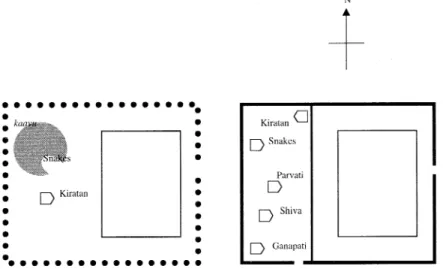
of Ochira, there was a new Kali temple called Kurakkaavu, which
liter-ally means `Kurava's Kaavu.' I was told that a local temple trust, which
consisted of Nayar and Izhava members, had constructed this temple
around 1993. Kuravas were conspicuously absent from the 'Kurava's
Kaavu.' By this time, I was familiar with several instances wherein
an-cestral 'palaces' and lineage groves of Kuravas had been encroached,
possessed, and transformed into Hinduised temples by Nayars and
Izhavas.7)
In the vicinity of Kurakkaavu, there was only one Kurava family
whose house was located about a half kilometre to the south. Kurifiukurifiu,
a Kurava old women in her eighties, told me that she was the uuraali of
the kaavu. The Kurakkaavu was a kaavu owned by three Kurava
lin-eages. But Kuravas had gradually left the place as their lands had been
encroached by Syrian Christinas, Nayars and Izhavas. Now Kuravas are
bared from approaching the Kurakkaavu temple. The Nayars and Izhavas
were intimidating the Kurava family. Under the threat of her grandson's
death, the Kurava family do not go near Kurakkaavu.
Today, there is a walled shallow shrub •\ which does not contain any
sacred or fearful auto-ecological trees important for ancestors and
dei-ties •\ at a corner of Kurakkaavu. At the centre of the shrub is a young
cashew-nut tree, which seemed to be five or six years old, as if to ridicule
the trimmed and disgraced kaavu. The iron gate of the walled shrub is
locked. A sign written on the wall reads, vettila parattunna sthalam ('the
place to throw betel leaf'), which seems to mean: "Do not enter. Throw
your offerings [to the cashew-nut tree] from the road." In the Kurakkaavu
temple yard, there is a shrine of Kiratan, a demigod associated with
'
savages
'of forested mountains and with Shiva (see below). Kiratan is a
'
terrible
'mountain
demigod
who
is now
enshrined
in a concrete
cham-ber.
This
indexes
both
the
connection
and
separation
of
Kiratan
from
the
kaavu
of the
'savages.'
More
importantly,
Kiratan
in the
new
Kura-kkaavu
temple
is a sign,
which
indexes
the
presence
of the
forest
and
its
inhabitants
of
malaya
(the
Western
Ghats)
in
Kurakkaavu,
the
signifi-cance
that
the
local
Nayars
and
Izhavas
try
to
repress
by
religious
and
violent
means.
The
deity,
however,
seemed
to
have
been
in the
process
of transformation
from
an
'uncivilised'
mountain
demigod
of hill
people
in malaya
to
'civilised'
Shiva •\
the
high
god
of
Hinduism
associated
with
a distant,
and
hence
more
abstract,
mountain
Kailas
in
himalaya
Journeys to Watersheds: Ecology, Nation and Shifting Balance of Malayaalam 113
('iced malaya' or the Himalayas)•\worshipped by 'cultured' people of
the plains.
Many untouchables and tribals have been driven out from their
lin-eage groves in the plains and forests in the hills. Encroachers from the
plains, students of environmental science, NGOs, Hindutva activists and
tourists are now entering forested mountains for various causes,
pur-poses and reasonings. Although the former and the latter do not share a
similar intensity of the loss of con-substantial connectedness to land
mediated by everyday agricultural and funerary practices, and their
im-plications, both of them are caught up in the moment of ecologisation of
nature, and a related moment of its commodification with a nationalist
twist of Hinduising non-Hindu deities of the hills. Thus, the
deregula-tion of Indian economy, via the B JP-led government intervention, is
taking place side by side with the regulation (or streamlining) of minor
deities along the meta-narrative of the Vedic order of things. Today, we
regularly hear the readings of Ramayana and Mahabharata, the prime
politico-poetic narratives of pan-Indian Hinduism, reverberating from
loudspeakers tied to aatmaavu ('soul') trees in various ancestral shrines
and groves of tribals in the plains and the hills. This repetitive and
disciplinary performance of offering Ramayana, the great epic of idealised
king from Ayodhya, is at the heart of the Hinduisation of Malayalee
landscape, and is part of a related process of the making of the postcolonial
Hindu national state inscribed in the latter. This is not unique to Hindu
India alone. There are historical precedents wherein forests are invested
with the images of authentic past.
2. September 24th 1998, at a Conference Hall in UNESCO
Yesterday we heard an ecological exegesis of the Hindu notion of
tiirtha yaatra, which was translated as 'the journey to the watershed.' I
must say here that there is a huge slippage: a slippage that eclipses the
poetics of analogies, that creates a new discursive space for problem
solving. Following Diana Eck (1981) I understand a tiirtha (or tiirtham
in Malayaalam) as a 'crossing place' where one crosses a river from this
side to the far shore, a crossing place that connects the world of the
living and that of divinities. There are tiirthas all over the Indian
114 Journal of the Japanese Association for South Asian Studies, 13, 2001
pilgrimage destinations beside sacred rivers, but also ponds, rocks,
moun-tain peaks, forests, and even single trees can be tiirthas. If peoples of the
subcontinent have been practising 'the journey to the watershed' since
the Vedic period, implying that they are natural conservationists, I must
stress that they have been making journeys to all sorts of crossing places
(including of course certain places in 'watersheds') to deal with anxieties
relating to life and death, which arise from the fundamental problem of
the living, viz. mortality (Gold 1988).
In this paper I am telling you a series of stories. Some are related.
Some are discordant. The perspective that connects these stories is
ana-logy (see Levi-Strauss 1966: 35; Strathern 1992: 84) and slippage,
follow-ing (or analogising) the strategy of Sandhyabhaasa, the esoteric language
of Kerala.8) Collectively, these stories form an analogy of the narrative
space of kaavu, conventionally translated into English as 'sacred grove,'
which I think is a misnomer. Kerala in South India is known for its
profuse and green vegetation. It has also been known as the land of
magic. The richness in green and magic is one of the peculiarities of
Kerala landscape, which is covered with networks of kaavus. What
fol-lows is an account of the location of kaavus in Malayalee social world.
What about biodiversity? I will touch on what I call 'biodiversity by
default' later in this paper.
Let me start with a description of what a kaavu looks like. A kaavu is
a grove consisting of several sacred and fearful trees,9) demigoddesses
and demigods, ancestors, artefacts used in rituals, ritual actions,
narra-tives of the superhuman power (shakti) and fearful fault (doosham) of the
kaavu and place. Size and age of kaavus vary. There are big, small, old
and new kaavus. Some are rich in biodiversity, while some kaavus have
only a few trees. Divinities in kaavus also vary but there usually are
ancestors, ghosts, demigoddesses, demigods, and the divine snake Naga
in them. Malayalees say that there are life-force (shakti) and fault (doosham)
in kaavus•\liminal places connecting the social and the superhuman,
enabling the transformation of life into place and death into life.
2.1 Image One: Planting the Dead
Let me present one image from South India as an introduction to the
world from which the familiar binary distinction of society and nature in
ques-Journeys
to Watersheds:
Ecology,
Nation and Shifting
Balance
of Malayaalam
115
tioned in a unique way.10) This is a sacred topography
of South India in
which there are certain places where the social is permeated
with the
natural and the supernatural
(or rather superhuman).
The purpose
of
presenting
this image is not to exoticise South Indian society. I am
presenting this image as a heuristic aid or satirical rhetoric to look at our
own society-nature
relationships
in a different way.
'
Hindus
'11)in Kerala
plant
various
seeds
and rhizomes
in cremation
as
well as burial pits during funerals. Middle-caste Nayars, for instance,
cremate the deceased at the south side of the house, which is usually part
of garden land where tapioca, yam, taro and coconut are planted. In
other words, the deceased is cremated, not as in north India, in a
sepa-rate cremation ground, but in agricultural land. After cremation, bones
are picked up, washed and put into an earthen pot, which is then
tempo-rarily buried under the 'house jack-fruit tree' until it is dug out a year
later and brought to a 'crossing place' on the coast for immersion in the
Arabian Sea. In an ideal case, the deceased is believed to depart from
this world to the abode of ancestors. At this point the ghost (preetam) is
transformed into a liberated ancestor (pitr). This is an ideal type of
Nayar funerary rites. In reality, however, many poorer Nayars buried,
rather than cremated, the deceased until recently.12)
Let me now return to the cremation pit. After the bones are picked up
the pit is filled with soil. A coconut will be planted on the spot which
corresponds to the naval of the deceased; a rhizome of banana at the
place of the head; wheat, paddy, nine kinds of pulses, mustard-seed, and
turmeric are planted over the soil. In the case of low-caste and poorer
people, connections between the dead, place and edible plants are more
direct, for the deceased is buried rather than cremated and the seeds and
rhizomes•\which vary from caste to caste•\are sown directly over the
body (Uchiyamada 1998). The soul of the deceased is then moved from
the burial ground to a lineage kaavu near its former house.
What strikes me is the image of grains, edible seeds, pulses, tubers,
fruits, and spices growing out directly from the body of the deceased in
the garden. As I have discussed elsewhere, the lower the caste and status,
the stronger is the people's attachment to land via what I call
endo-cannibalism (Uchiyamada 2000). The dead body is a 'seed,' as it were,
planted in the garden where people's everyday food grows. This is not a
116 Journal of the Japanese Association for South Asian Studies, 13, 2001
cut a long story short, ancestors of the lowest•\especially those of former
untouchables•\are believed to stay in, or more precisely move in and
out of, their lineage kaavus, from where they continue to intervene in the
everyday life of their descendants. This very phenomenon may be seen
from an elitist, middle-class and nationalist Hindu reformist viewpoint
(Chatterjee 1986) as that related to low-caste, 'uncultured' and
'supersti-tious' practice of worshipping the dead that haunt the domain of the
living.
2.2 Tiodiversity Management' vs. 'Death-Life Reciprocity'
You may now guess that the image of planting the deceased as a 'seed,'
from which various grains, pulses, tubers, fruits, and spices grow is an
indigenous allegory of biodiversity management. This is not the case.
The story is instead, firstly, one of reciprocal flows that unite the
ances-tors, the living and locality (Bloch 1986; de Coppet 1985), and secondly
,
of the fetishisation of the 'indigenous beliefs and practices' by rationalist
Hindu cultural ecologists, who are ideologically anti-modernist
simulta-neously•\and hence the inherent antinomy•\who use the magic of
'
indigenous
beliefs
and practices'
in the
spirit
of utilitarianism
to attain
the double objective of proposing an alternative and nationalist biodiversity
management
system, and by implication
an alternative nationalist
mo-dernity.
I shall introduce a pair of contrasting images, one is a simplified
anal-ogy of the world of biodiversity management,
and the other is exoticised
analogy of dead-life reciprocity which is located in a particular
place,
mediated by plants, groves and ancestors. I would like to draw attention
to the absence of the distinction of agricultural land and burial ground in
Malayalee social world. There is continuity,
rather than separation,
of
agricultural
practices and funerary rites wherein plants, place, ancestors
and descendants
mutually permeate. The practice of biodiversity
man-agement involves the opposite, which is predicated on the act of
separat-ing these loosely connected, loosely bounded and mutually permeatseparat-ing
'
domains'
into
subject-centred
and asymmetric
categories imbued with
the modern regime of power/knowledge
and management.
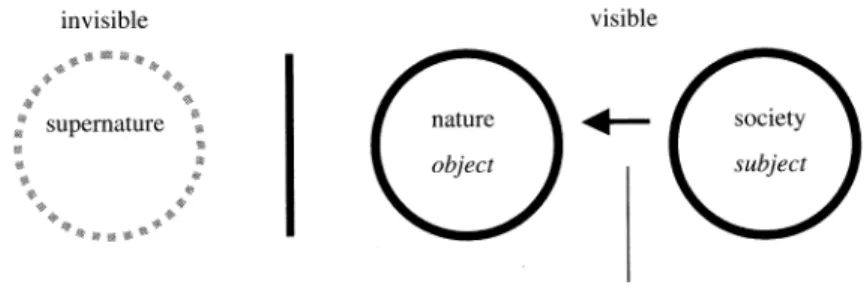
Figure 1 is an analogy of a post-Enlightenment
society centred
soci-ety-nature
relations, which is paradoxically
shared (at the level of
'the-matic' but not at the level of 'proble'the-matic')
by Hindu cultural ecologists
Journeys
to Watersheds:
Ecology, Nation
and Shifting
Balance of Malayaalam
117
(e.g. Gadgil and Guha 1992; Gadgil and Chandran 1992; Mitra and Pahl
1994), whose alternative ecology constitutes part of a wider 'problematic'
of alternative modernity of Indian nationalist thinking, as well as is
in-formed by the latter. 'They' (or 'we'?) are fundamentally
bourgeois-rationalist and simultaneously anti-modernist and nationalist. This is a
Cartesian model consisting of a series of binary oppositions, viz.
nature-society, nature-supernature, visible-invisible, and object-subject. The
protagonists of this dualistic world is a modern autonomous subject,
who gives little heed to its second meaning, i.e., the one who is
subju-gated to democracy or the modern regime of power (Cruikshank 1999),
who is, as an 'autonomous' agency (its first meaning), in a insulated and
privileged position to predate and protect •\ and therefore engages
him-self (including she) in the management of •\ the objectified nature, which
is now represented as 'natural resources,' sanitised from both the social
and the supernatural (Descola 1996; Palsson 1996).
The domain of supernature, which permeates the domain of the living
in non-Western societies (Gow 1995; Torren 1995; Dwyer 1996), and
Hollywood horror films in the West (Nuckolls 1999), is invisible to the
modern subject's enlightened eyes, and therefore remains beyond the
reach of modern management thoughts and practices. Nevertheless, a
group of ecologists of alternative kind argue that the supernatural is in
fact useful for managing biodiversity. These anti-modernist Hindu
cul-tural ecologists, who are at the same time bourgeois-rationalist,
repre-sent sacred groves as an instance of 'indigenous' or 'traditional' biodiversity
management systems (Gadgil and Chandran 1992; Mitra and Pahl 1994).13)
118
Journal of the Japanese
Association
for South Asian Studies, 13, 2001
There is a conflation of sacred groves, the existence of which is
insepa-rable from particular
ways of life and death as well as of place and
personhood making, which is fundamentally
non-modern,
and the Hindu
biodiversity
management,
which uses such embeddedness
as a useful
tool for attaining modernist
and nationalist
objectives, yet at the same
time is ontologically freed from the very embeddedness.
This may be the
reason why 'they' (or 'we') show little interest in describing historically
and place specific everyday workings of this embeddedness,
which is
rather casually black-boxed
and applied as a panacea, or magic. In this
model I am attempting to indicate that the project of Hindu (or similarly
indigenous)
biodiversity
management
is fundamentally
modernist
and
utilitarianist
in orientation,
despite their anti-modernist
political
out-look.")
Figure 2 is a simplified model of life-death reciprocity centred around
`sacred groves
,' the underlying assumption of which is endo-cannibalism
and con-substantiality
of people and place mediated by ancestors , edible
plants and groves. In this model, which draws on local exegeses, kaavus
of South India are depicted as (a) depositories of malevolence and
nega-tive qualities; (b) sites of super-human
life-force which grows junglish
vegetation as its manifestation;
(c) openings to the netherworld
and
cos-mogonic fertility; and (d) fuzzy and dark liminal places where hierarchy,
structure,
and binary oppositions
such as nature / supernature,
men /
women, living-kind / non-living-kind,
plant / people, pure / impure and
so on are all dissolve into a chaotic process of becoming.
In this second model, I am presenting
kaavu as a peculiar
tempo-spatial place connecting the world of the living and the netherworld
. It is
a metonym of the cosmogonic fertility of the netherworld.
Here, society,
which is regulated by the dharmic (moral) order, is separated from the
sacred grove, which is the depository
of highly destructive
and highly
fertile life-force. Yet this separation is partial. The reason is inherent in
the very nature of society. Death, sin, pollution of various kinds, such as
excrement
and menstrual
blood, all sorts of malevolence
and negative
qualities have to be constantly removed from the dharmic social order to
maintain its purity and auspiciousness. The hierarchical social order needs
kaavus and forests at the margins as the dumping ground for unwanted
substances and negative qualities.
Journeys to Watersheds: Ecology, Nation and Shifting Balance of Malayaalam
119
the affix 'sacred' is highly misleading.
I shall, therefore, add one more
affix and call it `goodbad' (or alternatively
gboaodd') sacred grove. Or I
shall just call it kaavu. A kaavu is sacred and fearful place, which is also
a dangerous
and powerful place haunted by jealous, greedy and
capri-cious ghosts, demons, ancestors, demigods and demigoddesses
who
in-tervene in the lives of the living. These divine beings cause misfortunes
120 Journal of the Japanese Association for South Asian Studies, 13, 2001
and epidemics. They also cure illnesses and protect people if properly
propitiated. Ancestors, lived bodies and places "interanimate each other"
(Casey 1996: 24).
It may be assumed more appropriate to call kaavu 'bad sacred' grove,
following the lead of Srinivas (1952), who followed Durkheim's
discov-ery of evil in the sacred (Das 1977: 114-131) and made a distinction of
`good sacred' and 'bad sacred
.' From a modern and reformist Brahmanical
point of view, many kaavus, especially those which are related to
low-castes, may appear as 'bad sacred' places. Precisely because these are
`bad sa
cred' places in the eyes of high caste people today, kaavus have to
be separated from the dominant social order. Nevertheless, viewed from
the low (as well as high) end of the hierarchy, the good-bad distinction is
not always so clear-cut.15)
In ancient Tamil texts, negative qualities were passed to Untouchl
ables and were then dumped in the forest (Hart 1975). In Kerala, it was
Untouchables who received food gifts (anna daanam) containing the sins
and malevolence of that haunted their higher-caste masters and
mis-tresses. In short, there was a one-way flow of sin, fault, and malevolence
from the centre to the margins of social order and to the dark forests and
groves.16) On the other hand, powerful life-force (shakti), which is
capri-cious and destructive but at the same time the source of fertility •\
agri-cultural, animal and human •\ had to flow from the forest and groves to
the centre of the hierarchised social order. The well-being of people was,
thus, predicated on the existence of the `goodbad' sacred groves as the
depository of negative qualities as well as the narrow paths that connect
the social and the cosmogonic fertility in the netherworld (see Shulman
1980).
2.3 Image Two: 'If Grove is Polluted, Pond Dries Up.'
Now let us examine the world of the `goodbad' sacred grove (hereafter
kaavu) from a different angle. "If kaavu is polluted, pond dries up (kaavu
tiindiyaal kulam vattum)" is said to be an old Malayalee proverb. In what
follows, I present two exegeses of the proverb: one is by a Malayalee
ecologist; the other by Raghu, a son of a local carpenter and my former
research assistant. The ecologist's exegesis appeared in an article in a
local magazine in 1992. The author argues that a pond in a kaavu never
Journeys
to Watersheds:
Ecology,
Nation and Shifting
Balance
of Malayaalam
121
absorption capacity of water, at the same time its canopy prevent
evapo-ration of water form the soil. But if a kaavu is 'cleared' (kaavu teliccaal),
the land's water absorption capacity is decreased and the pond will dry
up as a result (Mankattil 1992).
I was not satisfied with this scientific interpretation,
because the
Ma-layalee ecologist had replaced 'if kaavu is polluted'
(kaavu tiindiyaal)
with 'if kaavu is cleared' (kaavu teliccaal). Polluting a kaavu is one thing
and clearing it another. The former is a religious notion, while the latter
is not necessarily so.17) I have attempted
various interpretations
of the
proverb.
For instance, I interpreted
'pond' (kulam) as a metaphor
for
paddy field, and as a corollary, a metaphor for people's well-being. Yet
this was not satisfactory. Raghu, suggested that I replace kulam ('pond')
with kulam ('clan').18) His interpretation
seemed to me to make sense. 'If
kaavu is polluted, pond/clan dries up.' This exegesis was in line with my
conviction that the life-force, which flows from a kaavu as a path
con-necting the world of the living and the netherworld,
is crucial for
agri-cultural and human (female) fertility. To associate 'pond' (kulam) and
'
clan' (kulam) may appear arbitrary, or it may appear as a slippage.
Nev-ertheless
there are many precedents.
Vedic sages are known to have
attached
importance
to similarities
of words and sounds (O'Flaherty
1976: 170). Ayurvedic medical practitioners
of Kerala associate himalaya,
the mountains
rich in medicinal plants, with their mountains malaya, or
the Western Ghats in Kerala, to explain malaya's richness in medicinal
plants (Zimmermann
1982: 70). In this case, malaya is a metonym of
himalaya.19)
2.4
A Kaavu
as a Metonym
of the Forest
The question is, then, whether cutting down :trees in kaavu involves
polluting it. The short answer is that it is not always so. Contemporary
Kerala, where kaavus have been cleared at an unprecedented
pace,
espe-cially during the past three decades or so, after the land reforms, is
profuse with stories about people who suffered the consequences
of
cut-ting down trees in kaavus. People's
fear of capricious divinities who
haunt kaavus is surely a deterrent from clearing them. Yet this does not
prevent people from attempting
to cut them down. In fact, there are
ritual specialists, such as low caste Pulluvans, who have the capacity to
cut down trees without
causing misfortunes.
Pulluvans
are the people
122 Journal of the Japanese Association for South Asian Studies, 13, 2001
who can propitiate divine serpents, which are the principal owners and
residents of many kaavus. Yet even Pulluvans are often unable to cut
down all trees in kaavus. There are a number of sacred and fearful trees,
such as paala (known to colonial British as 'milk pines' or 'devil tree')
and palmyra palm which often escape felling, because people fear their
associations with the super-human and `goodbad' life-force.
People are familiar with such stories as: "When the Christian landlord
ordered to cut down the paala tree, the labourer who attempted to cut it
down died." "A Christian landlord bought land from a Nayar landlord.
There was a kaavu of former slaves on that land. As he was supervising
the cutting down of trees in kaavu, a tip of wood hit his eye and he died
from the injury." "A Nayar man inherited a plot of rubber plantation in
which there was a Murti kaavu. (Murti, a terrible form of Shiva, is the
god of untouchable Parayas.) The man trimmed the kaavu, cut the soil,
and expanded his rubber plantation. He got a job in the Gulf where he
died from an accident. This is the misfortune caused by Murti." If
certain trees and kaavus are known to have extraordinary power, even
Pulluvans will not attempt to touch them.
Although there are many instances where trees and kaavus escape
being felled, many kaavus have disappeared from the rapidly urbanising
landscape altogether, or have been recently trimmed down. Unlike
imag-ined 'hunter-gatherers' who live in the timeless ethnographic present in
forests in Papua New Guinea or in the Amazon, the everyday life of
Malayalees •\ production, reproduction, circulation and consumption •\
takes place not in the forest but in multiple localities including the
ances-tral house, agricultural land, local market, urban centres and even
work-places in the Persian Gulf.
The contradiction between the 'disembeddeding' forces of modernity,
which have been experienced by many Malayalees as land reforms, a
massive labour migration to oil-rich Persian Gulf countries, rapid
trans-formation of paddy fields into housing lots, land disputes between
sib-lings, on the one hand, and people's strong attachment to their ancestral
lands, on the other, resulted in clearing and trimming of lineage kaavus
as well as a surge of mysterious sufferings known as the 'misfortunes of
land' (vastunde doosham) all over Kerala. My first point is, then,
pre-cisely because kaavus are metonyms of the forest in malaya and are paths