students' comprehension of English indefinite
pronouns
著者
鈴木 明夫, Awazu Shunji
雑誌名
経営論集
号
74
ページ
47-62
発行年
2009-11
URL
http://id.nii.ac.jp/1060/00004550/
Creative Commons : 表示 - 非営利 - 改変禁止 http://creativecommons.org/licenses/by-nc-nd/3.0/deed.jaSubject-performed Tasks to Facilitate Japanese Students’ Comprehension
of English Indefinite Pronouns
SUZUKI, Akio
Toyo University
AWAZU, Shunji
Jissen Women’s University
Abstract
Previous research has suggested that enacting verbal phrases facilitates recall better than verbal or imagery encoding alone, a phenomenon known as the subject-performed tasks (SPTs) effect. In order to examine whether performing SPTs facilitates Japanese students’ learning of English indefinite pronouns, we conducted two experiments. In Experiment 1, twenty university students were randomly assigned to one of the following groups: (a) participants who received instructions in the concept of English indefinite pronouns through images; (b) participants who received the same instructions as group (a) and also performed SPTs. The results revealed that group (b) outperformed group (a) in a grammar test designed to assess students’ understanding of the concept of English indefinite pronouns. In Experiment 2, thirty university students were randomly assigned to one of the following two groups: (c) participants who received the same instructions as those received by group (a) and conducted SPTs without feedback; (d) participants who received the same instructions as those received by group (a) and conducted SPTs with feedback. The grammar test revealed no significant difference between group (c) and (d). These findings suggest that, in EFL settings, SPTs can facilitate students’ learning of English indefinite pronouns, regardless of the provision of feedback.
Subject-performed tasks
There are several methods of foreign language teaching that involve students moving parts or the whole of their body while listening to or speaking out English phrases that depict physical acts. Examples of these
methods include the Direct Method, the Total Physical Response, and the Silent Way.
The direct method proposes that a foreign language can be taught without translation when the meaning of a phrase is directly communicated through a demonstration or act (Titone, 1968). According to Richards and Schmidt (2002), an important principle of the direct method is that meanings should be conveyed by associating verbal forms from the target language with situations involving students’ bodily actions, external objects, memes, and gestures.
The total physical response method was developed by Asher (1969), and it involves teachers presenting aspects of a foreign language through commands and instructions that require a physical response, for instance, “open a window” or “stand up.” Asher (1969) claimed that the combination of verbal utterances, accompanied by motor activity, increases the possibility of recall in the target language.
The silent way was developed by Gattegno (1976), and it involves students learning a foreign language through gesture, mime, and particular “cuisinière rods:” wooden sticks of different lengths and colors which facilitate spontaneous talk among the students. An example of this learning context would be when one student says to another student “take two red rods and give them to me,” and the student who was addressed enacts the phrase; he takes two red rods and gives them to the student who gave the instruction. According to Stevick (1976), one of the principles of the silent way is that learning is enforced by combining verbal triggers with physical objects. This means that, in the example given, the rods provide a physical focus for the students’ language learning and also create memorable images, which help students recall a particular word, phrase, or sentence.
While there are differences between these various methods in terms of their objectives, principles, concrete materials, and procedures, they do have one aspect in common; in all of these methods, the verbal phrases or sentences of the target language are accompanied by actions. While the effectiveness of associating languages with actions has yet to be satisfactorily demonstrated, recently an idea has emerged that explains this correlation from the perspective of the subject-performed tasks (SPTs) effect (Backman, Nilsson, Herlitz, Nyberg, & Stigsdotter, 1991) .
One condition essential to the performance of SPTs is that participants are required to act out a sentence including at least one verb, such as “lift the pen.” A number of previous studies have reported that the performance of SPTs requires more robust memory skills than would be required for taking part only in verbal tasks (VTs) where, for instance, participants recite the same sentence: “lift the pen” but without any accompanying actions (Backman, 1985; Backman & Nilsson, 1984; Cohen, Peterson, & Mantini-Atkinson, 1987; Engelkamp & Zimmer, 1997; Lichty, Kausler, & Martinez, 1986; Norris & West, 1993).
In terms of memory retrieval, the difference between SPTs and VTs is demonstrated most significantly in the following situation: while participants in SPTs process information using their spatial, visual, and verbal capabilities, participants in VTs process the same information using only their verbal capability. Therefore, it is clear that more significant memory retrieval skills are required for the performance of SPTs, than are required for the performance of VTs (Dijkstra & Kaschak, 2006). Backman and Nilsson (1984; 1985) have also argued, in the same vein, that participants performing SPTs relate to the linguistic information in three ways: by hearing verbal phrases, seeing those external objects which are stated in the verbal phrases, and also perceiving them haptically when carrying out the actions. This combination of perception types means that participants performing SPTs are engaging in multimodal processes. Furthermore, in terms of this multimodal encoding, Backman and his colleagues (Backman, Nilsson, Herlitz, Nyberg, & Stigsdotter, 1991; Backman, Nilsson, & Kormi-Nouri, 1993) argued that it is not simply because SPTs require participants to physically enact commands, but because the performers themselves also directly manipulate real external objects and situations. Therefore performing SPTs requires dual-coding — both verbal and physical processes are utilized — whereas the performance of VTs requires the use of only verbal processes. It may therefore be argued that, by requiring participants to encode information through various modalities, SPTs can improve the robustness of memory; a situation which may result in participants being able to recall the linguistic stimulus with greater ease (Backman, Nilsson, & Chalom, 1986; Engelkamp & Zimmer, 1997).
Almost all previous studies examining the effects of SPTs were conducted only in the participants’ native language (L1); very few studies have been conducted in a language that is a foreign or second language (L2) for the participants. Research has revealed a number of differences between the way people engage with an L1 and the way they engage with an L2. For instance, researchers have suggested a number of differences between the linguistic skills and processes used when reading texts in an L1 and in an L2. These differences involve the orthographic depth hypothesis (e.g., Koda, 1999), lexical access (e.g., Grabe, 1999), knowledge of grammar (e.g., Urquhart & Weir, 1998), and language threshold (e.g., Alderson, 2000). Considering these differences, an investigation into whether SPTs proves to be effective in the acquisition of linguistic skills in an L2 is imperative.
Nakahara (2007) conducted a rare experiment investigating the effect of SPTs in the context of an L2. This study focused on how SPTs were performed by participants for whom Japanese was their second language. In this study, twelve undergraduates were asked to encode verbal phrases that were written in Japanese and presented visually on a monitor. Nakahara (2007) set up experiments in which the participants performed exercises that involved the following encoding tasks: SPTs, imagery tasks (ITs), and verbal tasks (VTs).
When performing the SPTs, the participants were required to enact the behaviors which were described in phrases shown on a monitor. When performing the ITs, they were asked to draw visual images of the actions depicted in the phrases, and when performing the VTs, they were required to recall freely the verbal phrases through writing them down. After completing one of these three tasks, the participants took a free-recall test. The test confirmed that those participants who performed either the SPTs or the ITs outperformed those who performed the VTs in terms of accurate recall. This research suggests that SPTs are effective in memorizing verbal phrases not only when language used in the stimuli is the native language of the participants, but also when it is a participant’s second or foreign language.
In addition to the fact that almost all previous studies were conducted using the native language of the participants, very few previous studies on the SPTs effect have focused on the students’ acquisition of grammatical concepts, but most previous studies have used very simple sentences as stimuli, which included one noun as an object and one verb, such as “lift the pen.” As various grammatical concepts may not have a direct translation in L2 learners’ mother tongue, SPTs may help facilitate comprehension of these concepts.
So far, we have discussed that there is a widespread positive agreement about the SPTs effect, and we have drawn attention to the lack of studies investigating the effectiveness of SPTs when performed in L2 and when aimed to acquire a grammatical concept not found in the participants’ native languages. It is therefore clear that an examination of whether SPTs can facilitate L2 learners to acquire grammatical concepts that are not found in their native language could be significant.
In this paper, we focus on Japanese students’ acquisition of the concept of indefinite pronouns in English learnt as a foreign language. The concept of English indefinite pronouns is difficult for Japanese students to understand because there is no corresponding concept in Japanese. In fact, many teachers who teach English to Japanese students claim that it is difficult for Japanese students to learn the concept of English indefinite pronouns (e.g. Iwakiri, 2006; Nakamoto, 1997; Nagasawa, 2006; Nishimura, 2001; Ueda, 2005). In an attempt to teach this concept in an easily understood manner, some of these teachers use illustrations to explain the difference between “others” and “the others” (see Nakamoto, 2004, p.71, for example).
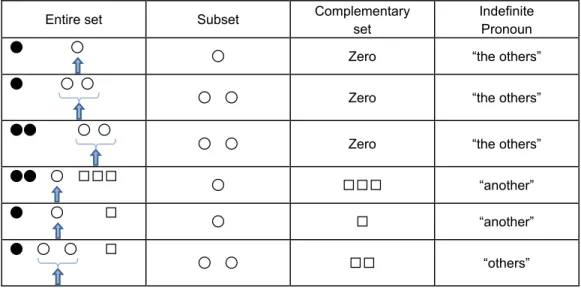
Furthermore, the reason we chose English indefinite pronouns as a stimuli in this present study is because the selection of those words “others,” “the other (s),” and “another” of English indefinite pronouns depends on the relationship of the number of objects in the entire set, subset, and complementary set (see Figure 1). In Figure 1, we use the following symbols: the symbol ● represents the concept of the one that has already been taken away from the entire set, the symbol ○ represents the target that is meant to be expressed by the indefinite pronouns (the subset), and the symbol □ represents that which will remain after both ● and ○
have been taken away (the complementary set). At this point it is pertinent to define the distinctions between the different indefinite pronouns. Danesi (2006) explains the distinction as follows:
The meaning of another is “one more in addition to the one(s) already indicated,” whereas other(s) means “several more in addition to the one(s) indicate,” and the other(s) means “what is left over from a given number.” (p.88)
It is safe to say that Danesi’s (2006) explanation is given from the perspective of a “set.” Figure 1 demonstrates that the correct selection of English indefinite pronouns, such as “others,” “the other (s),” and “another” is made depending on the number of objects in the subset as well as the number in the complementary set. For instance, when the number of objects in the subset is one and in the number in the complementary set is zero, the indefinite pronoun should be “the other.” In the same way, when the number in the subset is more than one and when the number in the complementary set is more than zero, the indefinite pronoun should be “others.” In this way, the selection of indefinite pronouns changes depending on the number of objects in the subset and complementary set. Since the selection of these words relies upon the changeable number of objects in each set, it is suggested that students might acquire the concept of English indefinite pronouns with greater ease if they can physically change the number of real external objects in the subset or complementary set by themselves in a direct way, rather than just reading or listening to the verbal explanation, or receiving illustrative explanation of the concepts. Considering that one of the most significant explanatory variables of the SPTs effect is that students can directly change situations by themselves through
Entire set Subset Complementary
set
Indefinite Pronoun ● ○
○ Zero “the others”
● ○ ○
○ ○ Zero “the others”
●● ○ ○
○ ○ Zero “the others”
●● ○ □□□ ○ □□□ “another” ● ○ □ ○ □ “another” ● ○ ○ □ ○ ○ □□ “others”
moving external objects (Backman, Nilsson, Herlitz, Nyberg, & Stigsdotter, 1991; Backman, Nilsson, & Kormi-Nouri, 1993), it is clear that the English indefinite pronoun is fitting subject matter to test the SPTs effect.
Thus far, we have argued the following; first, examining the SPTs effect in L2 is an important investigation and second, English indefinite pronouns are a promising grammatical concept in order to examine the SPTs effect in L2 (which is English in this study). In sum, it can be expected that students acquire the concept of English indefinite pronouns through performing SPTs more effectively than if they merely receive an illustrative explanation. Because Nakahara (2007) has confirmed that SPTs as well as ITs provides superior results to those achieved when just VTs are performed, it is unnecessary to test the difference between the effectiveness of SPTs and VTs, as well as the difference between ITs and VTs. In this study, we set up two conditions where one group of students receives an explanation of the concept of English indefinite pronouns through images (the control group) and the other group receives an explanation through images and they also perform SPTs (the experimental group). The first question we hope our research would resolve is: “On the basis of the SPTs effect, do Japanese students better comprehend the concept of indefinite pronouns in English when they perform SPTs, rather than when they merely receive instruction with images?”
Experiment 1
Experiment 1 examined whether Japanese EFL students could better comprehend the concept of English indefinite pronouns when they performed SPTs, rather than when they merely received instruction with images.
Methods
Design and participants
Instruction and task type (control group: instruction with images × experimental group: instruction with images plus SPTs) was the between-subject factor. The dependent variable was the percentage of the multiple-choice questions answered correctly when students were asked to choose between another, other(s),
the other(s), or N.A.
Twenty female undergraduates majoring in humanities and social sciences at a Japanese private university participated in this experiment. All the participants were given 1,000 yen for their participation. They were randomly assigned to one of two groups.
author using chalk on a blackboard. The experimental group (twelve participants) was also instructed using a blackboard, but they were also asked to perform the SPTs.
Materials
We constructed a pre-test and a post-test, in which twenty English sentences were taken from newspapers or exercise books pertaining to Japanese university entrance examinations. Five out of twenty English sentences did not include any indefinite pronouns. These five sentences were used as filler sentences and thus they were excluded from the analysis. Some of the questions that were used in the pre-test and post-test in Experiment 1 are shown below. The first and second examples shown below are taken from the pre-test, and the third and forth examples are taken from the post-test. For all these English sentences, Japanese translations were attached below so that participants’ general English vocabulary or lack thereof, would not affect the results.
1) Some students go to the university library after school, and ( ) go to their part-time jobs. 2) I have three sons; one lives in Chicago and ( ) live in New York.
3) How can I transfer my data from one computer to ( )?
4) I have two cars: one is an ordinary passenger car, and ( ) is a sports car.
For these questions, the participants were asked to choose one of the items from the following selection: 1) another
2) other or others 3) the other or the others 4) N.A.
Procedure
Before the instruction sessions began, the participants in both groups sat the pre-test for ten minutes. The participants were then randomly assigned to either the experimental group or the control group. The instruction sessions were conducted for both groups by the first author over approximately nine minutes and were filmed with a video camera and timed using a stopwatch. First, all of the participants were given a verbal explanation into the basic concept of indefinite pronouns and their usage for three minutes. After this, the participants were then given a presentation through illustrations for about three minutes, explaining each concept (using ‘another,’ ‘other(s),’ and ‘the other(s)’ as the example) and the differences between them. Finally, the participants were given instructions in English such as “there are five rods on the desk. I will take one rod, and he will take another, and she will take others, and you can take the others.” This instruction was also conducted with illustrations. In this way the participants in both groups were instructed about English
indefinite pronouns in terms of their basic concept, of the differences between them, of the image, and of the usage through English sentences.
After this instruction session, only the experimental group was required to conduct the SPTs. During the session of SPTs, ten red wooden rods (5cm×7mm×7mm) were prepared on a desk and the participants were shown the demonstration by the instructor (the first author). This demonstration involved the instructor taking one rod from the desk while stating “I take one rod,” and then he followed this with the statement “now, I have one rod.” Following this utterance and enactment, he then took another rod saying “I take another,” and then took two more rods saying “I take others.” In the same way, he took another three rods while saying “I take others.” At this stage, there were three rods remaining on the desk. Following this, he took the other rods saying “I take the others.” All the English sentences used in this SPTs session were totally identical to those used in the instruction session, in which the students from both groups participated. In this way, at the beginning of the SPTs session, the instructor showed the demonstration to the participants. After this demonstration, each participant was asked to take a rod or rods accompanied by a statement of what they were doing, for example, “I take another.” If the physical enactment did not match the utterance, then feedback informing the student of this mismatch between the act and the utterance was given by the instructor. The other students could watch each of his or her fellow students perform his or her utterance and action. This SPTs session lasted for about 15 minutes. While the experimental group conducted the SPTs session, the control group was told to wait for 15 minutes in another room quietly. Lastly, the participants in both groups took the post-test, which lasted for 10 minutes, at the same time but in different class rooms.
Results
Table 1 presents the means and standard deviations of the percentage of the questions answered correctly for both tests, and the differences between the pre-test and post-test. After confirming the homogeneity of the results of the pre-test between two groups (t (18) = 0.17, p > .05), a t test was conducted for the difference of the percentage of questions answered correctly between the pre-test and the post-test. These results revealed a significant difference (t (18) = 2.15, p < .05). Students learned the concept of English indefinite pronouns better when they received the instruction with graphical images and also conducted SPTs (M = 0.35, SD = 0.01) than when they merely received the instruction with images (M = 0.24, SD = 0.03). Testing confirmed that the SPTs effect was observed in the situations where students who were aiming to acquire the concept of indefinite pronouns in English, where English was as a foreign language.
TABLE 1
Means and Standard Deviations of the Percentage of Questions Answered Correctly for both Tests, and the Difference between the Pre-test and Post-test in Experiment 1
Type of group
Test Experimental Control
Pre-test M 0.34 0.40 SD 0.16 0.10 Post-test M 0.70 0.62 SD 0.13 0.18 Difference M 0.35 0.24 SD 0.01 0.03
Therefore, target sentences such as “lift the pen,” for instance, always corresponded correctly with the participants’ behavior; the participant actually lifted the pen in front of the researcher while saying “lift the pen.” In these studies, the feedback, in which the researchers tell the participants whether the enactment being conducted is correct or not, is not necessary. On the other hand, in this present study, it was essential we gave feedback to the participants, because the enactments did not always correspond to the utterances. For instance, in Experiment 1, one participant took two rods while saying “I take another.” In this case, we told the participant that she should have taken only one rod when she stated that she took another.
However, this feedback itself can be also effective in helping the participants learn the concept of indefinite pronouns. Accordingly, in Experiment 2, we shall test whether the feedback on the participants’ enactment would be a significant factor in facilitating the effectiveness confirmed in Experiment 1. Therefore, the second research question is: “Is the feedback given to students who are performing SPTs critical factor in facilitating the effectiveness of students’ acquisition of the concept of English indefinite pronouns?” This question will be answered in Experiment 2.
Experiment 2
Experiment 2 was designed to test whether or not the results obtained in Experiment 1can be attributed to the provision of corrective feedback.
Methods
Design and participants
Feedback type (control group: with feedback × experimental group: with no feedback) was the between-subject factor. The dependent variable was the percentage of questions answered correctly in response to the same test as used in Experiment 1.
Thirty undergraduates majoring in business administration at a Japanese private university, who did not participate in Experiment 1, participated in this experiment. All the participants were given 1,000 yen for their participation. They were randomly assigned to one of the two groups.
The experimental group (seven male and eight female participants) as well as the control group (eight male and seven female participants) was given an explanation of the concept and usage of indefinite pronouns of English. This presentation was given using the software of Microsoft PowerPoint, which was produced by the second author based on the video-taped recording of Experiment 1 — in order to maintain the homogeneity of the nature of the instruction. After this instruction, the participants in both two groups were required to conduct SPTs. In this session, as in the case of the control group, the feedback was given by the first author, while the participants in the experimental group were not given the feedback. The feedback was given with two cards, on one of which was written the sign “×,” indicating the wrong enactment, and on the other of which was written the sign “○,” indicating a correct enactment. The instruction and the SPTs for both two groups were conducted at the same time in a very large university classroom and each group was separated to ensure that the activity of one group would not be observed by the other.
Materials
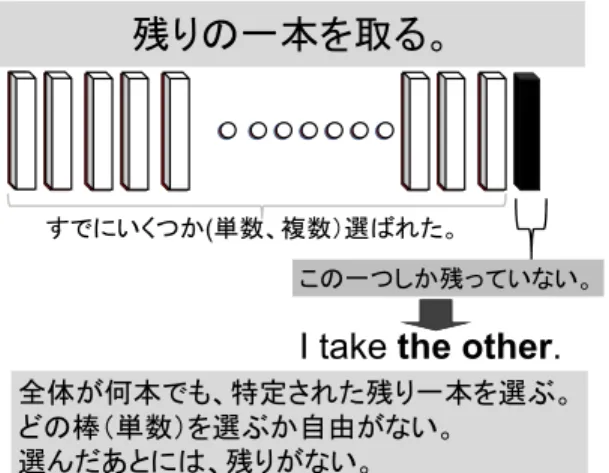
The study materials — red wooden rods — were the same as were used in Experiment 1. The pre-test and the post-test were identical to those employed in Experiment 1. However, in the instruction session we used the presentation produced with Microsoft PowerPoint. In this program, the narration was recorded corresponding with slides. An example of these slides is shown in figure 2.
Procedure
The sessions with the control and experimental groups were conducted by the first author and the second author for approximately 45 minutes. The pre-test and the post-test were timed by a stopwatch, while the time for the explanation was controlled by a computer (Microsoft PowerPoint). First, all of the students took the pre-test for 10 min. The students were then randomly assigned to one of the two groups. The explanation was given to both of the two groups at once using Microsoft PowerPoint presentation. The slides were also shown on a big monitor, which was set out in the front area of the classroom, and the accompanying narration was
played over the speakers installed in the classroom. The duration of the instruction session was approximately 10 minutes.
The presentation comprised 23 slides all of which were accompanied by narration, which was recorded by a professional voice actress. The PowerPoint slides were all written in Japanese and the narration was also conducted in Japanese. The computer controlled the viewing time from the first to the last slides automatically. The first slide previewed the instruction session. Slides 2 to 7 provided general grammatical knowledge about the usage of “a” and “some.” Slides 8 to 11 were focused on the usage of “another.” In the same way, slides 12 to 15 were focused on the usage of “others” or “some others,” slides 16 to 19 were focused on the usage of “the other,” and slides 20 to 22 on “the others.” The last slide marked the conclusion of the session.
After this instruction session, the participants in both groups were asked to perform SPTs separately, in groups that were far away form each other, but simultaneously. These SPTs were performed for the same time duration as those conducted in Experiment 1, with the only difference being that the experimental group in this experiment was not given corrective feedback. The duration of each SPTs session was 15 minutes for both groups. Lastly, the participants in both groups took the post-test for 10 minutes at the same time.
Results
Table 2 presents the means and standard deviations of the percentage of questions answered correctly for both tests, and the differences between the pre-test and post-test. After confirming the homogeneity about the results of pre-test between two groups (t (28) = 0.77, p > .05), a t test was conducted for the difference of the
Figure 2. An example of slides used in the instruction session of Experiment 2.
残りの一本を取る。
I take the other.
全体が何本でも、特定された残り一本を選ぶ。 どの棒(単数)を選ぶか自由がない。選んだあとには、残りがない。
すでにいくつか(単数、複数)選ばれた。
percentage of questions answered correctly between the pre-test and the post-test, but it did not yield a significant difference (t (28) = 0.21, p > .05). The rate of advance of the students who were not given corrective feedback while conducting SPTs (M = 0.16, SD = 0.16) was not significantly different from that of those who were given corrective feedback while doing SPTs (M = 0.14, SD = 0.18). Testing confirmed that the facilitative effectiveness of students’ acquisition of the concept of indefinite pronouns in English (where English is a foreign language), which was observed in Experiment 1, could not be attributed to the provision of corrective feedback.
TABLE 2
The Means and Standard Deviations of the Percentage of Questions Answered Correctly for both Tests and the Difference between the Pre-test and Post-test in Experiment 2
Type of group
Test Experimental Control
Pre-test M 0.49 0.54 SD 0.17 0.14 Post-test M 0.66 0.68 SD 0.13 0.17 Difference M 0.18 0.14 SD 0.16 0.18
Discussion
The results obtained in Experiment 1 indicated that participants who carried out SPTs in order to acquire the concept of English indefinite pronouns outperformed those who did not (see Table 1). Experiment 2 investigated whether these outcomes, as observed in Experiment 1, could be attributed to the provision of feedback given to participants during the SPTs session. However, it was not demonstrated that the effectiveness could be attributed to the provision of the feedback (see Table 2).
The results gained in Experiment 1 can be interpreted as follows; the nature of the condition of the SPTs, in which participants actually changed the number of objects in each set while saying the corresponding English sentences, is a fitting model to learn English indefinite pronouns. In Experiments 1 and 2, the experimental
and control groups received instructions in which the concept of English indefinite pronouns was illustrated with images. Identical images were used in both experiments with the exception of the media used: a blackboard was used in Experiment 1 and a monitor was used in Experiment 2. Participants received the images, in which rods were depicted as pictures, of the entire set, subset, and complementary set of English indefinite pronouns (see figure 2). The only difference between the experimental group and control group in Experiment 1 was whether or not participants themselves actually manipulated the number of real, external objects in each set. Therefore, it can be concluded that the enactment of English phrases is effective for Japanese students to learn the grammatical concept of English indefinite pronouns.
In Experiment 2, we examined the effectiveness of providing feedback during the SPTs session. The results showed that the facilitative effectiveness observed in Experiment 1 cannot be attributed to the provision of feedback (see Table 2). This could be because the number of students who uttered the wrong English phrases while moving the rods or who enacted in wrong ways was small; three participants in experimental group, and four in the control group. This means that, on the whole, the feedback given in this experiment, was reinforcing and positive feedback — telling the participants they were correct, rather than vice versa. Therefore, if the number of participants who required corrective feedback increased, there is a possibility that different results might be obtained.
The findings of this present study are of great significance for educators in the following three ways. First, we have revealed that when we teach abstract English grammatical issues such as indefinite pronouns, it can be effective to have students enact an English sentence in which one grammatical issue plays a central role in the sentence. From previous studies, it was already revealed that grammatical concepts of English as a foreign language can be more easily understood if visual images are employed in the instruction (see Matsunuma, 2007, for example). In addition to this finding, this present study has revealed that enactments of English sentences with grammatical concepts embedded are also effective way to teach English grammatical issues.
Second, we have provided a theoretical basis for the effectiveness of body enactment, as seen in such teaching methods as the Direct Method (Titone, 1968), TPR (Asher, 1969), and the Silent Way (Gattegno, 1976). All of these methods include students enacting English phrases. The effectiveness of the enactment of English phrases employed in these methods had yet to be experimentally demonstrated and had been previously based on successful teaching experiences. However, this study has empirically revealed that enactment is a useful method of teaching L2, and its effectiveness can be explained from the perspective of the theory of SPTs effect (Backman, Nilsson, Herlitz, Nyberg, & Stigsdotter, 1991).
Finally, from the fact that the material used in this present study was simple wooden rods, we suggest that teachers do not have to prepare special materials in order for students to carry out SPTs; instead, all they need are simple objects. With only simple colored rods, for example, it might be possible for students to learn the concept of relative pronouns. The set up would simply involve five rods on a table. One of five rods should be placed on two other rods. The other two rods would be placed on top of each other. In this set up, the teacher can instruct students in pairs to take the rod that is lying on top of one or two rods. Student A can then instruct Student B to take the rods by saying “Please take the rod which is on the two rods,” which leads Student B to enact the command. In this way, students might be able to learn how to use English relative pronouns only with simple materials.
This research does have some limitations, however. Although we succeeded in confirming the SPTs effect for students’ acquisition of the concept of English indefinite pronouns, both experiments were conducted in a group setting. This means that we could not exclude other variables such as learning effects brought about by observation. Thus, in future research, it will be necessary to investigate the SPTs effect on the acquisition of grammatical issues in an L2 in a setting with better controls. Nevertheless, a classroom setting can provide useful and valid results as illustrated in the present study.
We hope that educators and researchers will continue to consider and examine the application of the SPTs effect in a variety of settings. Since this study was conducted solely with Japanese learners of English, it would be difficult to generalize the results and conclusions to speakers of native languages besides Japanese, who are studying English. Thus, it will be necessary to examine whether or not the same results would be obtained with speakers of other languages, as well as with other target languages. In addition, it will prove useful to assess whether the SPTs would be effective for students of an L2 to acquire the concept of other grammatical issues, such as relative pronouns, or tenses and aspects.
References
Alderson, J. C. (2000). Assessing reading. New York: Cambridge University Press.
Asher, J. (1969). The total physical response approach to second language learning. Modern Language Journal, 53, 3-17. Backman, L. (1985). Further evidences for the lack of adult age differences on free recall of subject-performed tasks: The
importance of motor action. Human Learning, 4, 79–87.
Backman, L., & Nilsson, L. G. (1984). Aging effects in free recall: An exception to the rule. Human Learning, 3, 53–69. Backman, L., & Nilsson, L.G. (1985). Prerequisites for the lack of age difference in memory performance. Experimental
Backman, L., Nilsson, L. G., & Chalom, D. (1986). New evidence on the nature of the encoding of action events. Memory & Cognition, 14, 339–346.
Backman, L., Nilsson, L. G., Herlitz, A., Nyberg, L., & Stigsdotter, A. (1991). Decomposing the encoding of action events: A dual conception. Scandinavian Journal of Psychology, 32, 289–299.
Backman, L., Nilsson, L., G., & Kormi-Nouri, R. (1993). Attention demands and recall of verbal and color information in action events. Scandinavian Journal of Psychology, 34, 246–254.
Cohen, R. L., Peterson, M., & Mantini-Atkinson, T. (1987). Interevent differences in event memory: Why are some events more recallable than others? Memory & Cognition, 15, 109–118.
Danesi, M. (2006). Basic American grammar and usage: An ESL / EFL handbook. New York: Barron’s Educational Series Inc.
Dijkstra, K., & Kaschak, M., P. (2006). Encoding in verbal, enacted and autobiographical tasks in young and older adults. The quarterly journal of experimental psychology, 59, 1338–1345.
Engelkamp, J., & Zimmer, H. D. (1997). Sensory factors in memory for subject-performed tasks. Acta Psychologica, 96, 43–60.
Gattegno, G. (1976). The common sense of teaching foreign languages. New York: Educational Solutions.
Grabe, W. (1999). Developments in reading research and their implications for computer-adaptive reading assessment. In M. Chalhoub-deVille (Ed.), Issues in computer-adaptive testing of reading proficiency (Studies in Language Testing 10, pp. 11–47). Cambridge: Cambridge University Press.
Iwakiri, Y. (2006). Eigowa yappari eibunpou. Tokyo: Beret Press.
Koda, K. (1999). Development of L2 intraword orthographic sensitivity and decoding skills. Modern Language Journal, 83, 51–64.
Lichty, W., Kausler, D. H., & Martinez, D. R. (1986). Adult age differences in memory for motor versus cognitive activities. Experimental Aging Research, 12, 227–230.
Matsunuma, M. (2007). How can classroom instruction in English help Japanese high school students to learn the present perfect sentence? Japanese Journal of Educational Psychology, 55, 414–425.
Nakahara, S. (2007). Effects of subject-performanced tasks on memory of verbal phrases in Japanese as a second language. Journal of the Graduate School of Education, Hiroshima University, 56, 251–257.
Nakamoto, H. (1997). Eibunpou top 100. Tokyo: Sundai-bunko. Nakamoto, Y. (2004). Naruhodo gatten eibunpou. Tokyo: Sanshu-sha.
Ngasawa, T. (2006). Tokoton wakariyasuku kaisetsushita koukou sannenbunno eigo. Tokyo: Beret Press. Nishimura, Y. (2001). Eikaiwanotameno nanatsuno doushi hassouhou. Tokyo: Beret Press.
Norris, M. P., & West, R. L. (1993). Activity memory and aging: The role of motor retrieval and strategic processing. Psychology & Aging, 8, 81–86.
Richards, J. C., & Schmidt, R. (2002). Dictionary of language teaching and applied linguistics. Edinburgh: Pearson Education Limited.
Stevick, E. W. (1976). Memory, meaning and method: Some psychological perspectives on language learning. Rowley, Mass.: Newbury House.
Ueda, I. (2005). Hasshingataeigo super level writing. Tokyo: Beret Press.
Urquhart, S., & Weir, C. (1998). Reading in a second language: Process, product, and practice. New York: Longman.