P15
Simulation of Slope Failures and Sediment Runoff in a Basin Scale
〇Chen-Yu CHEN, Masaharu FUJITA
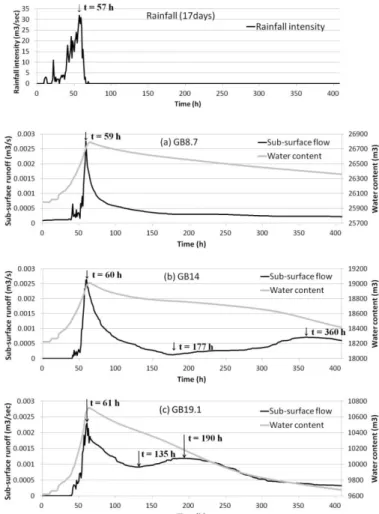
Recent researches indicated that the large-scale landslide induced by rainfalls usually occurred at the end of the rainfall, and the occurring conditions usually were attributed to the high accumulated rainfall. However, the researches which explore the relation of rainfall-runoff and the scale of the large-scale landslide are rare. This study used the integrated Rainfall-Infiltration-Slope stability model to simulate the process of rainfall-runoff and predict the occurring time and the scale of the large-scale landslide. The simulation showed that the runoff had double peak pattern in weathered granite slopes, but ladder recession pattern in volcanic debris slopes. The bedrock locations had influence on the peak timing and decreasing pattern of the runoff. It is expected to have possibility of large-scale landslide evaluation if the relation between the runoff and bedrock locations is further studied.
Figure 1. The simplified bedrock position model (β=22.85o, L=140m, H=62m, n=2.7m, and α=8.7o, 14o, 19.1o)
Table 1. Hydraulic characteristics of the soil of the simplified slope Hydraulic parameters Ks θs θr Ψm σ cm/s m3/m3 m3/m3 cm - Volcanic debris 3.50×10⁻³ 0.684 0.577 -797.4 2.53 Weathered granite 6.71×10⁻³ 0.387 0.128 -91.38 2.27
Figure 2. The rainfall-runoff hydrograph in weathered granite slope (a)bedrock inclination of 8.7o (b)bedrock inclination of 14o (c) bedrock inclination of 19.1o
Figure 3. The rainfall-runoff hydrograph in volcanic debris slope (a)bedrock inclination of 14o (b) bedrock inclination of 19.1o