The Japanese Psychonomic Society
NII-Electronic Library Service
The JapanesePsychonomic Society
ThejdPanesefournatofIls),chononticSciance
2005, VoL 24,N{].1,133-134
Summary
ofAwardedPresentation2P46
Theperception
of
a
Point
Light
Walker
across
a
-The
perception
ofthe
"humanlikeness'L
slit
ChihiroAsANol
andYoshihisa
Rihle.voUbeiversitJJ'
OSADA
The aim of the present study was to elarify whcther thependulum motion ol a Peint-Light
Walker
{PLW)
created aperception
ofit's
"humanlikeness".
To quantify the amount ofspatio-tempora]
information
rcquircd tocreate animpression
of "human likeness",thePLW was passedbehind a slit which varied inwidth and
the
expo$ure time was also varied.Observers
asscssed the"human likeness"
of each PLW
display,
The
experimental results revealed thata distinctimpres-sion of "human
likeness"iscreated when observcrs sec more than a halfcycle of the pendu]um
motion
from
thePLW
for
rnore than 41O ms. These findingssuggest that the pendulurn motion of aPLW conveys information whichis
relevantto
theperception of "human]jkeness"
under certain spatjal and temporal condjtions.Key words: PointLight Walker, slit, human likenes$,pendulum motion
Introduction
Even
without a completeimage
ofa humanwa]k-er,
bright
dots
representing thc mainjoints
of thehuman body when seen against a dark background
can give us
the
perception of one.Johansson
(1976}
has explained the mechanisms forthis phenomenon
within
the
frarnework of "figure"and '`ground"
seg-mentation, This conceptual framework separates
human
walkinginto
translationand pendulumrno-tions.Thependulum motion of a
PLW
is
consideredto
be
especiallyimportant
foridentifying
themove-ment as human
(Owens
et aL 1994;Shiffrar
et al.1997).To date itremains unknown as towhether the
pendulum motion of the "`figure"
alone inherentlyhas
information which
is
suMcient tolead
tothepercep-tionof "human likeness",
or not.
The
purpose of the present study was toinvesti-gate:
{1}
whether the pendulum motion of aPLW
containedinformation
relevant totheperceptionef ahuman
likeness;and(2)
how much spatio-temporalinformation was required tocreate an impression of
"human likeness"from the
pendulum motion.
Methods
Experiment
1:
Spatial
conditionsObservers Fifteen observers
(4
rnen and 11* Department of
Psychology,
Rikkyo
University,
34-1
Nishiikebukuro,
Toshima-ku,
Tokyo
O021
women) with normal visual acuity participated.
Stimuti Three motion patterns of the PLW
(up-right PLW, inverted PLW, scrambled PLW) were
shown behind a slit, moving from the leftto
the
righL The scrambled pattern,which
did
not containany inforrnationrelevant tothe perception of
"hu-man likeness"was constructed
by
randomlychang-ing
theframe
order of thePLW. Seven differentslitwidths with visual angles of O.80,1.60,2,40,3,20,4.0e,
and
4.80,
were used to limitthe spatial informationfrom themotion pattern, A slit width of 22.50 corre-sponded toa "no-slit"
condition,
Procedure The observers viewed three motion
patterns which were
behind
a slitand then ratedtheir
impression
of "humanlikeness"
of each. Thcrating scale
for
each rnotion pattern was from grade1
to5,
withgrade
1indicatingthat"human
likeness"was not perceivcd inthe metion patternand grade
5
indicating
that"human
]ikeness" was clearlyper-ceived in the motion pattern.
Five
trialsol theupright PLW,
5
trialsofthe
inverted
PLW,
and10
trials of the scrambled condition were presented in
random order
for
each observer. Sothat the $patialinformation
frorn
thePLW
could be quantified wemeasured the
distance,
along a horizontal axis ineach frame, from the head to the rightankle. The
pendulum-like motion of the right ankle was
repre-sented on a 2-dimensional plane by plotting each
ankle distance
ly-axis)
again$t thetirne(x-axis)
whichwas cnlculated frornthe
frame
rate.The Japanese Psychonomic Society
NII-Electronic Library Service
TheJapanesePsychonomic Society
134 The
Japanese
Journal
of Psychonornic Science Vol.24, No. 15
z4e.-<E3:8
2 1o.s
Figure l. The
ness with eac
D
1.6 2.4 3.2 4.0 4.S 22S
(NoSlit) SLTTWIDTH(degree)
estimation of a
human
h
orientation condition(Exp,
1)
Experiment
2: Temporal conditions
Observers
Six
observers{3
men and 3 wornen)with normal visual acuity participated.
Stimuli
UprightandinvertedPLWswercusedina similar manner tothatof
Experiment
1.
A
controlPLW, without any
information
of ahuman
likeness,
was constructed
by
moving 11 dots in a parallelarrangement towards the right, The three motion
patterns were passed behind a slit,frornthe leftto
the
right, with differentframe rates(15
frames persecond,
30
frames
per
second, and60
frames
persecond) so that the exposure
time
ofthe
patternscould
be
changed.
Procedure
Five trialsof each motion patternwere carried out ina random order and the observers rated theirimpre$sion of "human
likeness"in the
same manner as
in
Experiment
1,
Results
andDiscussion
Experiment
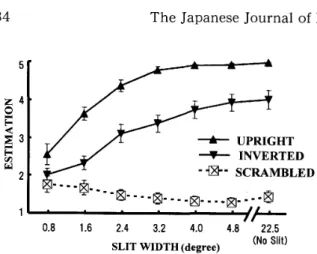
1: Spatial conditionsFigure 1 illustratesfor each motion pattern the
relationship between the estimation of "human
like-ness" and theslit width.
The
evaluation of"human
likeness"increased as the s]it width was expanded
with
the
upright andinverted
PLWs, whereas itre-mained
low
in
the scrambled PLW conditions. Therating
level
reached a plateau with an upright PLWand a slitwidth of 3.2degrees or rnore. Under these
conditions more than halfa cycle of the pendulum
motton was observed.
Experiment2: Temporalconditions
Figure 2 indicates
how
the evaluation of "humanlikeness" varicd with expansion of the slit width
under different
frame
rate conditions,The
evalua-tionof "human
likeness"
increasedsignificantly with
5
g4
:
E3
8
2
1 (NoSlit) SLITWIDTH(degree)
Figure2.
The
estimation of a humanness with an upright PLW, under three
conditions ef frame rate
(Exp.
2)expansion of the slit at allframe rates. A significant
difference
was not observedbetween
a rate of l5frames
and 30frames
per second.Within
the slitrange from
2,4
to
4.8
degrees
the evaluations forthe60 frames per second rate were signjficantly lower
than those
for
theotherframe
rates. The mechanismforthis
disparity
could be explained by a difference m exposure time tothependulum
motion,When
the exposure time wasless
than 410 rns, evaluation of "humanlikeness"remained low, even when the slit
width was 3.2degrees or more and
therc
was morethan one half-cycleof pendulurn motion.
General
Discussion
The present study revealed that the pendulum
motion of a
PLW
could provide information whichis
related to"human likeness".We foundthatinorder
to create a distinctimpression of 'Chuman
likeness",
observers need tosee more than one
half-cycle
of thepend ulurn motion over 410 ms,
Thus,
the penduluinmotion of a PLW can create a clear jmpression of
"human
likeness"within aspecific spatial and
tempo-ral window.
References
Johansson,
G. 1976Spatio-temporal
differentiationand integration
in
visual rnotion perception: Anexpenmental and theereticalanalysis of
likefunctions
in
visualdata
processing.Rsychologi-cat
Research,
38(4L
379-393.
0wens,
D.
A.
AntonofL
R,J.,
& Francis,E.L,1994
Biological
motion and nighttime Pedestrianspicuity. Hbeman Factors,
36(4),
718-732.
Shiffrar,
M. Lichtey,C. &Sheba
H.
1997
The
tionof biologicalmotion across apertures.