Panel Data Research Center, Keio University
PDRC Discussion Paper Series
住宅相続と金銭的援助の互恵的依存関係
岩田真一郎、行武憲史
2019 年 2 月 18 日
DP2018-001
https://www.pdrc.keio.ac.jp/publications/dp/4990/
Panel Data Research Center, Keio University
2-15-45 Mita, Minato-ku, Tokyo 108-8345, Japan
[email protected]
18 February, 2019
住宅相続と金銭的援助の互恵的依存関係 岩田真一郎、行武憲史 PDRC Keio DP2018-001 2019 年 2 月 18 日 JEL Classification: D10; J14; R21 キーワード: 世代間移転;遺産動機;住宅;暗黙的年金契約;日本 【要旨】 日本では、高齢者が子に住宅を遺産として残し、その礼として生前に子から金銭的な援助を受 け取るという互恵的依存関係の存在がしばしば指摘される。高齢者が世代間住宅資産移転を通 じて、子から金銭的な支援を受け取り、生活を維持しようとする試みは、親子間リバース・モ ーゲージが暗黙的に契約されていることを意味すると考えられる。そこで本稿では、この親子 間リバース・モーゲージの存在を理論的・実証的に検証した。シュタッケルベルグ・モデルを 応用した理論分析から、子から親への援助額は親が決定する住宅相続確率の増加関数であるこ とを導いた。そして、「日本家計パネル調査」を用いた実証分析の結果から、相続確率が上昇 すると、援助額が増加することを確認した。これは、親子間リバース・モーゲージの存在を支 持する結果である。しかし、十分な援助額を引き出すには、親は子に対して高い相続期待を持 たせる必要があることも同時に確認した。 岩田真一郎 富山大学経済学部 〒930-8555 富山県富山市五福3190 [email protected] 行武憲史 日本大学経済学部 〒101-8360 東京都千代田区神田三崎町1-3-2 [email protected] 謝辞:本研究は科研費基盤研究(C)(16K03616)による研究成果である。ここに記して 謝意を表したい。
Housing inheritance, …nancial assistance, and
reciprocal interdependence
Shinichiro Iwata
Faculty of Economics, University of Toyama, 3190 Gofuku, Toyama, 930-8555, Japan
Norifumi Yukutake
College of Economics, Nihon University,
1-3-2 Kanda-Misakicho, Chiyoda, Tokyo 101-8360, Japan [email protected]
February 18, 2019
Abstract
When adult children expect that their parents will bequeath residential property to them, they may show their appreciation by providing their parents with …nancial support. This paper theoretically and empirically examines this possibility. We adopt a simple noncooperative game framework with a Stackelberg equilibrium to examine the recipro-cal interdependence between the propensity of housing inheritance and …nancial assistance when formal care a¤ects decision-making. We use data from Japanese households to test this interaction. After considering both the censoring of …nancial transfers and the speci…-cation of inheritance propensity, which we control for using information on formal care, our empirical results suggest that the propensity to inherit the parental home has a signi…cantly positive impact on the amount of transfers from children to their parents. Consequently, an implicit annuity contract in the form of an intrafamily reverse mortgage appears to exist in Japanese society. However, parents should ensure they convey to their children a high expectation of future housing inheritance to extract su¢ cient …nancial assistance for their current consumption needs.
Keywords: Intergenerational transfers; Bequest motives; Housing; Implicit annuity contracts; Japan
JEL classi…cation: D10, J14, R21
1
Introduction
There has been growing pressure worldwide to cut expenditure on medical bene…ts and insur-ance payments for the elderly in aging societies. The elderly therefore increasingly expect to use their accumulated assets for welfare needs rather than relying as heavily on governmental transfers (Toussaint and Elsinga, 2009; Doling and Ronald, 2010). In turn, housing can play an important role in addressing this issue because it is the primary asset held by most elderly households, so …nancial instruments such as reverse mortgages may allow elderly homeowners to remain in their own home and provide a supplemental income until death. In this manner, a reverse mortgage functions like an annuity. However, reverse mortgages are still quite un-common because of their potentially high cost, small amount of potential proceeds, and the limited product knowledge of the elderly (Davido¤ et al., 2017; Moulton et al., 2017). As an alternative, in some countries, elderly homeowners tend to leave residential property as a future bequest to derive current …nancial provision from their adult children (see, e.g., Toussaint and Elsinga, 2009 on Europe; Ronald and Doling, 2012 on East Asia).1 The purpose of this paper is to examine this reciprocal interdependence: whether the anticipation of parental housing inheritance a¤ects the …nancial assistance behavior of adult children.
Our paper is thus associated with testing a bequest motive related to an implicit annuity contract (Kotliko¤ and Spivak, 1981). According to theory, the elderly choose to insure against the longevity risk by creating an implicit annuity contract with their children, whereby parents receive an annuity from their children while they live in exchange for a future bequest. Horioka (2002) suggested that one variant of this type of contract is an intrafamily reverse mortgage, whereby children agree to support their parents …nancially in exchange for inheriting the parental home (Farnham and Sevak, 2016). Children may also provide nonmonetary assistance rather than monetary support, especially in advanced countries. Indeed, the literature has accumulated evidence for a strategic bequest (exchange) motive by examining whether adult children provide in-kind transfers to their parents in return for receiving bequests (inter vivos
1In some cases, the elderly are more likely to leave their home because inheritance taxes give preferential treatment to real estate assets. This paper, however, is not concerned with tax issues.
gifts).
For instance, Bernheim et al. (1985) found that children’s attention to their parents, as measured by visits and phone calls, is positively a¤ected by parental bequests. Norton and Van Houtven (2006) revealed that children who provide informal care appear to receive larger inter vivos transfers, while Fu (2019) showed that inter vivos transfers are dependent on children’s current residential proximity, which may facilitate future informal care. Ciani and Deiana (2018) suggested that past downstream housing transfers, such as a real estate donation or down payment, tend to increase current informal elderly care. Tomassini et al. (2003) and Yamada (2006) indicated that past parental housing assistance has e¤ects on current children’s geographic proximity. Yin (2010) and Horioka et al. (2018) demonstrated that bequest expectations encourage intergenerational co-residence, while Yamada (2006) reported that children who expect to inherit a parental home in the future are more likely to co-reside with their parents. Turning to studies of upstream monetary support, Ohtake (1991) showed that …nancial transfers provided by children tend to increase when parents possess a large amount of inheritable assets, where …nancial and real estate assets are considered separately. The amount of housing assets, however, may not always be positively correlated with housing inheritance.2 Therefore, to our knowledge, little is known about implicit annuity contracts in the form of intrafamily reverse mortgages. The main contribution of this paper is testing for the existence of such contracts.
A Stackelberg model of reciprocal interdependence leads to an empirical model where …-nancial assistance is a function of the probability of housing inheritance, which depends on the cost of formal care. That is, the cost of formal care is assumed to in‡uence the bequest behavior of elderly parents. Our theory suggests that the probability of housing inheritance en-courages upstream …nancial support. To test this hypothesis, we used microdata on Japanese households. Such evidence may provide particularly interesting insights because Japan is very close to the situation described in the beginning of this paper. Japan is at the forefront of
2Begley (2017), while providing empirical evidence that an increase in housing wealth, driven by unanticipated shocks to house prices, exerts a positive e¤ect on the probability of elderly homeowners leaving a bequest, did not focus in particular on the probability of bequesting residential property.
population aging. Expenditure on social security is at a record level, with 70 percent of all social security expenditure being on the elderly in the form of public pensions and medical bene…ts. At the same time, approximately 90 percent of the Japanese elderly aged 65 years or over own residential property, and this accounts for 60 percent of their total wealth.3 Using the value of residential real estate holdings of the Japanese elderly, Suzuki (2007) calculated that an 810,000 yen annual annuity could be potentially obtained through reverse mortgages per household.4 This would more than cover the di¤erence between average yearly consumption expenditure and income of approximately 432,000 yen for a nonworking elderly single-person household and 660,000 yen for a nonworking elderly couple household.5
Nonetheless, it is quite di¢ cult for elderly homeowners to release cash from housing assets because the …nancial sector does not readily provide reverse mortgage loans against property (Kojima, 2013).6 In general, Japanese reverse mortgage loans are recourse loans. Therefore, both the collateral and other assets can be seized by lenders when borrowers default on their loan. Additionally, income support cannot be guaranteed for life; therefore, the support may end even while borrowers are living, and repayment may be required during the loan term when the assessed value falls because of falling land prices.7 On this basis, institutional innovations in Japan appear to lag far behind those in most Western countries (Mitchell and Piggott, 2004). Under these circumstances, the elderly may instead leave their housing assets to children to
3According to the 2014 National Survey of Family Income and Expenditure (Table 69. Estimated value of assets per household by age group of household head), 88.2 percent of households whose household head is 65 years or older own their own home. In terms of net (gross) value, their total assets are valued at 44,196,000 (66,746,000) yen, while their total housing and land assets are valued at 25,924,000 (45,231,000) yen.
4
Simulations by Green and Zhu (2018) suggested that converting home equity into annuity income rather than a lump sum tends to increase the feasibility of reverse mortgages in Japan under circumstances such as decreasing land prices and increasing life expectancy.
5Summary Results of the 2016 Family Income and Expenditure Survey reported that the disposable income of no-occupation one-person households with a household head aged 60 years or older is 107,648 yen per month, while their monthly consumption expenditure is 143,959 yen. They, thus, need an additional 36,311 yen per month to cover their living costs. For no-occupation aged-couple households, composed of a husband aged 65 years or older and a wife aged 60 years or older, the monthly disposable income is 180,958 yen, while their monthly consumption expenditure is 235,477 yen. Therefore, the shortfall is approximately 54,519 yen.
6
In his analysis, Suzuki (2007) considered various restrictions on contracting reverse mortgages.
7The 2016 Japan Household Panel Survey (JHPS) asked respondents (N = 4; 993) to report their intention to use a reverse mortgage based on the following question: “How likely is it that you will use a reverse mortgage? ” 1 = have used; 2 = very likely; 3 = likely; 4 = unlikely; 5 = very unlikely; 6 = do not know. On average, about 1.4 and 10.3 percent of respondents selected the second or third response, respectively, but less than 0.1 percent selected the …rst response.
draw monetary support while living. Similarly to other Asian societies, it is quite common in Japan for adult children to support their elderly parents, and inherit their parents’ property assets (Ronald and Doling, 2012). This is becoming increasingly common because the low fertility rate in Japan implies fewer siblings (Hirayama, 2010).
Two considerations are examined empirically. First, a speci…cation issue may exist associ-ated with the expectation of housing inheritance, which arises from the potential for measure-ment error inherent in a discrete dichotomous response to a question about housing inheritance expectation and the speci…cation of a dummy variable (Yamada, 2006). Some respondents may be confused by having to select one of two polar responses: they might have to respond with 0 even if they have a low positive propensity to inherit, while others might have to respond with 1 even if they do not expect a 100 percent probability of inheritance. To address this, we specify proxy variables for formal care that appear to a¤ect the bequest behavior of parents, and employ a probit model in our estimation. In fact, our empirical results indicate that the probability of housing inheritance is signi…cantly a¤ected by one of these formal care variables. The probit model is ideal for understanding how elderly parents respond to incentives. Second, we must also account for the censoring of transfers from adult children to aging parents be-cause our transfer observations are limited to values greater than or equal to zero. To examine this, we estimate a Tobit model, which can consider the intensive margin of upstream …nancial support (Cox, 1987). In light of both issues, our empirical results demonstrate that the expec-tation of inheriting housing wealth in the future has a signi…cantly positive e¤ect on current support payments. This suggests that an implicit annuity contract is a motive to consider regarding the reciprocal interdependence between housing inheritance and …nancial assistance. However, our empirical results also indicate that upstream …nancial transfers appear to be too small to cover the consumption needs of aging parents. To correct this, parents should provide their children with a substantially high expectation of inheriting the parental home.
The remainder of the paper is organized as follows. In Section 2, we present a theoretical model of reciprocal interdependence between housing inheritance and …nancial assistance. Sec-tion 3 discusses the data and empirical model used, along with the empirical results. SecSec-tion
4 summarizes the main …ndings of the paper.
2
Model
The purpose of this section is to construct a simple theoretical model that considers the ob-servable characteristics in our empirical study. The theory adopted within the model leads to testable hypotheses and informs the empirical analysis. There are two players in the model: a parent and a child. The parent is assumed to be imperfectly altruistic: the parent cares for the utility of the child, but the parent also cares about monetary transfers t that the child may pro-vide. In contrast, the child is assumed to be nonaltruistic. The following two-stage framework is adopted: the parent …rst decides the propensity to leave their own house valued at h as an inheritance to the child, and an amount of formal care m in the market. If the parent plans to bequest the house, then = 1, whereas if the parent does not, then = 0. Because we treat as the propensity, which is reasonable for parents who will choose an interior solution, ranges from zero to one. This also allows us to di¤erentiate the transfer function, as shown later. The child then decides consumption c and the size of transfers t, expecting to consume inherited housing h. Our model applies a simple noncooperative game framework with a Stackelberg equilibrium that can examine a reciprocal interdependence between t and . As discussed in Section 1, one reason why housing is left by the parent is the bequest motive arising from the implicit annuity contract: the parent receives …nancial assistance from the child upon leaving the child the home.
Assume that the (expected) utility function of the child is u(c)+ , where h is normalized to one because we cannot observe it from the data, and uc > 0 and ucc < 0, where the subscripts
indicate the …rst and second derivatives. The child will inherit the parental home whenever the utility obtained is not less than the reservation utility u that the child obtains from not inheriting the home.
u(c) + u (1)
The budget constraint of the child becomes:
where y is the income of the child.
The rational parent ensures that the child receives the reservation utility in order to be willing to supply …nancial support. Hereafter, we only consider the case where Eq. (1) is binding. Substituting the budget constraint Eq. (2) into the utility function Eq. (1) yields u(y t) + = u. The amount of transfers must satisfy this relationship. The transfers function then becomes:
t = t( ; y; u): (3)
Conversely, the child refuses the inheritance and chooses t = 0 when Eq. (1) does not hold. The primary variable of interest is . Di¤erentiating the transfer function with respect to a given value of , we obtain: @t=@ > 0. The positive sign indicates that the child can increase monetary support instead of reducing consumption expenditure if the parent is more willing to leave their own home because housing inheritance substitutes for consumption.
We now consider parental behavior. Assume that the private utility function of the parent depends on t and m. That is, …nancial transfers from the child to the parent directly gratify the parent’s utility. For example, assisting the parent with money can be regarded as a form of child attention, so receiving money from one’s own children appears to di¤er from receiving wages or pensions. Because the income of the parent is not observed from the data, private utility is assumed to be quasilinear: v(t) + m, where vt > 0 and vtt < 0. The imperfectly
altruistic parent’s utility function can be assumed to be:
v(t) + m + u(c) + : (4)
The parent uses both the housing asset and …nancial transfers to purchase m. As mentioned, it is di¢ cult for elderly homeowners to release part of their housing wealth as cash through the …nancial sector, particularly in Japan. For simplicity, however, we neglect this issue. Namely, the parent can theoretically convert the housing asset into cash. Note that the value of housing is normalized to one and the parent holds the housing asset with propensity (1 ). The budget constraint of the parent is then:
where p is the price of care services.
The parent maximizes Eq. (4) subject to the following four constraints: the child’s budget constraint Eq. (2), the transfer function Eq. (3), the parent’s budget constraint Eq. (5), and
0 ( 1).
Substituting Eqs. (2), (3), and (5) into the utility function Eq. (4) yields the result that the choice variables are reduced to only one variable: . Suppose the second-order condition of a maximum and @t=@ < 1. The latter assumption implies that the increment of …nancial help is less than the value of housing, which is normalized to one. Then, the optimal propensity of inheritance satis…es: vt @t @ + 1 p @t @ 1 0: (6)
The optimal value of is zero when Eq. (6) holds with inequality, while it is positive when Eq. (6) holds with equality. The inheritance propensity function then becomes:
= (p; y; u): (7)
Eqs. (6) and (7) imply that the cost of formal care a¤ects the bequeathing behavior of elderly homeowners. Under our assumptions, the partial derivative of the price of care services p is positive: @ =@p > 0. Because care services are assumed to be a substitute for the child’s support, the parent is more willing to leave their own home to the child when the price of care services rises.
3
Empirical analysis
3.1 Empirical model
Our data, which are introduced later, are based on a survey of children’s households i. We consider the following linear form of the …nancial transfer function:
ti= C i+ X C + "Ci; (8)
where ti is an observed value measuring the transfer paid, iis the probability of inheriting the
C and C are coe¢ cients, and "Ci is an error term. Theory suggests that the sign of C is
likely to be positive. Explanatory variables include household income (yi), which is presented
in Eq. (3). We also control for reservation utility u using household characteristics, region-speci…c e¤ects (using regional dummy variables), and time-region-speci…c e¤ects (using year dummy variables). Eq. (8) may still include unobserved heterogeneity. Panel data allow us to estimate a …xed e¤ects model, in which we can remove the unobserved e¤ect prior to estimation. We, however, apply pooled ordinary least squares (OLS) in the empirical stage, because we focus on dummy variables related to siblings of adult children, which are generally constant over time.8
We must account for the fact that optimizing behavior leads to a corner solution response for some signi…cant portion of adult children. That is, observations of monetary support are limited to values greater than or equal to zero. Suppose that children with low chances of inheriting tend to receive monetary transfers from parents rather than give to them. Then, the
C coe¢ cient estimated in Eq. (8) is likely to be biased downward because of the censoring.
To address this, we replace ti in Eq. (8) as an unobserved latent variable t#i , and estimate a
Tobit model. Namely, we estimate the upstream …nancial transfers on the intensive margin as in Cox (1987). The nonnegative value ti is de…ned as follows:
ti = t#i ; if t # i > 0
= 0; otherwise.
Unfortunately, we cannot observe the probability of housing inheritance i. Instead, we can
observe a dummy variable di measuring whether households have a probability of inheriting the parental home from the dichotomous response to the question. Yamada (2006) also cau-tioned that the measurement error of the dummy variable for future inheritance expectations may cause attenuation bias, although he did not examine this issue in his empirical analysis. To correct this speci…cation, we obtain a predicted value of the inheritance propensity as a generated regressor from the following linear form of the inheritance propensity function using
8
the probit model:
#
i = Ppi+ X P + "P i; (9)
where i#is an unobserved latent variable measuring the inheritance propensity, pi is the price
of formal care, P and P are coe¢ cients, and "P i is the error term. The latent variable
determines the outcome observed for the zero–one dummy idas follows:
d
i = 1; if # i > 0
= 0; otherwise.
We then replace i in Eq. (8) as the probability based on the generated regressor ^#i , and
estimate a second-stage Tobit model. Consistent with the theoretical analysis, this procedure allows the generated regressor of inheritance propensity in Eq. (8) to become a continuous variable ranging from zero to one. Given that the probabilities of inheritance calculated in the …rst-stage probit estimation provide the generated regressor, we use bootstrap standard errors for signi…cance tests of each coe¢ cient in the second-stage Tobit estimation.
Yamada (2006) assumed that future downstream housing transfers may be exogenous in his empirical analysis. Eq. (8), however, is a structural form model. The C estimated coe¢ cient
is likely biased because of the endogeneity of i, which arises from the possibility of omitted
variables. For example, unobservable characteristics of the value of the parental home may have an impact on the bequest behavior of parents (Begley, 2017). The variables also have a tendency to impact on the transfer decisions of children. Our empirical model, however, can consider not only the speci…cation of i but also the endogeneity of i. Estimating Eq. (9)
is useful, because we can interpret how the housing transfer decisions of elderly parents are altered by incentives.
3.2 Data
Our empirical analysis draws on the Japan Household Panel Survey (JHPS) to examine the relationship between heritability and the monetary transfer decisions of adult children. The JHPS, sponsored by the Japan Society for the Promotion of Science (JSPS), is a nationally
representative and large-scale survey of Japanese households. The JHPS comprises two sets of population surveys: one commenced in 2004 (originally called the Keio Household Panel Survey, KHPS) and the other in 2009 (the initial JHPS sample), both of which had an initial sample of approximately 4,000 households.9 The KHPS was integrated into the current JHPS in 2014. In the following analysis, we use the 12 years of the JHPS from 2005 to 2016. The JHPS is particularly suited to addressing the research questions in this paper because it contains detailed information on housing inheritance, …nancial support, and includes a rich set of family background characteristics. In our analysis, we use the questionnaire completed from the perspective of the adult child. The JHPS asks these respondents to report the total amount of …nancial assistance to their parents in the last year if their parents were alive (i.e., “how much …nancial assistance did you give to your parents last year?”). The possibility of inheriting the parental home in the future is evaluated using a dichotomous question on inheritance (i.e., “is there a possibility that you will inherit the parent’s home in the future?”). We therefore obtain a binary variable indicating whether adult children believe they will inherit the parental home in the future.
The housing assets of the Japanese elderly generally go to their eldest male child because patriarchy has traditionally been a common practice in Japanese society (Izuhara, 2010). Filial piety, where adult children have an obligation to look after and support their aging parents, also appears to be considered a virtue in Japanese society (Taniguchi and Kaufman, 2017). Housing asset transmission and intergenerational …nancial assistance then potentially have a positive correlation in Japan given existing social norms. To control for this e¤ect, we specify a dummy variable for the respondent being the eldest son. Under patriarchy, primogeniture, whereby the …rstborn son inherits the parental home, is considered as an appropriate form of inheritance. We also include a binary variable indicating whether a respondent has no siblings (an only child). If Japanese seniors are considering succession, an only child is then more likely to inherit the family home. In addition to these variables, we gather data on a number of important economic and demographic characteristics of adult children from the JHPS. These
9In addition, there were random refreshment samples of approximately 1,400 and 1,000 new respondents in 2007 and 2012, respectively.
include the age of the householder, household income, employment status, and the number of households. Child’s income is measured by the total annual income of all household members. Nonworker is a binary variable indicating that a householder is not employed. The dummy variables for region, city size, and the survey year serve as controls in all of our estimations. The JHPS categorizes a respondent’s location of residence across seven regions (Hokkaido, Tohoku, Kanto, Chubu, Kinki, Chugoku/Shikoku, and Kyushu) and three city sizes (20 major cities, other smaller cities, and towns/villages). All monetary variables are converted to 2005 prices using the consumer price index.
The price of formal care in the vicinity will in‡uence aging parent behavior. In this paper, we consider the long-term care (LTC) services provided by the market. However, we cannot obtain a market price for LTC because it is government controlled. Instead, we use the capacity of LTC institutions in each prefecture, which is obtained from the Survey of Institutions and Establishments for Long-term Care (Ministry of Health, Labour and Welfare). Izuhara (2006) noted that LTC institutions are unevenly distributed across the country, which results in a shortage of such institutions in some regions. Therefore, LTC institutions may provide su¢ cient variation in the data. To construct this variable, we divide the number of hospital beds, which re‡ects the supply side of institutional care, by the elderly population, which re‡ects the demand side. LTC capacity thus likely proxies the accessibility of formal care. Contrary to the expected sign of the price of formal care, the expected sign of LTC capacity is negative. In addition to LTC capacity, we consider professional care services for the home in each prefecture, data for which are also obtained from the above survey, and specify a home helper variable that equals the number of home helpers divided by the elderly population.
The number of observations is 63,097. The JHPS asks respondents to answer whether their parents are alive or not. As we examine …nancial transfers from adult children to living parents in our empirical analysis, we remove respondents whose parents passed away from this question, resulting in 35,298 observations. In addition, we remove respondents with a missing value for upstream transfers, resulting in 33,494 remaining observations. We also focus on respondents who respond to the question concerning the propensity to inherit the parental home, resulting
in 33,094 observations. Unfortunately, we cannot obtain the parents’residential location from the data prior to 2016. However, the JHPS asks respondents about the residential proximity to their parents or parents-in-law (respondents are asked to respond about whichever of these live closest to them). From this question, we can observe whether respondents and their parents reside in the same region. As data for LTC capacity and home helpers are only observed at the prefecture level, we restrict the sample to only those respondents whose parents reside in the same prefecture. However, because we cannot obtain data on the parents’ residential location when the closest living parents are not parents of the respondent but the parents of their spouse, this reduced the number of observations to 11,671. We thus supplement our data with information on parents’residential location using the 2016 JHPS. From this question, we can use observations of respondents whose parents have resided in the same prefecture since 2016. We also add observations by assuming that these same parents have remained in the same prefecture since before 2016. This assumption is somewhat valid because Japan is known as a low-residential-mobility society (Seko and Sumita, 2007). This increased the sample by 9,564 observations; consequently, there are now 21,235 observations. Finally, restricting the sample to those where all necessary information was available, our estimation is based on a total of 14,204 observations.
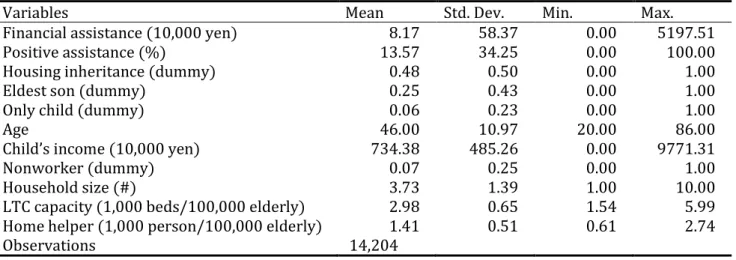
Table 1 provides descriptive statistics for our variables. On average, the annual …nancial support from adult children to their parents is approximately 81,700 yen, equivalent to about $742.7 ($1 = 110 yen). About one in seven respondents provide positive transfers to their parents. However, approximately half of all respondents expect to inherit the parental home. This disparity suggests that not all parents receive …nancial support from their children in exchange for leaving them the family home.
Table 2 presents the di¤erence in summary statistics for annual …nancial transfers between respondents who expect to inherit the parental home and those who do not. On average, adult children who expect to inherit the parental home provide a larger amount of …nancial support than those who do not. The proportion of adult children who provide a positive transfer to parents is also higher for children who expect to inherit the parental home than for those who
do not.
3.3 Estimation results
Table 3 reports the estimation results of the …rst-stage probit model, which are used to obtain the predicted value of inheritance propensity as the generated regressor. The coe¢ cient of eldest son has a positive and signi…cant sign. This indicates that the eldest son tends to plan to inherit the parental home, and this seems to correspond with the longstanding practice of primogeniture in Japan (Horioka, 2002; Ishino et al., 2017). As expected, respondents who are an only child are more likely to inherit the family home than their counterparts with siblings. The estimated coe¢ cient of income is signi…cantly positive, which is inconsistent with parents behaving in an altruistic way; that is, adult children with low incomes tend to inherit the parental home. The coe¢ cient of household size has a positive sign and is signi…cant, indicating that children are more likely to receive the parental home when they have a large family. As expected, the coe¢ cient of home helper has a negative and signi…cant sign, indicating that children are less likely to inherit the parental home when access to professional care services by seniors increases. In contrast, the coe¢ cient of LTC capacity has an unexpected sign and is statistically insigni…cant.
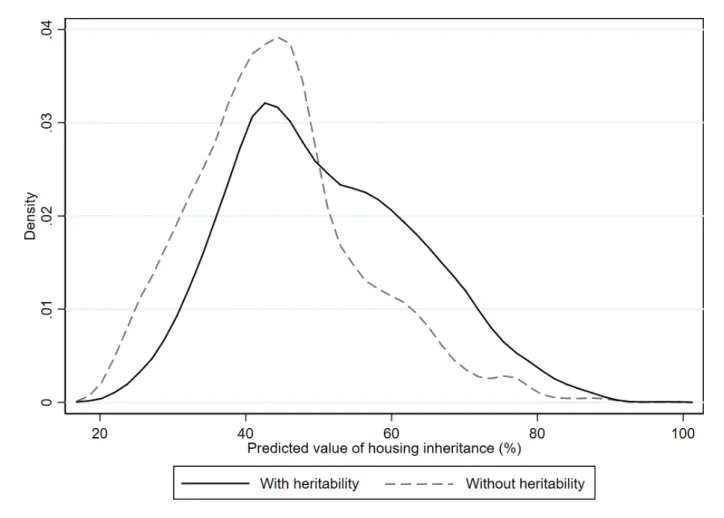
Figure 1 represents the kernel densities of the predicted value of the inheritance propensity with and without heritability, which we obtain from the …rst-stage probit model. Figure 1 indeed demonstrates that children with heritability are more likely to inherit the parental home.
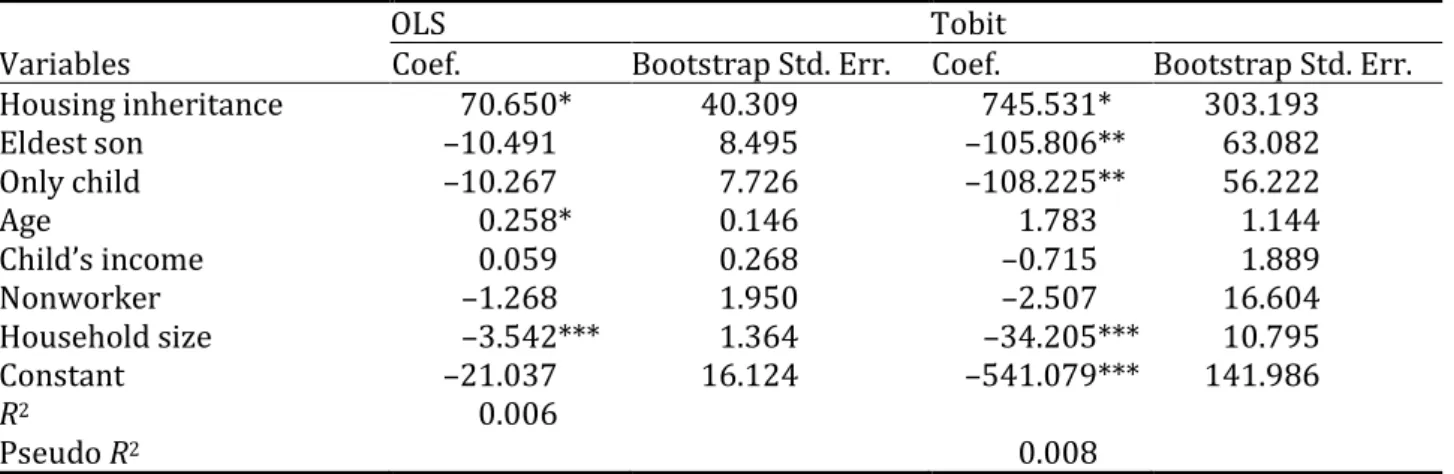
Table 4 provides the OLS and Tobit estimation results for monetary support from children to parents. In the second-stage OLS estimation in Table 4, the coe¢ cient of the generated re-gressor measuring the propensity of inheriting the parental home has a positive and signi…cant sign. This appears to con…rm the hypothesis of an implicit annuity contract in the form of an intrafamily reverse mortgage between adult children and their parents. However, while the second-stage OLS estimation in Table 4 considers the speci…cation issue of inheritance propen-sity, it does not control for the censoring of …nancial transfers. The second-stage Tobit model
in Table 4 considers both concerns. Again, the inheritance probabilities have a signi…cantly positive e¤ect on …nancial assistance from children to parents, which is consistent with our expectation. The coe¢ cient of housing inheritance in the Tobit model is larger in magnitude than in the OLS estimation, as expected. From the estimated results of the Tobit model in Table 4, we can compute a marginal e¤ect of housing inheritance probabilities on …nancial assistance by setting the values of all covariates to their means. The marginal e¤ect is 86.55 and its bootstrap standard error is 38.63.
In terms of the other explanatory variables, the Tobit model in Table 4 shows as follows. The coe¢ cients indicating the eldest son and an only child have negative and signi…cant signs. These results seem somewhat inconsistent with social norms. One possible interpretation is that these children are more likely to give their parents nonmonetary rather than monetary assistance. Household size also has a negative and signi…cant sign. This indicates that children cannot a¤ord the expense of supporting their parents when they themselves have a large family to support.
Figure 2 plots the kernel densities of the predicted value of housing inheritance obtained from the …rst-stage probit model in Table 3 using all observations. Figure 2 also depicts the relationship between the inheritance propensity and …nancial assistance from the second-stage Tobit model in Table 4. The average predicted value of inheritance propensity is approximately 47.6 percent and at this propensity the predicted value of …nancial assistance is 141,800 yen per year, which is 60,100 yen higher than the average value in Table 2. As mentioned in Section 1, however, nonworking elderly single-person households and nonworking elderly couple households respectively su¤er a de…cit in income of approximately 432,000 yen and 660,000 yen per year. The predicted value of …nancial assistance in the above average case is far below these values. Despite the fact that the number of children who can provide 432,000 or 660,000 yen per year to their parents is small, above the 89.8 or 96.4 percentile of the distribution, children are likely to do so when the predicted value of the inheritance propensity is 65.4 or 73.6 percent. Suzuki (2007) predicted that the elderly could extract 810,000 yen per year if they used formal reverse mortgages. Aging parents can receive this same value using intrafamily
reverse mortgages when they grant their children a 78.0 percent housing inheritance probability. This is despite the number of adult children who could provide 810,000 yen per year to their parents being much smaller, above the 98.3 percentile of the distribution. In sum, intrafamily reverse mortgages appear to serve as substitutes for formal reverse mortgages if parents give their children a substantially high expectation of inheriting the parental home.
We also check whether …nancial assistance varies among subgroups according to child’s income: household incomes below the 25th percentile (low-income child) and those at or above the 25th percentile (income child). Table 5 demonstrates that adult children in the high-income group signi…cantly increase their transfers when they expect to receive the parental home. Combined with the results from the …rst-stage probit model in Table 3, we can observe a strong interdependence between parents and their wealthy children. However, the coe¢ cient of housing inheritance is insigni…cant for children from the low-income group. This may re‡ect the fact that children with limited resources are more likely to give parents nonmonetary assistance when they cannot a¤ord to o¤er monetary support (Taniguchi and Kaufman, 2017). Alternatively, some elderly parents are purely altruistic, therefore, they bequest housing assets without an expectation of receiving …nancial help while they are alive from their low-income children.
3.4 Robustness checks
The remainder of this section reports the results of addtional speci…cations to assess the ro-bustness of our main …ndings. In Table 6, we show the empirical results of the OLS and Tobit models with a zero–one dummy for inheritance propensity, to see how the models in Table 4 modify possible bias. However, it is not easy to compare the magnitude of the coe¢ cients, because the generated regressor of inheritance propensity in Table 4 is a continuous variable ranging from zero to one, while inheritance propensity in Table 6 is a dummy variable taking on the values of zero or one. The results show that the estimated coe¢ cients for this dummy variable are positive and signi…cant in both models, which yield results that are qualitatively similar to those in Table 4.
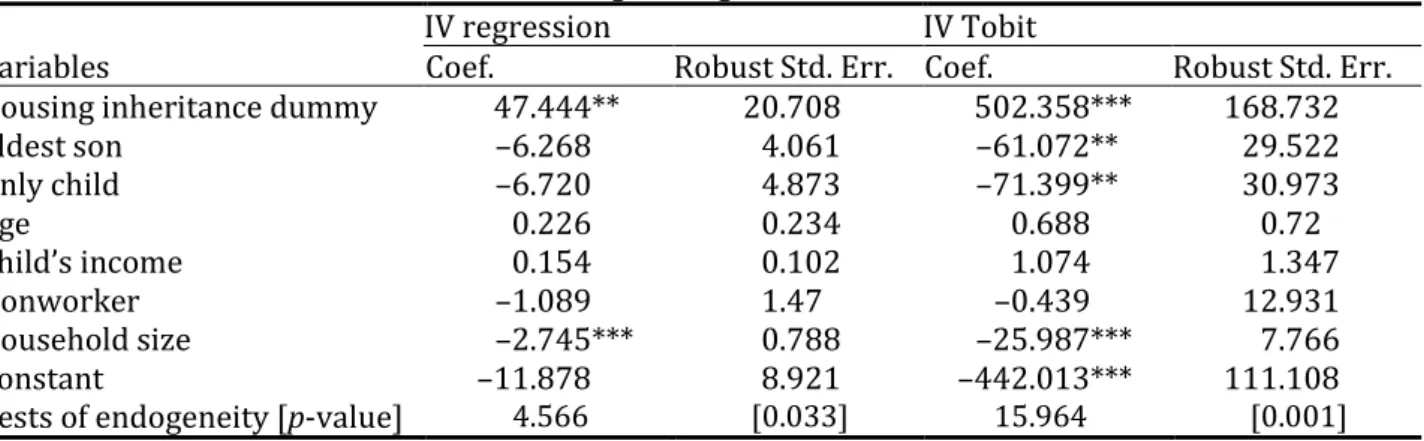
Table 7 presents the empirical results of the instrumental variable (IV) regression and the IV Tobit model. We again …nd that the estimated coe¢ cients of the dummy variable instrumented by the generated instruments indicating that adult children expect to receive the parental home are positive and signi…cant. The test statistics of endogeneity are su¢ ciently large in both models, indicating rejection of the null hypothesis that inheritance propensity is an exogenous variable at conventional signi…cance levels.
Instead of ti, we can consider an observed dummy variable measuring whether adult children
give …nancial transfers tdi. Then, the latent variable t#i is estimated by a probit model, which estimates the upstream transfers on the extensive margins (Cox, 1987). The zero–one dummy tdi is de…ned as follows:
tdi = 1; if t#i > 0 = 0; otherwise.
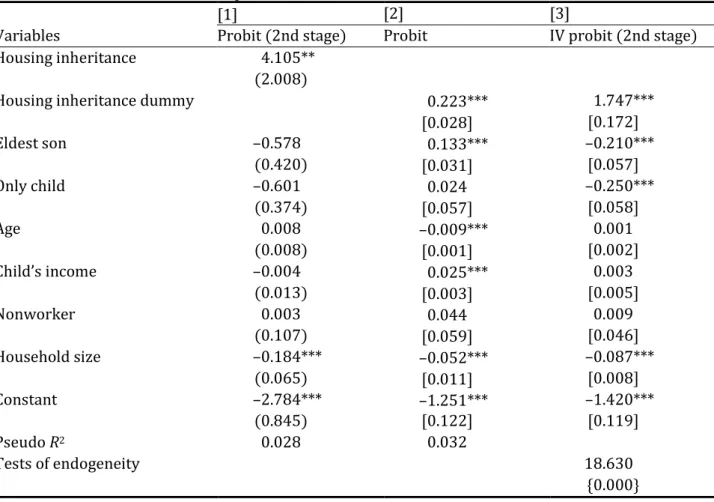
Model [1] in Table 8 demonstrates the empirical results of the second-stage probit model. The coe¢ cient of housing inheritance suggests that children are statistically more likely to give …nancial transfers when they expect to receive the parental home, which is consistent with our expectation. The estimated marginal e¤ect is 0.87 and its bootstrap standard error is 0.45. Models [2] and [3] in Table 8 show the empirical results of the probit and the second-stage IV probit models with a zero–one dummy for inheritance propensity. Both models also correspond with our expectation, because the coe¢ cients of housing inheritance dummy have a signi…cantly positive sign. Overall, the results in Tables 6, 7, and 8 provide some con…dence that our preferred …ndings are not unduly in‡uenced by alternative empirical models.
4
Conclusion
In Japan, elderly homeowners generally leave their housing assets to their children. It is also quite common that adult children demonstrate their appreciation to their aging parents by providing …nancial support while they are alive. This reciprocal interdependence appears to indicate that adult children and aging parents enter into an implicit annuity contract in the
form of an informal intrafamily reverse mortgage, whereby children agree to support their parents …nancially in exchange for inheriting the parental home. The purpose of this paper is to theoretically and empirically examine this possibility.
We applied a simple noncooperative game framework with a Stackelberg equilibrium to examine the reciprocal interdependence between the propensity of housing inheritance and …nancial assistance when formal care a¤ects decision-making. Theoretical models have sug-gested that adult children increase the amount of …nancial support to their parents when the probability of housing inheritance increases, which is consistent with a bequest motive arising from an implicit annuity contract.
We used data from Japanese households to test this reciprocal interdependence. Consider-ing both the censorConsider-ing of …nancial transfers and the speci…cation of the inheritance propensity, which are controlled using information on formal care, our empirical results indeed suggest that the propensity to inherit the parental home encourages transfers from adult children to their elderly parents. This may con…rm that the implicit annuity contract in the form of an intrafamily reverse mortgage appears to exist in Japanese society. However, altruism may also be a motive for bequeathing housing assets and engaging in …nancial provision. For example, altruistic children may o¤er …nancial assistance when parents run out of funds for living ex-penses. Parents then tend to show their appreciation to their children by bequeathing housing wealth. Instead, the bequest motive related to an implicit annuity contract may be an addi-tional motivator in societies where assets, particularly illiquid housing assets in our context, are quite di¢ cult to convert into cash.
The estimated results, however, suggest that on average, the amount of …nancial transfers from children tends to be too small to cover the welfare needs of their parents. Intrafamily reverse mortgages are e¤ectively available to elderly homeowners if children have high expec-tations of inheriting the parental home. This could be resolved if adult children were to legally contract with their elderly parents in relation to housing inheritance and …nancial assistance. For example, in the USA, National Family Mortgage, LLC provides a family-funded reverse mortgage called the Caregiver Mortgage, whereby adult children crowdfund a line of credit
against the equity in the parental home.
Subsample analysis indicated that the reciprocal interdependence found tends to operate best for children whose income is relatively high. However, …nancial support from children to parents is small when the income of the children is su¢ ciently low. These children cannot a¤ord to assist their elderly parents …nancially even if they receive the parental home in the future. Prolonged economic stagnation in Japan has resulted in a decreasing share of adult children in the higher income class. This suggests that intrafamily reverse mortgages may be available to even fewer elderly homeowners in the not-too-distant future. Nevertheless, this could be resolved if the commercial …nancial sector promoted customer-friendly reverse mortgage products to elderly homeowners.
There is, however, a consideration in that waiving inherited housing is becoming more com-mon in Japan (Hirayama, 2010). Indeed, the number of vacant houses is soaring in unattractive locations in Japan. Intrafamily reverse mortgages therefore would not be e¤ective in main-taining the welfare of the elderly in such areas. It is also di¢ cult for the commercial …nancial sector to develop reverse mortgages in locations with little prospect for pro…t. This situation is more likely to occur when adult children live a considerable distance away from their parents. Because we restricted our sample to respondents whose parents reside in the same prefecture, this issue remains a topic for future research.
Acknowledgments
The authors would like to thank Junya Hamaaki, Shih-Hsun Hsu, Takuya Ishino, Movshuk Oleksandr, Aslan Zorlu, seminar participants at UiT the Arctic University of Norway, University of Toyama, Nihon University, and conference attendees at ARSC, AsRES, ENHR, JEA for their valuable comments and suggestions. This research was part of a project by the Housing Research and Advancement Foundation of Japan, and supported by JSPS KAKENHI Grant Numbers JP16K03616 and JP17H00988. The authors are grateful to the Panel Data Research Center at Keio University for access to its microdata. The authors would also like to thank Michio Naoi and Kazuto Sumita for useful advice on using these data.
References
Begley, J. (2017). Legacies of homeownership: Housing wealth and bequests. Journal of Housing Economics, 35, 37–50. https://doi.org/10.1016/j.jhe.2016.12.002
Bernheim, B. D., Shleifer, A., & Summers, L. H. (1985). The strategic bequest motive. Journal of Political Economy, 93(6), 1045–1076. https://doi.org/10.1086/261351
Ciani, E., & Deiana, C. (2018). No free lunch, buddy: Past housing transfers and informal care later in life. Review of Economics of the Household, 16(4), 971–1001. https://doi.org/ 10.1007/s11150-018-9417-1
Cox, D. (1987). Motives for private income transfers. Journal of Political Economy, 95(3), 508–546. https://doi.org/10.1086/261470
Davido¤, T., Gerhard, P., & Post, T. (2017). Reverse mortgages: What homeowners (don’t) know and how it matters. Journal of Economic Behavior and Organization, 133, 151–171. https://doi.org/10.1016/j.jebo.2016.11.007
Doling, J., & Ronald, R. (2010). Home ownership and asset-based welfare. Journal of Housing and the Built Environment, 25(2), 165–173. https://doi.org/10.1007/s10901-009-9177-6 Farnham, M., & Sevak, P. (2016). Housing wealth and retirement timing. CESifo Economic
Studies, 62(1), 26–46. https://doi.org/10.1093/cesifo/ifv015
Fu, C. H. (2019). Living arrangement and caregiving expectation: The e¤ect of residential proximity on inter vivos transfer. Journal of Population Economics, 32(1), 247–275. https://doi.org/10.1007/s00148-018-0699-7
Green, R. K., & Zhu, L. (2018). The feasibility of reverse mortgages in Japan. Paper presented at the 23rd AsRES conference, Incheon.
Hirayama, Y. (2010). The role of home ownership in Japan’s aged society. Journal of Housing and the Built Environment, 25(2), 175–191. https://doi.org/10.1007/s10901-010-9183-8
Horioka, C. Y. (2002). Are the Japanese sel…sh, altruistic or dynastic? Japanese Economic Review, 53(1), 26–54. https://doi.org/10.1111/1468-5876.00212
Horioka, C. Y., Gahramanov, E., Hayat, A., & Tang, X. (2018). Why do children take care of their elderly parents? Are the Japanese any di¤erent? International Economic Review, 59(1), 113–136. https://doi.org/10.1111/iere.12264
Ishino, T., Seko, M., Sumita, K., & Naoi, M. (2017). The e¤ect of housing inheritance on heirs’ tenure choice and household wealth accumulation in Japan. Paper presented at the 31st ARSC meeting, Tokyo.
Izuhara, M. (2006). Changing families and policy responses to an ageing Japanese society. In Rebick, M. & Takenaka, A. (Eds.), The Changing Japanese Family (pp. 161–177), Routledge, London.
Izuhara, M. (2010). Housing wealth and family reciprocity in East Asia. In Izuhara, M. (Ed.), Ageing and Intergenerational Relations: Family Reciprocity from a Global Perspective (pp. 77–94), The Policy Press, Bristol.
Kojima, T. (2013). How to make reverse mortgages more common in Japan. Nomura Journal of Capital Markets, 4(4), 1–12.
Kotliko¤, L. J., & Spivak, A. (1981). The family as an incomplete annuities market. Journal of Political Economy, 89(2), 372–391. https://doi.org/10.1086/260970
Mitchell, O. S., & Piggott, J. (2004). Unlocking housing equity in Japan. Journal of the Japanese and International Economies, 18(4), 466–505. https://doi.org/10.1016/ j.jjie.2004.03.003
Moulton, S., Loibl, C., & Haurin, D. (2017). Reverse mortgage motivations and outcomes: Insights from survey data. Cityscape, 19(1), 73–98.
Norton, E. C., & Van Houtven, C. H. (2006). Inter-vivos transfers and exchange. Southern Economic Journal, 73(1), 157–172. https://doi.org/10.2307/20111880
Ohtake, F. (1991). Bequest motives of aged households in Japan. Ricerche Economiche, 45(2–3), 283–306.
Ronald, R., & Doling, J. (2012). Testing home ownership as the cornerstone of welfare: Lessons from East Asia for the West. Housing Studies, 27(7), 940–961. https://doi.org/ 10.1080/02673037.2012.725830
Seko, M., & Sumita, K. (2007). E¤ects of government policies on residential mobility in Japan: Income tax deduction system and the Rental Act. Journal of Housing Economics, 16(2), 167–188. https://doi.org/10.1016/j.jhe.2007.06.001
Suzuki, W. (2007). Reverse mortgage and e¤ective utilization of elderly assets (Ribasu mo-geji to koreisha shisan no yuko katsuyo). Japanese Journal of Research on Household Economics (Kikan Kakei Keizai Kenkyu), 74, 34–40. [in Japanese].
Taniguchi, H., & Kaufman, G. (2017). Filial norms, co-residence, and intergenerational ex-change in Japan. Social Science Quarterly, 98(5), 1518–1535. https://doi.org/10.1111/ ssqu.12365
Tomassini, C., Wolf, D. A., & Rosina, A. (2003). Parental housing assistance and parent-child proximity in Italy. Journal of Marriage and Family, 65(3), 700–715. https://doi.org/ 10.1111/j.1741-3737.2003.00700.x
Toussaint, J., & Elsinga, M. (2009). Exploring ‘housing asset-based welfare’. Can the UK be held up as an example for Europe? Housing Studies, 24(5), 669–692. https://doi.org/ 10.1080/02673030903083326
Wooldridge, J. M. (1995). Score diagnostics for linear models estimated by two stage least squares. In Maddala G. S., Phillips P. C. B., & Srinivasan T. N. (Eds), Advances in Econometrics and Quantitative Economics: Essays in Honor of Professor C. R. Rao (pp. 66–87), Blackwell, Oxford.
Yamada, K. (2006). Intra-family transfers in Japan: Intergenerational co-residence, dis-tance, and contact. Applied Economics, 38(16), 1839–1861. https://doi.org/10.1080/ 00036840600825746
Yin, T. (2010). Parent-child co-residence and bequest motives in China. China Economic Review, 21(4), 521–531. https://doi.org/10.1016/j.chieco.2010.05.003
Figure 1: Kernel densities of predicted value of housing inheritance probabilities with and without
Table 1: Descriptive statistics of the full sample
Variables Mean Std. Dev. Min. Max.
Financial assistance (10,000 yen) 8.17 58.37 0.00 5197.51
Positive assistance (%) 13.57 34.25 0.00 100.00
Housing inheritance (dummy) 0.48 0.50 0.00 1.00
Eldest son (dummy) 0.25 0.43 0.00 1.00
Only child (dummy) 0.06 0.23 0.00 1.00
Age 46.00 10.97 20.00 86.00
Child’s income (10,000 yen) 734.38 485.26 0.00 9771.31
Nonworker (dummy) 0.07 0.25 0.00 1.00
Household size (#) 3.73 1.39 1.00 10.00
LTC capacity (1,000 beds/100,000 elderly) 2.98 0.65 1.54 5.99
Home helper (1,000 person/100,000 elderly) 1.41 0.51 0.61 2.74
Observations 14,204
Note: Descriptive statistics for region, city size, and survey year dummies not shown.
Table 2: Annual financial assistance from adult children to parents
With heritability Without heritability
Mean (10,000 yen) 11.67 4.98
(81.25) (22.04)
Positive assistance (%) 16.64 10.79
Observations 6,760 7,444
Note: Standard deviation in parentheses.
Table 3: Estimation results of the first-stage probit model
Variables Coef. Robust Std. Err.
Eldest son 0.478*** 0.025 Only child 0.452*** 0.050 Age –0.012*** 0.001 Child’s income 0.021*** 0.003 Nonworker 0.027 0.046 Household size 0.088*** 0.008 LTC capacity 0.023 0.033 Home helper –0.094*** 0.033 Constant –0.186 0.129 Pseudo R2 0.050
Note: Number of observations is 14,204.
Model controls for region, city size, and survey year (estimates not shown). *** denotes significance at the 1% level.
Table 4: Estimation results of the second-stage OLS and Tobit models
OLS Tobit
Variables Coef. Bootstrap Std. Err. Coef. Bootstrap Std. Err.
Housing inheritance 70.650* 40.309 745.531* 303.193 Eldest son –10.491 8.495 –105.806** 63.082 Only child –10.267 7.726 –108.225** 56.222 Age 0.258* 0.146 1.783 1.144 Child’s income 0.059 0.268 –0.715 1.889 Nonworker –1.268 1.950 –2.507 16.604 Household size –3.542*** 1.364 –34.205*** 10.795 Constant –21.037 16.124 –541.079*** 141.986 R2 0.006 Pseudo R2 0.008
Note: Number of observations is 14,204.
Housing inheritance is the generated regressor obtained from the first-stage probit model. Child’s income is divided by 100.
Models control for region and survey year (estimates not shown).
Bootstrap Std. Err. obtained by bootstrap approximation using 500 resamples. ***, **, * denote significance at the 1%, 5%, 10% level, respectively.
Table 5: Estimation results of the subsamples according to child's income
High-income child Low-income child
Variables Coef. Bootstrap Std. Err. Coef. Bootstrap Std. Err.
Housing inheritance 968.678** 400.128 –40.185 300.073 Eldest son –151.055* 82.099 38.966 72.133 Only child –133.046* 72.133 1.646 82.099 Age 2.081 1.499 –0.144 1.086 Child’s income –2.486 2.467 –0.708 4.086 Nonworker 12.022 25.922 –10.457 15.131 Household size –44.345 14.413 –1.081 10.349 Constant –630.499*** 184.615 –128.288 119.606 Pseudo R2 0.009 0.008 Observations 10,655 3,549
Note: Housing inheritance is the generated regressor obtained from the first-stage probit model. Child’s income is divided by 100.
Models control for region and survey year (estimates not shown).
High-income child is defined as a child whose household income is at or above the 25th percentile. Low-income child is defined as a child whose household income is below the 25th percentile. Bootstrap Std. Err. obtained by bootstrap approximation using 500 resamples.
Table 6: Estimation results of the OLS and Tobit models
OLS Tobit
Variables Coef. Robust Std. Err. Coef. Robust Std. Err.
Housing inheritance dummy 6.281*** 1.113 47.282*** 11.788
Eldest son 1.273 1.004 22.196** 6.518 Only child 0.180 2.044 3.986 10.580 Age –0.032 0.028 –1.375*** 0.401 Child’s income 0.545** 0.146 4.572*** 1.232 Nonworker –0.573 1.334 5.148 10.370 Household size –1.352*** 0.514 –10.534*** 3.540 Constant 4.236 2.630 –263.258*** 65.025 R2 0.008 Pseudo R2 0.010
Note: Number of observations is 14,204. Child’s income is divided by 100.
Models control for region and survey year (estimates not shown). ***, ** denote significance at the 1%, 5% level, respectively.
Table 7: Estimation results of the second-stage IV regression and IV Tobit models
IV regression IV Tobit
Variables Coef. Robust Std. Err. Coef. Robust Std. Err.
Housing inheritance dummy 47.444** 20.708 502.358*** 168.732
Eldest son –6.268 4.061 –61.072** 29.522 Only child –6.720 4.873 –71.399** 30.973 Age 0.226 0.234 0.688 0.72 Child’s income 0.154 0.102 1.074 1.347 Nonworker –1.089 1.47 –0.439 12.931 Household size –2.745*** 0.788 –25.987*** 7.766 Constant –11.878 8.921 –442.013*** 111.108
Tests of endogeneity [p-value] 4.566 [0.033] 15.964 [0.001]
Note: Number of observations is 14,204.
Housing inheritance dummy is the generated IV obtained from the first-stage probit model. Child’s income is divided by 100.
Models control for region and survey year (estimates not shown).
The null hypothesis that all independent variables including housing inheritance dummy are exogenous in the IV regression model is tested using a Wooldridge (1995) robust regression-based test.
The null hypothesis that housing inheritance dummy is exogenous in the IV Tobit model is tested using the Wald test.
Table 8: Estimation results of the probit models
[1] [2] [3]
Variables Probit (2nd stage) Probit IV probit (2nd stage)
Housing inheritance 4.105**
(2.008)
Housing inheritance dummy 0.223*** 1.747***
[0.028] [0.172] Eldest son –0.578 0.133*** –0.210*** (0.420) [0.031] [0.057] Only child –0.601 0.024 –0.250*** (0.374) [0.057] [0.058] Age 0.008 –0.009*** 0.001 (0.008) [0.001] [0.002] Child’s income –0.004 0.025*** 0.003 (0.013) [0.003] [0.005] Nonworker 0.003 0.044 0.009 (0.107) [0.059] [0.046] Household size –0.184*** –0.052*** –0.087*** (0.065) [0.011] [0.008] Constant –2.784*** –1.251*** –1.420*** (0.845) [0.122] [0.119] Pseudo R2 0.028 0.032 Tests of endogeneity 18.630 {0.000}
Note: Number of observations is 14,204.
Housing inheritance in Model [1] is the generated regressor obtained from the first-stage probit model. Housing inheritance dummy in Model [3] is the generated IV obtained from the first-stage probit model. Child’s income is divided by 100.
Models control for region and survey year (estimates not shown).
The null hypothesis that housing inheritance dummy is exogenous in the IV probit model is tested using the Wald test.
Bootstrap Std. Err. in parentheses, Robust Std. Err. in brackets, p-value in braces. Bootstrap Std. Err. obtained by bootstrap approximation using 500 resamples. ***, ** denote significance at the 1%, 5% level, respectively.