Effect of Intravesical Bacilli Calmette-Guerin Therapy After Second Transurethral
Resection in Stage Ta T1 High-Grade Bladder Cancer
Yusuke Kimura,* Masashi Honda,* Shuichi Morizane,* Katsuya Hikita,* Tadahiro Isoyama,† Koji Ono,‡ Tsutomu Koumi,§ Chihiro Takahashi,‖ and Atsushi Takenaka*
*Division of Urology, Department of Surgery, School of Medicine, Tottori University Faculty of Medicine, Yonago 683-8503, Japan, †Torrori Prefectual Central Hospital, Tottori 680-0901, Japan, ‡Japanese Red Cross Tottori Hospital, Tottori 680-8517, Japan, §Japanese Red Cross Matsue Hospital, Matsue 690-8506, Japan, and ‖Yonago Medical Center, Yonago 683-0006, Japan
ABSTRACT
Background To evaluate the efficacy of Bacilli Calmette-Guerin (BCG) induction instillation therapy after second transurethral resection (TUR) in stage Ta T1 high-grade bladder cancer.
Methods We performed a retrospective analysis of 49 consecutive new onset Ta T1 high-grade bladder cancer patients treated with second TUR at our affiliated insti-tutions. Residual cancer rate, intravesical recurrence-free survival (RFS), and risk factors related to RFS were evaluated by univariate and multivariate Cox proportional hazard model analyses.
Results Thirty-one patients received BCG therapy af-ter the second TUR (BCG group), and 18 patients were treated with second TUR alone (no BCG group). There were statistically significant differences in the RFS rates between the two groups, (P = 0.037). BCG therapy was the only factor predictive of intravesical recurrence after second TUR in both univariate and multivariate analyses. After the second TUR, BCG therapy signifi-cantly decreased intravesical recurrence in the patients with residual tumors (P = 0.014). However, there was no significant difference in intravesical recurrence in the patients with no residual tumors between the two groups (P = 0.359).
Conclusion BCG therapy after second TUR signifi-cantly decreased intravesical recurrence of residual tumors found at the second TUR.
Key words bacilli calmette-guerin therapy; bladder cancer; second transurethral resection
High-grade non-muscle invasive bladder cancer (NMIBC) give some epidemiological data. The recur-rence rate after transurethral resection of bladder tumor (TURBT) has been reported to be approximately 60%–70%.1–3 The standard treatment for high-grade pT1 bladder cancer following TURBT was the intra-vesical Bacilli Calmette-Guerin (BCG) therapy before a second transurethral resection (TUR) was selected. This has decreased the recurrence rate to approximately 30%–50%.4, 5 For high risk groups in bladder cancer progression, the European Association of Urology guidelines indicate cystectomy or intravesical BCG therapy as the standard treatments.6 Cystectomy is a typical treatment that patients with high risk for blad-der cancer can follow. Additionally, it is an option for patients with low efficacy of BCG. For this reason, after TURBT for patients with high-grade pT1 bladder cancer, BCG induction therapy is chosen as the next treatment.
In several series of second TUR for bladder cancer, recurrence-free survival (RFS) was very different between patients who received a second TUR and those who received a single TUR. In the prospective random-ized study by Divrik et al (2010), 5y RFS of patients who had only T1 bladder cancer, who received a second TUR was 59% and those who received a single TUR was 32% (P < 0.001).7 According to the guidelines of the European Association of Urology, second TUR is recommended for those patients who have high-grade Ta T1 tumors in the bladder.6 Furthermore, in the National Comprehensive Cancer Network guidelines, if an accurate staging cannot be obtained in the first TUR or if there is no specimen including muscle layer in the TUR specimen, repeat resection is recommended for high grade pTa bladder cancers and any pT1 bladder cancers.8 According to these results, a single TUR alone may underestimate muscle invasive cancers, which may result in inadequate treatment. Considering the above, a second TUR is recommended for accurate diagnosis of disease and improvement of outcome in high-grade T1 bladder cancer.
As described above, the efficacy of second TUR
Corresponding author: Masashi Honda, MD, PhD [email protected]
Received 2019 January 31 Accepted 2019 May 8 Online published 2019 June 20
Abbreviations: BCG, Bacilli Calmette-Guerin; BMI, body mass index; CI, confidence intervals; CIS, concomitant carcinoma in situ; HRs, hazard ratios; NMIBC, non-muscle invasive bladder cancer; RFS, recurrence-free survival; TURBT, transurethral resection of bladder tumor
and BCG induction instillation therapy after (first) TUR-Bt in high-grade Ta T1 bladder cancers were shown. However, the adaptation and effects of BCG therapy af-ter the second TUR in high-grade Ta T1 bladder cancer have not been fully considered. In particular, it is essen-tial to determine if BCG induction instillation therapy is necessary for patients with no residual tumor at the second TUR. As far as we could search, there was only one study that has examined BCG therapy after second TUR. Thus, the aim of this study was to investigate the effects of BCG therapy after second TUR in high-grade Ta T1 bladder cancer. Furthermore, the effects of BCG therapy in patients with no residual tumors after the second TUR were evaluated.
MATERIALS AND METHODS
In this study, data were collected from five institutes, from June 2006 up to April 2015. Informed consent was obtained from all individual participants included in the study. In total, 60 patients were newly diagnosed with Ta T1 high-grade bladder cancer at the first TUR and who received a second TUR. We excluded one patient who received intravesical chemotherapy after the second TUR, five patients who underwent cystectomy before intravesical recurrence, and five patients with a past his-tory or complication of upper tract urothelial carcinoma. Excluding these patients, we retrospectively analysed 49 patients in a non-randomized study. All of the 49 patients underwent a second TUR within approximately 4–6 weeks following the first TUR. In the second TUR, deep resection was performed to obtain muscle in the pathological specimen with a tumor margin of approxi-mately one cm.
Among the 49 patients, 31 received BCG induction instillation within 2–4 weeks after the second TUR (BCG group), and 18 patients received no therapy after the second TUR (no BCG group). The reasons for no BCG therapy after the second TUR were, clinical decisions made by the attending physician in 13 cases, old age in 3 cases, and patient rejection in 2 cases. BCG consisted of one instillation weekly for 8 weeks. Cystoscopy and urinary cytology were performed 4–6 weeks after the BCG therapy, and a biopsy was performed if there was an abnormality. Patients were followed by urinary cytology and cystoscopy every three months in the first two years, every six months in the third to fourth year, and every 12 months in the fifth year and later. No patients received maintenance BCG therapy.
We checked the medical records with attention to patient characteristics, tumor status at first TUR, pathological findings of the second TUR, and adjuvant
therapy after the second TUR. Tumor size was defined as the maximum tumor dimension estimated at the time of TURBT and/or by clinical imaging. The numbers of tumors were estimated in the same manner. Concomitant carcinoma in situ (CIS) was revealed in the surgical pathology of TURBT. The clinical T stage and grade of the bladder were determined according to the 2002 TNM classification of bladder tumors. The pathological examination for bladder tumor was performed by pathologists at each institution.
We performed the chi-square test to compare the following patient background factors between the 2 groups. The primary end point of this study was the first intravesical recurrence. We estimated the RFS by using the Kaplan–Meier method and compared them between the 2 groups by performing the log-rank test. Univariate and multivariate analyses using a Cox proportional hazards regression model were used to analyze the potential risk factors for the intravesical recurrence after the second TUR.
Estimated hazard ratios (HRs) with their respec-tive 95% confidence intervals (CI) were defined for each variable analyzed. We used IBM SPSS Statistics for Windows (version 23.0; IBM, Armonk, NY) for statistical analyses. A P-value < 0.05 was considered as indicating statistical significance.
RESULTS
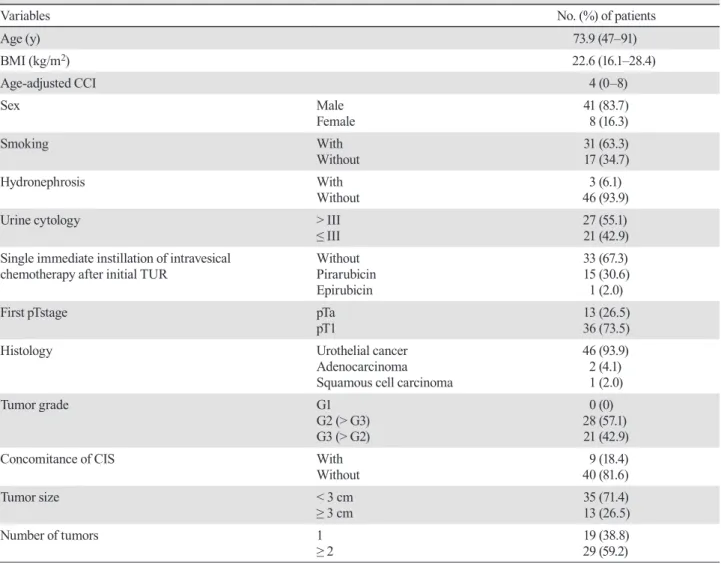
The median follow-up period for the 49 patients was 34.0 months (range, 8.7–117 months). This study in-cluded 41 male and eight female patients. In Table 1, the patients’ characteristics are presented. Of the 49 patients after second TUR, residual tumors (pTa, pT1, and pTis) were detected in 21 patients (42.9%), and no residual tumor (pT0) was found in 28 patients (57.1%). The rates of residual tumor were 53.8% in pTa and 38.9% in pT1. In the patients with high-grade pTa at the initial TUR, 2 patients were upstaged to pT1 at the second TUR.
Of the 49 patients, 13 (26.5%) developed intravesi-cal recurrences. The median period until intravesiintravesi-cal recurrence was 6.8 months (range, 3.6–35.6 months). The RFS rate was 79.5% at 1 year, 75.2% at 2 years, and 70.8% at 3 years.
At the second TUR, six patients were pT1, among whom two patients were pTa, and four were pT1 at the initial TUR. Intravesical recurrence was observed in three of the six (Ta, one patient; T1, two patients at the initial TUR), and all three of these patients underwent subsequent total cystectomy. Interestingly, these three patients did not receive add-on BCG after the second TUR, but three patients without recurrence did.
the chi-square test results of the 2 groups are presented. Differences were found in concomitant CIS (P = 0.01) and tumor size (P = 0.04) between the two groups.
In Table 3, the results of univariate and multivariate analysis to predict the risk factors for intravesical recur-rence are shown. BCG was the only factor predictive of intravesical recurrence after the second TUR in both the univariate and multivariate analyses. In this study, there were no preoperative factors predictive of intravesical recurrence.
The results of the intravesical RFS after the second TUR for the two groups (BCG vs. no BCG) determined by the Kaplan–Meier method and log-rank test are shown in Fig. 1. The 1-year RFS rates of the two groups were 84% (BCG group) and 61% (no BCG group). The RFS period was significantly longer for the BCG group than for the no BCG group (P = 0.037) (Fig. 1A). In 40 patients, excluding concomitant CIS, the RFS
was significantly longer for the BCG group (n = 22) compared to the no BCG group (n = 18) (P = 0.035) (Fig. 1B). For tumor maximum diameters at initial TUR of < 3 cm, there was a tendency of recurrence suppres-sion effect in the BCG group versus the no BCG group (P = 0.082), but there was no significant difference in recurrence between the two groups for tumor maximum diameters at initial TUR of ≥ 3 cm (P = 0.356). We also analysed the intravesical RFS rates between the two groups (BCG vs. no BCG) for the presence or absence of residual tumor after the second TUR. There was a significant recurrence suppression effect in the BCG group (P = 0.014) (Fig. 1C) in the patients with residual tumor after the second TUR, but there was no signifi-cant difference between the two groups in the patients with no residual tumor (P = 0.359) (Fig. 1D).
Table 1. Patients' characteristics of 49 patients with bladder cancer who underwent a second TUR
Variables No. (%) of patients
Age (y) 73.9 (47–91) BMI (kg/m2) 22.6 (16.1–28.4) Age-adjusted CCI 4 (0–8) Sex Male Female 41 (83.7) 8 (16.3) Smoking With Without 31 (63.3) 17 (34.7) Hydronephrosis With Without 46 (93.9)3 (6.1)
Urine cytology > III
≤ III 27 (55.1) 21 (42.9)
Single immediate instillation of intravesical
chemotherapy after initial TUR Without Pirarubicin Epirubicin
33 (67.3) 15 (30.6) 1 (2.0)
First pTstage pTa
pT1 13 (26.5) 36 (73.5)
Histology Urothelial cancer
Adenocarcinoma Squamous cell carcinoma
46 (93.9) 2 (4.1) 1 (2.0) Tumor grade G1 G2 (> G3) G3 (> G2) 0 (0) 28 (57.1) 21 (42.9)
Concomitance of CIS With
Without 40 (81.6)9 (18.4)
Tumor size < 3 cm
≥ 3 cm 35 (71.4) 13 (26.5)
Number of tumors 1
≥ 2 19 (38.8) 29 (59.2)
Table 2. Patient background factors and the chi-square test results
Second TUR alone Second TUR + BCG P-value
n = 18 n = 31 Age (y) < 76 ≥ 76 9 9 15 16 .574 Sex Male Female 15 3 26 5 .628 Urine cytology < IV ≥ IV 7 10 14 17 .517 Tumor size < 3 cm ≥ 3 cm 10 8 25 5 .040
Number of tumors Single
Multiple 8 10 11 19 .408
pTstage after initial TUR pTa
pT1 2 16 9 22 .136
Concomitant CIS With
Without 0 18 9 22 .010
Single immediate instillation of
intravesicalchemotherapy With Without 5 13 11 20 .410
Residual tumor after second TUR With
Without 5 13 16 15 .920
BCG, bacilli calmette-guerin; CIS, concomitant carcinoma in situ; TUR, transurethral resection; y, years.
Table 3. Univariate and multivariate analyses of preoperative and postoperative parameters predicting intravesical recurrence
Multivariate
Parameter Cutoff Univariate
P value Hazard ratio 95% CI P-value
Age (y) < 76 vs ≥ 76 0.692 0.772
BMI (kg/m2) < 25 vs ≥ 25 0.324 0.487
Age-adjusted CCI < 4 vs ≥ 4 0.395 0.137
Sex Male vs female 0.355 0.486
Smoking With vs without 0.618 0.713
Urine cytology < IV vs ≥ IV 0.054 0.125
Tumor size < 3 cm vs ≥ 3 cm 0.158 0.599
Number of tumors Single vs multiple 0.574 0.605
Histological history UC vs non UC 0.895 0.780
Initial TUR pTstage Ta vs T1 0.527 0.451
Concomitant CIS With vs without 0.751 0.915
Single immediate instillation of intravesical chemotherapy after
initial TUR With vs without 0.700 0.393
BCG after second TUR Without vs with 0.013 3.736 1.124–12.423 0.032
Residual tumor after second TUR With vs without 0.453 0.873
BCG, bacilli calmette-guerin; BMI, body mass index; CCI, charlson comorbidity index; CI, confidence interval; CIS, concomitant carcinoma in situ; TUR, transurethral resection; UC, urothelial carcinoma; y, years.
DISCUSSION
Many studies have reported that a second TUR for high-grade bladder cancer can prevent intravesical recurrence and enable detection of staging errors and residual tumors, therefore second TUR is strongly recommended for high-grade T1 bladder cancer. The results of the procedure can be useful in the decision-making process for subsequent management, including watchful follow-up, adjuvant intravesical therapy, or cystectomy.9 The rates of residual tumor and upstaging after the second TUR have varied between 28%–74%
and 1.7%–64%, respectively.1, 10–14 In our study, with the exclusion of some cases, the rate of residual tumor at the second TUR was 42.9%. When the excluded cases were included (n = 60), the rates of residual tumor and upstaging to muscle invasive at the second TUR were 50.0% and 1.7%, respectively, which are comparable with those of the previous studies cited above.
For high-grade Ta disease, the First International Consultation on Bladder Tumors recommends one immediate chemotherapy instillation after TURBT, followed two to four weeks later by repeat TURBT Fig. 1. Kaplan–Meier curves of recurrence-free survival in patients who received BCG instillation therapy after the second TUR and those who received the second TUR alone (no BCG) (A) in all patients (n = 49); (B) in patients without concomitant CIS (n = 40); (C) in patients with residual tumors after the second TUR (n = 21); and (D) in patients with no residual tumor after the second TUR (n = 28). BCG, bacilli calmette-guerin; CIS, concomitant carcinoma in situ; TUR, transurethral resection.
and bladder mapping biopsy.15 The standard American Urological Association approach to high-grade Ta, T1, and/or CIS primary bladder cancer after initial TURBT is second TUR before additional intravesical therapy.16 In our study, at the first TUR, not only high-grade T1 but also Ta occurred at half of the residual tumor rate after the second TUR. Two patients were upstaged to pT1 in the case of high-grade Ta at the initial TUR, and one of the two had undergone total cystectomy after intravesical recurrence. For the reasons above, although the sample size was small, we think that it is better to perform a second TUR not only for T1 but also Ta in high-grade.
The European Organization for Research and Treatment of Cancer has reported that are several characteristics of risk factors which have a role in the intravesical recurrence of NMIBC.17 Presence of con-comitant CIS, prior recurrence rate, the size of the tumor and the multiplicity were risk factors for intravesical re-currence in patients with Ta T1 bladder cancer who did not undergo TUR for the second time neither received maintenance therapy with instillation BCG. In another study, patients with high-grade T1 bladder cancer who had not undergone a second TUR, the location of the tumor was the risk factor for intravesical recurrence.18 In our study, there were no significant differences in in-travesical recurrence for the examined preoperative risk factors, including tumor size, tumor number, and tumor grade; only BCG instillation therapy was significantly associated with intravesical recurrence.
When pT1 disease is found at the second TUR, the question of which treatment should be added is contro-versial, particularly regarding cystectomy. Herr et al (2007)3 reported that patients with T1 remaining at the second TUR were more likely to progress even if BCG therapy was administered. For such cases, immediate cystectomy was proposed along with careful follow-up observation and the state of the residual tumor to decide on the most appropriate management. With reference to these findings, because the patients with high-grade T1 bladder cancer who undergo a second TUR are higher risk for progression, cystectomy at an early stage has more possibility to lead to cure. On the contrary, an-other study demonstrated that there was no significant difference in the survival rate between the patients who received early cystectomy and those who continued follow-up without cystectomy until they needed it.19 In the present study, bladder function was preserved in all three T1 patients receiving BCG induction therapy after the TUR for the second time. At the mention of the complications associated with chemotherapy, cystec-tomy or radiation therapy, the adequate BCG induction
therapy is one reasonable treatment option for careful management.
In the retrospective study by Iida et al (2016)20 where all the patients had new onset high-grade T1 bladder cancer, BCG therapy was the strongest factor predictive of intravesical RFS after the second TUR in both univariate and multivariate analyses. In that study, the 1- and 3-year RFS rates were 83% and 77% for BCG after the second TUR, respectively, and 60% and 32% for second TUR alone, respectively. The researchers concluded that even if the pathology of the second TUR was pT0, BCG therapy following a second TUR de-creased intravesical recurrence.20 On the other hand, in our study, although the RFS rates tended to be higher in the BCG group than those in the no BCG group, there was no significant difference in the RFS rates between the groups for the patients with no residual tumor at the second TUR. The reason for this discrepancy between our results and the results from the study by Iida et al20 (2016) is that our institution performed a more complete resection. The number of recurrent cases at the second TUR with no BCG and no residual tumor was 11 (58%) of 19 in the study by Iida et al previously cited study, whereas it was 5 (38.5%) of 13 in our study.
Our study has some limitations. It is a non-randomized, retrospective, multi-center study in a small number of patients. There was variation in the TUR procedures among the institutions, and the pathological results also may have varied. Additionally, the indica-tions for introducing BCG were not consistent among the different institutions. We did not consider whether the recurrence site was located at the second TUR area at another area and finally, we did not perform mainte-nance BCG after the second TUR.
BCG therapy after the second TUR in Ta T1 high-grade bladder cancer significantly decreased intravesi-cal recurrence. However, in patients with no residual tumor after the second TUR, there was no significant difference in RFS rates between patients who received second TUR with BCG therapy and those who received the second TUR alone.
The authors declare no conflict of interest. REFERENCES
1 Brauers A, Buettner R, Jakse G. Second resection and prognosis of primary high risk superficial bladder cancer: is cystectomy often too early? J Urol. 2001;165:808-10. PMID: 11176474, DOI: 10.1016/S0022-5347(05)66532-9
2 Herr HW. Restaging transurethral resection of high risk superficial bladder cancer improves the initial response to bacillus Calmette-Guerin therapy. J Urol. 2005;174:2134-7.
3 Herr HW, Donat SM, Dalbagni G. Can restaging transure-thral resection of T1 bladder cancer select patients for im-mediate cystectomy? J Urol. 2007;177:75-9. PMID: 17162005,
DOI: 10.1016/j.juro.2006.08.070
4 Böhle A, Jocham D, Bock PR. Intravesical bacillus Calmette-Guerin versus mitomycin C for superficial bladder cancer: a formal meta-analysis of comparative studies on recurrence and toxicity. J Urol. 2003;169:90-5. PMID: 12478111,DOI: 10.1016/S0022-5347(05)64043-8
5 Han RF, Pan JG. Can intravesical bacillus Calmette-Guérin reduce recurrence in patients with superficial bladder cancer? A meta-analysis of randomized trials. Urology. 2006;67:1216-23. PMID: 16765182,DOI: 10.1016/j.urology.2005.12.014
6 Babjuk M, Oosterlinck W, Sylvester R, Kaasinen E, Böhle A, Palou-Redorta J, et al. EAU guidelines on non-muscle-invasive urothelial carcinoma of the bladder, the 2011 update. Eur Urol. 2011;59:997-1008. PMID: 21458150, DOI: 10.1016/ j.eururo.2011.03.017
7 Divrik RT, Şahin AF, Yildirim Ü, Altok M, Zorlu F. Impact of routine second transurethral resection on the long-term outcome of patients with newly diagnosed pT1 urothelial carcinoma with respect to recurrence, progression rate, and disease-specific survival: a prospective randomised clinical trial. Eur Urol. 2010;58:185-90. PMID: 20303646, DOI: 10.1016/j.eururo.2010.03.007
8 Spiess PE, Agarwal N, Bangs R, Boorjian SA, Buyyounouski MK, Clark PE, et al. Bladder Cancer, Version 5.2017, NCCN clinical guidelines in oncology. J Natl Compr Canc Netw. 2017;15:1240-67. PMID: 28982750,DOI: 10.6004/ jnccn.2017.0156
9 Kulkarni GS, Hakenberg OW, Gschwend JE, Thalmann G, Kassouf W, Kamat A, et al. An updated critical analysis of the treatment strategy for newly diagnosed high-grade T1 (previously T1G3) bladder cancer. Eur Urol. 2010;57:60-70.
PMID: 19740595, DOI: 10.1016/j.eururo.2009.08.024
10 Dutta SC, Smith JA Jr, Shappell SB, Coffey CS, Chang SS, Cookson MS. Clinical under staging of high risk nonmuscle invasive urothelial carcinoma treated with radical cystectomy. J Urol. 2001;166:490-3. PMID: 11458053, DOI: 10.1016/ S0022-5347(05)65969-1
11 Rigaud J, Karam G, Braud G, Glemain P, Buzelin JM, Bouchot O, et al. [T1 bladder tumors: value of a second endo-scopic resection]. Prog Urol. 2002;12:27-30. PMID: 11980011
12 Zurkirchen MA, Sulser T, Gaspert A, Hauri D. Second trans-urethral resection of superficial transitional cell carcinoma of the bladder: a must even for experienced urologists. Urol Int. 2004;72:99-102. PMID: 14963348, DOI: 10.1159/000075961
13 Divrik T, Yildirim Ü, Eroğlu A, Zorlu F, Özen H. Is a second transurethral resection necessary for newly diagnosed pT1 bladder cancer? J Urol. 2006;175:1258-61. PMID: 16515974,
DOI: 10.1016/S0022-5347(05)00689-0
14 Herr HW. The value of a second transurethral resection in evaluating patients with bladder tumors. J Urol. 1999;162:74-6. PMID: 10379743,DOI: 10.1097/00005392-199907000-00018
15 Sylvester RJ, van der Meijden A, Witjes JA, Jakse G, Nonomura N, Cheng C, et al. High-grade Ta urothelial carcinoma and carcinoma in situ of the bladder. Urology. 2005;66(suppl 1):90-107. PMID: 16399418, DOI: 10.1016/ j.urology.2005.06.135
16 Hall MC, Chang SS, Dalbagni G, Pruthi RS, Seigne JD, Skinner EC, et al. Guideline for the management of non-muscle invasive bladder cancer (stages Ta, T1, and Tis): 2007 update. J Urol. 2007;178:2314-30. PMID: 17993339, DOI: 10.1016/j.juro.2007.09.003
17 Sylvester RJ, van der Meijden APM, Oosterlinck W, Witjes JA, Bouffioux C, Denis L, et al. Predicting recurrence and progression in individual patients with stage Ta T1 bladder cancer using EORTC risk tables: a combined analysis of 2596 patients from seven EORTC trials. Eur Urol. 2006;49:466-77.
PMID: 16442208, DOI: 10.1016/j.eururo.2005.12.031
18 Segal R, Yafi FA, Brimo F, Tanguay S, Aprikian A, Kassouf W. Prognostic factors and outcome in patients with T1 high-grade bladder cancer: can we identify patients for early cystectomy? BJU Int. 2012;109:1026-30. PMID: 21883838,
DOI: 10.1111/j.1464-410X.2011.10462.x
19 Dalbagni G, Vora K, Kaag M, Cronin A, Bochner B, Donat SM, et al. Clinical outcome in a contemporary series of restaged patients with clinical T1 bladder cancer. Eur Urol. 2009;56:903-10. PMID: 19632765, DOI: 10.1016/ j.eururo.2009.07.005
20 Iida K, Naiki T, Kawai N, Etani T, Ando R, Ikegami Y, et al. Bacillus Calmette-Guerin therapy after the second transure-thral resection significantly decreases recurrence in patients with new onset high-grade T1 bladder cancer. BMC Urol. 2016;16:8. PMID: 26920373, DOI: 10.1186/s12894-016-0126-x