AN ETHNOGRAPHIC STUDY OF
WASAN RICE FARM IN BRUNEI
DARUSSALAM
By
KHAIRUNNISA BINTI YAKUB
MARCH 2012
Thesis Presented to the Higher Degree Committee of Ritsumeikan Asia Pacific University
in Partial Fulfillment of the Requirements for the Degree of Master of Science in Asia Pacific Studies
i
ABSTRACT
This research explores the food security of Brunei Darussalam, particularly on how the state strives to be self-sufficient in rice production. It aims to understand the contemporary rice farming and discover the changes in the farming landscape. The fieldwork was conducted at Wasan Rice Farm which was the first large-scale mechanized wet rice cultivation in the country. An ethnographic method was used in the study with the use of unstructured interviews to discover the dynamics of Wasan and provide in-depth understanding of farming from the perception of the participants. The study discovered that the failure of Wasan project was attributed to the management problems and the socio-economic conditions of Brunei. The country is heavily dependant on oil and gas industry at the expense of agriculture. In addition, the local people have negative attitudes towards agriculture. It was seen as less prestigious compared to employment in the government and private sectors. The revival of Wasan had huge impacts on the agricultural landscape and renewed the hope for self-sufficiency in food. The research unraveled the roles of army personnel and village cooperatives at reviving the abandoned rice plots. These cooperatives improved the efficiency of the management of Wasan and restored the public confidence in rice farming. To a large extent, farming was no longer perceived as a ‗second class‘ income. However, the government‘s intervention on the farm began to affect the farmers. The farmers felt some of the policies were unsuitable to Wasan and reduced the yield‘s quality. Nevertheles, Wasan is still at an experimental stage and there are more to discover in that farmland.
ii
ORIGINALITY DECLARATION
I, Khairunnisa binti Yakub, hereby declare that the thesis is my own work that has not been submitted at any other university or educational institution for the award of degree or diploma.
All the information derived from other published or unpublished sources has been cited and acknowledged appropriately.
iii
ACKNOWLEDGEMENTS
In writing up research materials, I am truly grateful for the patience, guidance and encouragement of Professor A. Mani.
Special thanks are due to my informants for providing me valuable data on rice farming and for their cooperation during the interviews.
I also would like to express my gratitude to MEXT scholarship for realizing my dream to study in Japan.
In addition, I want to thank my seminar colleagues for guiding and giving me ideas on my write up.
Lastly, special appreciation is due to my beloved family and friends in Brunei for their moral support.
iv
CONTENTS
Abstract i Originality Declaration ii Acknowledgements iii List of Tables viList of Figures vii
Chapter 1 Introduction 1
Background 1
Overview of Brunei’s Economic and Food Security 10
Summary 19 Chapter 2 Methodology 21 Research Objectives 22 Research Questions 23 Data Collection 23 Summary 30
Chapter 3 The Dynamics of Wasan 32
Introduction 32
Development of Wasan and Brunei’s Agriculture 36
The Social and Economic Implications of Wasan’s Failure
v
Chapter 4 Farming Life In Wasan 58
Introduction 58
The Role of The Department of Agriculture and Agrifood
72
Issues on Wasan Farming 80
Summary 84
Chapter 5 Conclusion 86
v
LIST OF TABLES
Table 1.1 Place of agriculture in Brunei 14
Table 1.2 Agricultural production and consumption in 2009
15
Table 2.1 The data of farmers 24
Table 2.2 The data of non-farmers 25
Table 3.1 Compound annual growth rate of rice production and population, 1961-2007
33
Table 3.2 Rice production and consumption in Brunei, 1974-1978
40
viii
LIST OF FIGURES
Figure 1.1 Pulau Muara Besar 10
Figure 1.2 SPARK development plan 12
Figure 1.3 An aerial view of SPARK 12
Figure 1.4 Brunei’s industry development sites 13
Figure 2.1 The location of Wasan 27
Figure 2.2 View of Wasan’s rice fields 28
Figure 3.1 Bario rice 39
Figure 3.2 Pusu rice 39
Figure 3.3 The Kilanas Agricultural Center 41
Figure 3.4 The Kilanas Agricultural Center 41
Figure 3.5 Mulaut River 42
Figure 3.6 The original site of the Mulaut Agricultural Unit
43
Figure 3.7 The Layout of Wasan 47
Figure 3.8 The Sultan harvested Laila 54
Figure 3.9 The Sultan used a tractor 54
Figure 4.1 The sunset scenery at Wasan 58
Figure 4.2 A farmer used a pesticide 59
Figure 4.3 The Department of Agriculture and Agrifood office
63
v
Figure 4.5 The structure of co-operatives at Wasan 64
Figure 4.6 The KOSEKA site 65
Figure 4.7 A farm lot of KOSEKA member 65
Figure 4.8 The Village Cooperative’s signboard 65
Figure 4.9 A migrant worker 66
Figure 4.10 Two workers washed seed’s trays 66
Figure 4.11 Close-up view of a sulap 67
Figure 4.12 A minangkabau style sulap 67
Figure 4.13 A better built sulap 67
Figure 4.14 Paddy storage inside a sulap 67
Figure 4.15 The leader of Village Cooperative at his sulap
68
Figure 4.16 A signboard at the leader’s sulap 68
Figure 4.17 Inactive plots 71
Figure 4.18 Laila Rice 75
Figure 4.19 A tractor 77
Figure 4.20 A farmer used a machine 78
Figure 4.21 A surau 78
Figure 4.22 The road and electricity 79
Figure 4.23 A long pipe for supplying water from the Tajau River
79
Chapter 1 Introduction
1
CHAPTER 1
INTRODUCTION
BACKGROUND
During the financial crisis of 2008-2009, the food market became highly volatile and supply of food disrupted. Even the rich and developed countries were on high alert and aware that they were no longer safe from famine and hunger. With the world population now increasingly concentrated in the cities and urban areas, the risk is larger than before. The urban population does not grow its own food and is highly dependent on the market system to get food supply. Imagine if suddenly they are cut off from food supply and flow of food into their areas is stopped. Perhaps their governments have their own food reserves, but this is only for a short term. How long can the reserve sustain the population? There is immense threat of socio-economic and political breakdown due to food riots that could lead the country into oblivion. This could happen if the government does not have enough preparation for future food crisis. Many global institutions such as the World Bank, the International Monetary Fund (IMF) and the World Trade Organization (WTO) are conscious of these threats. Food crisis is no longer confined to one country or region. Countries are interlinked by the food market and are highly dependant on one another. The rising prices or shortage of supply of one food commodity such as rice or wheat could affect millions of people, especially in the developing countries. The impact of the food crisis on the livelihood of people can be summarized as follows:
Chapter 1 Introduction
2
―Even the poorest fifth of households in the United States spend only 16 percent of their budget on food. In many other countries, it is [more than that]. Nigerian families spend 73 percent of their budgets to eat, Vietnamese 65 percent, Indonesians half. They are in trouble. Last year, the food import bill of developing countries rose by 25 percent as food prices rose to levels not seen in a generation. Corn doubled in price over the last two years. Wheat reached its highest price in 28 years. The increases are already sparking unrest from Haiti to Egypt. Many countries have imposed price controls on food or taxes on agricultural exports…Continued growth of the middle class in China and India, the push for renewable fuels and anticipated damage to agricultural production caused by global warming mean that food prices are likely to stay high. Millions of people, mainly in developing countries, could need aid to avoid malnutrition‖ 1
These global institutions have played active roles in combating food problems all over the world. They have implemented global measures in hoping to reduce world hunger and nutrition. Different governments and institutions at regional and global levels have organized conferences and meetings to increase cooperation between countries in handling food crisis. One of most commonly implemented policy is food security. In fact food security is not something new. Nations have implemented this policy long before the food crisis of 2008-2009. ―The concept of food security emerged in the 20th century as post-WW II reconstruction efforts and the decolonization of many Third World countries created a global food regime that was managed through complex local, national, and international relations‖ (Schanbacher 2010: viii).
1
Chapter 1 Introduction
3
Let‘s first understand the different dimensions of food security. When talking about food security, we have to know there are different meanings attached to it. The simplest meaning is availability of food to the people, at local or global level (Pinstrup-Andersen 2009). The second dimension is self-sufficiency; always tied with the national food strategy of a country concerned on producing food on its own or for the need of its population. ―Again, it was seldom made clear whether self-sufficiency meant that all citizens had access to enough food to meet energy and nutritional requirements or whether meeting economic demand from domestic production was enough to claim self-sufficiency‖ (Pinstrup-Andersen 2009). This dimension also relates closely with demand and supply equation of food market. The third dimension is access to nutritious and preferred food, an extension of definition provided by Food and Agriculture Organization (FAO) at the World Food Summit 1996 in Rome. They define ―food security at the individual, household, national, regional and global levels…exists when all people, at all times, have physical and economic access to sufficient, safe and nutritious food to meet their dietary needs and food preferences for an active and healthy life‖ (Pottier 1999: 13). Through this meaning they emphasize people should not neglect food safety as well. In addition, Pinstrup Andersen (2009) also points out those ―food preferences‖ changes the concept of food security from mere access to enough food, to access of the food preferred by the people. We need to consider culture and religious preferences of different food, and this acknowledgment would make a lot differences in implementing food policy. The fourth dimension concerns with the right of securing food; links to food sovereignty movement. This movement supports the rights of farmers in cultivating their own food with less interference from national governments or international organizations.
Chapter 1 Introduction
4
We also can see the complexity of the term food security itself, involving different dimensions. These meanings or dimensions either stand on their own or intertwine with each other, depending on the policy-makers in formulating strategies of food security. One theme is prevalent in this; food security is a global policy formulated by international organizations and adopted by nations across the world. ―Within discussions pertaining to global hunger and malnutrition, the theme food security has emerged as a common concern for diverse groups of international financial and trade institutions, food rights activists, nongovernmental organizations, and national governments‖ (Schanbacher 2010: 1). He goes further by explaining different roles and strategies of global institutions such as the World Bank, IMF and WTO in eradicating world hunger and malnutrition. For instance, the World Bank concerns with economic development through world‘s economic integration. Food security is one key strategy of economic development and thus, it is very crucial to integrate food commodity into the world‘s market. They encourage trade liberation and nationalization of food commodity, allowing people especially local farmers to produce food in efficient ways as possible with the help of local governments and international organizations. The International Fund For Agriculture (IFAD) and Food and Agriculture Organization (FAO) challenge this approach. They argue that the emphasis need to be on the farmer – which food is deemed culturally importance to them – not what the World Bank, IMF or other world organizations want them to grow. They believe the farmers should be given the right to grow what they want and need, as well as not to give up their traditional farming (Schanbacher 2010: 4). In this sense, IFAD and FAO are different from the World Bank. However, at some point they are also similar with the World Bank in terms developmental efforts. ―One common theme that pervades all of these institutional strategies is
Chapter 1 Introduction
5
the focus on the alleviating poverty through developmental growth, with specific focus on agricultural reforms, trade and technological progress‖ (Schanbacher 2010: 21).
This shows that the formulation of food security is constructed from the perceptions of these organizations. The opponents of global food security point out that the issue is not only within the practice of global policy-maker ignoring local needs, but also within the definition of food security itself. One of the main problems of their definition is how they heavily focus on the rural and the poor. With more population concentrated in the urban areas, food security concepts need to be broadened to include these urbanites. Since most urban population depends heavily on the market to get access to food, they become more vulnerable to the volatile food market. This means that even highly developed countries are at high risks nowadays. Teng and Escaler (2010) use Singapore food security as a model for new urban perspectives. They highlight the fact that ―even a high-income country like Singapore is not immune to disruptions in the global food supply and to price fluctuations‖ (2010: 2). They propose four dimensions of food security: availability of food, physical access to food, economic access to food and food utilization (Teng and Escaler 2010: 4-5). This model is an expansion of earlier concept of food security, away from rural poor paradigm.
Each of these global organizations has their own agenda of economic growth and development. The formulation of food security allows them to categorize different countries and regions under the same policy. The result can be constructive or destructive on a particular country or region. The positive outcomes of food security implementation is that it enables government
Chapter 1 Introduction
6
interventions on farming practices at the local level and gives them necessary support for improving their production through agricultural reforms. In addition, it allows for more regional integration and cooperation in curbing food crisis within a region. For instance, since the 1970s there has been increasing regional cooperation in food security among ASEAN members. In 2009, the members developed ASEAN Integrated Food Security (AIFS) Framework to provide more long-term joint ventures among ASEAN nations in food security2. Through this venture, ASEAN could provide financial and technological assistance for the farmers in the region. They hope to improve the livelihood of the farmers through this program.
However, food security does not necessarily bring desirable outcomes. Famine, poverty and malnutrition are still persistent in many parts of the world, especially in developing countries. Moreover, programs and policies brought by global organizations are not always welcome by the local people. They feel there are too many interferences from these organizations and governments, hindering their own progress (Pottier 1999). For these people, the world aid to local farming is actually destroying their traditional lives and pushing them further into poverty or famine. Even the local people feel the institutions and organizations are ignoring their voices and knowledge. Jon Moris (1991) recalls a testimony of a Kenyan woman regarding how officials look down at her agriculture knowledge:
―We had completed the formal questionnaire when the respondent, an old woman, asked if she could now please tell us some facts. She was, she claimed, the person most knowledgeable about growing yams in the community…These plants, she insisted,
Chapter 1 Introduction
7
were very important for poor women like herself who only had little land. Now she was old and would soon die: could we please convey [her] observations to the Agricultural Department so that other women might be helped?‖
Moris describes the reply was disappointing. He further elaborates:
―[A]gricultural officials had no place in their programmes for yams. It was not, they explained, a priority crop. There was no-one to receive the old woman‘s tape-recorded empirical observations, garnered over a lifetime spent growing yams. The extension system was entirely orientated towards receiving messages from its research scientists: there was at that time no means of conveying new observations upward into the formal system‖ (1991: 55)
The above case shows the current approach of many policy makers in local farming. By dismissing the woman‘s knowledge, the policy makers might have less chance of implementing effective agricultural programme. Perhaps the woman‘s knowledge could help them more in their food security formulation. From the statement, it seems the local perceive yam is more important than other crops and could be a solution for their huger as well as poverty. Sadly, the officials do not take this into consideration. By ignoring the local‘s want, this could lead to tension and new problems. If they are growing crops which are not needed by the local people, so who are going to eat that? By growing the wrong crop, how are they going to help the locals
Chapter 1 Introduction
8
from hunger and poverty? And this is only one case. It happens all over the world where there is more international interventions on local agriculture. This interventions always brings tension between the higher ups and the local population. The international aid, to a large extent, has good intentions for helping the people but their policy hampers the efforts. This makes us think of two spectrums: global versus local and policy versus practice. The global food security supposes to work at all levels of society, regardless where they come from. Or is it the case?
The opponents of global food security are always critical of international institutions approach to food problem. They fail to recognize the complexity of local environment and population. Different societies have their own perceptions on hunger, poverty and how to secure food for their own needs. Here is another case of how local views on hunger are different from how global institutions define it. Pottier (1994b, 1996) describes his fieldwork at Rwanda in 1994. At that time, the country was thrown into war and genocide followed by formation of a new government. For the outside experts, the conflicts more likely left the people into disarray and hunger. They thought the population lost entire crops and all seeds were virtually eaten. But his five weeks stay proved otherwise. From the conversations with farmers and observing their environment, famine did not break out. The market slowly recovered and seeds‘ supply was not depleted. Reality unfolded itself and worst fear of the ‗experts‘ did not exactly happen (Pottier 1999: 2). This is just an extreme example. The point is, policy-makers should not blindly judge the situation of the local. Perhaps from their perspective, these people need help or more effective farming programme. But this is not necessarily the case. Without really understanding the local context, how will policy-makers know what they should or should not do? This is why global food security regimes keep on coming under attack due to their failures in understanding
Chapter 1 Introduction
9
the local‘s need. As what Schanbacher (2010: ix) mentions ―ultimately, the food security model is founded on, and reinforces, a model of globalization that reduces human relationships to their economic value‖.
Therefore in implementing food security policy, we need to take into consideration what the local population want and need. In addition, we also need to investigate the unique landscape of the region or particular place, how the environment could affect the crops grown there. Considerable weightage should be given to the farmer and the farmland because this is where food policy can be contested. As what the above discussion has mentioned, ignorance of local farming could cost policy-makers. Carr (2006) and Pottier (1999) argue that in discussing food security, we should always emphasize the roles of social actors especially the farmers. The importance of local knowledge and perception of food security should not be ignored. By studying local landscape and livelihood, it is possible to implement effective programmes for food security.
This study is not trying to dismiss the global food security model entirely, but rather following the recent perspective of broadening the food security concept. It is an attempt to bridge the gap between government policy and local practices. ―The challenge is to appreciate how the different actors involved (e.g. peasant smallholders, commercial farmers, transnational companies, policy-makers, banks and various agrarian organizations) struggle to negotiate outcomes‖ (Long 1996: 48). By understanding the farmers and farmland more, hopefully it would give policy makers
Chapter 1 Introduction
10
more insight on what countries really need in securing their own food and maximizing local production.
OVERVIEW OF BRUNEI’S ECONOMIC AND FOOD
SECURITY
Brunei Darussalam has tried to diversify the economy and reduce over reliance on the oil and gas industry, and rice farming development is part of this national effort. It is a component of larger vision, named Brunei Vision 2035. This new vision is formulated in response to Brunei‘s recent recession in the 1990s. After enjoying steady growth in its economy since its independence, the country experienced downturn due to Asian financial crisis 1997. Although the impact was not as severe as in other Asian countries like Malaysia, Thailand, Taiwan and South Korea, the crisis did affect the economy and politics of Brunei. The Amedeo Corporation owned by Prince Jefri collapsed and left the country with huge debts, amounting to U$30 billion (the exact figure is still unknown due to lack of transparency on Brunei Investment Agency). The public was not aware of this crisis as the state did not reveal them in order to avoid mass panic. It was a dire lesson for Brunei – not always to be in its comfort zone. Brunei is no longer spared from global downturn, and if the Sultanate is not prepared this could lead to massive socio-economic and political disaster in the future. That‘s why the government decided to reform and stimulates new economic development and face challenges. It is time for changes and Brunei Vision 2035 is the answer.
Chapter 1 Introduction
11 By the year 2035 Brunei wants to be
recognized as a country with exceptionally skilled citizens, high quality of life and sustainable economy. This vision would ensure Brunei‘s survival and continuity as a free nation. Indeed, the Sultanate is prosperous with the help of oil and gas industry. The citizens enjoy high living standards with extensive welfare benefits – free education and heath, as well as no tax on income. But
these should not be taken for granted. Anything can happen in the future, or even now. Brunei needs to change and adapt to the competitive world market. Hence, the state now begins to explore the full potential of socio-economic and environmental landscapes of the country which could provide new markets and employment not only to citizens, but also to foreign investors. Through the current 9th National Development Plan (2007-2012), Brunei has already begun its mega industrial projects such as Sungai Liang Industrial Park and Pulau Muara Besar. Both projects would cater to the growth of petrochemical industries and attract more foreign investors into the country. At the same time, this would enable the Sultanate to emerge as an important international business and finance hub in Asia. Attention is also given to other sectors especially housing, information technology (IT), finance and ecotourism. In the housing sector, the state has opened new lands for housing schemes. In addition, the education system also emphasizes leadership and professionalism; hoping to produce future leaders and skilled labor force who will Figure 1.1. Pulau Muara Besar Project; the government will transform it into a high class international shipping port. Source: http://www.bedb.com.bn/keyindustrialsites.html.
Chapter 1 Introduction
12
lead the country. In finance, the Islamic banking system expands their services in areas such as credit cards and student loans in order to reach the international banking standards. For ecotourism, the Tourism Board has made relentless promotion and efforts to attract more and more visitors to Brunei. Under the slogan ―Kingdom of Unexpected Treasures‖, Brunei is set to be an exotic destination for tourists who are seeking natural havens. Extensive forest reserve is still intact and not exploited yet, so the government turns them into popular resorts and recreational parks. Here we can see how Brunei tries to balance their development programs; preserving the environment is as important as developing new industries. By this, the country hopes to achieve better socio-economic and political stability as well as security.
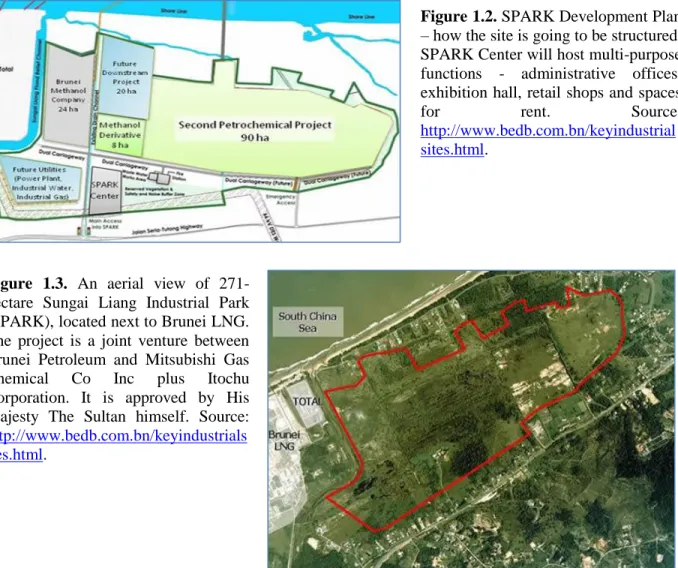
Figure 1.2. SPARK Development Plan – how the site is going to be structured. SPARK Center will host multi-purpose functions - administrative offices, exhibition hall, retail shops and spaces
for rent. Source:
http://www.bedb.com.bn/keyindustrial sites.html.
Figure 1.3. An aerial view of 271-hectare Sungai Liang Industrial Park (SPARK), located next to Brunei LNG. The project is a joint venture between Brunei Petroleum and Mitsubishi Gas Chemical Co Inc plus Itochu Corporation. It is approved by His Majesty The Sultan himself. Source: http://www.bedb.com.bn/keyindustrials ites.html.
Chapter 1 Introduction
13
The map above shows major development areas under the 9th National Development Plan and one step closer to Brunei Vision 2035. In order to achieve this vision, socio-economic and political stability as well as security are vital for progresses mentioned above. One of the vital aspects to stability and security is food. National development would be nothing if the people are starved and malnourished. Food security becomes significant agenda for the country. The state has been raising public awareness of food security issue and the need to develop Brunei agriculture. As shown in Figure 1.4, the Agrotech Park is also one of the major development landscapes. By placing the Agrotech Park on that map, it shows government‘s determination to expand the agricultural industry. This is a significant turning point for the Sultanate because for a long time they have struggled to develop their own agricultural sector. Food is important for the Figure 1.4. A map shows major industry development sites in all districts proposed under 9th National Development Plan, ranging from energy industries to ecotourism and agriculture. Source:
Chapter 1 Introduction
14
survival and continuity of a country, and yet Brunei mostly does not produce its own food. In fact, they import 80 per cent of their food requirements and the state subsidizes certain staples such as rice, milk and sugar3. With its oil revenue, the Sultanate has enough capital to buy food from other countries. However, with the increasing volatility of the food market, ensuring constant supply of staples into the country could be challenging. The risk is higher if Brunei does not produce its own staples.
During the food crisis 2008-2009, the price of basic foodstuffs like flour and onions increased dramatically. The public whined and complained about it on newspapers and internet. They were really worried this problem would affect rice as well, but the government ensured they would keep the subsidy and the rice price as usual. Bruneians felt blessed with this. For the state, they
Source: The Department of Economic Planning and Development (JPKE)
3
Brunei Economic Development Board 2011.
Table 1.1. Place of Agriculture in Brunei.
GDP at current prices, 2006-2008 (BN$ m)
2006 2007 2008 % value in GDP in 2008
GDP at current prices 18,225.8 18,458.8 20.397.9 100%
% change n/a 1% 11% -
Agriculture, forestry and fishery 128.7 127.3 129.7 1% Services 4760 5169.4 5150.7 25% Industry (including hydrocarbon) 13,336.9 13,161.7 15,117.5 74%
Chapter 1 Introduction
15
realize agriculture changes were needed. The government is worried what if someday Brunei is cut off from rice supply or other food imports. The Sultanate would be in a big trouble. The question now is not ‗what if‘, but rather ‗when‘. They need to act now.
The Table 1.1 above shows Brunei‘s GDP between 2006 and 2008. There was a huge increase in GDP, from 1 per cent in 2007 to 11 per cent in 2008. However, much of this growth came from the industrial sectors such as oil and gas. By far, they were the highest contributor to the economy. Although there was some improvement in agriculture, forestry and fishery, they were only 1 per cent of the GDP in 2008 – the lowest. This is why the government is concerned with agriculture. It has a long way to go.
Table 1.2. Agricultural Production and Consumption in 2009. Source: Department of Agriculture and Agrifood 2009
AGRICULTURE Total Consumption Local Production Import (%) Self-Sufficiency(%)
Egg 125.68 mil* 124.48 mil 1 99.0
Broiler chicken 21,176.62 mt** 19,536.2 mt 7.7 92.3 Vegetable 20.564.2 mt 12,183.4 mt 37.7 62.3 Fruits 18,703.8 mt 4,473.3 mt 76.6 23.40 Goat 23.09 mt 0.81 mt 96.5 3.5 Rice 31,786 mt 891.4 mt 97.2 2.8 Beef 2775.59 mt 29.98 mt 99.14 0.86 Diary 831,070 l*** 2,118 l 99.7 0.3
Chapter 1 Introduction
16
Table 1.2 shows that self-sufficiency rate for egg, broiler chicken and vegetables is very high, while fruits are at medium level. On the other hand, self-sufficiency for rice, beef and dairy products are very low; meaning Brunei mostly does not produce these staples and rely on imports. For beef, the Sultan owns a large buffalo and cattle ranch in Australia and this ensures the steady supply of beef to meet the demand of the country. For dairy products, it is not the main staple food of Bruneian compared to others. Rice is a big problem here. The consumption rate (in terms of metric tonnes) of rice is the highest compare to other food items such as broiler chicken and beef. With a high consumption pattern, only 2.8 per cent of rice is locally produced. Most rice is imported from Thailand. The country does not produce its own rice. This is why for agricultural development, rice has become one of the main agenda. Indeed the government also focuses on other staple food, but for them rice needs more urgent attention because Bruneians consume it the most. The people could not live without rice. Rice is a key to Brunei‘s stability and security. Even His Majesty the Sultan and Yang Di-Pertuan of Brunei Darussalam in 2008 urged:
―If a rice producing country that already has the capability to achieve 70 percent of its domestic requirement and is still striving to formulate policies to achieve 100 percent self-sufficiency, why is it that we, only achieving three per cent, are not exerting enough efforts to increase our national rice production? If I may recall, I have been emphasizing on this matter for the past few years. It is most appropriate now that we should have our own strategic plan and national agricultural policy that will guarantee national food security as one of its key strategies‖ (His Majesty‘s birthday address 2008, Borneo Bulletin Yearbook 2010: 34)
Chapter 1 Introduction
17
With the Sultan himself calling for the urgent need to be self-sufficient in rice, the people began to realize how vital local rice production is for the future. Rice imports should not be taken for granted anymore and the country must develop its rice farming in order to achieve Brunei Vision 2035. Oil and gas industry has transformed the Sultanate into a modern state with extensive welfare system and high GDP. The people enjoy free education and health as well as no income tax. In fact, this is not a new phenomenon. The country has struggled to develop its agriculture sector for a long time, even during the British colonial era. This is not the first time the state has called for self-sufficiency in rice production.
The government embarked on a National Rice Production project in 2009. The main aim of this project was to raise the level of self-sufficiency in these aspects: to ensure that the level of local commodity production is adequate, available and sustainable; to ensure a reasonable market price so that all levels of society can afford to purchase rice; and to ensure the continuous and accessible supply of food (Borneo Bulletin Yearbook 2010: 32). Brunei‘s food strategy is concerned mostly with self-sufficiency; how the country could produce its own food and maintain the supply without depending much on imports. Self-sufficiency is echoed over and over again on the media so that the public become aware of it, to the point the term is synonymous to food security. What the public is less aware is that there are different dimensions of food security (refer to earlier discussion), not only self-sufficiency. Nutritional dimensions of food security, to a large extent, has less emphasis here. The food security here is more market-driven; the government does not only concern with steady supply of rice, at the same time they try to promote new business opportunities based on the agrarian sector. For this purpose, the
Chapter 1 Introduction
18
Department of Agriculture was now expanded into Department of Agriculture and Agrifood in November 2009. Two major functions of Agrifood division are:
―Marketing and Information Management – Collecting and analyzing marketing informations, doing marketing analysis on agricultural projects, disseminating local and international projects information in relations to agriculture, promoting agricultural investment, undertaking surveys and research on agricultural commodities, compiling, preparing and distributing annual statistics on agriculture.
Agribusiness Advisory – Encouraging active participation of agricultural entrepreneurs, facilitating agribusiness entrepreneurs for development and exploiting their potentials in the agribusiness sector, assisting agribusiness entrepreneurs competency through capacity building, creation of partnership and better communication, delivering advisory/consultancy services in relation to information and opportunities in agribusiness, financial assistance, and business networking in the agribusiness sector. ― (Department of Agriculture: 2009. From :http://www.agriculture.gov.bn/DOA2009/contents/a gribusiness_development.html)
The functions of the new department show how agriculture has become market driven. The state believes that with the right policy, technology and policy execution, rice alone could become a profitable industry. Not only it could feed the people, it would also guarantee the survival and continuity of the country.
Chapter 1 Introduction
19
Summary
This chapter outlined the background of the study and Brunei‘s concern with food security. The different dimensions and problems of food security definition, to large extent, reflect the interest and perspectives of international organizations or national governments. They tend to over simply the complexity of local landscapes and people, and think they all have the same problems so that they could implement the same policy for everybody. Different places and people have different needs and food preferences. Thus those food security policies could not be for everybody. Implementing wrong policy could antagonize the local people and hamper efforts to produce more food. This is why we need to recognize the variations among people and understand food security issues from their perspectives. By doing this, we could narrow down the gap between policy-makers and the local people, thus resulting in more positive outcomes.
In the case of Brunei, although the country is oil-rich, is susceptible to the volatility of the global market. For survival and continuity, the Sultanate has put forward a futuristic vision named Brunei Vision 2035. The Vision is based on ideal world where the country achieves sustainable development and high quality life. But can be just wishful thinking visions if the country does not have enough food to feed the future population. The government is highly concerned of this issue and sees the need to implement effective food security policy. Brunei‘s food security here is mainly market-orientated and concerned with self-sufficiency. Rice production becomes one of the key agenda in this policy. The government sees the potential of mechanized rice farming. Besides being the main staple food of the population, rice also could open up a new lucrative market and technological advancement. With it, agriculture could be one of the largest industries
Chapter 1 Introduction
20
in Brunei and perhaps could guarantee the survival of the country when oil resources become depleted in the future. The new rice policy has profound impact on agriculture and people. It transforms the socio-economic landscape of the country, and this is where this study hopes to contribute to a comprehensive understanding.
21
CHAPTER 2
METHODOLOGY
Methodology
An ethnographic method was used for the study. The research will try to understand and discover mechanized rice cultivation from the perspectives of the people. The earlier chapter had discussed the need to recognize the roles of farmers in national food security policy, as well as highlight the variations of local farming landscapes. Pottier (1999) describes how anthropology is in search of relevance in this world; trying to fit into the formulation of policies. Traditional anthropologists always distance themselves and critical of policy-makers. His study on food security is an exciting attempt to narrow down the bridge between anthropology and policy-making, and so does this research. This does not mean the research will go against the food security or the policy-makers, rather it goes along within food security framework and at the same time attempt to incorporate anthropological elements in the analysis; particularly in explaining the findings based from fieldwork than from the perspectives of policy-makers. By doing this, it could provide a greater understanding of contemporary rice cultivation as well as recognize the rights of the farmers. We should acknowledge that farmers hold extensive knowledge about rice farming that is different from the policy-makers. This knowledge could make a difference and perhaps it could help to improve the agrarian situation of Brunei.
Chapter 2 Methodology
22
Research Objectives
The objectives of this research are to understand the contemporary, rice cultivation in Brunei and to discover the continuity as well as changes in the farming landscape. There have been ethnographic studies on rice farming, but many of them focus on traditional practices (cf: J. H., Ellen and Bantong Antaran: 1997, Maxwell: 1980). Some ethnographic research has been made on extensive, modern wet-rice cultivation in the country, as well as the roles of modern farmers who use the latest technology. But they focus more on formulating policy and management perspectives. For the former, these researches are largely following village-study discourse of Southeast Asia which has been prominent since the 1960s. They tend to lean towards certain ethnic groups (majority or minority) and villages. In the case of Brunei, the studies are based on the Brunei Malays, Kedayan, Murut, Dusun, Bisaya and Iban villages. The first five groups are the prominent ethnic groups in the country, while Iban is considered to be the minority. There have been significant studies made on these groups, especially by sociologists and anthropologists. By learning those villages and groups, students or scholars always uncover the traditional farming practices there. Rice cultivation tends to be small-scale and kinship based.
However, the government is moving fast towards Brunei Vision 2035 and encourages the practice of modern farming techniques, especially the use of hybrid rice and the latest machinery. More and more local farmers participate in mechanized farming projects, and integrate their rice production into the food market. They produce rice not for themselves, but in surplus for the market. It would be interesting to observe how far rice farming has changed and to what extent the traditional methods persist. In addition, through this study we could recognize the impact of
Chapter 2 Methodology
23
mechanized farming on socio-economic life of Brunei, as well as uncover challenges in the development of the modern rice farm.
Research Questions
These are the research questions for this study:
1. What is the pattern of rice farming in Brunei? 2. Why rice cultivation is undeveloped?
3. What are the socio-economic and political implications of farming to the country? 4. What are the impacts of the opening of Wasan to an agricultural landscape? 5. Who are the social actors responsible for Wasan?
6. How is Wasan Farm managed and how far it has improved under the new management? 7. What are the problems faced by farmers at Wasan?
Data Collection
There two types of data here: primary and secondary. The primary data comes from unstructured interviews, average 1-2 hours per person. There are total 21 informants here; 9 are farmers (middle age and old) and 12 are non-farmers (age ranged from 23 to 50). By conducting unstructured interviews on these participants, it gave them liberty to express themselves. This makes the research environment more casual and the participants feel relaxed to tell stories of their farming activities and experience. For non-farmer informants, their opinions and feelings on
Chapter 2 Methodology
24
rice cultivation do matter. They are very useful to analyze the socio-economic condition that influences the pattern of rice production.
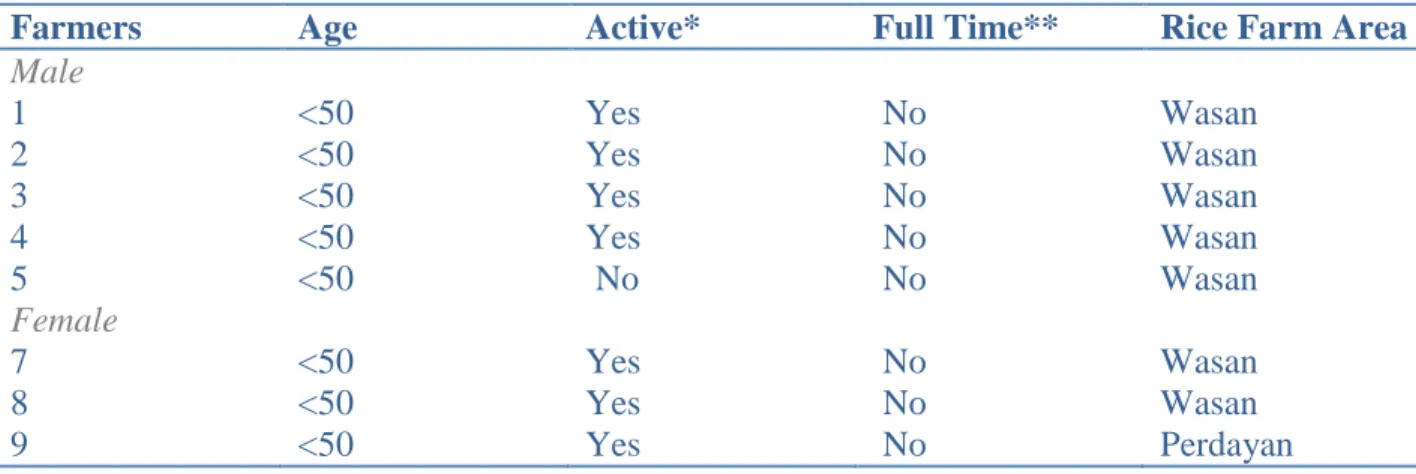
Table 2.1. The Data of Farmers
* Active – Still owned plot of rice farm and cultivate it by the time this research was conducted ** Full time – Economic income purely based on farming, not from other jobs or business
All of these farmers are local Bruneians and part-time rice farmers; meaning they have other source of income derived from non-farming jobs such as at government‘s offices and private businesses. Only one of them is no longer active due to commitment to his other job and this informant has given up farm land to his relative. They employ foreign workers (most are Indonesians and a few from Malaysia) to work on their fields. From these farmers, I was able to gather information on the structure of the rice farm and how it is managed. Each of them belonged to different farming cooperative or association that has operated the farm since 2006. Through the interviews, they unraveled so many stories of the farm ranging from the history of its establishment to social or environmental issues. On the other hand, one female farmer from the list does not belong to Wasan, but rather comes from Perdayan Farm at Temburong District.
Farmers Age Active* Full Time** Rice Farm Area
Male 1 <50 Yes No Wasan 2 <50 Yes No Wasan 3 <50 Yes No Wasan 4 <50 Yes No Wasan 5 <50 No No Wasan Female 7 <50 Yes No Wasan 8 <50 Yes No Wasan 9 <50 Yes No Perdayan
Chapter 2 Methodology
25
The reason I include her because this would enable me to get an overview of rice farming from other districts and correlate it with the pattern in Wasan.
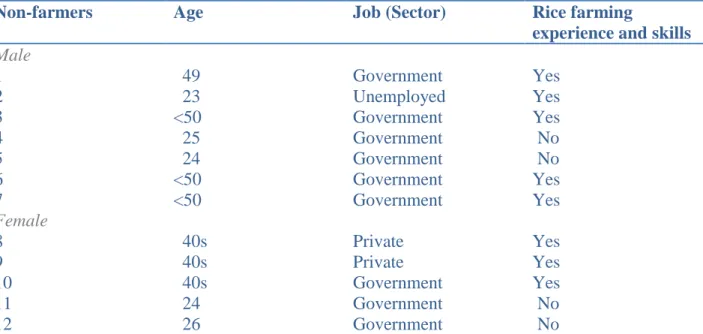
Table 2.2. The Data on Non-Farmers
Non-farmers Age Job (Sector) Rice farming
experience and skills
Male 1 49 Government Yes 2 23 Unemployed Yes 3 <50 Government Yes 4 25 Government No 5 24 Government No 6 <50 Government Yes 7 <50 Government Yes Female 8 40s Private Yes 9 40s Private Yes 10 40s Government Yes 11 24 Government No 12 26 Government No
For the second group, most of them have farming skills and experience especially among those who are above the age of 40. They come from a generation of rice-growers in the 1960s and the 1970s, periods during which rice production reached its peak. This explains why all of them have farming knowledge and techniques, although they are no longer involved in rice cultivation. They are now fully employed at the government sector or doing their own business such as operating retail shops. For younger informants, all of them (except one) have no experience on rice farming or even have not seen rice fields at all. These younger informants are also very crucial because their perspective on rice farming could uncover how far agriculture has changed
Chapter 2 Methodology
26
from the past. Only one is exceptional – he has rice farming experience from a young age, which is very rare in contemporary Brunei. This informant studied agriculture at secondary school - a subject which no longer exists since its abolition from the school curriculum in 2005. He never pursued any other career than agriculture until today.
Hence by expanding the age range for this study, we could get more comparative analysis of farming patterns, between old and young generations. This could explain why rice cultivation was stagnant for a long time, eventhough it was booming in 1970s.
In addition to data from the interviews, this research also relied on secondary data – statistics. Most of these statistics are published by the Department of Agriculture and Agrifood as well as the Brunei Economic Development Board. For this study, the focus of the statistics will be industrial development, agricultural output, food imports and consumption. These could show the agricultural pattern and development of Brunei for the past twenty years or more.
Apart from the people, this study also used a specific rice farm. Here it will employ social landscape perspectives. By landscape here, it does not only mean a surface on the earth but also connotes certain space and place that has social, cultural, economic and political meanings (Jacobson 1984). He also emphasizes that in studying landscape, visibility is important (1984: 31). Landscape has hidden stories behind it. By digging through these stories, we would uncover the actors, events and conditions that affect the formation or changes of the landscape. Hence
Chapter 2 Methodology
27
this is why focusing on specific rice farming place would enable us to understand the dynamics of Brunei agriculture.
The area of study here is Wasan Rice Farm Project; located at Wasan Village and about 30 minutes drive from the capital city, Bandar Seri Begawan. Figure 2.1 below shows the map of Brunei and the location of Wasan.
Figure 2.1. The Location of Wasan
WASAN
Chapter 2 Methodology
28 Picture was taken in April, 2011.
I chose Wasan is due to its accessibility and importance. The place is easily accessible and can be seen from the main road leading to Kuala Lurah Immigration Post and Limbang (a district of Sarawak, Malaysia). The farm is surrounded by five villages: Wasan, Pancur Murai, Limau Manis, Bebuloh and Batu Ampar. The name Wasan Rice Farm is in fact derived from Wasan Village due to its location. The area of the farm is 202 hectares; first opened by the government in 1978. It is very significant because the farm was the first large-scale mechanized wet-rice cultivation in the country. There was political pressure leading to its opening (Chapter 2 will describe this in detail) and since then, and has become an icon of agriculture. The study of Wasan could reveal the history of farming in Brunei and how far socio-economic conditions of the people affect the dynamics of the farm.
Chapter 2 Methodology
29
There are limitations on this research. Because it is people-oriented, it may be biased against government policy-makers. The analysis will be mostly descriptive; reflecting the perspectives of the informants. Moreover, there are other major farming areas such as Perdayan Farm in Temburong District, Lamunin Farm in Tutong District and Lot Sengkuang in Belait District. Due to insufficient time, I was not able to cover one of these farms. The focus is narrowed down to one particular place (Wasan), so it will be less comparative. The findings on Wasan will generalize the farming patterns in Brunei. Perhaps the case of Wasan might or might not reflect the whole rice farming patterns and trends across the country.
In addition, I was not able to interview one important group of farmers in Wasan — the foreign workers — due to limited time. These foreign workers were reluctant to be interviewed during my fieldwork there, so it took a lot of time to gain their trust. Everytime I tried to ask them questions, their replies were ―We do not know much and only do our jobs. If you want more information, please ask our employers. They know better than us‖. Sometimes they did not talk at all, only gave a few gestures that indicated they were unwilling for the interview. Another reason was security. I personally had an uncomfortable incident with a few of foreign workers there. I was taking photos of rice fields when one employee greeted me from his small hut. I politely returned his greeting and asked for an interview. He gestured me to come to his hut. As I approached the hut, suddenly another five men appeared at the window. They were topless and waved lecherously at me. I was scared and ran back to my car, 20 meters away. My 18 years old brother who was waiting inside the car was oblivious to it. Later, my family discouraged me from conducting fieldwork alone or with my younger brother. They were concerned with my personal safety and adviced me not to take risks. I had to distance myself a bit from the foreign
Chapter 2 Methodology
30
workers. As a young female researcher I was aware of my own limitation and inconvenience in conducting interviews on the rice field without any adult male companions.
Regardless of these limitations, I hope this study could still represent the reality of modern rice farming in Brunei. In addition, it is not my intent to give a negative picture of foreign workers here.
Summary
This research is hoping to provide an insight of modern rice farming in Brunei. The country is at a turning point now, and it is very interesting how modern agriculture fits in and plays its role in this new development program. One way to understand it is from Bruneian perspectives and that is why the study employs ethnography. It is rather fascinating and intriguing to know the experience of farming experiences from the perspectives of people involved in rice farming.
The next two chapters will discuss Brunei rice farming in more detail. Chapter 3 will analyze the dynamics of the Wasan Rice Farm and illustrate how the case of Wasan reflects agricultural trends in Brunei. It will reflect on the history of wet rice farming, development of modern agriculture and how it became stagnant. It will employ the perspective of social landscape and try to uncover hidden meanings behind Wasan. Chapter 4 will examine the roles of farmers in Wasan and their farming practices. It will focus on the social interactions in Wasan and how the farmers adapt to new farming techniques. The chapter will also try to look into socio-economic
Chapter 2 Methodology
31
and environmental issues pertaining to Wasan and how the government responds to them. Finally, Chapter 5 will be the conclusion and examine the overall discussions in the former chapters.
Chapter 3 The Dynamics of Wasan
32
CHAPTER 3
THE DYNAMICS OF WASAN
Introduction
There is a saying in Brunei ―alah ku lauk lain, nasi labih penting‖, literally translated as ―no other food is as important as rice‖. Like in many other Asian countries, rice is a staple food in Brunei. People value it highly and even the old generation teaches youngsters to value rice. They say ―jangan buang nasi, nanti kana sumpah rezeki‖ or ―nasi yang kamu buang menangis tu‖, which mean ―do not throw away rice, or you shall be cursed‖ and ―rice which you have thrown is crying right now‖. This truly shows how integral rice is to everyday life of Bruneians. The population could not live without rice. Rice is everything. Beras Wangi (―Fragrant Rice‖) is the main rice eaten and sold in the country. Even there are increasing number of Malaysians (from Sabah and Sarawak) who buy rice from Brunei due to its cheap price and delicious taste. They say Brunei‘s Beras Wangi taste better than their local rice. Yet, the Sultanate does not grow any of Beras Wangi. It is well known that the other name for Beras Wangi is Thai rice, because it is in fact jasmine rice imported from Thailand. That is the irony.
For most Bruneians the source of their rice is not a major concern. They do not see this as a big issue. Why? This is because for a long time, the country relied heavily on rice imports, especially from Thailand. They easily get access to rice from the market and do not need to grow it on their own. Since the population of the country is very small, estimated around 414,000 (Brunei
Chapter 3 The Dynamics of Wasan
33
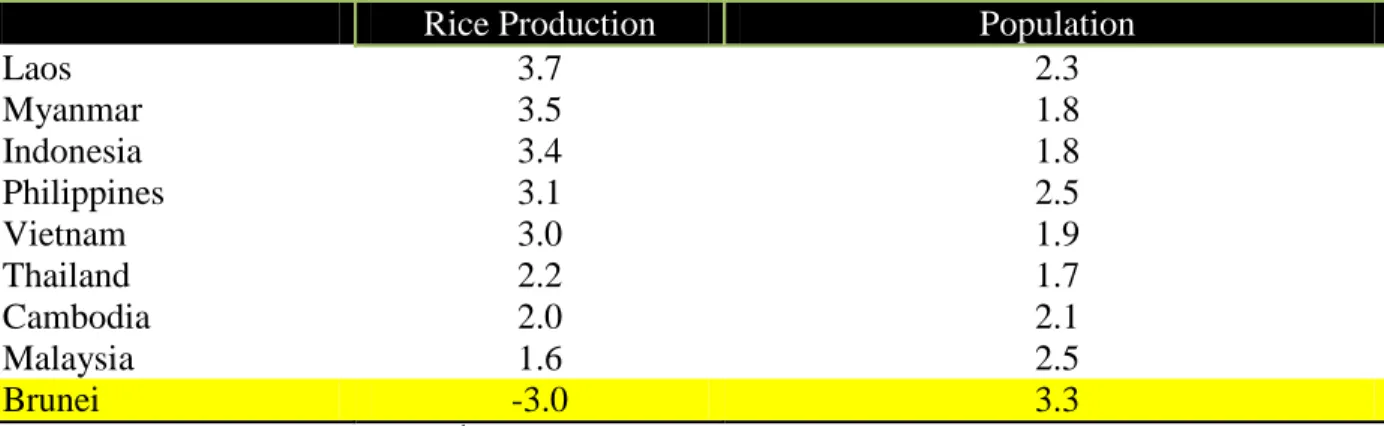
Economic Development Board: 2010), and the wealth from oil and gas industry mean that the government could afford to import rice for a long time. In addition, the government provides subsidy for rice. They buy rice from Thailand at B$25 per kilogram and sell it to public at B$11.80 per kilo. This price is quite cheaper than the neighboring countries like Malaysia. It could be said that the Bruneians are blessed with this cheap price. The main question is how long Brunei is going to depend on rice imports? The table below shows how far Brunei‘s rice production fared against other ASEAN countries:
Table 3.1. Compound Annual Growth Rate Of Rice Production and Population (%). 1961-2007
Rice Production Population
Laos 3.7 2.3 Myanmar 3.5 1.8 Indonesia 3.4 1.8 Philippines 3.1 2.5 Vietnam 3.0 1.9 Thailand 2.2 1.7 Cambodia 2.0 2.1 Malaysia 1.6 2.5 Brunei -3.0 3.3
Source: FAO, http://faostat.fao.org/4.
As shown in Table 3.1, while other ASEAN countries have positive growth on rice production between 1961 and 2007, Brunei shows a reverse trend. As one of the richest countries in Asia and well-known for its vast oil and gas resources, Brunei‘s rice farming has remained undeveloped and has fallen far behind many Asian nations. While it is really a peculiar sight for a country with extensive financial resources like Brunei spend heavily on food imports, we
4
Chapter 3 The Dynamics of Wasan
34
would wonder why they do not do the same for growing adequate. The economies of scale have been favorable to Brunei in allowing it to be in a peaceful region where money can buy adequate amount of rice from neighboring countries.
In order to understand this phenomenon, one aspect we could look at is the farming landscape in the country. One of most important rice farming area is Wasan; the first area for large-scale mechanized wet rice cultivation. By understanding the dynamics of Wasan, we could unravel the socio-economic and political conditions of Brunei that led to the Wasan project. Wasan is not just a physical site. It has its own story. When asked about what they know about Wasan, one of my male respondent, aged 25, answered:
―I don‘t know much about it, except it is one of the main rice farms in Brunei. Where? I don‘t really know the exact location. Yes, I know about Kampong Wasan (Wasan Village) and the rice farm is supposed to be there right? For a long time, I‘ve been wondering the exact location of it. Besides, I only know about Wasan because it is mentioned in the school textbook―
The ignorance about the Wasan rice growing area is common among Bruneians. Rice growing is one of the least concerns in Brunei. When this researcher pointed out the exact location of Wasan rice farm, another respondent replied as follows:
―Oh really?! That‘s Wasan? Yes, I saw a rice farm on the way to Limbang. I really didn‘t expect that‘s Wasan. So that rice farm truly exists. I thought it is only a name and
Chapter 3 The Dynamics of Wasan
35
nothing more. Well, I don‘t really understand why people make a huge deal of Wasan these days. It is only a rice farm, so what?‖
An older female respondent, in her 40s, recollected her memories of the histories of rice growing in Brunei. She recounted her memories:
―I don‘t remember much about Wasan. Back in the early 1990s, there were lots of farming activities there. Big tractors were working on the farm and smoke due to burning were there. After that, I don‘t know what happened. The farming just disappeared and the area became covered in bush. Now they clear the land again for farming. I know about the reopening of Wasan since it was a big event on the news. It‘s been a while I‘ve seen activities there…‖
These were some of the response that I got when I asked interviewees what they knew about Wasan. Young people were largely clueless about it, while older respondents had vague memories of farming activities there. The place was hailed as the first mechanized rice farm in the Sultanate, yet this fact has been largely forgotten by the public. Only recently Wasan appeared back on Brunei farming landscape after being forgotten for quite some time. After the farm was reopened in 2006, people began to be aware of the existence of Wasan again.
Why was Wasan forgotten? What happened to Brunei agriculture at that time? This chapter seeks to answer these questions, particularly in understanding the evolution of Wasan. The dynamics
Chapter 3 The Dynamics of Wasan
36
of Wasan reflects the socio-economic history of Brunei particularly how the country has been struggling to develop its non-oil and gas sectors.
The first part of this chapter will analyze the brief history of farming in Brunei and ―how the policy of self-sufficiency was a reflection of the Government‘s concern on Brunei‘s dependency on external supply for food‖ (Hajah Gayah 1995, 1996: 62). It will describe how Wasan brought hope and promise to Brunei‘s agriculture in achieving its self-sufficiency level, just to be hampered by bureaucratic and environmental problems. The second part will explain the social and economic implications of the failure of Wasan. Since there is limited data on Wasan during this period, the section will largely focus on interviews. The third part will briefly describe the reopening of Wasan and how far it could bring more prospects to Brunei. After being abandoned for a long time, Wasan reappears on Brunei‘s socio-economic map once again.
Development of Wasan and Brunei’s Agriculture
During the grand opening of Wasan Rice Farming Project in 2008, it was made into a national media event. Bruneians welcomed it with an open heart and proud of the country‘s achievement. The young generation thought this was the first time they saw such a spectacular event on agriculture. But many Bruneians forgot that this was not the first time the Sultanate strived for a national rice policy and self-sufficiency in food production. The call was made way back before the independence of Brunei, even during the British administration.
Chapter 3 The Dynamics of Wasan
37
During the colonial era in Brunei, the British were aware of the importance of rice to the colony. They implemented strategies to improve rice production between early 1900s and post Second World War. For instance in early 1900s, the British encouraged the people of Kampong Ayer (―Water Village‖) to move inland and start wet rice cultivation (Horton 1984:21). They also made the same call to the hill people in remote areas of Temburong, Belait and Tutong districts. The British administration hoped the opening of new lands for wet rice cultivation could improve rice production as well as increase self-sufficiency level. The traditional occupations of these people were mostly craftsmen and fishermen, hence wet rice cultivation was something new to them. Most of them were not familiar with the new farming methods, but the British were willing to train them through the establishment of an agricultural centre, such as Kilanas Agricultural Centre (the first one in Brunei). Although rice production began, it was far from satisfactory. Between the First and Second World War years, the country only produced between one-third and one-sixth of its own rice (Pengiran Mohamad 1998:5). Rice production fluctuated overtime and could not meet the demand of the population. The country had to import rice from neighboring countries with the wealth from the oil industry (which was discovered in 1929). In 1952, Brunei was the second largest oil producer in the British Commonwealth, with 103,000 barrels per day from 220 oil wells (Pengiran Mohamad 1998: 6). A good sign for oil industry, yet this did not do much for Brunei‘s agriculture. The Sultanate was heavily dependant on oil industry for survival.
Due to technological advances in the 1960s, new oil sites have been found offshore. Brunei Liquefied National Gas (BLNG) was established and they made large scale national gas plant at offshore sites. With the advancement of oil and gas industry, the Sultanate hoped this could
Chapter 3 The Dynamics of Wasan
38
stimulate the agricultural sector. They were worried that over reliance on oil would cost other industries, particularly agriculture, forestry and fishery. Through the Second National Development Plan (NDP 2) 1962-1968, the country formulated diversification efforts with emphasis on agriculture. ―Rice production was therefore one of the strategies adopted not only to realize the goals of self-sufficiency policy, but also those of the economic diversification policy‖ (Hajah Gayah 1995, 1996: 8). In order to realize this dream, the state spent millions of dollars in agricultural projects. They set up national census and research on farming with the help of Brunei Shell Petroleum Company. They even employed an expert from Taiwan in this project. In addition, The Association of Brunei‘s Farmers (which was set up by the British in 1919) supported this vision and encouraged their members to join the rice projects set up by the government. This association had 2,040 members in 1967 (Pelita Brunei 1967: 6)5 and increased to 3,642 members in 1968 (Pelita Brunei 1968: 5)6.
Almost at the same time of this period, the Green Revolution took off in Indonesia and the Philippines with the planting of high yield varieties (HYVs) rice. For Brunei, farmers still planted traditional rice such as adan and pusu. These varieties were initially from baras bukit (hill paddy) before they were adopted to wet rice cultivation. Compared with HYVs, it took longer to harvest – around 6 months – and the yield was twice a year. Nevertheless, Brunei rice farming took off during this period. In 1970, the rice production reached 35 per cent (FAO 2008) and by 1975, it peaked at 37.8 per cent (Department of Agriculture 1990).
5
Cited in Pengiran Mohamad 1998: 15
6
Chapter 3 The Dynamics of Wasan
39
One female interviewee remembered that rice farming was part of her childhood memories. She described her farming experience with fondness and a great sense of nostalgia. All of her family members – parents and nine siblings – worked together at the rice farm in Muara between 1969 and 1978. The farm was about eleven hectares, and each family was given a small plot of land. They planted baras bukit (hill paddy) such as adan, bario and pusu for wet rice cultivation. The paddy took around six months to mature and they harvested the yields twice a year. They kept most of the rice for their own consumption. Surplus rice was used an exchange commodity for other food such as fruits and belacan (shrimp paste) with other villages. Almost everybody in her village was involved with farming. But they also did other jobs such as fishing, construction and even in the goverment offices. Her father was a construction worker at Bandar Seri Begawan as well. Nevertheless, farming was still central to their lives as source of food.
However, even the spectacular depiction above did not fully represent the real picture of agriculture‘s contribution to the country. Reality was still grim. Hajah Gayah (1995,1996: 18) describes the real picture of agriculture:
Source: Hurul Ain 2010: 26. Source: Hurul ‗Ain 2010: 7.