Towards an Integrated Aid for Trade and Trade
Facilitation Framework: Logistics Management
Reform in Indonesia
1Riza Noer A
RFANI ※& Poppy S. W
INANTI※※ AbstractThe article endeavours to link Aid for Trade (AfT) and Trade Facilitation (TF) conceptual and practical frameworks following a much celebrated trade deal among the WTO (World Trade Organization) members in its 9th Ministerial Conference in Bali, Indonesia (December 2013). As part of the deal, the Trade Facilitation Agreement (TFA) marked an escape from a more-than-a-decade long negotiated Doha Round. Currently being in the process of members’ ratification, TFA proffers a question on whether and how developing country members would fully commit and implement the agreement considering their behind-the-border lacking resources and technical capacity. The case of Indonesia in particular presents an illustration where the country’s serious logistical problems could fur-ther limit its TF capacity building despite its AfT abundant programs and projects. The article is hence to assess the country’s logistics performance and its manage-ment reform in an effort to integrate the existing AfT and TF frameworks in the wake of preparing the country to a wider context of TFA commitment and implementation.
Keywords: Aid for Trade, Trade Facilitation, Logistics Performance, Logistics Management Reform
※ Lecturer at the Department of International Relations and chair of the WTO Chairs
Programme, Center for World Trade Studies (WCP-CWTS) at Universitas Gadjah Mada (UGM) Indonesia, and a PhD Candidate at the Graduate School of International Relations, Ristumeikan University
※※ Lecturer and head of the Department of International Relations and co-chair of the
WCP-CWTS at UGM Indonesia, and is a PhD in International Political Economy (University of Glasgow, UK)
© The International Studies Association of Ritsumeikan University:
Background
Indonesia offers a typical case in point where its ample Aid for Trade (AfT) commitments and disbursements do not necessarily end up in solid Trade Facilitation (TF) performance amidst its prolonged logistics complexities. The arti-cle is an effort to elaborate the country’s logistics practices and how reform for its management would imply to the integration of the existing AfT and TF frameworks. The country’s AfT scheme, i.e. particularly at its policy formulation stage, needs to be linked to its TF practices due to its prone tendency for red tape bureaucracy and extortion. The article hence looks for linkages of the two schemes by zooming out conceivable integrated framework in the midst of contemporary Indonesian gov-ernment initiatives to deal with the country’s rampant logistical management problems.
Despite significantly increased commitments and disbursements since the launch of AfT initiative in 2005 and despite considerable concentration in its allo-cation to infrastructure development-related sectors, Indonesia’s logistics practices –i.e. related particularly to ports and sea-lane shipments as well as rail and road ground delivery— continue to be underperformed. This leads to a question of whether the country’s logistics system (as a major component of its TF practices) is indeed in line with its AfT scheme. It leads to a query of whether recent TF Agreement (TFA) adoption, amidst its ratification and notification procedural complications, should be highlighted in light of acknowledging the need to integrate the country’s AfT and TF schemes.
Governed under a specific government regulation on foreign aid procurement procedures, Indonesia’s foreign aid scheme (under which AfT is administered) poses a discrete process that spans from its commitments stage by donors, its allo-cation, distribution, and finally actual disbursements stages (by varied-levels of governmental agencies). It is under such a long policy making process that the
1. The article is originated from a research conducted in the framework of the WTO Chairs Programme (WCP) 2015 entitled “Indonesia’s Practices in Improving Logistics Performance and Competitiveness: Exploring Cases on ‘Aid for Trade’ Facilitation” (Annex 1-Research Report 2015 WTO Chairs Programme Annual Report 2015, Universitas Gadjah Mada, Indonesia) in which the 2nd author served as the lead researcher and was assisted by Ms. Vinie Puspaningrum and Ms.
Nelly Cholida (to whom we would like to thank for their contribution in the early version of the report). While both authors conduct the analysis collaboratively, the 1st author is responsible for
the final drafting of the paper. The authors would like also to convey highest appreciation for valuable, detailed and constructive comments and suggestions offered by Professor Hideaki OHTA (of the Graduate School of International Relations) and the two anonymous reviewers (of the Ritsumeikan Annual Review of International Studies) on the initial versions of the article. ———————————————————
country’s AfT scheme is to be discussed. The discussion utilizes an analytical framework that presumes the country’s adoption of TFA and its comprehensive road map towards TF step-by-step implementation would lead to improved perfor-mance of the country’s logistics system, thus eventually its trade competitiveness.
Questions to Address
The following questions are thus raised in light of developing linkages of AfT and TF frameworks by comprehending the case of Indonesia’s logistics sector reform:
1. In spite of rigorous attempt in linking AfT and TF at conceptual and prac-tical levels, how does the case of Indonesia’s logistics sector reform offer il-lustration of attempts to benefit from such an integrated framework that is aimed at enhancing trade competitiveness?
2. How has the country’s logistics system undergone management reform as it expects integrated AfT and TF frameworks? How do and should its existing AfT scheme need to be in line with its TF commitment?
Argument and Outline of the Article
To address the questions, the following argument is proposed. Both at concep-tual and practical levels, AfT and TF are muconcep-tually linked to support developing countries integration to the world trading system by providing variety of both technical assistance and other non-technical measures aiming mostly at easing barriers to trade. The current linkage, however, fails to acknowledge significance of the AfT/TF implementing stages, i.e. as it goes deeper into a recipient country’s AfT/TF policy formulation and its management. As one of major recipients of AfT and key proponents of TF, Indonesia offers a case in point for integrated AfT/TF frameworks in which:
1. The country’s current TF status maintains a prevalence of supply-side constraints and behind the border barriers to trade as indicated in its un-derperformed logistics system;
2. Ineffective efforts to deal with such constraints and barriers –particularly in areas related to logistics management— are linked to the country’s AfT scheme that is incapable to keep up with the much needed reform;
attention on:
a. Coherent AfT and TF objectives and policy schemes;
b. Solid coordinating mechanism among relevant governmental agencies in implementing those objectives and schemes;
c. Redefined collaborative roles of leading governmental agencies respon-sible for the AfT disbursement both at national/ministerial and regional/ local levels;
d. Detailed TF arrangement to ensure accomplishment of the national single window initiative and national single gateway system aiming at easing export-import activities and other trade and investment facilitation;
e. Shared common views among logistics stakeholders as government revi-talizes the country’s logistics blueprint (National Logistics System/ SISLOGNAS).
To systematically present the argument, the article is structured as follows. Section 1 (Aid for Trade and Trade Facilitation) outlines conceptual and empirical integration of AfT and TF schemes. Section 2.1 (Indonesia’s Trade Facilitation Current Status), Section 2.2 (Indonesia’s Trade Facilitation and Logistics Performance) and Section 2.3 (Indonesia’s Logistics System) discuss respectively the country’s current status and progression in TFA, its TF practices and attain-ment as it relates particularly to the country’s logistics system and performance. Section 3.1 (Indonesia’s Aid for Trade Scheme) and Section 3.2 (Features of Indonesia’s Aid for Trade) presents correspondingly the country’s AfT existing scheme, practices and features as seen from the country’s policy formulation and management schemes. Section 4 (Integrating Aid for Trade and Trade Facilitation) attempts to assess integration of AfT and TF schemes referred to previously elabo-rated case of the Indonesian logistics. The final section (Concluding Remarks) summarizes the article’s original intention as it draws lessons to be learnt.
1. Aid for Trade and Trade Facilitation
Aid for Trade (AfT)2 and Trade Facilitation (TF)3 linkages have continuously 2. Launched at the World Trade Organization (WTO) Ministerial Conference in Hong Kong (2005), AfT initiative main purpose is to assist developing countries to increase their trade volume by integrating into the global trade regime and adjusting their trade regulations. It is designed to support developing countries, LDCS in particular, to build their trade capacity and infrastructure in order for them to benefit from their engagement with global trade system. By February 2006, a task force was established with the aim to implement the AfT program focusing on identifying ———————————————————
been highlighted to reiterate fuller participation by developing countries in global trade (UNCTAD 2003, 2007, OECD 2013 and OECD-WTO 2015). The need to link AfT to TF is particularly great among developing and least developed countries (LDCs) alike as trade cost is still considerably high despite their intensified partic-ipation in global trade. TF is needed to reduce trade costs which arise due to various barriers at the border, i.e. red tape bureaucracy, extortion and high taxes that should be paid by both exporters and importers which are commonplace among developing countries and LDCs (Suwa-Eisenmann and Verdier 2007).
TF also plays an important role in improving exporters comparative advantage in many AfT recipient countries (Francois and Machin 2007). It is closely linked to the reduction of transport costs that hinders the trade flows efficiently upon which development of transportation infrastructure is one of priority AfT sectors. Additionally, TF is regarded as an act of reform to create a custom system that is more efficient and to combat corruption resulted bureaucratic uncertainty as it is expected to accelerate delivery waiting time aimed to lower trading costs for ex-porters and imex-porters (Basnett et al 2012).
Under the World Trade Organization (WTO) AfT scheme, grants and conces-sional loans (as part of overall ODA/Official Development Assistance) are targeted as trade-related programmes and projects (WTO 2006). They consist of technical assistance on trade related policy and regulations, trade related infrastructure aid and aid to develop productive capacity. In support form the WTO Secretariate, technical assistance and training programmes are aimed at officials and stakehold-ers from developing countries. The main purpose of this trade capacity building is to enhance the capacity of developing countries to take full advantage of the rules-based multilateral trading system, to deal with new challenges and to enforce
the needs of recipient countries and having a role as a bridge between donors and developing countries. A monitoring body was also established to undertake a periodic global review based on reports from a variety of stakeholders.
3. TF is the only trade agenda (known as “the Singapore Issues” consisting of trade and invest-ment, trade and competition policy, transparency in government procurement and TF) that sur-vived from the WTO Ministerial Conference in Singapore (1996). While other agenda items were taken off the table after the WTO Ministerial Conference in Doha (2001), TF was the only agenda that all WTO members agreed to negotiate further. After negotiations launched in 2004, it took almost 10 years for the Trade Facilitation Agreement (TFA) to be finally concluded. It was con-cluded at the WTO Ministerial Conference in Bali (2013) as part of the Bali Package and has be-come the first multilateral trade agreement signed since the establishment of the WTO in 1994. TFA main purpose is to ease customs procedures and facilitate the movement, release and clear-ance of goods, thus by implementing TF bureaucracy is to be streamlined and corruption in cus-toms procedures is to be minimized, and consequently it speeds up trade and lowers the cost of international trade.
their rights and obligations.
In this regards, foreign aid aiming specifically towards trade facilitation mea-sures (known as the WTO Aid for Trade Facilitation/AfTF) has become a significant aspect of the AfT. The provision is hence a framework officially adopted by the WTO in linking AfT and TF at its policy level implementation. Under the frame-work, AfT incorporates technical assistance for developing countries to develop their trade strategies, negotiate more effectively and implement the outcomes as well as improving their trade-related infrastructures.
In spite of its major and significant roles in the initiation, formulation and application of AfT, the WTO only focuses on the formulation of trade rules oriented to the reduction of trade barriers. In more practical term, AfT is disbursed mostly bilaterally through donor countries or international, multilateral and regional fi-nancial agencies to the recipient countries. Some other agencies are also involved in designing, implementing, evaluating and monitoring AfT programs and projects4.
In terms of measuring effectiveness of AfT, and hence to conceptually rational-ize its linkage to TF practices and performance, various methodological prisms (including aggregate cross-country studies, program reviews and project evalua-tion) are initiated in lights particularly of the global value chains (GVC) framework. The prisms are applied in order to capture the relationships of AfT and trade cre-ation, update past empirical findings, push the cross-country analysis into new areas, look at impacts of different types of AfT on particular categories of developing countries, highlight the emerging role of value chains and work through the impli-cations for AfT, and finally look at the roles of government management systems and how they interact with AfT donors (OECD-WTO 2013b).
Echoing such an endeavor and by taking the Indonesian logistics case, the ar-ticle is to foster AfT-TF linkages so as to comprehend how a particular government management system (administering and responsible for designing, implementing, evaluating and monitoring AfT programs) correlate to the attainment of its TF
4. Apart from the WTO, key players of AfT include the World Bank, the African Development Bank, the Asian Development Bank (ADB), the European Bank for Reconstruction and Development, International Monetary Fund (IMF), Inter-American Development Bank (IADB), Islamic Development Bank (IDB), International Trade Centre (ITC), Organization for Economic Cooperation and Development (OECD), United Nations Conference on Trade and Development (UNCTAD), United Nations Development Programme (UNDP), United Nations Economic Commission for Africa (UNECA), United Nations Economic and Social Commission for Asia and the Pacific (UNESCAP), United Nations Industrial Development Organization (UNIDO), and the World Customs Organization (WCO).
practices and logistics system5. Priority areas in transport and logistics sectors that
will remain key in AfT agenda are hard infrastructure (ports, airports, roads and rail links), soft infrastructure (transport regulations, customs and border procedure and private sector development), and collaboration and coordination among donor countries, trading partner countries and the private sectors (OECD-WTO 2013a).
WTO AfTF (Aid for Trade Facilitation) scheme takes and designs TF policy measures, programs and projects in light of integrating existing foreign aid scheme into a wider trade and development context. It is thus essential to assess success and effectiveness of the AfTF scheme that is based on its impacts on “trade flows” (i.e. how TF measures enhance integration of developing countries into the trading system and global markets) and on “trade gains and economic growth” (i.e. how costly TF measures are if compared to its potential trade gains and other economic benefits) (Helble et al 2012). The article tracks AfT-TF linkages (as suggested in the existing WTO AfTF scheme) so as to elaborate the Indonesian logistics case.
2.1. Indonesia’s Trade Facilitation Current Status
Following its decision to be part of the WTO TFA signatories (the Bali Package) resulted from the 2013 WTO Ministerial Conference, Indonesia’s TF state of play centers on its ratification and notification issues. On the first one, more than two years after the decision, the country has not yet ratified the document and hence sparked policy debates among decision makers and trade stakeholders whether the government has eventually to make a decision to ratify. Nevertheless, the issue is actually a little more complicated. Whether the country decides to ratify or not to ratify, the TFA Protocol of Amendment requires two-thirds6 of the WTO members
5. In the area of TF as it relates to logistics performance, Desouza et al (2007) and Bahagia et al (2013) elaborate TF practices in the cases of ASEAN and Indonesian logistics respectively. Marc and Azhari (2007) additionally discuss cases in the Asian and the Pacific region highlighting the roles of public-private partnership scheme in implementing AfT.
6. It means that it would require around 107 out of 161 WTO members to ratify the TFA (as of September WTO memberships). To date (as of 30 August 2016 with the newest members to ratify the agreement, i.e. Senegal and Uruguay), there are 92 members that have ratified the agreement, and it means there are less than 28 members to go for enforcing the agreement. The full list of those who have ratified is as follows: Hong Kong, China (8 December 2014), Singapore (8 January 2015), United States of America (23 January 2015), Mauritius (5 March 2015), Malaysia (26 May 2015), Japan (1 June 2015), Australia (8 June 2015), Botswana (18 June 2015), Trinidad and Tobago (29 July 2015), Korea (30 July 2015), Nicaragua (4 August 2015), Niger (6 August 2015), Chinese Taipei (17 August 2015), Belize (1 September 2015), Switzerland (2 September 2015), China (4 September 2015), Liechtenstein (18 September 2015), Lao People’s Democratic Republic (29 September 2015), New Zealand (29 September 2015), Togo (1 October 2015), Thailand (5 ———————————————————
to ratify and convey their acceptance to the WTO Secretariat in order for the agreement to come into force.
The TFA enforcement thus seems inevitable. Unless, Indonesia is able to influ-ence other members not to ratify, the insertion TFA into the WTO Agreement is only a matter of time. With this in mind, to ratify or not to ratify is no longer the question. Once two-thirds of the members have ratified TFA will be automatically adopted, whether Indonesia ratifies it or not. Against such a background, the article suggests that it is far more appropriate to raise questions on what should the country do to prepare itself? What efforts should be made to take advantage of any opportunities following adoption of TFA? Because, by the time the agreement comes into force, the country has to face with the second issue, the tougher one, i.e. to provide notification of commitment categories for the TFA provisions.
As previously mentioned, TFA main purpose is to ease customs procedures and facilitate the movement, release and clearance of goods. It is expected to cut bu-reaucracy and corruption in customs procedures and consequently speed up trade and lower the cost of international trade. The first section of the agreement contains approximately 40 technical measures that the government is required to implement in order to reduce trade costs. These comprise a series of measures for the prompt and efficient movement of goods across borders. Under such provisions, each member is obliged to publish all information regarding procedures, regulations, fees and charges, penalties and any other necessary information. All information should be available on the Internet, along with enquiry points that should be made available. Furthermore, the TFA also obliges members to issue an advance ruling, provide procedures for appeal or review, ensure border agency cooperation and provide a guarantee for freedom of transit, among other things (OECD-WTO 2015:
October 2015), European Union and its Member states (5 October 2015), Former Yugoslav Republic of Macedonia (FYROM) (19 October 2015), Pakistan (27 October 2015), Panama (17 November 2015), Guyana (30 November 2015), Côte d’Ivoire (8 December 2015), Grenada (8 December 2015), Saint Lucia (8 December 2015), Kenya (10 December 2015), Viet Nam (15 December 2015), Brunei Darussalam (15 December 2015), Norway (16 December 2015), Ukraine (16 December 2015), Zambia (16 December 2015), Myanmar (16 December 2015), Lesotho (4 January 2016), Georgia (4 January 2016), Seychelles (11 January 2016), Jamaica (19 January 2016), Mali (20 January 2016), Cambodia (12 February 2016), Paraguay (1 March 2016), Turkey (16 March 2016), Brazil (29 March 2016), Macao, China (11 April 2016), United Arab Emirates (18 April 2016), Samoa (21 April 2016), India (22 April 2016), Russian Federation (22 April 2016), Montenegro (10 May 2016), Albania (10 May 2016), Sri Lanka (31 May 2016), Saint Kitts and Nevis (17 June 2016), Madagascar (20 June 2016), Republic of Moldova (24 June 2016), El Salvador (4 July 2016), Honduras (14 July 2016), Mexico (26 July 2016), Peru (27 July 2016), Saudi Arabia (28 July 2016), Afghanistan (29 July 2016), Senegal (24 August 2016), Uruguay (30 August 2016).
Chapter 4).
In addition to the obligations embedded in the agreement, it should be noted that TFA is the only WTO trade agreement that extends comprehensive and special provisions regarding developing countries and least developed countries (Section 2) that uniquely allows them to implement the Agreement based on their own assess-ment. In this regard, each developing country and LDC may determine when it will implement and identify whether it will need any technical assistance and support for capacity building to implement the measures7. As part of the
obliga-tions, on July 31 2014, Indonesia notified the Preparatory Committee on Trade Facilitation that three provisions could be categorized into Category A, i.e. provi-sions on penalty disciplines, pre-arrival processing, and the use of Customs Brokers.
2.2. Indonesia’s Trade Facilitation and Logistics Performance
Beyond its last notification of commitment categories (July 31 2014) and not-withstanding of the Indonesian government efforts to disseminate the TFA provi-sions, to date (as of May 2016), less concerted measures are taken by relevant trade stakeholders in the country in terms of preparation for TFA full implementation and how they are detailing and scoping notification procedures. In the midst of such inaudible situation with regards to Indonesia’s current status over TFA, the country’s TF performance –including essentially in the logistics-related sectors— is to be questioned for its discontented feature and lack of bold improvement measures.
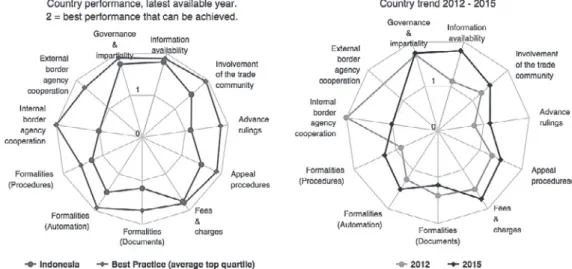
Based on Trade Facilitation Indicators (TFI) that comprises 11 indicators/ areas8 referring to TFA provisions (OECD 2015), overall Indonesia’s TFI
7. TFA sets out three different categories of notifications. Category A provisions mean that the member is able to implement when the Agreement comes into force. Category B provisions mean that the member is able to implement the Agreement after a transitional period following it coming into effect. Category C provisions allow a nation to not only implement the agreement’ requirements after a transitional period as in Category B, but also provides that nation with as-sistance and capacity building support. To assist with reaching these goals, the WTO members also created the Trade Facilitation Agreement Facility (TFAF) in 2014 as a supporting body and a focal point to assist developing countries and least developed countries in dealing with their TFA obligations.
8. The areas/indicators are (1) Information Availability (publication of trade information, in-cluding on Internet); (2) Involvement of the Trade Community (consultations with traders); (3) Advance Rulings (prior statements by the administration to requesting traders concerning the classification, origin, valuation method, etc., applied to specific goods at the time of importation; the rules and process applied to such statements; (4) Appeal Procedures (the possibility and ———————————————————
performance continues to be below best performance. The country however matches best performance across the sample as regards information availability and fees and charges as it also exceeds the average performance of lower middle-income countries in all TFI areas apart from internal border agency cooperation. Its perfor-mance nevertheless has improved between 2013 and 2015 in all TFI areas apart from the simplification and harmonization of documents and internal border agency cooperation. Its performance in the area of simplification and harmoniza-tion of documents is stable, while on internal border agency cooperaharmoniza-tion some ground was lost (see the following Diagram 1: Indonesia’s TFI Performance).
Diagram 1: Indonesia’s TFI Performance
Source: Trade Facilitation Indicators Country Note Indonesia (OECD, 2015)
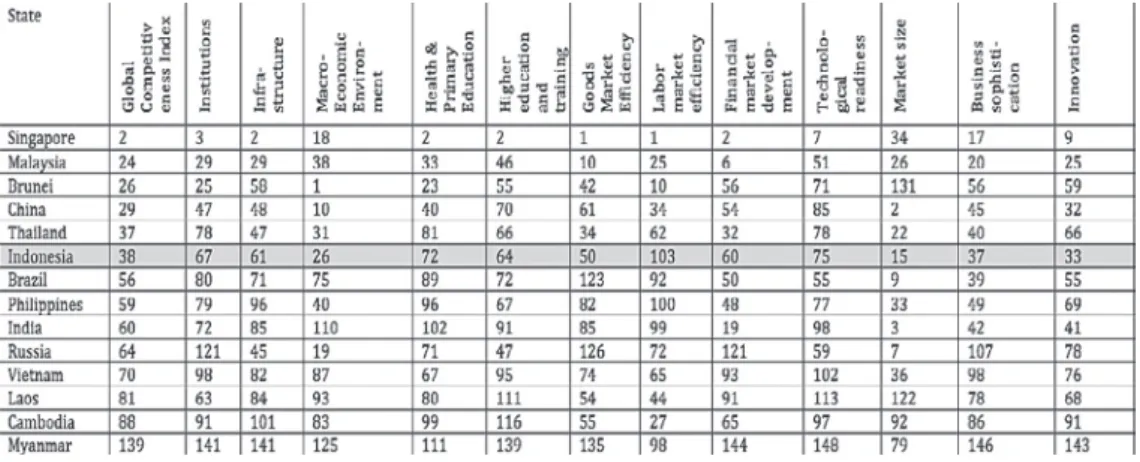
If measured under global competitiveness index (GCI), Indonesia ranks at 34 out of 144 (WEF 2014-5). Several major ASEAN economies rank higher, i.e. Thailand (31), Malaysia (20) and Singapore (2), while others, i.e. the Philippines,
modalities to appeal administrative decisions by border agencies); (5) Fees and Charges (disci-plines on the fees and charges imposed on imports and exports0; (6) Formalities – Documents (acceptance of copies, simplification of trade documents; harmonization in accordance with inter-national standards; (7) Formalities – Automation (electronic exchange of data; use of risk man-agement; automated border procedures; (8) Formalities – Procedures (streamlining of border controls; single submission points for all required documentation (single windows); post-clearance audits; authorized economic operators); (9) Internal Cooperation (control delegation to customs authorities; cooperation between various border agencies of the country); (10) External Co-operation CoCo-operation with neighboring and third countries; (11) Governance and Impartiality (customs structures and functions; accountability; ethics policy).
Vietnam, Laos, Cambodia and Myanmar rank lower at 52, 68, 93, 95 and 134 re-spectively. Against the BRICS, Indonesia is well above that of India (71), Brazil (57), South Africa (56) and Russia (53), but quite far behind that of China (28). In the past 5 years, the country’s performance is in steady improvement (38 (of 148) in 2013-4, 50 (of 144) in 2012-3, and 46 (of 142) in 2011-2). With 4 (four) notches up to 34, the country’s overall GCI performance continues to progress, including those of infrastructure and connectivity pillar. Up 5 (five) places from past year (2013-4) and 20 (twenty) places since 2011, Indonesia ranks 56th in related GCI pillar (see
the following Table 1: Global Competitiveness Index of ASEAN and BRICS Countries)
Table 1: Global Competitiveness Index of ASEAN and BRICS Countries
Source: Global Competitiveness Report 2013-2014
In comparison to other market economies, Indonesia logistics performance in-dex (LPI) sits at 53 among 150 countries surveyed (World Bank 2014). Against the BRICS, the country is comparable that of India (54) and way ahead of Brazil (65) and Russia (90), but far behind South Africa (34) and China (28). Among the ASEAN (Association of Southeast Asian Nations) major economies, Indonesia overtook the Philippines (57) but fell behind Vietnam (48), Thailand (35), Malaysia (25) and Singapore (5). In 2007, the country ranked at 43 (of 150), then 75 (of 155) in 2010 and 59 (of 155) in 2012. Such fluctuated and unstable performance indicates the complexity of logistics issues to be addressed in this archipelagic country.
As indicated in its volatile LPI performance, Indonesia requires a much im-proved logistics capabilities –despite solid improvement in infrastructure and con-nectivity and overall GCI rank. It is particularly the case for ports (sea-lane
shipments) as well as rail and road (ground delivery). As an archipelagic country, Indonesia is urged to have adequate main port(s) as a hub of international trade. The country has a few numbers of ports that have the capability to handle interna-tional shipment and trade flow from the small ports, and they need to be upgraded to international ports. Around 94% of international freight shipments are served at 5 (five) main ports, i.e. Tanjung Priok port of Jakarta, Tanjung Perak port of Surabaya, Belawan port of Medan, Tanjung Emas port of Semarang and
Soekarno-Hatta port of Makassar (OECD 2012).
At the same time, contribution of domestic freight shipments in those five ports has shown a very high number, nearly 85% (OECD 2012). Dense frequency of delivery of goods, which are concentrated in those five ports, may contribute to cause the worsening dwelling time. Accumulation of goods and delivery schedules setback further complicates the problem that eventually leads to inefficiency. The port of Tanjung Priok in Jakarta itself has a fairly low productivity when compared to ports in Southeast Asian countries, such as Malaysia, the Philippines, and Thailand (Ministry of Transportation 2012). Indonesia’s 2014-5 GCI pillar on infra-structure represents the complexity where the quality of port infrainfra-structure –ranks at 77th— in particular has placed the country far behind its closest competitor
economies, such as Thailand (54), China (53) and South Africa (46). The country’s port quality is simply not to be compared with that of Malaysia (19) and Singapore
Diagram 2: Indonesia Overall LPI (2007-2014)
Source: World Bank 2014
0 0.5 1 1.5 2 2.5 3 3.5 4
Customs Infrastructure International Shipment Logistics Competence Tracking and Tracing Timeliness
Customs Infrastructure InternationalShipment CompetenceLogistics Tracking andTracing Timeliness
2014 2.87 2.92 2.87 3.21 3.11 3.53
2012 2.53 2.54 2.97 2.85 3.12 3.61
2010 2.43 2.54 2.82 2.47 2.77 3.46
(2), and is only comparable to that of India (76) and Russia (81).
During the past decade, overall Indonesia’s logistics performance9 resembles
complexities and the need of how to better manage its customs and logistics infra-structure. As shown in the following Diagram 2 Indonesia Overall LPI (2007-2014), despite its sound performance in international shipment, logistics competence, tracking and tracing ability, and timeliness (by having scores of >3 in average during 2007-2014), the LPI scores on customs and logistics infrastructure are aver-agely low during the entire same period. Continuingly to score <3, the two sub-in-dicators reflect basic problems faced by the country’s logistics system, i.e. to embrace soft and hard infrastructures alike10 (see Diagram 2 above).
2.3. Indonesia’s Logistics System
Confronting with such complexities, Indonesian authority and its logistics stakeholders have managed to agree in a common platform identifying strategic issues, steps and roadmap to move forward. The platform –which is codified in the Blueprint on National Logistics System or SISLOGNAS (stands for Sistem Logistik
Nasional in Bahasa Indonesia) under Presidential Regulation No. 26 (March
2012)— is a major reference in outlining key commodities, roles of logistics players and logistics service providers, status and development of transport and ICT infra-structure, human resource management, relevant laws and regulations, and its
9. Logistics Performance Index (LPI) (World Bank/WB, 2014) offers 6 sub-indicators and de-fines: (1) customs as efficiency of the clearance process (i.e. speed, simplicity and predictability of formalities) by border control agencies, including customs; (2) logistics infrastructure as qual-ity of trade and transport related infrastructure (e.g. ports, railroads, roads and information technology); (3) international shipment as ease of arranging competitively priced shipments; (4) logistics competence as competence and quality of logistics services (e.g. transport opera-tors, customs brokers); (5) tracking and tracing as ability to track and trace consignments; and (6) timeliness as timeliness of shipments in reaching destinations within the scheduled and ex-pected delivery time.
10. Soft logistical matters include national logistics system and transport sector regulation along with customs and border procedure as they would impact on delays and uncertainty faced by traders (WTO/OECD, 2013). Hard logistical infrastructure problems on ports, roads, railroads and information technology are certainly much more damaging as trade impediments is now originated not only from tariffs, other non-tariff barriers, but also from changes in the nature of supply-chains management and production network that are more and more flexible and frag-mented horizontally, spatially. The latter phenomenon requires: (1) functioning hard logistics infrastructure and accelerating infrastructure investment that should be combined with a solid soft logistics governance reform (Jacobs 2012; Blyde 2012); (2) quality of hard logistics infrastruc-ture, particularly its transport-related one, that relates specifically to the development and ad-vancement of relevant information communication and technology (ICT) (Limao and Venables 2002; Clark, Dollar and Micco 2004; and Baldwin 2011).
——————————————————— ———————————————————
institutional schemes (SLI 2013).
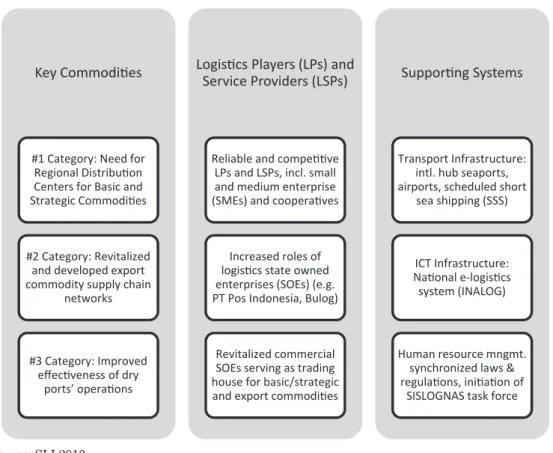
SISLOGNAS maintains that the country logistics system is divided into 3
(three) categories based on its key commodities: (1) primary and strategic commod-ity; (2) export oriented product; (3) general product. It further asserts that the second product category is aimed to enhance Indonesia’s competitiveness that hence needs government supports in trade facilitation to improve infrastructure and export quantity.
The following Diagram 3: SISLOGNAS Assessment (2011-2015) outlines as-sessment of major conditions, requirements and schemes needed in order to deal with the complexities faced by Indonesia’s logistics stakeholders. Aside from its institutional scheme under SISLOGNAS, utilization of relevant foreign aid or grant to improve the country’s logistics performance has also been persistently endeavored, especially in terms of channeling infrastructure investment projects and programs to ease the country’s logistics problems. As previously stated, the
Diagram 3: SISLOGNAS Assessment (2011-2015)
Source: SLI 2013
Key Commodities
#1 Category: Need for Regional Distribution Centers for Basic and Strategic Commodities
#2 Category: Revitalized and developed export commodity supply chain
networks
#3 Category: Improved effectiveness of dry
ports’ operations
Logistics Players (LPs) and Service Providers (LSPs)
Reliable and competitive LPs and LSPs, incl. small and medium enterprise (SMEs) and cooperatives
Increased roles of logistics state owned enterprises (SOEs) (e.g. PT Pos Indonesia, Bulog)
Revitalized commercial SOEs serving as trading house for basic/strategic and export commodities
Supporting Systems
Transport Infrastructure: intl. hub seaports, airports, scheduled short
sea shipping (SSS)
ICT Infrastructure: National e-logistics system (INALOG)
Human resource mngmt. synchronized laws & regulations, initiation of
article is hence an effort to reiterate how such an endeavor is perceived and even-tually formulated by the country’s policy makers who deal with, first of all, aid and grant management and, secondly, logistics-related technicalities.
Practices of SISLOGNAS, however, are hampered by lack of achievement in the targets and goals set in its previous assessment scheme of 2011-2015. Those missing targets are particularly worth to be noted in the case of logistics supporting systems for sea-lane transport modes and international hub seaports. Under the previous SISLOGNAS assessment, the systems are to be relied on the development of national sea-lane LPs/LSPs and SSS (scheduled short sea-shipping) by limiting the movement of international sea-lane LPs/LSPs, i.e. by assigning two major seaports as the only international hub for the latter type of LPs/LSPs, i.e. Kuala
Tanjung and Bitung as western and eastern most sea ports respectively. The new
scheme of “Tol Laut”11 introduced by the new government under President Joko
Widodo would conversely be detrimental to the previous SISLOGNAS assessment as it would rely more on the presence of shipping armada with much larger tonnage than the existing ones –regardless they are of national or international origins.
3.1. Indonesia’s Aid for Trade Scheme
Similar to the case of many other middle-income countries, Indonesia’s Aid for Trade (AfT) scheme takes a specific form of ODA which is part of foreign aid com-prising foreign loan and grant. Procurement procedure for both types of foreign aid is regulated under the Indonesian Government Regulation No. 10 (2011) (IGR 10-2011) entitled “Procurement Procedures for Foreign Loan and Grant Acceptance.” Accordingly, it should be used as the guidelines for the ministries and other insti-tutions in dealing with foreign loan and grant.
Foreign loan requires stricter rules than that of foreign grant. It is the Ministry of Finance (MoF) who has the authority to perform the loan agreement, acting as representative of the Indonesian government. As stipulated in Article 3 of IGR 10-2011, the MoF has the authority to perform foreign loan and accept grant source from outside and inside the country. Further it is being emphasized in the next article, Article 4, that other ministries/institutions, regional government and state-owned enterprises (SOEs) are prohibited to perform any kind of agreement that will raise the obligation such as foreign loan. Any kind of aid for trade in the form
11. Literally means “Sea Toll” (in parallel to that of Toll Road), the scheme is introduced by the President himself in his effort to connect all the country’s existing major seaports to further ease sea-lane movement of goods and other logistical barriers in sea transportation.
of loan will have to be registered by the MoF. Therefore, administratively the MoF should have all the relevant data and information regarding this form of aid.
Grant on the other hand follows the same rule, yet less strict. There are two types of grant according to the way it is disbursed, planned grant and direct grant. The State Ministry of National Development Planning (also known as BAPPENAS - stands for Badan Perencanaan Pembangunan Nasional in Bahasa Indonesia) is in charge of drafting medium and yearly activity plan, which will be funded from the grant. It is important to note that Indonesian planning system is different from a typical central planning model where the core planning function is located within the jurisdiction of the budget office (MoF). The Indonesian system puts this func-tion within BAPPENAS jurisdicfunc-tion.
However, both BAPPENAS and MoF share responsibility in managing the aid. In the case of a direct grant, before the conclusion of grant agreement, ministries/ institutions shall consult on the planning with MoF, BAPPENAS and other related ministers/institutions. Evaluation mechanism applicable for both foreign loan and grant is through a quarterly report submitted to the MoF and BAPPENAS. The report consists of information regarding the implementation of goods/services pro-curement, its progress, fund’s realization, problems occurred during implementa-tion and any follow up activity.
Although it has been regulated explicitly in IGR 10-2011 that ministries/insti-tutions, regional government and SOEs are obliged to submit quarterly report re-garding the grant that they have received, in practice this does not occur. As ex-plained in more detail below, BAPPENAS confirms that they do not have a good procedure and mechanism in evaluating grants implementation. BAPPENAS just started to create a database and standard operating procedure to administer aid in the form of grant. BAPPENAS eventually asserts that donor agencies conversely have a better mechanism and procedure of monitoring and evaluation.
Yet the mechanism for aid distributions is carefully selected by BAPPENAS. Directorate of Development Planning is one of the divisions in BAPPENAS that has various partnerships with some other ministries. The directorate does not govern all incoming flows of aid for trade. Their authority has been only focusing over foreign aid flows into governmental bodies. The directorate governs national development plan with funds originating from both local and foreign donors which might be either grants or loans scheme. IGR 10-2011 stipulates that each govern-mental body has the authority to manage the scheme independently but should report to BAPPENAS.
differently due to their distinct idea and characteristics. Grants –categorized under “direct” and “planned” grants— are more flexible, short term, and could be dis-bursed in the middle of fiscal year. Conversely, loans are long term and more structurally planned. The flow of information of grant or foreign loan is published from the Ministry of Finance at least once every six month. The mechanism of grant selection is as follows: donors origins, purpose, following warranty, and it relations to Medium Term National Developmental Plan (also known as RPJMN-stands for Rencana Pembangunan Jangka Menengah Nasional in Bahasa
Indonesia).
The direct grant is less complex than planned grant. The direct grant is only interacting with BAPPENAS and the chosen ministry. Meanwhile, the planned grant mechanism is as follows. Following the donor’s final decision, BAPPENAS coordinates with the MoF to establish a “grant agreement” which then to be for-warded to the related ministry that already includes in BAPPENAS plan. IGR 10-2011 Article 57 specifies that grant could be forwarded or lend to local government and/or SOEs. It has then to be recorded in national state budget (also known as
APBN - stands for Anggaran Pendapatan dan Belanja Negara in Bahasa Indonesia)
in the case of SOEs, or regional/local government budget (also known as APBD - stands for Anggaran Pendapatan dan Belanja Daerah in Bahasa Indonesia) in the case of local/regional governments as grant recipients.
The succeeding Diagram 4: Indonesia’s Grant Categories and Selection Mechanism offers elaborate diagrammatic description:
BAPPENAS recaps that Indonesian government has not yet developed a single
database that records grant or loan transactions, including specifically with re-gards to infrastructure and other logistics-related supporting schemes from the aid recipients. This is a crucial issue as more and more private sectors participate in infrastructure development projects. Based on the medium term national develop-ment plan (RPJMN) and also the long term national developdevelop-ment plan (RPJP - stands for Rencana Pembangunan Jangka Panjang in Bahasa Indonesia), infra-structure is the key project that needs to collaborate with private sectors. Indonesia has the Public Private Partnership (PPP) scheme (also known as KPS - stands for
Kemitraan Pemerintah-Swasta in Bahasa Indonesia) which proportionally defines
the roles of government and private sectors12. Even though the biggest funding
12. Introduction of PPP scheme in infrastructure investment dates back to 1998 when the Government of Indonesia promulgated Presidential Decree No. 7/1998 on cooperation between government and business entity in development or management of infrastructure. The regulatory framework (which was updated/amended in 2005, 2010, 2011, 2013 and 2015) serves as the basic ———————————————————
came from private sectors, the Indonesian government plays crucial role to decide which project(s) is or are to be taken.
3.2. Features of Indonesia’s Aid for Trade
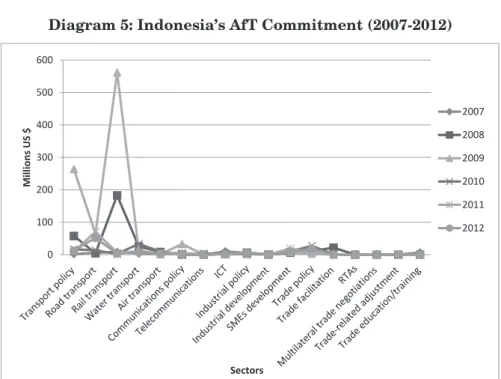
The following Diagram 5: Indonesia’s Aid for Trade (AfT) Commitment (2007-2012) and Diagram 6: Indonesia’s AfT Disbursement (2007-(2007-2012) feature respec-tively donors’ commitment and Indonesian government efforts to allocate and dis-burse AfT. Discrepancy between the commitment made and actual AfT allocation/ disbursement is quite apparent reaffirming –as previously indicated— the
Diagram 4: Indonesia’s Grant Categories and Selection Mechanism
Grant Direct (BAPPENAS & Related Ministries) Ministerial/Regio nal/SOEs Planned BAPPENAS & Ministry of Finance "Grant Agreement" Ministerial/Regional /SOEs
reference for infrastructure development in the country under PPP scheme. The PPP projects are selected based on its levels of readiness: (1) Potential Projects; (2) Prospective Projects; and (3) Ready to Offer Projects. The categorization reflects differences in the treatment, terms and condi-tions of each PPP project. The overall process and procedures of the selection and assessment of a proposed project are administered under BAPPENAS Directorate of Government-Private Cooperation or in Bahasa Indonesia, Direktorat Pengembangan Kerjasama Pemerintah-Swatsa (PKPS). The directorate is therefore responsible in coordinating with relevant ministries, region-al/local governments or SOEs in defining terms and condition of a PPP infrastructure project, including in determining the types of funding of the project incurred, i.e. via mixed loan, full grant or private investment. (see: BAPPENAS. 2015. PPP Infrastructure Project Plans in Indonesia 2015).
complexity of the country’s discreet mechanism in AfT-related planning and imple-mentation which spans across different (horizontal) ministerial agencies and varied levels of (vertical) governmental agencies. This has lead to recurrent changes in policy and sectoral priorities. AfT actual allocation and disbursement for road transport have been much larger than its committed values for almost the entire period of 2007-2012 (except in 2007). Whereas AfT actual allocation and disburse-ment for rail transport have been smaller than its committed values (2007-2012).
As shown in Diagram 5, in terms of commitment, areas considered to be the focus of the country’s AfT scheme are infrastructure sector (especially in rail and road transport) and transport policy and administrative management. The largest aid committed by the donors flows into infrastructure sector, i.e. to include road and railway transportation networks. These two infrastructure sectors are the backbone of the country’s logistics. Since most of industries are located on the is-land of Java, both sectors play a vital role to ease trade flows from main industrial area to both domestic and global market. Inversely, air and water transportation receive fewer foreign aid funds if compare to land transportations.
Transport policy and administrative management is the second largest sector of foreign aid committed by the donors, i.e. 21% (as compare to rail transport which got 44% share) of the total AfT commitment in 2007-2012 period. Transport policy and administrative management is part of reform in soft infrastructure that plays significant role in customs clearance and trade regulation issues. The reform is aimed at reducing perception on notorious Indonesia’s red tape bureaucracy result-ed from unsound policy and administrative management.
While technical assistance is offered in order to create a conducive and inves-tor-friendly policy, donors have been committed also to provide foreign funds bilat-erally or multilatbilat-erally making most of foreign aid committed into trade policy, trade facilitation and communication policy sectors. See Diagram 5 especially for commitment made to trade facilitation in 2008, communications policy in 2009, and trade policy in 2010. However, as shown in Diagram 6, in terms of disbursement, trade policy sector has much bigger allocation than the one for trade facilitation and communications policy. In 2012, trade policy is the 5th largest sectors to receive
actual allocation of AfT trailing behind that of transport policy, water transport, rail transport and road transport (which is also the largest actual AfT receiving sector for the entire period is road sector). See Diagram 6 for the details.
0 100 200 300 400 500 600 M illion sUS $ Sectors 2007 2008 2009 2010 2011 2012
Diagram 5: Indonesia’s AfT Commitment (2007-2012)
Source: OECD Query Wizard for International Development Statistics (QWIDS) (accessed as of March 9 2016, available online at: http://stats.oecd.org/qwids)
Diagram 6: Indonesia’s AfT Disbursement (2007-2012)
Source: OECD QWIDS 2016 (accessed as of March 9 2016, available online at: http://stats.oecd.org/ qwids) 0 20 40 60 80 100 120 140 160 180 M illion sUS $ Sectors 2007 2008 2009 2010 2011 2012
It is also apparent that in the period of 2007-2012, Indonesian government emphasized more on land transport rather than other modes of transport. As the next Diagram 7: Total Allocated Indonesia’s AfT Commitment (2007-2012) exhibit-ed, AfT commitment for rail transport during the period reached the total of US $ 764.6 millions or 44% of the overall AfT commitment. At the same period, road transport sector got a total of US $ 211.06 millions or 12% of the overall AfT com-mitment. AfT commitment for transport policy and administrative management which is mostly allocated for land transport reached the total amount of US $ 362.36 millions or 21% of the overall AfT commitment during the same period.
Most of the logistics gridlock was, however, found in delivering industrial products to outer and remote islands outside Java. This has been pointed out as the trigger of price gaps between Java and other islands in Indonesia which in turn cause the country unable catching up its neighboring countries in order to achieve a highly economic competitiveness. AfT scheme is therefore suggested to delivering aid towards more needed sectors, such as assisting Indonesian government to build extensive and high quality air and water transportation. As Diagram 7 also shown, water transport got only a 5% share of the total AfT commitment in the period of 2007-2012 (valued US $ 93.545 millions).
Sector with least foreign aid committed is ICT (Information and communica-tion technology) that is believed to be a contributing factor to drive logistics system more efficiently and providing fast and reliable service for both exporters and im-porters13. The sector got a mere 1% share of the total AfT commitment in 2007-2012
which is valued as small as US $ 19.952 millions (see Diagram 7). Other sector di-rectly linked to ICT is telecommunications which also had a very small share (less then 1% and valued only US $ 4 millions of the total AfT commitment in 2007-2012.
National single window (NSW) is one of ICT-related trade facilitation initiative that enables international (cross-border) traders to submit regulatory documents at a single location and/or single entity. Typical documents to be covered and han-dled under the NSW initiative are customs declarations, applications for import/ export permits, and other supporting documents such as certificates of origin and trading invoices. ICT development is mandatory for the national government and several stakeholders (including foreign stakeholders and parties) in managing
13. Modernization of ICT aiming to help human resources to do their duty well and to deliver good services for customers is closely related to custom clearances process. ICT is therefore seri-ously needed to integrate all requirements and regulations from participating ministries in cus-toms and logistics-related matters.
trade issue which hinders trade flows in the country.
As previously indicated, Diagram 8 shows that land transportation holds the largest amounts of aid disbursal in the period of 2007-2012. However, AfT dis-bursement for water transportation sector is substantially greater than its commit-ment in the overall period of 2007-2012. As Diagram 8 Total Allocations of Indonesia's AfT Disbursement (2007-2012) exhibited, AfT disbursement for water transport sector reach the total value of US $ 253.24 millions or 18% of the AfT funds disbursed during the overall period of 2007-2012. AfT commitment for water transport is only 5% of overall AfT commitment for the period of 2007-2012 (see Diagram 6). However, as Diagram 7 also revealed, total AfT disbursement of road transport is much larger than its total commitment during the same period, i.e.
Transport policy 362.36 21% Road transport 211.06 12% Rail transport 764.6 44% Water transport 93.545 5% Air transport 28.878 2% Communications policy 40.855 2% Telecommunications 4.0971 0% ICT 19.952 1% Industrial policy 29.622 2% Industrial development 1.75 0% SMEs development 57.445 3% Trade policy 72.161 4% Trade facilitation 25.122 1% RTAs 0.0399 0% Multilateral trade negotiations 0.1475 0% Trade-related adjustment 0 0% Trade education/training 7.6297 0% その他 105.1001 6%
Diagram 7: Total Allocated Indonesia’s AfT Commitment (2007-2012) (Millions US $ and Percentage)
35% disbursed as compare to 12% committed.
Water transport sector has eventually been rampant with severe problems which lead to underperformed logistics system. Port bottleneck and longer dwelling time (if compared to ports in neighboring countries) is a warning sign for logistics stakeholders in the country. It is a strong indication that increased trade volume has not been followed by capable physical infrastructure, especially that of port. Economic losses triggered by port gridlock are quite enormous, and it is being worsened by lack of good shipping services as the basic requirement for the country sea logistics system given its archipelagic nature that is prone to sustained changing weather condition14.
Road transport 480.8 35% Rail transport 271.68 20% Water transport 253.24 18% Transport policy 131.81 10% Trade policy 56.976 4% Air transport46.221 3% ICT 40.851 3% SMEs development 35.932 3% Industrial policy 27.086 2% Industrial development 12.817 1% Trade education/ training 7.6872 1% Trade facilitation 7.5734 1% Communications policy 5.4522 0% Telecommunications 4.089 0% RTAs 0.4118 0% Multilateral trade negotiations 0.2831 0% Trade-related adjustment 0 0% その他 17.8095 1%
Diagram 8: Total Allocations of Indonesia’s AfT Disbursement (2007-2012) (Millions US $ and Percentage)
14. Ambitious agenda by the current government to establish self-sufficient shipping services (the so-called “tol laut” or “shipping toll-lane”) would aspire not to rely too much on foreign provid-ers. If the government is able to provide good quality shipping services, it will overcome the trade issue at the port. But if not, it would certainly hurdle Indonesia’s economic sustainability in the future.
4. Integrating Aid for Trade and Trade Facilitation Linkages
Based on the previous elaboration on the country’s logistics case, along with its TF and AfT current state of play and status, the ensuing Table 2 Integrated Indonesia AfT-TF Framework recaps main points to be taken in an attempt to ap-ply AfT-TF integrated framework into the country’s logistics case.
Table 2: Integrated Indonesia AfT-TF Framework
TF - Trade Facilitation
State of Play
On TF Agreement
• Not ratified (as of May 2016): the country may have to accept TFA enforcement in the near future looking at the latest numbers (79) of members ratified the agreement
• Notification: Category A (on pen-alty disciplines, pre-arrival pro-cessing, and the use of Customs Brokers) (as of July 31 2014) • Little concerted measures taken
by trade stakeholders in prepara-tion for TFA enforcement and its full implementation (as of May 2016)
AfT - Aid for Trade
Scheme
• Nature: ODA/foreign aid (loan & grant)
• Procurement procedure: regulat-ed under the Indonesian Government Regulation No. 10 (2011) (IGR 10-2011) “Procure-ment Procedures for Foreign Loan and Grant Acceptance.” • IGR 10-2011 as guidelines for the
ministries and other institutions for AfT/ODA/foreign aid (loan and grant) procurement
• Key agencies: Ministry of Finance, the State Ministry of National Development Planning (BAPPENAS)
General Performance
On OECD TF Indicators (2015) • Overall performance: below best • Best-match areas: information
availability and fees and charges • Except on the area of internal
border agency cooperation, over-all performance exceeds average performance of lower middle-in-come countries in all other areas • Except on the areas of
simplifica-tion and harmonizasimplifica-tion of docu-ments and internal border agency cooperation, overall performance nevertheless has improved be-tween 2013 and 2015 in all other areas
Features
On AfT commitment (2007-12) • Focused areas: infrastructure
and trade policy and administra-tive management
• Most committed: infrastructure sector (road and railway trans-portation networks as the back-bone of the country’s logistics), with lesser commitment made for air and water transportation • Least committed: ICT sector On AfT disbursement (2007-12) • Focused areas: more on land
transport rather than other modes of transport
• Stagnated area: simplification and harmonization of documents • Loosing ground area: internal
border agency cooperation (i.e. need to improve the cooperation on the ground between various administrations present at the border)
• Most disbursed: road and rail transport, (however disburse-ment for water transportation sector is substantially greater than its commitment)
• Least disbursed: trade-related adjustment sector
Specific Aspect Performance
On WEF GCI (2014-15) • Overall rank: 34 (out of 144) • Comparison to ASEAN countries
• Higher: Thailand (31), Malaysia (20) and Singapore (2)
• Lower: the Philippines (52), Vietnam (68), Laos (93), Cambodia (95) and Myanmar (134)
• Comparison to the BRICS • Higher: China (28)
• Lower: India (71), Brazil (57), South Africa (56) and Russia (53)
• Past 5 years performance: 4 (four) notches up to 34, steady improve-ment (38 (of 148) in 2013-4, 50 (of 144) in 2012-3, and 46 (of 142) in 2011-2)
• Infrastructure and connectivity pillar: 56 (up 5 (five) places from past year (2013-4) and 20 (twen-ty) places since 2011)
On World Bank LPI (2014) • Overall performance: 53 (out of
150)
• Comparison to the BRICS
• Lower: India (54) and way ahead of Brazil (65) and Russia (90)
• Higher: South Africa (34) & China (28)
• Comparison to major ASEAN countries
Evaluation
• Transport policy and administra-tive management as the 2nd larg-est sector committed
• The policy is part of soft infra-structure –playing significant role in customs clearance issue and trade regulation.
• Negative perception on the country’s red tape bureaucracy and protectionist trade policy - resulted from unsound policy a n d a d m i n i s t r a t i v e management.
• Technical assistance is offered to policy makers in order to create a conducive and investor-friendly policy
• Committed bilateral and multi-lateral committed AfT into trade policy sector
• Most of the logistics gridlocks: delivering industrial products to outer and remote islands outside Java
• Triggering price gaps between Java and the other outer islands
• Loosing competitiveness to neighboring countries
• AfT scheme is suggested to deliv-ering aid towards more needed sectors and areas, such as exten-sive and high quality air and wa-ter transportation
• Lower: the Philippines (57) • Higher: Vietnam (48), Thailand
(35), Malaysia (25) and Singapore (5)
• Past performance: 43 (of 150) in 2007, 75 (of 155) in 2010 and 59 (of 155) in 2012
• Unstable performance indicates complexity in the country’s logis-tics system
On the country’s logistics system
• Agreed common platform: the Blueprint on National Logistics System or SISLOGNAS (Sistem
Logistik Nasional) governed
un-der Presidential Regulation No. 26 March 2012
• Key commodities: primary and strategic commodity; export ori-ented product; and general product
• Assessments on key commodities, logistics players (LPs) and service providers (LSPs), and supporting systems (SISLOGNAS 2014) • On supporting systems
• Transport infrastructure: in-ternational hub seaports, air-ports, scheduled short sea shipping (SSS)
• ICT infrastructure: national e-logistics system (INALOG) • Human resource management:
synchronized laws & regula-tions, initiation of SISLOGNAS task force
• As the least AfT committed sec-tor, ICT should be contributing factor to drive logistics system more efficiently and to provide fast and reliable service for both exporters and importers
• The sector got a mere 1% share of the total AfT commitment (valued US $ 19.952 millions). • Other sector directly linked to
ICT is telecommunications which also had a very small share (less then 1% and valued only US $ 4 millions of the total AfT committed).
• Indonesia National Single Window (INSW) as an ICT-related trade facilitation initiative
• INSW enables international (cross-border) traders to submit regulatory documents at a sin-gle location and/or sinsin-gle entity
• Typical documents to be cov-ered under INSW: customs declarations, applications for import/export permits, and other supporting documents (certificates of origin and trad-ing invoices).
• ICT development is mandatory in managing and handling those complex procedural and adminis-trative paper works and facilitat-ing other trade matters.
The framework offers a stylized and compact analytical description on how the linkages of AfT and TF should be best used in addressing the country’s underper-formed AfT and TF schemes and practices, and hence hopefully also to manage (and deal with) its logistics complexities. The following notes intend to provide a non-exhaustive assessment list that is derived from the integrated framework
previously elaborated.
The “first things first” point to be made is that there is little evidence of bold and clear guidance from relevant governmental authorities on how the current AfT scheme should be aimed at and administered by, i.e. in the midst of its abundant potential in terms of facilitating trade. Similarly, there has not been adequate guidance on how the existing TF practices should be conducted coherently, i.e. to cover TF areas systematically and comprehensively. Conversely, the current state of play with regards to enforcement and full implementation of TFA should be managed shows no adequate progression, i.e. especially in terms of targeted specific goals and objectives, resources needed, roadmaps and timeframe towards step-by-step procedures of notification of TFA commitment. Concerted actions among rele-vant trade stakeholders should hence be initiated and designed under an integrated AfT and TF framework and in light of provisions outlined in TFA.
On the existing AfT scheme, there is a concern over the government capability to create a “one-roof” system of foreign aid disbursement mechanism. From the government point of view, it is a mechanism that could directly identify and appoint which agency/ministry/SOE/local government is in need for which particular aid/ AfT/TF is critically desired. The mechanism could be materialized by closer and detailed collaboration between MoF, BAPPENAS and the Indonesian Coordinating Ministry for Economic Affairs (CMEA). Those 3 (three) ministries need to set up and appoint “1st-echelon level representative” roundtable which meet up, discuss and make decisions on a regular basis. Should proper and sound mechanism of foreign aid disbursement be entirely set up, decision making and policy formulation over AfT/TF-related projects and programs could focus on assuring that implemen-tation of projects and its expenditures are conducted by the right agencies/institu-tions on their proper needs.
Under the current implementation of decentralization policy in Indonesia, however, best option is to appoint BAPPENAS as a single institution that has a legal right to coordinate the flow of foreign aid nation-wide, including that of AfT and TF scheme. Among the three ministries previously mentioned, BAPPENAS is the only agency that has an “arms-length” representative at the regional and local levels. As a legacy of the Orde Baru (New Order) administrative system, Agency for Development Planning at Local/Regional level or BAPPEDA (stands for Badan
Perencanaan Pembangunan Daerah in Bahasa Indonesia) is a suitable counterpart
of BAPPENAS at local/regional levels. BAPPENAS and BAPPEDA has long history of collaborations in terms of data and information sharing, joint works on develop-ment planning and co-trainings and research, etc.
In order to improve the implementation and monitoring systems of aid dis-bursement, the government should make a target and evaluation scheme based on each agreement with respective donor. Best practices by international donor agencies offer elaborate procedures and techniques of monitoring and implementa-tion evaluaimplementa-tion of aid disbursement. An integrated AfT and TF disbursement scheme could therefore emulate the schemes suggested by major aid donor agencies in the country, such as the World Bank and JICA (Japan International Cooperation Agency)15.
INSW (Indonesia National Single Window) initiative alone can not certainly be treated as an all-inclusive solution to ensure improvement of the country’s logistics system. Further TF arrangement is required in order the government to be much bolder and decisive in implementing the initiative. The Indonesian government should acquire advance IT system in order to integrate export and import docu-ments from port and airport considering that INSW is an initial stage towards the next transformation into National Single Gateway system which focuses on merg-ing the export-import and investment clearance.
Leaner bureaucracy is indeed a prerequisite by which local exporters could easily access the global markets and by which they could increase quality of their export commodity. Leaner bureaucracy assures achievement of world-class local service providers and of holding a certified training agency for better and advanced local logistics expertise. Finally, a shared common mission and vision among rele-vant stakeholders is a must in order to strengthen Indonesia’s national logistics system. Opportunities to compete, collaborate and jointly operate with foreign lo-gistics service providers could only achieved under a shared platform among logis-tics stakeholders. The government should hence persistently revitalize the Presidential Decree No. 26/2011 of SISLOGNAS Blue Print and through which create more working bodies responsible to execute renewed programs of national logistics system based on the blue print and government’s RPJMN and RPJP.
Concluding Remarks
Despite some improvements in its logistics performance, Indonesia’s position as compared to other major ASEAN countries and the BRICs is lagging behind. As the fifth largest recipient country for AfT, the country shall be able to utilize the
15. Detailed comparison between the two agencies is presented in the report of the study to which the article is referred (Annex 1-Research Report 2015 WTO Chairs Programme Annual Report 2015, Universitas Gadjah Mada, Indonesia).
scheme to improve its logistics performance. As previously shown, road, railroads and water transport infrastructure and transport policy and administrative man-agement are main areas which become the focus of Indonesia’s AfT commitment. The largest aid committed by the donors flows and disbursed into transport infra-structure sectors, especially road and railway transportation networks. Given such a feature, AfT should have contributed to an improved logistics system. Other sec-tors such as trade policy and administrative management should also have sup-ported efforts to improve the country’s logistics performance.
Nevertheless, the underlying AfT-TF scheme formulated and currently imple-mented in the country has a substantial effect in properly mapping out the overall needs and planning of the country’s logistics system. As the aforementioned policy notes suggest, it deals not only with governmental institutional problems (where coordination among various levels authorities is lacking), but also with much broader complexities with regards to lack of shared common understanding and platform among relevant logistics stakeholders on how the complexities should be dealt with and, particularly, on how AfT-TF scheme fits to their improvement needs.
Last but not least, this specific case on Indonesian logistics have confirmed significant roles of AfT and TF scheme amidst complexities in its formulation and implementation. For the country’s trade and logistics stakeholders, the country’s compliance to obligations under the TF Agreement is something worth to note and draw lessons from. Integrating AfT and TF scheme is therefore a strategic policy option for a country like Indonesia who is pursuing advanced facilitations of trade and at the same time who is aspring for strengthened and improved logistics competitiveness.
Reference
Arvis, Jean Francois et al. 2014. Connecting to Complete: Trade Logistics in the Global Economy. World Bank, Washington DC
Bahagia, Senator Nur, et al. 2013. State of Logistics Indonesia (SLI) 2013. World Bank Indonesia, Jakarta
Baldwin, R. 2011. "Trade and Industrialisation after Globalisation’s 2nd Unbundling: How Building and Joining a Supply Chain are Different and Why It Matters" NBER Working Papers 17716, National Bureau of Economic Research
Banomyong, R. 2008. “Logistics Development in the Greater Mekong Sub-region: A Study of the North-South Economic Corridor”. Journal of Greater Mekong Sub-region Development Studies. Vol. 4 (44)
Basnett, Y., et al. 2012. “Increasing the Effectiveness of Aid for Trade: the Circumstances under which It Works Best’, ODI Working Paper 353, Overseas Development Institute (ODI),