232
Molecular-Dynamics Simulation of Vulcanian Eruption
Satoshi YUKAWA and Nobuvasu ITO
Deportment
of
Applied Physics, Schoolof
Engineering, The Universityof
Tokyo, 7-3-1, Hongo, Bunkyo-ku, 113-8656, JAPANVulcanian explosive eruption, which is a nonlinear and nonequilibriuin abrupt dynamics of magma-gas mixture, is modeled by a two-component Lermard-Jones
particle system. Molecular dynamics sinmlation of a shock-t he experim ent gives consistent results with aexplosive eruption picture of volcanology; Shock wave and
expansion wave are reproduced. In addition bubble nucleation of a gas component
in themagma lTlelt and spinodal-like decom positionare observed in the simulation.
The result is also compared with a continuum hydrodynamic model; Qualitative features of continuum dynamics arereproduced by the present model. We find that
the particle description ofdynamics is an effective method in such kin$1\mathrm{d}$ ofabrupt dynamics
I. INTRODUCTION
Volcanic eruption is complicated physical phenomena and the physical understanding has
not been well establish ed yet; The problem is to understand nonlinear and nonequilibriuin
dynan icsof
magma-gas
mixture accompanied byphasetransitions. [1 3] Existenceof gas. which$\mathrm{i}_{\mathrm{i}\supset}$ mainly $\mathrm{H}_{\underline{9}}\mathrm{O}$, is sometim
es
forgotten, but it is pointed out that such gas component plays animportant role in explosive eruption.[4] Type of volcanic eruption is classified into three classes
by chronological behavior; One is so-called Vulcanian type eruption, which is widely observed
in Japanese volcanos. This type is characterized by
an
interm ittent explosive eruption andformation of a lava dome. These features are determ ined }}$\mathrm{v}$ physical properties of magma;
Specifically viscosity of magma controls them.
Inthis paper, we$\grave{\mathrm{b}}\mathrm{t}\iota \mathrm{l}\mathrm{d}\mathrm{y}$ Vulcanianeruption. because itsexplosivemechanis$\mathrm{m}$ willbe themost
interesting physically, in particular, inthe context of nonequilibriuin physics; In thevolcanology.
an
eruption picture is consideredas
follows: A stage of eruption dyna mics consists ofa magmachamber and aconduit. Top of conduit is covered by a lava dorne. In a top ofmagmachamber
or a lower part of conduit, a gas
com
ponent isatm
ost $\mathrm{c}\mathrm{o}$mpletely dissolved into the magmamelt. In thleupper region ofsaturated magma, the gasis exsolved according to the equilibrium
solubility law. As decreasing the lithostatic pressure, volume fraction of gases is increasing.
At the beginning of eruption, pressure of the $\mathrm{m}\mathrm{a}\mathrm{g}$ma-gas mixture is considered to increase,
although the mechanism is not clearyet. When the lava domecannotsupport this overpressure,
it disrupts the lava dome. At the next moment, two shock waves appear and propagate; One
is a shock wave formed between atmosphere and compressed air a1lel it propagates upward.
Another is decor pression wave in magma-gas melt and it goes to opposite direction. During
the eruption it is observed that the transition from the lam inar flow of bubbly melt to the
the present understanding of the eruption dynam ics is still unsatisfactory in the context of nonequilibrium physics.$[2, 3]$
Recent progress of experimental techniques enables
us
to compare such theoretical model with experimental results; These experiments are called as shock-t be experiment, $6-9|$ Inthe $\exp\zeta^{\Delta},\mathrm{r}\mathrm{i}1\mathrm{n}\mathrm{e},11\mathrm{t}$, analogue materials of
magma-gas
mixture, suchas
viscoelastic materials andpowder, are used. It is observed that the })$\mathrm{e}\mathrm{l}\mathrm{l}\mathrm{a}\mathrm{v}\mathrm{i}\mathrm{o}\mathrm{x}$ of explosion depends on the viscosity of
analogue materials. Thus
a
non-viscotic treatment ina
theoretical study is not sufficient.In this paper, we try toestablish a computational microscopicmodel of Vulcanian eruption;
So tosay, we want to make “an Ising model ofVulcanian eruption
...
Here we describedynam-ics of the mixture by microscopic particle dynamics. A particle dynamics simulation can be
regar ded
as
an ideal shock-tube experiment, because we can calculate macroscopic quantities.In addition, using the particle dynamics. we
can
also reproduce hydrodynamic behaviorde-scribed by a continuum description of Navier-Stokes equation. Even in Newtonian dynamics,
we can produce macroscopic behavior in linear nonequilibrium thermodynamic regime. [10 13]
Moreover
we can
also discuss phenomena in far from equilibrium state, whichare
not capt uredby continuum descriptions based
on
local equilibrium. Thus the particle 1odel enableus
toexplore $\mathrm{n}\mathrm{o}\mathrm{n}\mathrm{e}(1^{11\mathrm{i}}1\mathrm{i}\dagger)\mathrm{r}\mathrm{i}\iota 1\mathrm{r}\mathrm{n}$ dynamics of volcano, as well as the model can verify an macroscopic
theor etical model
II. MODEL
Here we
assume
microscopic dynamics are governed by the following Ha miltonian:$H$ $= \sum_{i=1}^{N}\frac{\mathrm{p}_{l}^{2}}{2m_{i}}+\frac{1}{2}\sum_{i.j}^{N}\alpha_{i}\alpha_{j}\emptyset(|\mathrm{q}_{\mathrm{i}}-\mathrm{q}_{?}|)$
{1)
where$\phi(r)$isLennard-Jones12-6potential: $q1(r)=4\epsilon\{(\sigma/r)^{12}-(\sigma/r)^{6}\}+\prime \mathrm{j})_{0}$. Forcomputation al
efficiency,
we
introduce a potential cutoffas
$3.9\mathrm{a}$ and determine the value of$\phi_{\mathit{0}}$ tobe $\varphi^{\int}(3.9\sigma\grave{)}=$$0$. And$N$ denotestotal particlenumber, $m_{i}$ denotes $\mathrm{n}1\mathrm{a}\mathrm{s}^{\backslash }\mathrm{s}$of particle $\mathrm{i}$
, $\mathrm{p}_{i}$ and$\mathrm{q}_{i}$ denoteparticle
th$\mathrm{r}\mathrm{e}\mathrm{e}$-dimensional momenta and coordinates, respectively. Dimensionless parameters
$\alpha_{i}$ and
$m_{\mathrm{g}\mathrm{a}\mathrm{e}}/m_{\mathrm{r}\mathrm{r}1\mathrm{a}\mathrm{g}\mathrm{n}\mathrm{a}}1$
are
selected so that it will reproduce similar properties as magmagas;[4] We take$\alpha_{i}$ tobe 1 for magma particles, and 0.1 for gas particles. It determines energyscales ofmagm a
and gas. Ratioof melting temperatures ofmagmato gas is givenby $\alpha_{\mathfrak{n}1\mathrm{a}\mathrm{g}\mathrm{m}\mathrm{a}}^{2}/\alpha_{\mathrm{g}\mathrm{a}\mathrm{b}}^{2}$ and itis 100 in
the present model, although it is approximately 1000 for actual magma and gas. Present choice
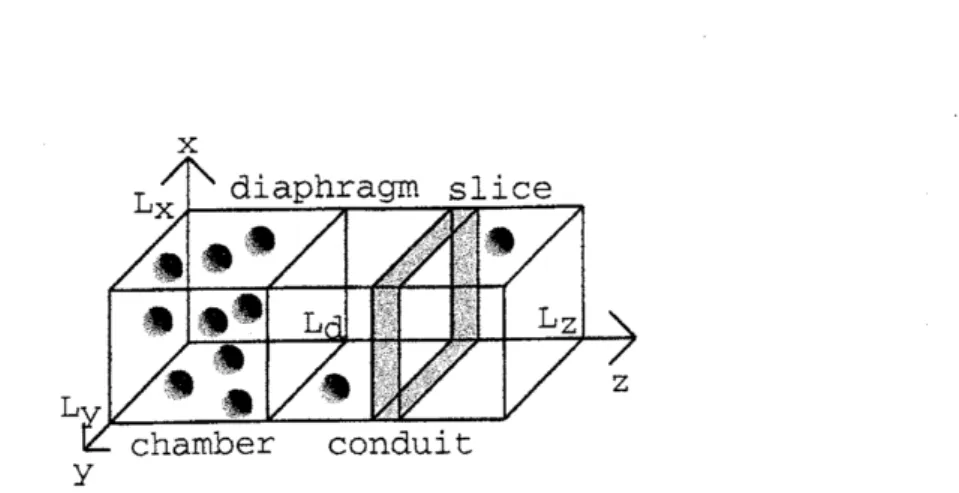
FIG. 1: Geometry of the system. When we calculate physical quantities, we slice the system with a unit length.
will showin the following. Particle
mass
ratio ischosenas
$m_{\mathrm{g}\mathrm{a}_{\llcorner}\mathrm{s}},/m_{\mathrm{m}\mathrm{a}\mathrm{g}\mathrm{m}\mathrm{a}}$ $=0.1$,which is oforderactual 11lassratio. Hereafter
we
measure
length.mass, andenergyby the unitsof$\sigma_{\backslash }m_{\mathrm{m}\mathrm{a}\mathrm{g}\mathrm{n}\mathrm{a}}\mathrm{I}$ and$\epsilon\backslash$ respectively, and
use
dimensionless variables. Employing the Lennard-Jones 12-6 potentialmakes us to describe the rmodynamic phases ofgas, fluid, solid, and their coexisting state.
Using the above Hamiltonian, we calculate particle motion. The geometry of the system is
as follows (see also Fig. 1): Consider rectangular parallelepiped with a size $L_{\alpha}\cross$ $L_{y}\cross$$L_{\sim},$. For$x$
and $y$ directions, periodic boundary conditions are imposed. A eruption direction is to
$z$ axis,
and we prepare elastic walls at bottom and top. These walls are represented by repulsion part
of Lennard-Jones potential.
First we have to prepare initial state as thermal equilibrium one. In this stage, whole
system is divided into two parts, ‘.chamber’. $(0 \leq z\leq L_{d})$ and ‘.C01lduit” $(L_{d}\leq\sim\wedge/\leq L_{\sim}\neg)\mathrm{b}\mathrm{v}$
a diaphragm, which is located at $z=L_{d}$, made of same elastic walls at $\approx=0$ and $\approx=L_{z}$.
At the beginning, magma and gas particles are contained in the chamber. Contrarily, on lv
gas particles are in the conduit. For preparing initial state, we do an isothermal simulation
with $*\backslash ^{\mathrm{Y}}|0\acute{\mathrm{s}}\mathrm{e}$-Hoover thermostat in each part of the
svstem414
16] Density and temperature inthe chamber
are
chosen as gas particles are uniformly mixed into magmaparticles; There is nophase separation.
After thermalization, we rem ove the separator between conduit andchamber and
we
detachthe the 1mostat. Then the system obeys the Hamiltonian dynam ics If pressure in the chamber
is higher than one in the conduit, an explosion is activated.
Simulation details
are
asfollows: The second order symplectic method (theleapfrog method)is used in numerical integration. Time integration slice is taken to be $10^{-3}$. This value is
sufficient for present simulations, which is checked by energy conservation.
III. RESULTS
In the simulation, we calculate several physical quantities in boxes whicll
are
obtained byslicing along $z$-direction with a unit length $\sigma.[17.1\mathrm{S}]$ Number density $n(z)$ and
mass
density$\rho(z)$ of the slice $z$
are
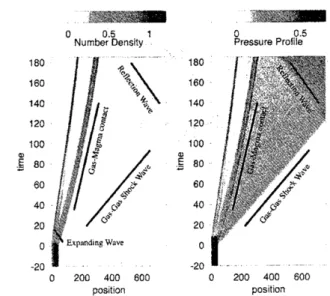
basic quantities ofmacroscopic dynamnics defined by counting a numberFIG. 2: Space-time profileof number density (left) and local pressure (right): Horizontal axis
repre-sents coordinate of explosion direction ($z$ axis) and vertical axis is time At timne
$0_{\backslash }$ a diaphragm is
removed. Characteristicwaves areguided by lines.
the slice. Pressure$\mathrm{p}(\mathrm{z})$, isdefined by a $\mathrm{t}\mathrm{r}\mathrm{a}\mathrm{c}\mathrm{e}$ofstress tensor. And temperature $T(\approx)$ is defined
by variance of particle velocities from local barycentric motion.
Here we present a typical result of si mulation
as
space-timle profile of physical quantities.In Figs. 2. number density $n(z)$ and pressure $p(z)$ are presented. In this sir ulation. we take
following parameters: Systemsize is $L_{x}=L_{y}=40$
.
$L_{z}=74\mathrm{t}$). In an initial therm al equilibrationstage, a diaphragm is located at $z$ $=40$, sothlesizeof magma chamberis40$\rangle\langle$$40\cross$$40$ and
one
ofthe conduit is$40\cross$$40\cross 700$. Total number of particle is 176000, whichconsistsof57600 magma
particles and 118400gas particles. The chamber contains 57600magm aparticles and 6400gas
particles. Other 112000 gas $\mathrm{p}_{C}$‘xrticles
are
in the conduit. Then initial number densities are 1for the chamber and 0.1 for the conduit. Thermalizationisdone with the chamber temperature
2 aJld $\mathrm{t}\mathrm{I}_{1}\mathrm{e}$conduit temperature 0.8.
In Figs. 2, a horizontal axiscorrespondsto $z$direction and explosiongoesto right. A vertical
axis represents time. At the time 0, the diaphragm is removed. In the profile of number
density,
we
recognize two characteristic densitywaves.
First one begins at $(Z/=40, f=0)$and propagates to $(750, 120)$. This
wave
corresponds to a shock wave between hot gas, whichis heated bv adiabatic compressing, and thermal equilibrium gas. Its velocity is larger than
a sound velocity of equilibrium conduit gas. This wave is reflected at $(757. 12\mathrm{t}3)_{\tau}$ because an
elastic wall exists at there. Another
wave
propagates more slowly than the shockwave
from$\mathrm{n}$$(4\mathrm{t}1, 1\mathrm{I})$ to $(300, 185)$. Front position of this density
wave
corresponds tomagma-gas
contactsurface.
There
are
othersmall
waves
in this figure. A wave propagating from (0.10) to $(170, 185)$is also reflecting
wave
caused by the elastic wall located at $z=0$ . Awave
propagating toopposite direction, which is from $(40, 0)$ to (0.10), is also observed in the figure. This wave is
an
expansionwave
of dense magma-gas
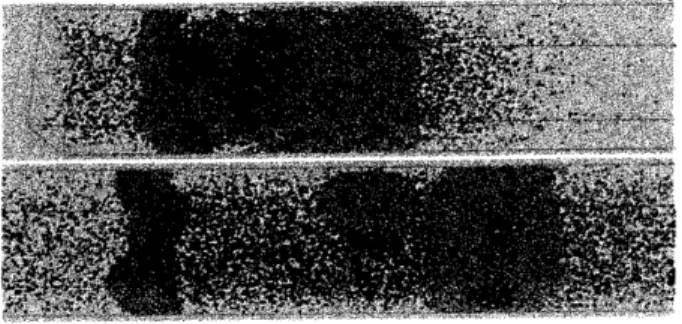
mixture.FIG. 3: Snapshots of simulation: (Up) Snapshot at $t=40$. (Down) Snapshot at $t=170$
.
Parametersare identical to ones of Fig 2. Eruption propagates to the right direction. Only particles originated from the chamber are plotted; A red ball represents a magma particle, and blue one is a gas particle
At the initial condition$t=0_{\backslash }$ blue and red particles are uniformly mixed inthe chamber.
gas contact wave,
som
$\mathrm{e}$internal structures areglowing. To investigate the internalstructure indetails, we show snapshot of simulation are shown in Figs. 3. These snapshot are taken from
the simulation drawing Fig. 2 so simulation parameters are identical
ones
of that simulation.We only draw 1agma particles and gasparticles which are in the magma chamber at the initial
condition. Gas particles coming from the conduit are omitted. Explosion propagates to the
right direction in this figure, which is $z$ axis.
Before removing thediaphragm, magma and gas areuniformlymixedinthe$\mathrm{m}\mathrm{a}\mathrm{g}$machamber.
But, in Figs. 3, inhomogeneous mixing of those components is gradually growing during the
eruption. This rerninds us of spinodal decomposition. Size of exsolved gas bubble grows from
Figs. $3(\mathrm{a})$ to (b); In Fig. $3(\mathrm{a})$, bubble size
are
widely distributed but, in (b), one large gasbubble and small bubbles in the thick magmaexists. In large gas bubble,
one
magma dropletis observed.
In this way, magma-gas mixture becom $\mathrm{e}$ inhom
ogeneous
mixture and internal structure ofbubbles
are
growing. Such behavior is consistent with the scenario of volcanology. But in thepresent simulation, transition to rnag1na dispersion flow is not observed. The
reason
may bethat smaller
cross
section of conduit and finiteness particles.Next we $\mathrm{c}\mathrm{o}$ mpare the present simulation results with the continuum description given by
Woods.[5] In his model, magma-gas mixture is described by one-dimensional nonviscotic com
-pressible one-component fluid. The dynamics are described by a continuity equation, an
equa-tion ofmotion, and the followings:
$\frac{1-n}{\rho_{l}}+\frac{nRT}{p_{g}}=\frac{1}{\rho}$
.
$p_{\mathit{9}}( \frac{\emptyset}{\rho})^{\gamma_{m}}=$ const. (2)where $\rho\backslash p_{l}$,$p_{g}$.T.$R$,$n$,$cb$and $\gamma_{m}$, denote $\mathrm{r}\mathrm{n}\mathrm{a}\mathrm{b}^{\tau}\mathrm{b}$ density, mass density ofmagma com ponent.
pres-sure
of gascomponent, temperature, a gas constant, amass
fraction ofmagmaand gascom
nI)$()$-$\mathrm{n}\mathrm{e}\mathrm{n}\mathrm{t}\mathrm{b}_{\backslash }$ avolume fraction ofmagmaand gascomponents, and ratio of specificheats, respectively.
In these quantities, $\rho,p_{\mathit{9}^{\wedge}}T$ and $\phi^{-1}\equiv 1+\frac{1-n}{\gamma}‘\frac{p_{y}}{\rho;RT}$
are
variables. Other $\rho_{l\backslash }R_{\backslash }\tau\iota_{\backslash }$ and $\gamma_{m}$are
fixed to
som
$\mathrm{e}$constant values. The first equation is an equation ofstates, and the secondone
expresses an isentropic condition derived from the first law of the rmodynamics. As
we
knowthe equation $\mathrm{i}\mathrm{I}1$ characteristic regions. For obtaining global shock tube solution, we ha $\mathrm{v}\mathrm{e}$ to
glue the solution with appropriate boundary conditions.
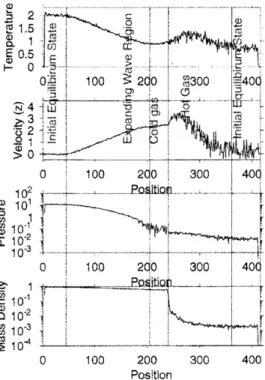
FIG. 4: Spatial profilesoftemperature, velocity(z), pressure, and $\mathrm{n}\iota \mathrm{a}\mathrm{i},\cdot \mathrm{b}$ densityat $t=15$: System size
is taken to be $L_{x}=32$
.
$L_{y}=32.L_{\mathrm{z}}=408$and size of lnagm a chamber is 32 $\mathrm{x}$ $32\mathrm{x}200$. Initial massdensityandtemperaturearetakento be 1 and 2, respectively. $\mathrm{W}^{\gamma}\mathrm{e}$ canrecognize cha1acte1istic
regions.
Rom right, “initial equilibrium state.), “hot gas region” , “coldgas region”$\backslash$ “expanding waveregion”
and “initial $\mathrm{e}$quilibrium statc” againareobserved. These regions areindicated by gray rectangular.
In Fig. 4. temperature $T(_{\sim}^{\mathrm{v}})\backslash$ barycentric velocity $\mathrm{v}(\approx)_{z}$, pressure $p(z)$
. mass
density $\rho(z)$ of$\mathrm{t}1_{1}\mathrm{e}$present simulation
are
shown. Simulation parametersaretakentobeasfollows: System sizeis $L_{x}=L_{y}=32$,$L_{z}=408$ and sizeofmagmachamber is 32 $\mathrm{x}$ $32\cross 200$. Initial number densitv ofmagma chamberis taken to be 1
an
$1\mathrm{d}$ conduit density is 0.02, thus the number of particles inthe chamber is 204800, which contains 10% gas particles. The num ber of gas particles in the
conduit is 4096. In thissimulation, we imposed an artificial boundary condition at the top of
conduit; For decreasing reflection effects from the top elastic wall, we attach a particle sink at
the top, in which particles with theenergy larger than
some
threshold value are removed fromWe
can
observe characteristic regions in Fig. 4. Letus
compare these results withcontin-uum descriptions. Thesolution ofEq. (3) teaches
us
that there are three regions in shocktube analysis, that is, a hot gas region, a cold gas region, and an expanding wave region.Corre-sponding regions of simulation
are
indicated in the figure; In the “hot gas” region, gases areheating up by the shock wave. In contrast, in the “cold gas” region, gases are cooling by an
adiabatic expansion. Another region is an “expanding wave” region in which the expanding
wave exists and physical quantities
are
smoothly changed. Physical properties of such regionsobtained by the simulation are almost equivalent to ones of shock tube analysis. But there
is a little mismatch with the solution; Analysis of compressible fluid gives constant profiles of
physical quantities in both hot and cold gas regions. But, in this simulation,
some
structuresare $0$})selved in each regions. For example, in a velocity profile of the hot gas region, velocity
near
cold gas is rather faster than otherareas.
This high velocityarea
is caused by pushingeffects of magma-gas contact surface, which is corresponding to the front of cold gas contact.
These high velocity particles are not thermalized yet; In the molecular dynamics simulation,
microscopic relaxation is apparently observed.
IV. SUM MARY
To sumlnarize, we have constructed a microscopic model of Vulcanian eruption by a
two-components Leonard-Jonesparticle system. We observed that the particledynamics isefficient
in this kind of dynamics. Using the present model we can reproduce characteristic features
of explosive eruption such as a shock wave, a expansion
wave.
At the early stage of theeruption, we also compare the simulation result with the analytic model given by Woods.
Qualitative behavior is almost consistent with the analytic result,
even
though the flow istreated
as
nonviscotic one in the analytic model, In addition, we have also observed that theinternalstructure is growing during the eruption. Internal bubble structure cannotbecaptured
by the Woods model. This behavior is also consistent with a eruption picture of volcanology
study. Thus we conclu dethat the present model is a candidateof “an Ising model of Vulcanian
eruption
To establish the present model, a quantitative study is inevitable. For this purpose, we
have to enlarge the size of system ; A transition from bubbly magm a flow to
magma
dispersionflow will be reproduced and studied by simulation of the system with ten times larger to all
directions. And themore details ofvolcanic eruption not only Vulcanian but also Strombolian,
and Plinian will be elucidated. Present typical computational time is approximately 80 hours
for 208896 particles with single AMD opteron 248 $(2.2\mathrm{G}\mathrm{H}\mathrm{z})$. Hence much larger simulation is
feasible with large super computers.
Acknowledgment$\mathrm{s}$
The authors thank T. Koyaguchi for valuable discussion and comments. This work is
par-tially supported by the Ministry ofEducation, Science, Sports and Culture, Grant-in-Aid for
[3 T. Koyaguchi: J. Volcanol. Geotherm. ${\rm Res}$. 143 (2005) 29.
[4] H.-U. Schmlncke: Volcanism (Springer-Verlag, Berlin, 2004).
[5] A. W. Woods: NucL Eng. Design, 155 (1995) 345.
[6 Y. Zhang, B. Sturtevant, and E. M. Stolper: J. Geophys. ${\rm Res}$. 102 (1997) 3077.
[7] B. Gagnoli, A. Bartnin, O. Melnik, R. S. J. Sparks: Earth Planet. Sci. Lett. 204 (2002) 101.
[8 O. Spieler, D. B. Dingwell, and M. Alidibirov: J. Volcanol. Geotherm. ${\rm Res}$. 129 (2004) 109.
[9] M. Ichihara, D. Rittel, and B. Sturtevant: J. Geophys. ${\rm Res}$. 107(B1O), 2229,
doi:10.1029/2001JB000591, (2002).
[10 T. Ishiwata, T. Murakami, S. Yukawa, and N. Ito: Int. J. Mod. Phys. C15 (2004). [11 T. Murakami, T. Shimada, S. Yukawa, and N. Ito: J. Phys. Soc. Jpn. 72 (2003) 1049.
$\lceil 12$ H. Okum uraand N. Ito: Phys. Rev. E67 (2003) 045301(R). $\mathrm{I}13$ H. Okumura and $\mathrm{D}_{\sim}$ M. Heyes: Phys. Rev. E70 (2004) 061206.
[14 S. Nose: Mol Phys. 52 (1984) 255.
[15 S. Nose’: J. Chem. Phys. 81 (1984) 511.
[16 W. G. Hoover: Phys. Rev. A31 (1985) 1695.
[17 J. H. Irving andJ. G. Kirkwood: J. Chem. Phys. 18 (1950) 817.
[i8] J.-P.Hansenand I.R.McDonald: Theory
of
Simple Liquids(AcademicPress, Amsterdam , 1986).[19 H. Lamb: Hydrodynamics (Dover, New York, 1945).