Tetsuya
Abe
Research
Institute
for Mathematical
Sciences,
Kyoto
University
Motoo
Tange
Institute of
Mathematics,
University
of Tsukuba
ABSTRACT. The purpose of this note is twofold: First, we prove that Omae’s knot is
ribbon,whichwasknown tobehomotopically slice. Second,wegiveasufficient condition
for agiven knot to be ribbon. As acorollary, we show that the knot $12_{a990}$ is ribbon,
which wasknown to be slice.
1, $OMAE’ S$ KNOT IS RIBBON
A knot $K$ in the 3-sphere $S^{3}=\partial D^{4}$ is slice if there exists
a
smoothlyembedded disk $D^{2}\subset D^{4}$ such that $\partial D^{2}=K.$ $A$ knot $K$ is ribbon if there
exists
a
smoothly immersed disk $D^{2}\subset S^{3}$ with only ribbon singularitiessuch that $\partial D^{2}=K$. It is easy to
see
that every ribbon knot is slice. Theslice-ribbon conjecture due to Fox [5] states that
every
slice knot is ribbon,which has been
a
long-standing unsolved problem in knot theory.In the positive direction, the slice-ribbon conjecture
was
conformed fortwo-bridge knots [19, Lisca], certain pretzel knots [11, Greene-Jabuka],
cer-tain Montesinos knots [17, Lecuona] and simple slice knots [23, Shibuya].
On the other hand, potential counterexamples to the slice-ribbon
con-jecture
are
demonstrated through the study of the 4-dimensional smoothPoincar\’e conjecture [2, 6, 7, 9].
Omae [22] studied the knot depicted in the left of Figure 1. The first
author and Jong [1] observed that Omae’s knot bounds
a
smoothlyem-bedded disk in
a
homotopy 4-ball $W$ which is represented by the handlediagram
as
in the right of Figure 1 (see also Section 4). In this note,we
prove the following.
FIGURE 1. Omae’s knot and a homotopy 4-ball $W.$
Proof.
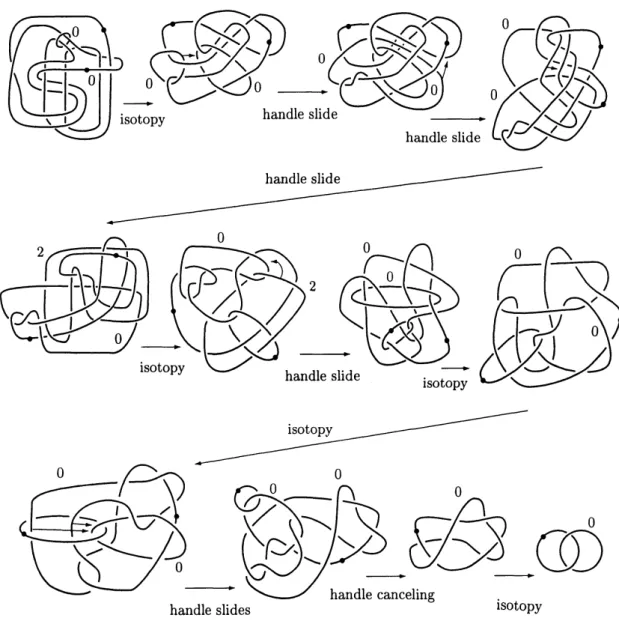
Handle calculus in Figure 2 implies that $W$ is diffeomorphic to thestandard 4-ball. $\square$
Corollary 1.2. Omae’s knot is slice. Furthermore, it is ribbon.
Proof.
Theorem1.1
implies that Omae’s knot is slice. Recall that Omae’sknot is isotopic to the boundary of
cocore
disk of the 2-handle (coloredGrey) of the top left handle diagram in Figure 2. By chasing Omae’s knot
in handle diagrams in Figure 2, we obtain
a
ribbon presentation of Omae’sknot
as
in Figure 3. $\square$Remark 1.3. Another potential counterexample to the slice-ribbon
conjec-ture is the (2, 1)-cable of the figure eight knot. Livingston and Melvin [18] and Kawauchi [14] proved that it is algebraically slice. Furthermore
Kawauchi [15] showed that it is rationally slice. On the other hand, by the
theorem of
Casson-Gordon
[4], Miyazaki $[21]$ proved that it is not ribbon.Untill now, it is not known whether the (2, 1)-cable of the figure eight knot
is slice
or
not. See also Gomp-Miyazaki [8].2. THE KNOT $12_{a990}$ IS RIBBON
The simplest slice knot which might not be ribbon is $12_{a990}$
.
Indeed,Herald, Kirk and Livingston [12] showed that the connected
sum
of $12_{a990}$and right-and left-handed trefoils is ribbon, implying that $12_{a990}$ is slice.
However it was unknown whether $12_{a990}$ is ribbon 1
$A$ $t_{n}$
-move
isa
tangle replacementas
in Figure 4. In this section,we
show the following.
lC. Livingston ($e$-mail communication) informed us that they knew that $12_{a990}$ is ribbon, however
FIGURE 2. Handle diagrams which represent $W.$
Theorem 2.1. Let $K$ be a knot.
If
we obtain the 3-component unlinkfrom
$K$ by applying
a
$t_{2n+1^{-}}$ and $t_{-(2n+1)}$-move, then $K$ is ribbon.We denote by $T(p, q)$ the torus knot of type $(p, q)$. First,
we
show thefollowing.
Lemma 2.2. Let $K$ be a knot.
If
we
obtain the 3-component unlinkfrom
$K$by applying
a
$t_{2n+1^{-}}and$ $t_{-(2n+1)}$-move, then $K\# T(2,2n+1)\# T(2,$ $-(2n+$ $1))$ is ribbon, where $\#$ denotes the connectedsum.
Proof.
We mayassume
thata
$t_{2n+1}$-move
anda
$t_{-(2n+1)}$-move are
doneFIGURE 3. $A$ ribbon presentation of Omae’s knot.
FIGURE 4. The definition of a $t_{n}$-move for $n>0$ (left) and for $n<0$ (right).
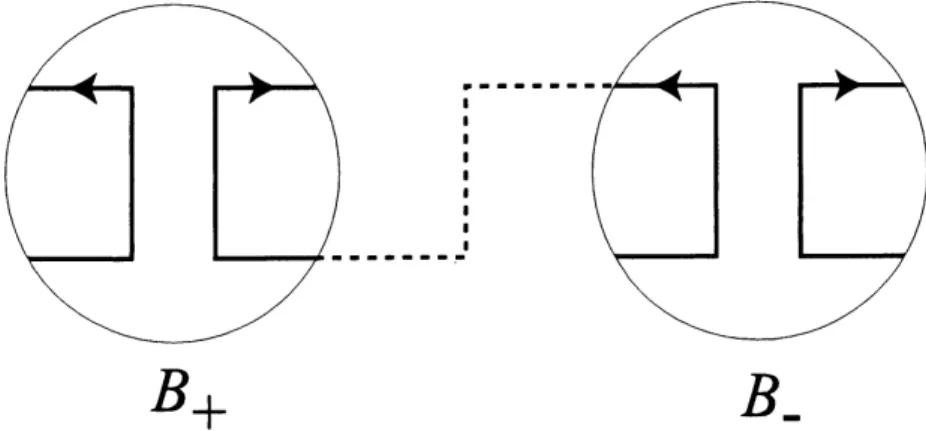
$(B_{-}, T_{-})$ with $B_{+}\cap B_{-}=\emptyset$ such that ifwe apply a $t_{2n+1}$-move for $(B_{+}, T_{+})$
and
a
$t_{-(2n+1)}$-move
for $(B_{-}, T_{-})$, thenwe
obtain the 3-component unlink.Now we consider $K\# T(2,2n+1)\# T(2, -(2n+1))$ as in Figure 5. If
we
add$B+ B_{-}$
FIGURE 5. The knot $K\# T(2,2n+1)\# T(2, -(2n+1))$.
two bands along dotted
arcs
in Figure 5, then the resulting 3-componentlink is trivial by the assumption. Therefore $K\# T(2,2n+1)\# T(2,$ $-(2n+$
Now
we
consider again $K\# T(2,2n+1)\# T(2, -(2n+1))$as
in Figure5
with$B_{+} B_{-}$
FIGURE 6. Connectivity of two trivial tangles $(B_{+}, T_{+})$ and $(B_{-}, T_{-})$.
two bands attached along dotted
arcs.
Then we deform $T(2, -(2n+1))$as
in Figure
7
with the band. Wecan see
the knot$T(2,2n+1)\# T(2, -(2n+1))$$B_{+} B_{-}$
FIGURE 7. $A$ deformation of$T(2, -(2n+1))$.
in $B_{+}$ which is known to be ribbon. We concentrate
on
$B_{+}$ and deform thetangle (in $B_{-\vdash}$)
as
in Figure 8. Thenwe
obtaina
ribbon presentation of $K.$ $\square$FIGURE 8. Deformations in $B_{+}.$
As a corollary of Theorem 2.1, we obtain the following.
Corollary 2.3. The knot $K_{n}$ in the
left of
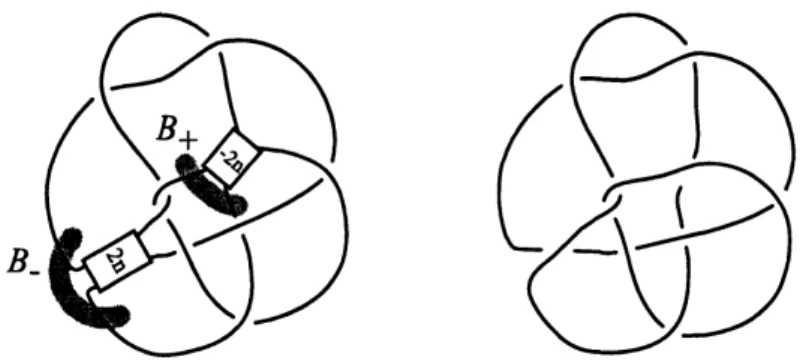
Figure 9 is ribbon. In particular,$K_{1}=12_{a990}$ is ribbon.
FIGURE 9. Left: the knot $K_{n}$, Right: the knot $12_{a990}.$
Proof.
We choose two 3-balls $B_{+}$ and $B_{-}$ as in the left of Figure 10. Weapply a $t_{2n+1}$
-move
for $(B_{+}, K_{n}\cap B_{+})$ and a $t_{-(2n+1)}$-move for $(B_{-}, K_{n}\cap B_{-})$.Then
we
obtain the 3-component linkas
in the right of Figure 10 which isFIGURE 10. Left: 3-balls $B_{+}$ and $B_{-}$, Right: the 3-component unlink.
3. ON THE RIBBON FUSION NUMBER
A
ribbon knot $K$ isof
$m$-fusions
if $K$ is isotopic to$\bigcup_{i=0}^{m}S_{i}^{1}$ –int$( \bigcup_{j=1}^{m}b_{j}(\partial I\cross I)\cup\bigcup_{j=1}^{m}b_{j}(I\cross\partial I)$
where $\bigcup_{i=0}^{m}S_{i}^{1}$ is the $(m+1)$-component unlink and $b_{j}$ : $I\cross Iarrow S^{3}$
$(j=1,2, \ldots, m)$
are
disjoint embeddings such that$S_{i}^{1}\cap b_{j}=\{\begin{array}{ll}b_{j}(\{0\}\cross I) if i=0,\emptyset b_{j}(\{1\}\cross I) if i=j,\end{array}$
otherwise.
It is known that
a
ribbon knot is of $m$-fusions forsome
$m[20,25]$. Theribbon
fusion
number ofa
ribbon knot is defined to be the minimal numberof such $m$. For the study of the ribbon fusion number,
see
[3, 13, 24].Question 1. Is the ribbon
fusion
numberof
Omae’s knot two?Question 2. $I_{\mathcal{S}}$ the ribbon
fusion
numberof
the knot $12_{a990}$ two?4. HOMOTOPY 4-SPHERES ASSOCIATED TO UNKNOTTING NUMBER ONE
RIBBON KNOTS
In the conference, Intelligence of Low-dimensional Topology, the first
author talked
on
annulus twist, diffeomorphic 4-manifolds, and slice knots.In this section,
we
assume some
terminologies in [1]. The first author andProposition 4.1 ([1]). Let be
an
unknotting number one knot, $(A, b, c, \epsilon)$the associated bandpresentation and $K_{n}$ the knot obtained
from
$K$ byapply-ing
an
annulus twist $n$ times.If
$K$ is ribbon, then there existsa
homotopy4-ball $W_{n}$ with $\partial W_{n}=S^{3}$ such that $K_{n}$ bounds a $\mathcal{S}$moothly embedded disk
in $W_{n}$. In particular, we
can
associate a homotopy 4-spherefor
each $n.$Let $K$ be the knot $8_{20}$. Note that the unknotting number of $8_{20}$ is
one
and the associated band presentation of$K$ is depicted in Figure 11. Let $K_{n}$
the knot obtained from $K$ by applying
an
annulus twist $n$ times. Then $K_{1}$is Omae’s knot. Since $8_{20}$ is ribbon,
we can
associatea
homotopy 4-sphere$\Sigma_{n}$ for each $n$ by Proposition 4.1. Theorem 1,1 implies that $\Sigma_{1}$ is standard.
FIGURE 11. The associated band presentation for $8_{20}.$
Conjecture 4.2. The homotopy 4-sphere $\Sigma_{n}$ is standard
for
each $n.$ACKNOWLEDGMENTS
The first author
was
partially supported by KAKENHI, Grant-in-Aid forResearch Activity start-up (No. 00614009), Japan Society for the
Promo-tion of Science.
REFERENCES
[1] T. Abe and I. Jong, Annulus twist and diffeomorphic 4-manifolds, preprint (2012).
[2] S. Akbulut, Cappell-Shaneson homotopy spheres are standard Ann. of Math. (2) 171 (2010), no. 3,
2171-2175.
[3] S. A. Bleiler and M. Eudave-Munoz, Composite ribbon number oneknotshave two bridge summands, Trans. Amer. Math. Soc. 321 (1990) 231-243.
[4] A. Casson and C. Gordon, A loop theorem for dualityspaces andfibred mbbon knots, Invent. Math.
74 (1983), no. 1, 119-137.
[5] R. Fox,Some problems in knottheory,Topologyof 3-manifolds and relatedtopics(Proc. The Univ.of
GeogiaInstitute), (1962), 168-176.
[6] M. Freedman, R. Gompf, S. Morrison and K. Walker, Man and machine thinking about the smooth
4-dimensional Poincare conjecture, QuantumTopol. 1 (2010), no. 2, 171-208.
[7] R. Gompf, More Cappell-Shaneson spheres are standard, Algebr. Geom. Topol. 10 (2010), no. 3,
[13] T.Kanenobu, Band SurgeryonKnots andLinks,J. Knot Theory Ramifications 19(2010) 1535-1547.
[14] A. Kawauchi, On links not cobordant to split links, Topology 19 (1980), no. 4, 321-334.
[15] A. Kawauchi, Rational-slice knots via stronglynegative-amphicheiralknots,Commun. Math. Res. 25 (2009), no. 2, 177-192.
[16] R. Kirby, Problems in low dimensionalmanifold theory, Proc. Sympos. PureMath., XXXII, Amer. Math. Soc., Providence, R.I., 1978.
[17] A. Lecuona, On the slice-mbbon conjecture for Montesinos knots, TranS. Amer. Math. Soc. 364
(2012), no. 1, 233-285.
[18] C. Livingston and P. Melvin, AlgebraiC knots are algebmically dependent, Proc. Amer. Math. Soc. 87 (1983), no. 1, 179-180.
[19] P. Lisca, Lens spaces, rational balls and the nbbon conjecture, Geom. Topol. 11 (2007), 429-472.
[20] Y. Marumoto, Onrebbon 2-knots of1-fusion, Math. Sem. Notes, Kobe Univ. 5 (1977) 59-68.
[21] K. Miyazaki, Nonsimple, nbbonfiberedknots, Trans. Amer. Math. Soc. 341 (1994), no. 1, 1-44.
[22] Y. Omae, 4-manifolds which are constructedfromknots andshake genus, (in japanese) Master thesis ofOsaka University (2011 ).
[23] T. Shibuya, Any simple slice knot u a nbbonknot, preprint (2012).
[24] T. Tanaka, On bredge numbers of composite nbbon knots, J. Knot Theory Ramifications 9 (2000$)$
423-430.
[25] T. Yanagawa, On rebbon 2-knots. I. The 3-manifoldbounded by the 2-knots, Osaka J. Math. 6 (1969$)$
447-464.
Research Institute for Mathematical Sciences
Kyoto University Kyoto606-8502 JAPAN
$E$-mail address: [email protected]
$\hat{/5_{\backslash }^{1}}\xi\beta*\not\cong^{\backslash }.\mathscr{X}tgffi^{7J}ffiffl_{\Lambda\overline{P}}^{*}HK_{\mathfrak{k}1}’{\}ff3_{B}^{\backslash }$
Institute of Mathematics
University of Tsukuba
Ibaraki 305-8571
JAPAN
$E$-mail address: [email protected]