ON THE SECOND COEFFICIENT OF THE TWISTED
ALEXANDER POLYNOMIAL
TAKAYUKIMORIFUJI
1. INTRODUCTION
Let $K$ be a knot in the 3-sphere $S^{3}$ and $G(K)$ its knot group. Namely it is the
funda-mental group of $N=S^{3}\backslash K$
.
In this note we consider the twisted Alexander polynomial$\Delta_{K,\rho}(t)$ (see [6] and [11]) associated to a parabolic representation $\rho$ : $G(K)arrow SL(2, \mathbb{C})$,
which sends the meridian $\mu$ of $K$ to a parabolic element of $SL(2, \mathbb{C})$, i.e. tr$\rho(\mu)=2$
holds. For a hyperbolic knot $K$ in $S^{3}$ (that is, $N$ admits
a
complete hyperbolicmetric of finte volume), a typical example is the holonomy representation $\rho_{0}$ : $G(K)arrow SL(2, \mathbb{C})$,which is alift of a discrete faithful representation $\overline{\rho}_{0}$ : $G(K)arrow PSL(2, \mathbb{C})\cong Isom^{+}(\mathbb{H}^{3})$
so
that $\mathbb{H}^{3}/G(K)\cong N$ (see [10]). It is known that such a representation is determineduniquely up to conjugation.
In [1],Dunfield,$\mathbb{R}iedl$and Jackson studiedthe twistedAlexanderpolynomial$\Delta_{K,\rho 0}(t)\in$
$\mathbb{C}[t^{\pm 1}]$ associated tothe holonomyrepresentation$\rho_{0}$, whichis called the hyperbolic torsion
polynomial and denoted by $\mathcal{T}\kappa$
.
Itis well known that the coefficient ofthe highest degree term of$\mathcal{T}_{K}$has informationon
fiberedness of knots. Based on hugenumerical calculationsfor hyperbolic knots of 15 or fewer crossings, they found an interesting pattem on the
second coefficient of $\mathcal{T}_{K}$ and asked the following question as one of the open problems
(see [1, Section 1.13]): For
fibered
knots, why is the secondcoefficient of
$\mathcal{T}_{K}$ sooflen
real2As explained in [1, Section 6.5], for fibered knots, the twisted homology of the universal
cyclic
cover can
be identified with that of the fiber, hence the action ofa
generator of the deck transformation group on this homology of thecover can
be thought ofas
theaction of the monodromy of the bundle on the twisted homology of the fiber. Then the
second coefficient of $\mathcal{T}_{K}$ is just the sum of the eigenvalues of this monodromy map, but
it is unclear why this should often be a real number. In contrast, the second coefficient
is real for only few nonfibered knots. Hence we would like to explain these phenomena
reasonably, but it is still widely open.
The purpose of this note is to observe the above question and confirm the property of
the second coefficient of the twisted Alexanderpolynomial $\Delta_{K,\rho}(t)$ associated toparabolic
representations$\rho$ (not onlyfor the holonomy representation$\rho_{0}$) for well known two infinite
families of knots. One is a torus knot $T_{2,q}$ and the other is a twist knot $J(2,2n)$
.
Everytorus knot is non-hyperbolicfibered and wecan see that the second coefficient of$\Delta_{K,\rho}(t)$
is actually real (precisely zero) for anyirreducible representation $\rho:G(T_{2,q})arrow SL(2, \mathbb{C})$
.
For parabolic representations of twist knots,we
can
show that the second$co$efficient is aninteger forfibered case and not rational fornonfibered knots except for $J(2,4)$
.
In Section 2.1, we review the representation space of irreducible representations into
$SL(2, \mathbb{C})$ (see [3]) and the formula of the twisted Alexander polynomial (see [5]) of the
torus knot $T_{p,q}$
.
In Section 2.2, we review the Riley polynomial (see [9]) and the formulaof$\Delta_{K,\rho}(t)$ for $K=J(2,2n)$ (see [7]). In particular, we calculate the second coefficient of
the twisted Alexander polynomial for the twist knot.
2. OBSERVATION
In this section, we observe the second coefficient ofthe twisted Alexander polynomial
associated to a parabohc $SL(2, \mathbb{C})$-representation of the knot group.
2.1. Torus knots. Let $(p, q)$ be a pair of coprime natural numbers and $T_{p,q}$ the $(p, q)-$
torus kn$ot$. We take and fix the following presentation of$G_{p,q}=G(T_{p,q})$:
$G_{p,q}=\langle x, y|x^{p}y^{-q}\rangle.$
Here
we
note that this is nota
Wirtinger presentation.Let$R$bethesetof irreducible$SL(2, \mathbb{C})$-representationsof$G_{p,q}$ and $\hat{R}$thequotientspace
of $R$ by conjugate action of $SL(2, \mathbb{C})$
.
We denote the conjugacy class, which contains arepresentation $\rho$, by $\hat{\rho}$
.
In general$\hat{R}$ has several components. Choosing a pair
$(r, s)$ of
natural numbers satisfying $p_{\mathcal{S}}-qr=1$, then $\mu=x^{-r}y^{S}\in G_{p,q}$ represents a meridian
of $T_{p,q}$
.
For $\hat{\rho}\in\hat{R}$, let $\alpha^{\pm 1}=\exp(\pm\sqrt{-1}\pi a/p)$ and $\beta^{\pm 1}=\exp(\pm\sqrt{-1}\pi b/q)$ be theeigenvalues of $\rho(x)$ and $\rho(y)$ respectively, where we
can assume
that$0<a<p$
and$0<b<q.$
Under the notations above, the space of conjugacy classes of irreducible $SL(2, \mathbb{C})-$
representations ofthe torus knot group $G_{p,q}$ is described as follows:
Proposition 2.1 (Johnson [3]). The representation space$\hat{R}$
consists
of
$(p-1)(q-1)/2$components, denoted by $\hat{R}_{a,b}$, which are determined by thefollowing data:
(1) $0<a<p$ and $0<b<q.$
(2) $a\equiv bmod 2.$
(3) For every $\hat{\rho}\in\hat{R}_{a,b}$,
we
have tr$\rho(x)=2\cos(\pi a/p)$, tr$\rho(y)=2\cos(\pi b/q)$ and$\rho(x^{p})=\rho(y^{q})=(-I)^{a}.$
(4) tr$\rho(\mu)\neq 2\cos\pi(ra/p\pm sb/q)$
.
Inparticular, $\hat{R}_{a,b}$ is parametrized by tr$\rho(\mu)$ and hence $\dim_{\mathbb{C}}(\hat{R}_{a,b})=1.$
Remark 2.2. An easyargumentshows that there is just one conjugacyclass ofparabolic
representations oneach component $\hat{R}_{a,b}$ (see [5, Proposition 4.4]).
Let $K=T_{p,q}$ and $\hat{\rho}\in\hat{R}_{a,b}$
.
Then the twisted Alexander polynomial is given by$\Delta_{K,\rho}(t)=\frac{(1-(-1)^{a}t^{pq})^{2}}{(1-\alpha t^{q})(1-\alpha^{-1}t^{q})(1-\beta t^{p})(1-\beta^{-1}t^{p})},$
and
moreover
wesee
that each $co$efficient of$\triangle_{K,\rho}(t)$ isa
locally constant functionon
$\hat{R}.$Namely every coefficient ofthe twisted Alexander polynomial is a constant function on
each component $\hat{R}_{a,b}$ (see [5]).
Example 2.3. Let $K=T(2,3)$, the trefoil knot. In this case, $a=b=1,$ $\alpha^{\pm 1}=\pm\sqrt{-1}$
and $\beta^{\pm 1}=(1\pm\sqrt{-3})/2$
.
Hence there isjust one component $\hat{R}_{1,1}$ and we see that$\triangle_{K,\rho}(t)=\frac{(1+t^{6})^{2}}{(1+t^{6})(1-t^{2}+t^{4})}=1+t^{2}$
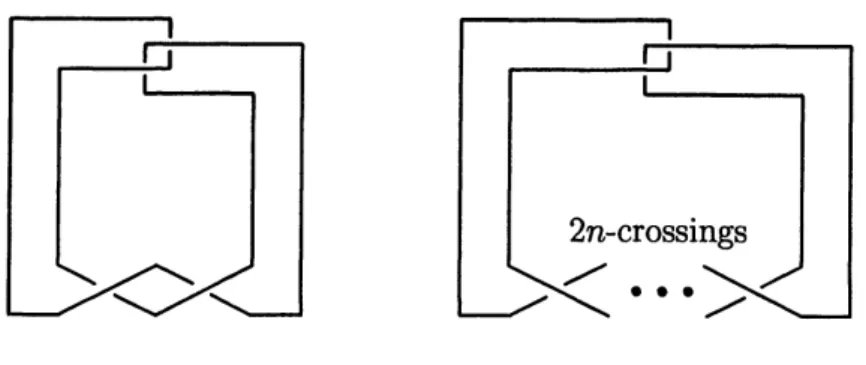
FIGURE 1. The figure eight knot $J(2, -2)$ and $J(2,2n)$
The above example shows the second coefficient of$\Delta_{K,\rho}(t)$ is
zero
for every irreduciblerepresentationofthetrefoilknot. Thisis not
an
accident and infactwe
have thefollowing:Claim 2.4. For any $\hat{\rho}\in\hat{R}$
of
$K=T_{2,q}$, the secondcoefficient
of
$\Delta_{K,\rho}(t)$ is zero. $In$particular, it is zero
for
everypambolic representation.Proof.
When$p=2$, the twisted Alexander polynomial of $K=T_{2,q}$ is given by $\Delta_{K,\rho}(t)=(t^{2}+1)\prod_{0<j<q,j:odd,j\neq b}(t^{2}-\xi_{j})(t^{2}-\overline{\xi}_{j})$for$\hat{\rho}\in\hat{R}_{1,b}$, where $\xi_{j}=\exp(\sqrt{-1}\pi j/q)$
.
Namely $\triangle_{K,\rho}(t)$ is a polynomial in $t^{2}$ and hence$\Delta_{K,\rho}(t)$ has onlyeven degree terms. Therefore the second coefficient of$\triangle_{K,\rho}(t)$ is zerofor
any irreducible $SL(2, \mathbb{C})$-representation. $\square$
Arepresentation$\rho:G(K)arrow SL(2, \mathbb{C})$ is calledmetabelian ifthe commutatorsubgroup
of $G(K)$ is sent to
an
abelian subgroup in $SL(2, \mathbb{C})$ by $\rho$.
As shown in [12], the twistedAlexander polynomial associated to
an
irreducible metabelian representation $\rho$ satisfies$\Delta_{K,\rho}(-t)=\Delta_{K,\rho}(t)$ and hence it has only even degree terms. Since $T_{2,q}$ is a 2-bridge
knot, every component $\hat{R}_{1,b}$ ($0<b<q$ and $b$is odd) contains
an
irreducible metabelianrepresentation (see [4, Lemma 4.7]). Moreover each coefficient of $\Delta_{K,\rho}(t)$ is
a
locallyconstant function
on
$\hat{R}$,
so
that Claim 2.4 also follows from these facts.Remark2.5. Ifacomponent$\hat{R}_{a,b}$contains
an
irreduciblemetabelian representation,thenby Remark 2.2, there is a parabolic representation $\hat{\rho}\in\hat{R}_{a,b}$ so that the second coefficient
of $\Delta_{K,\rho}(t)$ is zero. However, in general, some component may contain no irreducible
metabelianrepresentation.
2.2. Twist knots. Let $K=J(\pm 2, k)$ be the twist knot $(k\in \mathbb{Z})$
.
It is known that$J(\pm 2,2n+1)$ is equivalent to $J(\mp 2,2n)$ and $J(\pm 2, k)$ is the mirror image of $J(\mp 2, -k)$
.
Hence we only consider the
case
where $K=J(2,2n)$ for $n\in \mathbb{Z}$ (see Figure 1). The knot $J(2,0)$ presents the trivial knot, so that we alwaysassume
$n\neq 0$.
The typical examplesare
the trefoil knot $J(2,2)$ and thefigure eight knot $J(2, -2)$.
The Alexander polynomial of$K=J(2,2n)$ is given by $\Delta_{K}(t)=n-(2n-1)t+nt^{2}.$
Since the twist knots are 2-bridge knots, $J(2,2n)$ is fibered if and only if $|n|=1$
.
It isalso known that $J(2,2n)$ is hyperbolic if$n\not\in\{0,1\}.$
The knot group $G(J(2,2n))$ has the presentation (see [2]):
where $w=[y, x^{-1}]$. Suppose that $\rho$ : $G(J(2,2n))arrow SL(2, \mathbb{C})$ is a parabolic
representa-tion. After conjugating, if necessary, we may assume that for a complex number $u$
$\rho(x)=(\begin{array}{ll}1 10 1\end{array})$ and $\rho(y)=(\begin{array}{ll}1 0-u 1\end{array}).$
It isknownthat$\rho$defines arepresentationwhen$u$satisfies $\phi_{n}(u)=0$(see [9, Theorem2]),
where
$\phi_{n}(u)=(1-u)\frac{\lambda_{+}^{n}-\lambda^{\underline{n}}}{\lambda_{+}-\lambda_{-}}-\frac{\lambda_{+}^{n-1}-\lambda^{\underline{n}-1}}{\lambda_{+}-\lambda_{-}}$, and $\lambda_{\pm}(u)=\frac{u^{2}+2\pm\sqrt{u^{4}+4u^{2}}}{2}$
denote theeigenvaluesof the matrix$\rho(w)$
.
Wecall$\phi_{n}(u)$ the Riley polynomialof the twistknot $J(2,2n)$. See also [7, Proposition 3.1] forthe above formula of$\phi_{n}(u)$. Ofcourse, the
holonomy representation $\rho_{0}$ corresponds to
one
of the roots of $\phi_{n}(u)=0$ if $n\not\in\{0,1\}.$Example 2.6. We can easily check that $\phi_{1}(u)=1-u,$ $\phi_{-1}(u)=1+u+u^{2},$ $\phi_{2}(u)=$
$1-2u+u^{2}-u^{3},$ $\phi_{-2}(u)=1+2u+3u^{2}+u^{3}+u^{4}$ and $\phi_{3}(u)=1-3u+3u^{2}-4u^{3}+u^{4}-u^{5}.$
In general the Riley polynomial $\phi_{n}(u)$ satisfies the following:
(a) $\phi_{n}(u)\in \mathbb{Z}[u]$ isirreducible and its highest coefficient is $\pm 1.$
(b) $\deg\phi_{n}(u)=2|n|$ -max{sign(n),$0$
}.
For a parabolic representation $\rho$ : $G(K)arrow SL(2, \mathbb{C})$ of the twist knot $K=J(2,2n)$,
the twisted Alexander polynomial $\triangle_{K,\rho}(t)$ is given by
$\triangle_{K,\rho}(t)=\alpha\beta+\{\alpha+\beta-2\alpha\beta+\frac{\lambda_{+}-\lambda_{-}}{2+\lambda_{+}+\lambda_{-}}(\alpha-\beta)\}t+\alpha\beta t^{2},$
where $\alpha=1+\lambda_{+}+\lambda_{+}^{2}+\cdots+\lambda_{+}^{n-1}$ and $\beta=1+\lambda_{-}+\lambda^{\underline{2}}+\cdots+\lambda_{-}^{n-1}$ (see [7, Theorem 4.1]).
Example 2.7. For the figure eight knot $K=J(2, -2)$, we can easily check that there
are
twoparabolic representations correspondingto $u=(-1\pm\sqrt{-3})/2$up to conjugation.Wethen obtain $\triangle_{K,\rho}(t)=1-4t+t^{2}$ for both ofthem.
Let $\delta_{n}(u)$ be the second coefficient of $\Delta_{K,\rho}(t)$
.
Aswe
saw
in Examples2.3
and 2.7, $\delta_{\pm 1}(u)$are
integers for the fibered twist knots $J(2, \pm 2)$.
Next we consider the nonfibered
case.
As stated in [8, Remark 3.3], $\delta_{n}(u)\in \mathbb{Z}[u]$ and$\deg\delta_{n}(u)=2n-4$ for $n\geq 2$. First we check the degree of $\delta_{n}(u)$. Let $\tau_{n}(u)=$ tr$\rho(w^{n})=$
$\lambda_{+}^{n}+\lambda^{\underline{n}}$
.
Easy calculations show that$\alpha+\beta=(1+\lambda_{+}+\lambda_{+}^{2}+\cdots+\lambda_{+}^{n-1})+(1+\lambda_{-}+\lambda_{-}^{2}+\cdots+\lambda^{\underline{n}-1})$ $=2+\tau_{1}+\tau_{2}+\cdots+\tau_{n-2}+\tau_{n-1},$ $\alpha-\beta=(1+\lambda_{+}+\lambda_{+}^{2}+\cdots+\lambda_{+}^{n-1})-(1+\lambda_{-}+\lambda_{-}^{2}+\cdots+\lambda_{-}^{n-1})$ $=(\lambda_{+}-\lambda_{-})\{1+(\lambda_{+}+\lambda_{-})+(\lambda_{+}^{2}+1+\lambda_{-}^{2})+(\lambda_{+}^{3}+\lambda_{+}+\lambda_{-}+\lambda_{-}^{3})+\cdots\}$ $=(\lambda_{+}-\lambda_{-})\{1+\tau_{1}+(\tau_{2}+1)+(\tau_{3}+\tau_{1})+\cdots+(\tau_{n-2}+\tau_{n-4}+\cdots)\},$ $\alpha\beta=(1+\lambda_{+}+\lambda_{+}^{2}+\cdots+\lambda_{+}^{n-1})(1+\lambda_{-}+\lambda_{-}^{2}+\cdots+\lambda_{-}^{n-1})$
Since $\lambda_{+}-\lambda_{-}=\sqrt{u^{4}+4u^{2}}$ and $2+\lambda_{+}+\lambda_{-}=u^{2}+4$, wehave
$\delta_{n}(u)=(2+\tau_{1}+\cdots+\tau_{n-1})-2$
{
$\tau_{n-1}+2\tau_{n-2}+(some$polynomial $in \tau_{1}, \ldots, \tau_{n-3})$}
$+u^{2}$
{
$\tau_{n-2}+$ $(some$polynomial $in \tau_{1}, \ldots, \tau_{n-3})$}
$=-\tau_{n-1}-(3-u^{2})\tau_{n-2}+(some$ polynomial $in \tau_{1}, \ldots, \tau_{n-3})$
.
Now
as
shown in [7, Corollary 4.3], $\tau_{n}$ is given by$\tau_{n}=\frac{1}{2|n|-1} \sum_{\dot{o},0<\leq|n|,|n|arrow;even}(\begin{array}{l}|n|j\end{array})\tau_{1^{j}}(\tau_{1^{2}}-4)^{L^{n}\perp_{2}-\lrcorner}$
$=\tau_{1^{n}}+(some$ polynomial $in \tau_{1^{n-2}}, \tau_{1^{n-4}}, \ldots)$
and $\tau_{n}(u)=\tau_{-n}(u)\in \mathbb{Z}[u]$ is amonic polynomial of degree $2|n|$
.
Since $\tau_{1^{n}}=(u^{2}+2)^{n}=$$u^{2n}+2nu^{2n-2}+\cdots+2^{n}$, we have
$-\tau_{n-1}-(3-u^{2})\tau_{n-2}=-(u^{2(n-1)}+2(n-1)u^{2(n-1)-2}+\cdots)$
$-(3-u^{2})(u^{2(n-2)}+2(n-2)u^{2(n-2)-2}+\cdots)$ $=-5u^{2n-4}+$ (lower degree terms)
and hence $\deg\delta_{n}(u)=2n-4(n\geq 2)$
.
If$\delta_{n}(u)=\frac{l}{m}\in \mathbb{Q}$ for a parabolic representation corresponding to a root of $\phi_{n}(u)=0,$
then $\phi_{n}(u)$ divides $m\delta_{n}(u)-l$, because of the property (a) of the Riley polynomial $\phi_{n}(u)$
.
However this contradicts the fact that
$\deg\phi_{n}(u)=2|n|$ –max{sign(n),$0$
}
$>2n-4=\deg\delta_{n}(u)$.
Therefore we can conclude that $\delta_{n}(u)$ with $n\geq 3$ is not a rational number for every
parabolic representation.
A similar argument can be applied to the case of $J(2,2n)$ with $n\leq-2$
.
In thiscase
$\alpha+\beta$ and $\alpha\beta$ are the same as that of $n\geq 2$, but $\alpha-\beta$ changes to the opposite $sign.$
Hence
we
obtain$\delta_{n}(u)=(2+\tau_{1}+\cdots+\tau_{n-1})-2$
{
$\tau_{n-1}+2\tau_{n-2}+(some$ polynomial $in \tau_{1}, \ldots, \tau_{n-3})$}
$-u^{2}$
{
$\tau_{n-2}+$ $(some$ polynomial $in \tau_{1}, \ldots, \tau_{n-3})$}
$=-\tau_{n-1}-(3+u^{2})\tau_{n-2}+(some$ polynomial $in \tau_{1}, \ldots, \tau_{n-3})$
$=-2u^{2|n|-2}+$ (lower degree terms)
and $\deg\delta_{n}(u)=2|n|-2$
.
Therefore $\delta_{n}(u)$ is not a rational number for $n\leq-2.$Finally we consider the nonfibered hyperbolic knot $K=J(2,4)$. In this case we can
easilycheck that $\alpha+\beta=u^{2}+4,$ $\alpha-\beta=\sqrt{u^{4}+4u^{2}}$ and $\alpha\beta=u^{2}+4$. Hence we have
$\delta_{2}(u)=(u^{2}+4)-2(u^{2}+4)+\frac{\sqrt{u^{4}+4u^{2}}}{u^{2}+4}\cdot\sqrt{u^{4}+4u^{2}}=-4$
and$\Delta_{K,\rho}(t)=(u^{2}+4)-4t+(u^{2}+4)t^{2}$ for every parabohc representation. In particular,
we see that the second coefficient $\delta_{2}(u)$ is
an
integer for the holonomy representation $\rho_{0}:G(J(2,4))arrow SL(2, \mathbb{C})$.
Acknowledgements. This research was partially supported by Grant-in-Aid for Scientific
Research (No. 23540076), the Ministry of Education, Culture, Sports, Science and Tech-nology, Japan.
REFERENCES
[1] N. Dunfield, S. Friedl and N. Jackson, Twisted Alexanderpolynomials ofhyperbolic knots,
Experi-ment. Math. 21 (2012),329-352.
[2] J. Hoste and P. D. Shanahan, Tracefields oftwist knots, J. Knot TheoryRamifications 10 (2001),
625-639.
[3] D. Johnson, $A$ geometric
form of
Casson’s invariant and its connection to Reidemeister torsion,unpublished lecture notes.
[4] T. Kim and T. Morifuji, Tutsted Alexander polynomials and chamcter varieties of2-bridge knot
groups, Intemat. J. Math. 23 (2012), 1250022, 24 pp.
[5] T. Kitano and T. Morifuji, Twisted Alexanderpolynomialsfor irreducible $SL(2, \mathbb{C})$-representations
oftorus knots, Ann. Sc. Norm. Super. Pisa Cl. Sci. (5) 11 (2012), 395-406.
[6] $X$.-S. Lin, Representations ofknot groups and twisted Alexanderpolynomials,Acta Math. Sin. (Engl.
Ser.) 17 (2001), 361-380.
[7] T. Morifuji, Twisted Alexanderpolynomials oftwist knotsfornonabelian representations, Bull. Sci.
Math. 132 (2008), 439-453.
[8] T. Morifuji, On a conjecture ofDunfield, $Fk\iota edl$ and Jackson, C. R. Acad. Sci. Paris, Ser I 350
(2012), 921-924.
[9] R. Riley, Pambolic representationsofknot groups, $I$, Proc. London Math. Soc. (3) 24 (1972),
217-242.
[10] W. Thurston, Three-dimensionalgeometry and topology, Vol. 1, volume35of Princeton Mathematical
Series, PrincetonUniversity Press, Princeton, $NJ$, 1997. EditedbySilvioLevy.
[il] M.Wada, TwistedAlexanderpolynomialforfinitely presentablegroups, Topology 33 (1994),241-256.
[12] Y. Yamaguchi, On the twisted Alexander polynomial for metabelian represetations into $SL_{2}(\mathbb{C})$,
arXiv:1101.3989.
DEPARTMENT OF MATHEMATICS, HIYOSHI CAMPUS, KEIO UNIVERSITY, YOKOHAMA 223-8521,
JAPAN