A Viral
Infection
Model with Saturating
Expansion and Immune
Impairment*
Zhiping
Wang
a,
Xianning
Liu
a,b,\daggera School
of
Mathematics andStatlstics, Southwest University, Chongqing 400715, Chinab Department
of
SystemsEngineering, Shizuoka University, Hamamatsu, 432-856l, JapanAbstract
The paperconsiders aviral infection model withsaturatingexpansionandimmune
impairment. The model may exhibit a bistable behavior in some parameter regions,
which
means
that infection will result in diseaseorimmune controloutcome, dependingon the initial conditions. It is shown that the disease could change from a diseaee
progression and tend toan immune $CO1^{-}itro1$outcome ifsomephase ofdrugtherapy is
introduced, despitethat thetherapy is not necessarily lifelong.
Keywords: Virusdynamics; Immuneimpairment; Immune control;Stability;
Perma-nence.
1
Introduction
Many models have been proposed to describe virus dynamics in different situations. In
virus dynamics
we
usually examine which conditionsare
necessary for virus increasingor
decreasing. This is important for studying the evolutionary process of disease and
can
bedescribed
well with models of differentialequations.Taking immune response into consideration, Nowak and May [1] presented several basic
models, which differ mainly in terms of describing the expansion of the immmune response.
It is true that virus infections typically evoke immune responses composed of antibodies
and $CD8+cytotoxicT$ cels, but several human pathgens have the ability to suppress
im-mune
responses, allowingthemselves to establisha
persistent and productive infection thateventually results in pathology. A potent strategy is to impair virus-specific CD4 $T$ helper
cell responses (directly
or
indirectly), because theyare
the centralcomponent orchestrating$Suppo$rted by the National NaturalScience Foundation ofChina (10571143).
antiviral effector mechanisms. According to clinical data, the most prominent examples of
this
are
HIV, hepatitis $C$ virus (HCV), and hepatitis $B$ virus (HBV) infections ([2, 3]).In this paper, based
on
the previous models and considering both antigenic stimulationand immune impairment,
we
introducea
vIralinfectionmodel, and then study its dynamics,especially the effect of immune impairment.
Let $x,$ $y,$$v$ and $z$ represent the concentration of susceptible cells, productively
infected
cells,
&ee
virus particles and virus-specific CTL cells, respectively. The following equationsrepresent the rate ofchangeofthese populations:
$\frac{dx}{dt}=\lambda-dx-\beta xv$,
$\frac{dy}{dt}=\beta xv-\delta y-pyz$,
$\frac{dv}{dt}=n\delta y-rv$,
(1.1)
$\frac{dz}{dt}=f(y, z)-bz$,
The constant $\lambda$ represents
a
source
of susceptible cells,and $d$ is their death rate. $\beta$ is
the infection rate constant, and infection is assumed to
occur
ata
rate proportional to theproduct of the concentration of virus and target cells,
an
assumption which is valid fora
well-mixed system with relatively high concentrations of each product. $\delta$ is the death rate
ofinfected cells, $p$ is the efficacy of the immune response in killing
infected
cells, $n$ is thenumber of free viral particles produced during the average infected cell life span, and $r$ is
the death rate of the ffee virus. The function $f(y, z)$ represents the increasing of immune
activity, and $b$ is the decay rate ofCTL cells.
Since the mechanism how immune cells
are
induced is largely unknown, thereare
many
forms
of$f(y, z)$ ([1]), suchas
$f(y, z)=c,$$f(y, z)=w$and
$f(y, z)=wz$ ,which describe
self-regulating CTL-reaction, linear immune response and bilinear CTL-reaction, respectively.
However, interactIons between two populations
are
not alwaysas
simpleas
these, and theform ofsuch expressions maychange, among other ways,
as
the relative and absolutepopu-lation sizes varying. Here,
we
take both antigenic stimulation and lmmune impairment intoconsideration, andconsider the followingform of$f(y, z)$:
$f(y,z)= \frac{cyz}{1+\epsilon y}-qyz$,
which ls
an
example in [7] for describing the dynamics of the populations of virus andis a saturating function of the amount of infected cells. The infected cells population also
inhibits the immune respomse at a rate $qyz$
.
Furthermore,
we
assume
that the turnover of freevirus ismuch faster than thatofinfectedcells (see [4]), and study
a
simplified system by assuming that $v$ ls ata
steady state givenby$\dot{v}=0$, whlch implies $v=n\delta y/r$
.
Let $k=\beta\delta n/r$, and theseas
sumptionslead to$\frac{dx}{dt}=\lambda-dx-kxy$
,
$\frac{dy}{dt}=kxy-\delta y-pyz$, (1.2)
$\frac{dz}{dt}=\frac{cyz}{1+\epsilon y}-qyz-bz$
.
Our purpose isto investigatethe effect of immune impairment via mathematical analysis of
(1.2). The equihbria and their stability
are
discussed in Section 2, and the pemanence ofthe system is given inSection 3. In the final section,
we
willdiscussour
results.2
Equilibria
and
their
stability
Firstly, from the epidemiological point ofview,
we
point out that there should besome
posItive
ranges
of$y$ such that $z’>0,$.
Therefore, from$\frac{w}{1+\epsilon y}-qy-b=\frac{-\epsilon qy^{2}+(c-\epsilon b-q)y-b}{1+\epsilon y}$,
we obtain that $c-\epsilon b-q>0$ and $(c-\epsilon b-q)^{2}-4b\epsilon q>0$ should always hold. Under this
assumption, there
are
two roots ofequation $cy/(1+\epsilon y)-qy-b=0$:$y_{1,2}^{*}= \frac{c-\epsilon b-q\mp\sqrt{(c-\epsilon b-q)^{2}-4b\epsilon q}}{2\epsilon q}$,
where $0<y_{1}^{l}<y_{2}^{*}$
.
Define$h(y) \Delta=(\frac{w}{1+\epsilon y}-qy-b)’=\frac{c}{(1+\epsilon y)^{2}}-q$,
then it is easyto check that $h(y_{1}^{*})>0$ and $h(y_{2}^{*})>0$
.
Furthemore, the basic reproductive ratio of the virus is given by $R_{0}=\lambda k/\delta d$, which
describes the average numberofnewly infected cells generated ffom
one
infected cel at theSystem (1.2) has four equilibria. The first
one
is $E_{0}=(x_{0},0,0)=(\lambda/d, 0,0)$, and itrepresents the state in which there is no infection and
no
immune response. The second is$E_{1}=(x_{1}, y_{1},0)=( \frac{\delta}{k}, \frac{\lambda}{\delta}-\frac{d}{k}, 0)=(\frac{\delta}{k}, \frac{d}{k}(R_{0}-1),$ $0$),
which has epidemiological meaning if $R_{0}>1$
.
$E_{1}$ represents the state that the viruscan
establlsh an
infection in the absence ofImmune response. We will refer to itas
the virusequilibrium. The third is
$E:=(x_{1}^{*}, y_{1}^{l},z_{1}^{l})=( \frac{\lambda}{d+ky_{1}^{r}},y_{1}^{*}, \frac{kx_{1}^{*}-\delta}{p})$,
which lies in the Interior ofthe first quadrant if $R_{0}>1+ky_{1}^{*}/d$
.
$E_{1}^{*}$ is the state that thevirus
can
establishan
infection that is controlled byan
immune response,we
refer to thisoutcome
as
the Immunecontrol equilibrium. The last is$E_{2}^{*}=(x_{2}^{*}, y_{2}^{*}, z_{2}^{l})=( \frac{\lambda}{d+ky_{2}^{*}},y_{2}^{l}, \frac{kx_{2}^{*}-\delta}{p})$,
which lies in the interior of the first quadrant if $R_{0}>1+ky_{2}^{l}/d$
.
$E_{2}^{l}$ is always unstable(Theorem 2.4) and therefore it is epidemiologically irrelevant.
Now
we
will study the local and global stability of these equilibria, via the method ofLyapunov function and Routh-Hurwitz criterion.
Theorem 2.1. $E_{0}$ is globally asymptotically stable when $R_{0}<1$
.
Proof.
Definea
Lyapunov function,$V_{0}=x-x_{0}-x_{0} \ln\frac{x}{x_{0}}+y+\frac{pz}{c}$,
Along the trajectories ofsystem (1.2),
we
have$V_{0}’$ $=x’-\mathfrak{B}_{X’+y’+}xcz’$
$=$ $- \frac{1}{dx}(\lambda-dx)^{2}-\delta(1-R_{0})y-e_{\frac{z}{\epsilon}(\frac{2}{y}+qy+b)}1\mp\epsilon\propto\mu$
.
Thus $V_{0}’\leq 0$ when $R_{0}<1$, and
the
result follows from LaSalle’s invariance principle. $\square$Theorem 2.2. $E_{1}$ is globally asymptotically stable
if
$1<R_{0}<1+ky_{1}^{l}/d$, and is locallyProof.
Define a function,$V_{1}=(x-x_{1}-x_{1} \ln\frac{x}{x_{1}})+(y-y_{1}-y_{1}\bm{i}\frac{y}{y_{1}})+\frac{p}{h(y_{1}^{*})}z$
.
Along the trajectoriesof system (1.2),
we
have$V_{1}’$ $=\text{儒_{}xy\overline{h}(yi\overline{)}^{Z’}}’-\lrcorner x+y’y’+$
.
$=$ $- \frac{\lambda}{k\delta x}(\delta-kx)^{2}-\frac{1}{h(yi)}pz[h(y_{1}^{*})(y-y_{1})-(R-qy-b)]$
.
Let $g(y)=cy/(1+\epsilon y)-qy-b$, then $h(y)=g’(y)=c/(1+\epsilon y)^{2}-q$, and $g”(y)=-2c\epsilon/(1+$
$\epsilon y)^{3}<0$
.
Then by intemediate vdue $th\infty rem$, there is $\xi_{1}$ between $y$ and $y_{1}^{s}$ such that$g(y)=g(y)-g(y_{1}^{*})=h(y_{1}^{l})(y-y_{1}^{*})+ \frac{1}{2}g’’(\xi_{1})(y-y_{1}^{l})^{2}$. (2.1)
(a) If $1<R_{0}<1+ky_{1}^{*}/d$, whichis equivalent to $0<y_{1}<y_{1}^{*}$, from (2.1),
we
have$g(y)\leq h(y_{1}^{l})(y-y_{1}^{*})<h(y_{1}^{*})(y-y_{1})$,
for all $y>0$
.
Thus, $V_{1}’\leq 0$,
and therefore, $V_{1}$ isa
global Lyapunovfunction.(b) If $R_{0}>1+ky_{2}^{l}/d$, which is equivalent to$y_{1}>y_{2}^{*}$,
we
have$g(y)<h(y_{1}^{*})(y-y_{1})$ (2.2)
for $y>y_{1}$, since $g(y)<0$, but $h(yi)(y-y_{1})>0$
.
It is clear that (2.2) $stiU$ holds forall $y>y_{1}-\xi_{2}$, where $\xi_{2}>0$ is sufficiently small. Thus, $V_{1}’\leq 0$, and therefore, $V_{1}$ is
a
localLyapunovfunction
near
$E_{1}$.
The result follows from LaSalle’s invariance principle. 口
Theorem 2.3. $E_{1}^{*}$ is locally asymptotically stable
if
it $e$zis$ts$.
Proof.
The characteristic equation of the Jacobin matrix at $E_{1}^{*}$ is$s^{3}+a_{1}s^{2}+a_{2}s+a_{3}=0$, (2.3) where $a_{1}=d+ky_{1}^{t}>0$, $a_{2}=py_{1}^{l}z_{1}^{*}h(y_{1}^{l})+k^{2}y_{1}^{l}x_{1}^{*}$, $a_{3}=py_{1}^{l}z_{1}^{*}h(y_{1}^{*})(d+ky_{1}^{*})>0$, $a_{1}a_{2}-a_{3}=k^{2}y_{1}^{l}x_{1}^{*}(d+ky_{1}^{l})>0$
.
The result followsfrom Routh-Hurwitz criterion. $\square$
The stability of the last equilibrium ls given in the following theorem without proof,
because it is similarto the above one, except that $h(y_{2}^{*})<0$
.
3
Permanence
Firstly,
we
showthat system (1.2) is unlformly bounded above.Theorem 3.1. There $ex\dot{j}sts$
an
$M>0$ such that all the solutionsof
system (1.2) satisfy$x(t),y(t),$$z(t)\leq M$
for
all large $t$.
Proof.
It iseasy
to check that all solutions of (1.2)are
nonnegative for $t>0$.
Furthemore,we
have$x’+y’+\epsilon_{t}c$ $=\lambda-dx-\delta y-pyz+_{c}z(1\ovalbox{\tt\small REJECT}_{\frac{z}{\epsilon y}}+-qyz-bz)$ $\leq\lambda-\alpha(x+y+_{c}zz)$,
where $\alpha=\min\{d, \delta, b\}$
.
Hence by comparison $th\infty ry$ of differential equations, it is easy toverifythat there exists$t_{1}>0$ such that$x(t)+y(t)+pz(t)/c \leq M=A\max\{1, c/p\}\lambda/\alpha+\epsilon_{0},t>$
$t_{1}$ for$\epsilon_{0}>0$
.
The proof is $\infty mplete$.
$\square$Theorem
3.2.
If
$1+ky_{1}^{*}/d<R_{0}<1+ky_{2}^{*}/d$,
then system (1.2) is uniformlypersis-tent, i.e., there exists
an
$\epsilon>0$ such that $\lim\inf_{tarrow+\infty}x(t)\geq\epsilon$,$\lim\inf_{tarrow+\infty}y(t)\geq\epsilon$, and$\lim\inf_{tarrow+\infty}z(t)\geq\epsilon$
.
Proof
By Theorem 3.1, there existsan
$M>0$ such that $y(t)<M$ for all $t>t_{1}$, Thuswe
have
$x’=\lambda-dx-kxy\geq\lambda-(d+kM)x$,
for all $t>t_{1}$, and the result for $x$ follows immediately. Therefore, it suffices to prove that
$\lim\inf_{tarrow+\infty}y(t)\geq\epsilon$, and$\lim\inf_{tarrow+\infty}z(t)\geq\epsilon$, which follows from
an
applicatlonofTheorem4.6
in [5], with$X_{1}=int(R_{+}^{3})$ and $X_{2}=bd(R_{+}^{3})$.
The left of the proofisto verify that$E_{0}$ and$E_{1}$
are
weak repellers for $X_{1}$, andwe
omit ithere
since it is similar to that of [6, Theorem3.2]. $\square$
Theorems 3.1 and 3.2 imply that (1.2) is permanent provided that $1+ky_{1}^{\wedge}/d<R_{0}<$
$1+ky2/d$
.
Fbom the results in Sections 2 and 3,
we
can
summarize the stability of the equilibriaTable 1: The stability of the equilibria and the behaviors of system (1.2). Here $R_{1}=1-$}$-$
$ky_{1}^{*}/d,$ $R_{2}=1+\cdot ky_{2}^{*}/d$
.
:GAS’, ‘LAS’, ‘US’ and ‘-, represent that the equilibrium is globallyasymptotically stable, locally asymptotically stable, unstable and nonexistent, respectively.
4
Discussion
As what Komarova et al. [7] suggested, $E_{1}$ describes the failure of long-temcontrol in
the model and
can
correspond toan
in vivo scenario where suboptimal immune responsesare
temporarily maintained and subsequently collapse. Such suboptimal responses are notexplicitly
included
inthemodel
butcan
be assumed to be implicitinparametersdeterminingvirus load (such
as
the replication rate and the death rate). Touse
specific examples,the immune control outcome $(E_{1}^{*})$ in the model
can
correspond to the state of long-temnonprogression InHIV infection ([8]), whereas failure of long-term controlin the model $(E_{1})$
corresponds to typical HIV disease progression. A similar difference
can
beseen
in HCVinfection:
a
small fraction of patients control the virus (or clear virus from blood) andestablIsh long-temimmunity $(E_{1}^{*})$, whereas most patlents fail to do
so
and eventually maydevelop disease $(E_{1})$ ([9]).
We seek to understand the stability of these equilibria
as
$R_{0}$ increases fromlow to high,because it is influencedby drug therapy. These results suggest that
(i) If $R_{0}$ is
very
smail, the virus cannot infect the host, and the systemconverges
to $E_{0}$.
(ii) If$R_{0}$
crosses
a threshold,an
infectioncan
be established, but the amount of antigenicstimulation is too lowto trlgger sustained immunity. The systemconverges to $E_{1}$
.
(iii) If$R_{0}$ is higher and
crosses
another threshold, levels ofantigenare
sufficient to triggersustained immunity. The system converges to the equilibrium describing long-tem
immunological control, $E_{1}^{*}$
.
(iv) If $R_{0}$ is still higher and
crosses
a
final threshold, the immune responsecan
bevirus equilibrium $(E_{1})$
are
stable, and the outcome of infection dependson
the initialconditions.
Now
we
assume
that the patient is inthebistable parameterregion (iv). Thus, infectionwill result in disease
or
immune control outcome, dependingon
the lnitial condltions, i.e., which region does $(x(O),y(O),$$z(O))$ belong to, the basin of attraction for $E_{1}$or
$E_{1}^{*}$?How-ever, the model suggests that therapeutic intervention may shift the dynamics toward the
immune control outcome. During therapy, $R_{0}$ is reduced in the model and the amount of
reductlon corresponds to the efficacy of the drugs. On cessation of therapy, $R_{0}$ is reset to
its pretreatment value. Iftherapy is efficient enough to reduce $R_{0}$ at least fromparameter
region (iv) to region (iii), then after
one
phase (or several phases) of therapy, the systemmay enter the basin of attraction for $E_{1}$
.
Then the therapy could be stopped, since $R_{0}$ hasbeen reset to region (iv), thus the system may result in the immune control outcome, $E_{1}^{l}$
.
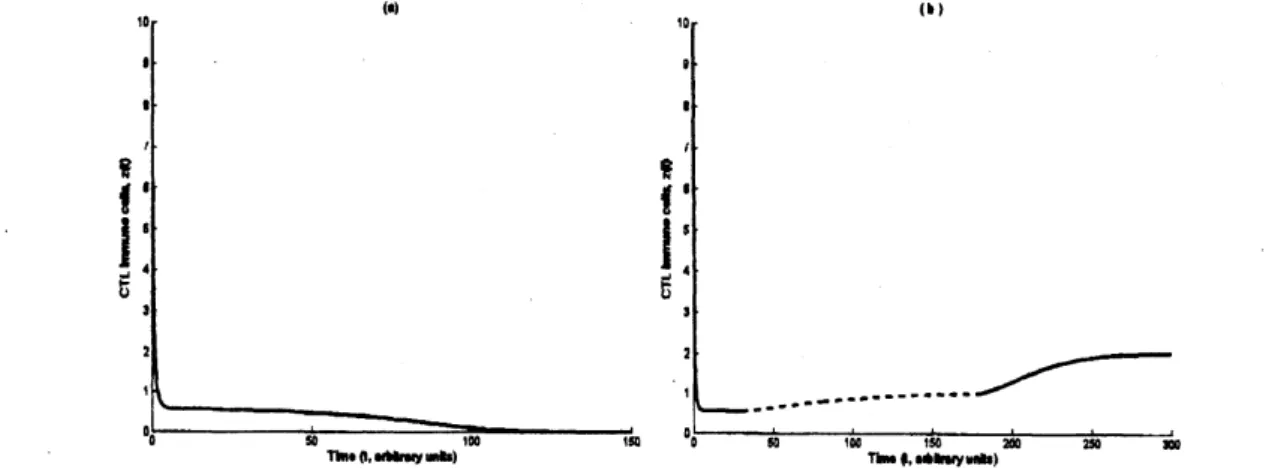
Figure 1: Timeseriesof$z$. The phaseoftreatment is indicatedby dash line. (a)Withouttherapy,
$z(t)$ tendsto zero. (b) After a phase of therapy, which begins at $t=30$, the system will tend to
inimune control outcome, although the treatment has $l$)$eer\iota$ stopped at $l=180$
.
Parameter valuesare chosen $a8$ follows: $\lambda=1,$$d–0.05.k-0.5,p_{-}--0.3,$$c-0.6,\epsilon--0.5_{r}.q--0.2,$b—-0.2,$\delta--0.3$
.
During therapy, $\delta--\cdot 0.6$
.
An simulation is shown in Fig. 1. The initial values ofthe two trajectories
are
thesame
(20, 10, 10), butthere is
a
phaseof therapy (from $t=30$ to 180) inthe rightone.
Theresultsare
obviously different, i.e., the phase of the therapy leads toan
immunological control,instead of the disease outcome in the left
one.
Theoretically, the optImal timing of when therapy should be stopped $and/or$ restarted
Finally,
we
point out that the bistable behavior as described inthis paper hinges ontheassumption that the virus impairs specific immune responses. Therapy
can
therefore shiftthe patient from
a
diseaseprogressiontoacontrol outcome. With viruses that donot impairimmunity, there is
no
bistability.References
[1] Nowak M. A., May R. M., Virus dynamics: Mathematical principles of immunology and
virology, Oxford: Oxford UniversityPress, NewYork, 2000.
[2] Lechner F., WongD. K., DunbarP. R., Chapman R., ChungR. T., Dohrenwend P., Robbins
G., Phillips R., Klenerman P., Walker, B. D., Analysis ofsuccessful immune responses in
persons infected with hepatitis $C$ virus, J. $Exp$
.
Med. 191 (2000) 1499-1512.[3] Lohr H. F., Krug S., Herr W., Weyer S., Schlaak J., Wolfel T., Gerken G., Meyer zum
Buschenfelde K. H., Quantitative and functional analysis ofcore-speciflc T-helpercell and
CTL activities in acute and chronic hepatitis$B$, Liver 18 (1998) 405-413.
[4] Wodarz D., Christensen J. P., Thomsen A.R., The importance oflyticand
nonlfiic
immuneresponses in viral infection, TRENDS in Immunology 23 (2002) 194-200.
[5] Thieme H. R., Persistence underrelaxed point-dissipativity (with applicationtoan endemic
model), SIAM J. Math.Anal. 24 (1993) 407-435.
[6] Liu X., Takeuchi Y., Spreadofdisease with transport-related infection and entryscreening,
J. Theor. Biol. 242 (2006) 517-528.
[7] KomarovaN.L., Barnes E., KlenermanP., Wodarz D., Boostingimmunity by antiviraldrag
therapy: Asimple relationship among timing, efficacy, and success, Immunology 100 (203)
1855-1860.
[8] Harrer T.,Harrer E., Kalams S.A., ElbeikT., StapransS. I., Feinberg M.B., CaoY.,Ho D.
D., Yilma T., CaliendoA. M., et al., Strongcytotoxic$T$ cell and weak neutralizing antibody
responses in a subset of persons with stable non-progressingHIVtype1 infection, AIDSRes.
Hum. Retroviruses 12 (1996) 585-592.
[9] Lechner F., Gruener N. H., Urbani S., Uggeri J., Santantonio T., Kammer A. R., Cerny
A., Phillips R., Ferrari C., Pape G. R., Klenerman P., $CD8+T$ lymphocyte responses are
inducedduring acute hepatitis $C$ virus infection but are not sustained, Eur. J. Immunol. 30