The
Elliptic Representation
of the
Painleve’
6Equation
Davide Guzzetti –RIMS
1Introduction
We review
our
results, tobe found in [10] [11],on
theellipticrepresentation of the sixth Painleve’equation$\frac{d^{2}y}{dx^{2}}=\frac{1}{2}[\frac{1}{y}+\frac{1}{y-1}+\frac{1}{y-x}](\frac{dy}{dx})^{2}-[\frac{1}{x}+\frac{1}{x-1}+\frac{1}{y-x}]\frac{dy}{dx}$
$+ \frac{y(y-1)(y-x)}{x^{2}(x-1)^{2}}[\alpha+\beta\frac{x}{y^{2}}+\gamma\frac{x-1}{(y-1)^{2}}+\delta\frac{x(x-1)}{(y-x)^{2}}]$, (PVI).
Though the elliptic representation of PVI has been known since R.Fuchs [7], in the literature there is
no
general study of its analytic implications. To fill this gaP,we
studied in [11] the analytic propertiesof the solutions in ellipticrepresentationfor $\mathrm{a}11$
(
values of$\alpha$,$\beta,\gamma$,$\delta$ and
we
derived their critical behaviorcloseto the singular points $x=0$, 1,$\infty$
.
Moreover,we
solved the connection problem for generic valuesof$\alpha$,$\beta$,$\gamma$,
$\delta$ and in [10] for the special (non-generic)
case
$\beta$$=\gamma=1-2\delta=0$, which is important in 2-Dtopological fieldtheory.
The first analytical problem with Painleve’ equations is to determine the critical behavior of the
transcendents
at the critical points$x=0$,
1,$\infty$.
Such abehavior must dependon
twoparameters,whichare
integration constants. The second problem, called connection problem, is to find the relation betweenthe couples of parameters at different critical points. The method of isomonodromic
deformations
developed in [14] [15]
was
applied to the Painleve’ 6equation in [13], to solve such problems for aclassof solutions of PVI with generic values of the parameters. The non-generic
case
$\beta=\gamma=1-2\delta=0$ isstudiedin [6] [19] [10] forits applicationstotopological fieldtheory. Studies
on
thecritical behaviorcan
be also foundin [25].
Here
we
show that the elliptic representation is avaluable tool to study the critical behavior ofthe Painleve’ 6transcendents. In [10] [11]
we
obtained results which include the results of [13] [6]and extend the class of solutions to which they aPPly. On the other hand,
we
needed touse
theisomonodromic deformation theory to solve the connection problem, to be formulated below, for the
elliptic representation.
The elliptic representation
was
introduced by P. Painleve’in [22] and R. Fuchs in [7]. Let$\mathcal{L}:=x(1-x)\frac{d^{2}}{dx^{2}}+(1-2x)\frac{d}{dx}-\frac{1}{4}$
.
bealinear differential operator and let$\wp(z;\omega_{1}, \omega_{2})$ be theWeierstrass elliptic function of theindependent
variable $z\in \mathrm{P}^{1}$, with half-periods
$\omega_{1}$, $\omega_{2}$
.
Letus
consider the following independent solutions of thehyper-geometric equation$\mathcal{L}\omega=0$:
$\{v_{1}(x):=\frac{\pi}{2}F(\frac{1}{2},$ $\frac{1}{2},1;x)$ , $\{v_{2}(x):=i\frac{\pi}{2}F(\frac{1}{2},$$\frac{1}{2},1;1-x)$ ,
where $F$$( \frac{1}{2}, \frac{1}{2},1;x)$ is thestandardnotation forthehyper-geometric function. Here$x$is in the universal
covering of $\mathrm{P}^{1}\backslash \{0,1, \infty\}$,
so
that at this stagewe
do not worry about the choice of branch-cuts. It isproved in [7] that the Painleve’ 6equation is equivalent to the following differential equation for
anew
function $u(x)$:
$\mathcal{L}(u)=\frac{1}{2x(1-x)}\frac{\partial}{\partial u}\{2\alpha[\wp(\frac{u}{2};\omega_{1},$$\omega_{2})+\frac{1+x}{3}]-2\beta,\frac{x}{\wp(\frac{u}{2}\cdot\omega_{1},(v_{2})+\frac{1+x}{3}}+$
$+2 \gamma\frac{1-x}{\wp(\frac{u}{2}-\omega_{1},\omega_{2})+\frac{x-2}{3}}+(1-2\delta)\frac{x(1-x)}{\wp(\frac{u}{2}-\omega_{1},\omega_{2})+\frac{1-2x}{3}}\}$ (1)
数理解析研究所講究録 1296 巻 2002 年 112-123
The connection to Painleve’ 6is given by the following representation of the transcendents:
$y(x)= \wp(\frac{u(x)}{2};\omega_{1}(x),$$\omega_{2}(x))+\frac{1+x}{3}$.
The algebraic-geometrical properties of the elliptic representations where studied in [18].
Nev-ertheless, the analytic properties of the function $u(x)$
were
not studied, except for the specialcase
$\alpha=\beta=\gamma=1-2\delta=0$
.
In thiscase
the function $u(x)$ is alinear combination of$\omega_{1}$ and$\omega_{2}$.
Thiscase
was
well known to Picard [23], and the critical behaviorwas
studied in [19].In [11],
we
studied the analytic properties of $u(x)$ for any value of $\alpha$,$\beta$,$\gamma$,
$\delta$
.
As aresult, givena
Painleve 6equationspecified by achoiceof$\alpha$,$\beta$,$\gamma$,
$\delta$,
we
found the criticalbehavior of its transcendentsbelonging to aclass whichcontainsalmostallpossiblesolutionsoftheequation. Themeaning of “almost”
will be clear later. Atranscendent in the class vanishes
as
$x$ (asas
variable in the universal coveringof$\mathrm{P}^{1}\backslash \{0,1, \infty\})$ approaches acriticalpoint. Nevertheless, along
some
particular paths approaching thecritical point, the transcendent does not vanish: it has oscillatory behavior. Qualitatively speaking,
the oscillations
are
due to the existence of (movable) poles close to the particular paths havingan
accumulation point in thecritical point. In [10] we found analogous results for the special
case
$\beta=\gamma=$$1-2\delta=0$and $\alpha$
any
complex numberAs remarked above,
our
class of solutions include “almost” all transcendents, but thereare some
transcendents which
are
not singed out byour
method. This is for example thecase
of the Chazysolutions, whose critical behavior is different from
ours
(see [19]).2Our results
2.1
Local
Representation
The equation $L(u)=0$ has ageneral solution $u_{0}(x)=2\nu_{1}\omega_{1}(x)+2\nu_{2}\omega_{2}(x)$, $\nu_{1}$,$\nu_{2}\in \mathrm{C}$. We look for a
solution of(1)$\underline{\mathrm{o}\mathrm{f}}$the form $u(x)=2\nu_{1}\omega_{1}(x)+2\nu_{2}\omega_{2}(x)+2v(x)$, where$v(x)$ is aperturbation of$u\circ\cdot$ Let
$\mathrm{C}_{0}:=\mathrm{C}\backslash \{0\}$, $\mathrm{C}_{0}$ the universal covering and let
$0<r<1$
.
Wedefine the domains$D(r;\nu_{1}, \nu_{2}):=\{x\in\overline{\mathrm{C}_{0}}$ such that $|x|<r$, $| \frac{e^{-i\pi\nu_{1}}}{16^{1-\nu_{2}}}x^{1-\nu_{2}}|<r$,$| \frac{e^{i\pi\nu_{1}}}{16^{\nu_{2}}}x^{\nu\underline{\circ}}|<r\}$ (2)
$D_{0}(r):=\{x\in\overline{\mathrm{C}_{0}}$ such that $|x|<r\}$ (3)
We observe that the translations $\nu_{i}\mapsto\nu_{i}+2N_{i}$, $i=1,2$, $N_{i}\in \mathrm{Z}$ do not change atranscendent in the
elliptic representation
$y(x)= \wp(\nu_{1}\omega_{1}(x)+\nu_{2}\omega_{2}(x)+v(x);\omega_{1}(x),\omega_{2}(x))+\frac{1+x}{3}$
.
This is aconsequence ofthe periodicityofthepfunction. Therefore,
one can
take$0\leq\Re\nu_{i}<2$, $i=1,2$.
Nevertheless,
we
don’t need to suppose sucharange
explicitly. Only in thecase
$\Im 1\ =0$we
need tosupposethat $0\leq\nu_{2}<2$. Finally, let us introduce the following expansion:
$v(x; \nu_{1}, \nu_{2}):=\sum_{n\geq 1}a_{n}x^{n}+\sum_{n\geq 0,m\geq 1}b_{nm}x^{n}[e^{-i\pi\nu_{1}}(\frac{x}{16})^{1-\nu_{2}}]^{m}+\sum_{n\geq 0,m\geq 1}c_{nm}x^{n}[e^{i\pi\nu_{1}}(\frac{x}{16})^{\nu_{2}}]^{m}$ (4)
Theorem 1: Let $\nu_{1}$, $\nu_{2}$ be tetto complex numbers.
I) Forany complex $\nu_{1}$, $\nu_{2}$ such that$\Im\nu_{2}\neq 0$ there exist apositive number$r<1$ and
a
transcendent$\mathrm{y}(\mathrm{x})=\wp(\nu_{1}\omega_{1}(x)+\nu_{2}\omega_{2}(x)+\mathrm{u}(\mathrm{x})\nu_{1},$ $\nu_{2});\omega_{1}(x),\omega_{2}(x))+\frac{1+x}{3}$
such that$v(x;\nu_{1}, \nu_{2})$ is holomorphic in the domain$D(r;\nu_{1}, \nu_{2})$ and it is given by the expansion (4) which
is convergent in$D(r;\nu_{1}, \nu_{2})$
.
Thecoefficients
an, $b_{nm}$, $c_{nm}$, $i=1,2$,are
certain rationalfunctions of
$\nu_{2}$. Moreover, there exists
a
positive constant $M(\nu_{2})$ such that$|v(x; \nu_{1}, \nu_{2})|\leq M(\nu_{2})(|x|+|e^{-i\pi\nu_{1}}(\frac{x}{16})^{1-\nu\circ}\sim|+|e^{i\pi\nu_{1}}(\frac{x}{16})^{\nu_{2}}|)$ in $D(r;\nu_{1}, \nu_{2})$ (5)
II) For any complex $\nu_{1}$ and real $\nu_{2}$, with the constraint $0<\nu_{2}<1$ or $1<\nu_{2}<2$, there exists $a$
positive r $<1$ and a transcendent
$\mathrm{y}(\mathrm{x})=\wp(\nu_{1}\omega_{1}(x)+\mathrm{V}2\mathrm{U}2(\mathrm{x})+v(x;\nu_{1}, \nu_{2});\omega_{1}(x),$ $\omega_{2}(x))+\frac{1+x}{3}$,
if
$0<\nu_{2}<1$or
$\mathrm{y}(\mathrm{x})=\wp(\nu_{1}\omega_{1}(x)+\nu_{2}\omega_{2}(x)+v(x;-\nu_{1},2-\nu_{2});\omega_{1}(x),\omega_{2}(x))+\frac{1+x}{3}$,
if
$1<\nu_{2}<2$such that$v(x;\nu_{1}, \nu_{2})$ and$v(x;-\nu_{1},2-\nu_{2})$ are holomorphic in$D_{0}(r)$, with convergent expansion (4) and
bound (5) (for $1<\nu_{2}<2$ substitute$\nu_{1}\mapsto-\nu_{1}$, $\nu_{2}\mapsto 2-\nu_{2}$).
Note that in the theorem
$\nu_{2}\neq 0,1$
We stress that in
case
$\mathrm{I}\mathrm{I}$), if$\nu_{2}$ is greater that
2or
less then 0,we can
always make atranslation$\nu_{2}\mapsto\nu_{2}+2N$ to obtain $0<\nu_{2}<2$ (ontheotherhand, $\mathrm{i}\mathrm{f}-2N<\nu_{2}<2-2N$, theformulae of
case
$\mathrm{I}\mathrm{I}$)hold with the substitution $\nu_{2}\mapsto\nu_{2}+2N$). Note also that $\nu_{1}$ and $\nu_{2}$ Play asymmetric roles.
Observation 1: As aconsequence ofthe theorem, for any $N\in \mathrm{Z}$ and for any complex $\nu_{1}$,$\nu_{2}$ such that
$\propto s\nu_{2}\neq 0$, there exists $rN<1$ and atranscendent $y(x)=\wp(\nu_{1}\omega_{1}(x)+[\nu_{2}+2N]\omega_{2}(x)+v(x;\nu_{1},$$\nu_{2}+$
$2\mathrm{N})$;VO(r),$\omega_{2}(x))+\frac{1+x}{3}$ in $D(r;\nu_{1}, \nu_{2}+2N)$
.
By periodicity of the $\wp-$-functionwe
$\mathrm{r}\mathrm{e}$-write thetran-scendent
as
follows:$\mathrm{y}(\mathrm{x})=\wp(\nu_{1}\omega_{1}(x)+\mathrm{V}2\mathrm{U}2(\mathrm{x})+\mathrm{v}(\mathrm{x}]\nu_{1}, \nu_{2}+2N);\omega_{1}(x),\omega_{2}(x))+\frac{1+x}{3}$ in $D(r;\nu_{1}, \nu_{2}+2N)$
.
Moreover,
we
showed in [11] that ifatranscendent has the elliptic representation$y(x)=\wp(\nu_{1}\omega_{1}(x)+\nu_{2}\omega_{2}(x)+v(x;\nu_{1}, \nu_{2});\omega_{1}(x),$$\omega_{2}(x))+\frac{1+x}{3}$
in $D(r, \nu_{1}, \nu_{2})$ for
some
$\nu_{1}$,$\nu_{2}$, $\Im\nu_{2}\neq 0$, then for any integer$N$ there exists $\nu_{1}’$ (dependingon
$\nu_{1}$, $\nu_{2}$ and$N)$ such that the transcendent has also the representation
$\mathrm{y}(\mathrm{x})=\wp(\nu_{1}’\omega_{1}(x)+\mathrm{V}2\mathrm{U}2(\mathrm{x})+v(x;\nu_{1}, \nu_{2}+2N);\omega_{1}(x),\omega_{2}(x))+\frac{1+x}{3}$
in $\mathrm{V}(\mathrm{r}, \nu_{1}’, \nu_{2}+2N)$
.
$\nu_{1}’$can
be explicitly computed.Observation 2: Another
consequence
ofthe theorem is that for any complex $\nu_{1}$,$\nu_{2}$ such that $\Im\nu_{2}\neq 0$there exists $y(x)= \wp(-\nu_{1}\omega_{1}(x)+[2-\nu_{2}]\omega_{2}(x)+v(x;-\nu_{1},2-\nu_{2});\omega_{1}(x),\omega_{2}(x))+\frac{1+x}{3}$
.
Againwe
use
the fact that the pfunctionisperiodic w.r.t. $2\omega_{2}$ and it is
an
even
function. Therefore the transcendentbecomes
$y(x)=\wp(\nu_{1}\omega_{1}(x)+\nu_{2}\omega_{2}(x)-v(x;-\nu_{1}, 2-\nu_{2});\omega_{1}(x)$,$\omega_{2}(x))+\frac{1+x}{3}$, in $D(r;-\nu_{1},2-\nu_{2})$
Note that the series $-v(x;-\nu_{1},2-\nu_{2})$ is of the form
$\mathrm{I}$$a_{n}x^{n}+ \sum_{n\geq 0,m\geq 1}b_{nm}x^{n}[e^{-i\pi\nu_{1}}(\frac{x}{16})^{2-\nu_{2}}]m+\sum_{n\geq 0,m\geq 1}c_{nm}x^{n}[e^{i\pi\nu_{1}}(\frac{x}{16})^{\nu_{2}-1}]m$
where
we
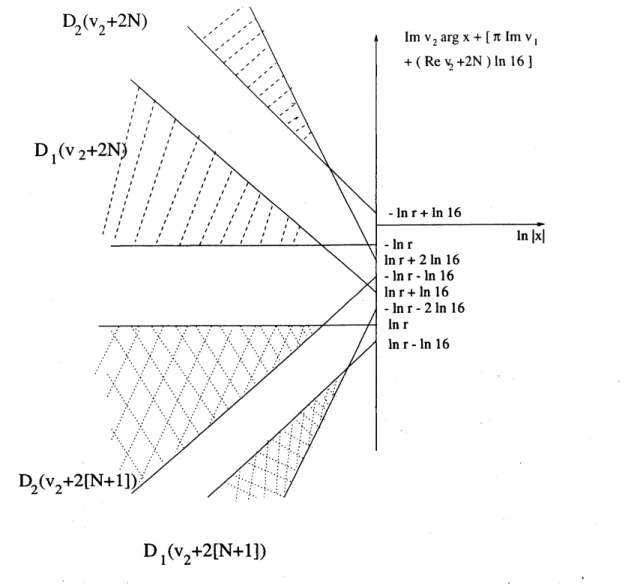
have $\mathrm{r}\mathrm{e}$-named the constants $a_{n}$,$b_{nm}$,$c_{nm}$.The domain $D(r_{N} ; \nu_{1}, \nu_{2}+2N)$
can
be writtenas
follows:$( \Re\nu_{2}+2N)\ln\frac{|x|}{16}-\pi s\nu_{1}\propto-\ln r_{N}<\propto s\nu_{2}\arg x<$
$<( \Re\nu_{2}-1+2N)\ln\frac{|x|}{16}-\pi s\nu_{1}\propto+\ln r_{N}$, $|x|<r_{N}$
$\mathrm{D}_{1}(\mathrm{v}_{2}+2[\mathrm{N}+1])$
Figure 1: Thedomains$D_{1}(r;\nu_{1}, \nu_{2}+2N):=D(r;\nu_{1}, \nu_{2}+2N)$,$D_{2}(r;\nu_{1}, \nu_{2}+2N):=D(r;-\nu_{1},2-\nu_{2}-2N)$
and $D_{1}(r;\nu_{1}, \nu_{2}+2[N+1])$, $D_{2}(r;\nu_{1}, \nu_{2}+2[N+1])$ for arbitrarily fixed values of $\nu_{1}$, $\mathrm{v}_{2}$, $N$
.
Theyare
represented in the plane $(\ln|x|, \Im\nu_{2}\arg x+[\pi\Im\nu_{1}+(\Re\nu_{2}+2N)\ln 16])$.
Therefore the domain $D(rN, -\nu 1,2-\nu 2-2N)$ is
$( \Re\nu_{2}-1+2N)\ln\frac{|x|}{16}-\pi s\nu_{1}\propto-\ln r_{N}<s^{\propto}\nu_{2}\arg x<$
$<( \Re\nu_{2}-2+2N)\ln\frac{|x|}{16}-\pi\Im\nu_{1}+\ln r_{N}$, $|x|<r_{N}$
We
can
draw their picture in the $(\ln|x|, \propto s\nu_{2}\arg x)$ planeSee
figufe 1.It is remarkable that the ellipticrepresentationallows
us
toconclude
that thesame
transcendent hasdifferent representations
on
theunion ofthe domains $D(r_{N}, -\nu_{1},2-\nu_{2}-2N)$, $D(r_{N} ; \nu_{1}, \nu_{2}+2N)$.
Themovable poles ofthe transcendent
are
outside the union.2.2
Critical Behavior
It is possible to compute the critical behavior for$xarrow \mathrm{O}$ of atranscendent ofTheorem 1. For simplicity,
we
consider $xarrow \mathrm{O}$ along the paths defined below. Let $\propto s\nu_{2}\neq 0$ and $\mathcal{V}\in \mathrm{C}$. Wedefine
the followingfamily of paths joining apoint $x0\in D(r;\nu 1, \nu 2)$ to $x=0$
$\arg x=\arg x_{0}+\frac{\Re\nu_{2}-\mathcal{V}}{\propto,s’\nu_{2}}\ln\frac{|x|}{|x_{0}|}$, $0\leq \mathcal{V}\leq 1$ (6)
The paths
are
contained in$D(r;\nu_{1}, \nu_{2})$.
If|sv2=0any regularpathcontainedin $D_{0}(r)$can
beconsidered
Theorem 2: Let $\nu_{1}$, $\nu_{2}$ be given.
If
$\Im\nu_{2}\neq 0$, the critical behaviorof
the transcendent $y(x)=\wp(\nu_{1}\omega_{1}+\nu_{2}\omega_{2}+v(x;\nu_{1}, \nu_{2});\omega_{1},$$\omega_{2})+$$(1+x)/3$ when $xarrow \mathrm{O}$ along the path (6) is:
For$0<\mathcal{V}<1$:
$y(x)=- \frac{1}{4}[\frac{e^{i\pi\nu_{1}}}{16^{\nu_{2}-1}}]x^{\nu_{2}}(1+O(|x^{\nu_{2}}|+|x^{1-\nu_{2}}|))$
.
(7)(8) For$\mathcal{V}=0$:
$\mathrm{y}(\mathrm{x})=[\frac{x}{2}+\sin^{-2}(-i\frac{\nu_{2}}{2}\ln\frac{x}{16}+\frac{\pi\nu_{1}}{2}+\sum_{m\geq 1}c_{0m}[e^{i\pi\nu_{1}}(\frac{x}{16})^{\nu_{2}}]^{m})]$ $(1+O(x))$
.
For$\mathcal{V}=1$:
$y(x)=x \sin^{2}(i\frac{1-\nu_{2}}{2}\ln\frac{x}{16}+\frac{\pi\nu_{1}}{2}+\sum_{m\geq 1}b_{0m}[e^{-i\pi\nu_{1}}(\frac{x}{16})^{1-\nu_{2}}]^{m})(1+O(x))$
.
(9)For$\nu_{2}$ real
we
have twocases.
For$0<\nu_{2}<1$, thetranscendent$y(x)=\wp(\nu_{1}\omega_{1}+\nu_{2}\omega_{2}+v(x;\nu_{1}, \nu_{2});\omega_{1},\omega_{2})+$ $(1+x)/3$defined
in $D_{0}(r)$ has behavior$\mathrm{y}(\mathrm{x})=-\frac{1}{4}[\frac{e^{i\pi\nu_{1}}}{16^{\nu_{2}-1}}]x^{\nu_{2}}(1+O(|x^{\nu_{2}}|+|x^{1-\nu_{2}}|))$, $0<\nu_{2}<1$ (10)
For $1<\nu_{2}<2$, the transcendent$y(x)=\wp(\nu_{1}\omega_{1}+\nu_{2}\omega_{2}+v(x;-\nu_{1},2-\nu_{2});\omega_{1},\omega_{2})+(1+x)/3$
defined
in $D_{0}(r)$ has behavior
$\mathrm{y}(\mathrm{x})=-\frac{1}{4}[\frac{e^{i\pi\nu_{1}}}{16^{\nu_{2}-1}}]-1x^{2-\nu_{2}}(1+O(|x^{2-\nu_{2}}|+|x^{\nu_{2}-1}|))$, $1<\nu_{2}<2$ (10)
Note that for$\mathcal{V}=0$the transcendent has oscillatory behavior with
no
limitas
$xarrow \mathrm{O}$.
The oscillationsare
due the existence of poles that lie outside the union of the domains of figure 1. They havean
accumulation point in the critical point $x=0$
.
In [11]we
showed the existence of such poles inone
example for $\alpha=\beta=\gamma=1-2\delta=0$
.
2.3
The Critical Points x
$=1$,
oo
Theorems 1and 2deal with the point $x=0$
.
Wenow
turn to the other critical points. Letus
use
thenotation $\omega_{1}^{(0)}:=\omega_{1}$, $\omega_{2}^{(0)}:=\omega_{2}$; they
are
abasis ofsolutions for the hyper-geometric equation at $x=0$.
Let us define $\omega_{1}^{(1)}:=\omega_{2}$, $\omega_{2}^{(1)}:=\omega_{1}$: they are abasis of solutions for the hyper-geometric equation at
$x=1$
.
Finally, let $\omega_{1}^{(\infty)}:=\omega_{1}+\omega_{2}$, $\omega_{2}^{(\infty)}:=\omega_{2}$: theyare
abasis ofsolutions for the hyper-geometricequation at $x=\infty$
.
We construct solutions$\frac{u(x)}{2}=\nu_{1}^{(1)}\omega_{1}^{(1)}(x)+\nu_{2}^{(1)}\omega_{2}^{(1)}(x)+v^{(1)}(x)$
in aneighborhood of$x=1$, and solutions
$\frac{u(x)}{2}=\nu_{1}^{(\infty)}\omega_{1}^{(\infty)}(x)+\nu_{2}^{(\infty)}\omega_{2}^{(\infty)}(x)+v^{(\infty)}(x)$
inaneighborhood of$x=\infty$. Forthe computationof the criticalbehaviors of$u(x)$
we
need theconnectionformulas for the three bases of solutions ofthe hyper-geometric equation (see [20]). Thus, it is
necessary
to specify branch-cuts in the above definitions. We choose $|\arg x|<\pi$ for$\omega_{1}^{(1)}$, $|\arg(1-x)|<\pi$ for $\omega_{2}^{(1)}$,
$-\pi<\arg x<0$ for $\omega_{1}^{(\infty)}$ and $|\arg x|<\pi$ for$\omega_{2}^{(\infty)}$
.
Once
theyare so
defined, theyare
continuedon
theuniversal covering of$\mathrm{P}^{1}\backslash \{0,1, \infty\}$.
We refer to [11] for the analogous ofTheorems 1and 2at $x=1$,$\infty$
.
2.4
Connection
Problem
The elliptic representation allows
us
to obtained detailed information about the critical behavior ofthePainleve’ transcendents. On the other hand, the local analysis does not solve the connection problem.
This is the problem of determining the critical behavior of agiven transcendent at $x=0$, $x=1$ and
$x=\infty$. In
our
framework,we
ask ifatranscendent may have, at thesame
time, three representations$y(x)= \wp(\nu_{1}^{(0)}\omega_{1}^{(0)}+\nu_{2}^{(0)}\omega_{2}^{(0)}+v^{(0)})+\frac{1+x}{3}$
$= \wp(\nu_{1}^{(1)}\omega_{1}^{(1)}+\nu_{2}^{(1)}\omega_{2}^{(1)}+v^{(1)})+\frac{1+x}{3}$
$= \wp(\nu_{1}^{(\infty)}\omega_{1}^{(\infty)}+\nu_{2}^{(\infty)}\omega_{2}^{(\infty)}+v^{(\infty)})+\frac{1+x}{3}$
.
Moreover,
we
look for formulae which connect the three couples ofparameters $(\nu_{1}^{(0)}, \nu_{2}^{(0)})$, $(\nu_{1}^{(1)}, \nu_{2}^{(1)})$,$(\nu_{1}^{(\infty)}, \nu_{2}^{(\infty)})$
.
The
connection
problem may be solved using the method of isomonodromic deformations,as
itwas
firstdone in [13]. ThePVIis the isomonodromydeformation equation ofaFuchsian systemof differential
equations
$\frac{d\mathrm{Y}}{dz}=[\frac{A_{0}(x)}{z}+\frac{A_{x}(x)}{z-x}+\frac{A_{1}(x)}{z-1}]Y$
The 2 $\mathrm{x}2$ matrices $A_{i}(x)$ ($i=0$,$x$,1
are
labels) dependon
$x$ in such away that the monodromyof afundamental solution $\mathrm{Y}(z, x)$ does not change for small deformations of $x$
.
They dependon
theparameters $\alpha$,$\beta$,
$\gamma$,
$\delta$ ofPVI
as
follows:$A_{0}(x)+A_{1}(x)+A_{x}(x)=- \frac{1}{2}$ $(\begin{array}{ll}\theta_{\infty} 00 -\theta_{\infty}\end{array})$ , eigenvalues of$A_{i}(x)= \pm\frac{1}{2}\theta_{i}$, $i=0,1$,$x$
$\alpha=\frac{1}{2}(\theta_{\infty}-1)^{2}$, $\beta=-\frac{1}{2}\theta_{0}^{2}$, $\gamma=\frac{1}{2}\theta_{1}^{2}$, $\delta=\frac{1}{2}(1-\theta_{x}^{2})$
In [11]
we
solvedthe connection problem for the elliptic representation for generic values of$\alpha$, $\beta$, $\gamma$,$\delta$
.
More precisely, bygeneric
case we
mean:
$\nu_{2}^{(i)}$,
$\theta_{0}$, $\theta_{x}$, $\theta_{1}$, $\theta_{\infty}\not\in \mathrm{Z}$;
$\frac{\pm 1\pm\nu_{2}^{(i)}\pm\theta_{1}\pm\theta_{\infty}}{2}$
, $\frac{\pm 1\pm\nu_{2}^{(i)}\pm\theta_{0}\pm\theta_{x}}{2}\not\in \mathrm{Z}$
(12)
The signs $\pm \mathrm{v}\mathrm{a}\mathrm{r}\mathrm{y}$ independently. This is atechnical condition which
can
be abandoned (except for$\nu_{2}^{(i)}\not\in \mathrm{Z})$at the priceofmaking the computations
more
complicated. Forexample, the non-genericcase
$\beta=\gamma=1-2\delta=0$ and at any complex number
was
analyzed in [10] for its relevant applications toFrobenius manifolds andquantum cohomology.
To summarize the results for the generic case,
we
first observe that the critical behaviors providedby the elliptic representations along regular paths (except special directions for $\mathcal{V}=0,1$,
see
Theorem2) at $x=0$, $x=1$ and $x=\infty$ respectively (see [11] for$x=1$,$\infty$)
are
$y(x)=a^{(0)}x^{\nu_{2}^{(0\rangle}}$(1+ higher orders in $x$), $xarrow \mathrm{O}$ (13)
$y(x)=1-a^{(1)}(1-x)^{\nu_{2}^{(1)}}$(1+ higherorders in $(1-x)$), $xarrow 1$ (14)
$y(x)=a^{(\infty)}x^{1-\nu_{2}^{(\infty)}}$( 1+ higherorders in $x^{-1}$), $xarrow\infty$ (15)
and the parameters $\nu_{1}^{(i)}$
are
given by$e^{i\pi\nu_{1}^{(\mathrm{O})}}=-4a^{(0)}16^{\nu_{\mathrm{Q}}^{(0)}-1}\sim$
, $e^{-i\pi\nu_{1}^{(1)}}=-4a^{(1)}16^{\nu_{2}^{(1)}-1}$
, $e^{i\pi\nu_{1}^{(\propto)}}=-4a^{(\infty)}16^{\nu_{2}^{(\propto)}-1}$
If$\nu_{2}^{(i)}$ is real, the behavior is
as
above when $0<\nu_{2}^{(i)}<1$.
Otherwise, when $1<\nu_{2}^{(i)}<2$ it is:$\mathrm{y}(\mathrm{x})=a^{(0)}x^{2-\nu_{\underline{\mathrm{Q}}}^{(())}}$(1+ higherorders in
$x$), $xarrow \mathrm{O}$ (1)
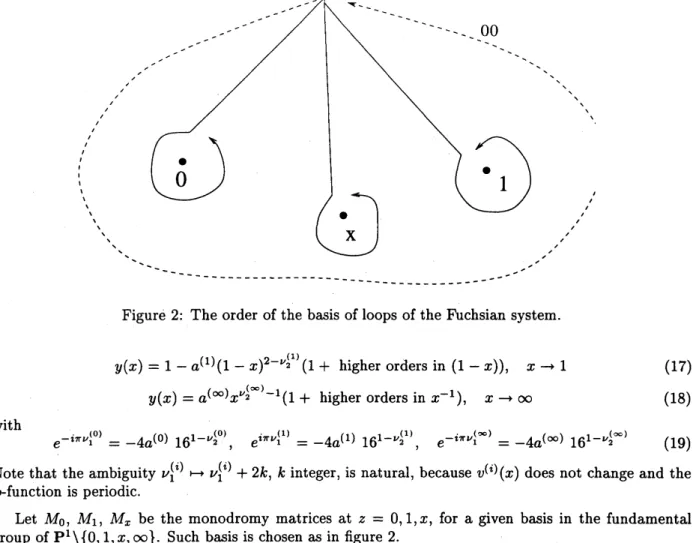
Figure 2: The order of the basisof loops of the Fuchsian system.
$y(x)=1-a^{(1)}(1-x)^{2-\nu_{2}^{(1)}}$($1+\mathrm{h}\mathrm{i}\mathrm{g}\mathrm{h}\mathrm{e}\mathrm{r}$ orders in $(1-x)$), $xarrow 1$ (17)
$y(x)=a^{(\infty)}x^{\nu_{2}^{(\infty)}-1}$($1+\mathrm{h}\mathrm{i}\mathrm{g}\mathrm{h}\mathrm{e}\mathrm{r}$ orders in $x^{-1}$), $xarrow\infty$ (18)
with
$e^{-i\pi\nu_{1}^{(\mathrm{O})}}=-4a^{(0)}16^{1-\nu_{2}^{(\mathrm{O})}}$ $e^{i\pi\nu_{1}^{(1)}}=-4a^{(1)}16^{1-\nu_{2}^{(1)}}$ $e^{-i\pi\nu_{1}^{(\infty)}}=-4a^{(\infty)}16^{1-\nu_{2}^{(\infty)}}$
(19)
Note that theambiguity $\nu_{1}^{(i)}\mapsto\nu_{1}^{(i)}+2k$, $k$ integer, is natural, because $v^{(i)}(x)$ does not changeand the
$\wp$-function is periodic.
Let $M_{0}$, $M_{1}$, $M_{x}$ be the monodromy matrices at $z=0,1$ ,$x$, for agiven basis in the
fundamental
group
of$\mathrm{P}^{1}\backslash \{0,1, x, \infty\}$.
Such basis is chosenas
infigure 2.If
$\theta_{0}$, $\theta_{x}$, $\theta_{1}$, $\theta_{\infty}\not\in \mathrm{Z}$
thereis
aone
toone
correspondence between agiven choiceofmonodromy data 00,$\theta_{x}$, $\theta_{1}$, $\theta_{\infty}$, $tr(M0Mx)$,$\mathrm{t}\mathrm{r}(M_{0}M_{1})$, $\mathrm{t}\mathrm{r}(M_{1}M_{x})$ and atranscendent $y(x)$ (see[13] [6], [10]). Namely:
$\mathrm{y}(\mathrm{x})=y(x;\theta_{0}, \theta_{x}, \theta_{1}, \theta_{\infty}, \mathrm{t}\mathrm{r}(M_{0}M_{x}), \mathrm{t}\mathrm{r}(M_{0}M_{1}), \mathrm{t}\mathrm{r}(M_{1}M_{x}))$ (20)
We proved that such atranscendent has elliptic representations at $x=0,1$,$\infty$, provided that (12) is
satisfied. The three sets ofparameters $(\nu_{1}^{(i)}, \nu_{2}^{(i)})$, $i=0,1$,$\infty$
are
functions of the monodromy data $\theta_{0}$,$\theta_{x}$, $\theta_{1}$, $\theta_{\infty}$, $tr(M0Mx)$, $\mathrm{t}\mathrm{r}(M_{0}M_{1})$, $\mathrm{t}\mathrm{r}(M_{1}M_{x})$
.
Namely,we
showed that2$\cos(\pi\nu_{2}^{(0)})=-\mathrm{t}\mathrm{r}(M_{0}M_{x})$, 2$\cos(\pi\nu_{2}^{(1)})=-\mathrm{t}\mathrm{r}(M_{1}M_{x})$, 2$\cos(\pi\nu_{2}^{(\infty)})=-\mathrm{t}\mathrm{r}(M_{0}\mathrm{J}/I_{1})$ (21) $a^{(i)}=a^{(i)}(\nu_{2}^{(i)} ; \theta_{0}, \theta_{x}, \theta_{1}, \theta_{\infty}, \mathrm{t}\mathrm{r}(M_{0}M_{x}), \mathrm{t}\mathrm{r}(M_{0}M_{1}), \mathrm{t}\mathrm{r}(M_{1}M_{x}))$ , $i=0,1$,
oo
(22)The formulas of $a^{(i)}$
are
quite long,so we
do not write them here. They dependon
the monodromydatathroughrational, trigonometricand$\Gamma$-functions. In particular,$\nu_{2}^{(i)}$ enters explicitly. Theprocedure
for computing such formulae is given in the Appendix of [11]. We note that the condition $\nu_{2}^{(i)}\not\in \mathrm{z}$ is
equivalent to $\mathrm{t}\mathrm{r}(MiMj)\neq\pm 2$.
Conversely, we proved that atranscendent $y(x)$ given by its elliptic representation, under the
condi-tionsof Theorem 1(and Theorem 3of [11]), is atranscendent (20). This follows from the consideration
that the couple$(\nu_{1}^{(i)}, \nu_{2}^{(i)})$ isgiven at thecritical point $x=i$, and $\theta_{0}$, $\theta_{x}$, $\theta_{1}$, $\theta_{\infty}$
are
fixed by the equationPVI
we are
considering. From these datawe
can
compute $\mathrm{t}\mathrm{r}(\Lambda f_{0}\mathrm{J}/f_{x})$, $\mathrm{t}\mathrm{r}(M_{1}M_{x})$, $\mathrm{t}\mathrm{r}(\Lambda f_{0}M_{1})$. One ofthe traces is -2$\cos(\pi\nu_{2}^{(i)})$, the others depend
on
$\nu_{1}^{(i)}$,$\nu_{2}^{(i)}$,$\theta_{0}$, $\theta_{x}$, $\theta_{1}$, $\theta_{\infty}$ through rational, trigonometric
and $\Gamma$-functions. The formulae
are
rather long,so
we
refer the reader to the Appendix of [11]. In thisway the transcendent (20) is obtained. From the monodromy data
we
compute the couples $(\nu_{1}^{(j)}, \nu_{2}^{(j)})$at the other two critical points and we get the the elliptic representation ofthe initial transcendent at the other critical points. Therefore, the connection problem is solved.
Note that if
we
startfrom the elliptic representation atone
critical point, sayfor example$x=0$, then$\nu_{1}^{(0)}$,$\nu_{2}^{(0)}$
are
given. Asexplained above,we can
computethe monodromy data andfromthemwe
compute $\nu_{2}^{(j)}$ and $a^{(j)}$ (then $\nu_{1}^{(j)}$) at the other two critical points. As already observed, the ambiguity $\nu_{1}^{(g)}\mapsto$$\nu_{1}^{(j)}+2k$ ($k$ integer) does not change the elliptic representation. On the other hand, the ambiguities
$\nu_{2}^{(j)}\mapsto\nu_{2}^{(j)}+2N$ ($N$ integer), $\nu_{2}^{(j)}\mapsto-\nu_{2}^{(j)}$ and the ambiguity in the choice $0\leq\Re\nu_{2}^{(j)}\leq 1$
or
$1\leq$$\Re\nu_{2}^{(j)}\leq 2$, which results from the cosines in (21), is due to the fact that the
same
transcendent hasdifferent
elliptic representations in different domains (the choice of $\nu_{2}^{(j)}$ determines the representationand the domain!).
To summarize the results,
we
say that :Inthe generic
case
(12) there is $a$one-tO-One correspondence between monodromy data andtranscen-dents (20).
If
$tr(M_{i}M_{j})\neq\pm 2$ they have elliptic representation whose parameters $(\nu_{1}^{(i)}, \nu_{2}^{(i)})$are
givenby the
formulae
(21), (22), (19). Conversely,a
transcendent whose elliptic representationsatisfies
theconditions
of
Theorem 1(and Theorem3of
[11]) is a transcendet (20). The connection between its threepairs $(\nu_{1}^{(i)}, \nu_{2}^{(i)})$ is explained above. This solves the connection problem.
To conclude the discussion of thegeneric case,
some
commentsaboutour
extension of previous knownresults
are
in order. The critical behavior for aclass ofsolutions to thePainleve’ 6equationwas
foundby Jimbo in [13] for generic values of$\alpha$, $\beta$, $\gamma\delta$. Atranscendent in this class has behavior:
$y(x)=a^{(0)}x^{1-\sigma^{(0)}}(1+O(|x|^{\delta}))$, $xarrow \mathrm{O}$, (23)
$y(x)=1-a^{(1)}(1-x)^{1-\sigma^{(1)}}(1\mathrm{t}O(|1-x|^{\delta}))$, $xarrow 1$, (24)
$\mathrm{y}(\mathrm{x})=a^{(\infty)}x^{-\sigma^{(\infty)}}(1+O(|x|^{-\delta}))$, $xarrow\infty$, (23)
where $\delta$is asmall positive number, $a^{(i)}$ and $\sigma^{(i)}$
are
complex numbers such that $a^{(i)}\neq 0$ and$0\leq\Re\sigma^{(i)}<1$
.
(26)We remark that $x$convergestothe critical points inside a sectorwith vertex
on
the corresponding criticalpoint. Theconnection problem, i.e. the problemoffinding the relationamongthe three pairs $(\sigma^{(i)}, a^{(i)})$,
$i=0,1$,$\infty$,
was
solvedin [13] for the above class of transcendentsusing the isomonodromy deformationstheory. Actually, atranscendent in the class above coincides with atranscendent (20). In particular
2$\cos(\pi\sigma^{(0)})=\mathrm{t}\mathrm{r}(M_{0}M_{x})$, 2$\cos(\pi\sigma^{(1)})=\mathrm{t}\mathrm{r}(M_{1}M_{x})$, 2$\cos(\pi\sigma^{(\infty)})=\mathrm{t}\mathrm{r}(M_{0}M_{1})$ (27)
and
$a^{(i)}=a^{(i)}(\sigma^{(i)} ; \theta_{0}, \theta_{x}, \theta_{1}, \theta_{\infty}, tr(MiMx), \mathrm{t}\mathrm{r}(M_{0}M_{1}), \mathrm{t}\mathrm{r}(M_{1}M_{x}))$, $i=0,1$,$\infty$
For the formulas of$a^{(i)}$
we
refer to [13]. The monodromy dataare
restricted by the following condition,equivalent to (26):
$|\mathrm{t}\mathrm{r}(M_{i}M_{j})|\leq 2$, $\Re\{\mathrm{t}\mathrm{r}(MiMj)\}\neq-2$ (28)
As explained above, we have shown that the transcendents (20) have elliptic representation.
There-fore, Jimbo’s transcendents
are
included inour
class of transcendents obtained by the ellipticrepresen-tation. Observethat the behaviors (23)-(25)
are
included in the behaviors (13)-(15) with $\sigma^{(i)}=1-\nu_{2}^{(i)}$(and (16)-(18) with$\sigma^{(i)}=\nu_{2}^{(i)}-1$). We proved in [11] that the condition (26) isextended toany$\sigma^{(i)}\in \mathrm{c}$
such that$\sigma^{(i)}\not\in(-\infty, 0]\cup[1, +\infty)$ (as
we
must expect, ifwe
observe that $\nu_{2}^{(i)}\not\in(-\infty, 0]\cup\{1\}\cup[2, +\infty)$and that (27) defines $\sigma^{(i)}$ up to $\sigma^{(i)}\mapsto\pm\sigma^{(i)}+2n$, $n$ integer). Therefore
we
have solved the connectionproblem for any complex value of $\mathrm{t}\mathrm{r}(M_{i}M_{j})$ with the only
constraint
$\mathrm{t}\mathrm{r}(M_{i}M_{j})\neq\pm 2$. This conditionextends (28).
To be
more
precise, the condition $\nu_{2}^{(i)}\neq 1$ is equivalent to $\mathrm{t}\mathrm{r}(M_{0}\Lambda f_{x})\neq 2$ at $x=0$; to $\mathrm{t}\mathrm{r}(M_{1}M_{x})\neq 2$at $x=1$;to $\mathrm{t}\mathrm{r}(hf_{0}M_{1})\neq 2$ at $x=\infty$. Nevertheless, in the
case
$\mathrm{t}\mathrm{r}(NI_{i}NI_{j})=2$ the critical behaviorand the solution of the connection problem
were
achieved by Jimbo. Unfortunately, the condition$\nu_{2}^{(i)}\neq 1$ which
we
had to impose to study the elliptic representation (except for non-genericcase
$\mathrm{s}$ like$\beta=\gamma=1-2\delta=0)$ does not allow
us
to know the analytic properties and the critical behavior of theelliptic representation in this case. We expect that the properties of $u(x)$ are such to exactly produce
the critical behavior found by Jimbo for $\mathrm{t}\mathrm{r}(MiMj)=2$, but
we
still have tocover
thiscase.
The condition $\nu_{2}^{(i)}\neq 0$ (and 2), implies that we
can
not give the critical behaviors(and the elliptic
representation) of (20) at $x=0$ for $\mathrm{t}\mathrm{r}(M_{0}M_{x})=-2$;at $x=1$ for $\mathrm{t}\mathrm{r}(M_{1}M_{x})=-2$;at $x=\mathrm{o}\mathrm{o}$ for
$\mathrm{t}\mathrm{r}(M_{0}M_{1})=-2$. Toour knowledge, these
cases
have not yet been studied in the literature.To conclude, the results of [13] together with
our
extension provide the critical behaviors and thesolution ofthe connection problem for thetranscendents (20) in the generic
case
forany
value of$\mathrm{t}\mathrm{r}(M_{i}M_{j})\neq-2$which corresponds to exponents
$\sigma^{(i)}\in \mathrm{C}$ such that $\sigma^{(i)}\not\in(-\infty, 0)\cup[1, +\infty)$
.
We turn
now
to the specialcase
$\beta=\gamma=1-2\delta=0$, important for its applications to topologicalfiled theory, Frobenius manifolds [4] and quantum cohomology [17] [12]. This
case
is fully studied in[10]. We
can
give arepresentation of$u(x)$ in adomain whichis wider thanthegenericcase.
Namely, at$x=0$, the domain is
$D(rj\nu_{1}, \nu_{2}):=\{x\in\tilde{\mathrm{C}}\circ||x|<r$, $|e^{-i\pi\nu_{1}}( \frac{x}{16})^{2-\nu_{2}}|<r$, $|e^{i\pi\nu_{1}}( \frac{x}{16})^{\nu_{2}}|<r\}$
In this domain $v(x)$ is holomorphic with convergent expansion
$v(x)= \sum_{n\geq 1}a_{n}x^{n}+\sum_{n\geq 0,m\geq 1}b_{nm}x^{n}[e^{-i\pi\nu_{1}}(\frac{x}{16})^{2-\nu_{2}}]^{m}+\sum_{n\geq 0,m\geq 1}c_{nm}x^{n}[e^{i\pi\nu_{1}}(\frac{x}{16})^{\nu_{2}}]^{m}$
If$\nu_{2}$ is real, thevalue$\nu_{2}=1$ is
now
allowed, namely, theconstraint is $\iota \mathrm{g}$ $\not\in(-\infty, 0]\cup[2, +\infty)$.
Therefore,by periodicity ofthe pfunction
we can
assume
$0\leq\Re\nu_{2}<2$, $\nu_{2}\neq 0$.
Asimilar result holds at $x=1$and $x=\infty$
.
According to [6],
we
define $2-x_{0}^{2}:=\mathrm{t}\mathrm{r}$ $M_{0}M_{x}$, $2-x_{1}^{2}:=\mathrm{t}\mathrm{r}$ MOMX, $2-x_{\infty}^{2}:=\mathrm{t}\mathrm{r}$ $M_{0}M_{1}$.
Thereis
aone
toone
correspondence between triples $(x_{0}, x_{1}, x_{\infty})$ (defined uPto the change of two signs) andPainleve’ transcendents, provided that at most
one
$x_{i}$ iszero
and not all the $x_{i}$are
+2 at thesame
time. Therefore
we
write $y(x)=y(x;x0, x_{1}, x_{\infty})$. We show thatone
such transcendent has ellipticrepresentations (half-periods
are
understood)$y(x;x_{0}, x_{1}, x_{\infty})= \wp(\nu_{1}^{(0)}\omega_{1}^{(0)}(x)+\nu_{2}^{(0)}\omega_{2}^{(0)}(x)+v^{(0)}(x;\nu_{1}^{(0)}, \nu_{2}^{(0)}))+\frac{1+x}{3}$
$= \wp(\nu_{1}^{(1)}\omega_{1}^{(1)}(x)+\nu_{2}^{(1)}\omega_{2}^{(1)}(x)+v^{(1)}(x;\nu_{1}^{(1)}, \nu_{2}^{(1)}))+\frac{1+x}{3}$ (29)
$= \wp(\nu_{1}^{(\infty)}\omega_{1}^{(\infty)}(x)+\nu_{2}^{(\infty)}\omega_{2}^{(\infty)}(x)+v^{(\infty)}(x;\nu_{1}^{(\infty)}, \nu_{2}^{(\infty)}))+\frac{1+x}{3}$ (30)
The parameters $\nu_{2}^{(i)}$
are
obtained from$\cos\pi\nu_{2}^{\langle i)}=\frac{x_{i}^{2}}{2}-1$, $0\leq\Re\nu_{2}^{(i)}\leq 1$, $\nu_{2}^{(i)}\neq 0$, $i=0,1$,
oo
Note that the condition $x_{i}\neq\pm 2$, $i=0,1$,$\infty$, corresponds to $\nu_{2}^{(i)}\neq 0$
.
The parameter $\nu_{1}^{(0)}$ is obtainedby the formul
$e^{i\pi\nu_{1}^{(0)}}=- \frac{i\Gamma^{4}(1--\nu_{2}^{(0)}=)}{2\sin(\pi\nu_{2}^{(0)})\Gamma^{2}(\frac{3}{2}-\mu-\underline{\nu}_{2}^{(0)}=)\Gamma^{2}(\frac{1}{2}+\mu-\underline{\nu}_{2}^{(\mathrm{O})}arrow)}[2(1-e^{i\pi\nu_{\underline{\mathrm{Q}}}^{(()\rangle}})-$
$-f(x_{0}, x_{1}, x_{\infty})(x_{\infty}^{2}-e^{i\pi\nu_{2}^{(0)}}x_{1}^{2})]\mathrm{u}(\mathrm{x})x_{1},$$x_{\infty})$
$f(x_{0}, x_{1}, x_{\infty}):= \frac{4-x_{0}^{2}}{x_{1}^{2}+x_{\infty}^{2}-x_{0}x_{1}x_{\infty}}$, $\alpha=\frac{(2\mu-1)^{2}}{2}$
Moreover,$\exp\{-i\pi\nu_{1}^{(1)}\}$,$\exp\{i\pi\nu_{1}^{(\infty)}\}$
are
given byananalogous formula with the substitutions$(x_{0},$$x_{1}$,$x_{\mathrm{o}}$$(x_{1}, x_{0}, x_{0}x_{1}-x_{\infty})$, $\nu_{2}^{(0)}\mapsto\nu_{2}^{(1)}$ and $(x_{0}, x_{1}, x_{\infty})\mapsto(x_{\infty}, -x_{1}, x_{0}-x_{1}x_{\infty})$, $\nu_{2}^{(0)}\mapsto\nu_{2}^{(\infty)}$ respectively.
The most general choice of $\nu_{2}$ is $0\leq\Re\nu_{2}<2$
.
This corresponds to the fact that the transcendent$y(x;x_{0}, x_{1}, x_{\infty})$ also has three representations
$y(x;x_{0}, x_{1}, x_{\infty})= \wp(\tilde{\nu}_{1}^{(0)}\omega_{1}^{(0)}(x)+\tilde{\nu}_{2}^{(0)}\omega_{2}^{(0)}(x)+v^{(0)}(x;\tilde{\nu}_{1}^{(0)},\tilde{\nu}_{2}^{(0)}))+\frac{1+x}{3}$
$= \wp(\tilde{\nu}_{1}^{(1)}\omega_{1}^{(1)}(x)+\tilde{\nu}_{2}^{(1)}\omega_{2}^{(1)}(x)+v^{(1)}(x_{j}\tilde{\nu}_{1}^{(1)},\tilde{\nu}_{2}^{(1)}))+\frac{1+x}{3}$
$= \wp(\tilde{\nu}_{1}^{(\infty)}\omega_{1}^{(\infty)}(x)+\tilde{\nu}_{2}^{(\infty)}\omega_{2}^{(\infty)}(x)+v^{(\infty)}(x;\tilde{\nu}_{1}^{(\infty)},\tilde{\nu}_{2}^{(\infty)}))+\frac{1+x}{3}$
where
$\cos\pi\tilde{\nu}_{2}^{(i)}=\frac{x_{i}^{2}}{2}-1$, $1\leq\Re\nu_{2}^{(i)}<2$, $i=0,1$,
oo
The parameter $\tilde{\nu}_{1}^{(0)}$ is obtained bythe formula
$e^{-i\pi\overline{\nu}_{1}^{(0)}}= \frac{i\Gamma^{4}(-\overline{\nu}_{2}^{(0)}=)}{2\sin(\pi\tilde{\nu}_{2}^{(0)})\Gamma^{2}(\frac{1}{2}-\mu+=)\underline{\overline{\nu}}_{2}^{(0)}\Gamma^{2}(-\frac{1}{2}+\mu+p\nu_{2})}[2(1-e^{-i\pi\overline{\nu}_{2}^{(0)}})-$
$-f(x_{0},x_{1}, x_{\infty})(x_{\infty}^{2}-e^{-i\pi\tilde{\nu}_{2}^{(0)}}x_{1}^{2})]$ p{ 0’$x_{1},$$x_{\infty}$).
$\exp\{i\pi\tilde{\nu}_{1}^{(1)}\}$, $\exp\{-i\pi\tilde{\nu}_{1}^{(\infty)}\}$
are
given by an analogous formula with the substitutions $(x_{0}, x_{1}, x_{\infty})\mapsto$(31)$x_{0},$$x_{0}x_{1}-x_{\infty}),\tilde{\nu}_{2}^{(0)}\mapsto\tilde{\nu}_{2}^{(1)}$ and $(x_{0}, x_{1}, x_{\infty})\mapsto(x_{\infty}, -x_{1}, x_{0}-x_{1}x_{\infty}),\tilde{\nu}_{2}^{(0)}\mapsto\tilde{\nu}_{2}^{(\infty)}$ respectively.
Theformulae above have limits for $\nu_{2}=1,1\pm 2\mu+2m$, $m$ integer. They
are
listed in [10] and [11].Conversely, atranscendent
$\mathrm{y}(\mathrm{x})=\wp(\nu_{1}\omega_{1}^{(0)}(x)+\nu_{2}\omega_{2}^{(0)}(x)+v^{(0)}(x;\nu_{1}, \nu_{2}))+\frac{1+x}{3}$, at $x=0$ (31)
coincides with $y(x;x_{0}, x_{1}, x_{\infty})$, with thefollowing monodromy data.
If$0\leq\Re\nu_{2}\leq 1$:
$x_{0}=2 \cos(\frac{\pi}{2}\nu_{2})$
$x_{1}=[ \frac{4^{-\nu_{2}}2e^{i\frac{\pi}{2}\nu_{1}}}{f(\nu_{2},\mu)G(\nu_{2},\mu)}+\frac{G(\nu_{2},\mu)}{4^{-\nu_{2}}2e^{i\frac{\pi}{2}\nu_{1}}}]$
$x_{\infty}=[ \frac{4^{-\nu_{2}}2e^{i\frac{\pi}{2}(\nu_{1}-\nu_{2})}}{f(\nu_{2},\mu)G(\nu_{2},\mu)}+\frac{G(\nu_{2},\mu)}{4^{-\nu_{2}}2e^{i\frac{\pi}{2}(\nu_{1}-\nu_{2})}}]$
where
$f( \nu_{2}, \mu)=-\frac{2\sin^{2}(\frac{\pi}{2}\nu_{2})}{\cos(\pi\nu_{2})+\cos(2\pi\mu)}$, $G( \nu_{2}, \mu)=4^{-\nu_{2}}2\frac{\Gamma(1--\nu_{2}A)^{2}}{\Gamma(\frac{3}{2}-\mu--\nu_{2}A)\Gamma(\frac{1}{2}+\mu-\frac{\nu\circ}{2})}$
If $1\leq\Re\nu_{2}<2$:
$x_{0}=2 \cos(\frac{\pi}{2}\nu_{2})$
$x_{1}=[ \frac{e^{-i\frac{\pi}{2}\nu_{1}}}{4^{1-\nu_{2}}2f(\nu_{2},\mu)G_{1}(\nu_{2}./\iota)}+\frac{4^{1-\nu_{2}}2G_{1}(\nu_{2},\mu)}{e^{-i\frac{\pi}{?}\nu_{1}}}]$
$x_{\infty}=[ \frac{e^{i\frac{\pi}{\sim 9}(\nu_{2}-\nu_{1})}}{41-\nu\circ\sim 2f(\nu_{2},\mu)G_{1}(\nu_{2},\mu)}+\frac{4^{1-\nu_{2}}2G_{1}(\nu_{2},\mu)}{e^{i\frac{\pi}{\sim \mathrm{Q}}(\nu\circ-\nu_{1})}\sim}]$
where
$G_{1}( \nu_{2}, \mu)=\frac{1}{4^{1-\nu_{2}}2}\frac{\Gamma(^{\underline{\nu_{2}}}\mathrm{z})^{2}}{\Gamma(\frac{1}{2}-\mu+p\nu_{2})\Gamma(-\frac{1}{2}+\mu+\frac{\nu\circ}{2})}$
After computing the monodromy data,
we can
write the elliptic representations of $y(x;x_{0}, x_{1}, x_{\infty})$ at$x=1$ and$x=\infty$, namely (29), (30).
Since
theyare
the elliptic representations at$x=1$, $x=\infty$ of(31),we
havesolved the connection problem for (31).Weobserved that there is
aone
toone
correspondence between Painleve’ transcendents and triples ofmonodromydata$(x_{0}, x_{1}, x_{\infty})$, defined uP tothe change of two signs, satisfying$x_{i}\neq\pm 2$, $i=0,1$,$\infty$, i.e.
$\nu_{2}^{(i)}\neq 0$ (and 2), and at most
one
$x_{i}=0$.
Thecases
when these conditionsare
not satisfiedare
studiedin [19]. However,if$x_{i}=\pm 2$ (namely the$\mathrm{t}\mathrm{r}\mathrm{a}\mathrm{c}\mathrm{e}\mathrm{i}\mathrm{s}-2$) the problemoffindingthe critical behavior at the
corresponding criticalpoint $x=i$ is still open (except when all the three $x_{i}$
are
82: in thiscase
there isaone-parameter class of solutions called Chazy solutions in [19]$)$. We conclude that the results of
our
papers [10] [11] plus the resultsof[19]
cover
all the possible transcendents, except thespecialcase
whenone or
two$x_{i}$are
82.Finally,
we
expect that in all non-genericcases
we can
solve theconnection problem andexpress
theparameters$\nu_{1}$, $\nu_{2}$in termsof monodromy data. From theconceptualpointof view nothing should change
with respect to [13] [6] [10] [11]; but the technical details
may
require along time for computations.Acknowledgments: Iam grateful to B.Dubrovin for many discussions and advice. Iwould like to thank
A.Bolibruch, A.Its, M. Jimbo, M.Mazzocco, S.Shimomura for fruitful discussions which helped
me
towrite [10] [11]. Theauthoris supported by afellowship ofthe Japan Society forthePromotionof
Science
(JSPS).
References
[1] DijkgraafR.,Verlinde E., Verlinde H.: Topological Strings in d $<1$
.
Nucl. Phys B, 352, (1991),59-86.
[2] B.Dubrovin: Integrable Systemsin Topological Field Theory. Nucl. Phys B, 379, (1992),
627-689.
[3] B.Dubrovin: Geometrry
of
2D topologicalfield
theories. Lecture Notes in Math, 1620, (1996),120-348.
[4] B.Dubrovin: Painleve trascendents in tw0-dimensional topological field theory. The Painleve
Prop-erty, One Century later, R.Conte, Springer 1999.
[5] B.Dubrovin: Differential geometry
on
thespaceof orbits ofaCoxeter group. Surv.Differ.
Geom.,IV, 181-211, Int. Press, Boston, MA, (1998).
[6] B.Dubrovin-M.Mazzocco: MonodromyofCertainPainlev\’e-VItrascendentsandReflection Groups.
Invent, math., 141, (2000),
55-147.
[7] Fuchs R.: Uber lineare homogene Differentialgleichungen zweiter Ordnung mit drei im Endlichen
gelegenen wesentlich singularen Stellen. Mathematische Annalen LXIII, (1907),
301-321
[8] GambierB.: Surdes EquationsDifferentiellesdusecond Ordreet duPremier Degre’dontl’Int\’egrale
est \‘aPoints Critiques Fixes. Acta Math., 33, (1910), 1-55
[9] Guzzetti D: Stokes matrices and monodromy for the quantum cohomology of projective spaces.
Comm.Math.Phys. 207, (1999),
341-383.
[10]
Guzzetti D:On
the Critical Behavior, theConnection
Problem and the EllipticRepresentation ofaPainleve 6Equation . Mathematical Physics, Analysis and Geometry, 4, (2001), 293-377
[11] Guzzetti D: The Elliptic Representation of the General Painleve’ 6Equation. Communications in
Pure and Applied Mathematics, Vol LV (2002).
[12] Guzzetti D:Inverse Problem and MonodromyData for 3-dimensional Frobenius Manifolds .
Afath-ematical Physics, Analysis and Geometry, 4, (2001), 254-291.
[13] M.Jimbo: Monodromy Problem and the Boundary Condition for Some Painleve’ Trascendents.
Publ. RIMS, Kyoto Univ.,18 (1982),
1137-1161.
[14] MJimbo, T.Miwa, K.Ueno: Monodromy PreservingDeformations ofLinear Ordinary Differential
Equations with Rational Coefficients (I). Physica, D2, (1981),
306
[15] MJimbo, T.Miwa :Monodromy Preserving Deformations of Linear Ordinary Differential
Equa-tions with Rational Coefficients (II). Physica , D2, (1981),
407-448
[16] MJimbo, T.Miwa :Monodromy Preserving Deformations of Linear Ordinary Differential
Equa-tions withRational Coefficients (III). Physica, D4, (1981), 26
[17] Kontsevich M., Manin Y.I. : Gromov-Witten classes, Quantum Cohomology and Enumerative
Geometry. Comm.Math. Phys, 164, (1994),
525-562
[18] Manin V.I. : Sixth Painleve Equation, Universal Elliptic Curve, and Mirror of$\mathrm{P}^{2}$
.
Geometryof
differential
equations, Amer. Math. Soc. Transl. Ser 2, 186, Amer. Math. Soc, Providence, RI,(1998), 131-151
[19] M.Mazzocco: Picard and Chazy Solutions to the Painleve VI Equation. Math. Ann., 321, no.1,
(2001), 157-195.
[20] N.E.Norlund: The
Loga-ritmic Solutions of the Hypergeometric Equation. Mat.Fys.Skr.Dan.Vid.Selsk., 2, (1963),
no.
5,1-58
[21] Painleve P.:
Sur
lesEquationsDifferentielles du Second Ordreetd’Ordre Superieur,dontlTntegraleG\’en\’erale est Uniforme. Acta Math, 25, (1900),
1-86
[22] Painleve P.: Sur les Equations differentielles du second ordre \‘a points critiques fixes. CRAS 143
(1906) 1111-1117.
[23] Picard, E.: Memoire
sur
la Theorie des functions algebriques de deux variables. Journal deLiou-ville, 5, (1889), 135- 319
[24] M.Sato, T.Miwa, M.Jimbo: Holonomic Quantum Fields. II -The Riemann-Hilbert Problem -.
Publ. RIMS. Kyioto. Univ, 15, (1979), 201-278.
[25] S.Shimomura: Painleve Trascendents in the Neighbourhood of Fixed Singular Points.
Funk-cial. Ekvac., 25, (1982),
163-184.
Series Expansions of Painleve Trascendents in theNeighbourhood ofaFixedSingular Point.
Punk-cial.Ekvac.,25, (1982),
185-197.
Supplement to “Series Expansions ofPainleve Trascendents in theNeighbourhood of aFixed
Sin-gular Point”. Funkcial.Ekvac.,25, (1982),
363-371.
AFamily ofSolutionsofaNonlinear OrdinaryDifferntial Equationand its Application to Painleve
Equations (III), (V), (VI). J. Math. Soc. Japan, 39, (1987),
649-662.
[26] Witten E.: On the Structure ofthe TopologicalPhase ofTwo Dimensional Gravity. Nucl. PhysB,
340, (1990), 281-332