175
PATHS, TABLEAUX,
AND
$q$-CHARACTERS
OFQUANTUM
AFFINE ALGEBRAS
名古屋大学大学院多元数理科学研究科 中井 和香子 (Wakako Nakai)
Graduate School ofMathematics, Nagoya University
1. INTRODUCTION
This
paper
is basedon
[15], joint work with T. Nakanishi.Let 9 be
a
simple Lie algebraover
$\mathbb{C}$,
and let $\hat{\mathfrak{g}}$ be the corresponding non-twistedaffine Lie algebra. The quantum affine algebra $U_{q}(\hat{\mathfrak{g}})$ is the quantized
universal
enveloping algebra of $\hat{\mathfrak{g}}$
.
The$q$-character of $U_{q}(\hat{\mathfrak{g}})$
was
introduced in [9] to study the intricate structure of the finitedimensional
representations of $U_{q}(\hat{\mathfrak{g}})$.
Earlier than the introduction of the $q$-character, the tableaux descriptions of the spectra of the transfer
matrices
of a vertex model associated to $U_{q}(\hat{\mathfrak{g}})$was
studied in [5, 11, 13] etc. for $\mathfrak{g}$ of classical type. Since the $q$-character is designed
to be
a “universalization”
of the family oftransfer
matrices,one can
interpret theirresults in the context ofthe$q$-character. Then,the
$\mathrm{J}\mathrm{a}\mathrm{c}\mathrm{o}\mathrm{b}\mathrm{i}-^{\Gamma}\mathrm{b}\mathrm{u}\mathrm{d}\mathrm{i}$determinant
$\chi\lambda/\mu,a$
is conjectured to be the $q$-character of certain finite
dimensional
representationassociated
to a skew diagram $\lambda/\mu$ and $a\in \mathbb{C}$ for $A_{n}$ and $B_{n}$.
For these cases, thedeterminant $\chi_{\lambda/\mu,a}$ is
described
by the tableaux which satisfy certain “horizontal”and “vertical” rules $[5, 11]$
.
In contrast, thetableaux description of$\chi\lambda/\mu,a$ for $C_{n}$and $D_{n}$ is known only for the
cases
when $\lambda/\mu$ is aone-row
or
one-column diagram.In thisPaPer,
we
conjecture that $\chi\lambda/\mu_{)}a$ is the$q$-character ofa
finite dimensionalrepresentation, and give a summary ofthe method to give
a
tableaux descriptionfor $C_{n}$, using the “$\mathrm{p}\mathrm{a}\mathrm{t}\mathrm{h}_{\mathrm{S}}$
)’ method of Gessel-Viennot [10]. For simplicity, the paths
method is
introduced
by applying it for the $A_{n}$case.
To apply it for the $C_{n}$ case,some modifications are
required.As
a
result, the tableauxare
given by certainhorizontal
andvertical
rules withan
“extra” rule. Thecase
for two-row diagramsare
given,which
is the simplest typical example of it. In conclusion,we
give $\mathrm{a}$conjecture of
an
implicit form of the extra rule in terms ofpaths.2. PRELIMINARIES
2.1.
Quantum affine algebras. Let $\mathfrak{g}$ bea
simple Lie algebraover
$\mathbb{C}$ ofrank n,
and let $\hat{\mathfrak{g}}$ be the corresponding affine Lie algebra. Let
$U_{q}(\hat{\mathfrak{g}})$ be the quantum
affine
algebra, namely, it is the
associative
algebra generated by $x_{i}^{\pm}$,
$k_{i}^{\pm 1}$ (i $=0,$\ldots ,n) with relations $k_{i}k_{i}^{-1}=k_{i}^{-1}k_{i}=1$
,
$k_{i}k_{j}=k_{j}k_{i}$, $k_{i}x_{j}^{\pm}k_{i}^{-1}=q^{\pm B_{ij}}x_{j}^{\pm}$, $x_{i}^{+}x_{j}^{-}-x_{j}^{-}x_{i}^{+}= \delta_{ij}\frac{k_{i}-k_{i}^{-1}}{q_{i}-q_{i}^{-1}}$, $\sum_{r=0}^{1-C_{ij}}||^{1-C_{ij}}r]_{qi}(x_{i}^{\pm})^{r}x_{j}^{\pm}(x_{i}^{\pm})^{1-C_{ij}-r}=0$, i $\neq j$.Here, $q\in$
C’ ,
$C=(C_{ij})_{0\leq i,j\leq n}$ is the Cartan matrix of$\hat{\mathfrak{g}}$,
and $q_{i}:=q^{r_{i}}$,
where $r_{i}’ \mathrm{s}$are
relatively prime integers such that $B=(B_{ij})=DC$ for $D=$ diag$(r_{1}, \ldots, r_{n})$.
We also set
$\{\begin{array}{l}st\end{array}\}$
$q:= \frac{[s]_{q}!}{[t]_{q}![s-t]_{q}!}7$
$[s]_{q}!:=[s]_{q}[s-1]_{q}\ldots[1]_{q}$
,
$[s]_{q}:= \frac{q^{s}-q^{-s}}{q-q^{-[perp]}}$.
Ifwe let $qarrow 1$, then $U_{q}(\hat{\mathfrak{g}})$ becomes the universal enveloping algebra $U(\hat{\mathfrak{g}}’)$ of the subalgebra $\hat{\mathfrak{g}}’:=\mathfrak{g}$ $\otimes \mathbb{C}[t_{7}t^{-1}]\oplus \mathbb{C}\mathrm{c}$$\subset\hat{\mathfrak{g}}$ ($c$ is the center).
2.2. Finite
dimensional
representations of$U_{q}(\hat{\mathfrak{g}})$.
There isa
bijection betweentheset of the isomorphismclasses ofthe finite
dimensional
representations of$U_{q}(\hat{\mathfrak{g}})$and the set of$n$-tuples polynomials $\mathrm{P}(u)=(P_{i}(u))_{\mathrm{i}=1,\ldots,n}$ with constant term 1,
which
are
called theDrinfel’d
polynomials [6, 7]. For any skew diagram $\lambda/\mu$ withitsdepth $d(\lambda/\mu)\leq n$ ($d(\lambda/\mu)\leq n-1$ for$B_{n}$ and $d(\lambda/\mu)\leq n-2$ for $D_{n}$) and
a
$\in \mathbb{C}$,
let $V(\lambda/\mu,$a) be the representation that corresponds to the Drinfel’d polynomial
$\prod_{j=1}^{d(\lambda’/\mu’)}\mathrm{P}_{\lambda_{\acute{\mathrm{j}}}-\mu_{j}’,a(j)}(u)$
where $\mathrm{P}_{\iota,a}(u)=(Pj(u))j=1,\ldots,n$ is defined
as
$P_{j}(u)=\{$
$1-uq^{a}$
,
ifj $=i$,
1, otherwise,
and
$a(j)=a+(2j-\lambda_{j}’-\mu_{j}’-1)\delta$
.
Here, $\lambda’$ denotes the conjugate of A. Then, the highest weight of $V(\lambda/\mu_{)}a)$
con-sidered
as
a $U_{q}(\mathfrak{g})$-module is $\sum_{j=1}^{d(\lambda’/\mu’)}\omega_{\lambda_{\acute{j}}-\mu_{\acute{j}}}$, where$\omega_{r}$ is the $r$th
fundamental
weight.For the definition of the representation $V$(A$/\mu$,$a$) associated to
a
skew diagram$\lambda/\mu$ of$d(\lambda/\mu)=n$ for $B_{n}$ and $d(\lambda/\mu)=n-1$
,
$n$ for $D_{n}$,
see [15].2.3. The $q$-characters of quantum affine algebras. The $q$-character of $U_{q}(\hat{\mathfrak{g}})_{:}$
introduced in [9], is
an
injective ring homornorphism(2.1) $\chi_{q}$ : Rep$U_{q}(\hat{\mathfrak{g}})arrow U_{q}(\tilde{\mathfrak{h}})[[u]]$
,
where Rep$U_{q}(\hat{\mathfrak{g}})$ bethe
Grothendieck
ring ofthe category of the finite dimensionalrepresentations of$U_{q}(\hat{\mathfrak{g}})$
,
and $U_{q}(\tilde{\mathfrak{h}})$ isa
certainsubalgebraof$U_{q}(\hat{\mathfrak{g}})$.
It is definedas
a
composition oftwo maps; themap
that sends $V\in$ Rep$U_{q}(\hat{\mathfrak{g}})$ to the “universal”transfer matrix
$t_{V}(u):=\mathrm{T}\mathrm{r}_{V}(\pi_{V(u)}\otimes \mathrm{i}\mathrm{d})(\mathcal{R})\in U_{q}(\hat{\mathfrak{g}})[[u]]$,
and the projection $U_{q}(\hat{\mathfrak{g}})[[u]]arrow U_{q}(\tilde{\mathfrak{h}})[[u]]$
.
The element $\mathcal{R}\in U_{q}(\hat{\mathfrak{g}})\otimes U_{q}(\hat{\mathfrak{g}})\wedge$,
calledthe universd$R$-matrix, satisfies the Yang-Baxter equation
Sending the second component of7? by
a
representation $(\pi^{\otimes p}, W^{\otimes p})$, the element$tv(u)$ becomes the transfer matrix
$t_{V}$$(u;u_{1_{7}}\ldots, u_{p}):=\mathrm{R}v(Rv,w(u-u_{1})$
. . .
$Rv,w(u-u_{p}))$.For the simplest example, the tableaux description (with spectral parameter
$a\in \mathbb{C})$ of the $q$-character for the first
fundamental
representation $V((1), a)$ is givenas follows:
(2.2) $\chi_{q}(V((1), a))=\sum_{i\in I}z_{i,a}=\sum_{i\in I}\underline{\bigcap_{a}i}$
.
Here, the set I is
(2.3) $I=\{$
$\{1, 2, \ldots,n, n+1\}$
,
$(A_{n})$$\{1\prec 2\prec\cdots\prec n\prec 0\prec\overline{n}\prec\cdots \prec\overline{2}\prec\overline{1}\}$
,
$(B_{n})$$\{1\prec 2\prec\cdots\prec n\prec\overline{n}\prec\cdots\prec\overline{2}\prec\overline{1}\}$
,
$(C_{n})$$\{1\prec 2\prec-\cdot\prec\prec\cdots\prec\overline{2}\prec\overline{1}\}n$
.
$(D_{n})$$\overline{n}$
See [9] forthe
monomials
$z_{i,a}$ occurring in (2.2).3. THE JACOBI-TRUDI F0RMULA FOR THE $q$-CHARACTERS
For any $a\in \mathbb{C}$,
we
define $E_{a}(z, X)$ and $H_{a}(z, X)$as
follows:$E_{a}(z, X):=$
(3.1) $\{$
$\{\prod_{arrow}^{arrow}1\leq k\leq n(1+z_{k,a}X)\}(1-z_{0,a}X)^{-1}\{\prod_{1\leq}\vec{\prod}_{1\leq k\leq n+1}(1+z_{k,a}X)arrow arrow k\leq n,(1+z_{\overline{k},a}X)\}$ $(A_{n})(B_{n})$
$\{\prod_{arrow}1\leq k\leq n(1+z_{k,a}X)\}(1-z_{n,a}Xz_{\overline{n},a}X)\{\prod_{1} arrow\leq k\leq n,(1+z_{\overline{k},a}X)\}$
$(C_{n})$
$\{\prod_{1<k<\pi}(1+z_{k,a}X)\}(1-z_{\overline{n},a}Xz_{n,a}X)^{-1}\{\prod_{1\leq k\leq n}(1+z_{\overline{k},a}X)\}$ $(D_{n})$
-(3.2)
$H_{a}(z, X):=$
$\{$
$\Pi\{\Pi\{\Piarrow arrowarrowarrow 1\leq k\leq n+11\leq k\leq n1\leq k^{\wedge}\leq n(’ 1-z_{\overline{k},a}X)^{-1}\}(1+z_{0,a}X)\{\prod_{X(1-z_{\overline{k},a}X)^{-1}\}(1-z_{n,a}z_{\overline{n},a}X)^{-1}}^{arrow}1\leq k\leq n(1-z_{k,a}X)^{-1}\}(1-z_{k,a}X)^{-1}arrow\{\Pi_{1\leq k\leq n}(1-z_{k,a}X)^{-1}\}arrow(C_{n})(B_{n})(A_{n})$
$\{\Pi_{1\leq k\leq n}(1-z_{\overline{k},a}X)^{-1}\}(1-z_{\overline{n},a}Xz_{n,a}X)\{\Pi_{1\leq k\leq n}(1-z_{k,a}X)^{-1}\}$ $(D_{n})$
where $\prod_{1\leq k\leq n}A_{k}=A_{1}\ldots A_{n}arrow$ and $\prod_{1\leq k\leq n}A_{k}=A_{n}arrow\ldots$$A_{1}$
,
and(3.3) $z_{i,a}z_{\gamma,a’}=z_{j,a’}z_{i,a}$, $Xz_{i,a}=z_{i,a-2\mathit{5}}X$,
$\mathrm{i},j\in I\cdot a,a’\in \mathbb{C}\}$
’ where $\delta$ is (3.4) $\delta=\{$ 1, $(A_{n}, C_{n}, D_{n})$
2.
$(B_{n})$ Thenwe
haveIt has been observed in $[8, 12]$ (see also [11, 13]) that $e_{i,a}$ is the $q$-character of
the $r$th fundamental representation $V((1^{r}), a)$ of $U_{q}(\hat{\mathfrak{g}})$ for $1\leq r\leq n(r\neq n$ for
$B_{n}$
,
$r\neq n-$ $1$,
$n$ for $D_{n}$)} while $h_{r,a}$ is the $q$-character of the $r$th “sym metric”power ofthe first fundamentalrepresentation of$U_{q}(\hat{\mathfrak{g}})$ for any $r\geq 1$
.
Thetableauxdescription is given as follows:
$e_{r_{\gamma}a}= \sum_{\mathrm{i}_{1\}}\ldots,i_{\gamma}\in I;(\mathrm{V})}\prod_{l=1}^{r}z_{i_{\mathrm{t}},a+2(1-l)}=i_{1},\ldots$
,
$\sum_{i_{r}\in I;(\mathrm{V})}$ ,
$h_{r,a+2r-2}= \ldots\sum_{i_{1,\}}\mathrm{i}_{r}\in I;(\mathrm{H})}\prod_{l=1}^{r}z_{i_{l},a+2(l-r)}=\sum_{i_{1,.-}.,i_{r}\in I;(\mathrm{H})}$
The rules (V) and (H) for $\mathrm{i}_{1}$,
$\ldots$ ,$\mathrm{i}_{r}\in I$
,
called the vertical and horizontal rules,are
givenas
follows [5, 11, 13]: for any $k=1$,
$\ldots$ ,$r$,(V) $\mathrm{i}_{k}<\mathrm{i}_{k+1}$, $(A_{n})$
$\mathrm{i}_{k}\prec \mathrm{i}_{k+1}$
or
$\mathrm{i}_{k}=\mathrm{i}_{k+1}=0$, $(B_{n})$(3.6)
$\mathrm{i}_{k}\prec i_{k+1}$ and $[(\mathrm{i}_{k},\mathrm{i}_{k}’)=(c,\overline{c})\Rightarrow k’-k\leq n-c]$, $(C_{n})$
$\mathrm{i}_{k}\prec \mathrm{i}_{k+1}$ or $(\mathrm{i}k, \mathrm{i}_{k+1})=(n,\overline{n})$
or
$(ik,$$\mathrm{i}_{k+1J}^{\backslash }=(\overline{n}, n)$.
$(D_{n})$(H) $\mathrm{i}_{k}\leq \mathrm{i}_{k+1}$
,
$(A_{n})$$\mathrm{i}_{k}\preceq\iota_{k+1}$ and $\mathrm{i}_{k}$ $=\mathrm{i}k+1\neq 0$, $(B_{n})$
(3.7) $\lfloor \mathrm{i}_{k}\ulcorner\preceq i_{k+1}$ or $(\mathrm{i}_{k}, \mathrm{i}_{k+1})=(\overline{n}, n)]$
and $(\mathrm{i}k, \mathrm{i}_{k+1}, \mathrm{i}_{k+2})\neq(\overline{n},\overline{n}, n)$, $(\overline{n}, n, n)$, $(C_{n})$
$i_{k}\preceq \mathrm{i}_{k+1}$ and $n$ and$\overline{n}$ do not appear simulaneously. $(D_{n})$
Due to the relation (3.5), it holds that [14]
(3.8) $\det(h_{\lambda_{i}-\mu i^{-i+j,a+2\langle\lambda_{i}-\mathrm{z})\delta}})_{1\leq i,j\leq l}=\det(e_{\lambda_{\acute{i}}-\mu_{\acute{j}}-i+j,a-2(\mu_{\acute{j}}-j+1)\delta})_{1\leq i,j\leq l’}$
for any partitions $(\lambda, \mu)\}$ where $l$ and $l’$
are
any non-negative integers such that$l\geq d(\lambda)$
,
$d(\mu)$ and $l’\geq d(\lambda’)$,
$d(\mu’)$.
For any skew diagrams $\lambda/\mu$,
let$\chi\lambda/\mu,a$ denote
the determinant
on
the left or righthand
side of (3.8), We call it theJacobi-Trudi
determinant of $U_{q}(\hat{\mathfrak{g}})$ associated to $\lambda/\mu$ and $a$ $\in$ C. Note that $\chi(r),a=h_{r,a}$ and
$\chi_{(1^{r}),a}=e_{\tau,a}$
.
We remark that the determinant (3.8)
appears
in [5] for $A_{n}$ and [11] for $B_{n}$ inthe context of transfer matrices.
Weconjecture that
Conjecture 3.1. (1)
If
$\mathfrak{g}$ isof
type $A_{n}$or
$B_{n}$ and $\lambda/\mu$ is a skew diagramof
$d(\lambda)\leq n$, then $\chi\lambda/\mu,a=\chi_{q}(V(\lambda/\mu, a))$
.
(2)
If
$\mathfrak{g}$ isof
type $C_{n}$or
$D_{n}$ and $\lambda/\mu$ is a skew diagramof
$d(\lambda)\leq n$ when9
is
of
type $C_{n}$ (resp. $d(\lambda)\leq n-1$ uthen 9 isof
type $D_{n}$), then$\chi_{\lambda/\mu,a}$ is
the $q$
-character
of
certain (not necessarily irreducible) representation $V$of
$U_{q}(\hat{\mathfrak{g}})$ which has $V(\lambda/\mu, a)$
as
a
subquotient; furthermore,if
$\mu=\phi$,
then $\chi_{\lambda,a}=\chi_{q}(V(\lambda, a))$.
Remark
3.2.
An
analogue of Conjecture3.1
is true for the representations of Yan-gian $Y(\mathfrak{s}\mathrm{r}_{n})$,
whichcan
be proved [2] using theresults
in $[3, 4]$.
Remark
3.3.
The representation $V$ in Conjecture3.1
for $C_{n}$ and $D_{n}$ do notcoin-cide with the
irreducible
representation $V(\lambda/\mu, a)$, in general. Thecase
$(\lambda, \mu)=$$((3, 1)$, (2)$)$ is
a
counter-example for $C_{2}$ and for $D_{4}$, whichcan
be shown from thesingularities ofthe $R$-matrices (see [1] for example).
In the following sections,
we
give the tableaux description by applying the pathmethod of Gessel-Viennot [10] (see also [16]). First,
we
introduce the method forthe $A_{n}$
case
in Section 4, and thenwe
refer to the modification of this method toapply it for $C_{n}$ in Section 5.
4.
TABLEAUX DESCRIPTION OF TYPE $A_{n}$The
method was
originallyintroduced
to derive the well-knownsemistandard
tableaux description of the Schur function from the (original)
Jacobi-Hudi
de-terminant. For $A_{n}$, this method works out without any modification (except for
inserting the spectral parameters).
During this section, I is of type $A_{n}$ in (2.3).
4.1. Pathsdescription. Inthissubsection,
we
give apaths descriptionof of$\chi\lambda/\mu,a$(3.8) in terms ofthe method of Gessel-Viennot.
A path p in the lattice $\mathbb{Z}$
x
$\mathbb{Z}$ isa
sequence of steps $(s_{1}, s_{2},$\ldots )
such that eachstep $s_{i}$ is of unit lengh with the
northward
(N) or eastward (E) direction. Forexample, see Figure 1.
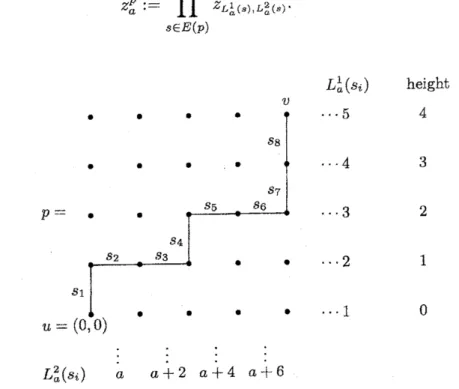
Letp be anypath such that the initial point is at height 0 and the final point is
at height n, and set $E(p):=$
{
s
$\in p$|s
isan
eastward
step}.
Themaps
$L_{a}^{1}$ : $E(p)arrow I$
,
$L_{a}^{2}$ : $E(p)arrow\{a+2k$|k
$\in \mathbb{Z}\}$,
called
the $h$-labelingof
type $A_{n}$associated
to a $\in \mathbb{C}$, are
definedas
in Figure 1. Forexample, $z_{a}^{p}=z_{2,a}z_{2,a+2}z_{3,a+4}z_{3,a+6}$ forp in Figure 1. We define
(4.1) $z_{a}^{p}:= \prod_{s\in E(p)}z_{L_{a}^{1}(s),L_{a}^{2}(\epsilon)}$
.
$L_{a}^{1}$(si) height
$v$ .,
.
5 4.
..4 3.
..3 2 . ..
21 ..
.I0 $L_{a}^{2}$(si)$.\cdot.a$ $a+\cdot.\cdot 2a+\cdot.\cdot 4a+\cdot.\cdot 6$
Then
we
have(4.2) $h_{r,a+2r-2}(z)=$ $\sum$ $z_{a}^{p}$
.
$(0,0)^{\mathrm{P}}arrow(r,n)$
For any skew diagrams $\lambda/\mu$, let $l=d(\lambda)$, and let $\mathrm{u}_{\mu}=(u_{1}, \ldots , u_{l})$ and $\mathrm{v}_{\lambda}=$
$(v_{1}, \ldots, v_{l})$ be $l$-tuples of fixed initial andfinal points
defined
as
$u_{i}=(\mu_{i}+1-\mathrm{i}, 0)$and $v_{i}=$ $(\lambda_{i}+1 -\mathrm{i}, n)$
.
Let $\mathrm{P}(\mathrm{A}\mathrm{n};\mathrm{u}_{\mu’\lambda}\mathrm{v})$ be the set of $l$-tuples of paths$\mathrm{p}=$
$(p_{17}\ldots,p_{l})$ such that $uiarrow p_{i}v_{\pi(i)}$ for
some
permutation $\pi\in \mathfrak{S}_{l}$.
We define the weight $z_{a}^{\mathrm{p}}$ and the signature $(-\mathrm{l})^{}$ for any $\mathrm{p}\in \mathfrak{P}(A_{n};\mathrm{u} \mathrm{v})\mu$, $\lambda$ and$a\in \mathbb{C}$ by
$z_{a}^{\mathrm{p}}= \prod_{i=1}^{l}z_{a}^{p_{i}}$
,
$(-\mathrm{l})^{}$ $=\mathrm{s}\mathrm{g}\mathrm{n}\pi$.Then, the determinant (3.8)
can
be writtenas
(4.3) $\chi_{\lambda/\mu_{\}}a}=\sum_{\mathrm{p}\in \mathfrak{P}(A_{nj}\mathrm{u}_{\mu},\mathrm{v}\mathrm{x})}(-1)^{\mathrm{p}}z_{a}^{\mathrm{p}}$
,
by (4.2). Applyingthe method of [10],
we
haveProposition 4.1. For any skew diagrams $\lambda/\mu$
,
(4.4) $\chi_{\lambda/\mu,a}=\sum_{\mathrm{p}\in P\langle A_{n};\mu,\lambda)}z_{a}^{\mathrm{p}}$,where $P(A_{n};\mu, \lambda)$ is the set
of
$al\iota^{\mathrm{w}}\mathrm{p}=(p_{1}, \ldots,p\ell)\in\zeta\beta(A_{n};\mathrm{u}_{\mu}, \mathrm{v}_{\lambda})$ which do nothave any intersectingpairs
of
paths $(p_{l},pj)$.The idea ofits proofisto consider aweight-preserving, sign-changing involution$\iota$
on
all$\mathrm{p}\in \mathfrak{P}(A_{n}; \mathrm{u}\mathrm{v})\mu’\lambda$ whichpossessan
intersecting pair of paths. Itimmediatelyfollows that the contributions of all such $\mathrm{p}$tothe right hand side of (4.3)
are
canceledwith each other.
4.2. Tableaux description. We define the weight $z_{a}^{T}$ for
any
tableau T of shape$\lambda/\mu$
as
$z_{a}^{T}:= \prod_{(i,j)\in\lambda/\mu}z_{T(i,j),a+2(j-i)}$,
where $T(\mathrm{i},$j) is the entry of T at (i,j), namely, the entry at the i th
row
and the j th column.Atableau Twhichsatisfiestherules (V) and (H) of$A_{n}$ in(3.6) and (3.7) is called
an
$A_{n}$-tableau. Namely,an
$A_{n}$-tableau is nothing buta
semistandard tableau. Wewrite the set of all the $A_{n}$-tableauxof shape $\lambda/\mu$ by $\mathrm{T}\mathrm{a}\mathrm{b}(A_{n}, \lambda/\mu)$
.
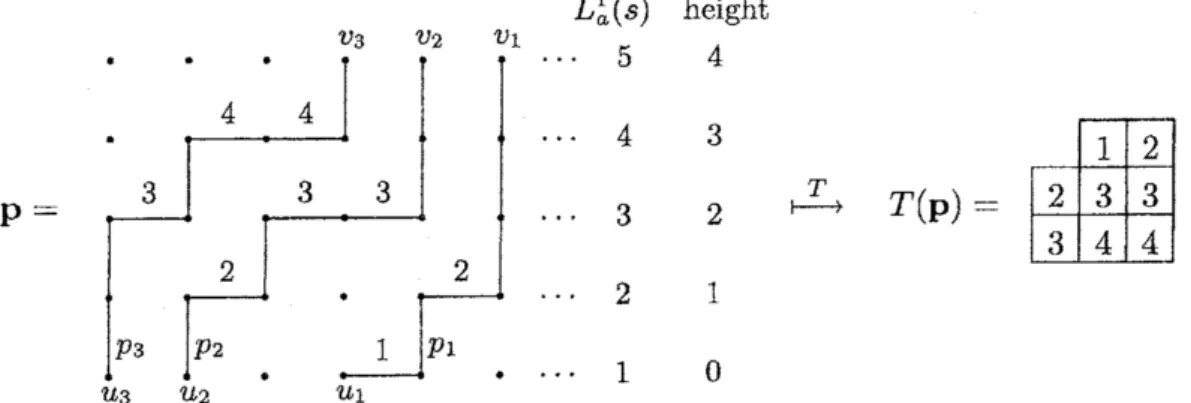
For any p $=(p_{1}, \ldots,p_{l})\in P(A_{n};\mu, \lambda)$
, we
associate atableau
$T(\mathrm{p})$ of shape$\lambda/\mu$ such that the ith
row
of $T(\mathrm{p})$ is given by $\{L_{a}^{1}(s)|s\in E(p_{i})\}$ listed in theincreasing order. See Figure 2 for
an
example. Clearly, $T(\mathrm{p})$ satisfiesthehorizontal
rule because of the $h$-labeling rule of p, and $T(\mathrm{p})$ satisfies the vertical rule sincep $\in P(A_{n};\mu, \lambda)$
do
not have any intersecting pairs of paths. Therefore,we
obtaina map
(4.5) $T:P(A_{n};\mu, \lambda)\ni \mathrm{p}\mapsto T(\mathrm{p})$ $\in \mathrm{T}\mathrm{a}\mathrm{b}(A_{n}, \lambda/\mu)$
for any skew diagrams $\lambda/\mu$
.
In fact,$L_{a}^{1}(s)$ height . . . 5 4
.
..
4 3 $\mathrm{p}=$. .
, 3 2 $\mapsto T$ $T(\mathrm{p})=$ . ., 2 1 . ..
10FIGURE 2. An example of$\mathrm{p}$ and the tableau $T(\mathrm{p})$ for $(\lambda, \mu)=((3^{3}),$(1)
$)$.
By Proposition 4.1 and 4.2,
we
reproduce the result of [5], Theorem 4.3 ([5]).If
$\lambda/\mu$ is a skew diagram, then$\chi_{\lambda/\mu,a}=\sum_{T\in \mathrm{T}\mathrm{a}\mathrm{b}(A_{\mathfrak{n}},\lambda/\mu)}z_{a}^{T}$
.
5. TABLEAUX DESCRIPT1ON OF TYPE $C_{n}$
In this section,
we
consider thecase
that $\mathfrak{g}$ is of type $C_{n}$.
5.1. Paths description. In view of the definition of the generating function of
$H_{a}(_{\backslash }z,$X) in (3.2),
we
definean
$h$-path and its $\mathrm{f}\mathrm{e}$-labelingas
follows:Definition
5.1. Considerthe lattice $\mathbb{Z}\rangle\langle$ $\mathbb{Z}$.
An
$h$-pathof
type $C_{n}$ is a path $uarrow vp$such that the initial point $u$ is at height $-n$ and the final point $v$ is at height $n$
,
and the number ofthe eastward steps at height 0 is
even.
Let $P(C_{n})$ denote theset of all the h-paths oftype $C_{n}$
.
For any $p\in P(C_{n})$, the $h$-labeling $(L_{a}^{1}, L_{a}^{2})$
of
tyPe $C_{n}$ associated to $a\in \mathbb{C}$ isdefined
as
in Figure 3. $L_{a}^{1}(s)$ height. .
. $\overline{n-1}$ 2. .
. $\overline{n}$ 1.
..
$\overline{n}$, $n$ 0.
..
$n$ -1 . ..
$n-1$ -2 $L_{a}^{2}(s)$By (3.2), we have
(5.1) $h_{r,a+2r-2}(z)=$ $\sum$ $z_{a}^{p}$,
$(0,-n\rangle rarrow(r,n)$
where $z_{a}^{p}$ is defined
as
in (4.1) by the $h$-labeling of type $C_{n}\wedge$For any skew diagram $\lambda/\mu$, let $l=d(\lambda\rangle$
,
and let $\mathrm{u}\mu=(u_{1}, \ldots, u_{l})$ and $\mathrm{v}_{\lambda}=$$(v_{1}, \ldots, v_{l})$ be $l$-tuples ofinitial and final points defined
as
$u_{i}=(\mu_{i}+1-\mathrm{i}, -n)$and $v_{i}=(\lambda_{i}+1-\mathrm{i}, n)$. As in the
case
of type $A_{n}$,we
set $;\mathrm{p}(C_{n}; \mathrm{u}_{\mu}, \mathrm{v}_{\lambda})$ be theset of$l$-tuples of paths $\mathrm{p}=$ $(p_{1}, \ldots,p\iota)$ such that
$u_{i}-arrow v_{\pi(i)}p_{i}$ for
some
permutation$\pi\in \mathfrak{S}_{l}$
.
anddefine
$z_{a}^{\mathrm{p}}$ and $(-1)^{\mathrm{p}}$ for any $\mathrm{p}\in \mathfrak{P}(C_{n}; \mathrm{u} \mathrm{v}_{\lambda})\mu$, and$a\in \mathbb{C}$ by the
$h$-labeling of type Cn. Then, the determinant (3.8)
can
be writtenas
$\chi_{\lambda/\mu,a}=\sum_{\mathrm{p}\in\S 3(C_{nj}\mathrm{u}_{\mu},\urcorner r_{\lambda})}(-1)^{\mathrm{p}}z_{a}^{\mathrm{p}}$,
by (5.1).
The first difference from the $A_{n}$
case
is that, theinvolution
$\iota$ is not definedon
all $\mathrm{p}=$ $(p_{1)}\ldots,p\iota)$ $\in;\mathfrak{p}(C_{n};\mathrm{u}_{\mu},\mathrm{v}_{\lambda})$ which
possess an
intersecting pair of paths$(p_{\iota},p_{g})$
,
because of the definition of the A-paths of tyPe $C_{n}$ (Definition 5.1). Todefine the involution for the $C_{n}$ case,
we
give the definition of the specially (resp.ordinarily) intersecting pair of paths (see [15]). Applying the method of $[10]_{7}$ all
$\mathrm{p}=$ $(\mathrm{p}\mathrm{i}, \ldots,p_{l})\in \mathrm{P}(\mathrm{C}\mathrm{n};\mathrm{u}_{\mu}, \mathrm{v}_{\lambda})$ with
an
ordinarily intersecting pair $(Pi,pj)$are
canceled, and
we
haveProposition 5.2. For any skew diagrams $\lambda/\mu$,
(5.2) $\chi_{\lambda/\mu,a}=$ $\sum$
$(-1)^{\mathrm{P}}z_{a}^{\mathrm{p}}$,
$\mathrm{p}\in P(C_{n};\mu,\lambda)$
where $P(C_{n}; \mu, \lambda)$ is the set
of
all$\mathrm{p}=(p_{11}\ldots ,p_{l})$ $\in \mathfrak{P}(C_{n}j\mathrm{u}_{\mu}, \mathrm{v}\lambda)$ which does nothave any ordinarily intersecting pair
of
paths $(p_{i}, \mathrm{P}j)$.
The second difference from$A_{n}$ is that, the
sum
(5.2) is alternating. However,we
conjecture that the
sum
(5.2) turns out to bea
positivesum
for any skew diagram$\lambda/\mu$
.
To obtaina
positive sum,we
use the relations(5.3) $z_{i,a}z_{\overline{i},a-2n+2i-4}=z_{i-1,a}z_{\overline{i-1},a-2n+2i-4}$, $\mathrm{i}=1$,$\ldots$
,
$n;a\in \mathbb{C}$.
The third difference isthat there exist
some
$\mathrm{p}\in P(C_{n}; \mu, \lambda)$ that have a“trans-posed” pair of paths $(p_{\dot{\mathrm{t}}},pj)$
.
(Roughly speaking, if the initial points $\mathrm{u}=(u_{1}, u_{2})$and final points $\mathrm{v}=(v_{1}, v_{2})$
are
in order and $u_{1}arrow p_{1}v_{2}$,
$u_{2}arrow p_{2}v_{1}$, then $(p_{1},p_{2})$ is called a transposed pair ofpaths. For example, $(p,p’)$ in Figure3
is transposed.)For such $\mathrm{p}$
, we cannot
definea
tableau of shape$\lambda/\mu$
as same
as $T(\mathrm{p})$ in (4.5),and therefore, the map $T$
on
$P(C_{n};\mu_{\gamma}\lambda)$ toa certain
set oftableaux
of shape $\lambda/\mu$cannot
bedefined
as same as
(4.5) of$A_{n}$.
5.2. Tableaux description. To
formulate
the tableaux description, we definea
tableau $T(\mathrm{p})$ for any p $=(p_{1}, \ldots p_{l})\in \mathfrak{P}(C_{n};\mu, \lambda)$ such that any pair of paths
$(p_{i},p_{j})$ is neither ordinarily intersecting
nor
transposed. Thenwe
havea
weight-preserving bijectionas
in (4.5), where $\tilde{P}(C_{n}; \mu, \lambda)$ is theset
of all $\mathrm{p}\in \mathfrak{P}(C_{n};\mathrm{u}_{\mu’\lambda}\mathrm{v})$which do not haveany transposed pair of paths. The set $\overline{\mathrm{T}\mathrm{a}\mathrm{b}}(C_{n}, \lambda/\mu)$
can
also be described by theset of all tableaux $T$ of shape $\lambda/\mu$ which satisfy the following “horizontal” and
$(‘ \mathrm{v}\mathrm{e}\mathrm{r}\mathrm{t}\mathrm{i}\mathrm{c}\mathrm{a}\mathrm{l}’)$ rules
as
in the $A_{n}$ case, which reduce to the rules (H) and (V) for $C_{n}$ in(3.7) and (3.6), when $\lambda/\mu$ is a
one-row
diagram for (H) and one-column diagramfor (V).
(H) Each $(i,j)\in\lambda/\mu$satisfies both of the following conditions:
$\bullet$ $T(\mathrm{i}, j)\preceq T(\mathrm{i},j+1)$
or
$(T(\mathrm{i},j)$,$T(\mathrm{i},j+1))=(\overline{n}, n)$.$\bullet$ $(T(i, j-1),T(\mathrm{i},j)$,$T(i, j+1))\neq(\overline{n},\overline{n}, n)$, $(\overline{n}, n, n)$
.
(V) Each $(\mathrm{i},j)\in\lambda/\mu$ satisfies at least
one
ofthe following conditions:$\bullet T(\mathrm{i}, j)\prec T(\mathrm{i}+1,j)$
.
$\bullet$ $T(\mathrm{i}, j)=T(\mathrm{i}+1, j)=n$, $(i+1, j-1)\in\lambda/\mu$ and $T(i+1,j-1)=\overline{n}$.
$\bullet$ $T(i, j)=T(\mathrm{i}+1, j)=\overline{n}$
,
$(\mathrm{i},j+1)\in\lambda/\mu$ and $T(\mathrm{i}, j+1)=n$.We expect that the alternating sum (5.2) $\underline{\mathrm{c}\mathrm{a}\mathrm{n}}$be translated into
a
positivesum
by a certain set of tableaux $\mathrm{T}\mathrm{a}\mathrm{b}(C_{n}, \lambda/\mu)\subseteq \mathrm{T}\mathrm{a}\mathrm{b}(C_{n}, \lambda/\mu)$
as
(5.5) $\chi_{\lambda/\mu,a}=\sum_{T\in \mathrm{T}\mathrm{a}\mathrm{b}(C_{n)}\lambda/\mu)}z_{a}^{T}$
.
Thus, the tableaux in $\mathrm{T}\mathrm{a}\mathrm{b}(C_{n}, \lambda/\mu)$
are
described by a horizontal rule and thevertical rule with
an
$‘’.\mathrm{e}\mathrm{x}\mathrm{t}\mathrm{r}\mathrm{a}^{7\}}$ rule which selects them out of$\overline{\mathrm{T}\mathrm{a}\mathrm{b}}(C_{n}, \lambda/\mu)$.
The idea in [15] to obtain from (5.2) is
as
follows: We introducesome
weight-preserving, sign-inverting injections which “resolves”
a
transposed pair of paths,which is well-defined if $d(\lambda)\leq n$
.
$\prime \mathrm{r}\mathrm{h}\mathrm{e}$ relation in (5.3) playsa
crucial role forthe weight-preserving property of these injections. Then, we
can
show that thecontributions for (5.2) from all $\mathrm{p}$ with a transposed pair of paths almost cancel
with each other.
In the following subsection, we givethetableauxdescription for$\lambda/\mu$ of$d(\lambda)=2$
.
In this case, the set $\tilde{P}(C_{n}; \mu, \lambda)$ is exactly the set of all $\mathrm{p}=(p_{1},p_{2})\in P(C_{n};\mu)\lambda)$
such that $(\mathrm{P}\mathrm{t}, p_{2})$ is not transposed. Moreover,
we
do not have to consider anycancellations between all the transposed pairs $\mathrm{p}=(p_{1},p_{2})$
.
The contributions forallthe transposed pairs $\mathrm{p}=(p_{1},p_{2})$
are
all negative,which turn intothe extrarule.5.3. Skew diagrams of two
rows.
Let $\mathrm{T}\mathrm{a}\mathrm{b}(C_{n}, \lambda/\mu)$ be the set ofall theHV-tableaux $T$ with the following extra condition:
(E-2R) If $T$
contains a
subtableau (excluding $a$ and $b$)(5.6)
where $k$ is
an
odd number, then at leastone
ofthe following conditions holds:(1) Let $(\mathrm{i}_{1},j_{1})$ be the position of the top-right
corner
of thesubtableau
(5.6).Then $(\mathrm{i}_{1},j_{1}+1)\in\lambda/\mu$ and $a:=T(\mathrm{i}_{1},j_{1}+1)=n$
.
(2) Let (i2,$j_{2}$) betheposition ofthe
bottom-left
corner
of thesubtableau
(5.6).Then $(\mathrm{i}_{2_{\mathrm{J}}}j_{2}-1)\in\lambda/\mu$
and
$b:=T(i_{2},j_{2}-1)=\overline{n}$.
Then
Theorem
5.3.
For any skern diagrams $\lambda/\mu$ with $d(\lambda)=2$ andn
$\geq 2$, the equalityheight
.
.
.
2.
.
.
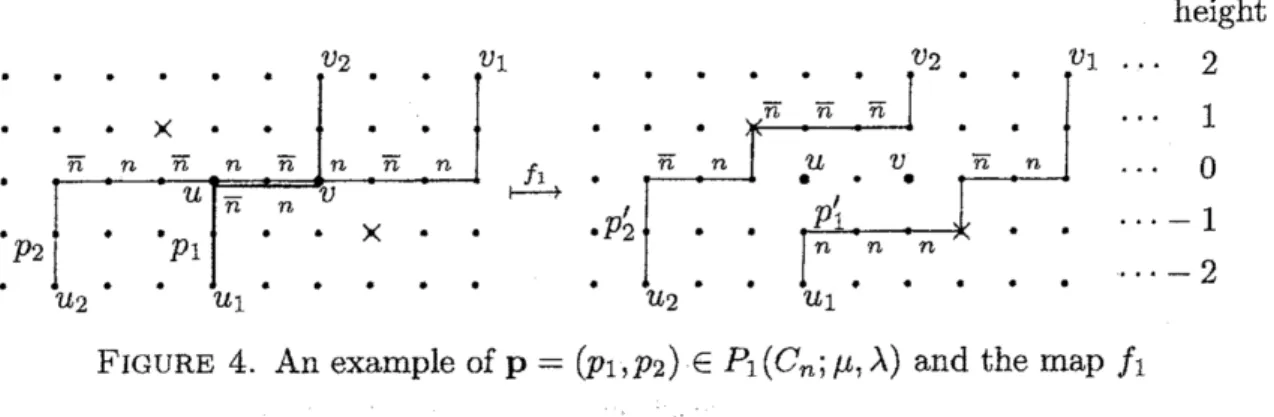
1 0 $\ldots-1$ $\ldots-2$FIGURE 4. An example of$\mathrm{p}=(p_{1},p_{2})\in P_{1}(C_{n}; \mu, \lambda)$ and the map $f_{1}$
Proof.
Let$P_{1}(C_{n};\mu, \lambda)$ (resp.$P_{0}$($C_{n};\mu$,
$\lambda$) ) bethesetof all$\mathrm{p}=(p_{1},p_{2})\in P(C_{n}; \mu, \lambda)$such that $(p_{1},p_{2})$ is transposed (resp. ($P1$
,
$P2$) is not transposed). In this case,we
have $P_{0}(C_{n}; \mu, \lambda)=\tilde{P}(C_{n}; \mu, \lambda)$.
Define
a
weight-preserving, sign-inverting injection$f_{1}$ : $P_{\mathrm{I}}(C_{n};\mu, \lambda)arrow P_{0}(C_{n^{4}}, \mu, \lambda)$
as
follows (see Figure 4 for example): Let $u$ (resp. $v$) be the leftmost (resp.right-most) intersecting point of$p_{1}$ and $p_{2}$
at
height 0, Weassume
that $u-(0, 1)$ and$v+(0,1)$ is
on
$p_{1}$ while $u-(1,0)$ and $v+(1,0)$ ison
$p_{2}$.
Set $f1(p_{1},p_{2})=(p_{1}’,p_{2}’)$ by$p_{1}’$ : $u_{1}arrow p_{1}$ u-l- $(0, -1)arrow v+(1, -1)arrow v+(1, 0)arrow v_{1}\mathrm{P}2$,
$p_{2}’$ : $u_{2}arrow uP2+(-1, \mathrm{O})arrow u+(-1,1)arrow v+(0, 1)parrow v_{2}1$
.
Roughly speaking, $f1$ resolves the transposed pair $(p_{1},p_{2})$
.
from (5.2) and (5.4),we
have$\chi_{\lambda/\mu,a}=\sum_{T\in\overline{\mathrm{T}\mathrm{a}\mathrm{b}}(C_{n},\lambda/\mu)}z_{a}^{T}-\sum_{\mathrm{p}\in{\rm Im} f_{1}}z_{a}^{T(\mathrm{p})}$
.
The set $\{T(\mathrm{p})|\mathrm{p}\in{\rm Im} f1\}$ consists ofall the tableaux in $\overline{\mathrm{T}\mathrm{a}\mathrm{b}}(\mathrm{C}_{n}, \lambda/\mu)$prohibited
by the extra rule (E-2R). $\square$
5.4.
Conjectureon
the implicit form of the extra rule. Let $P_{1}(C_{n};\mu, \lambda)$ bethe set of all $\mathrm{p}=$ $(p_{1}, \ldots,pl)\in P(C_{n};\mu, \lambda)(l=d(\lambda))$ such that
one
pair ofpaths$(p_{i},pj)$ is transposed. Let $P_{1}^{i,i+1}(C_{n}; \mu, \lambda)$ be the set of$\mathrm{p}\in P_{1}(C_{n};\mu, \lambda)$ such that
thepair $(p_{i_{2}}p_{i+1})$istransposed. Then
we
have$P_{1}(C_{n}; \mu, \lambda)=\sum_{i=1}^{l-1}P_{1}^{i_{1}\iota+1}(C_{n)}.\mu, \lambda)$.
We conjecture that
one can
always resolve the transposed pair $(Pi,p_{i+1})$(with-out producing any ordinarily intersections)
and
definea
weight-preserving, sign-inverting injection $f_{1}^{\iota,\mathrm{z}+1}$ : $P_{1}^{i,i+1}$$(C_{n} ; \mu, \lambda)$ $arrow P_{0}(C_{n};\mu, \lambda)$.
Furthermore,we
conjec-ture thatConjecture 5.4. For any skew diagram $\lambda/\mu$
of
$d(\lambda/\mu)\leq n$,Tab$(C_{n}, \lambda/\mu)=\overline{\mathrm{T}\mathrm{a}\mathrm{b}}(C_{n}, \lambda/\mu)\backslash \{T(\mathrm{p})|\mathrm{p}\in\bigcup_{i=\mathrm{I}}^{d(\lambda)-1}{\rm Im} f_{1}^{\dot{x},i+1}\}$
.
In other words, for
a
tableau $T\in\overline{\mathrm{T}\mathrm{a}\mathrm{b}}(C_{n}, \lambda/\mu)$, the extra rule (E), which givesthe condition for $T$ to bein Tab$(C_{n}, \lambda/\mu)$
,
is implicitlystated
in terms of pathsas
follows:
(E) If $\mathrm{p}\in P(C_{n};\mu, \lambda)$ corresponds to $T$, then $\mathrm{p}$ is not obtained from
some
REFERENCES
[1] T. Akasaka, M. Kashiwara, Finite-dimensional representations of quantum affine algebras, Publ. ${\rm Res}$
.
Inst. Math. Sci. 33 (1997), no 5, 839-867,[2] T. Arakawa, private communication,
[3] T. Arakawa, Drinfeld functor and
finite-dimensional
representations of Yangian, Comm. Math. Phys. 205 (1999), no. 1, 1-18.[4] T. Arakawa, T. Suzuki, Duality between 5$\mathrm{I}_{n}(C)$ and the degenerate affine Hecke algebra, J.
Algebra 209 (1998), no. 1, 288-304.
[5] V. V. Bazhanov, N. Reshetikhin, Restrictedsolid-on-solid modelsconnected with simply laced algebras and confomal
field
theory, J. Phys. A 23 (1990), no. 9, 1477-1492.CK V. Chari, M. Kleber, Symmetricfunctions andrepresentations ofquantumaffinealgebras, Contemp. Math. 297 (2002), 27-45.
[6] V. Chari, A. Pressley, Quantum affine algebras and their representations, Canadian Math. Soc. Conf. Proc. 16 (1995), 59-78.
[7] V. Chari,A. Pressley, A Guide to Quantum Groups, Cambridge UniversityPress,Cambridge, 1995.
[8] E. Frenkel, N. Reshetikhin, Quantum
affine
algebras and deformations ofthe Virasoro and$\mathcal{W}$ algebras, Comm, Math. Phys. 178 (1996) 237-264.
[9] E. Frenkel, N. Reshetikhin, The $q$-characters ofrepresentations ofquantum
affine
algebrasand
deformations
of$\mathcal{W}$-algebras, Contemp. Math. 248 (1999), 163-205.[10] I. Gessel, G. Viennot, Binomial deterrninants, paths, and hook length formulae, Adv. in Math. 58 (1985), no. 3, 300-321.
KNS
[11] A Kuniba, Y. Ohta, J. Suzuki, Quantum Jacobi-$I[]\backslash ud\mathrm{i}$ and Giambelli
fomulae
for$U_{q}(B_{r}^{(1)})$from the analytic Bethe ansatz, J. Phys. A 28 (1995), no. 21, 6211-6226.
[12] A. Kuniba, M. Okado, J. Suzuki, Y. Yamada, DifferenceL operatorsrelated to q-characters, J. Phys. A 35 (2002), no.6, 1415-1435.
[13] A. Kuniba, J. Suzuki, Analytic Bethe ansatzfor
fundamental
representations of Yangians, Comm, Math. Phys. 173 (1995), no. 2, 225-264.LR
[14] I. G. Macdonald, Symmetr$\tau\dot{\tau}c$functions and Hall polynomials, 2nd ed., Oxford Univ. Press,
Oxford, 1995.
[15] W. Nakai, T. Nakanishi, Paths, tableaux, and $q$-characters of quantum affine algebras: the
$c_{n}$ case, in preparation.
[16] B. E. Sagan, The Symmetric Group. Representations, CombinatorialA$lg_{\mathit{0}?\mathrm{Y}}\mathrm{f}hms$, and
Syrn-metric Functions, 2nd ed., GraduateTexts in Mathematics203, Springer-Verlag, New York,