
ON THE ENDOSCOPIC LIFTING OF SIMPLE SUPERCUSPIDAL REPRESENTATIONS OF CLASSICAL GROUPS (Automorphic Forms and Related Topics)
8
0
0
全文
(2) 168. Here. W_{F}. is the Weil group of F Thus we get a pair of L ‐packets $\Pi$_{ $\phi$} \subset $\Pi$(G) and $\Pi$_{ $\iota$\circ $\phi$} \subset which are related via the natural operation on the dual side. In this situation, .. $\Pi$(\mathrm{G}\mathrm{L}_{N}(F). call the unique representation in $\Pi$_{ $\iota$\circ $\phi$} the endoscopic lifting of $\Pi$_{ $\phi$} from G to \mathrm{G}\mathrm{L}_{N}(F) endoscopic character relation is an equality of characters of representations in these. we. .. Then the. L ‐packets, and characterizes the. endoscopic lifting representation‐theoretically:. $\Theta$_{$\pi,\ theta$}(g)=h\displayst le\mapstog$\pi$G\in$\Pi$\sum\frac{D_{G}(,h)^{2}{D_{\mathrm{G}\mathrm{L}_{N}$\theta$}(g)^{2}$\Delta$_{G,\mathrm{G}\mathrm{L}_{N}(h,g)\sum_{$\rho$}, \Theta$_{$\pi$}G(h). ,. Here, \bullet \bullet \bullet. \bullet. $\pi$. to. \mathrm{G}\mathrm{L}_{N}(F). ,. $\Theta$_{ $\pi$}G (resp. $\Theta$_{ $\pi,\ \theta$} ) is the character of $\pi$_{G} (resp. the $\theta$ ‐twisted character of $\pi$ ), D_{G} (resp. D_{\mathrm{G}\mathrm{L}_{N}, $\theta$} ) is the Weyl‐discriminant (resp. the $\theta$‐twisted Weyl‐discriminants),. $\Delta$_{G,\mathrm{G}\mathrm{L}_{N} g is. \bullet \bullet. endoscopic lifting of $\Pi$_{ $\phi$} from G. is the. the. is the Kottwitz‐Shelstad transfer. strongly $\theta$‐regular $\theta$ ‐semisimple. a. sum. is. over. Since the characters of. stable. factor,. element of. conjugacy classes of. \mathrm{G}\mathrm{L}_{N}(F). ,. and. h\in G of g.. norms. representations satisfy the linear independence, this equality charac‐. terizes the each L ‐packets of G.. Here. we. consider the. following. Describe the local. natural. problem:. Langlands correspondence for. \mathrm{G}. explicitly.. Then, from the above formulation of the local Langlands correspondence for \mathrm{G} problem into the following two problems:. ,. we can. divide. this. (1). For. (2). endoscopic character relation. Determine the L ‐parameter corresponding. given irreducible smooth representation $\pi$_{G}\in $\Pi$(G) determine the finite subset of $\Pi$(G) containing $\pi$_{G} and the representation $\pi$ of \mathrm{G}\mathrm{L}_{N}(F) satisfying the. a. ,. ( L‐packet). to. $\pi$.. Namely, we can divide the problem of explicit description of the local Langlands correspon‐ dence for \mathrm{G} into the problems of explicit description of the endoscopic lifting from \mathrm{G} to \mathrm{G}\mathrm{L}_{N} and the local. Langlands correspondence for \mathrm{G}\mathrm{L}_{N}.. In this. article, we report on some results on the first problem for simple supercuspidal representations, which were introduced by Gross‐Reeder in [GR10], of quasi‐split classical groups.. Notation.. integers,. Let p be its maximal. an. image of points \mathrm{G}(F) by G. \overline{x} denotes the. odd. ideal, x. prime. number. We fix. and its residue field. in k. .. For. an. algebraic. a. p‐adic field F. by \mathcal{O}, \mathfrak{p}. ,. group \mathrm{G}. and k , over. F,. .. We denote its. respectively. we. For. ring of x. \in. \mathcal{O},. denote its F ‐rational. Acknowledgement.. The author would like to thank Professor Shoyu Nagaoka and Pro‐ fessor Yoshinori Mizuno for giving him an opportunity to talk in the conference. The author is also grateful to his supervisor Yoichi Mieda for his helpful support and encouragement. This work. was. supported by the Program for Leading Graduate Schools, MEXT, Japan..
(3) 169. 2. SIMPLE SUPERCUSPIDAL REPRESENTATIONS OF CLASSICAL. GROUPS. We recall the definition of. [GR10]. See. or. We first take a. simple supercuspidal representations of classical groups briefly. for the details of the arguments in this section. quasi‐split classical group \mathrm{G} over F that is a general linear group, an unitary. [\mathrm{O}\mathrm{i}\mathrm{l}6\mathrm{b}] a. ,. group, or a special orthogonal group. For simplicity, we assume that \mathrm{G} F‐split maximal torus \mathrm{T} of G. Then it defines an apartment \mathcal{A}(\mathrm{G}, \mathrm{T}) of. symplectic. group, is split. We fix. an. the Bruhat‐Tits. building of G. By taking a fundamental alcove C of this apartment, we get corresponding Iwahori subgroup I of G which is a minimal parahoric subgroup of G If we take a point \mathrm{x} of the closure of C then we get a filtration of I by the Moy‐Prasad theory. We take this point \mathrm{x} to be the barycenter of the alcove C and denote the first two steps of the filtration by I^{+} and I^{++} Then we have an isomorphism the. .. ,. ,. ,. .. I^{+}/I^{++}\cong k^{\oplus l+1}, where l is the rank of G. For the. following \bullet \bullet. an. character $\chi$ of I^{+} ,. we. say that $\chi$ is. affine generic if $\chi$. satisfies. two conditions:. $\chi$ is trivial on I^{++} , and $\chi$ is not trivial on every summand k of. I^{+}/I^{++}.. Let $\chi$ be an character of ZI^{+} such that $\chi$|_{I+} is affine generic. Here Z is the F ‐valued of the center \mathrm{Z} of G Then we define the normalizer N_{G}(I^{+}; $\chi$) of $\chi$ as follows:. points. .. N_{G}(I^{+}; $\chi$):=\{n\in N_{G}(I^{+}) |$\chi$^{n}= $\chi$\}. Here. N_{G}(I^{+}). is the normalizer of I^{+} in G , and. $\chi$^{n}. is the twist of $\chi$ via. $\chi$^{n}(x):= $\chi$(nxn^{-1}) Now. we can. define. n. defined. by. .. simple supercuspidal representations of G. .. We have the. following key. proposition:. Proposition. (1). 2.1.. We have. a. decomposition. \displayst le\mathrm{c}-\mathrm{I}\mathrm{n}\mathrm{d}_{ZI+}^{G}$\chi$\cong\bigoplus_{\tilde{$\chi$}\dim(\tilde{$\chi$})\cdot$\pi$_{\overline{$\chi$}. Here the $\chi$. sum. (namely,. is. over. the set. of. irreducible representations. irreducible constituents. of. \mathrm{c}-\mathrm{I}\mathrm{n}\mathrm{d}_{ZI+}^{N_{G}(I^{+}; $\chi$)} $\chi$ ),. of N_{G}(I^{+}; $\chi$) containing. and $\pi$_{\overline{$\chi$}. :=. \mathrm{c}-\mathrm{I}\mathrm{n}\mathrm{d}_{N_{G}(I+, $\chi$)}^{G}(\tilde{ $\chi$}). Moreover, each $\pi$_{\overline{$\chi$} is irreducible, hence supercuspidal. (2) For an another pair ($\chi$', $\chi$ $\pi$_{\overline{ $\chi$} \cong$\pi$_{\overline{ $\chi$}^{J} if and only if $\chi$^{n}\cong$\chi$' and \tilde{ $\chi$}^{n}\cong(\tilde{ $\chi$}')^{n} for. n\in N_{G}(I^{+}). .. some. .. We call the irreducible supercuspidal representations of G obtained in this way simple supercuspidal representations. By computing the normalizer N_{G}(I^{+}) of I^{+} we can describe the set of equivalence classes of simple supercuspidal representations explicitly. For example, in the case of \mathrm{G}\mathrm{L}_{N} we can compute an Iwahori subgroup and the set of simple supercuspidal representations as follows: ,. ,. Example. 2.2. (the. case. of. \mathrm{G}=\mathrm{G}\mathrm{L}_{N} ). We take. \mathrm{T} to be the. diagonal maximal torus, and corresponding to the upper‐ subgroup and its filtration are. choose the fundamental alcove C contained in the chamber. triangular. Borel. subgroup.. Then the. corresponding. Iwahori.
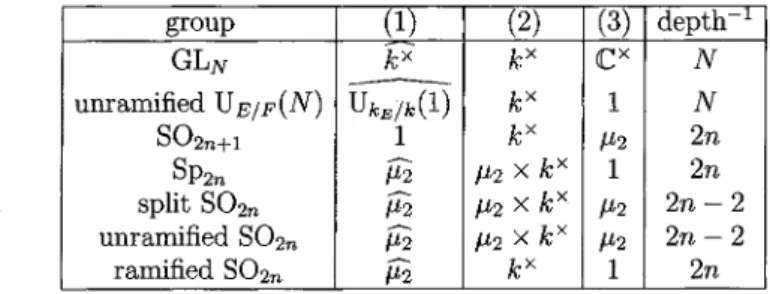
(4) 170. given by I=. \left(bgin{ary}l \mathcl{O}^\times}& \mathcl{O}\ &dots&\ mathfrk{p}& \mathcl{O}^\times} \nd{ary}\ight) \left(bgin{ar y}{l 1+&\mathfrk{p}& \mathcl{O}\ & \dots&\ mathfrk{p}& 1+\mathfrk{p} \end{ar y}\ight) I^{+}=. ,. ,. and. I^{+ }=\left(\begin{ar y}{l } & & \ & & \ & & \ & & \end{ar y}\right). The normalizer of I in G is. given by. Z_{G}I\langle$\varphi$_{a}\},. for any a\in k^{\times} , where Z_{G} is the center of G and $\varphi$_{a} is. a. matrix defined. as. follows:. \left(\begin{ar y}{l 0&I_{N-1}\ $\varpi$a&0 \end{ar y}\right).. Here I_{N-1} is the unit matrix of size N-1 and ca is a uniformizer of F Note that we have classes of simple supercuspidal representations of G $\varphi$^{N}= $\varpi$ a Then the set .. of—equivalence. .. is. parametrized by. we. define. a. the set k^{\times} \times k^{\times} \times \mathbb{C}^{\times}. character. \tilde{ $\chi$}_{( $\omega$,a, $\zeta$)}. of. .. To be. precise, for ( $\omega$, a, $\zeta$) \in\hat{k^{\times}}\times k^{\times} \times \mathbb{C}^{\times},. more. ZI^{+}\langle$\varphi$_{a^{-1} \rangle by. z\in k^{\mathrm{X}}=\mathrm{Z}(k)\subset Z, \tilde{ $\chi$}_{( $\omega$,a, $\zeta$)}(z) := $\omega$(z) \tilde{ $\chi$}_{( $\omega$,a, $\zeta$)}(x) := $\psi$(\overline{x_{12}}+\cdots+\overline{x_{N,N-1}}+a\overline{$\varpi$^{-1}x_{N1}}) \tilde{ $\chi$}_{( $\omega$,a, $\zeta$)}($\varphi$_{a}):= $\zeta$. for. Here. we. fixed. a. non‐trivial additive character. \mathrm{c}-\mathrm{I}\mathrm{n}\mathrm{d}_{ZI+}^{G}\langle\tilde{ $\chi$}. is. a. for. x=(x_{ij})_{ij}\in I^{+}. ,. and. $\psi$ of k Then the representation $\pi$(w,a, $\zeta$) := simple supercuspidal representation, and we can check that every. simple supercuspidal representation of \mathrm{G}\mathrm{L}_{N}(F). .. is. equivalent. to $\pi$( $\omega$,a, $\zeta$) for. a. unique ( $\omega$, a, $\zeta$)\in. k^{\times} \times k^{\times} \times \mathbb{C}^{\times}.. In a similar way to this example, we can compute sets of representatives of simple su‐ percuspidal representations of quasi‐split classical groups, and parametrize them by triples consisting of. (1) a central character $\omega$, (2) an (equivalence class of an affine generic (3) images of the normalizer of $\chi$. Moreover,. as. in the above. characters whose zero. only. one. element of k^{\times} , and. computation,. we. get the. example, the or. we. set of. character $\chi$. (2). on. I^{+} and ,. is in fact exhausted. by affine generic. components of k^{\oplus l+1} (\cong I^{+}/I^{++}) are twisted by a non‐ parametrize them by k^{\times} or $\mu$_{2} \times k^{\times} By a case‐by‐case. two. can. following. .. table:. Remark 2.3. In the above parametrization of simple supercuspidal representations, we have to fix some non‐canonical data. For example, in the case of \mathrm{G}\mathrm{L}_{N} in order to parametrize the ,. generic characters of I^{+} we have to fix a uniformizer $\varpi$ of F and a non‐trivial additive character $\psi$ of k In the case of the unitary group \mathrm{U}_{E/F}(N) attached to an unramified quadratic extension E/F we have to fix a trace‐zero element of set of. equivalence. classes of affine. ,. .. ,.
(5) 171. Parametrizing. TABLE 1.. depth of simple supercuspidal. sets and the. represen‐. tations of classical groups. the residue field. k_{E} of E. non‐canonical and. in addition to. depend. on. $\varpi$. and $\psi$. Thus the above. .. parametrizations. are. such data.. Remark 2.4. We can characterize the simple supercuspidal representations via the depth of admissible representations. For an admissible representation $\pi$ of G we can define the depth of $\pi$ which is a non‐negative rational number, by using the Moy‐Prasad theory. Then we can check that an irreducible admissible representation $\pi$ of G is simple supercuspidal if and ,. ,. only if. $\pi$. has the minimal. positive depth. positive depth is given by the of \mathrm{G}\mathrm{L}_{N} it is \displayst le \frac{1} N .. the minimal in the. case. In the. of. split. \mathrm{G}, example,. connected reductive group. ,. 3. MAIN First. case. inverse of the Coxeter number of G. For. explain. we. We treat the. the. endoscopic. endoscopic. RESULTS. groups which. we. consider in this article. We put. J_{N}:=\left(\begin{ar y}{l & &1\ & -1&\ &\cdot& \ (-\mathrm{l})^N-1}& & \end{ar y}\right). groups of the. following. four types:. (1) (\mathrm{G}, \mathrm{H})=(\mathrm{G}\mathrm{L}_{2n}, \mathrm{S}\mathrm{O}_{2n+1}) : Let $\theta$ be an automorphism of \mathrm{G}\mathrm{L}_{2n} over F defined by J_{2n}{}^{t}g^{-1}J_{2n}^{-1} Then \mathrm{S}\mathrm{O}_{2n+1} is an endoscopic group for (\mathrm{G}\mathrm{L}_{2n}, $\theta$) with respect $\theta$(g) =. to. a. .. natural. embedding. of L ‐groups:. L\mathrm{H}=\mathrm{S}\mathrm{p}_{2n}(\mathbb{C})\times W_{F}\l corner+\mathrm{G}\mathrm{L}_{2n}(\mathbb{C})\times W_{F}=L\mathrm{G}. (2) (\mathrm{G}, \mathrm{H})=({\rm Res}_{E/F}\mathrm{G}\mathrm{L}_{N}, \mathrm{U}_{E/F}(N)) :. Let. E/F. be. an. unramified. quadratic. extension. of f\succ‐adic fields. Let $\theta$ be an automorphism of {\rm Res}_{E/F}\mathrm{G}\mathrm{L}_{N} over F defined by J_{N}^{t}c(g)^{-\mathrm{I} J_{N}^{-1} Here c is the Galois conjugation of the quadratic extension E/F .. the. unitary. to the. group. \mathrm{U}_{E/F}(N). following embedding. is. an. endoscopic. group for. of L ‐groups:. ({\rm Res}_{E/F}\mathrm{G}\mathrm{L}_{N}, $\theta$). L\mathrm{H}=\mathrm{G}\mathrm{L}_{N}(\mathbb{C})\rangle\triangleleft W_{F}\rightar ow(\mathrm{G}\mathrm{L}_{N}(\mathbb{C})\times \mathrm{G}\mathrm{L}_{N}(\mathbb{C}) \rangle\triangleleft W_{F}=L\mathrm{G} gx $\sigma$\mapsto(g, J_{N}^{t}g^{-1}J_{N}^{-1})\rangle\triangleleft $\sigma$.. $\theta$(g)= .. Then. with respect.
(6) 172. (3) (\mathrm{G}, \mathrm{H})=(\mathrm{G}\mathrm{L}_{2n+1}, \mathrm{S}\mathrm{p}_{2n}) :. $\theta$(g)=J_{2n+1}{}^{t}g^{-1}J_{2n+1}^{-1}. to. a. natural. Let $\theta$ be. Then. .. embedding. \mathrm{S}\mathrm{p}_{2n}. is. automorphism of \mathrm{G}\mathrm{L}_{2n+1} over F defined by endoscopic group for (\mathrm{G}\mathrm{L}_{2n+1}, $\theta$) with respect. an. an. of L ‐groups:. L\mathrm{H}=\mathrm{S}\mathrm{O}_{2n+1}(\mathbb{C})\times W_{F}\mapsto \mathrm{G}\mathrm{L}_{2n+1}(\mathbb{C})\times W_{F}=L\mathrm{G}. (4) (\mathrm{G}, \mathrm{H})= ( \mathrm{G}\mathrm{L}_{2n}. ramified \mathrm{S}\mathrm{O}_{2n} ): Let. E/F. be a ramified quadratic extension of p‐ \ma t h r m { G } \ ma t h r m { L } _ { 2 n} over F defined by $\theta$(g)=J_{2n}{}^{t}g^{-1}J_{2n}^{-1}. automorphism Then the non‐split quasi‐split even special orthogonal group \mathrm{S}\mathrm{O}_{2n,E} corresponding to E/F is an endoscopic group for (\mathrm{G}\mathrm{L}_{2n}, $\theta$) with respect to the following embedding of ,. adic fields. Let $\theta$ be. of. an. L ‐groups:. L\mathrm{H}=\mathrm{S}\mathrm{O}_{2n}(\mathbb{C})\rangle\triangleleft W_{F}\mapsto \mathrm{G}\mathrm{L}_{2n}(\mathbb{C})\times W_{F}=L\mathrm{G} g\rangle\triangleleft 1\mapsto g\rangle\triangleleft 1, 1. Here,. Now. we. w. is the. state. our. Theorem 3.1. Let above. four types.. following. \aleph $\sigma$\mapsto. \left{bginary}{l 1\ranglemthr{}$\sigma&\ thrm{i}\athrm{f}$\sigma nW_{E},\ wrangle\ti left$\sigma&\ thrm{o}\athrm{}\athrm{}\athrm{e}\athrm{}\athrm{w}\athrm{i}\athrm{s}\athrm{e}. \nd{ary}\ight.. element:. w:=\left(\begin{ar y}{l &0&1&\ I_{n-1}&\mathrm{l}&0&I_{n-1} \end{ar y}\right). main results.. (\mathrm{G}, \mathrm{H}). be. a. pair of connected reductive. a one of the corresponding lifting of $\Pi$_{$\phi$_{H}. groups overF which is. Let r\mathrm{r}_{H} be a simple supercuspidal representation of H, $\phi$_{H} the L ‐parameter (thus its L ‐packet \mathrm{I}\mathrm{I}_{$\phi$_{H} contained $\pi$_{H} ), and $\pi$_{G} be the endoscopic to G.. (1). In the case of (1), the L ‐packet $\Pi$_{$\phi$_{H} is a singleton and $\pi$_{G} is again simple supercus‐ pidal. Moreover, if $\pi$_{H} corresponds to (1, a, $\zeta$) in the sense of the parametrization in Table 1, then $\pi$_{G} corresponds to (1, 2a, $\zeta$) In the case of (2), the L ‐packet $\Pi$_{$\phi$_{H} is a singleton and $\pi$_{G} is again simple supercus‐ (2) pidal. Moreover, if $\pi$_{H} corresponds to ( $\omega$, a, 1) in the sense of the parametrization in Table 1, then $\pi$_{G} corresponds to .. \left\{ begin{ar y}{l ($\omega$,a -$\omega$(-1) &ifNisev n\ ($\omega$,a$\epsilon,\ omega$(-1) &ifNisod , \end{ar y}\right. where. $\epsilon$. is the. fixed. trace‐zero element. of the. residue. field of. E used in the. parametriza‐. tion in Table 1.. (3). In the. of (3), the L ‐packet $\Pi$_{$\phi$_{H} consists of the adjoint orbit of $\pi$_{H} The order of 2, and its endoscopic lifting $\pi$_{G} is an irreducible tempered represen‐ of G given by case. .. this L ‐packet is tation. \mathrm{I}\mathrm{n}\mathrm{d}_{P_{2n,1} ^{G}$\pi$\ovalbox{\t \smal REJECT}$\omega$_{$\pi$},.
(7) 173. where. is the F ‐valued. P_{2n,1}. points of. group is given by \mathrm{G}\mathrm{L}_{2n}\times \mathrm{G}\mathrm{L}_{1}, and $\omega$_{ $\pi$} is the central character. (4). In the. case. idal.. of (4),. (1). Remark 3.2.. the L ‐packet. The result in the. $\pi$. is. of. $\pi$.. a a. \mathrm{I}\mathrm{I}_{$\phi$_{H}. is. case. of. parabolic subgroup of \mathrm{G}\mathrm{L}_{2n+1} whose Levi sub‐ simple supercuspidal representation of \mathrm{G}\mathrm{L}_{2n_{J} a. singleton. (1). was. and $\pi$_{G} is. again simple. also obtained. by Adrian. .. (3). in. [Adr15]. assumption that p\geq (e+2)(2n+1) , where e is the absolute ramification index of F Thus our result (1) is new for 2<p<(e+2)(2n+1) under the. (2). supercusp‐. .. The L ‐embedding considered in the. embedding, and there ding from L\mathrm{H} to L\mathrm{G}. details). In the. cases. of. (3). case. (2). of. exists another .. For this. and. (4),. is called the standard base. change. embedding called the twisted base change embed‐ embedding we have analogous results (see [\mathrm{O}\mathrm{i}\mathrm{l}6\mathrm{b}] for. we can. cuspidal representations explicitly. as. determine the in. (1). and. (2).. correspondence of simple super‐ This computation is in progress. now.. (4) By. the works of Bushnell‐Henniart. explicit description of. ([BH05]). and Imai‐Tsushima. L ‐parameters of. ([IT15]),. we. have. an. simple supercuspidal representations of \mathrm{G}\mathrm{L}_{N}. Thus combining it with the above theorem, we get an explicit description of the L‐ parameters of simple supercuspidal representations of classical groups of the above types.. Finally. on a rough outline of the proof of the above theorem. We show the by case‐by‐case arguments. (1), (2): The key point of the proof in these cases is to start from a simple supercuspidal representation of G not H To show the assertions directly, we first have to determine the structure of the L ‐packet containing $\pi$_{H} However, if we start from a simple supercuspidal representation $\pi$_{G} of G of the form in Theorem (1) or (2), we can check easily that it is the endoscopic liftin \mathrm{g} of an L ‐packet of H which is a singleton consisting of a supercuspidal representation. Namely, we can avoid the difficulty of determining the structure of the L‐packet. We write $\pi$_{H}' for the supercuspidal representation of H which is descended from a simple supercuspidal representation $\pi$_{G} of G Then our task is to show that this is and determine its parameter (in the sense representation $\pi$_{H}' simple supercuspidal of Table 1). These are done by investigating the endoscopic character relation. Since we can write the twisted characters of simple supercuspidal representations of G explicitly in terms of the Kloosterman sums, we get an description of the characters of $\pi$_{H}' via Kloosterman sums through the endoscopic character relation between $\pi$_{G} and $\pi$_{H}' Then, by using elementary properties of Kloosterman sums, we can recover the simple supercuspidality of $\pi$_{H}' from its characters. (3): In this case, we can not apply the above argument because we do not have a way to compute the twisted characters of representations which are parabolically induced from \mathrm{n}\mathrm{o}\mathrm{n}- $\theta$ ‐stable parabolic subgroups. Thus we start from $\pi$_{H} Our first task it to determine the structure of the L ‐packet $\Pi$_{$\phi$_{H} To do this, we consider the standard endoscopy of H By using the standard endoscopic character relation between H and its endoscopic groups, we can bound the depth of representations we. comment. above statements. ,. .. .. .. .. .. .. ..
(8) 174. and show that every representation in $\Pi$_{$\phi$_{H} is either depth 0 supercuspidal simple supercuspidal. Then the statement on the structure of $\Pi$_{$\phi$_{H} follows from the uniqueness of a generic representation and the constancy of formal degrees of representations in an L‐packet. Next we have to determine the endoscopic lifting to G Since the order of the L ‐packet $\Pi$_{$\phi$_{H} is 2, $\Pi$_{$\phi$_{H} is the endoscopic lift of an L ‐packet $\Pi$_{(p_{H} ' of an endoscopic group of H We can check that this endoscopic group is in fact a ramified even special orthogonal group \mathrm{H}' Since it is known that this endoscopic lifting from H' to H is compatible with the $\theta$‐correspondence, we can conclude that $\Pi$_{$\phi$_{H} ' consists of a single simple supercuspidal representation of H' by using the depth‐preservation theorem for the $\theta$ ‐correspondence ([Pan02]). Thus our problem is reduced to the case of (4). in. $\Pi$_{$\phi$_{H}. or. .. .. .. (4):. From the arguments in the case of (3), we already know the structure of the L‐ packet containing a simple supercuspidal representation of H Thus we can show the claim by the same method as in the cases of (1) and (2). .. REFERENCES. [Adr15]. M.. On the. Adrian, Langlands parameter of a simple supercuspidal representation: odd orthogonal preprint, arXiv: 1501.07500, 2015. [Art13] J. Arthur, The endoscopic classification of representations: orthogonal and symplectic groups, American Mathematical Society Colloquium Publications, vol. 61, American Mathematical Society, Providence, RI, 2013. [BH05] C. J. Bushnell and G. Henniart, The essentially tame local Langlands correspondence. II. Totally ramified representations, Compos. Math. 141 (2005), no. 4, 979‐1011. [GR10] B. H. Gross and M. Reeder, Arethmetic invariants of discrete Langlands parameters, Duke Math. J. 154 (2010), no. 3, 431‐508. [HTOI] M. Harris and R. Taylor, The geometry and cohomology of some simple Shimura vareeties, Annals of Mathematics Studies, vol. 151, Princeton University Press, Princeton, NJ, 2001, With an appendix by Vladimir G. Berkovich. Local Galois representations of Swan conductor one, preprint, arXiv: 1509.02960, 2015. [IT15] [Mok15] C. P. Mok, Endoscopic classification of representations of quasi‐split unitary groups, Mem. Amer. Math. Soc. 235 (2015), no. 1108, \mathrm{v}\mathrm{i}+248. [Oi16a] M. Oi, Endoscopic lifting of simple supercuspidal representations of \mathrm{S}\mathrm{O}(2n+1) to \mathrm{G}\mathrm{L}(2n) preprint, groups,. —,. ,. arXiv: 1602.. 03453, 2016.. [Oi16b]. M.. [Pan02]. 1603.08316, 2016. Shu‐Yen Pan, Depth preservation in local theta correspondence, Duke Math. J. 113. Oi, Endoscopic lifting of simple supercuspidal representations of \mathrm{U}(N). to. \mathrm{G}\mathrm{L}(N) preprint, ,. arXiv:. 531‐592.. GRADUATE SCHOOL. OF MATHEMATICAL SCIENCES, 153‐8914, JAPAN. E‐mail address: [email protected]‐tokyo.ac.jp. MEGURO -\mathrm{K}\mathrm{U} , TOKYO. THE. UNIVERSITY. OF. TOKYO,. (2002),. 3‐8‐1. no.. 3,. KOMABA,.
(9)
図
関連したドキュメント
We list in Table 1 examples of elliptic curves with minimal discriminant achieving growth to each possible torsion group over Q
Key words: Density theorem, prehomogeneous vector spaces, quadratic forms, Tamagawa numbers, local zeta functions.. The first author was partially supported by Teijin
We give several combinatorial characterizations of this property, classify the Coxeter groups with finitely many fully commutative elements, and classify the parabolic
“rough” kernels. For further details, we refer the reader to [21]. Here we note one particular application.. Here we consider two important results: the multiplier theorems
We describe a filtration of Pic( L I ) in the last section as well as the proofs of some facts. We also discuss there the small objects in some local stable homotopy categories...
These include the relation between the structure of the mapping class group and invariants of 3–manifolds, the unstable cohomology of the moduli space of curves and Faber’s
In the present paper, starting from Matsumoto’s presentations, we calculate pre- sentations for all punctured mapping class groups M (F g,r , P n ) as quotients of Artin groups by
In this paper, we prove that Conjecture 1.1 holds in all the covering groups of the symmetric and alternating groups, provided p is odd (Theorem 5.1).. The proof makes heavy use of
