Self-sustained flow-oscillations
in
hole-tone
problem
Mikael A.
Langthjem\dagger ,Masami
Nakano\ddagger\dagger Faculty
of
Engineering, Yamagata University,Jonan
4-chome, Yonezawa-shi,992-8510
Japan\ddagger Institute
of
Fluid Science, Tohoku University,
2-1-1
Katahira, Aoba-ku, Sendai-shi,
980-8577
Japan
Abstract
A method for simulating the hole-tone feedback cycle (Rayleigh’s bird-call), based on a
three-dimensional discrete vortex method, is described in detail. Evaluation ofthe sound
generatedbytheself-sustained flow oscillations is basedonthePoweh-Howetheoryof vortex
sound andthe boundary element method. Emphasisis placedonthedevelopmentofamodel
for the coupling between thevortex-dominated main flow and the acousticfield. Thefinal
part ofthe paper considers, briefly, an analysis based on the method of proper orthogonal decomposition.
Keywords: aeroacoustics; self-sustained flowoscihations; three-dimensionalvortex method;
vortexsound; boundary element method; proper orthogonal decomposition
1
Introduction
Self-sustained
fluid oscihationscan occur
ina
varietyofpractical applicationswherea
shear layerimpinges upon
a
solid structure $[16, 17]$.
The praeent paper is concerned with such oscillationsin the hole-toneproblem $[15, 2]$, where
a
fluid jet issuingfroma
circular holeina
plate(or koma
nozzle) impinges upona
(second) plate witha
similar hole, located alittle downstream fromthe nozzle. Self-sustained oscihations of the jet
are
generated, accompanied by sound witha
definite tone. The
common
teakettle whistle and thebird-call1
is an example ofutilization ofthephenomenon.
In his $Theo\eta$
of
Sound [15] Rayleigh explained the basic mechanismas
follows: “Whena
symmetrical
excrescence
reachesthe second plate, it isunable
topaes
thehole
with freedom,andthedisturbance is thrown back, probably withthe velocityofsound, to the firstplate, where it
gives rise to
a
further disturbance, to grow in its turn duringthe progress of thejet.”The system isthus
one
wherethesoundgenerationiscaused by synchronization [14] betweenthe sound-generating flow and the acousticfield.
The dominating frequency $f_{0}$ satisfiesthe criterion
$\ell/u_{c}+l/q=n/f_{0}$
,
(1)where $\ell$ is the length of the gap between the nozzle exit and the end plate,
$u_{c}$ is the vortex
convection velocity ($u_{c}\approx 0.6u_{0}$, where $u_{0}$ is the
mean
flow velocity), $c_{0}$ is the speed ofsound,and $n$ is
a
mode number which may take the values2’ $Z$
1 1,$\theta\ldots$
.
A change in the value of$n$
implies
a
corresponding ‘jump’ in thefrequency $f_{0}$.
A number ofexperimentalstudiesonthe hole toneproblem have been published; particularly noteworthy is the comprehensive work of Chanaud
&Powell
[2]. Theoretical and numericalstudies
are
however few, A large body of work has been done on the related, $tw\sim dimeoional$edge-tone problem;
some
parallels between the two problemsare
drawn inRef. [2].As explained in
an
earlier paper [8],one
of the main purposes of thiswork is to investigatethe effects of non-axisymmetric flow disturbances, imposed ‘mechanically’, in the experiments
via piezoelectric actuatorsplaced around the circumference inside the nozzle. In the numerical
computatioms, this is simulated via
a
deformable nozzle. A threedimensional formulation isthus necessary. The forcing (control) problem will be considered in
a
future paper. In thispaper the numerical method will be described in detail in
Sections 2-3.
A numerical examplewill be presented in Section 4. Finally,
an
analysis basedon
the method of proper orthogonaldecomposition will be described briefly in Section 5.
2
The
discrete
vortex
flow
model
2.1
Vortex
fllament
model
of the jet flow
The shear layer
of
the jet issuing from the nozzleis represented bydiscrete vortex rings. Theserings will be disturbed mechanically at the nozzle exit such that they loose their natural
ax-isymmetricform, and
are
thus represented bythree-dimensional vortex filaments. The inducedvelocity $u_{fv}=(u_{1},u_{2}, u_{3})_{fv}$, at position $x=(x_{1}, x_{2}, x_{3})_{i}$ and time $t,$ $homN_{fv}$ vortex rings
represented bythe space
curves
$r_{j}(\xi,t)$, is obtained&om
the generalized Biot-Savart law [9]$u_{fv}(x,t)=-\sum_{j=1}^{N_{f\nu}}\frac{\Gamma_{j}}{4\pi}\oint_{C_{j}(}\frac{\{x-r_{j}(\xi,t)\}x\partial r_{j}/\partial\xi q(|x-r_{j}(\xi,t)|/\sigma_{j})}{\epsilon)|x-r_{j}(\xi,t)|^{3}}d\xi$
.
(2)Here $\Gamma_{j}$ is the strength (circulation) ofthe$j’ th$ vortex ringand $C_{j}(\xi)$ itscontour, described by
the parameter$\xi$
.
The ‘smoothing function’$q(y)$ representsthestructureofthe vortex core, with$\sigma_{j}(\xi,t)$ being the
core
radius. Iteliminates the logarithmic singularity at$x=r_{j}$,
and smoothesout the vorticitydistribution. In the present work the Rosenhead-Moore function
$\dot{q}(\kappa)=\frac{\kappa^{3}}{(\kappa^{2}+\alpha)^{3}z}$ (3)
ischosen [9]. If(2)and(3)
are
to give thesame
single-ring speedas
theGaussiancore
distribution$\varpi(\rho)=\pi^{-g}2\exp(-\rho^{2})$, (4)
with the corresponding smoothingfunction
$q(n)=4 \pi\int_{0}^{\kappa}\varpi(\rho)\rho^{2}d\rho$, (5)
then the parameter $\alpha$ should have the value
0.413
[1]. This value is accordingly used in thenumerical simulations.
2.2
Representation
of
solid surfaces
The solidsurfaces
are
represented byrectilinear vortexring ‘panels’, made up of fourstraightvortex filaments,
as
indicated inFig. 1. The velocity induced from sucha
vortex panelcan
be$y_{j+1},$ $j=1,$$\ldots,$$4$, where $y_{5}$ $:=y_{1}$
.
Following the approach ofKatz&Plotkin
[6], the velocityinduced from $N_{bv}$ panels is
$u_{bv}(x)=\sum_{j=1}^{N_{bv}}\sum_{i=1}^{4}\frac{\Gamma_{j}}{4\pi}[\frac{r_{i}\cross r_{|+1}}{|r_{i}xr_{i+1}|^{2}}r_{0}\cdot(\frac{r_{i}}{r_{i}}-\frac{r_{i+1}}{r_{i+1}})]_{j}$ , (6)
where $r_{i}=y_{i}-x$ and $r_{0}=r_{i}-r_{i+1}$ (and r5 $:=r_{1}$). The
mean
jet flow is also provided bya number of such vortexpanels, placed
on
the ‘back’ ofthe nozzle tube, and bya
single pointsource, which providesthe induced velocity
$u_{\mu}(x)=\frac{\sigma}{4\pi}\frac{r}{r^{8}}$
.
(7)Here $\sigma$ is the
source
strength,$r=x-y$
and $r=|r|$.
The velocity atan
arbitrary point $x$ is thus given by$u(x)=u_{fv}+u_{bv}+u_{ps}$
.
(8)The strengths ofthe bound vortex panels, and the single point source,
are
dictated bytheboundaryconditions and the
mean
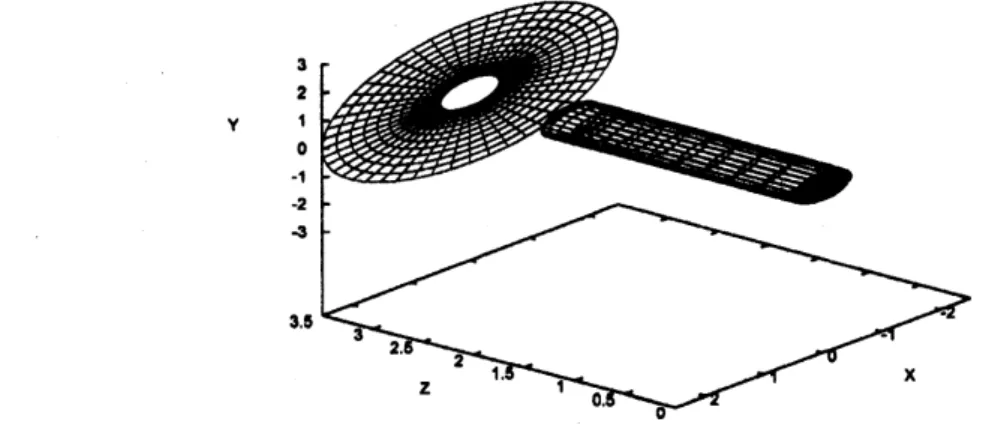
jet velocity.Figure 1: Solid surfaces represented by vortex panels. The
mean
flow-generating pane18are
placed at $z=0.O$, the nozzle exit at $z=2.5$
,
and the endplate at $z=3.5$.
First, it isrequired that the inviscid boundarycondition of
zero
normal velocity issatisfiedon
the exit pipe (surfaoe 2’) and the end plate (’surface3’), i.e.$u_{n}(x_{1\dot{0}}^{cpk})=0$
,
$i=1,$ $\ldots,$$N_{\theta k}$, $j=1,$
$\ldots,$$N_{rk}$, $k=2,3$, (9)
where$x_{i_{\dot{O}}}^{cpk}$
are
control points located in the center of the vortex panels, $N_{\theta k}$ is the number ofpanels incircumferential direction, and $N_{rk}$ the number ofpanels in radial direction.
Second, the velocitydistribution
on
themean
flow-providingupstream end ofthe exit pipe (’surface 1’) is required to beuniform. This is obtained bythe following two conditions:$u_{n}(x_{i_{\dot{\theta}}}^{cp1})-u_{n}(x_{1+1,j}^{cp1})=0$, $i=1,$
$\ldots,$$N_{\theta 1}-1$, $j=1,$$\ldots,$$N_{r1}$, (10)
$u_{n}(x_{1\dot{\theta}}^{cp1})-u_{\mathfrak{n}}(x_{i_{\dot{\theta}}+1}^{cp1})=0$
,
$i=N_{\theta 1}-1$,
$j=1,$$\ldots,$$N_{r1}$
.
(11)Equation (10) expresses
a zero
velocityjumpacross
anytwo adjacent pane18 inradialdirection,at any circumferential station. Equation (11) expresses
a zero
velocityjumpacross
any twoadjacent panels in circumferentialdirection, for
one
particular radius.The third and final condition is the specification of the
mean
velocity ata
specified point$x_{*}$;
The conditions (9)$-(12)$ constitute $\sum_{k}(N_{\theta k}\cross N_{rk})+1$ equations with the
same
number ofunknowns. The matrix equation system corresponding to these equations takes the form
Ar$=b$
.
(13)Here the matrixAcontains theinfluence coefficients and$\Gamma$the unknown$vortex/source$strengths.
The vector $b$contains the inducedvelocities from the freevortices; the elements
are
given by$b_{j}=- \sum_{i=1}^{N_{fv}}$害
{ufv}
, (14)where $S\{\}$repraeents the ‘operations’ defined by (9)$-(12)$
.
2.3
Vortex shedding
mechanism
The rate of continuous sheddingof circulation $\gamma$ from the nozzle is given by
$\frac{d\gamma}{dt}=_{R}^{1}(u_{t-}^{2}-u_{t+}^{2})$, (15)
where $u_{t-}$ isthe (tangential) velocity at thepipe exit, $z_{exit}$ say,
on
the inner surface, and $u_{t+}$ isthe corresponding velocity
on
theouter surface. This equationcan
be obtain\’e by integratingthe tangential component of the Euler equations
over
the tube surface, and using the Kuttacondition, which demands that thepressure alittle abovethe nozzle edge equalsthe pressure
a
little below.
In thesimulation
a
vortex ringisreleased at everytimestep, at the position$z_{z^{1}e1}=z_{exit}+ \frac{1}{2}\Delta t(u_{t-}+u_{t+})$
.
(16)Itsstrength is obtained from (15)
as
$\Gamma=arrow 1\Delta t2(u_{t-}^{2}-u_{t+}^{2})$
.
(17)The vortexrings, described by the space
curves
$r_{j}(\xi, t)$,are
discretized by employing $N_{mp}$marker points
on
each curve, connected via cubic splines. The positions of the marker pointsonthe shed vortex rings,describedbythevectors$r_{m}(\zeta_{n}, t)$
, are
updated by solving numericallythe systemofordinarydifferential equations
$\frac{dr_{m}(\zeta_{n},t)}{dt}$ $=$
$- \sum_{j=1}^{N_{fv}}\frac{\Gamma_{j}}{4\pi}\oint_{C_{j}(\xi)}\frac{\{r_{m}(\zeta_{n},t)-r_{j}(\xi,t)\}x\partial r_{j}/\partial\xi}{\{|r_{m}(\zeta_{n},t)-r_{j}(\xi,t)|^{2}+\alpha\sigma_{j}^{2}(\xi,t)\}^{\frac{3}{2}}}d\xi$ (18)
$+$ $u_{bv}(\zeta_{n},t)+u_{p\epsilon}(\zeta_{\mathfrak{n}},t)$, $m=1,$
$\ldots,$$N_{fv}$
,
$n=1,$$\ldots,$$N_{cp}$.
To this end the fourth-order Runge-Kutta method is applied. The integrations
over
$C_{j}(\zeta)$ in(18)
are
carriedout usingGaussian
quadrature [7].Exceptfor the viscous effect simulatedbythe Kuttacondition,thecomputations
are
basicallyinviscid. This
means
that the vortex rings keep their strengths throughout the simulation,once
released. The volume of each individual ring must thus be kept constant; this constraint is
imposedvia theequations
$\frac{d}{dt}(\sigma_{n}^{2}\ell_{\mathfrak{n}})_{m}=0$, $n=1,$
$\ldots,$$N_{cp}$, $m=1,$$\ldots,$$N_{fv}$, (19)
where$\ell_{n}$ isthe instantaneouslength of the n’thfilament.
Finally, it must be mentioned that, following
an
advice of$L\infty nard[9]$, thecore
radius $\sigma_{j}$ in (18) is replaced by - $(\sigma_{m}^{2}+\sigma_{j}^{2})^{1/2}$.
This symmetric form will preserve linear and angular3
Aeroacoustic
model
3.1
The equation of
vortex
sound and
its
formal
solution
in terms
of integral
equations
Toevaluate the sound generated by the
self-sustained
flow oscillations, the start point Istakenin Howe’s equation forvortex sound at low Machnumbers [5]. Here the soundpressure$p(x, t)$
is relatedto thevortexforce $L(x,t)=w(x,t)xu(x,t)$ viathe$non- homogen\infty us$waveequation
$( \frac{1}{d}\frac{\partial^{2}}{\partial t^{2}}-\nabla^{2})p=\rho\nabla\cdot L$
,
(20)where the vorticity$w=\nabla xu$
.
Theboundaryconditionsare
$\frac{\partial p}{\partial n}=0$
on
the end
plate, $parrow 0$for
$|x|arrow\infty$,
(21)
where$n$ denotes the outward normalvector.
Fourier transform with resPect totime $t$ and frequency $\nu$
are
definedas
$P( x, \nu)=\frac{1}{2\pi}\int_{-\infty}^{\infty}p(x,t)e^{i\nu t}dt$, $p( x,t)=\int_{-\infty}^{\infty}P(x, \nu)e^{-i\nu t}d\nu$
.
(22)APplying the first ofthe equations (22) to (20) gives
$(\nabla^{2}+k^{2})P=-\rho\nabla\cdot \mathfrak{L}$ (23)
where $\mathfrak{L}(x, \nu)$ is the Fourier transform of$L(x, t)$, and $k=\nu/c_{0}$ is the
wave
number. Ib solve(23)
use
is madeof the free-spaceGreen’s
function$G( x,y)=\frac{e^{ikr}}{4\pi r}$
,
$r=|x-y|$(24)
which is
a
solution of theequation$(\nabla^{2}+k^{2})G=-\delta(x-y)$
,
(25)and which satisfies the second of the boundary conditions (21). The function $\delta(x-y)$ is the
deltafunction. Here and inthesequel, $x$denotes the location of
an
observationpoint and$y$thelocationof
an
acousticsource.
Multiplying (23) by $G$ and (25) by $P$ gives, after integration and
use
of Green’s secondidentity,
$\sigma P(x, \nu)$ $=$
$\rho\int_{\int\int}\int\int G(x,y)\nabla_{y}\cdot.g(y,\nu)d^{3}y[G(x,y_{\beta})\frac{\partial}{\partial n_{\beta}}P(y_{\beta},\nu)-P(y_{\beta},\nu)\frac{\partial}{\partial n_{\beta}}G(x,y_{\beta})]d^{2}y_{\beta}$
.
(26)
The subscript $y$
on
the del-operatorin the first temon
theright hand side indicatesdifferenti-ation with respectto the
source
coordinates$y$.
Thesubscript $\alpha$on $y_{\beta}$ indicatesa
point on the end plate and$n_{\beta}$ the normal vector at that point. The notation $d^{3}y$ isused for$dy_{1}dy_{2}dy_{3}$ and$d^{2}y_{\beta}$ for $dy_{\beta 1}dy_{\beta 2}$
.
Theparameter $\sigma$is given by [13]The first of the equations (21) gives that $\partial P/\partial n_{\beta}=0$
.
The first term
on
the right hand side of(26) can, via integration by parts, be rewrittenas
$- \int\int\int\frac{\partial G}{\partial y_{j}}\mathfrak{L}_{j}d^{3}y$
.
(28)In this equation and in the sequel, summationover repeated latin indices is to be understood.
[Summationis not carried out
over
repeated greek indices.]Considering
a
plate ofvanishing thickness, Terai [19] has shown that thepressure
ata
point$x$ away$hom$ the plate
can
be expressedas
$P( x, \nu)=-\int\int\int\rho\frac{\partial G(x,y)}{\partial y_{j}}\mathfrak{L}_{j}(y, \nu)d^{3}y+\int\int\tilde{P}(y_{\beta}, \nu)\frac{\partial G(x,y_{\beta})}{\partial n_{\beta}}d^{2}y_{\beta}$
,
(29)where $\tilde{P}\rho$is the pressuredifference
across
the plate. Toevaluatethis quantity,use
wiU be madeofthe normal derivative of(29) at
a
point $x_{\alpha}$on
theend
plate. As$\frac{\partial P(x_{\alpha},\nu)}{\partial n_{\alpha}}=0$ (30)
we
obtain$\int\int\overline{P}(y_{\beta})\frac{\partial^{2}G(x_{\alpha},y_{\beta})}{\partial n_{\alpha}n_{\beta}}d^{2}y_{\beta}=\rho\int\int\int\frac{\partial^{2}G(x_{\alpha},y)}{\partial x_{1}\partial y_{j}}n_{\alpha i}\mathfrak{L}_{j}(y, \nu)d^{3}y$
.
(31)3.2
Discretization via
the boundary
element
method and
expansion
of
the
surface
integrands
Equation (31) is
a
Ftedholm integral equation of first kind. To solve it with respect to thepressure difference $\tilde{P}$, a boundary element method is applied. The surface ofthe end plate is
dividedinto quadrilateralelements. Asimpleapproach, where$\tilde{P}$
is aesumed constant overeach
element,is applied. This significantly simplifies the evaluationofthe normal derivatives,
as
willbeevident in the following.
The last term inequation (29) isthus approximated as follows:
$\int\int\tilde{P}(y_{\beta})\frac{\partial G(x,y_{\beta})}{\partial n_{\beta}}d^{2}y_{\beta}\approx\sum_{\epsilon}\tilde{P}_{\beta e}\int\int\frac{\partial G(x,y_{\beta\epsilon})}{\partial n_{\beta}}d^{2}y_{\beta e}$ , (32)
and the first term inequation (31)
as
follows:$\int\int\tilde{P}(y_{\beta})\frac{\partial^{2}G(x_{\alpha},y_{\beta})}{\partial n_{\alpha}n_{\beta}}d^{2}y_{\beta}\approx\sum_{e}\tilde{P}_{\beta\epsilon}\int\int\frac{\partial^{2}G(x_{\alpha},y_{\beta e})}{\partial n_{\alpha}n_{\beta}}d^{2}y_{\beta\epsilon}$
.
(33)In (32)
we
always have $x\neq y_{\beta}$ andget accordingly$\int\int\frac{\partial G(x,y_{\beta\epsilon})}{\partial n_{\beta}}d^{2}y_{\beta\epsilon}=\int\int\frac{e^{ikr_{x\beta}}}{4\pi r_{x\beta}}(\frac{1}{r_{x\beta}}-ik)coe(r_{x\beta}, n_{\beta})d^{2}y_{\beta\epsilon}$, (34)
where
$r_{x\beta}=x-y_{\beta e}$, $r_{x\beta}=|r_{x\beta}|$, $\cos(r_{x\beta},n_{\beta})=\frac{r_{x}\rho\cdot n_{\beta}}{r_{x\beta}}$
.
(35)In (33)
we
start with evaluation ofthe derivationwith respect to $n_{\alpha}$, which gives$\frac{\partial^{2}G}{\partial n_{\alpha}\partial n_{\beta}}$ $=$ $\frac{\partial^{2}}{\partial n_{\alpha}\partial n_{\beta}}(\frac{e^{ikr_{\alpha\beta}}}{4\pi r_{\alpha\beta}})$ (36)
$=$ $- \frac{e^{ikr_{\alpha\beta}}}{4\pi r_{\alpha\beta}}\cos(r_{\alpha\beta},n_{\alpha})\cos(r_{\alpha\beta},n_{\beta})\{\frac{3}{r_{\alpha\beta}^{2}}(1-ikr_{\alpha\beta})+(ik)^{2}\}$
Two different
cases
have to be considered: $x_{\alpha}\neq y_{\beta e}$ and $x_{\alpha}=y_{\beta e}$. The firstcase
isstraight-forward,
as
$\cos(r_{\alpha\beta}, n_{\alpha})=\cos(r_{\alpha\beta}, n_{\beta})=0$and $\cos(n_{\alpha)}n_{\beta})=1$;we
thenobtain$\int\int\frac{\partial^{2}G(x_{\alpha},y_{\beta e})}{\partial n_{\alpha}n_{\beta}}d^{2}y_{\beta e}=\int\int\frac{e^{ikr_{\alpha\beta}}}{4\pi r_{\alpha\beta}^{3}}(1-ikr_{\alpha\beta})d^{2}y_{\beta e}$
.
(37)For the second
case we
follow the approach of Terai [19] and consider the limit $x_{\alpha}arrow y_{\beta e}$.
Let $n=n_{\alpha}=n_{\beta}$ and $r=r_{\alpha\beta}$
.
We have then $r\cdot n\approx\epsilon$, where $\epsilon$ isa
small number. Thus$\cos(n, n)=1,$ $\cos(r, n)=\epsilon/r$, and
$\int\int\frac{\partial^{2}}{\partial^{2}n}(\frac{e^{ikr}}{4\pi r})d^{2}y_{\beta\epsilon}$ (38)
$=- \iint\frac{e^{ikr}}{4\pi}[\{\frac{3}{r^{3}}(1-ikr)+\frac{(ik)^{2}}{r}\}(\begin{array}{l}\epsilon-r\end{array})-\frac{1}{r^{3}}(1-ikr)]d^{2}y_{\beta\epsilon}$
$=- \int_{0}^{2\pi}\int_{\epsilon}^{R_{C}(\theta)}\frac{e^{ikr}}{4\pi}[\{\frac{3}{r^{3}}(1-ikr)+\frac{(ik)^{2}}{r}\}(\frac{\epsilon}{r})^{2}-\frac{1}{r^{l}}(1-ikr)]rdrd\theta$
$=- \frac{1}{4\pi}\int_{0}^{2\pi}[\frac{e^{ikr}}{r}\{(3-ikr)(\frac{\epsilon}{r})^{2}-1\}]_{\epsilon}^{R_{\epsilon}(\theta)}d\theta$
$arrow\frac{1}{4\pi}\int_{0}^{2\pi}\frac{e^{1kR_{\epsilon}(\theta)}}{R_{\epsilon}(\theta)}$
d\mbox{\boldmath$\theta$}--1ik
for $\epsilonarrow 0$.
3.3
Expansion
of the
source
integrals
Expansion ofthe derivativesappearing in the
source
term of(29) gives$\rho\int_{=\rho}\int\int_{\int\int\int}\frac{\partial G(x,y)}{\frac{\partial y_{j}e^{1kr}}{4\pi r^{3}}(}\mathfrak{L}_{j}(y,\nu)d^{3}y1-ikr)(x_{j}-y_{j})\mathfrak{L}_{j}(y, \nu)d^{3}y$
,
(39)
where $r=|x-y|$
.
The derivative of this integral in the direction ofthe normal $n_{\alpha}$ takes theform
$\rho\int\int\int\frac{\partial^{2}G(x_{\alpha},y)}{\partial x_{j}\partial y_{j}}n_{\alpha i}\mathfrak{L}_{j}(y, \nu)d^{3}y=\rho\int\int\int\frac{e^{ikr}}{4\pi r^{3}}x$ (40) $x[\delta_{ij}(1-ikr)-((ik)^{2}-\frac{3ik}{r}+\frac{3}{r^{2}})(x_{1}\cdot-y_{i})(x_{j}-y_{j})]n_{\alpha}\iota \mathfrak{L}_{j}(y, \nu)d^{3}y$,
where $\delta_{*j}$ is Kronecker’s delta.
3.4
Time-domain expressions
Applying the inverse Fouriertransform (22) to (29),
we
obtain$p( x,t)=p_{vtx}(x, t)+\sum_{e}\int\int\frac{1}{4\pi r_{x\beta}}(\frac{1}{r_{x\beta}}[\tilde{p}_{\beta e}]_{t}$
.
$+ \frac{1}{c0}[\frac{\partial\tilde{p}_{\beta e}}{\partial t}]_{t}.)\cos(r_{x\beta}, n_{\beta})d^{2}y_{\beta\epsilon}$,
(41)where
In similar fashion, (31) takes, for $x_{\alpha}\neq y_{\beta}$, the form
$\frac{\partial p_{Jtx}\backslash (x_{\alpha},t)}{\partial n_{\alpha}}+\sum_{e}\int\int\frac{1}{4\pi r_{\alpha\beta}^{2}}$
(
$\frac{1}{r_{\alpha\beta}}1^{\tilde{p}_{\beta e}]_{t}}$.
十 $\frac{1}{c_{0}}[\frac{\partial\tilde{p}_{\beta e}}{\partial t}]_{t}.$)
$d^{2}y_{\beta e}=0$.
(43) For$x_{\alpha}=y_{\beta},$ (31) takes the form$\frac{\partial p_{vtx}(x_{\alpha},t)}{\partial n_{\alpha}}+\sum_{e}([\tilde{p}_{\beta\epsilon}]_{t}$
.
$\int_{0}^{2\pi}\frac{d\theta}{4\pi R(\theta)}+\frac{1}{2\infty}[\frac{\partial\tilde{p}_{\beta e}}{\partial t}]_{t_{*}})=0$.
(44)In both cases, the first term is
$\frac{\partial p_{vtx}(x_{\alpha},t)}{\partial n_{\alpha}}=\int\int\int\frac{m}{4\pi}[$ $-$ $t^{\frac{\delta_{\dot{|}j}}{r^{3}}-\frac{3}{r^{5}}(x-y:}:$)$(x_{j}-y_{j})\}[L_{j}]_{t_{*}}$ (45) $+$ $\{\frac{\delta_{ij}}{c_{0}r^{2}}-\frac{3}{c_{0}r^{4}}(x_{i}-y_{i})(x_{j}-y_{j})\}[\frac{\partial L_{j}}{\partial t}]_{t}$
.
$+$ $\frac{1}{0^{r^{3}}}(x_{i}-y:)(x_{j}-y_{j})[\frac{\partial^{2}L_{j}}{\partial t^{2}}]_{t}.]d^{3}y$
.
3.5
Acoustic feedback model
The velocity at any point $x$
can
be thought ofas
consisting of two parts:one
part from theincompressible ‘background flow’ (which is modelled by discrete vortices), and
one
partgen-erated by $acou8tlc$ pressure fluctuations, that is, by comproesibility effects. Clearly the latter
contribution is muchsmaller than the former.
Let $v(x, t)$ denote the acoustic velocity component. It is related to the acoustic pressure
$p(x,t)$ via the linearized Eulerequation
$\rho\frac{\theta v(x,t)}{\partial t}=-\nabla p(x,t)$
.
(46)Applying the
Fourier
transform (22) to this equation gives$\rho i\nu V(x, \nu)=-\nabla P(x, \nu)$
.
(47)Equation (29)
can
be usedin evaluating the velocity V from (47). The theory of vortexsound,represented by the first term
on
the right hand side of (29), is however only correct if theobservation point $x$ is located in the ‘far field’, well away from the sound-generating
vortex-dominated flow. The sound scattered by the end plate, described by the second term
on
theright hand sidein (29)is of
course
generated by the preceding vortex soundterm, thatis, by thenearby vortices. But no far field approximations have been introduced into (29); it is ‘exact’.
Henoe
we
chooseto base the evaluation of acousticvelocityon
the scattered pressure field anduse the approximation
$\rho i\nu V(x, \nu)\approx-\nabla P_{\epsilon cat}(x, \nu)$, (48)
where
$P_{scat}=( x, \nu)=\int\int\tilde{P}(y_{\beta})\frac{\partial G(x,y_{\beta})}{\partial n_{\beta}}d^{2}y_{\beta}$
.
(49)Inserting (34) into (49), followed bydifferentiation with respect to $x_{j}(j=1,2,3)$,
we
obtain$V(x, \nu)$ $=$ $\frac{1}{\rho c_{0}}\sum_{e}\tilde{P}_{\beta e}\int\int\frac{e^{1kr_{\alpha\beta}}}{4\pi}[(-\frac{1}{ikr_{x\beta}^{3}}+\frac{1}{r_{x\beta}^{2}})x$ (50)
$x$ $(3 \cos(r_{x\beta}, n_{\beta})\frac{x-y_{\beta}}{r_{x\beta}}-n_{\beta})$
Taking the inverse Fourier transform (22) of(50), weobtain
$v(x,t)$ $=$ $\frac{1}{4\pi\rho}\sum_{e}\int\int[$ ノ
$\frac{1}{r_{x\beta}^{3}}\int_{-\infty}^{t}[\tilde{p}_{\beta e}]_{t}$
.
$dt+ \frac{1}{c_{0}r_{x\beta}^{2}}[\tilde{p}_{\beta c}]_{t}.)x$ (51)$x$ $(3 \cos(r_{x\beta}, n_{\beta})\frac{x-y_{\beta}}{r_{x\beta}}-n_{\beta})$
十 $\frac{1}{d}[\frac{\partial\tilde{p}_{\beta e}}{\partial t}]_{t}.\cos(r_{l\beta}, n_{\beta})\frac{x-y_{\beta}}{r_{x\beta}^{2}}]d^{2}y_{\beta\epsilon}$
.
Thisvelocity field is added to the hae vortexrings
near
the nozzle exit. In this waya
couplingbetween the ‘vortex field’ and the acoustic field (acoustic feedback) is established. It is noted
that thisapproachisinfull agreement with Rayleigh’s explanationof the ‘manner ofaction’,
as
cited in Section 1.
3.6
Numerical evaluation of the boundary integrals
Toevaluatenumerically theintegrals (37) and(38)
over
the boundary elements,an
isoparametriccoordinate transformation is applied, such that the quadrilateral elements
are
mapped intorectangles [3]. In the global (physical) coordinatesystemthecoordinates$y_{\beta c}$ withih
an
elementcan
be expressed in terms of the elementcorner
coordinates $(y_{\beta e})_{j},$$(j=1, \ldots,4)$ and theisoparametric coordinates$\xi_{k},$$(-1\leq\xi_{k}\leq 1, k=1,2)$
, as
$y_{\beta}=\sum_{j}N_{j}(\xi_{1},\xi_{2})(y_{\beta\epsilon})_{j}$
,
(52)where
$N_{1}=^{1}2(1+\xi_{1})(1-\xi_{2})$, $N_{2}=_{5}^{1}(1+\xi_{1})(1+\xi_{2})$, (53) $N_{3}= \frac{1}{2}(1-\xi_{1})(1-\xi_{2})$
,
$N_{4}=_{f}^{1}(1-\xi_{1})(1-\xi_{2})$.
The surface integral (37)
can
then be writtenas
$\int\int\frac{\partial^{2}G(x_{\alpha},y_{\beta\epsilon})}{\partial n_{\alpha}n_{\beta}}d^{2}y_{\beta e}$ (54).
$= \int_{-1}^{1}\int_{-1}^{1}\frac{e^{ikr_{\alpha}\rho(\xi_{1},\xi_{2})}}{4\pi r_{\alpha\beta}^{3}(\xi_{1},\xi_{2})}\{1-ikr_{a\beta}(\xi_{1},\xi_{2})\}J(\xi_{1},\xi_{2})d\xi_{1}d\xi_{2}$,
where $J(\xi_{1},\xi_{2})$ is the Jacobian of the mapping. Similarly, the final line integral of (38)
can
bewritten as
$\frac{1}{4\pi}\int_{0}^{2\pi}\frac{e^{ikR_{\epsilon}(\theta)}}{R_{e}(\theta)}d\theta$ (55)
$= \frac{1}{4\pi}\int-1\frac{\exp(ik\sqrt{1+\xi_{1}^{2}})}{(1+\xi_{1}^{2})^{\theta}a}\{J(\xi_{1}, -1)+J(\xi_{1},1)\}d\xi_{1}1$
$+ \frac{1}{4\pi}\int_{-1}^{1}\frac{\exp(ik\sqrt{1+\xi_{2}})}{(1+\xi_{2}^{2})^{3}\pi}\{J(-1,\xi_{2})+J(1,\xi_{2})\}d\xi_{2}$
.
These integrals,
on
the right handsides of(54) and (55),are
ideallysuited fornumericalevalu-ation via
Gaussian
quadrature [7].Theexpressionsgiven here
are
forthe&equencydomain; theyare howeverdirectly applicable3.7
Numerical integration of
theacoustic equations
The acoustic equations
are
integrated in time using the trapezoidal method, where the relationbetween the pressure$p$ and its time derivative$\dot{p}$ is given by
$p_{n+1}=p_{n}+\frac{\Delta t}{2}(\dot{p}_{n}+\dot{p}_{n+1})$
.
(56)This maybe rewritten
as
$\dot{p}_{n+1}=\frac{2}{\Delta t}(p_{n+1}-p_{n})-\dot{p}_{n}$
.
(57)Rewriting (43)-(45) into
matrix
formwe
obtain$C\beta_{\mathfrak{n}}+Kp_{n}=r_{n}$, (58)
where
$C_{ij}=\{\begin{array}{ll}-\Sigma^{C_{0}}1-1 for i=j,0 fo i\neq j,\end{array}$ (59)
(60)
$K_{1j}=\{-\int_{\frac{d}{4}-\int\int_{\pi}}o_{fort\neq j}^{2\pi}\frac{d\theta}{4\pi R(\theta),\prec 2yr_{j}}fori=j$
and
$\partial p_{vtx}(x_{j},t)$
$r_{j}=\overline{\partial n_{j}}$
.
(61)Inserting (57) into (58), the latter equation may be rewritten into the form of
a
standard
linear equation, $K^{eff}p_{n+1}=r_{n+1}^{eff}$
,
(62) with $K^{eff}=\frac{2}{\Delta t}C+K$, (63) and $r_{n+1}^{eff}=r_{n+1}+C(\frac{2}{\Delta t}p_{n}+\dot{p}_{n})$.
(64)Equation (62) issolved with respectto $p_{\mathfrak{n}+1}$ at each time step. Followingthis, $\beta_{\mathfrak{n}+1}i8$updated
using (57). But,
as
‘numerical noise’ in the velocities is unavoidable by the discrete vortexmethod, the
use
of(57) may$ampli\Psi$this ‘noise’ toan
unacceptablelevel. A smoother andmore
useful pressure time series
can
be obtained by differentiatinga
least-square fit ofa number
ofconsecutive
pointson
the ‘pressure curve‘,as
suggested by Lanczos [7]. The formula for thegeneral
case
ofsmoothingbyuse
of$K$ neighborson
both sides of thepoint where thederivativeiswanted isgiven by
$\frac{\partial p(t)}{\theta t}=(\sum_{k=-K}^{K}kp(t+k\Delta t))/(2\sum_{k=1}^{K}k^{2}\Delta t).\cdot$ (65)
As values ahead
are
needed, thepressure evaluationmust lag$K$time stepsafter theactual state.If$K=2$
,
for example, the formula is$\frac{\partial p(t-2\Delta t)}{\partial t}=\frac{1}{10\Delta t}\{-2p(t-4\Delta t)-p(t-3\Delta t)+p(t-\Delta t)+2p(t)\}$, (66)
or, with the notation usedin this section,
3.8
Testof the
boundaryelement
methodThe scattering of
a
plane, harmonic wavebya
thin rigid disk, ofradius$a$, isconsideredas
a testcase for the boundary element method. An analytical solution has been derived byNoble [12].
The incoming pressure wave, incident normally
on
the disk, is given by $P_{i}=\exp(-ikz)$.
Thescattered pressure wave
can
be expressedas
$P_{\epsilon}(r, \theta, \lambda)=\frac{2}{\pi}k^{2}a^{3}\sum_{n=0}^{\infty}\frac{(-1)^{n}(\lambda a)^{2n}}{1\cdot 3\cdots(4n+1)}X_{2\mathfrak{n}+\frac{a}{2}}(\lambda a)P_{2n+1}(\cos\theta)(\frac{2\lambda}{\pi r})^{1}zK_{2n+\frac{3}{2}}(\lambda r)$ , (68)
where$\lambda=-ik$
.
Thefunctions$X_{2n+\frac{3}{2}}(\lambda a)$are
definedinRef.
[12] interms ofa
recursive
formula.The terms
necessary
to evaluatethe pressure
to order $(\lambda a)^{4}$are
$X_{\frac{s}{2}}(\lambda a)$ $=$ $\frac{1}{3}-\frac{4}{75}(\lambda a)^{2}+\frac{2}{27\pi}(\lambda a)^{3}+\frac{1}{5\cdot 7^{2}}(\lambda a)^{4}+\cdots$ (69) $X_{\text{フ}}(\lambda a)$ $=$ $\frac{1}{5}-\frac{2}{3^{2}\cdot 7}(\lambda a)^{2}+\cdots$
,
$x_{\#}( \lambda a)=\frac{1}{7}+\cdots$The functions$P_{2n+1}(\theta)$
are
Legendre polynomials, given by$P_{1}(\cos\theta)$ $=$
cos
$\theta$, (70)$P_{2}(\cos\theta)$ $=$
\S1
(3cos
$\theta+5$cos
39), $P_{3}$(coe$\theta$) $=$$\overline{1}T81$ ($30$
cos
$\theta+35$cos
$3\theta+63$cos
$5\theta$),:
Finally, the functions $K_{2\mathfrak{n}+3,2}(\lambda r)$
are
modified $B\propto sel$functions
of thesecond kind.The intensity of the scattered sound field
as
function of the angle $\theta$,
computed via theboundary element method and via the analytical expression (68), is shown in
a
polar plot inFig. $2(a).$
.The
diameter ofthe disk is lm, the frequency is 10Hz, and the distance from thecenterofthe plateto the observationpoint$r$ is $10m$
.
The agreement is verygood forrelativelysmallvalues of$ka$, i.e. for low
&equencies, as
considered here. [The agreement is less good forhigher frequencies; it appears that
more
terms in series for the X-functions of (69)are
thenneeded.] The plot also illustrates
a
pure dipole behavior of the plate for low &equencies. Thiscan
also beseen
directly $hom(68)-(70)$.
Fig. 2(b) shows the boundary element grid used; thenumber of elements is 1152.
Figure
2:
(a) Layout ofa
thin rigid disk and the incoming wave, and intensity $di_{8}tribution$ of4
Numerical example
Computations have been carried out for data corresponding to an experimental rig with nozzle
and end plate hole diameter $d_{0}=2r_{0}=50$
mm
[11]. The outer diameter of the end plate is250
mm.
The gap length $\ell$ is50
mm,e.g.,
equal to $d_{0}$.
Themean
velocity $u_{0}$ of the air-jetis 10 $m/s$
.
At $20\circ c$ this corresponds toa
Reynolds number $Re=u_{0}d_{0}/\nu\approx 3.3\cross 10^{4}$ anda
Mach number $M=u_{0}/c_{0}\approx 0.03$
,
where the speed of sound $c_{0}=340$ $m/s$ and the kinematicviscosity $\nu=1.5x10^{-5}m^{2}/s$. Theinitial vortex
core
radii$\sigma_{j}=0.275r_{0}$.
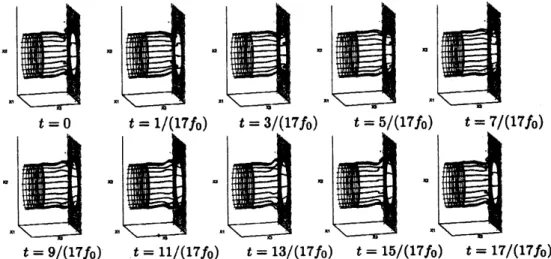
Anumberof sideview‘snapshots’ ofthe jet during
one
period of the oscillationsare
shown in Fig. 3. The computedfundamental frequency $f_{0}\approx 190$ Hz, whichis quite close to the experimentally observed value
$ofl96Hz$
.
Figure 3: Side viewofthe jet during
one
period of oscillation.Velocityfluctionsin the shearlayer
are
illustratedinFig. 4(a). The data have been recorded0.2
$d_{0}$away
from the end plate. Part (b) of the figure shows the to part (a) correspondingfre-quency
spectrum(givenin$dB$,
using5
$ms^{-1}$as
referencevelocity). The level at the characteristicfrequency$f_{0}$isin goodagreement with theexperimentallyrecorded value[11]. The experimental
spectrumcontains however less ‘noise’ and exhibits distinct higherharmonics $(2f_{0},3f_{0}, \ldots)$
.
Figure 4: (a) Velocityfluctuationsin the shear layer at
a
distance0.2$d_{0}$ fromthe endplate. (b)5
Proper
orthogonal decomposition
analysis
5.1
Description of the methodProper orthogonal decomposition (POD) is
a
method for extracting coherent structures fromexperimental
or
computational data [4]. By coherentstructures
is meant fundamental fluidmodes, containing
a
concentration of vorticity $and/or$ responsible for the major part ofenergy
transport.
Thevelocity field$u(x,t)$ is recorded at $N$grid points$x_{1},$$\ldots,x_{N}$ and at $M$ times$t_{1},$
$\ldots,$$t_{M}$
,
$u(x,t)=(\begin{array}{llll}u(x_{l},t_{1}) u(x_{2},t_{l}) u(x_{N},t_{1})u(x_{1},t_{2}) u(x_{2},t_{2}) u(x_{N},t_{2})\vdots \vdots \ddots \vdotsu(x_{1},t_{M}) u(x_{2},t_{m}) u(x_{N},t_{M})\end{array})$
.
(71)The PODmethod determines
a
set oforthogonal vector functions$\varphi_{n}(x)homA(x, t)$, such thatthe expansionof$u(x, t)$ in terms of thesefunctions,‘
$u_{N}(x,t)=\sum_{\mathfrak{n}=1}^{N}a_{\mathfrak{n}}(t)\varphi_{n}(x)$
,
(72)hasthe smallest error, in the
sense
that$(||u_{N}-u||^{2}\rangle$ $arrow\min,$ (73)
where $\Vert\cdot\Vert$ denotes the $L^{2}$-norm, and $\langle\cdot\rangle$ denotes averaging.
The determination ofthePODmodes$\varphi_{\mathfrak{n}}$involves, in the so-calleddirectmethod, thesolution
of
an
$NxN$ eigenvalue problem.Often the number of grid points $N\gg M$
,
the number of temporal points. This is takeninto advantage in the ‘method ofsnapshots’, where the POD modes $\varphi_{\mathfrak{n}}$
are
writtenas a
linearcombination ofthe $Msnap_{8}hots’$,
$\varphi(x)=\sum_{m=1}^{M}c_{m}u(x,t_{m})$
.
(74)Texts
on
POD,e.g.
[4], show that the constants $q_{n}$can
be determined by solving the $MxM$symmetric eigenvalue problem
$\sum_{m=1}^{M}\frac{1}{M}u_{n}\cdot u_{m}c_{m}=\lambda c_{n}$
,
$n=1,$$\ldots,$M. (75)
5.2
Numerical
exampleVelocities
are
recorded at 51 $x$ 101 grid points,as
shown in Fig. 5. Snapshotsare
takenover
10 flow-oscillation periods, with
8
snapshotsin each period. Thus with $N=5151$ and $M=80$,it is clearly ofadvantageto
use
the method of snapshots. The modalfunctions
$\varphi_{1},$$\ldots,$$\varphi_{4}$
are
shown in Fig.
6..
It should be noted that themean
velocity $u_{0}(x)$was
subtracted before (75)was
set up and solved. Thus,rather than (72), the expansion$u_{N}(x,t)=u_{0}(x)+\sum_{n=1}^{N}\tilde{a}_{n}(t)\varphi_{\mathfrak{n}}(x)$ (76)
isconsidered. Mode 1 has
a
mean-flow-like appearance,while modes 2, 3,and 4are
characterizedFigure
5:
The51$x$101
gridused for obtainingvelocity snapshots. (a) The wholecomputationalsystem. (b) Zoom-in aroundthe grid.
that the mentionedphenomenon of modejumpsis related to the mutualbalancebetween these
fundamental
modes. Thiscan,we
believe, beverifiedbya
low-dimensionalanalysisbasedon
theEuler equations, discretized via the
Galerkin
method, with the POD modesas
basisfunctions.
Rowley et al. have applied such
an
approach to the problemofself-sustainedoscillations in theflow
over
a
rectangular cavity, andfound that the results ofa
full simulation could be capturedbythe Galerkin approximation using justfour modes.
Figure 6: POD modes 1 through 4 (from left to right). The figures in the upper
row
showvelocity vectors; thosein the lower
row
are
iso-velocitycontourplots. Thecoordinatesare as
inThis appears to apply to the present problem
as
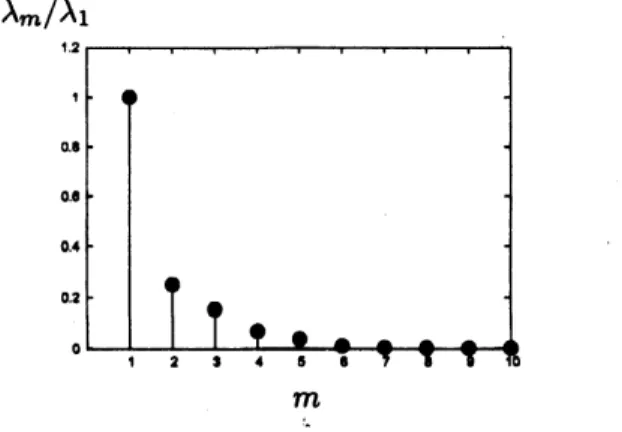
well. Theeigenvalues $\lambda_{m}$ of (75)are
showninFig.
7.
These eigenvaluev represent twice the kineticenergy
of the correspondingmode
$\varphi_{m}$.
It is
seen
that themagnitudefalls off rapidlywithincreasing mode number. Thusonly thefirstfour
or
five modes will be ofsignificance ingoverning the dynamics ofthe system.$m$
Figure
7:
Eigenvalues related to the POD modes.Acknowledgement
The support of the present project through
a JSPS
Grant-in-Aid for Scientific Research (No. 18560152) is gratefully acknowledged.References
[1] W.T. Ashurst, $E$, Meiburg, Three-dimensional shear layers via vortex dynamics, J. Fluid
Mech.
189
(1988),87-116.
[2] R.C. Chanaud, A. Powell, Someexperiments concerningthe hole and ring tone, J. Acoust.
Soc. Am. 37 (1965) 902-911.
[3] R.D. Cook, D.S. Malkus, M.E. Plesha, Concepts andApplications
of
Finite ElementAnal-ysis, John Wiley&Sons, New York,
1989.
[4] P. Holmes, J.L. Lumley, G. Berkooz, $\mathfrak{R}$rbulence, Coherent Structures, Dynamical Systems
and Symmetry, Cambridge University Press, Cambridge UK, 1996.
[5] M. S. Howe, Theory
of
VortexSound, Cambridge University Press, Cambridge UK,2003.
[6] J. Katz, A. Plotkin, Low-SpeedAerdynamics,CambridgeUniversity Press, CambridgeUK,
2001.
[7] C. Lanczos, Applied Analysis, DoverPublications, NewYork, 1988.
[8] M.A. Langthjem, M.Nakano, A numericalstudyon the influence of non-axisymmetric flow
perturbations
on
the holetone feedback cycle, RIMS K\^oky\^urvku1543
(2007),21-30.
[9] A.Leonard,Computingthree-dimensionalincompressibleflows withvortexelements,Annu.
Rev. Fluid Mech. 17 (1985), 523-559.
[10] P.M. Morse, K.U.Ingard, Theoretical Acoustics, PrincetonUniversity Press, Princeton NJ,
[11] M. Nakano, D. Tsuchidoi, K. Kohiyama, A. Rinoshika, K. Shirono, Wavelet analysis on
behavior of hole-tone self-sustained oscillation of impinging circular air jet subjected to
acousticexcitation, (In Japanese) Kashikajouhou 24 (2004), 87-90.
[12] B. Noble, Methods based on the Wiener-HopfTechnique
for
the Solutionof
PartialDiffer-ential Equations, Chelsea Publishing Company, New York, 1988.
[13]
I.G.
Petrovsky, Lectureson
PartialDifferential
Equations, Dover Publications, NewYork,1991.
[14] A. Pikovsky, M. Rosenblum, J. Kurths, Syncronization: A Universal Concept inNonlinear
Sciences, Cambridge University Press, Cambridge UK, 2001.
[15] LordRayleigh, The Theory
of
Sound, Vol. II, DoverPublications, NewYork,1945.
[16] Rockwell, D., Naudascher, E., Self-sustained oscillations of impinging
&oe
shear layers.Annu. Rev. Fluid Mech. 11 (1979)
67-94.
[17] Rockwell, D., Oscillations ofimpinging shear layers. AIAA J. 21 (1983)
645-664.
[18]
C.W.
Rowley, T. Colonius, R.M. Murray, Model reduction for compraesible flows usingPOD and
Galerkin
projection, Physica $D$189
(2004),115-129.
[19] T. Terai,