KANTOROVICH
TYPE
OPERATOR
INEQUALITIESViA
THESPECHt
RATIO
II大阪教育大学附属高校天王寺校舎 瀬尾祐貴 (Yuki
SEO
$)$Tennoji Branch, Senior Highschool, Osaka Kyoiku University
ABSTIUCr. Yamazaki [14] showed new order preserving operator inequalities on the
usual order and the chaotic order by estimatiq the lowerboundof the difference. Mond
and Shisha $[7, 8]$ gave anestimate ofthe difference ofthe arithmetic
mean
to the geometric one, as aconverse ofthe arithmetic-geometric mean inequality. $\mathrm{h}$ this report,
we shallpresent otherorder preservingoperatorinequalities
on
the usual order andthechaotic one via the Nond\lrcorner Shlsha difference. Among $\mathrm{o}\mathrm{t}\mathrm{h}\mathrm{e}^{\mathrm{r}\mathfrak{g}}$, as an application oftire
Furutainequality, weshow that if$A$and $B$
we
positive operators onaHilbert space$H$and$k$ $\geq B\geq 1/k$ forsome$k$ $\geq 1$,then for$\mathrm{a}\grave{\mathrm{g}}\mathrm{i}\mathrm{v}\mathrm{e}\mathrm{n}\delta$$\in[0, 1]$, $A^{\delta}\geq B^{\delta}$ implies $A^{p}+2k^{p-2\delta}L(1,k^{2p-2\delta})\log M_{k}^{-},\{p-\delta$)$I\geq B^{p}$ holdsfor all$p\geq 2\delta$, where thecase
a
$=0$meansthe chaotic order and $\mathrm{t}\mathrm{b}\mathrm{e}$ Specht ratio$M_{k}(r)$ isdefined for
each$r>0$as
$M_{k}(\mathrm{r})$ $\Leftrightarrow\frac{(k^{r}\sim 1)k_{\mathrm{t}}^{\frac{r}{\mathrm{t}^{\mathrm{P}}-1}}}{re1\mathrm{o}\mathrm{g}^{l}k}$ $(k >0,k \neq 1)$ and
$M_{1}(r)$ $=1$
.
1. $\mathrm{I}_{\mathrm{N}\mathrm{T}\mathrm{B}\mathrm{O}\mathrm{D}\mathrm{U}\mathrm{C}\mathrm{T}\mathrm{I}\mathrm{O}\mathrm{N}}$We
shall
considerabounded
linearoperatoron a
complexHilbert
spac$\mathrm{e}H$.
An operator$A$ is said to be positive (in symbol: $A\geq 0$) if $(Ax, x)\geq 0$ for all $x\in H$
.
The L\"owner$\cdot$Heinz theorem assefts that $A\geq B\geq 0$
ensures
$A^{p}\geq B^{p}$ forall$p\in[0,1]$.
However$A\geq B$does not always
ensure
$A^{p}\geq B^{p}$for
$p>1$in
general. Yamazaki{13]
showedthat
$t^{2}$ isorder preserving in the following
sense:
(1) $A\geq E\geq 0$ and $M\geq B\geq m>0$ imply $A^{2}+ \frac{(M-m)^{2}}{4}I\geq B^{2}$
.
Moreover, he showed the following order preservingoperator inequality
as
an
extensionof (1):
Theorem A. Let $A$ and $B$ be positive operators on a
Hilbert space
$H$ satisfying $M\geq$$E\geq m>0$
.
If
$A\geq B$ $>0$, then$A^{p}+M(M^{\mathrm{p}-1}-fn^{p-1})I\geq A^{\mathrm{p}}+\mathrm{C}(m, M,p)I\geq B^{p}$
for
all$p\geq 1$,where
$C(m,M, \mathrm{p})-"\frac{mM^{p}-Mm^{p}\prime}{M-m}+(p-1)$ $( \frac{M^{p}arrow m^{p}}{p(M-m)})^{\overline{\mathrm{p}}\neg}\epsilon_{\overline{1}}$
For positive invertible operators $A$ and $B$
on
aHilbert space $H$, the order defined by$\log A\geq\log B$ is
called
the chaotic order. Sinte $\log t$ isan
operator monotone $\mathrm{f}\mathrm{u}\mathrm{n}\mathrm{c}\mathrm{t}^{\mathrm{I}}1\mathrm{o}\mathrm{n}$,the chaotic order is weaker thanthe usual
one
$A\geq B$.
J.I.Pujii and the author [1]showed数理解析研究所講究録 1312 巻 2003 年 100-107
the following order preserving operator inequalities on the chaotic order which is parallel
to Theorem A.
Theorem B. LetA andB be positive invertible operators on a Hilbert space H satisfying
M $\geq B\geq m>0$
. If
$\log A\geq\log B_{f}$ then$A^{p}+ \frac{M}{m}(M^{p}-m^{p})I\geq A^{p}+\frac{1}{m}C(m, M,p+1)I\geq B^{p}$
for
all$p\geq 0$,In fact, $\log A\geq\log B$ does not always ensure $A\geq B$ in general. However, by Theorem
$\mathrm{B}$, it follows that
$\log A\geq\log B$ and $M\geq B\geq m>0$ imply $A+ \frac{(M-m)^{2}}{4m}I\geq B$
.
On the other hand, Specht [9] estimated the upper bound of the arithmetic
mean
by the geometric onefor positive numbers: For $x_{1}$,$\cdots$ ,$x_{n}\in[m, M]$ with $M\geq m>0$,$M_{h}(1) \sqrt[n]{x_{1}\cdots x_{n}}\geq\frac{x_{1}+\cdots+x_{n}}{n}\geq\sqrt[\hslash]{x_{1}\cdots x_{n}}$,
where $h= \frac{M}{m}(\geq 1)$ is ageneralized condition number in the sense of Turing [12] and the
Specht ratio $M_{h}(1)$ is defined for $h\geq 1$ as
(2) Mh(1) $= \frac{(h-\mathrm{l})h^{\frac{1}{h-1}}}{e1\mathrm{o}\mathrm{g}h}$ $(h>1)$ and $M_{1}(1)=1$
.
Yamazaki [14] showed anew characterization of chaotic order as follows:
Theorem C. Let$A$ and$B$ bepositive invertible operators on aHilbert space $H$ satisfying
$M\geq B\geq m>0$
.
Then $\log A\geq\log B$ is equivalent to$A^{p}+L(mp, M^{p})\log M_{h}(p)I\geq B^{p}$ holds
for
all$p>0$,where $h= \frac{M}{m}>1$, the logarithmic mean $L(m, M)= \frac{M-}{\log M}$ and a generalized Specht
ratio $M_{h}(p)$ is
defined
as(3) $M_{h}(p)= \frac{(h^{p}-1)h^{\frac{\mathrm{p}}{h\mathrm{P}-1}}}{pe1\mathrm{o}\mathrm{g}h}$ $(h>0, h\neq 1)$ and $M_{1}(p)=1$
.
What is the meaning of the constant $L(m^{p}, M^{p})\log M_{h}(p)$ in Theorem $\mathrm{C}$ ? Mond
and Shisha $[7, 8]$ made anestimate ofthedifference between the arithmetic mean and the
geometric one: For $x_{1}$,$\cdots$ ,$x_{n}\in[m, M]$ with $M\geq m>0$,
$\sqrt[n]{x_{1}\cdots x_{n}}+D(m, M)\geq\frac{x_{1}+\cdots+x_{n}}{n}$,
where $h= \frac{M}{m}(\geq 1)$ and
$D(m, M)=\theta M+(1-\theta)m-M^{\theta}m^{1-\theta}$ and $\theta=\log(\frac{h-1}{1\mathrm{o}\mathrm{g}h})\frac{1}{\log h}$
which we call the Mond-Shisha
difference.
As amatter offact, J.I.Fujii and the author [1]showed that the Mond-Shisha difference exactly coincides with the constant in Theorem
$\mathrm{C}$ via the Specht ratio: If
$M>m>0$
, then$D(m^{p},M^{p})=L(m^{p}, M^{p})\log M_{h}(p)$
where $h= \frac{M}{m}$.
Comparing Theorem A with Theorem $\mathrm{B}$, we observe the difference between
$p$ and $p-1$
in the power of the constant. Hence one might expect that the following result holds
under the usual order as a parallel result to Theorem $\mathrm{C}$ via the Mond-Shisha difference:
Let $A$ and $B$ be positive invertible operators satisfying $M\geq B\geq m>0$
.
Then$A\geq B$ implies $A^{p}+mL(m^{p-1}, M^{p-1})\log M_{h}(p-1)I\geq B^{p}$ for all$p\geq 2$,
where $h= \frac{M}{m}\geq 1$. However, we have a counterexampleto this conjecture. Put
$A=$ $(\begin{array}{ll}3 11\frac{3}{2} \end{array})$ and $B=(\begin{array}{l}200\frac{1}{2}\end{array})$
then $A\geq B\geq 0$ and $2I \geq B\geq\frac{1}{2}I$
.
Then we have $mL(m^{1}, M^{1})\log M_{h}(1)=0.126638$.
Onthe other hand, $A^{2}+\alpha I\geq B^{2}$ holds if and only if $\alpha\geq\frac{-35+\sqrt{1465}}{8}=0.409415$. Therefore
$A^{2}+mL(m^{1}, M^{1})\log M_{h}(1)I\not\geq B^{2}$
.
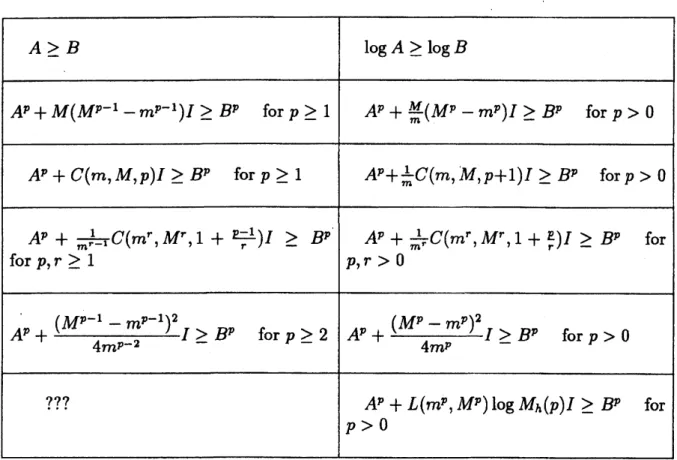
We collect the difference between the usual order and the chaotic one in the following
table.
TABLE 1. The difference between the usual order and the chaotic order .
$\log$$A\geq\log$$B$
$A^{p}+M(M^{p-1}-m^{p-1})I\geq B^{p}$ for$p\geq 1$ $A^{p}+ \frac{M}{m}(M^{\mathrm{p}}-m^{p})I\geq B^{p}$ for$p>0$
$A^{p}+C(m, M,p)I\geq B^{p}$ for $p\geq 1$ $A^{p}+ \frac{1}{m}C(m, M, p+1)I\geq B^{p}$ for$p>0$
$A^{p}+ \frac{1}{m^{r-1}}C(m^{f}, M^{\mathrm{r}}, 1+\frac{p-1}{f})I$ $\geq$ $B^{p}$
for$p$,$r\geq 1$
$A^{p}+ \frac{1}{m^{r}}C(m^{f}, M^{r}, 1+Ef)I\geq B^{p}$ for
$p$,$r>0$
$Ap[perp]\underline{(M^{p-1}-m^{p-1})^{2}}$
$r$ $\backslash >pp$ $\mathrm{f}_{\mathrm{r}\mathrm{r}}$
$\mathrm{r}$ $\backslash >9$ $A^{p}+ \frac{(M^{p}-m^{p})^{2}}{4m^{p}}I\geq B^{p}$
for$p>0$
$\sim \mathrm{T}\overline{4m^{p-2}}l$ $-$’
.
$1\cdot 1$ $r\underline{\wedge}$ $4$$??$? $A^{p}+L(m^{p}, M^{\mathrm{p}})\log$ $M_{h}(p)I\geq B^{p}$ for
$p>0$
In this report, we shall present order preserving operator inequalities on the usual
order and the chaotic one in terms ofthe Mond-Shisha difference. As an application of the Furuta inequality, we show that if $A$ and $B$ are positive operators and $k$ $\geq B\geq 1/k$
for some $k\geq 1$, then for agiven $\delta\in[0,1]A^{\delta}\geq B^{\delta}$ implies
$A^{p}+2k^{p-2\delta}L(1, k^{2p-2\delta})\log M_{k^{2}}(p-\delta)I\geq B^{p}$ holds for all $p\geq 2\delta$.
2. MAIN RESULTS
First of all, we present other characterizations of the chaotic order viathe Mond-Shisha difference.
Theorem 1. Let $A$ and$B$ be positive invertible operators on a Hilbert space $H$ satisfying
$k \geq B\geq\frac{1}{k}$
for
some $k\geq 1$.
Then the following are mutually equivalent: (i) $\log A\geq\log B$(ii) $(A^{\frac{t}{2}}B^{p}A^{\frac{\mathrm{t}}{2}})^{s}+qk^{r}L(1,k^{\frac{(p+\prime)s+\mathrm{r}}{q}})\log M_{k}((p+t)s+r)I\geq B^{(p+t)s+r}$ holds
for
$p\geq 0_{r}t\geq 0$, $s\geq 0$, $q\geq 1$ with $(t+r)q\geq(p+t)s+r$.
(ii) $(A^{\frac{t}{2}}B^{p}A^{\frac{\mathrm{P}}{2}})^{s}+2k^{(p+t)s-2t}L(1, k^{2(p+t)s-2t})\log M_{k}(2(p+t)s-2t)I\geq B^{(p+t)s}$
holds
for
$p\geq 0$, $t\geq 0_{f}s\geq 0$ with $(p+t)s\geq 2t$.
(iv) $A^{p}+2k^{p}L(1, k^{2p})\log M_{k}(2p)I\geq B^{p}$ holds
for
$p>0_{J}$where $M_{k}(r)$ is
defined
as (3).Let $A$ and $B$ be positive invertible operators on aHilbert space $H$
.
We consider anorder $A^{\delta}\geq B^{\delta}$ for $\delta\in(0,1]$ which interpolates the usual order $A\geq B$ and the chaotic
one $\log A\geq\log B$ continuously, where the case of $\delta=0$ means the chaotic order. By
virtueoftheFurutainequality, we show the following order preserving operator inequality
associated with the Mond-Shisha difference.
Theorem 2. Let $A$ and$B$ be positive invertible operators on a Hilbert space $H$ satisfying $k \geq B\geq\frac{1}{k}>0$
.
If
$A^{\delta}\geq B^{\delta}$for
some $\delta\in[0,1]$, then$A^{p}+2k^{p-2\delta}L(1, k^{2p-2\delta})\log M_{k^{2}}(p-\delta)I\geq B^{p}$ holds
for
all$p\geq 2\delta$,where $M_{k}(r)$ is
defined
as (3).If we put $\delta=1$ in Theorem 2, then we have ausual order version via the Mond-Shisha
difference.
Theorem 3. Let$A$ and $B$ be positive invertible operators on a Hilbert space $H$ satisfying
$k$ $\geq B\geq\frac{1}{k}>0$.
If
$A\geq B$, then$A^{p}+2k^{p-2}L(1, k^{2p-2})\log M_{k^{2}}(p-1)I\geq B^{p}$ holds
for
all$p\geq 2$,where $M_{k}(r)$ is
defined
as (3).Remark 4. Theorem 2interpolates Theorems 1(iv) and Theorem $S$ by means
of
theMond-Shisha
diffrence.
Let $A$ and $B$ be positive invertible operators on a Hilbert space $H$satisfying $k$ $\geq B\geq\frac{1}{k}>0$
.
Then the following assertions hold:$(\mathrm{i})$ $A\geq B$ implies $A^{p}+2k^{p-2}L(1,k^{2p-2})\log M_{k^{2}}(p-1)I\geq B^{p}$
for
all$p\geq 2$.
$(\mathrm{i}\mathrm{i})$ $A^{\delta}\geq B^{\delta}$ implies $A^{p}+2k^{p-2\delta}L(1, k^{2p-2\delta})\log M_{k^{2}}(p-\delta)I\geq B^{p}$
for
all$p\geq 2\delta$.
$(\mathrm{i}\mathrm{i}\mathrm{i})$ . $\log A\geq\log B$ implies $A^{p}+2k^{p}L(1, k^{2p})\log M_{k^{2}}(p)I\geq B^{p}$
for
all$p>0$.
It
follows
that the Mond-Shishadifference of
(ii ) interpolates the scalarsof
(i)and(iii)continuously. In fact,
if
we put $\delta=1$ in (ii ), then we have $(\mathrm{i})$, alsoif
we put$\deltaarrow 0$ in $(\mathrm{i}\mathrm{i})$, then we have $(\mathrm{i}\mathrm{i}\mathrm{i})$
.
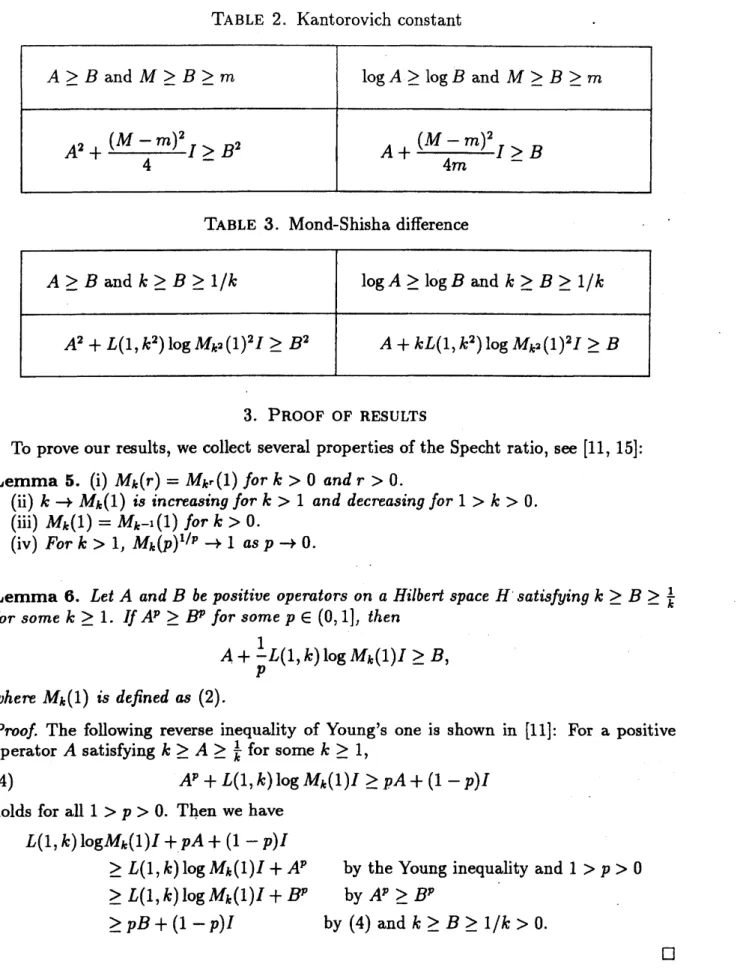
TABLE 2. Kantorovich constant
$A\geq B$ and $M\geq B\geq m$ $\log$$A\geq\log$$B$ and $M\geq B\geq m$
$A2_{[perp]}\underline{(M-m)^{2}}$
$r$ $\backslash >p2$ $A[perp]\underline{(M-m)^{2}}$$r[searrow] D$
$[]$
$\mathrm{T}\overline{4}\mathrm{J}$ $-$
’
.
$[]$$\tau \mathrm{z}\overline{4m}$ $\underline{/}lJ$
TABLE 3. Mond-Shisha difference
$A\geq B$ and $k\geq B\geq 1/k$ $\log$$A\geq\log$$B$ and $k\geq B\geq 1/k$
$A^{2}+L(1, k^{2})$$\log$$M_{k^{2}}$(1) $I\geq B^{2}$ $A+kL(1, k^{2})$$\log$ $M_{k^{2}}$(1) $I\geq B$
3. $\mathrm{p}_{\mathrm{R}\mathrm{O}\mathrm{O}\mathrm{F}}$
OF RESULTS
To prove our results, we collect several properties ofthe Specht ratio, see $[11, 15]$:
Lemma 5. (i) $M_{k}(r)=M_{k^{r}}(1)$
for
$k>0$ and $r>0$.
(ii) $karrow M_{k}(1)$ is increasing
for
$k>1$ and decreasingfor
$1>k>0$.
(ii) $M_{k}(1)=M_{k^{-1}}(1)$for
$k>0$.
(iv) For$k>1$, $M_{k}(p)^{1/p}arrow 1$ as$parrow \mathrm{O}$.
Lemma 6. Let A and B be positive operators on a Hilbert space H satisfying k $\geq B\geq\frac{1}{k}$
for
some k $\geq 1$.
If
$A^{p}\geq B^{p}$for
some p $\in(0,$1], then$A+ \frac{1}{p}L(1, k)\log M_{k}(1)I\geq B$,
where $M_{k}(1)$ is
defined
as (2).Proof
The following reverse inequality of Young’s one is shown in [11]: For apositiveoperator $A$ satisfying $k \geq A\geq\frac{1}{k}$ for some $k\geq 1$,
(4) $A^{p}+L(1, k)$$\log M_{k}(1)I\geq pA+(1-p)I$
holds for $\mathrm{a}\mathbb{I}$ $1>p>0$
.
Then we have$L(1, k)$$\log M_{k}(1)I+pA+(1-p)I$
$\geq L(1, k)$$\log M_{k}(1)I+A^{p}$ by the Young inequality and $1>p>0$
$\geq L(1, k)\log M_{k}(1)I+B^{p}$ by $A^{p}\geq B^{p}$
$\geq pB+(1-p)I$ by (4) and $k$ $\geq B\geq 1/k>0$
.
Cl
The following order preserving operator inequality is
our
key lemma in this reportLemma 7. Let A and B be positive operators on a Hilbert space H satisfying k $\geq B\geq$
$\frac{1}{k}>0$
for
some k $\geq 1$.
If
A $\geq B$, then$A^{p}+pL(1, k^{p})\log M_{k}(p)I\geq B^{p}$
for
all $p\geq 1$,where $M_{k}(1)$ is
defined
as (2).Proof.
Since $(A^{p})^{1/p}\geq(B^{p})^{1/p}$ for $0< \frac{1}{p}\leq 1$ and $k^{p}\geq B^{p}\geq k^{-p}$, it follows from Lemma6that
$A^{p}+pL(1, k^{p})\log M_{k}(p)I\geq B^{p}$ for all $p\geq 1$
.
Cl To prove Theorem 1, we need the following result [3, Proposition 7]:
Theorem D. Let $A$ and $B$ be positive
invertible
operators on a Hilbert space H.If
$\log A\geq\log B$, then
$\{B^{\frac{r}{2}}(B^{\frac{t}{2}}A^{p}B^{\frac{}{2}}‘)^{s}B^{\frac{r}{2}}\}^{\frac{1}{q}}\geq B^{\mathrm{L}+\lrcorner t}\sigma.[perp] r$
holds
for
$p,t$,$s,r$ $\geq 0$ and $q\geq 1$ with $(t+r)q\geq(p+t)s+r$.$P$
roof of
Theorem 1.$(\mathrm{i})\Rightarrow(\mathrm{i}\mathrm{i})$:By $\mathrm{T}\mathrm{h}\infty \mathrm{r}\mathrm{e}\mathrm{m}\mathrm{D}$, (i) ensures
(5) $\{B^{\frac{r}{2}}(B^{\frac{t}{2}}A^{p}B^{\frac{\mathrm{t}}{2}})^{s}B^{\frac{r}{2}}\}^{\frac{1}{q}}\geq B^{1R\mathrm{L}^{\mathrm{p}}\rfloor[perp]}q*r$
holds for $p,t,s,r\geq 0$ and $q\geq 1$ with
(6) $(t+r)q\geq(p+t)s+r$
.
$1L+\lrcorner t\underline{*+r}$
Put $A_{1}=A$ $q$ and $B_{1}=(A^{\frac{r}{2}}(A^{\frac{\mathrm{t}}{2}}B^{p}A^{\frac{t}{2}})^{s}A^{\frac{r}{2}})^{1/q}$, then $A_{1}\geq B_{1}$ by (5) and $k\geq A\geq$
$1/k>0$ assures $k^{1\mathrm{L}^{+[perp]\iota\underline{+r}}}q\geq A^{\frac{(\mathrm{p}+t)\iota+r}{q}}\geq k^{-\frac{(p+t)\cdot+r}{q}}$
By applying Lemma 7to $A_{1}$ and $B_{1}$,
we have
$A_{1}^{q}+qL(1, k^{(p+t)s+r}\log M_{k\mathrm{t}_{\mathrm{P}}+t)\cdot+r}(1)I\geq B_{1}^{q}$
.
Multipying $B^{-\frac{r}{2}}$on both sides, we have (ii).
(ii) $\Rightarrow(\mathrm{i}\mathrm{i}\mathrm{i})$:Put $r=(p+t)s-2t\geq 0$ and $q=2$ in (ii). Then the condition (6) is
satisfied and $(p+t)s\geq 22$, so wehave (iii).
(iii) $\Rightarrow(\mathrm{i}\mathrm{v})$:Ifwe put $t=0$ and $s=1$ in (iii), then we have (iv).
(iv) $\Rightarrow(\mathrm{i})$:If we put $parrow \mathrm{O}$ in (iv), then we have (i) by (iv) ofLemma 5. $\square$
Related to the extension of the L\"owner-Heinz theorem, Furuta [4] established the fol-lowing ingenious order preserving inequality which is now called the Furuta inequality
Theorem F (Furuta inequality) If $A\geq B\geq 0$, then for each $r>0$
(i) $(B^{\frac{r}{2}}A^{p}B^{\frac{r}{2}})^{\frac{1}{q}}\geq(B^{\frac{r}{2}}B^{p}B^{\frac{r}{2}})^{\frac{-1}{q}}$
and
(ii) $(A^{\frac{r}{2}}A^{p}A^{\frac{r}{2}})^{\frac{1}{q}}\geq(A^{\frac{r}{2}}B^{p}A^{\frac{r}{2}})^{\frac{1}{q}}$
hold for $p\geq 0$ and $q\geq 1$ with
$(1+r)q\geq p+r$
.
Alternative proofs of Theorem $\mathrm{F}$ have been given in [2], [6], and one page proof in [5].
The domain drawn for $p$,$q$ and $r$ in Figure is the best possible one [10] for Theorem F.
To prove Theorem 2, we need the following Furuta inequality:
Theorem $\mathrm{F}’$
.
Let $A$ and $B$ be positive $inve\hslash ible$ opemtors on a Hilbert space $H$ and$\delta$ $\in[0,1]$. Then the following properties are mutually equivalent:
(i) $A^{\delta}\geq B^{\delta}$
(ii) $(B^{\frac{r}{2}}A^{p}B^{\frac{r}{2}})^{\frac{\delta+r}{p+r}}\geq B^{\delta+r}$
for
$p\geq\delta$ and $r\geq 0$.
Proof of
Theorem 2.Suppose that $A^{\delta}\geq B^{\delta}$ for some $\delta\in[0,1]$. By the Furuta inequlity, we have
$(B^{\frac{r}{2}}A^{p}B^{\frac{r}{2}})^{\frac{\delta+r}{\mathrm{p}+r}}\geq B^{\delta+r}$
for$p\geq\delta$ and $r\geq 0$
.
and $k^{\delta+r}\geq B^{\delta+r}\geq k^{-\delta-r}$
.
By Lemma 7and $\mathrm{L}\delta++_{\frac{r}{r}}\geq 1$, it follows that
$B^{\frac{r}{2}}A^{p}B^{\frac{r}{2}}+ \frac{p+r}{\delta+r}L(1,k^{p+r})\log M_{k}(p+r)I\geq B^{p+r}$
.
Hence we have
$A^{p}+ \frac{p+r}{\delta+r}k^{r}L(1, k^{p+r})\log M_{k}(p+r)I\geq B^{p}$
for $p\geq\delta$ and $r\geq 0$
.
Put $r=p-2\delta(\geq 0)$, then$A^{p}+2k^{p-2\delta}L(1, k^{2\mathrm{p}-2\delta})\log M_{k}(2p-2\delta)I\geq B^{p}$
for all $p\geq 2\delta$
.
ClREFERENCES
[1] J.I.Fujii and Y.Seo, Characterizations ofchaotic order associated with the Mond-Shisha difference,
Math. Ineq. Appl., $5(2002)$, 725-734.
[2] M.Fujii, hruta ’s inequality andits mean theoretic approach, J.Operator Theory, 23(1990), 67-72.
[3] M.Fujii, M.Hashimoto, Y.Seo and M.Yanagida, Characterizations of usual and chaotic order via
Furuta and Kantorovich inequalities, Sci. Math., $3(2000)$, 405-418.
[4] T.Furuta, $A\geq B\geq 0$ assures $(B^{r}A^{p}B^{r})^{1/q}\geq B^{(p+2r)/q}$ for$r\geq 0$, $p\geq 0$, $q\geq 1$ with $(1+2r)q\geq$
$p+2r$, Proc. Amer. Math. Soc, 101(1987), 85-88.
[5] T.Furuta, Elementary proofofan order preserving inequality, Proc. JapanAcad., 65(1989), 126.
[6] E.Kamei, A satellite to Rrruta’s inequality, Math. Japon, 33(1988), 883-886.
[7] B.Mond and O.Shisha, Differenceand ratio inequalities in Hilbert space,“Inequalities$\mathrm{I}\mathrm{I}"$, (O.Shisha,
ed.). Academic Press, New York, 1970, 241-249.
[8] O.Shisha and B.Mond, Bounds on difference of means, “Inequalities”, (O.Shisha, ed.). Academic
Press, New York, 1967, 293-308.
[9] W.Specht, Zur Theorie derelementaren Mittel, Math. Z., 74(1960), 91-98.
[10 K.Tanahashi, Best possibilityofthe Furuta inequality, Proc. Amer. Math. Soc, 124(1996), 141-146.
[11 M.Tominaga, Specht’s ratio in the Young inequality, Sci. Math.Japon., 55,N0.3(2002), 585-588.
[12 A.M.Turing, Roundingoff-errorsin matrixprocesses, Quart. J.Mech. AppLMath., 1(1948), 287-308.
[13 T.Yamazaki, An extension ofSpecht ’s theorem via Kantorovich inequality andrelated results, Math.
Inequl. Appl., 3(2000), 89-96.
[14] T.Yamazaki, Further characterizations of chaotic order via Specht’s ratio, Math. Inequl. Appl.,
$2(2000)$, 259-268.
[15] T.Yamazaki and M.Yanagida, Characterizations ofchaotic order associated with Kantorovich
in-equality, Sci. Math., $2(1999)$, 37-50.