GROUP ACTIONS ON SYMMETRIC SPACES RELATED TO
LEFT-INVARIANT
GEOMETRICSTRUCTURES
HIROSHI TAMARU
ABSTRACT. In this paper, we summarize how the theory and results ofgroup
actions on symmetric spaces can be applied to the study of left-invariant
geo-metric structures on Lie groups. We also present a list ofproblems on group
actions, which naturally arise from this framework.
1. INTRODUCTION
Isometric actionson Riemannian symmetric spaces ofnoncompact type, suchas cohomogeneity one actions and (hyper)polar actions, have been studied actively in these decades (see [1-7, 19] and references therein). The theory and results of these actions have recently been applied to the study of left-invariant geometric
structures on Lie groups ([10-12, 17, 18, 38 The aim of this survey paper is to
present our framework and recent results. We also propose several problems
on
group actions, which naturally arise from
our
framework. Theanswers
of these problems would be interesting, not only from the viewpoint of group actions and submanifold geometry, but also for possible applications to the further studies on left-invariant geometric structures.Left-invariantgeometric structures
on
Liegroups, suchas
(pseudo-)Riemannianmetrics, symplectic structures, and (generalized) complex structures, have pro-vided
a
lot of interesting examples, and have been studied very actively (for left-invariant metrics, we refer to [8, 9, 13-16, 20, 22-27, 29-36, 39-44]). One of the central problems is the following existence and nonexistence problem.Problem 1.1. For a given Lie group, determine whether it admits “nice” left-invariant geometric structures
or
not.Note that, for a given Lie group and a given left-invariant structure, one can directly study the properties ofthem. For example, the following
can
be studied in the Lie algebra level – curvatures of a left-invariant metric, the integrabilitycondition of
a
left-invariant almost complex structure, andso on.
However, thisdoes not mean that the above mentioned problem is easy. One ofthe difficulties
comes
from the fact that a Lie group admits so many left-invariant geometric structures. For left-invariant metrics,one
knows the following.Fact 1.2. Let
$G$be
a
Lie group
of
dimension
$n$.Then there
are
identifications
$\overline{\mathfrak{M}}:=$
{left-invariant
Riemannian metricson
$G$}
$\cong${inner
productson
$\mathfrak{g}$ $:=Lie(G)$}
$\cong GL(n, \mathbb{R})/O(n)$,
$\overline{\mathfrak{M}}_{(p,q)}:=$
{left-invariant
metricson
$G$ with signature $(p, q)$}
$\cong GL(n, \mathbb{R})/O(p, q)$.
Therefore, for studying the existence and nonexistence of (nice” left-invariant
metrics, such
as
Einsteinor
Ricci soliton,one
has to study all pointson
the above spaces.For
left-invariant
metrics,of
course
the
Einstein
equation isa
linear equation, but it contains $(1/2)n(n+1)$ variables, which is in general very hard to be solved. In order to avoid this difficulty,we
have proposedan
approach from the following viewpoint.Fact 1.3. The above spaces $\overline{\mathfrak{M}}$
and $\overline{\mathfrak{M}}_{(p,q)}$
are
symmetric spaces (theformer
isnoncompact Riemannian, but the latter is pseudo-Riemannian). Furthermore, there
are
natural $action\mathcal{S}$of
the automorphism groupsof
the Lie algebrason
these spaces.This connects naturally the studies of left-invariant geometric structures and of group actions
on
symmetric spaces.Remark 1.4. We only mention left-invariant metrics in this paper, but believe that similar frameworks also work for other left-invariant geometric structures. In many cases, the set of
some
geometric structuresforms
a
symmetric space.Isometric actions
on
Riemannian symmetric spaces of compact typeare
cer-tainly interesting topics, and have been studied by many authors. We would like to say that, isometric actions
on
Riemannian symmetric spaces of noncompact type, and group actions on pseudo-Riemannian symmetric spaces,are
also inter-esting topics. Theyare
ofcourse
interesting from the viewpoint of group actions and submanifold geometry, and also interesting because of possible applications to the studieson
left-invariant geometric structures.Acknowledgements. The author would like to thank Takashi Sakai for
a
kind invitation and for givingme
this opportunity. He also thanks to Takayuki Okuda and Akira Kubo for reading the manuscript carefully. This workwas
supported by JSPS KAKENHI Grant Numbers 24654012,26287012.
2. ISOMETRIC ACTIONS ON RIEMANNIAN SYMMETRIC SPACES OF
NONCOMPACT TYPE (1 )
Let us consider isometric actions of $H$
on
Riemannian symmetric spaces $M$GROUPS ACTIONS STRUCTURES
mention
some
known results, and their applications to the study of left-invariant Riemannian metrics on Lie groups.2.1. Results
on
cohomogeneityone
actions. First of all,we
recallsome
fundamental notions
on
group actions, and review aresulton
cohomogeneityone
actions.
Definition 2.1. Consider
an
isometric action ofa
Lie group $H$on a
Riemannianmanifold $M$. Then, orbits
of
maximaldimensionare
said to be regular, and otherorbits singular. The codimension of
a
regular orbit is called the cohomogeneity of the action.For cohomogeneity
one
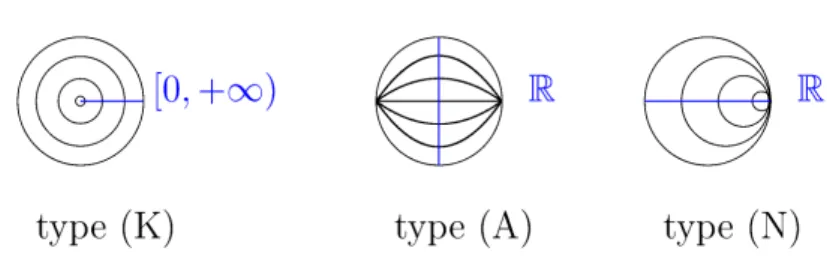
actions on symmetric spaces ofnoncompact type, pos-sible topological types ofthe orbit spaces have been studied.Theorem 2.2 (Berndt-Br\"uck ([1])). Let $M$ be
a
Riemannian symmetric spaceof
noncompact type, and consider a cohomogeneity one actionof
$H$on
$M$ with$H$ being connected. Then, the orbit space $H\backslash M$ is homeomorphic to either$\mathbb{R}$ or
$[0, +\infty)$.
As
an
example,we
here drawa
picture ofthis situation for cohomogeneityone
actions
on
the real hyperbolic plane$\mathbb{R}H^{2}=SL(2, \mathbb{R})/SO(2)$.
Example 2.3. Consider the Iwasawa decomposition $SL(2, \mathbb{R})=KAN$, where
$K=SO(2)$, $A=\{(\begin{array}{ll}a 00 -a\end{array})|a>0\},$ $N=\{(\begin{array}{ll}1 b0 1\end{array})|b\in \mathbb{R}\}.$
Then, the actions of $K,$ $A$, and $N$
on
$\mathbb{R}H^{2}$are
ofcohomogeneityone
(and in fact they exhaust all, up to orbit equivalence). The orbits and the orbit spaces of these actions are as in Figure 1. More precisely,(K) The action of $K$ has a fixed point, the center $0$. Other orbits
are
circlescentered at $0$. In this case, the orbit space is homeomorphic to $[0, +\infty$).
(A) The orbit of$A$ through the center $0$ is
a
geodesic, and other orbitsare
itsequidistant lines. The orbit space is homeomorphic to $\mathbb{R}.$
(N) The orbits of $N$
are
horocycles. In this case, all orbitsare
congruent to each other, and the orbit space is homeomorphic to $\mathbb{R}.$2.2. Results on
left-invariant
metrics. We now consider $\overline{\mathfrak{M}}$, the set of all left-invariant Riemannian metrics
on
a
given Lie group $G$.Assume
that $G$ issimply-connected, for simplicity.
Remark 2.4. Denote by $\mathfrak{g}$ the Lie algebra of $G$. Let $n:=\dim \mathfrak{g}$, and fix a basis
of $\mathfrak{g}$. Then one has identifications
type (K) type (A) type (N)
FIGURE 1. The orbits and the orbit spaces of actions
on
$\mathbb{R}H^{2}$Then, it is well-known that $\overline{\mathfrak{M}}$
equipped with the canonical $GL(n, \mathbb{R})$-invariant
Riemannian metric is
a
Riemannian symmetric space, which is noncompact. In this paper, this Riemannian metric is always assumed to be equipped.We consider the group actions
on
$\overline{\mathfrak{M}}$given by
$\mathbb{R}^{\cross}:=\{c. id: \mathfrak{g}arrow \mathfrak{g}|c\in \mathbb{R}_{\neq 0}\},$
$Aut(\mathfrak{g}):=\{\varphi\in GL(\mathfrak{g})|\varphi =[\varphi(\cdot) , \varphi$
Definition 2.5. The orbit space
of
the actionof
$\mathbb{R}^{\cross}Aut(\mathfrak{g})$on
$\overline{\mathfrak{M}},$$\mathfrak{P}\mathfrak{M}:=\mathbb{R}^{\cross}Aut(\mathfrak{g})\backslash \overline{\mathfrak{M}},$
is called the moduli $\mathcal{S}pace$ ofleft-invariant Riemannian metrics
on
$G.$Remark 2.6. The actionof$\mathbb{R}^{\cross}Aut(\mathfrak{g})$ gives rise to isometry up toscaling of
left-invariant Riemannian metrics. Therefore, all Riemannian geometric properties of left-invariant metrics
are
preserved by this action. Thus, in order to examine the existence and nonexistence ofa
“nice” metric,one
has only to study the moduli space $\mathfrak{P}\mathfrak{M}.$We here give
one
easy example ofa
description of the moduli space $\mathfrak{P}\mathfrak{M}.$Throughout this
paper,
thecanonical
basisof
$\mathfrak{g}=\mathbb{R}^{n}$ isdenoted
by $\{e_{1}, \cdots, e_{n}\}.$Proposition 2.7 (Hashinaga-Tamaru-Terada ([12])). Consider the Lie algebra
$\mathfrak{g}$ $:=$
$(\mathbb{R}^{3}, [, ])$ with $[e_{1}, e_{2}]=e_{2}$ (and others are zero). Denote by $\langle,$ $\rangle_{0}$ the canonical
inner product on $\mathfrak{g}=\mathbb{R}^{3}$ Then one $ha\mathcal{S}$
(1) the action
of
$\mathbb{R}^{\cross}Aut(\mathfrak{g})$ on$\overline{\mathfrak{M}}$
is
of
cohomogeneity one, (2) the moduli space $\mathfrak{P}\mathfrak{M}$ can be expressedas
$\mathfrak{P}^{\mathfrak{M}=}\{\mathbb{R}^{\cross}Aut(\mathfrak{g}).((\begin{array}{lll} 1 1 \lambda 1\end{array}).\langle, \rangle_{0})|\lambda\in \mathbb{R}\}.$
Remark 2.8. In order to give
an
expression of $\mathfrak{P}\mathfrak{M}$,one
needs direct matrixGROUPS ACTIONS RELATED TO LEFT-INVARIANT GEOMETRIC STRUCTURES
orbit spaces in Theorem 2.2. This general theory of cohomogeneity
one
actions does not give an expression of$\mathfrak{P}\mathfrak{M}$, but gives us a certification.This expression of the moduli space $\mathfrak{P}\mathfrak{M}$ provides the following Milnor-type
theorem. The
reason
of this naming is that the basis mentioned below isa
kind ofa
generalization of “Milnor frames”, obtained by Milnor ([29]).Proposition 2.9 ([12]). Let $\mathfrak{g}$ $:=(\mathbb{R}^{3}, [, ])$ be the Lie algebra in Proposition 2.7,
and $\langle,$$\rangle$ be
an
arbitrary inner product
on
$\mathfrak{g}$.
Then, there exist $\lambda\in \mathbb{R},$ $k>0,$and an orthonormal $ba\mathcal{S}is\{x_{1}, x_{2}, x_{3}\}$ with respect to $k\langle,$ $\rangle$ such that the nontrivial
bracket relations are given by
$[x_{1}, x_{2}]=x_{2}-\lambda x_{3}.$
When
we
apply this Milnor-type theorem,one
can
assume
$k=1$ without lossof generality, since $k>0$ isjust
a
scaling factor. In terms of the basis $\{x_{1}, x_{2}, x_{3}\},$one can
directly calculate the curvatures, which proves the following.Corollary 2.10 ([12]). The Lie algebra in Proposition 2.7 does not admit
left-invariant Einstein metrics, and furthermore, it $doe\mathcal{S}$ not admit
left-invariant
met-ricsof
negative Ricci curvature.The above Lie algebra is just
an
easy example. We have studiedsome
other Lie algebrasas
well, including the followingones.
Remark 2.11. Milnor-type theorems have been obtained for (1) all
three-dimensional
solvable Lie algebras ([11]), (2) allfour-dimensional
nilpotent Lie algebras ([10]), (3)some
higher-dimensional Lie algebras ([10, 12, 38 It is remarkable that the action of $\mathbb{R}^{\cross}Aut(\mathfrak{g})$ on$\overline{\mathfrak{M}}$
can be of cohomogeneity one,
even
if the dimension of $\mathfrak{g}$ is high. In fact, for any $n\geq 3$, there existsa
Liealgebra $\mathfrak{g}$ of dimension $n$ whose corresponding action is of cohomogeneity
one.
2.3. Problems. In thelast ofthis section,
we
proposesome
problems concerning with the orbit spaces of isometric actionson
symmetric spaces of noncompact type.Problem 2.12. For Riemannian symmetric spaces of noncompact type, classify possible topological type of orbit spaces of
some
particular classes of actions (for examples, cohomogeneity two, (hyper)polar, andso
on).The
answers
of the above problem would be useful to obtain Milnor-typethe-orems
for more complicated Lie algebras. On the Lie algebra side, the following problems would be natural.Problem 2.13. Classify Lie algebras $\mathfrak{g}$
so
that the actions of $\mathbb{R}^{\cross}Aut(\mathfrak{g})$on
$\overline{\mathfrak{M}}$have
some
particular properties (for examples, cohomogeneityone or
two, (hy-per)polar, andso
on).Note that Taketomi ([37]) has
constructed
Lie algebras $\mathfrak{g}$so
thatthe actions of
$\mathbb{R}^{\cross}Aut(\mathfrak{g})$
are
hyperpolar, havinga
singular orbit and higher cohomogeneity. Inthis way, the study of left-invariant metrics would also contribute to the study of isometric actions
on
symmetric spaces.3.
ISOMETRIC ACTIONS ON RIEMANNIAN SYMMETRIC SPACES OFNONCOMPACT TYPE (2)
In this section,
we
continue to consider isometric actionson
Riemannian sym-metric spaces ofnoncompact type. We here focuson
the geometry of the orbits, in particular,some
“distinguished” orbits.3.1. Results
on
cohomogeneityone
actions. First of all,we
recalla
resulton
cohomogeneityone
actions. The following is not explicitly written in [4], but can be seen from the classification result (we also refer to [7]).Theorem 3.1 (Berndt-Tamaru ([4])). Let $M$ be an irreducible Riemannian
sym-metric space
of
noncompact type, and considera
cohomogeneityone
actionof
$H$on
$M$ with $H$ being connected. Then, this actionsatisfies
one
of
the following:(K) There exists a unique singular orbit.
(A) All orbits are regular, and there exists
a
unique minimal orbit.(N) All orbits are regular, and furthermore, all $orbil\mathcal{S}$
are
isometricallycon-gruent to each other.
One
already knows examples of these actions in Figure 1. Recall that thenames
(K), (A), and (N)come
from
the Iwasawa decompositionof
$SL(2, \mathbb{R})$.
Remark 3.2. For a cohomogeneity
one
action of type (K)or
(A), there existsa
unique “distinguished” orbit, that is, the unique singular orbit for type (K) ,
or
the unique minimal orbit for type (A). For the
case
of
type (N), it looks that there does not exista
distinguished orbit.3.2.
Resultson
left-invariant metrics. We nowsee
how the above pictures of cohomogeneityone
actionsare
related to the study of left-invariant Riemannian metrics. We are interested in the following class of left-invariant metrics.Definition 3.3. Let $(\mathfrak{g}, \langle, \rangle)$ be a metric Lie algebra, and denote by $Ric:\mathfrak{g}arrow \mathfrak{g}$
the Ricci operator. Then, $\langle,$ $\rangle$ is said to be algebraic Ricci soliton if there exist
$c\in \mathbb{R}$ and
a
derivation $D\in Der(\mathfrak{g})$ such that $Ric=c\cdot id+D.$It is easy to
see
that “Einstein” implies “algebraic Ricci soliton” Recall thata
derivation $D$ : $\mathfrak{g}arrow \mathfrak{g}$ isa
linear map satisfyingRELATED TO LEFT-INVARIANT GEOMETRIC STRUCTURES
Remark 3.4. If $(\mathfrak{g}, \langle, \rangle)$ is algebraic Ricci soliton, then it gives rise to
a
Ricci soliton metric $([23, 25$ More precisely, $if (\mathfrak{g}, \langle, \rangle)$ is algebraic Ricci
soliton, then the corresponding simply-connected Lie
group
with theinduced left-invariant
metric $(G, \langle, \rangle)$ is Ricci soliton, in the
sense
that there exist $c\in \mathbb{R}$ and $X\in X(G)$such that
$ric=c\langle, \rangle+\mathfrak{L}_{X}\langle, \rangle.$
Here, $ric$ denotes the Ricci $(0,2)$-tensor, and $\mathfrak{L}_{X}$ the Lie derivative along $X.$
We study algebraic Ricci soliton metrics, from the view point of the actions of
$\mathbb{R}^{\cross}Aut(\mathfrak{g})$. In the following case, there is a very nice correspondence.
Theorem 3.5 (Hashinaga-Tamaru ([11])). Let $\mathfrak{g}$ be a three-dimensional solvable
Lie algebra. Then,
an
innerproduct $\langle,$ $\rangle$on
$\mathfrak{g}$ is algebraic Ricci soliton
if
and onlyif
the orbit $\mathbb{R}^{\cross}Aut(\mathfrak{g}).\langle,$ $\rangle$ isa
minimalsubmanifold.
Recall that theambient space $\overline{\mathfrak{M}}=GL(3, \mathbb{R})/O(3)$ is equipped with thenatural
$GL(3, \mathbb{R})$-invariant metric, and is
a
noncompact Riemannian symmetric space.Remark 3.6. A key point of Theorem 3.5 is that, for a three-dimensional solv-able Lie algebra $\mathfrak{g}$, the action of$\mathbb{R}^{\cross}Aut(\mathfrak{g})$ is ofcohomogeneity at most
one
(thatis, transitive
or
cohomogeneity one). For the cohomogeneityone
cases, algebraic Ricci soliton metricsare
exactly corresponding to the “distinguished” orbitsde-scribed in Remark 3.2.
We checked several Lie algebras $\mathfrak{g}$ whether it has the similar property
or
not.The answer is affirmative for some cases, but not for some
cases.
For examples, Theorem3.7
(Hashinaga ([10])). For afour-dimensional
nilpotent Lie algebra$\mathfrak{g}$,
an
inner product $\langle,$$\rangle$ is algebraic Ricci solitonif
and onlyif
$\mathbb{R}^{\cross}Aut(\mathfrak{g}).\langle,$$\rangle$ isa
minimal
submanifold.
On the other hand, there exists afour-dimensional
solvable Lie algebra $\mathfrak{g}$ such that the both implications do not hold.Despite of the above result,
we
still expect that (algebraic) Ricci solitonmetrics$\langle,$$\rangle$
are
corresponding to “distinguished”$\mathbb{R}^{\cross}Aut(\mathfrak{g})$.$\langle,$$\rangle$. One naive certification is
that, if $\langle,$ $\rangle$ is bi-invariant, then
$\mathbb{R}^{\cross}Aut(\mathfrak{g}).\langle,$$\rangle$ is totally geodesic.
3.3. Problems. In the last of this section, we propose some problems on isomet-ric actions, which naturally arise from
our
framework.Problem 3.8. For
Riemannian
symmetric spaces of noncompact type, study the geometry of orbits ofsome
particular actions. For examples, cohomogene-ityone
actions (with $H$ not necessarily connected), cohomogeneity two actions, (hyper)polar actions, andso
on.The next problem is about
a
characterizationof particularleft-invariant metrics in terms of the corresponding submanifolds.Problem 3.9. Examine whether properties of $\mathfrak{g}$
can
be understood by thecor-responding group actions. For examples, the following properties
can
be charac-terized by submanifolds? – (algebraic) Ricci soliton, flat, positive or negativecurvatures, and
so
on.
4. NONISOMETRIC ACTIONS ON $R$-SPACES
We here consider group actions, not necessarily isometric, on $R$-spaces. In this
section,
we
mentionone
simple example, andsome
possible problems. We refer to [28, 21] and references therein for related and deeper results.4.1. Results
on
group actions. We heresee
one example of $a$ (nonisometric)group action
on an
$R$-space.Definition 4.1. Let $L$ be
a
semisimple Lie group with trivial center, and $Q$ bea
parabolic subgroup
of
$L$.Then
the cosetspace
$M$ $:=L/Q$ iscalled
an
$R$-space.
An $R$-space is also called
a
real flagmanifold.
An
exampleon
whichwe
con-centrate in this section is the real projective space.
Example 4.2. The real projective space $\mathbb{R}P^{n}$ is
an
$R$-space. In fact,one
hasan
expresslon
$\mathbb{R}P^{n-1}=SL(n, \mathbb{R})/\{(00* *** ***)|\det=1\}.$
Remark 4.3. It is known that
an
$R$-spacecan
be realizedas an
orbitof
theisotropy representation of
a
Riemannian symmetric space. In fact, $\mathbb{R}P^{n-1}$can
berealized
as an
orbit ofthe isotropy representation of $SL(n, \mathbb{R})/SO(n)$.We consider the natural action of $SO(p, q)$
on
$\mathbb{R}P^{p+q-1}$. Thereason
of thischoice will be mentioned in the next section.
Proposition 4.4 (Kubo-Onda-Taketomi-Tamaru ([18])).
Consider
$SO(p, q)$ with$p,$$q\geq 1$. Let $\langle,$ $\rangle_{0}$ be the canonical inner product on $\mathbb{R}^{p+q}$ with signature $(p, q)$,
which $i\mathcal{S}$ invariant under the action
of
$SO(p, q)$. Then, the actionof
$SO(p, q)$ on $\mathbb{R}P^{p+q-1}$ has exactly three orbits, namely,$\mathcal{O}^{+}:=\{[v]\in \mathbb{R}P^{p+q-1}|\langle v, v\rangle_{0}>0\},$
$\mathcal{O}^{0}:=\{[v]\in \mathbb{R}P^{p+q-1}|\langle v, v\rangle_{0}=0\},$
$\mathcal{O}^{-}:=\{[v]\in \mathbb{R}P^{p+q-1}|\langle v, v\rangle_{0}<0\}.$
Note that $\mathcal{O}^{+}$ and $\mathcal{O}^{-}$ are open orbits. Since $SO(p, q)$ preserves $\langle,$$\rangle_{0}$, it is easy
GROUPS ACTIONS RELATED TO LEFT-INVARIANT GEOMETRIC STRUCTURES
Remark 4.5. Note that $SO(p, q)$ is
a
symmetric subgroup of $SL(n,\mathbb{R})$, that is,$(SL(n, \mathbb{R}), SO(p, q))$ is
a
symmetric pair. The above mentioned action would beinteresting from this view point, since it
can
be consideredas an
analogy ofa
“Hermann action”
4.2. Problems. In the last of this section,
we
proposesome
problemson
group actionson
$R$-spaces. The following problems must be related to representationtheory.
Problem 4.6. Let $M=L/Q$ be an $R$-space, and $H$ be a Lie subgroup of $L.$
Consider the action of $H$
on
$M=L/Q.$(1) Among such actions, find interesting examples. (2) Study what happens if $(L, H)$ is
a
symmetric pair.(3) Examine when it has
an
open orbit.Next problem is about submanifold geometry. At the moment, the author knows no interesting examples, but it would be natural.
Problem 4.7. Consider the same situation as Problem 4.6. Then, orbits $H.p$
can be inhomogeneous with respect to Isom (M). However, study whether the orbits still have
some
“nice” properties (as Riemannian submanifold) or not.5. ISOMETRIC ACTIONS ON PSEUDO RIEMANNIAN SYMMETRIC SPACES
In this section,
we
considerisometric actions onpseudo-Riemannian symmetric spaces. This is related to the topic of the previous section, and also has applica-tions to the study ofleft-invariant pseudo-Riemannian metrics on Lie groups. 5.1. Resultson
group actions. We here mention the following only one ex-ample of an isometric action.Proposition 5.1 (Kubo-Onda-Taketomi-Tamaru ([18])). The action
of
thefol-lowing $Q$ on $GL(p+q, \mathbb{R})/O(p, q)$ has exactly three orbits:
$Q:=\{ (00* * \cdot*\cdot *)\in GL(p+q, \mathbb{R})\}.$
One can certificate this from Proposition 4.4. In fact, the orbit space of this
action coincides with the orbit space of the action of $O(p, q)$ on
5.2. Results
on
left-invariant metrics. We now recall
$\tilde{\mathfrak{M}}_{p,q}$,
the
setof all
left-invariant metrics
on a
Lie group $G$ with signature $(p, q)$.Denote
by $\mathfrak{g}$ the Liealgebra of $G$, and consider the group $\mathbb{R}^{\cross}Aut(\mathfrak{g})$
as
in the Riemanniancase.
Definition 5.2. The orbit space of the action of$\mathbb{R}^{\cross}Aut(\mathfrak{g})$
on
$\overline{\mathfrak{M}}_{p,q},$$\mathfrak{P}\mathfrak{M}_{p,q}:=\mathbb{R}^{\cross}Aut(\mathfrak{g})\backslash \overline{\mathfrak{M}}_{p,q},$
is called the moduli space ofleft-invariant metrics
on
$G$ with signature $(p, q)$.We pic up the following two Lie algebras. Recall that $\{e_{1}, . . . , e_{n}\}$ denotes the
canonical basis of$\mathbb{R}^{n}$
, and
we
only writenonzero
bracket relations. Definition 5.3.We
define the following two Lie algebras:(1) $\mathfrak{h}^{3}=(\mathbb{R}^{3}, [, ])$ with $[e_{1}, e_{2}]=e_{3}$ is called the Heisenberg Lie algebra.
(2) $\mathfrak{g}_{\mathbb{R}H^{n}}=(\mathbb{R}^{n}, [, ])$ with the following bracket relations is called the solvable
Lie algebra
of
$\mathbb{R}H^{n}$:$[e_{1}, e_{2}]=e_{2}$,
.
. . , $[e_{1}, e_{n}]=e_{n}.$Note that $\mathbb{R}H^{n}$ is the real hyperbolic space. The simply-connected Lie group
$G_{\mathbb{R}H^{n}}$ with Lie algebra
$\mathfrak{g}_{\mathbb{R}H^{n}}$ acts simply-transitively
on
$\mathbb{R}H^{n}.$
Theorem 5.4 ([18]). Let $\mathfrak{g}$ $:=\mathfrak{h}^{3}$
or
$\mathfrak{g}_{\mathbb{R}H^{n}}$. Then,for
all$p,$$q\in \mathbb{N}$ with $dimg=$$p+q$, there exists exactly three
left-invariant
metricson
$\mathfrak{g}$ with signature $(p, q)$,up to $isometr1/and$ scaling.
The proof is based
on
the fact that, for the Lie algebras $\mathfrak{g}$ mentioned above,$\mathbb{R}^{\cross}Aut(\mathfrak{g})$ is
a
parabolic subgroup. In fact, it coincides with $Q$ in Proposition 5.1.Remark 5.5. For the
case
of $\mathfrak{h}^{3}$, the above result has been known by Rahmani ([36]), but the method is different. The properties of these three metrics have also been studied by Onda ([35]).
Remark 5.6. For the
case
of$\mathfrak{g}_{\mathbb{R}H^{n}}$,we
have proved that these three left-invariantmetrics have constant sectional curvatures ([18]). Note that the Lorentzian
case
of these results have been known by Nomizu ([34]), but the method is different. Our argument simplifies the proof of his results, and also extends it to the
case
of generic signatures.
5.3. Problems. As mentioned above, the study of isometric actions
on
$GL(p+$$q,$$\mathbb{R})/O(p, q)$ has applications to left-invariant pseudo-Riemannian metrics. This
motivates to study the following problems.
Problem 5.7. Study isometric actions of $H$
on
pseudo-Riemannian symmetric spaces $M$. First ofall, study thecase
when $H$ isa
parabolic subgroup (thiscase
GROUPS ACTIONS RELATED TO LEFT-INVARIANT GEOMETRIC STRUCTURES
Problem 5.8.
Construct
“nice” isometric actionson
a pseudo-Riemannian sym-metric space $M=U/K$. For example, let $K’$ bea
maximal compact subgroupof $U$, and consider the Riemannian symmetric space $M’=U/K’$ of noncompact
type. If the action of $H$
on
$M’$ is nice insome
sense, thenso
is the action of $H$on
$M$?REFERENCES
[1] Berndt, J., Br\"uck, M.: Cohomogeneity one actions on hyperbolic spaces, J. Reine Angew.
Math., 541 (2001), 209-235.
[2] Berndt, J., D\’iaz-Ramos, J. C., Tamaru, H.: Hyperpolar Homogeneous
foliations
onsym-metric spaces
of
noncompact type, J. Differential Geom. 86 (2010), 191-235.[3] Berndt, J., $Dom\’{i} n_{\epsilon}\sigma uez$-V\’azquez, M.: Cohomogeneity one actions on some noncompact symmetric spaces
of
rank two, Ransform. Groups, to appear. ArXiv:1312.3284.[4] Berndt, J., Tamaru, H.: Homogeneous codimension one
foliations
on noncompact typesymmetric spaces, J. Differential Geom., 63 (2003), 1-40.
[5] Berndt, J., Tamaru, H.: Cohomogeneity one actions on noncompactsymmetricspaces with
a totally geodesic singular orbit, Tohoku Math. J., 56 (2004), 163-177.
[6] Berndt, J., Tamaru, H.: Cohomogeneity one actions on noncompact symmetric spaces of
rank one, hans. Amer. Math. Soc., 359 (2007), 3425-3438.
[7] Berndt, J., Tamaru, H.: Cohomogeneity one actions on symmetric spaces
of
noncompacttype, J. Reine Angew. Math., 683 (2013), 129-159.
[8] Fern\’andez-Culma, E. A.: Classification of 7-dimensional Einstein nilradicals, Ransform.
Groups, 17 (2012), 639-656.
[9] $Ferna_{n}dez$-Culma, E. A.: Classification ofNilsoliton metrics in dimension seven,J. Geom.
Phys., 86 (2014) 164-179.
[10] Hashinaga, T.: On the minimality
of
the correspondingsubmanifolds
tofour-limensional
solvsolitons, Hiroshima Math. J., 44 (2014), 173-191.
[11] Hashinaga, T., Tamaru, H.: Three-dimensional solvsolitons and the minimality
of
thecorresponding submanifolds, preprint.
[12] Hashinaga, T., Tamaru, H., Terada, K.: Milnor-type theoremsfor left-invariant
Riemann-ian metrics on Lie groups, preprint.
[13] Heber, J.: Noncompacthomogeneous Einstein spaces, Invent. Math., 133 (1998), 279-352.
[14] Jablonski, M.: Concerning the existence
of
Einstein and Ricci soliton metrics on solvable Lie groups, Geometry & Topology, 15 (2011), 735-764.[15] Jablonski, M.: Homogeneous Ricci solitons, J. Reine Angew. Math., to appear.
[16] Jablonski,M.: Homogeneous Ricci solitons are algebraic, Geometry&Topology, to appear. [17] Kodama, H., Takahara, A., Tamaru,H.: The space
of
left-invariant
metrics on aLie groupup to isometry and scaling, ManuscriptaMath., 135 (2011), 229-243.
[18] Kubo, A., Onda, K., Taketomi, Y., Tamaru, H.: On the moduli spaces
of
left-invariantpseudo-Riemannian metrics on Lie groups, inpreparation.
[19] Kubo, A., Tamaru, H.: A sufficient conditionfor congruency oforbits ofLie groups and
some applications, Geom. Dedicata, 167 (2013), 233-238.
[20] Kerr, M. M., Payne, T. L.: The geometryof filiform nilpotent Lie groups, Rocky Mountain J. Math., 40 (2010), 1587-1610.
[21] Kroetz, B., Schlichtkrull, H.: Finite orbit decomposition ofrealflag manifolds, preprint.
ArXiv: 1307.2375.
[22] Lafuente, R., Lauret, J.: Structure
of
homogeneous Ricci solitons and the Alekseevskii[23] Lauret, J.: Ricci soliton homogeneous nilmanifolds, Math. Ann., 319 (2001), 715-733.
[24] Lauret, J.: Einsteinsolvmanifolds are standard,Ann. of Math. (2), 172 (2010), 1859-1877.
[25] Lauret, J.: Ricci soliton solvmanifolds, J. ReineAngew. Math., 650 (2011), 1-21.
[26] Lauret, J., Will, C.: Einstein
solvmanifolds:
existence andnon-existence questions, Math.Ann., 350 (2011), 199-225.
[27] Lauret, J., Will, C.: On the diagonalization ofthe Ricciflow on Lie groups, Proc. Amer.
Math. Soc., 141 (2013), 3651-3663.
[28] Matsuki, T.: Orbits on flag manifolds, in: Proceedings of the International Congress of
Mathematicians, Vol. I, II (Kyoto, 1990), 807-813.
[29] Milnor, J.: Curvatures
of left
invariant metrics on Lie groups, Advances in Math., 21(1976), 293-329.
[30] Nikolayevsky, Y.: Einstein
solvmanifolds
withfree
nilradical Ann. Global Anal. Geom.,33 (2008), 71-87.
[31] Nikolayevsky, Y.: Einstein
solvmanifolds
with a simple Einstein derivation, Geom.Dedi-cata, 135 (2008), 87-102.
[32] Nikolayevsky, Y.: Einstein
solvmanifolds
and the pre-Einstein derivation, Trans. Amer.Math. Soc., 363 (2011), 3935-3958.
[33] Nikolayevsky, Y.: Einstein
solvmanifolds
attached to two-step nilradicals, Math. Z., 272(2012), 675-695.
[34] Nomizu, K.:
Lefl-invariant
Lorentz metrics on Lie groups. Osaka J. Math. 16 (1979),143-150.
[35] Onda, K.: Lorentz Ricci Solitons on 3-dimensional Lie groups, Geom. Dedicata, 147
(2010), 313-322.
[36] Rahmani, S.: Metriques de Lorentz sur les groupes de Lie unimodulaires, de dimension
trois, J. Geom. Phys., 9 (1992), 295-302.
[37] Taketomi, Y.: Examples
of
hyperpolaractions ofthe automorphism groups ofLie algebras,Topology Appl. (Special Issues), to appear.
[38] Taketomi, Y., Tamaru, H.: On the nonexistence
of left-invariant
Ricci solitons – acon-jecture and examples, in preparation.
[39] Tamaru, H.: A class
of
noncompact homogeneous Einstein manifolds, In: DifferentialGeometry and its Applications, 119-127, Matfyzpress, Prague, 2005.
[40] Tamaru, H.: Noncompact homogeneous Einsteinmanifolds attachedto graded Lie algebras,
Math. Z., 259 (2008), 171-186.
[41] Tamaru, H.: Parabolic subgroups of semisimple Lie groups and Einstein solvmanifolds,
Math. Ann., 351 (2011), 51-66.
[42] Will, C.: Rank-one Einstein
solvmanifolds
of
dimension 7, Differential Geom. Appl., 19(2003), 307-318.
[43] Will, C.: A curve
of
nilpotent Lie algebras which are not Einstein nilradicals, Monatsh.Math., 159 (2010), 425-437.
[44] Will, C.: The space ofsolvsolitons inlowdimensions, Ann. Global Anal. Geom., 40 (2011),
291-309.
DEPARTMENTOFMATHEMATICS, HIROSHIMA$UNIVERSITy_{\}}$ HIGASHI-HIROSHIMA 739-8526,
JAPAN