
日本産フクジュソウの植物学的研究
36
0
0
全文
(2) ^m~S.^.^±^SS (S2OT) ^39^ ^l^- BSfR63^10^. Journal of Hokkaido University of Education (Section II B) Vol. 39, No. 1 October, 1988. Botanical Studies on Adonis amurensis Regel et Radde. in Japan (Part 1Y Tsunehiko NISHIKAWA Biological Laboratory, Asahikawa College, Hokkaido University of Education, Asahikawa 070. B^^7^>>^ y>©»^Wg (^-^)". IS Jll M ^. vs^^^mm^^^ Summary. Due to unrestrained development of suburbs of big cities like Sapporo and Asahikawa, spring ephemerals like Corydalis ambigua, Erythronium japonicum, Adonis amurensis etc. are endangered or threatened. This makes botanical studies on these plants indispensable to ensure nature conservation, as botanical studies by many workers in the past and present have not. been adequate. Thus, I have conducted a study of Adonis amurensis, which has been a popular spring ephemeral since the Edo Period in Japan (A.D. 1603-1867). The study provides basic data for future preservation of the species as well findings of botanical interest. The results are as follows: 1. Japanese Adonis can be divided into three species on the basis of morphology and chromosome numbers: 1) A. amurensis Regel et Radde has 2n= 16 chromosomes and bears only. a single flower per stem; sepals are slightly longer or shorter than petals, purple to dark purple, and fruits are broadly elliptic to suborbiculate. It distributes from the Okhotsk Sea to the Pacific Ocean in Eastern Hokkaido. 2) A. multiflom Nishikawa et Ko. Ito sp. nov. has 2n=16 chromosomes and bears many flowers per stem; sepals are shorter than petals, pale to dark green, and fruits are globose. It distributes from northern Honshu to Kyushu. 3) A. ramosa. « Thesis of Ph. D.E.S. of Hokkaido University. (D.
(3) 2 Tsunehiko NISHIKAWA Franchet has 2n=32 chromosomes and bears one or more flowers per stem; sepals are nearly. as long as petals, purple to dark purple, and fruits are broadly elliptic to suborbiculate. It distributes in Hokkaido, Honshu, and Shikoku, endemic to Japan. 2. A triangular cross experiment of A. amurensis, A. miiltiflora, and A. ramosa was. successful. From the meiotic chromosome behavior of hybrids, the habits of flower setting and leaf arrangement, and distribution of the three species A. ramosa was found to be an allotetra-. ploid derived from A. amurensis and A. mnltiflora. 3. The time of meiosis and the distribution pattern of Adonis species showed that observation of the relations between the differentiation time of flower buds and day length provided a useful approach to understanding the distribution route of the plants. 4. The Adonis cultivars were divided into three groups on the basis of ploidy and origin: 1) diploid cultivars descending from A. multiflora Nishikawa et Ko. Ito (cvs. Kotobuki, Hinodeko, Sandamaki, etc.), 2) tetraploid cultivars descending from A. ramosa Franchet (cvs. Benten,. Kogikn, Kinsai, etc.), and 3) tri- and pentaploid cultivars derived from hybrids of A. witdtiflora Nishikawa et Ko. Ito and A. ramosa Franchet (cvs. Fukujukai, Nadeshiko, Taiho, etc.).. 1. Introduction. 11. The aim Fukujuso (:(§^^) is one of the most popular ornamental herbs in Japan, and is particularly appreciated by the Japanese. It is a custom to decorate a porch table with its golden blossoms on the First day of the new year, and so it is also called "Ganjitsuso" (76 0^). Fukujuso has frequently appeared in literature - particularly in Waka and Haiku. The following are especially famous and popular in Japan (Mizuhara et al., 1981; Matsuda, I960): Hinoshouji Taikonogotoshi Fukujuso. (Takashi Matsumoto).. rB®P$^^:^O^L^^^J &* fc^^L Fukujuso Kogane Hanaguki Honobonoto Fufugomoru Haruni Ahinikerashimo. (Tokujiro Oyama). <" t ^(.0 ^'® <»:. ^^^-S^K.^u^H^Ltj %0j ^Sr.gp In addition to this, a large population of Adonis admirers were found thronghout Japan, in particular during the Edo Period (A.D. 1603-1867). It was during this period that most cultivars of Fukujuso were developed (Mizuno, 1681; Matsudaira, 1846), and their number reached 131 at the height of Fukujuso's popularity (Izumimoto, 1862). Some of these cultivars have been illustrated (Masuda, 1827; Shimizu, 1955). The popularity of Fukujuso has declined since the Meiji Restoration, and many culitvars have disappeared (Yoshimura and Sakurai, 1968). At present about 40 kinds are cultivated (Nihon-fukujuso-no-kai and Nakamura, 1978; Murai, 1984).. (2).
(4) Botanical Studies on Adonis amnrensis Regel et Radde in Japan (Part 1) 3. Fukujuso, which is taxonomically called "Adonis amwensis Regel et Radde, " is found in Manchuria, Amur, the Bureja, Sakhalin, the S. Kuriles, Japan, and Korea.. The genus Adonis belongs to the family Ranunculaceae and includes 30 (Wang and Wang, 1980) or 40 (HeB et al., 1970) species. They distribute from Europe through West and central Asia to East Asia. Four species are known in Europe. One flowers in spring (A. vernalis L.) but. the rest in late spring to summer. In this aspect, the European Adonis is different from the Japanese Adonis amurensis, particularly that used as a new year ornamental-f lower. According. to HeB et al., no hybrids are known, though most cultivars in Japan are of hybrid origin (Nishikawa and Ito, 1985). Ten species are known in China (Wang and Wang, 1980). Most flower from early (April) to late spring (June) and grow in mountainous areas, from 1,000m to 5,000m in altitude. A. amurensis is part of Chinese flora and grows in meadows or in under-floors of. woods or forests in NE China (Manchuria). Like the Japanese Adonis amnrensis, it is the earliest blossoming Adonis in China as well, flowering from March to April. For a long time ,"Fukujuso" was believed to be identical with A. amurensis Regel et Radde, which is described from the Amur region. It is a member of the section Consiligo DC, characterized by perennial habit and recurved styles in fruiting. In 1969, Gorovoy and Gurzenkov published a new opinion of Adonis amurensis in the Far East and proposed that the Japanese Adonis was different from the Continental A. amurensis and that the Japanese Adonis should be A. ramosa Franchet. Their work was based on morphological and cytological observations,. and I felt a need for a re-examination of the Adonis species in Japan, and this was the primary motive behind the present studies. There is also another motive, however: Adonis amurensis is an early spring ephemeral, which appears in late winter or early spring on southern mountain slopes when conditions are. favof-able. It flowers and bears fruit in late spring when the foliage of the forest crown shades the floor - and creates adverse conditions for spring ephemerals, which require much light to survive. For these reasons, Adonis amurensis in Japan prefers light forest floors on hillsides or at the foot of mountains. It never appears in dark forest floors such as those of conifer forests. or at the higher altitudes of in mountains. Moreover, the rapid development 'of the suburbs of large cities and of field areas around human communities have deprived Adonis of its natural habitat. Studies of species conservation of short-lived plants, such as Ad. amnrensis, Corydalis. ambigtia, Erythronium japonicum etc. point to the need for protection from human activity. The present studies, therefore, aim at the following:. (1) a clarification of the taxonomic problems concerning Adonis amurensis proposed by Russian taxonomists in 1969, (2) application of the results to species conservation in the future, (3) cytogeography of Adonis species by a comparison of wild plants and cultivars. In reference to the last item, it is interesting that in European Adonis no hybrids have been described, and the chromosome numbers are 2n=16 and 2n=32 (HeB et al. 1970. "Bastarde: keine sicheren Angaben".). In my work, however, 2n:=16, 2n=24, 2n=32, and 2n=48 have been. determined and a variety of hybrids was 2n=24, very likely a hybrid of 2n=16 and 2n=32.. (3).
(5) Tsunehiko NISHIKAWA 12. Adonis amurensis Regel et Radde s. 1. 121. A general description of A. amnrensis Regel et Radde s. 1.. Division Subdivision Class Subclass Order. Spermatophyta Angiospermae. Dicotyledoneae Choripetalae Ranales. Suborder. Ranunculineae. Family. Ranunculaceae. Adonis. Genus. Adonis L. (1753). Fukujuso Zoku QS^'^-K) (Photo 1). Perennial or sometimes annual herbs with branched stems; leaves alter-. nate and are pinnately dissected, the lower often reduced to a sheath or scale; flowers terminal, rather large, yellow, sometimes red; sepals several, green, deciduous; petals 5-40, petaloid, deciduous, without a nectariferous gland; stamens many; carpels many, free, each. with a pendulous ovule; fruiting heads globose to cylindric; achenes with a short style. Few species, in the N. Hemisphere.. Adonis amurensis Regel et Radde (1861) in Bull. Soc. Nat. Mosc. 33 (1): 35. Fukujuso.. Rhizomes short and thick, with numerous stout fibrous roots; stems 10-. 30 cm long, often branched, high parts usually papillose-puberulent, sometimes pubescent; lower leaves membranous,. sheathlike, the normal cauline leaves. Photo 1. Adonis amnrensis Regel et Radde s. 1.. alternate, deltoid-ovate, 3-10 cm long, petiolate, pinnately dissected, ultimate segments lanceolate, glabrous or pubescent underneath; stipules small, lobed, green; flowers bright-yellow or yellow, 3-4 cm across; sepals several, commonly ovate, sometimes lanceolate-ovate; petals longer or shorter than the sepals, 10-22, spreading, obovate to broadly oblanceolate; anthers 1-2 mm long; achenes puberulent, 3-3.5 mm long, on receptacles about 1-1.5 cm long; the heads ovoid-globose; style short and recurved. IVIarch-May. Hokkaido, Honshu, Shikoku, Kyushu. Korea, Manchuria, and E. Siberia.. (4).
(6) Botanical Studies on Adonis amnrensis Regel et Radde in Japan (Part 1) 5. 122. Subdivision of A. amurensis Regel et Radde in Japan In the past, one species and three varieties were distinguished: (1) A. ramosa* Franchet (1894) : in Bull. Soc. Philomath. 6: 91. Edauchi-fukujuso (Makino,. 1901). Glaber, nunc elatus, saepins e basi ramosns, plnriflorns; vaginae inferiores aphyllae; folia illis A. amurensis simillima; petala lutea oblonga, obtusa, apice erosa; carpella tenuiter pubescentia, style arcuato paulo longiora; akenia antice globosa, parva, reticulata, stylo arcte appresso. Hab. Le nord de Nippon, dans la province d'Aomori (R.P. Faurie, nos.327, 70,610, 366,. 286). The present species was distinguished from A. amurensis by branchings from the stembase and by having many flowers.. (2) A. amnrensis var. unifloms Makino (1901): in Bot. Mag. Tokyo 14: 97. Fukujuso (Makino), without description. This was characterized by having one flower. (3) A. amurensis var. yezoensis Kudo (1922) : in Hokkaido Yakuyo Shokubutsu Zui. p. 44. Oku-fukujuso, nom. nudum with Japanese description (Fig. 1). (4) A. amw'ensis var. ptiberula. Honda (1939) : in Bot. Mag. Tokyo 52: 49. Folia praesertim subtus puberula.. Nom. Nipp. Kitami-fukujuso. Hab. Hokkaido: Tokoro, prov. Kitami (H. Iwamoto, no. 86, anno 1936—typus in Herb. Imp. Univ. Tokyo). Planta endemica.. This was characterized by having hairy leaves. The type specimen was colleced from Tokoro. Vill. in Abashiri Prov. by H. I wamoto.. Fig. 1 Adonis amurensis Regel et Radde var. yezoensis Kudo. (Kudo and Suzaki, 1922).. * In original description, Adonis ramosus. (5).
(7) 6 Tsunehiko NlSHIKAWA. 123. Taxonomical problems of Adonis amurensis Regel et Radde Adonis amiirensis Regel et Radde, Japanese name "Fukujuso," belongs to the family. Ranunculaceae; in Japan it is commonly found in central and northern Honshu and Hokkaido, but is rare in SW Honshu, Shikoku and Kyushu. Furthermore, it is a well-known garden plant. in early spring, and is often called "Ganjitsuso (x; B ^0 ". In early taxonomic mentions of Fukujuso, Franchet (1894) recognized two species: Adonis amurensis Regel et Radde (Fukujuso) and A. ramosa Frachet (Edauchi-fukujuso, Makino 1901), which was described in the Japanese materials collected from Aomori Pref. by U.J. Faurie. According to Franchet, A. ramosa differs from A. amnrensis in having many flowers.. Makino (1901) pointed out that there were no differences between A. ramosa and A. amnrenisis, but he divided A. amnrensis into two varieties: var. uniflorus Makino and var.. ramosus Makino. Later, he did not consider his two varieties in Makino's Illustrated Flora of Nippon (1940) because poorer plants of A. amurensis bore a single flower, whereas more vigorous plants bore more flowers.. Honda (1939) published the fourth variety, var. pubenda Honda, based on materials collected from Tokoro Village, Abashiri Prov., characterized by having hairy leaves. In current floras (Ohwi, 1975; Ohwi and'Kitagawa, 1983; Kitamura and Murata, 1961; Shimizu, 1982), there is only one species of Adonis-Adonis amnrensis Regel et Radde - although not all the varieties mentioned above have been considered.. Gorovoy and Gurzenkov (1969) published their opinion that the Japanese A. amnrensis was distinctly different from the Far Eastern Adonis amnrensis both in morphological characteristies and in chromosome number. According to Gorovoy and Gurzenkov, the most prominent differences ifrom Japanese A. amnrensis could be found in the chromosome number, in the. number of flowers per stem, and in the ratio of sepal length to petal length; the chromosome number was n^8, there was one flower per stem, and the sepals were equal to or a little longer than the petals in Far Eastern A. amnrensis. In Japanese Adonis plants, the chromosome number was n=12, there were many flowers per stem, and the sepals were shorter than the petals. In addition, Gorovoy and Gurzenkov made a nomenclatural correction on the Far. Eastern Adorns: A. amnrensis Regel et Radde should be retained for the continental species; A. ramosa Franchet is the correct name for the Japanese species.. Kitagawa (1971) accepted their opinion and retained the Japanese name "Fukujuso" for A. ramosa Franchet, having newly proposed "Ichige-fukujuso" for A. amurensis Regel et Radde.. Nishikawa and Ito (1978) published chromosome numbers of 2n=16 and 32 for Adonis amnrensis Regel et Radde in Hokkaido, and pointed out the discrepancies between their count and other counts of n= 12 (Takamine, 1916; Ishikawa, 1916), n=20 (Sugiura, 1931) and 2n=24 (Kurita, 1955). According to Nishikawa and Ito, A. amurensis var. pnbenda Honda is the 2n= 16 plant. Furthermore, Nishikawa and Ito (1979) examined Adonis plants collected from northern Honshu and suggested the occurrence of three taxa of Adonis in Japan, based on the. the morphological characteristics and chromosome numbers: (1) Adonis amwensis Regel et Radde with 2n=16 and 32; (2) A. ramosa Franchet sensu Gorovoy et Gurzenkov with 2n=16; (3) A cultivar with 2n==24, presumably originating from hybridization. However, they think that. (6).
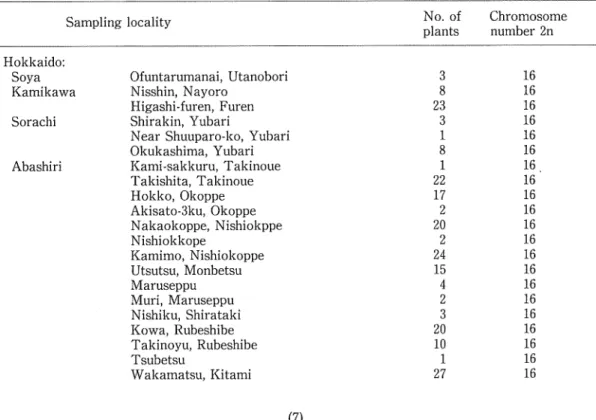
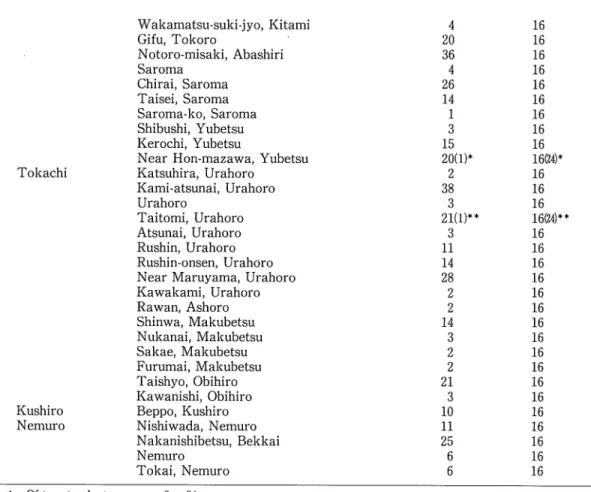
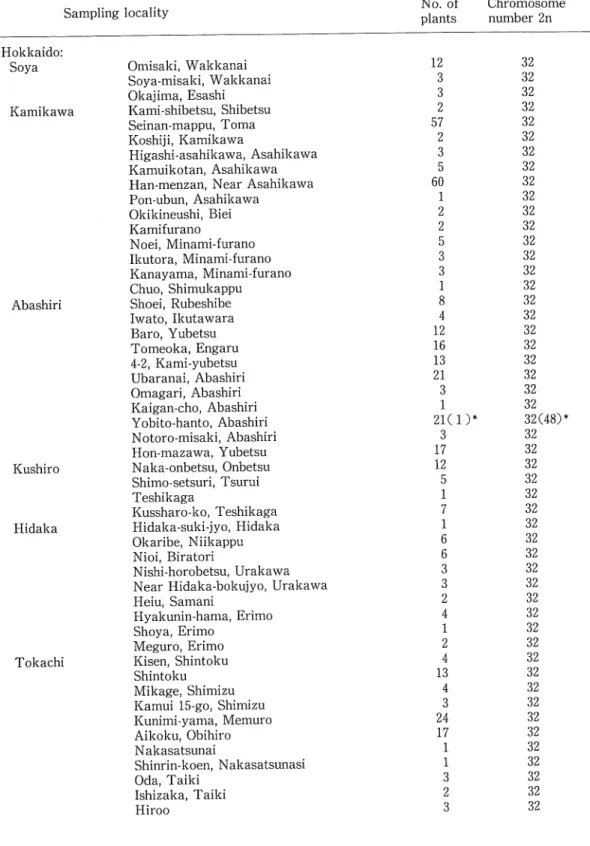
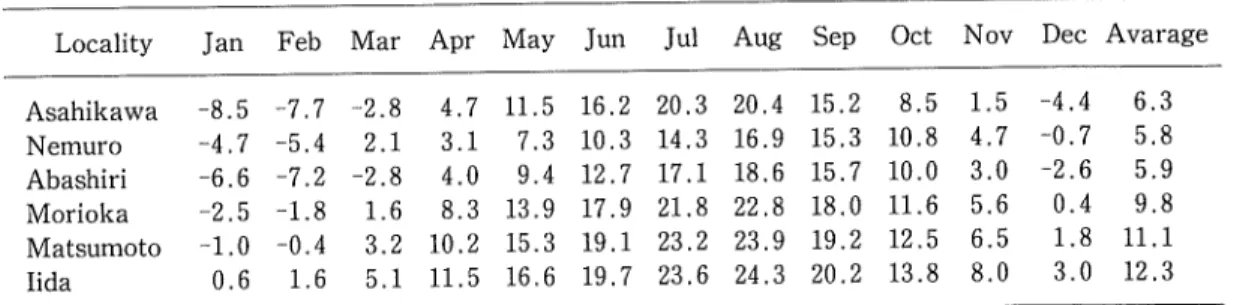
(8) Botanical Studies on Adorns ammwisis Regel et Radde in Japan (Part 1) 7 further studies are necessary to revise the Far Eastern Adonis species.. Later, Nishikawa and Ito (1985) examined the occurrence of the 2n=24 chromosome number found it only in cultivar Fukujukai by crossing Adonis plants with 2n=16 with 2n=32. Furthermore, they found that the chromosomes in 7 of 24 Adonis cultivars were 2n=24.. 2. Materials and methods. (D Wild plants Living plants were collected from 168 localities in central Honshu (Chubu District), northern Honshu (Kanto and Tohoku Districts), and Hokkaido from March to May for ten years from 1978 to 1987 (Tables 1, 2 and 3). They were transplanted in Asahikawa. The transplantation followed the normal methods; plants were planted in clay pots with a 2 : 1 mixture of Akadama-tsuchi and Fuyo-do soils, frequently watered to prevent drying up, and. fertilized with a chemical fertilizer (0.5g Hyponex/lpot) in spring and autumn. Climatic data of 6 representative localities are shown in Table 4. For the determination of the somatic chromosome number, the ovules and root tips were used. They were treated with 8 hydro-oxyquinoline (0.002M) for 4-5 hours or 0.05-0.1% aqueous. solution of colchicine for 1 to 2 hours, fixed in a 3:1 mixture of alcohol and acetic acid for about 5 minutes, and transferred to 1N-HC1 at 60"C for 1 to 2 minutes thereafter. They were squashed in 1% aceto-orcein. Table 1. Chromosome number and sampling localities of Adonis amiirensis Regel et Radde Sampling locality No- ,of Chromosome plants number 2n. Hokkaido:. Soya Ofuntarumanai, Utanobori Kamikawa Nisshin, Nayoro Higashi-furen, Furen Sorachi Shirakin, Yubari Near Shuuparo-ko, Yubari Okukashima, Yubari Abashiri Kami-sakkuru, Takinoue Takishita, Takinoue Hokko, Okoppe Akisato-Sku, Okoppe Nakaokoppe, Nishiokppe. Nishiokkope. Kamimo, Nishiokoppe Utsutsu, Monbetsu Maruseppu Muri, JVIaruseppu. Nishiku, Shirataki. Kowa, Rubeshibe Takinoyu, Rubeshibe Tsubetsu Wakamatsu, Kitami. (7). 3 8 23 3 1 8 1 22 17 2 20 2 24 15 4 2 3 20 10 1 27. 16 16 16 16 16 16 16 16 16 16 16 16 16 16 16 16 16 16 16 16 16.
(9) Tsunehiko NISHIKAWA Wakamatsu-suki-jyo, Kitami Gifu, Tokoro Notoro-misaki, Abashiri Saroma Chirai, Saroma Taisei, Saroma Saroma-ko, Saroma. Shibushi, Yubetsu. Kerochi, Yubetsu. Near Hon-mazawa, Yubetsu. Tokachi Katsuhira. Urahoro Kami-atsunai, Urahoro Urahoro Taitomi, Urahoro Atsunai, Urahoro Rushin. Urahoro. 4 20 36 4 26 14 1 3 15. 20(1)*. 2 38 3. 21(1)**. Rushin-onsen, Urahoro. Near Maruyama, Urahoro Kawakami, Urahoro Rawan, Ashoro Shinwa, Makubetsu Nukanai, Makubetsu Sakae, Makubetsu Furumai, Makubetsu. Taishyo, Obihiro. Kawanishi, Obihiro Kushiro Beppo, Kushiro Nemuro Nishiwada, Nemuro Nakanishibetsu, Bekkai Nemuro Tokai, Nemuro. 3 11 14 28 2 2 14 3 2 2 21 3 10 11 25 6 6. 16 16 16 16 16 16 16 16 16 16(24) 16 16 16 16(24) 16 16 16 16 16 16 16 16 16 16 16 16 16 16 16 16 16. * Of twenty plants, one was 2n=24. * * Of twenty-one plants, one was 2n=24.. Table 2. Chromosome number and sampling localities of Adonis multiflora Nishikawa et Ko. Ito Sampling locality No- of Chromosome plants number 2n Honshu: Aomori. 8 3 2 36 20 3 8 5 3 5 3. Shiwa, Towada Kirita, Towada Fujishima, Towada Horanai, Towada Shimodaira, Towada. Iwate Nagano. Oobuke, Nishine Osaka, Okaya Gowa, Achi. Ankokuji, China Harano, Kisofukushima Tokko-san, Ueda. (8). 16 16 16 16 16 16 16 16 16 16 16.
(10) Botanical Studies on Adonis amwensis Regel et Radde in Japan (Part 1) Table 3. Chromosome number and sampling localities of Adonis ramosa Franchet No. of. Sampling locality Hokkaido: Soya. Kamikawa. plants. Omisaki, Wakkanai Soya-misaki, Wakkanai Okajima, Esashi Kami-shibetsu, Shibetsu Seinan-mappu, Toma. Koshiji, Kamikawa Higashi-asahikawa, Asahikawa Kamuikotan, Asahikawa Han-menzan, Near Asahikawa. Pon-ubun, Asahikawa. Okikineushi, Biei. Kamifurano Noei, Minami-furano Ikutora, Minami-furano Kanayama, Minami-furano. Abashiri. Chuo, Shimukappu Shoei, Rubeshibe Iwato, Ikutawara Baro, Yubetsu Tomeoka, Engaru 4-2, Kami-yubetsu. Ubaranai, Abashiri Omagari, Abashiri Kaigan-cho, Abashiri Yobito-hanto, Abashiri Notoro-misaki, Abashiri Kushiro. Hon-mazawa, Yubetsu. Hidaka. Naka-onbetsu, Onbetsu Shimo-setsuri, Tsurui Teshikaga Kussharo-ko, Teshikaga Hidaka-suki-jyo, Hidaka. Tokachi. Nioi, Biratori Nishi-horobetsu, Urakawa Near Hidaka-bokujyo, Urakawa Heiu, Samani Hyakunin-hama, Erimo Shoya, Erimo Meguro, Erimo Kisen, Shintoku. Okaribe, Niikappu. Shintoku. Mikage, Shimizu Kamui 15-go, Shimizu Kunimi-yama, Memuro. Aikoku, Obihiro. Nakasatsunai Shinrin-koen, Nakasatsunasi. Oda, Taiki. Ishizaka, Taiki Hiroo. (9). 12 3 3 2 57 2 3 5 60 1 2 2 5 3 3 1 8 4 12 16 13 21 3 1 21(1)* 3 17 12 5 1 7 1 6 6 3 3 2 4 1 2 4 13 4 3 24 17 1 1 3 2 3. Chromosome number 2n. 32 32 32 32 32 32 32 32 32 32 32 32 32 32 32 32 32 32 32 32 32 32 32 32 32(48)* 32 32 32 32 32 32 32 32 32 32 32 32 32 32 32 32 32 32 32 32 32 32 32 32 32 32.
(11) 10. Tsunehiko NlSHIKAWA Ashoro-ko, Ashoro. Minami 9-go, Toyokoro Tofutsu, Toyokoro Taitomi, Urahoro Maruyama, Urahoro Near Kitamachi, Urahoro Tsunetoyo, Urahoro Sorachi. Urahoro-ton-neru, Urahoro. Minami-yoshino, Sunagawa Shibun, Iwamizawa Mogami, Kurisawa Sakuraoka, Kuriyama. Nishikizawa, Yubari. Numanosawa, Yubari Osoushi-no-sawa, Yubari. Ishikari Iburi. Onikubi-yama, Yubari Kuruki-rindo, Yubari Shinrin-koen, Ebetsu Shokubutsuen, Sapporo Shikotsuko, Chitose Takaoka, Atsuma Sokuryozan, Muroran. Shiribeshi Hiyama. Oshima Honshu: Aomori. Raiba. Noboribetsu Toyoura, Toyoura Toyoura Rebunge, Toyoura Shirozumi, Kuromatsunai Nakasato, Imagane Kaitorima, Taisei Kaminoyama, Assabu Miyakoshi, Kaminokuni Okushiri Isl. Niyama, Oono Nakayama-toge, Oono. Omagoshi, Iwasaki Nantozawa, Shichinohe Yakeyama, Towada Ainai-gawa, Soma. Nagano. Ichinowatari, Hirosaki Tanesashi, Hachinohe Herai, Shingo Chusonji, Hiraizumi Nakayamadaira, Naruko Sawaguchi, Yoshida Isama, Yoshida Hekiitazawa, Ryogami Hinataooya-Kurasawa, Ryogami Takikoshizawa, Ryogami Ryogami Urayama, Chichibu Kamihon-iri, Takeishi. Mie. Hokuryu-ike, liyama Eboshi-yama, Sanada Fujiwara-dake, Fujiwara. Iwate. Miyagi. Saitama. Hofukuji, Shiga. * Of twenty-one plants, one was 2n=4. (10). 1 2 2 6 5 4 11 24 15 1 3 5 10 4 6 11 9 2 1 1 2 3 1 15 3 2 1 2 2 24 22 1 5 6. 32 32 32 32 32 32 32 32 32 32 32 32 32 32 32 32 32 32 32 32 32 32 32 32 32 32 32 32 32 32 32 32 32 32. 5 2 2 1 1 29 2 9 2 1 1 1 2 1 1 1 2 23 2 2 3. 32 32 32 32 32 32 32 32 32 32 32 32 32 32 32 32 32 32 32 32 32.
(12) 11. Botanical Studies on Adonis amwensis Regel et Radde in Japan (Part 1) Table 4-A. Jul. Aug. Sep. 11,5. 16.2. 20.3. 20.4. 15.2. 8.! .5. 1.5. -4.4. 6.3. 7.3. 10.3. 14.3. 16.9. 15.3. 10.i ,8. 4.7. -0.7. 5.8. 4.0. 9.4. 12.7. 17.1. 18.6. 15.7. 10.( ,0. 3.0. -2.6. 5.9. 1.6. 8.3. 13.9. 17.9. 21.8. 22.8. 18.0. 5.6. 0.4. 9.8. -0.4. 3.2. 10.2. 15.3. 19.1. 23.2. 23.9. 19.2. 12.!.5. 6.5. 1.8. 11.1. 1.6. 5.1. 11.5. 16.6. 19.7. 23.6. 24,3. 20.2. 13.! ,8. 8.0. 3.0. 12.3. Feb. Mar. Asahikawa. -8.5. -7.7. Nemuro. -4.7. -5.4. Abashiri. -6.6. Morioka Matsumoto. lida. average temperatures ^~C)*. Jun. Jan. Locality. Monthly Apr. May. -2.8. 4.7. 2.1. 3.1. -7.2. -2.8. -2.5. -1.8. -1.0. 0.6. Oct. 11.f6. Nov. Dec Avarage. * Tokyo Astronomical Observatory ed., 1986.. Table 4-B. Average monthly precipitation (1951-1980) (mm)*. Locality Asahikawa Nemuro. Abashiri Morioka Matsumoto. lida. Jan. Feb. Mar. Apr. May. Jan. Jul. Aug. Sep. Oct. Nov. 80 52 68 65 36 62. 64 41 37 57 46 75. 62 68 58 88 66 121. 65 83 49 97 95 159. 74 104 67 91 96 154. 78 105 80 121 161 240. 119 95 78 170 140 236. 168 114 105 165 104 177. 134 140 98 155. 104 132 82 108 98 126. 116 81 63 91 51 79. 145. 192. Dec Avarage. 95 56 53 75 31 60. 97 89 70 107 89 140. * Tokyo Astronomical Observatory ed., 1986.. co*. Table. 4.C.. Locality. Jan. Feb. Mar. Apr. May. Jun. Jul. Aug. Sep. Oct. Nov. Asahikawa. -4.3. -2.8. 1.9. 10.1. 18.0. 22.2. 25.8. 25.8. 21.1. 14.4. 5.6. -0.9. Nemuro. -1.8. -2.1. 1.1. 7.0. 11.6. 14.2. 18.0. 20.5. 18.6. 14.1. 7.9. 2.1. 9.3. -3.3. -3.4. 0.8. 8.5. 14.2. 16.8. 20.8. 22.3. 19.8. 14.3. 6.7. 0.6. 9.8. Abashiri Morioka Matsumoto. lida. Average monthly diurnal maximum temperatures. Dec Avarage 11.4. 1.6. 2.6. 6.5. 14.2. 20.2. 23.1. 26.6. 27.8. 23.2. 17.5. 10.8. 4.4. 14.9. 4.5. 5.6. 9.9. 17.3. 22.4. 24.9. 28.8. 30.2. 24.9. 18.7. 13.3. 7.6. 17.3. 6.4. 8.0. 12.1. 18.5. 22.8. 25.4. 29.1. 20.3. 25.9. 20.2. 14.9. 9.3. 18.6. * Tokyo Astronomical Observatory ed. 1., 1986.. Table Locality Asahikawa Nemuro. Abashiri. 4-D.. Average monthly diurnal minimum temperatures. co*. Mar. Apr. May. Jun. Jul. Aug. Sep. Oct. Nov. Dec Avarage. -13.4 -13.2. -7.8. -0.3. 5.7. 11.1. 15.9. 16.3. 10.5. 3.8. -2.1. -8.3. -9.1. -5.1. 0.0. 3.9. 7.3. 11.5. 14.3. 12.6. 7.6. 1.3. -4.0. 2.7. -10.3 -11.3. -6.4. 0.2. 5.3. 9,3. 14.0. 15.8. 12.2. 6.3. -0.3. -5.9. 2.4. Jan. -8.2. Feb. 1.5. Morioka. -6.5. -6.1. -2.7. 2.8. 8.0. 13.4. 17.9. 19.0. 13.8. 6.6. 1.1. -3.3. 5.3. Matsumoto. -6.1. -5.7. -2.5. 3.9. 8.9. 14.3. 18.9. 19.3. 15.0. 7.7. 1.3. -3.3. 6.0. -4.5. -3.8. -0.8. 5.5. 10.0. 15.2. 19.6. 20.0. 16.1. 9.1. 2.6. -2.2. 7.2. lida. * Tokyo Astronomical Observatory ed., 1986.. (11).
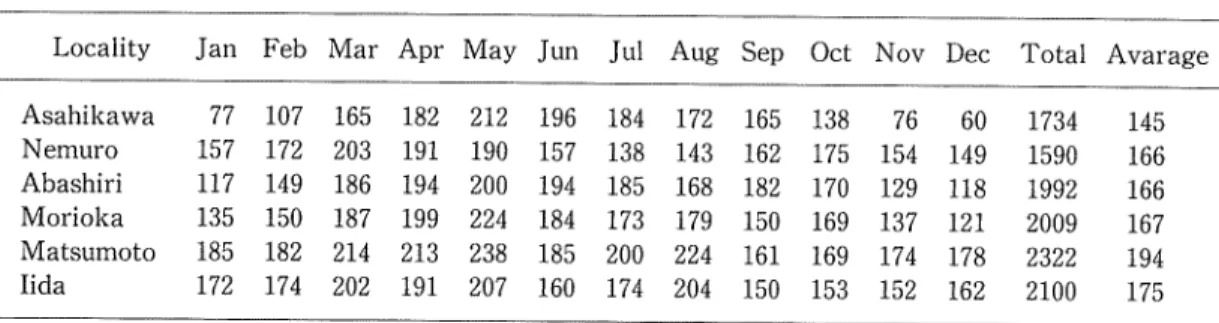
(13) 12. Tsunehiko NISHIKAWA Table 4-E. Average Monthly sunshine (hours)* Locality Jan Feb Mar Apr May Jun Jul Aug Sep Oct Nov Dec Total Avarage. Asahikawa 77 107 165 182 212 196 184 172 165 138 76 60 Nemuro 157 172 203 191 190 157 138 143 162 175 154 149. Abashiri 117 149 186 194 200 194 185 168 182 170 129 118 Morioka 135 150 187 199 224 184 173 179 150 169 137 121 Matsumoto 185 182 214 213 238 185 200 224 161 169 174 178. lida 172 174 202 191 207 160 174 204 150 153 152 162. 1734 1590 1992 2009 2322 2100. 145 166 166 167 194 175. * Tokyo Astronomical Observatory ed., 1986.. Meiotic chromosomes were observed in PMCs (Pollen Mother Cells). Anthers were fixed in a 3 : 1 mixture of alcohol and acetic acid for several seconds. After this the anthers were macerated in 1N-1HC1 for several seconds at 60"C.. Photo 2. Seedlings of hybrids with 2n=24 (A. ramosa x A. mii.ltiflora). A: One-year seedlings. B: Two-year seedlings. C: Three-year seeding. D: Five-year seeding. Scale indicates 2cm.. (12).
(14) Botanical Studies on Adonis amurensis Regel et Radde in Japan (Part 1) 13. Pollen fertility was estimated by staining pollen grains from mature anthers in a lactophenol-cottonblue solution (Tateoka 1973). Darkly stained and normal pollen grains were scored as viable.. Herbarial specimens were also made available to this study. The specimens were in the following herbaria: SAPT (Herbarium, Faculty of Agriculture and Environmental Science, Hokkaido University), KYO (Herbarium, Department of Botany, Faculty of Science, Kyoto University), MAK (Makino Herbarium, Tokyo Metropolitan University), TI (Herbarium, Department of Botany, The University Museum, Universty of Tokyo), TNS (Department of Botany, National Science Museum), and SHIN (Herbarium and Biological Institute, Faculty of Liberal Arts, Shinshu University). The voucher specimens were deposited in SAPT. (2) Cross experiment Three species were used: Adonis amurensis, A. multiflora and A. ramosa.. Crossing experiments were carried out indoors in Asahikawa with potted plants. The emasculation of flowers was performed before blooming. Before blooming and thereafter, female flowers were isolated with paraffine bags. Seeds were obtained about 5 weeks after pollination. For the purpose of effective development, seeds were sown soon after the harvest-. ing in mid to late May. The seeds germinated the following year. The seedlings of the hybrids are shown in photo 2. In most cases, the hybrids set flowers after six years.. (3) Cultivars Tweny-four cultivars were obtained from commercial sources. These plants were transplanted in Asahikawa. To determine somatic chromosome numbers, the ovules and the root tips were used. The procedures were like those used for the wild plants.. 3. Botanical Studies 31. Wild plants 311. Chromosomes Somatic chromosome numbers: Chromosome numbers were determined on the A. amurensis. specimens (so-called) collected from 32 localities in Honshu and 138 in Hokkaido. The somatic chromosome numbers were found to be 2n=16, 24, 32, and 48 (Tables 1, 2, 3, and Photo 3). Chromosome numbers of 2n=16 and 32 were reported by Nishikawa and Ito (1978, 1979), and 2n=48 are being reported for the first time for A. amurensis in Japan. The 2n=32 specimens were found from Hokkaido to Kansai (Figs. 2 and 3). All four chromosome numbers were observed in Hokkaido. The 2n=32 specimens were more common than the 2n=16 specimens, however, the 2n=16 specimens were concentrated in Northern and Eastern Hokkaido, and the 2n=32 specimens in Central, Southern, and South-. Western Hokkaido, although a few were from North-Eastern Hokkaido (Fig.2). It is notable that the 2n=16 specimens were in the northern area, and discontinuously near Mt. Yubari in. Central Hokkaido across the regime of the 2n=32 specimens.. (13).
(15) 14. Tsunehiko NISHIKAWA. Photo 3. Somatic chromosomes. A: Chromosome number 2n=16 (Higashi-furen,Furen, Hokkaido). B: Chromosome number 2n= 16 (Shimodaira, Towada. Aomori Pref.). C: Chromosome number 2n=24 (Taitomi, Urahoro, Hokkaido). D: Chromosome number 2n=32 (Notoro-misaki, Abashiri, Hokkaido). E: Chromosome number 2n=32 (Tanesashi, Hachinohe, Aomori Pref.). F: Chromosome number 2n=48 (Yobito-hanto, Abashiri, Hokkaido). Scale indicates 10//m.. The 2n=24 specimens and the 2n=48 specimens were quite rare. But 2n=24 specimens were always found together with the 2n=16 specimens and 2n=48 with 2n=32 specimens. In Honshu, Adorns specimens were mainly found in central and northern Honshu. and 2n= 16 and 2n=32 chromosome numbers were observed (Fig.3). The 2n=32 specimens were predominant in Honshu as well, from Aomori to Mie, and 2n=16 specimens were found on the Pacific side of Aomori Pref., Iwate, and Nagano. However, they grew in geographically limited areas. (Fig. 3). The reported 2n=24 was in cv. Fukujukai obtained from Yorii (Saitama Pref.). As this cultivar is the most popular, the Japanese name "Fukujuso" frequently represents this cultivar. (Fig. 4. cf. Makino, 1940).. (14).
(16) Botanical Studies on Adonis amurensis Regel et Radde in Japan (Part 1). Fig. 2. Distribution of 2n=16 and 2n=32 specimens in Hokkaido. 0 : 2n=16 specimens. • : 2n=32 specimens.. Fig. 3. Distribution of 2n=16 and 2n=32 specimens in central and northern Honshu. 0 : 2n=16 specimens. • : 2n=32 specimens.. (15). 15.
(17) 16. Tsunehiko NISHIKAWA. Fig. 4. Adonis mnn.re.nsis Regel. et Radde sensu Makino (Makino, 1940).. Photo 4.. Meiotic chromosomes. A & B. 2n=16 Hokkaido specimen (A: Metaphase I. B: Anaphase I). C & D. 2n=32 Hokkaido specimen (C: Metaphase I. D: Anaphase I). E. 2n=32 Honshu specimen (Diakinesis). Scale indicates 10//m.. Meiosis: Twelve plants of 2n=16 specimens were collected from six localities in Hokkaido: Saroma, Rubeshibe, Utanobori, Kitami, and Maruseppu. Meiosis in the PMCs was normal, with. the formation of eight bivalents at diakinesis and metaphase I in all specimens (Photo 4-A). At metaphase I, the bivalents were arranged normally on the equatorial plate. At anaphase I, the. eight bivalents were observed to separate regularly without any chromosome bridge (Photo 4-B). No micro-nucleus was found in the tetrads. Chromosomes at metaphase I were both of the. ring and rod from. Meiotic divisions were initiated early to middle September (Fig. 5). Localities 2n Utanobori. 16. 3. Kllaml. 16. I. Rubeshlbe. 16. Towada. 16. Nlshlne. 16. JL. c. X. •s. 3. f 3. Okaya. 16. Kromatsunal. 32. Assabu. 32. Shichinohe. 32. trt c. Shiga 0. I. Yoshida. 11 12 )0 ] 10 20 30 10 20 30 10 20 30 10 20 30 10 20 30. 32 32 Fig. 5. Time of meiosis in 1984 and 1985.. (16).
(18) Botanical Studies on Adonis amm'ensis Regel et Radde in Japan (Part 1). 17. Only two Hokkaido 2n==24 specimens were collected from near Hon-mazawa (Yubetsu T.). and Taitomi (Urahoro T.). This was not expected but was found by coincidence, because the 24 chromosome number was rare in field populations. One plant from near Hon-mazawa was used,. and observation on PMCs showed that meiosis was abnormal, with the formation of univalents and trivalents at diakinesis and metaphase I (Photo 5-A). At anaphase II, one or two lagging chromosomes (Photo 5-B) and chromosome bridges were seen in some PMCs. One or two. micronuclei were also seen in many tetrads. Pollen fertility was 0.8% and the frequency of normal achenes was 0.0% in open pollination after four-year cultivation.. B. A. xitX ^<!». f~". D. ?. '7.^. <?. •^. &. Photo 5. Meiotic chromosomes. A & B. 2n=24 Hokkaido specimen (A: Metaphase I, 6IH+2II+2I. B: Anaphase H). C & D. 2n=16 Honshu specimen (C: Metaphase I. D: Anaphase I). Scale indicates 10/^m. The 2n==24 specimens were collected from two populations with 2n=16 near Hon-mazawa. (Yubetsu T.) and Taitomi (Urahoro T.). This suggested that the 2n=24 specimens could be derived from the 2n=16 specimens by fertilization of unreduced gametes, and they are consid-. ered autotiploids (Stebbins, 1950; 1971; Schulz-Schaeffer, 1980). In the Hokkaido 2n=32 specimens, 14 plants were collected from 14 localities: Omisaki (Wakkanai), Aikoku (Obihiro), Shinrin-koen (Ebetsu), Shoei (Rubeshibe), Nioi (Biratori), Omagari (Abashiri), Kauinoyama (Assabu), Takaoka (Atsuma), Kamuikotan (Asahikawa), Shirozumi (Kuromatsunai), Kaitorima (Taisei), Anecha (Urakawa), Seinan-mappu (Toma), and Okikineushi (Biei). Meiosis in the PMCs was normal in all specimens. Sixteen bivalents were observed at diakinesis and metaphase I (Photo 4-C). At anaphase I, sixteen bivalents were observed to separate regularly without chromosome bridges or lagging chromosomes (Photo 4-D). There was no micronucleus in the tetrads. Meiotic division was initiated from late. (17).
(19) 18. Tsunehiko NISHIKAWA. September to early October (Fig. 5.). In the Honshu 2n=16 specimens, eight plants were collected from four localities in Tohoku and Chubu: Shiwa, Towada (Aomori), Oobuke, Nishine (Iwate), and Osaka, Okaya and Gowada, Achi (Nagano). Meiosis in PMCs of these plants was found to be like that of the 2n=16 Hokkaido specimens (Photo 5-C and D). The beginning of meiosis of the 2n=16 Honshu specimens was later than the 2n=16 Hokkaido specimens (Fig.5). It must be stressed that the beginning meiosis of the Hokkaido and Honshu specimens was different, despite the same chromosome number.. In the Honshu 2n=32 specimens, six plants were collected from six localities: Ichinowatari, Hirosaki; Nantozawa, Shichinohe; Omagoshi, Iwasaki; and Ainai-gawa, Soma (Aomori); Sawaguchi, Yoshida (Saitama); and Hofukuji, Shiga; and Mt. Eboshiyama, Sanada (Nagano). As in the 2n=32 Hokkaido specimens, meiosis in PMCs of the Honshu specimens was also normal in all specimens (Photo 4). In the 2n=32 specimens, the period of meiosis overlapped and the start of meiosis was delayed from September 10, to September 30 along a geographical gradient; earlier in the Hokkaido specimens than in the Honshu specimens (Fig. 5). 312. Morphology Number of flowers per stem: The investigation of the number of flowers per stem used 517 living wild and cultivated plants. All the 2n=16 Hokkaido specimens bore one flower per stem (Table 5), while all the 2n=16 Honshu specimens bore three or more flowers. This points to two different cytological races within the Adonis population of Japan. Most of the 2n=32 specimens bore a single flower, but a few bore more flowers, in Honshu Table 5. Number of flowers per stem Locality. 2n. Hokkaido. Honshu. 16 16 32 32. Cultivar*. 24. Honshu. Hokkaido. No. of. No. of flowers. 3. 4. 5. 0 0 18 6. 0 7 10 4. 0 7 4 1. 0. 4. 8. 1. 2. 51 23 259 166. 51 0 227 155. 18. 0. plants. per stem. 6. 7. 8. 0 4 0 0. 0 4 0 0. 0 0 0 0. 0 1 0 0. 5. 0. 1. 0. Average. 1.0 4.4 1.2 1.0 4.2. * cv. Fukujukai.. as well as Hokkaido pointing to only one cytological race of number of flowers. A cv. Fukujukai of 2n=24 usually bore three or more flowers on a stem similar to the multiflowered cytological race with 2n=16.. The relation of sepal length to petal length: According to Gorovoy and Gurzenkov (1969), the ratio of sepal to petal length was one characteristics for separating A. ramosa from continental. Adonis amnrensis. This characteristic showed in two ways: the sepal legth to the petal length ratio, and the difference between the lengths of the two. Figs. 6 and 7 show that the petals of. (18).
(20) Botanical Studies on Adonis amurensis Regel et Radde in Japan (Part 1) 19. Localities 2n No.of samples —Qg —^0—},2 " 1,4 —\g —i^s. Hokkaido 16 15. Honshu 16 12. Hokkaido 32 33 Honshu 32 14 Honshu 24 30 ^Cyltivar). '* "^51 '—' Ran9e I Mean Fig. 6. The petal to sepal ratio.. the 2n=16 Honshu specimens are clearly longer than the sepals. Both the 2n=32 and 2n=16 Hokkaido specimens have petals which are a little longer or shorter than the sepals. Fig. 7 shows the difference between the sepal length and petal length, and clearly shows a definite trend of longer petals in the 2n=16 Honshu specimens than Fig. 6, which shows the ratio of sepal to petal length. Number of petals and sepals: Table 6 shows that the 2n=16 Hokkaido specimens had more petals and sepals than the 2n=16 Honshu specimens. In the former, the number of petals range. from 11 to 22, coinciding with the 15 to 20 in the original description of Adonis amnrensis Regel et Radde. This petal range from 11 to 22 was not in agreement with the 20 to 30 mentioned in some current floras however, (e.g, Kitamura and Murata, 1961; Ohwi, 1975; Shimizu, 1982; Ohwi and Kitagawa, 1983). The sepal number range of the 2n=16 Hokkaido specimens were similar to the 2n=32 specimens in both Hokkaido and Honshu, but the mean for the 2n=16 Hokkaido specimens was larger, 8.5, than that of the 2n=16 Honshu specimens, 5.1.. Shape of sepals and petals: All cytological races had usually elliptic to obovate petals, and inner petals were narrower. The upper margin of petals was entire, and sometimes serrate. The sepals were usually elliptic to obovate, but the 2n::=:16 Honshu specimens were usually rhombic-. oval to obovate and not elliptic. The shape of the inner sepals was narrower than that of outer ones.. Color of sepals and petals: The color of the inner petals was usually yellow to golden yellow, while the 2n=16 Honshu specimens were bright yellow. The color of the outer petals was different from the inner ones; the 2n=16 Hokkaido specimens and the 2n=32 specimens were commonly yellow tinged with purple or dark purple, and the 2n::=:16 Honshu specimens. were reddish brown on the upper margin of the petals. The petals of the 2n=16 Honshu specimens faded and became colorless when preserved in herbaria.. Sepals of the 2n=16 Hokkaido specimens and the 2n=32 specimens were commonly pale yellow to yellow on the inside, and purple to dark purple with a narrow yellow margin on the outside; sepals of the 2n=16 Honshu specimens were pale yellow to pale green inside and pale green to dark green outside. The sepals of especially the 2n=16 Hokkaido specimens are. (19).
(21) 20. Tsunehiko NlSHIKAWA. 28. mm. p\. 24. I. ^> 20 LJ. ^16tUJ U"). ^---'0\. 02n=16 Hokkaido. \ 0 \ 00 o a)0)\ \ 0). .-"0 0\ it> ~ OCD~. ^a.CD 0)0 \. • 2n--16 Honshu. \0. .° \ ''P °. ^1-0. ^. PO;. .0. -..,tfio//. -^Q) •2n=32. 121-. Honshu. 02n=32 Hokkaido -4. ^'~\. mm 24 /1'G~. Z20. UJ. ,0. CD. /000<. li -A /"~'^~. 11 c'^/. \. \/. )0 Q?. \. V. \ \ s\/ /-/ v y\. / 00 0/' ^' 0. LO. I. ^'' v \ '^ i. ./ C&CDOO ./. $ GJ. 8 mm. -4. 28. ^rs.:\ ^-/'. '^ 12. 8. 0. 02n=24 Cultivar '< I. V2 ^4~. 8 mm. PETAL LENGTH - SEPAL LENGTH PETAL LENGTH - SEPAL LENGTH Fig. 7. Scatter diagram of the relationship between "petal minus sepal length" and "sepal length".. (20).
(22) Botanical Studies on Adonis amnrensi's Regel et Radde in Japan (Part 1). 21. Table 6. Number of petals and sepals No. of. Locality. 2n. Hokkaido. 16 16. 46 39. Honshu. 32 32. 102 16. cv. Fukujttkai. 24. 37. 14-16.0-19. Honshu. Hokkaido. samples. No. of petals. No. of sepals. 11-14.2-22*. 6-8.. 5-12*. 10-12.9-15. 5-5.. 1- 7. 9-13.0-19. 5-7.. 2-10. 11-13.9-15. 5-6.. 6- 8. 5-5.. 8- 8. * Min.— Mean— Max.. sometimes tinged with pale yellow and yellow on the outer margin. Hokkaido specimens with dark purple sepals occur mainly in the eastern Hokkaido population, particulary that near Cape Erimo. Fruit: Achenes were commonly green and were covered with comparatively dense long hairs. In the 2n=16 Honshu specimens, achenes were smaller, lighter in color, and the hairs. shorter and thinner (Photo 6-A). The number of achenes per aggregate fruit was smaller in 2n= 16 Honshu specimens, about 35 versus about 55 (Fig. 8). Hokkaido 2n=16 (104)" Honshu 2n=16 (40) Hokkaido 2n =32 (160) Honshu 2n=32 (13). 3-. -E. 20 W 60 80. Range | Mean I 1 S.D.. 100 120 130. Achene. •' No. of samples. Fig. 8. Number of achenes per fruit.. The aggregate fruit of the 2n=16 Honshu specimens was different from those of the rest (Photo 6-B). In the 2n=16 Honshu specimens it was globose, and smaller than the rest, which were also broadly elliptic to suborbiculate. The receptacle of the 2n=16 Honshu specimens was different and considerably smaller than the rest (Photo 6-C). Style: Gorovoy and Gurzenkov (1969) pointed out that A. amurensis is bent at the base and A. ramosa is straight. However, no noticeable differences were detected in the style features of. any of the cytological races (Photo 6-A). Peduncle: The thickness of peduncles was measured on both cultivated and natural plants. The peduncle for the first flower was used in the measurements. The 2n=16 Honshu specimen. peduncles were remarkably smaller than the rest (Fig. 9).. (21).
(23) 22. Tsunehiko NISHIKAWA. Hairiness of leaves: The upper side of leaves was glabrous in all the cytological races. The underside was glabrous in the 2n=:16 Honshu specimens, with scattered hairs or glabrous in the 2n^32 specimens, and moderately to densely. hairy in the 2n=:16 Hokkaido specimens. When plants develop leaves at an early stage, the. hairiness of the leaf was useful to discriminate the 2n=16 Hokkaido specimens and the 2n=32 specimen (Photo 7-A and B), as well as between the 2n=16 Honshu specimen and the 2n=16 Hokkaido specimens.. Hairiness of sepals: The underside of sepals was moderately to densely hairy, in both the 2n=16 Honshu and Hokkaido specimens, except. at the base, which was densely hairy. The 2n=32 specimens were usually glabrous, but with scattered hairs at the base.. Cross section of petiole and stem: The lower part of stems and cauline leaves were used to describe cross sections. There were no differ-. ences in the cross section of petioles in any of the cytological races. The petioles were semicircu-. lar-horseshoe-shaped and hollow with a distinct ventral canal (Fig. 10), as also described by. Photo 6. A. Achenes (1: 2n=16 Hokkaido specimen. 2: 2n=16 Honshu specimen. 3: 2n=32 Hokkaido specimen). B. Aggregate fruits (1: 2n= 16 Hokkaido specimen. 2: 2n=16 Honshu specimen. 3: 2n=32 Hokkaido speci-. Tamura (1962). There were differences in stem cross sections; the stem of the 2n=16 Honshu specimens was hollow, but the rest were solid. (Photo 7-C). There was no differences between the 2n=32 specimens in Hokkaido and Honshu. The stems of the 2n=:16 Hokkaido specimens Hokkaido 2n=16 (Wf Honshu 2n=16 (37) Hokkaido 2n =32 (55) Honshu 2n=32 (17) 1.0 2.0 3.0 .< No. of samples •—'Range [Mean. Fig. 9. Thickness of peduncles.. (22). men).. C. Aggregate fruits showing receptacles (1: 2n=16 Hokkaido specimen. 2: 2n=16 Honshu specimen. 3: 2n=32 Hokkaido specimen). Scale indicates 10mm..
(24) Botanical Studies on Adonis amm'ensis Regel et Radde in Japan (Part 1). 23. ;N Fig. 10. Cross sections of petioles. A: 2n=16 Hokkaido specimen. B: 2n=16 Honshu specimen. C: 2n= 32 specimen.. were more compactly solid than the 2n=32 specimens.. Flowering time: Flowering time observations were made of plants collected from Honshu and Hokkaido and cultivated for several years in Asahikawa. The date of the first flower opening was recored, and table 7 shows flower opening dates in 1986. The flowering dates of the 2n=16 Honshu specimens were later than the other groups: blossom-. ing from late April to early May and other specimens finished blossoming by late April. This shows that the 2n= 16 Hokkaido specimens tend to blossom earlier than the 2n=16 Honshu specimens, suggesting distinct physio-. logical differences, even when the chromosome numbers of the two different specimens were the same.. Hisauchi (1941) and Okuhara (1985) reported differences in flower opening dates in Adonis specimens in Honshu.. Hisauchi (1941) stated that Yokohama native stock was different from Toho-. ku stock and that the flowering dates of the Yokohama stock were later than those from Tohoku. From Hisau-. chi's description, the Yokohama stock may correspond to the 2n=16 Honshu specimens, and the Tohoku stock to the 2n==32 Honshu specimens. Thus, Photo 7.. the differences in flowering time were A & B. Hairiness of leaf (A^2n=16 Hok- ^^ by genetic factors, and the. specimen. B: 2n=32 Hokkaido specimen). C: Cross sections of stem (1: 2n=16 flowering time may parallel the start Honshu specimen. 2: 2n=16 Hokkaido speci- of meiosis. men. 3: 2n=32 Hokkaido specimen). Scale indicates 10mm.. (23).
(25) 24. Tsunehiko NISHIKAWA. Table 7. Date of flower opening in 1986 of the Adonis amnrensis groups cultivated in Asahikawa Date of flower opening. Locality. Ofuntarumanai, Utanobori Notoro-misaki, Abashiri I Higashi-furen, Furen Maruseppu Wakamatsu, Kitami Kirita, Towada Osaka, Okaya II Fujishima, Towada Shiwa, Towada Oobuke, Nishine Niyama, Oono Asahikawa Meguro, Erimo. Ill. Kussharo-ko, Teshikaga Heiu, Samani Miyakoshi, Kaminokuni Sunagawa Kaitorima, Taisei Ichinowatari, Hirosaki Omagoshi, Iwasaki Nantozawa, Shichinohe. IV. Sawaguchi, Yoshida Eboshi-yama, Sanada Yakeyama, Towada Hokuryu-ike, liyama Fujiwara-dake, Fujiwara. April May number 2n 12 14 16 18 20 22 24 26 28 30 2 4 6. Chromosome. 16 16 16 16 16. +. + +. + + +. 16 16 16 16 16 32 32 32 32 32 32 32 32. +. 32 32 32 32 32 32 32 32. +. + + +. +. + +. +. + + + +. + + + +. +. I & HI: Hokkaido. II & IV: Honshu.. Size and fertility of pollen grain: More than two hundred pollen grains were examined to determine the size range and the fertility of pollen grains. Pollen grains of the 2n=16 specimens were generally smaller than those of the 2n=:32 specimens (Fig. 11). In the 2n=24 and 2n=48 specimens, solid anthers were usually filled with empty pollens, and sometimes, darkly stained gigantic pollens grains were mixed with empty pollens. In 2n=16 and 32 specimens the pollen fertility ranged from 91.8% to 97.9%, while in the 2n=24 and 48 specimens it ranged to 0.8% to 15.0% (Table 8). From the above, the 2n=24 and 48 specimens were presumed to have originated by hybridization of a reduced and an unreduced gamate and they may be triploid and hexaploid, respectively.. (24).
(26) Botanical Studies on Adonis amwensis Regel et Radde in Japan (Part 1). Naypro. 2n=16. Atsunai. 2n=16. Towada. 2n=16. Nishine. 2n=16. Yorii. 2n=2A. Sunagawa. 2n=32. Kurivama. 2n=32. Soma. 2n=32. Yoshida. 2n=32. Hokkaido. Hokkaido Honshy. Honshu. Cultivar. Hokkaido. Hok'kaido. Honshu. Honshu. 25. >—E. ^. 0" 22 26 30 34 Range | Mean Fig. 11. Size of pollen grains. 32. Cross experiment 321. Taxonomic names Before performing the cross experiment, convenient taxonmic names corresponding to the. three cytological races distinguished in Chapter 3 were given. The names were temporarily used in the cross experiment, and they will be discussed, and receive substantial status, in Chapter 4.. (1) Cytological race of 2n=16 Hokkaido plant: Adonis amurensis Regel et Radde (2) Cytological race of 2n=16 Honshu plant: Adorns multiflora Nishikawa et Ko. Ito (3) Cytological race of 2n=32 plant: Adonis ramosa Franchet A. amurensis x A. multiflora: Seven cross experiments were set and all were successful.. The chromosome numbers of Fi-hybrids were 2n=16 (Table 9, Photo 8-A). The meiotic behavior of chromosomes was irregular, and the chromosome configurations at the. diakinesis and metaphase I are shown in Table 10, and Photo 9-A and B. Ten types of configurations were observed: 8 II, 7 II+2I, 1IV+6II, 6 II +41, 1VI+ 5 II, 1IV+5II +21, 2IV+ 311 +2 I, 2VI+2H, 3IV+1H +21, and 2VI+1II +2 I. The most prevalent configuration was 8 H (76.3%), followed by 7 11+2 I (12.4%). Of 186 PMCs observed, about 90% were of these two configurations. The pollen stainability of Fi plants was good (Photo 10-A), but most of the pollen grains were abnormally shaped, and fertility was 5.2% to 27.6%, average 15.8% (Table 11), Seed fertility in open pollination was from 0.0% to 16.3% average 6.8% (Table 12).. (25).
(27) 26. Tsunehiko NISHIKAWA. Table 8. Pollen fertility Locality Hokkaido: Higashi-furen, Furen Ofuntarumanai, Utanobori Wakamatsu, Kitami Nakanishibetsu, Bekkai Notoro-misaki, Abashiri Honshu: Fujishima, Towada Horanai, Towada Shiwa, Towada Oobuke, Nishine Osaka, Okaya. Hokkaido:. 2n. Pollen fertility %. 16 16 16 16 16. 92.0. 16 16 16 16 16. 94.9. 24 24. Hon-mazawa, Yubetsu. Taitomi, Urahoro. Hokkaido:. 32 32 32 32 32. Niyama, Oono Heiu, Samani Meguro, Erimo Shirozumi, Kuromatsunai Hyakunin-hama, Erimo Honshu:. 32 32 32 32 32. Nantozawa, Shichinohe Yakeyama, Towada Sawaguchi, Yoshida Hokuryu-ike, liyama Eboshi-yama, Sanada. 95.5 94.3 96.0 95.8. 91.8 95.3 95.0 92.4. 0.8 1.2. 97.1 97.9 97.8 94.9 95.0. 94.4 95.7 96.0 95.0 93.6. Hokkaido: Yobito-hanto, Abashiri. 15.0. Measured with more than 200 grains.. The external morphology of two sets of Fi were observed during 1986 and 1987: Wakamatsu (-?•) x Fujishima {<?} and Ofuntarumanai (-?-) x Fujishima (c?1). Sixty individuals of Fi grew up well, and showed hybrid vigor, practically in stem height and leaf size. The appearance was similar to A. midtiflom (c?) (Photo 11-A); the number of flowers was intermediate between A. amurensis and A. midtiflora, from 1 to 5, average 1. 9 (Table 13).. (26).
(28) Botanical Studies on Adonis amwensis Regel et Radde in Japan (Part 1). ^ /ss. ^ 0 D- ^. ,t '^. ^^. ^. 27. ^^ ^•*^. ^. e..^ w^ &AS... Photo 8. Somatic chromosomes of hybrids. A: A. amurensis x A. multiflora. B: A. multiflora x A. amurensis. C: A. multiflora x A. ramosa. D: A. ramosa x A. multiflora. E: A. amurensis x A. ramosa.. F: A. ramosa x A. amurensis. Scale indicates 10/<m.. In the sepal vs. the petal length relation, the petals were of different length: in Fi of Wakamatsu (-?•) x Fujishima (</'), the relation was closest to A. multifloa (<?'); and in Fi of Ofuntarmanai (^-) x Fujishima (c?'), the relation was closest to A. amurensis (-?•) (Fig.12). The stipules were absent in the Fi of Ofuntarumanai (-?-) x Fujishima (c?1), as in A. amurensis (-?-) (Photo 11-B). A new characteristic appeared, a dwarf form found in some individuals of Ofuntarumanai. W x Fujishima (c?) (Photo 11-C). A, multiflom x A. amurensis: Flowering time of A. multiflora (-?-) and A. amurensis (c?) were different (Table 7). In Asahikawa, A. multiflora flowered three weeks later than A. amurensis. Therefore, it was difficult to carry out the cross experimet, and only one set, in 1983,. (27).
(29) 28. Tsunehiko NISHIKAWA Table 9. Crosses between A. amnrensis and A. multiflora Male. Female. 2n of the. cross. Locality. 1 2 3 4 5 6. Locality. 2n. Fujishima Fujishima Shiwa Shiwa Shiwa. Wakamatsu. 16 16 16 16 16 16. Kosaka. 16. Wakamatsu Ofuntarumanai Ofuntarumanai Wakamatsu Wakamatsu. 2n. hybrid. Harano. 16 16 16 16 16 16. 16 16 16 16 16 16. Maruseppu. 16. 16. x A. multiflora. 7: A. multiflora x A. amurensis.. 1-6: A. amurensis. Table 10. Chromosome configuration at meiosis in PMCs of hybrids between Adonis amurensis* and A. multiflora** Chromosome. PMCs. configurations. observed. 1IV + 1IV 2VI 1VI 2IV 2VI 3IV. + +. +. + + +. 811 711 611 611 511 in 511 311 211 in. Frequency. (%). 142 23 8 5 2 2 1 1 1 1. + 21 + 41 + 21 + 21 + 21 + 21. 76.3 12.4 4.3 2.7 1.1 1.1 0.5 0.5 0.5 0.5. 186. Total. * collected from Wakamatsu, Kitami, Hokkaido. * * collected from Fujishima, Towada, Aomori Pref.. Table 11. Pollen fertility of hybrids Range. No. of. plants A. amurensis. x. A. multiflora. A. f'amosa. x. A. amiirensis. A. ramosa. x. A. mtdtiflora. A. midtiflora. x. A. ramosa. (28). 16 24 24 24. 24 2 3 11. Min.. Mean. Max.. 5.2. 15.80. 27.6. 2.4. 6.75. 11.1. 2.5. 3.50. 5.0. 0.5. 3.12. 6.0.
(30) 29. Botanical Studies on Adonis amurensis Regel et Radde in Japan (Part 1). Table. 12.. Seed fertility of hybrids 2n. Cross. No. of. Range. plants Min.. Mean. A. amm'ensis. x A. mnltiflom 16. A. ramosa. x A. amurensis 24. 2. ------. 0.0. A. ramosa. x A. mitltiflora 24. 3. ------. 0.0. A. mnltiflora. x A. ramosa 24. Max.. 28 0.0 6.8 16.3 ------. 11 ------ 0.0. Table 13. Number of flowers per stem Cross. 2n. A. amurensis x A. multiflora. 16 24 24 24. A. midtiflora x A. ramosa A. ramosa x A. multiflora A. ramosa x A. amin'ensis. No. of No. of flowers per stem. plants 123456. 55 11 25 4. Average. 309 93 4 0 1.9 004610 3.7 927430 2.6 400000 1.0. was successful. The examination of Fi hybrids showed the chromosome number as 2n=16. (Photo 8-B), and the seedlings of the hybrids had not set flower in 1987. Thus, meiosis and fertility were not examined. The general appearance of the seedlings were similar to that of A. mnltiflora (-?-). A. midtiflora x A. ramosa: This cross was made in 1980, 1981, 1982, and 1983. Five combinations were successful (Table 14). The chromosome number of Fi was 2n=24 and the Table 14. Crosses between A. multiflora and A. ramosa.. Male. Female cross —. Locality. 1 2.. 3 4 5 6 7 8. 2n. x. Locality. Nishi-horobetsu. 32 32 32 32 32. 24 24 24 24 24. Shiwa Shiwa Shiwa. 16 16 16. 24 24 24. Fujishima Fujishima Oobuke Oobuke Oobuke. 16 16 16 16 16. Miyakoshi. Shirozumi. 32 32 32. Nakasato Yakeyama. Omagoshi Seinan-mappu. Seinan-mappu. .1.5: A. miiltiflora x A. ramosa. 6-8: A, ramosa x A. nwltiflora.. (29). 2n. 2n of the hybrid.
(31) 30 Tsunehiko NlSHIKAWA. plants were triploid (Photo 8-C). Fi of Fujishima (-?-) x Omagoshi (a7') were used in the meiosis observations. All individuals were irregular in the meiotic behavior (Photo 9-E and G). In 29 examples of PMCs at diakinesis and metaphase I, 17 configuration types were observed (Table 15). The commonest were 8 III and 6 III+2 II +2 I. In addition, configurations having trivalents were common, while those having octavalent, hexavalent, pentavalent, and tetravalent were occasionally observed. Table 15. Chromosome configuration at meiosis in PMCs of hybrids between A. multiflora* and A. ramosa"*. sin GUI 7III 5III 1IV IV sin 2IV 1IV 1IV 1IV 1VI 1VI 1VI 1IV ivm 511. + + + + + + + + + + + + + + + +. Chromosome. No. of PMCs. configurations. observed. 21 11 31 211 in 51 HI 211 311 511 2ffl 1IV 1IV 81 2in. 5 5 3 3 1 1 1 1 1 1 1 1 1 1 1 1 1. 211 in 311 5III sin 211 4III 4ffl 4iii 2IH IV IV IV 611 1VI 141. + + + + + + + + + + + + + + +. + II + 21 + + + + + + +. 21 41 21 41 HI + 51 2ni + in + n 2ffl + 31. + in + 21. Frequency. (%). 17.2 17.2 10.3 10.3 3.4 3.4 3.4 3.4 3.4 3.4 3.4 3.4 3.4. 3.4 3.4 3.4 3.4. * collected from Fujishima, Towada, Aomori Pref. * * collected from Omagoshi, Iwasaki, Aomori Pref.. Pollen grains of Fi were almost all empty and were not stained (Table 11, and Photo 10-B). None of the seeds of Fi developed (Table 12). The Fi individuals had more flowers than A. ramosa (^) (Table 13), and the characteristics of stems without flowers were near to A. multoflora {^-). The sepal vs. petal length of Fi was similar to A. ramosa (c?)) (Fig. 12). A. ramosa x A. multiflora: Three cross experiments were carried out in 1980, 1981, 1982, 1983, and 1987, and all were successful (Table 14). The Pi chromosome number was 2n=24, and the plants were triploid (Photo 8-D). Meiosis of one hybrid of Nakasato (•?-) x Shiwa (cf) was observed. The meiotic behavior was irregular (Photo 9-C and F). The configuration at diakinesis and metaphase I was complicated in most of the PMCs, and six PMCs with exceptionally simple configuration were analysed. Five types were recognized. All configuration had trivalents (Table 16).. (30).
(32) Botanical Studies on Adonis amurensis Regel et Radde in Japan (Part 1). 31. v ^ -t^ B. D. %w \ "Y" <. E. n^. ^ ^ A.. ^^^ H. \:.. %. Photo 9. Meiotic chromosomes of hybrids. A & B. A. amin'ensis x A. multiflora at metaphase I (A: 8 II. B: 6 H+4 I). C & F. A. ramosa x A. midtiflora (C: Metaphase I. F: Chromosome bridges at anapnase II). D & H. A. ramosa x A. amnrensis (D: Metaphase I, 2III+6II+6 I. H: Lagging chromosomes at anaphase I). E & G. A. multiflora x A. ramosa (E: 8 III. G: Pollen-tetrad having a micro-cell). Scale indicates 10/<m.. Pollen and seed fertility are shown in Table 11 and 12. Pollen grains of Fi were almost all empty (Photo 10-C), and seed fertility was 0.0%. This extremely low fertility resulted from disturbed meiosis. The general appearance of Fi was similar to that of A. ramosa (^-), and the hybrids grew well, showing hybrid vigor in height, leaf and flower size. The number of flowers ranged from 1 to 5, average 2.6 (Table 13), similar to A. mnltiflom (<?). The sepal vs. petal length was like that of A. ramose (-?-) (Fig. 12).. (31).
(33) 32. Tsunehiko NlSHIKAWA. Table 16. Chromosome configuration at meiosis in PMCs of hybrids between A. ramosa* and A. mtdtiflom** Chromosome. No. of PMCs. configuratoins. observed. un GUI GUI un un. + + + + +. 911 311 211 811 611. 2 1 1 1 1. + 31 + 21 + 51 + 91. * collected from Nakasato, Imagane, Hokkaido. * * collected from Shiwa, Towada, Aomori Pref.. A. amurensis x A. ramosa: The cross experiments were carried out in 1982, and the. combinations are shown in Table 17. The Fi was 2n=24 and the plants were triploid (Photo 8-E). They had not had set a flower in 1987, so meiosis and pollen fertility were not determined. The general appearance of Fi was near A. ramosa (cf).. A. B. '•9. y. 0". Q A ^. d&. Bo^. ^ & t*. •^ C3K, ^. •^ Photo 10. Pollen grains of hybrids. A: A. amurensis x A. multiflora. B: A. multiflora x A. ramosa. C: A. ramosa x A. mnltiflora. D: A. ramosa x A. amitrensis. Scale indicates 40/<m.. (32). [?.
(34) Botanical Studies on Adonis amwensis Regel et Radde in Japan (Part 1) 33. Table 17. Crosses between A. amurensis and A. ramosa. Male. Female cross. x. Locality. 2n. Higashi-furen. Locality. 2n. Shirozumi. 2n of the hybrid. 1 2. Wakamatsu. 16 16. Niyama. 32 32. 24 24. 3. Shirozumi. 32. Ofuntarumanai. 16. 24. 1 &2. 3. : A. amurensis x A. ramosa. : A. ramosa x A. amnrensis.. A. ramosa x A. amnrensis: This cross experiment was carried out in 1980 and 1981, and was completely successful. The combinations are shown in Table 17. The chromosome number of. Fi was 2n=24 and the plants were tripoid (Photo 8-F). The meiotic behavior was irregular (Photo 9-D and H). The chromosome configurations at diakinesis and metaphase I are shown in Table 18. Seventeen PMCs were observed: 5III+3II +. 31,2HI+6H+61,6HI+2H+2 i, GIH+IH +41,5111+411+1 i, 4111+411+41,3111+711+11, 2ffl+ 711+4 I, 1IH+9H+3I, 1VI+1V+3HI+2II, andlV+2IH+6H+U. Table 18. Chromosome configuration at meiosis in PMCs of hybrids between A. ramosa* and A. amwensis**. Chromosome No. of PMCs Frequency configurations observed (%). 5III 2IH GUI 6III 5III 4iii 3III 2111 un 1VI IV. + + + + + + + + +. 311 611 211 in 411 411 711 711 911 + IV + 2III. + + + + + + + + + + +. 3 3 2 2 1 1 1 1 1 1 1. 31 61 21 41 II 41 11 41 31. 3 III -h. 211 611 -h 11. 17.6 17.6 11.8 11.8 5.9 5.9 5.9 5.9 5.9 5.9 5.9. * collected from Shirozumi, Kuromatsunai, Hokkaido. * * collected from Ofuntarumanai, Utanobori, Hokkaido.. Pollen fertility and seed fertility of Fi are shown in Tables 11 and 12, and Photo 10-D. In this Fi, pollen stainability is higher than Fi of A. ramosa x A. multiflora, in spite of the two having the same chromosome number.. (33).
(35) 34. Tsunehiko NISHIKAWA. m Photo 11. Leaf arrangement. A, B, & C: A. amurensis x A. multiflora (A: Common leaf arrangement. B: Secondary stem without stipule like "A. "amurensis. ;: A dwarf form of hybrid). D: A. ramosa x A. ami(rensis."E:'A^amurensis. Arrows indicate opposite leaf arrangement. Scale indicates 2cm.. The general appearance of Fi was like A. mmosa (H but it was a dwarf form. Slightly smaller stipules than of A. ramosa W appeared on secondary stems. The Fi bore only a single. flower per stem (Table 13), and stems without flower were like A. amurensis (c?) (Photo U-D and E). The sepal vs. petal length was similar to A. amzirensis (o") (Fig. 12).. (34).
(36) Botanical Studies on Adonis amnrensis Regelet Radde in Japan (Part 1). 221. 35. 2n=2A. 2n=16. mm|. 20}. 518^ z. Ld. ^. 16|. ^t4. 101 -202^68. PETAL LENGTH -SEPAL LENGTH. ^ I -20246. 8mm. PETAL LENGTH-SEPAL LENGTH. Fig. 12. Scatter diagram of the relationship between "petal minus sepal length" and "sepal length" for A. amurensis x A. multiflom (D : Ofuntarumanai x Fujishima. • '• Wakamatsu x Fujishima). A. multflora x A. ramosa (A : Fujishima x Seinan-mappu). A. ramosa x A. multiflora (0 : Shirozumi x Shiwa. • : Nakasato x Shiwa). A. ramosa x A. amurensis (+: Shirozumi x Wakamatsu).. (to be continued). (35).
(37)
図

+7


関連したドキュメント
Algorithm 2 takes as input any directive bi-sequence of length n for a two-letter alphabet, normalized or not, and computes, in linear time with respect to the length of the
If condition (2) holds then no line intersects all the segments AB, BC, DE, EA (if such line exists then it also intersects the segment CD by condition (2) which is impossible due
В данной работе приводится алгоритм решения обратной динамической задачи сейсмики в частотной области для горизонтально-слоистой среды
Theorem 4.8 shows that the addition of the nonlocal term to local diffusion pro- duces similar early pattern results when compared to the pure local case considered in [33].. Lemma
Keywords: continuous time random walk, Brownian motion, collision time, skew Young tableaux, tandem queue.. AMS 2000 Subject Classification: Primary:
This paper presents an investigation into the mechanics of this specific problem and develops an analytical approach that accounts for the effects of geometrical and material data on
While conducting an experiment regarding fetal move- ments as a result of Pulsed Wave Doppler (PWD) ultrasound, [8] we encountered the severe artifacts in the acquired image2.
Wro ´nski’s construction replaced by phase semantic completion. ASubL3, Crakow 06/11/06
