Studies on Freshness-lowering and Storage-life
of Tiger Prawn, Penaeus japonicus, Muscle
under Low Storage Temperature
著者
NISHIMOTO Jun-ichi, SUWETJA I. Ketut, TEZONO
Sumiro, MIKI Hidemasa
journal or
publication title
鹿児島大学水産学部紀要=Memoirs of Faculty of
Fisheries Kagoshima University
volume
36
number
1
page range
27-36
別言語のタイトル
低温貯蔵クルマエビの鮮度低下と貯蔵寿命
Mem. Fac. Fish., Kagoshima Univ. Vol. 36, No. 1, pp. 27-36 (1987)
Studies on Freshness-lowering and Storage-life of Tiger Prawn,
Penaeus japonicus, Muscle under Low Storage Temperature
Jun-ichi Nishimoto*1, I. Ketut Suwetja*", Sumiro Tezono*
and Hidemasa Miki*Abstract
The analysis of quality-lowering was done to investigate the keeping freshness period and practical storage life of tiger prawn, Penaeusjaponicus, muscle under low storage temperature.
The K value of the sample corresponding with the excellent score on the sensory evaluation was equivalent to 10% and the VBN content was 10 mg/100 g .
The keeping freshness period was equivalent to the K value of 20% and VBN content of 18-19 mg/100 g , that it was the sashimi level freshness if the black spot did not appear.
The practical storage life (PSL) was equivalent to the K value of 30-32% and VBN content of 20 mg/100 g , and it was the safe line of the sample as the raw material of food. The PSL was also obtained in connection with the various low storage temperatures.
Tiger prawn in one of the important commercially valuable product in fisheries culture and fishing. Limit of quality keeping period during the distribution and processing is different with the chemical index of quality. The K value, one of the index of freshness, is
related to decomposition of ATP related compounds, and Araij) proposed that the main
pathway of degradation of ATP in the muscle of prawn may be ATP-* ADP-* AMP-^AdR-*HxR-*Hx, but the route passing through IMP may hardly be probable. And also it was
shown the similar pattern in Gulf shrimp2), pink and brown shrimp3). On the other hand,
there is a report that the volatile base nitrogen (VBN) content, one of the index offreshness, in white shrimp muscle4) increased during initial postmortem storage. It means
the ammonia production can thus potentially take place.
Foot note:
The following abbreviation are used :
ATP : Adenosine triphosphate, IMP : Inosine monophosphate, ADP : Adenosine diphosphate, AdR : Adenosine,
AMP : Adenosine monophosphate, HxR : Inosine, Hx : Hypoxanthine.
Laboratory of Food Preservation Science, Faculty of Fisheries, Kagoshima University, 50-20 Shimoarata 4, Kagoshima, 890 Japan.
Present Address : Faculty of Applied Biological Science, Hiroshima University, 2-17 Midori chyo, Fukuyama, 720 Japan.
28 Mem. Fac. Fish., Kagoshima Univ. Vol.36, No.1 (1987)
Uchiyama etal5) mentioned that the chemical index at stageof primary decomposition was
decided to be 30 mg/100 g in VBN for imported frozen shrimps in Japan. Lately, Shaban etal6) described that —40°C is reasonable to keep the quality unchanged for a long-term
storage, though —20°C is low enough for a short-term storage up to a few months.The present studies were undertaken to determine the practical storage life (PSL) at various storage temperatures according to initial freshness.
Materials and Methods Materials
Alive cultured tiger prawn, Penaeus japonicus, (whole weight 15-20 g ) were obtained and
killed quickly by removal of the head portion with the hands to avoid struggling which may cause depletion of the inherent ATP. Prawn sample bodys were stored at 10, 5, 0, —3, —5, —10, and —20°C, controlled within 0. 5°C, using the electric thermo-sensor. After samples were in constant storage temperature, a certain weight of muscle in duplicate was withdrawn
at intervals time of storage for chemical analysis. In each sample, two determinations were
made. Some photographs were taken after the separated head jointed to the body.
Chemical analysis
The K value was measured by anion exchange column chromatography. The
ionexchan-ger used was Dowex 1x4, Cl~ form with a mesh of 100 to 200.
The volatile base nitrogen (VBN) content was measured by trichloroacetic acid extract, micro diffusion method (Conway's method). The TBA number was measured by using the
method of Sinnhuber and Yu7,8). Sensory evaluation
The prawns (shell on) were heated in closed polyethylene film bags in a boilling water
bath for 5 min. The samples were served to the panelists and were asked to evaluate the prawn for odour, flavour, appearance and overall acceptability. An intensity of hedonic
scale ranging from a high of 9 (highest value) to a low of 1 (lowestvalue) was used9). The
median of intensity of hedonic scores were used in statistical analysis of sensory evaluation
data in storage life10).
Results and Discussion
Changes in K value, VBN content and TBA number of tigerprawn muscleduring storageat various
temperatures
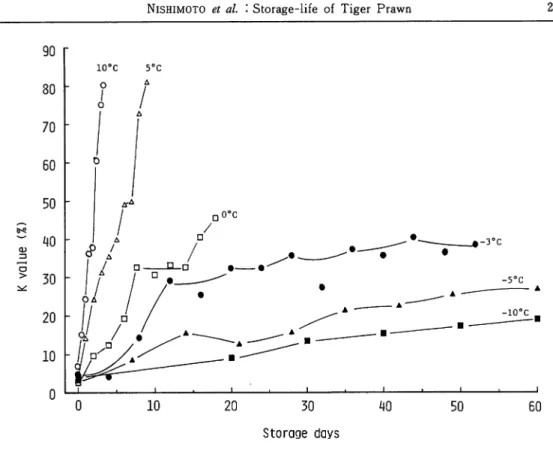
The changes in K value of tiger prawn muscle during storage at various low temperatures are shown in Fig. 1. This figure shows that the change of K value is rapid up to about 30% and then occurred the flat change at around 30-40% for relative long period of time, especially on the sample stored at 0 and —3°C and is followed by the rapid change.
The outline of the degradation of ATP in tiger prawn could be explained as follows. On
the rapid change of K value up to 30% level, the ATP degradation is via AMP-»TMP-*HxR pathway, when the K value is in flat change, that pathway is in relative constant rate, while
NlSHIMOTO et al. '. Storage-life of Tiger Prawn 29
10°C 5°C
20 30
Storage days
40 50 60
Fig. 1. Changes in K value of tiger prawn muscle during storage at various low temperatures.
(Initial K value ((instantly killed)) is roughly 4%).
the remain of AMP is dephosphorylated to AdR, and after the flat change is via AMP—TMP
—HxR and AMP—AdR—HxR pathways.
The rate constant of freshness-lowering (kf) on tiger prawn muscle is shown in Fig. 2. Lines of freshness-lowering in this figure indicated the first-order reaction. These reaction
rates could be expressed by the Qio temperature quatient using the eqn. Qio==K(t+io)/Kt,
and is shown in Table 1. These Qio suggest that the reaction rate on freshness-lowering in
tiger prawn muscle falls by a factorof 7. 37 on the reduction of temperature 10°C from +10 to 0°C, by a factor of 14. 50 on the reduction of temperaturefrom 0 to —10°C, and by a factor of
10. 0 on the reduction oftemperature from —10 to —20*C. Nishimoto etal n) reported that the
most effect of temperature on increasing in rate of freshness-lowering in mackerel, Scomber japonicus, muscle is by a coefficient of 20 occurring at temperature from —10 to 0°C. It means that the effect of temperature on coefficient increasing rate of freshness-lowering in mackerel muscle is 1.38 times bigger than that in tiger prawn muscle.Changes in VBN content of tiger prawn-muscle during storage at various temperatures is
shown in Fig. 3. On 30 mg/100 g level of VBN content, the storage time of sample at —3°C
30
2.Or
Mem. Fac. Fish., Kagoshima Univ. Vol.36, No. 1 (1987)
30 1*0.
Storage days
Fig. 2. First-order reaction rate on freshness-lowering (kf) of tiger prawn muscle during storage at various temperatures.
(The kf was obtained by using the eqn. log (100-Kt)=log (100-Ko)-kf/2.303t
where, (100—Kt) is the value at any one time of the remaining amount of
nucleotide.
(100—K0) is the initial value of the remaining amount of nucleotide, kf is the rate constant of freshness-lowering, t is the time in hour. ).
Table 1. Rate constant (kf) and temperature quotient (Qio) of freshness—lowering in tiger prawn muscle.
kf and Q10 Temperature of storage (*C ) 10 - 5 -10 kf X 103 (h"l) 12.83 4.14 1.74 0.19 0.12 7.34 14.50 21.79
80
Z 60
40
a > 20
NlSHIMOTO et al '. Storage-life of Tiger Prawn
(P 10 °C -A5°C -po°c ^—— -3°C
- 9 f ryzJf
-10°C -5°C 1 i i i ' ' 1 1 1 J 31 10 20 30 40 50 Storage days 60 70 80 90Fig. 3. Changes in VBN contents of tiger prawn muscle during storage at various
temperatures.
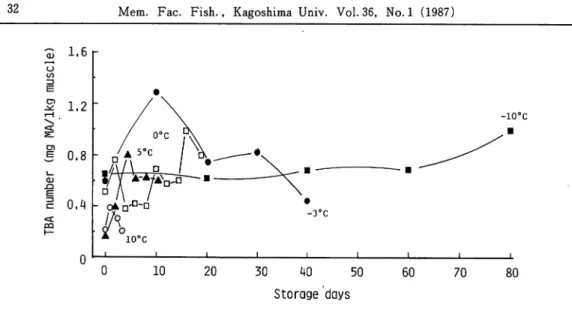
Changes in TBA number (malonaldehyde : mg MA/1 kg muscle) of tiger prawn muscle
during storage at various temperatures is shown in Fig. 4. Increment of TBA number was
noted in the sample stored at 10, 5, 0, and —3°C after 1.5, 4, 2, and 10 days, respectively, and then was followed by almost unchanged from 6 to 9 days during storage at 5°C, and from 4 to 14 days during storage at 013.
The TBA number express lipid oxidation in mg malonaldehyde (MA) per kg of muscle
sample. This test therefore, only measure the MA as results of the dissociation of
hydroperoxides formed during fatty acid oxidation. MA is an active compound that can
react with various substances, including free amino acid. According to Angel et al12),
because of free amino acids accumulate during storage at 0*C, it is possible that
condensation of MA took place with this amino acids. The TBA value remained low level,
almost all below than 1 mg MA/1 kg muscle during 4, 9, 18, 40 and 80 days of storage at + 10, +5, 0, —3 and —ICC, respectively. The reason of this results could be due to the low level of lipid content at around 0. 77-0. 78 g /100 g sample.
Assessment of tiger prawn quality by sensory evaluation during storage at 0*C
The assessed scores of boiled tiger prawn by 17 panelists were treated statistically. The
usual summary statistics, mean and standard deviation, have limited use measured of the hedonic response of a panel. The median, a more meaningful measure of the centre of the
32
« 1.6
1.2
0.8
0.4
Mem. Fac. Fish., Kagoshima Univ. Vol.36, No. 1 (1987)
fl±f*~--i
10 20 30 40 50 Storage days 60 70 -io°c 80Fig. 4. Changes in TBA number of tiger prawn muscle during storage at various
temperatures.
The median of scoring on appearance, odour and flavour of prawn muscle during storage at 0°C are ploted to storage days. These correlations were shown as the coefficients (r) of —0.93, —0.87, —0.82, and —0.95 for the appearance, odour, flavour, and total
assessment, respectively.
Limit of excellent acceptability on score 9 to 8 in sensory evaluation, the keeping freshness period (KFP) on score 7 to 6 and the practical storage life (safe line as food) on
score 5, were shown in Table 2 as a whole.
In the raw prawn, the black spot appeared at around head and part of body-connect after 2
days of storage, they were expanded gradually at all part from 6 to 10 days of storage, and after further 12 days almost all of the body surface became black colour (plate I-IV).
Relationship between the sensory evaluation and the K value or VBN content
The K value of the sample corresponding with the excellent score (9 to 8) was equivalent to 10%, and VBN content was 10mg/100 g . The over all of assessment score could be
explained as shown on Table 2, and the K value and VBN content of sample corresponding
to their score is illustrated in Figs. 1 and 3, respectively.
The equivalent of K value was 20% and its of VBN content was 18-19 mg/100 g in KFP, it was the sashimi level freshness if the black spot was not appear.
In the safe line as food, that is practical shelf life (PSL), the K value was equivalent to 30-32%, and the VBN content was 20 mg/100 g (Table 3).
As mentioned above, it gives fairly good quality with the index of chemical freshness, but for occur blackening on the body surface, the score of sensory assessment was low from the real quality. Therefore, we have to be judged the tiger prawn from thus view point.
NlSHIMOTO et al '. Storage-life of Tiger Prawn
Table 2. Assessment score of boiled tiger prawn after stored at 0°C quality by sensory evaluation related to storage life (days).
Organoleptic properties Hedonic test score* 9 - 8 (Excellent) 7 - 6 (KFP) 5 (PSL) Remark 33
Appearance 2 8 11 Black spot appear
Odour 2 11 18 after 2 days, and after
Flavour 2 8 11 - 12 10 days, it becomes
Over all 2 6 9 almost black at head
part. After 12 days,
whole body become
black colour. KFP : Keeping freshness period, PSL : Practical storage—life.
(Safe line as food)
Score Appearance Odour Flavour Over all
9 Transparent white Very fresh prawn
odour
Sweet, meaty, creamy
Like extremely
8 White meat Fresh prawn odour Sweet, meaty,
characteristic
Like very much
7 Foggy Very few fresh
prawn odour
Weak neutral flavour
Like moderately
6 Pale No fresh prawn
odour and no off—odour Insipid, flavourless Like slightly 5 Faintly bluish
white meat and detectable black spot Detectable off—odour Slightly sourness, slight musty, stale flavour
Neither like nor dislike
4 - 3 Severe black spot Severe off—odour Slight bitterness,
sour, 'off
Dislike slightly dislike moderately
2 - 1 Bluish white meat and severe black—spot Pronounced ammonia odour Strong bitterness, sour, sulphide
Dislike very much dislike extremely
Assessment of PSL of tiger prawn stored at various temperatures
From the results ; the increasing curve of VBN content in tiger prawn muscle during
storage is shown a sigmoid type, and in the case of kf=l at 0°C we obtained the coefficient of
kf, we presume the PSL for stored tiger prawn at various temperatures. We got the PSL
based on the calculation of kf.
The PSL ploted to the storage temperature is shown in Fig. 5. This figure would enables one to predict the PSL of tiger prawn which include the change of freshness and the degradation of quality by blackening of the surface.
34 Mem. Fac. Fish., Kagoshima Univ Vol. 36, No.1 (1987).
Table 3. Hedonic scores vs. K value and VBN content during storage at 0*C.
Overall s c o r e storage days K value % VBN cont. mg/lOOg muscle 9 - 8 7 - 6 5 2 6 9 10 20 30-32 10 18-19 20
Initial K value ca. 4%
Initial VBN cont. 8mg/100g
O : Based on K value A : Basedon VBN cont.
-20 -10 0
Temperature(°C)
Fig. 5. PSL for tiger prawn as function of temperature.
References
1 ) Arm, K. (1966) : "VI, Acid soluble nucleotides in muscle of marine invertbrates-Degradation of adenylic acid in the muscle of prawn, carp and calf. Bull Fac. Hokkaido Univ., 17, 99-109 (in Japanese).
2 ) FLICK, G. J. and R. T. LOVELL (1972) I Postmortem Biochemical changes in the muscle of Gulf shrimp, Penaeus aztecus. J. Food Sci., 37, 609-611.
3 ) Cheuk, W. L., G. Finne and R. Nickelson H (1979) : Stability of adenosine deaminase and adenosine monophosphate deaminase during ice storage of pink and brown shrimp from the Gulf of
NiSHIMOTO et al. '. Storage-life of Tiger Prawn 35 4 ) Yeh, Chia-Ping S., R. Nickelson II and G. Finne (1978) I Ammonia-Producing Enzymes in
White Shrimp Tails. J. Food Sci., 43, 1400-1404.
5 ) Uchiyama, S., R. Amano, T. KoNDOandH. Tanabe (1974) ! Studies on the chemical Indexes and the change of ATP and Related Compounds in Decomposition of Frozen Shrimps. J. Food
Hygienic Soc. Japan, 15, 301-307 (in Japanese).
6 ) Shaban, O., Y. Ochiai, S. Watabe and K.Hashimoto (1987) : Quality Changes in Kuruma Prawn during Frozen and Ice Storage. Nippon Suisan Gakkaishi, 53, 291-296.
7 ) SlNNHUBER, R. 0. and T. C. Yu (1977) ! The 2-thio barbituric acid method reaction, an objective measure of the oxidative deterioration occurring in fats and oils. Yukagaku, 26, 259-267. 8 ) SHIMAZAKI, H. (1983) I Seitainai kasanka shishitsu no sokutei. "Kasanka shishitsu Jikkenho"
(ed. by Kaneda, T. and N. Ueda), Ishiyaku Press, Tokyo (in Japanese).
9 ) Hawgate, P. (1985) I Approaches to the Definition and Measurement of the Storage Life of Chilled and Frozen Fish. (ed. by IIR commissions C2 & D3, Aberdeen (United Kingdom)),
pp. 45-53, IIR, Paris.
10) Whittle, K.J., K.W. Young, P. Hawgate, A. Craig and G.L. Smith (1984) : Storage-life of fish minces. "Thermal processing and quality of food" (ed. by ZEUTHEN, P. et al ), pp. 754-760, Elsevier applied Sci. Pub., London and New York.
11) NiSHIMOTO, J., I. K. SUWETJA and H. MiKI (1985) : Estimation of keeping freshness period and
practical storage life of mackerel muscle during storage at low temperature. Mem. Fac. Fish.
Kagoshima Univ., 34, 89-96.
12) Angel, S., D. Basker, J. Kanner and B. J. Juven (1981) : Assessment of self-life of fresh water prawns at 0°C. J. Food Technol, 16, 357-366.
36 Mem. Fac. Fish., Kagoshima Univ. Vol.36, No. 1 (1987)
Plate 1. The appearance of tiger prawn im
mediately after killed.
Plate EI. The change in appearance of tiger prawn after 10 days stored at 0°C.
Plate II. The change in appearance of tiger
prawn after 2 days stored at 0°C.
Plate IV. The change in appearance of tiger