Distribution and Ecology of Malaysian
Rhododendrons in Papua New Guinea
著者
TAGAWA Hideo, UESATO Kenji, SAKATA Yusuke,
KUNIMOTO Tadamasa, TANAKA Takayuki
journal or
publication title
南海研紀要
volume
2
number
1
page range
123-160
URL
http://hdl.handle.net/10232/15604
Mem. Kagoshima Univ. Res. Center S. Pac, Vol. 2, No. 1, 1981 123
Distribution and Ecology of Malaysian
Rhododendrons in Papua New Guinea*
Hideo TAGAWA*1, Kenji UESATO*2, Yusuke SAKATA*3,
Tadamasa KUNIMOTO*4 and Takayuki TANAKA*5
* 1 Institute of Biology, College of Liberal Arts, Kagoshima University.
* 2 Laboratory of Ornamental Horticulture, Faculty of Agriculture, Ryukyu University.
* 3 Laboratory of Ornamental Horticulture, Faculty of Agriculture, Kagoshima University.
* 4 Oita Research Station for Agricultural Utilization of Hotsprings, Oita.
* 5 Laboratory of Ornamental Horticulture, Faculty of Agriculture, Kyushu University.
INTRODUCTION
This is the second report from the expedition of the Kagoshima University team to Papua New Guinea (PNG) from Oct. 16 to Dec. 6, 1979. The purpose of the expedition was to study the intra- and interspecific variations of the ornamental characteristics such as shoot development, flowering, size of cluster, color, etc., distribution and ecology of Malaysian (Vireya) rhododenronons.
The places where we conducted field observations have already been described in TAGAWA et al (1980) in detail. As they have a close relation to the explana
tions in the text, we would like to reproduce only the outlines of the route we traversed.
Port Moresby =i> Wapenamanda —> Wabag —> Mount Kaiap (Sirunki, Kakas, Pumas)—>Tomba -* Mount Hagen—> Baiyer River—> Mount Hagen —> Goroka (Dauro Pass, Lufa, Frigano, Marafunga, Pine Plantation, Kassam Pass) —> Lae —> Wau (Mt. Kainki, Bulolo, Aseki) —» Bulldog Road —> Wau (Kaisinik) -» Lae (Buso, Wagan, Nadzab) =i> Port Moresby (Fig. 1).
The places in parenthesis are those we visited from a base written before the parenthesis. Our research team for Malaysian rhododendrons obtained the hearty co-operation of Mrs. ANDREE MILLAR, the Director of National Capital Botanic Gardens in PNG, who kindly gave us helpful suggestions and a plan for out researches in the field and gave us every facility. Mr. MICHAEL GALORE, the Director of National Herbarium at Lae offered every facility for us and gave us a chance to identify the collected plants. Mr. KARL KERENGA, Junior Botanist at the Herbarium, helped us while we
were at Lae and Wau. Mr. DIKE KALI, Chief Officer, Mr. ATAIA ANDREW, Officer,
*This research was greatly aided by the Grant-in-Aid for Overseas Research no. 404146 from the Ministry of Education, Science and Culture to Prof. Dr. KENICH1 ARISUMI, Faculty of Agriculture, Kagoshima University, the leader of the present project "Researches for Malaysian Rhododendrons".
/&•£ WESTERN HIGK-AND PRO/INCE & ENGA PROVINCE^"* fount Hagen r~~ Minj Kundiawa "^-» . Ht Wilhelm Marafunga ^._ Dauro Pass Chuave x. >?-•* ^ Frigaro EASTERN HIGH-AND PROVINCE ± Mt Michael Kalnantu ^P ^wm
Fig.
1.
A
map
of
Papua
New
Guinea
showing
the
location
of
the
quadrats
placed
and
the stations for rhododendron observation. M3TOBE PROVINCE 13 z oMem.Kagoshima Univ.Res.Center S.Pac, Vol.2,No. 1, 1981 125
and the staff of the Provincial Office of Forestry, EHP, gave us precise information
on rhododenrons and guided us every day in Goroka. Dr. J. L. GLESS1TT, Director, and Dr. A. ALLISON, Vice-director of Wau Ecology Institute, kindly offered lodge facilities for us and showed us a good field to collect rhododendrons. Prof. Dr. T. SHIN, Kagoshima University helped us to identify bryophyte, and Prof. Dr. K. 1WATSUKI, Kyoto University, kindly identified pteridophyte for us. Groups of farmers, who were led by Mr. PETER PlAOEN, helped us in the field works on Mt. Kaiap. Our research in PNG would not have succeeded but for their invaluable help.
CLIMATE AND VEGETATION OF PNG
Climate PNG lies between about 2°S and 12° S, and the climate is tropical in the
lowland area. Temperature decreases with increasing altitude, and it is so cold some times as to necessitate a fire in the fireplaces of hotels in Mount Hagen (1500 m alt.) in the night. Frost and snow fall on the alpine area higher than 4000 m above sea level.
Rainfall is distributed unevenly over PNG. Trade winds blow from the southeast
between May and October, and bring much rain to the southern slopes of the central mountain ranges. About 5000 mm of rain falls on the southern area from Kikori to Kiunga, and more than 4000mm at Lae. The monsoon season is from December to
March, and the northern lowland has heavy rain which fills up the Sepik and Ramu Rivers. The amount of rain varies with the topography of the region. The regions
of little rain are Port Moresby and south ; the area connecting Menyamya, Aseki and Edie Creek; Tabibuga east of Baiyer River with 1200mm per year; south-west of a
line from Morehead to Weam, with 1600mm (PNG Nat. Met. Service, 1975).
Geology According to the Bureau of Mineral Resources, Geology and Geophysics (1972), a large area southwest of PNG covering the Fly River basin has thick sedimentary rock and alluvium. Active or dormant volcanoes which have eruptive history with lava flow are Bosavi, Sisa, Kerewa, Doma Peaks, Giluwe, Hagen, lalibu,
Suaru, Kaimui, Mountain, Duau, Murray, Lamington and small volcanic islands in the
Bismarck Sea. As one approaches the central mountain ranges from the south,
alluvium becomes thin and disappears to be replaced with limestone in places.
The Kubor Range and Mt. Wilhelm, the highest mountain in PNG, were made by an uprising of granite with or without sedimentary rock on it. The bed of the
northern side of the central mountain range is igneous rock which is covered by a thick layer of sedimentary rock or alluvium on the Sepik.
Vegetation The vegetation of PNG has been studied intensively by Australian ecologists and an instructive book on the vegetation and vegetation maps have already been published (Paijmans, 1975 and 1976). The nature and the distribution of vegetation types are of general reference to the study on the habitat of Malaysian
rhododendrons. We recognize the following eleven types based on many papers and
a book, and our own observations.
1. Mangrove. The estuaries of the Fly, Sepik and other rivers, and the delta of Deception Bay are covered with dense stands of mangrove which are composed of the species of Rhizophora, Bruguiera, Avicennia, Sonneratia, Ceriops and Lumnitzera.
126 Distribution and Ecology of Malaysian Rhododendrons in Papua New Guinea
Mangrove trees grow up above 30 m, and the forest floor is open because the submerged floor carries no herb, grass and fern. In such a mangrove habitat rhododendrons may grow only as epiphytes, but epiphytic rhododendron has never been reported from PNG and Irian Jaya, except on Bornean mangroves.
2. Lowland rain forest. Lowland rain forest covers the northern shore, west of Speik River, Mt. Victory and in places in the lowland areas. Paijmans (1976) defined several types based on the size of tree crown. It develops in areas which have a rainfall of more than 2000 mm and where there is no distinction between the wet and dry seasons. Trees in the forest reach about 60 m, form buttresses and cauriflories, and are dressed up with many epiphytes and lianes. The forest floor is very seldom inundated with water. There is a great mixture of species such as Pometia, Octomeles, Aistonia, Terminalia and so on. Species composition is quite different from the SE
Asian tropical rain forest dominated by Dipterocarpaceae, and there are a few species
of Anisoptera, Vatica, Hopea, and Valeria of the genus in Dipterocarpaceae.
3. Swamp forest.
Parts of the area north of the Fly River are submerged
throughout the year, other parts only when it rains heavily.
The continually
submerged type of swamp forest is represented by Campnosperma forest with the following common species in the first layer, Terminated, Syzygium, and Myristica with prop roots. The intermittently inundated swamp forest is dominated by Melaleucaspp. and it has an affinity with the Australian swamp forest. Podocarpus, Dacrycarpus
and Dacrydium of Podocarpaceae make a swamp forest in altitudes over 1700 m. These swamp forests are gradually being replaced by Phragmites grassland as a result of human interference.4. Montane forest zone. Montane forest is seen in the mountain area below
about 1400 m, and it coincides with the hill forest of Paijmans' classification. Trees in
the forest are as low as 40 m, and buttress is rare. The species composition is greatly
affected by topography, edaphic condition and rainfall. A canopy is made of Pometia,
Canariurn, Anisoptera, Cryptocarya, Terminalia, Syzygium, Ficus, Celtis, etc. In Buloloand^Watut Valley there is a mixed coniferous forest whose dominants are Araucaria
hunsteinii and A. cunninghamii.
These conifers have been successfully afforested in
a large area of Bulolo Valley. The natural Araucaria forest is preserved in McAdam
National Park near Bulolo. The Wildlife and Bird of Paradise Sanctuary at Baiyer
River which our party visited is on the upper limit of the montane forest.5. Castanopsis forest zone.
As one goes higher the dominant of vegetation
converges into a small nunber of species. Castanopsis acuminatissima zone appearsbetween f400m and 2300m (the altitude is different from place to place).
In this
forest zone trees grow to at most 40 m. The forest floor is characterized by the growth
of Zingiberaceae and climbers of Hymenophyllaceae are abundant on the tree surface. Accumulation of litter on the forest floor becomes thick, and a dense shrub layer develops.The climate is similar to that of warm temperate zones which have no winter, and
the human population has increased in the Castanopsis and Nothofagus forest zones
with the introduction of sweet potato as food. A vast area of Castanopsis forest has
been turned into grassland by human interference, and pigs domesticated by the local
people disturb the forest floor.Mem.Kagoshima Univ. Res.Center S.Pac, Vol.2, No. 1, 1981 127
enveloped in dense cloud and mist every afternoon and the surfaces of plants, dead matter and rocks are thickly covered in bryophytes which creates a mossy forest.
6. Nothofagus forest zone. Between 2300 m and 3400 m alt. Nothofagus
grandis, N. pullei and N. rubra dominate in the forest where many species of
Lauraceae and Elaeocarpaceae, Pandanus papuana and climbing bomboos grow. The hight limit of cultivation is on about 2800 m where it is cold at night, and above this the mountain becomes so steep as to make land-slides frequent. Rhododendrons pay an important role for revegetation on the land-slide site. Ericaceae and Podocarpaceae increase their importance in the forest in the upper part of this zone. The quadrats placed along the Bulldog Road were near the upper limit of this zone.
7. Coniferous forest zone. Up to 3900 m where the timber line runs, the forests are of conifers such as Dacrycarpus, Phyllocladus and Papuacedrus, and as the forest goes up near the timber line the trees become stunted to make scrub with their branches stretching horizontally.
8. Alpine scrub. Above the timber line there are many types of scrub dominated by Ericaceae. We did not visit this alpine zone because our main purpose was to introduce genes resistant to high temperature into the Japanese
rhododendrons.
9. Savanna forest. The vegetation hitherto described is that of rainy areas, but there are much drier places in PNG. Dry climate with a long dry season and annual rainfall lower than 2600mm makes savanna vegetation. Eucalypt savanna has a sparse distribution of evergreen Eucalyptus alba, E. papuana, E. confertiflora and E. tereticornis with an undergrowth of Themeda australis. This grass is dried up in the dry season, and green in the rainy season. Eucalypt savanna is seen in Port Moresby and adjacent areas.
Cajuputi savanna comes into existence in the southwest of PNG, where there is a long dry season and which is shortly inundated in the wet season. The dominants are Melaleuca cajuputi, M. leucadendron and M. viridiflora, and undergrowth is mainly Tfiemeda spp. Cajuputi savanna is said to be originated from the artificial fire. Tree-fern savanna develops on the well-drained slope between 2700m and 3300m in alt.,
and tree-fern (Gyathea) is resistant to fire.
On the south shore of the central region there is a small area of rain green forest between savanna and grassland which is refered to in the next section. Deci duous trees are Garuga floribunda, Brachychiton carruthersii, Intsia bijuga, Protium
macgregorii, Gyrocarpus americanus, Bombax ceiba, Albizzia sp., etc.
10. Grassland. This is the vegetation of the dry continental climate, and the
natural grassland in PNG is observed as savanna with or without trees described in the preceding section. Kunai, a local name of Imperata cylindrica grassland, occupies a large area of the irregularly inundated terrace of Mahkam River and the newly
abandoned gardens, but it is thought to be a serai stage changing into a forest, or
alternatively, a disclimax due to intermittent flood.
As described before, Castanopsis and Nothofagus forest zones have been heavily deforested by the people in a long history of shifting cultivation, and there are vast areas of several types of grassland between about 1000 m and 3000 m a.s.l. These
grasslands have been maintained by making fires for the last hundred years. The
128 Distribution and Ecology of Malaysian Rhododendrons in Papua New Guinea
they make.
Short grassland dominated by Themeda australis and the other grasses comes shortly after the burning, and it is gradually replaced by the tall grassland where
Miscanthus florididus dominates. Phragmites karka on the wet soils and Sacharum spontaneum on the humid soils mediate between the pioneer vegetations and forests. Rhododendron species prefer to invade the short grassland and disappear from the
ground as it changes into tall grassland and forest. In our expedition grasslands were the main subject of study.
11. Cultivated land. People make round mounds in their gardens in the
montane region and ridges near the developed colonies and cities to plant sweet potatoes; they do not use a hoe but a rod to dig the ground and to remove the
weeds. Coffee production in the Highland Provinces and in New Britain ranks second
in the world. For the cultivation of coffee, tea and coconut, the fields are constantly managed and planted, but the gardens surrounding the straw huts of the people are used cyclically in the following pattern,
Cultivation -* abandonment -* short grassland -> tall grassland -> scrub -»
burning ~* cultivation.
They do not use nutrients such as compost. No attention as described by RAP
PAPORT (1971) is payed to soil conservation in the civilized communities and no terraced fields were found.
In general, land is owned by the people, and the wild plants in their own land belong to them. Weed communities in the gardens will described in the future.
METHODS
Ecological observations were carried out by placing quadrats arbitrarily on the habitat where rhododendrons were growing. As we had to devote much labour to the study of ornamental observations such as size, branching, and phyllotaxis of the shrubs of rhododendron, flowering, size of flowers and cluster, colour of flower, size of leaves, and to the collection of cuttings to send and bring back to Japan, we set
up only 10 quadrats of various sizes. They were; 1 in Nothofagus forest, 3 in
Miscanthus grassland with shrubs in places, 2 in Themeda grassland with scattered shrubs, 3 on the cliffs made by the road excavation and 1 on the site of a landslide. Altitudes were measured directly with an altimeter. In these equatorial region the variation of atmospheric pressure in a day was slight at a few millibars.
Besides the botanists who were described in the introduction some other botanists helped us in the troublesome identification based on the flowerless herbarium from the quadrats. They were Dr. J.L.RAUSE, University of Melbourne, and Dr.D.G.FLODIN,
University of Papua New Guinea.
Collected specimens were kept in the Institute of Biology, College of Liberal Arts, Kagoshima University, and a list of the specimens was published in the
Mem.Kagoshima Univ.Res.Center S.Pac, Vol.2, No. 1, 1981 129
RESULTS
Three quadrats, PNG-1, PNG-4 and PNG-5 were placed on the gentle slope
of Kaiap in the NW from Wabag and between Ambum and Lai River. PNG-1 was
in Miscanthus florididus grassland along a pathway, PNG-4 was on the excavated
surface of a road made in 5 or 6 years before, and PNG-5 was in a typically welldeveloped Nothofagus grandis forest. All these places were in the Nothofagus zone.
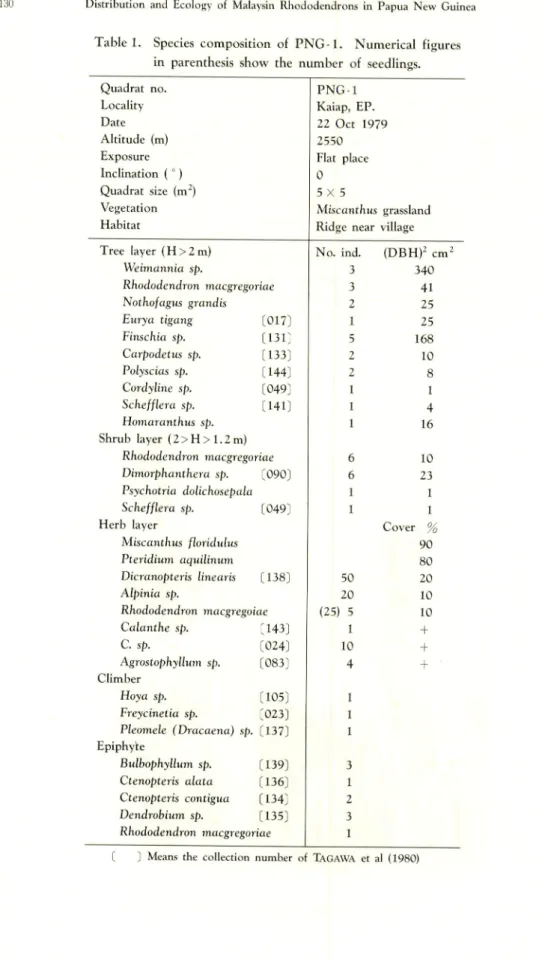
PNG-1 The results are shown in Figs. 2 and 18 and Table 1. It is obvious fromthe figure that trees such as Weimannia sp., Finschia sp. and Rhododendron
macgregoriae were extended from the grassland taller than 2 m. It is noted that Rh.
macgregoriae grew both on the ground and on the stem of Finschia sp., and that
there were no rhododendron seedlings. This may be because of the darkness on the floor in the tall grassland. In the afternoon in these mountain region between 1500 m and 3000m a.s.l. it rains for a few hours everyday. If there is enough medium toRhododendron macgregoriae
1 2 3
Fig. 2. Profile diagram of PNG-1.
Miscanthus f l o r i d u l u s
130 Distribution and Ecology of Malaysin Rhododendrons in Papua New Guinea
Table 1. Species composition of in parenthesis show the
PNG-1. Numerical figures number of seedlings.
Quadrat no. PNG-1
Locality Kaiap, EP.
Date 22 Oct 1979
Altitude (m) 2550
Exposure Flat place
Inclination ( °) 0
Quadrat size (m:) 5X5
Vegetation Miscanthus grassland
Habitat Ridge near village
Tree layer (H>2m) No. ind. (DBH)2 cm2
Weimannia sp. 3 340 Rhododendron macgregoriae 3 41 Nothofagus grandis 2 25 Eurya tigang [017) 1 25 Finschia sp. [131] 5 168 Carpodetus sp. (133) 2 10 Polyscias sp. [144] 2 8 Cordyline sp. (049) 1 1 Schefflera sp. C141) 1 4 Homaranthus sp. 1 16 Shrub layer (2>H>1.2m) Rhododendron macgregoriae 6 10 Dimorphanthera sp. (090) 6 23 Psychotria dolichosepala 1 1 Schefflera sp. (049) 1 1
Herb layer Cover %
Miscanthus florididus 90 Pteridium aquilinum 80 Dicranopteris linearis (138) 50 20 Alpinia sp. 20 10 Rhododendron macgregoiae (25) 5 10 Calanthe sp. (143) 1 + C. sp. (024) 10 + Agrostophyllum sp. (083) 4 + Climber Hoya sp. (105) 1 Freycinetia sp. (023) 1 Pleomele (Dracaena) sp.(137) 1 Epiphyte Bulbophyllum sp. (139) 3 Ctenopteris alata (136) 1 Ctenoptcris contigua (134) 2 Dendrobium sp. (135) 3 Rhododendron macgregoriae 1
Mem. Kagoshima Univ. Res. Center S.Pac, Vol.2, No. 1, 1981 131
sustain roots of rhododendron, epiphytic life may be possible in humid air at the branching of the trunk.
The vegetation in this quadrat was on a serai stage where shrubs and trees were prominent from the tall grassland and an initial stage for regeneration of forest. Terrestrial and epiphytic orchids were remarkable.
PNG-4 The results are shown in Figs. 3 and 21 and Table 2. The surface where the quadrat was placed was densely covered by bryophytes. Woody species were the
seedlings and saplings of Rh. macgregoriae, Rh. inconspicuum, and Rh. ph.aeoch.itum,
and Cordyline sp. Soil beneath bryophytes was wet and humid enough to maintain the rhododendron seedlings. Capsules were kept even on Rh. macgregoriae not taller than 70 cm in height.
PNG-5 Only one quadrat was placed in the forest. There was no trace of using
stone axes on the trees. The forest has never been cut down simultaneously in a
large area, but pigs on the prowl for their food in the forest disturb the undergrowth heavily. We never saw earthworms, frogs, snakes or small lizards in the forests in the highland provinces, so their densities might have been decreased by pigs.
The results are shown in Figs. 4 and 22 and Table 3. The first layer was dominated by Nothofagus grandis and it reached about 40 m in height. Many acorns were found on the forest floor, but there were no seedlings on the floor except for the side of the path in the sun. Total coverage of this layer was 50%. The second
Miscanthus floridulus Rhododendron macgregoriae Lichen Dendrobium sp, Rh. inconspicum cm 50 -0 Lycopodium sp. Q
132 Distribution and Ecology of Malaysian Rhododendrons in Papua New Guinea
layer was made up of a mixed growth of Strehius sp., Polyosma sp., Timonius sp.,
Pandanus papuanus and so on. The third layer had several common species such as Ascarina sp., Psycholria valetonii, Finschia sp., and Syzygium sp. In this layer there were many climbing bamboos. Macaranga spp. which is the characteristic
species in the subseral communities of montane vegetations in PNG, were growing
only in the layer lower than the third. The shrub layer was characterized by Psycholria valetonii and Dimorphanthera sp., a few species of ferns and Zingiberaceae
grew on the floor.
It is noticeable that four seedlings of Rh. phaeochitum were growing simultaneously
on the sunny floor and on the trunks of old Nothofagus grandis. Rh. dielsianum and
Rh. sp. were also found as epiphytes. The epiphytic position of rhododendrons on the trunk of Nothofagus grandis is shown in Table 4, and there is not a clear difference in the epiphytic position among 3 species of rhododenrons.
Table 2. Species composition of PNG-4.
Quadrat no. PNG-4
Locality Kaiap, EP.
Date 22 Oct. 1979
Altitude (m) 2620
Exposure S41°W
Inclination ( ° ) 65
Quadrat size (m ) 2.5 X 10
Vegetation Mossy carpet
Habitat Road cutting
Herb layer No. ind. Cover %
Rhododendron macgregoriae 188 Rh. inconspicuum 39 Rh. phaeochitum 1 Cordyline sp. (144) 1 Dendrohium papuana 8 Lycopodium sp. 3 Miscanthus florididus 7 5 Gleicheniaceae 2 5 Dipteris conjugata (042) 2 Crypsinus sp. 2 Lycopodium clavatum (254) 3 Hypericaceae (275) 2 Compositae (258) 1 Rabiaceae 1 Habenaria sp. 1 Crypsinus sp. (162) 2 Grammitis frigida (256) 1 Lycopodium cernuum (110) 1 + Jackiella sp. (257) 50 Frullania sp. (257) 60 Polytrichum sp. (253) Lichen 60
Mem. Kagoshima Univ. Res.Center S.Pac, Vol.2, No. 1, 1981 133
PNG-2 and 3 were placed in the Miscanthus florididus grassland which is near
Lake Ivae and a small community, Sirunki, on the upper reaches of Lai River. The
underground water-table was high, and there were a number of small patches
dominated by Juncus sp. Domesticated pigs have created in the floor of the grassland
canals in whichi no vegetation grows (Figs. 5 and 6).
PNG-2 The results are shown in Fig. 5 and Table 5. The height of the grassland
was about 2 m, and Rh. macgregoriae, Saurauia sp., Cordyline sp., Dodonaea viscosa
were taller than the other grasses, so this might be a younger stand than PNG-1.
Miscanthus grasses were replaced by hnperata grasses in places and vice versa.
Saplings of Rh. macgregoriae were abundant, but seedligs were never found.
20 m [scanthus floridulus Syzygium sp. Angiopteris sp. Psychotria valetonii Syzygium sp. Ctyptocarya sp.
Fig. 4. Profile diagram of PNG-5.
134 Distribution and Ecology of Malaysian Rhododendrons in Papua New Guinea
Table 3. Species composition of PNG-5.
Quadrat no. PNG-5 Schefjkra sp. 1 4 21
Locality Kaiap, EP. Sloania sp. (331) 3 34
Data 26 Oct. 1979 Cryptocarya sp. (231) 3 35
Altitude (m) 2475 C. sp. (195) 1 1
Exposure S45'W Levieria sp. (194) 1 1
Inclination ( ° ) 23 Reus sp. (219) 2 60
Quadrat size (m ) 20 X 20 Mischocarpus sp. (196) 2 2
Vegetation Nothofagus forest Dodonaea viscosa (132) 2 8
Habitat Slope, maiiun moist Notho/agus grandis
Ascarina sp. (233)(202)
3 2
73
1st tree layer (H>20m) No. ind. (DBH)2 cm2 101
Notho/agus grandis 3 26902 Planchonclla sp. (205) 1 25
2nd tree layer (20>H>10m) Saurauia sp. (230)(206) 4 8
Nothofagus grandis 1 225 S. sp. (207) 1 6
SlreWus sp. (190] 2 1341 Xanthomjrtus sp. (211) 1 64
Eurya tigang 1 36 Cryptocarya sp. (210) 1 2
Dodonaea viscosa (132) 1 1369 Sloanea sp. (224) 1 16
Pandanus papuanus 1 400 Saurauia sp. (229) 1 36
Polyosma sp. (212) 4 857 TYimcnia sp. (236) 1 18 Timonius sp. (215) 4 990 Vacciniam sp. (237) 2 21 Splicnostemon sp. (220) 1 144 Pittosporum sp. (238) 1 1 Daphniphyllum sp. (223) 1 196 Planchonclla sp. (241) 1 16 Pittosporum sp. (226) 1 81 Reus sp. (243) 1 1 P. sp. (238) 2 244 Dimorphunthcra sp. (red) (052) 4 59 Trimewa sp. (236) 1 196 D.sp. (ye!) 3 29 Scht?omeria sp. (235) 1 • 196 Elaeocarpus sp. ® 1 § 2 Ascarina sp. (202) 2 458 Unknown 1 2 3 A. sp. (198) 1 100 Unknown 2 1 1
3rd tree layer (10>H>2ffl) Shrub layer (2>H> 1.2m)
Psycholria valetonii 27 115 Nothofagus grandis 1 2
Helicia sp. (188) 38 Psychotria valetonii 32 46
Saurauia sp. (189) 151 Letiera sp. (187) 1 1 Strehlus sp. (190) 11 132 Helicia sp. (188) 3 4 Primus sp. (191) 57 StreUus sp. (190) 5 9 Syjygium sp. (192) 16 99 Syzygium sp. (192) 2 2 Daphniphyllum sp. (123) 43 Daphniphyllum sp. (223) 1 Schejjkra sp. 11 96 Eiiischia sp. (017) 1 Finschia sp. (017) 21 185 Acacia sp. 1 Ascarina sp. (198) 13 256 Sloania sp. (331) 1
Eurya tigang 95 Eurya tigang 1
Macaranga sp. (203) 10 46 Planchonella sp. (205) 1 M. sp. (221) 10 21 Alstonia sp. (208) 1 Mischocarpics sp. (242) 4 7 Olcaria sp. (209) 1 Polwsraa sp. (212) 2 6 Cryptocarya sp. (210) 2 Timonius sp. (215) 7 100 Timonius sp. (215) 1 Rupanaeu sp. (214) 5 253 Cypholophus sp. (216) 1 Mcmecyhm sp. (217) 8 20 Rapanaca sp. (214) 3 (218) 3 3 R sp. (109) 6 Sphenostemon sp. (220) 4 18 Macaranga sp. (221) 1 Eurya sp. (225) 4 26 Mcdinilla sp. (222) 1
Mem. Kagoshima Univ. Res. Center S.Pac, Vol.2, No.l, 1981 135 Symplocos sp. (227) Saurauia sp. S. sp. (230) Cryptocarya sp. (231) Pittosporum sp. (232) Trimcnia sp. (236) Pittosporum sp. (238) Polyosma sp. (239) Sche/flera sp. Dimorphunthcra sp. (red) (052) D. sp. (yel) Pundanus papuana Climber Climbing bamboo FreidnetiVi $p. Piper sp. Pahncria sp. (010) (023) (025) (197) Ficus sp. Meringium orulum (317) Mecodium polyanthos (327) Herb layer Phododendi on phaeochitum Ctenopteris eelebieu (251) Angiopteris sp. (245) Alpinia sp. Ruhus sp. Cyperus sp. (246) Pilca sp. (249) Cyathca sp. (244) Coleus sp. (250) Begonia sp. (247) Calanthe sp. (024) Liparis sp. (306) Nertera granadense (324) Crypsinus albidosuuumatus (118) Ctenopteris contigua (282) Athyriinn sp. (292) Thelypteris obtusata (291) Dryoptcris sparsa (305) Thelypteris sp. (293) Cyathea sp. (312) (4) 22 7 12 1 4 5 2 17 4 2 2 1 1 1 1 1 1 1 1 1 1 2 2 1 1 1 5 1 99 2 + 27 1 1 10 + + Cover % + 20 10 10 + + + • + + + + + + + + + + + + Crypsinus sp. Thelypteris sp. Plagiogyria sp. Dryopleris sparsa Grammitis jrigida Selliguea feci Thelypteris heddomei Cyathea sp. Pteridophyte Ptcridopbyte (128) (294) (288) (284) (325) (127) (283) (313) (315) (316) Polypodium suhauriculatum (329) Pteridophyte Scluginclla sp. Viola sp. Phaius sp. Epiphyte Agrostophyllum sp. (278) Bulbophyllum (280) (298) (299) (300) (306) (319) Dendroum (281) (285) (286) (301) (302) (307) (308) (310) (311) (302) (321) (322) (323) (326) Diplocaulohium (296) (303) Etta javanica (277) Epiblastte sp. (279) Oberonia (295) (328) Thelasis sp. (297) Mynnecodia sp. Epiphyte H>2m Rhododendron phaeochitum (318) (309) (289) (290) (304) + • + + + + + + + + + + + No. of species 1 1 1 2 I 1 No. ind. (DBH)2 cm2 6 81 Rh. diclsianum 1 9 Rh. sp. 2 4 Epiphyte 2>H>1.2m Rh. phaeochitum (273) 2 9 Rh. sp. 3 11 Epiphyte H> 1.2m Rh. phaeochitum (273)10 Rh. sp. (230) 17
PNG-3 This was close to PNG-2, and the vegetation was quite similar to that of PNG-2. Figure 6 and Table 6 show the profile diagram and species composition in the quadrat. Rh. macgregoriae and Dodonaea viscosa reached about 3 m in height.
Seedlings and saplings of both species of rhododendron were generated commonly
136 Distribution and Ecology of Malaysian Rhododendrons in Papua New Guinea
Table 4. Distribution of epiphytic rhododendrons.
Flight of epiphytic position (m) 0 0.5 1 2 3 4 5 8 9 10 20 Total
H> 2m 1 2 2 5 Rhododendron phaeochitum 2> H> 0.03m 8 5 5 18 Seedling 4 270 3 277 H> 2m 1 1 2 Rh. sp. 2> H> 0.03m Seedling 1 1 2 1 215 1 1 6 3 1 2 3 17 222 H> 2m 1 1 Rh. dielsianum 2> H> 0.03m Seedling
Table 5. Species composition of PNG 2.
Quadrat no. PNG-2
Locality Sirunki, Ep.
Date 23 Oct 1979
Altitude (m) 2580
Exposure N35°E
Inclination ( ° ) 8
Quadrat size (nor) 5X5
Vegetation Miscanthus grassland
Habitat Gentle s
drainage
lope with bad
Shrub layer (2>H>1.2m) No. ind (DBH)2 cm2
Rhododendron macgregoiae 18 52
Breynia sp. (153) 1 1 Herb layer Miscanthus florididus 90 hnperata cylindrica 30 Weimannia sp. (003] 1 + Viola sp. (154) 7 + Bidens parviflora (155) 7 4-Spathoglotis sp. (047) 2 + Anaphalis sp. (149) 2 + Erigeron sumatrensis 1 + (156] 1 1
Rhododendron macgrego iae 53 10
Rabiatae (152) 5 +
Rufous sp. (147) 1 +
Mem. Kagoshima Univ. Res.Center S.Pac, Vol.2, No. 1, 1981 137
PNG-6 The results are shown in Figs.7 and 23 and Table 7. This quadrat yvas
placed on the abandoned garden on a rather steep slope on the way to the silvicultural
spot where a big project of afforestation was being carried out. The surface of the
ground was completely covered by Themeda australis and a leafless parasitic liane,
Cassytha filiformis leaving a narrow space between the dead leaves of Themeda with
a network of Cassytha and the ground surface for the seedlings of Rh. zoelleri.On the ground under the shrubs of Vaccinium sp. and Wendrandia sp., Themeda
grass disappeared but ferns grew up.
Miscanthus floridulus was seldom in the
quadrat.
Vegetation in the quadrat is thought to be in the process of changing from
short grassland to scrub without changing into tall grassland. m 3 2 1 -Miscanthus floridulus Rhododendron macgregoriae 152 0 1 2 3
Fig. 5. Profile diagram of PNG-2.
Micro sor ium scolopendria
\
Rhododendron macgregoriae Saurauia sp.
I Cordyline sp.
Miscanthus
floridulus
7.Cadetia sp.>Bulbophyllum sp^imperata cylindrica
1 2
138 Distribution and Ecology of Malaysian Rhododendrons in Papua New Guinea
Table 6. Species composition of PNG-3.
Quadrat no. PNG 3
Locality Sirunki, EP.
Date 24 O :t. 1979
Altitude (m) 2580
Exposure E
Inclination ( °) 8
Quadrat size (m") 5 X 5
Vegetation Mtscunthis grassland
Habitat Gentle slope with bad
drainage No. ind. (DBH): cm2 Tree layer (H>2m) (165) 2 2 Dodonaea viscosa (160) 2 6 Rhododendron macgregoriae 3 23 Rh. inconspicuum 1 10 Shrub layer (2>H>1.2m) Dodonaea viscosa (160) 3 3 Rhododendron macgregoriae 19 91 Rh. inconspicuum 2 7 Saurauia sp. (157) 4 5 Vaccinium sp. (159) 2 11 Cordyline sp. 1 1 Zanthoxylum sp. 1 1
Herb layer Cover %
Miscanthus floridulus 60 hycopodium sp. 30 Pteridium aquilinum 12 10 Poaceae (164) + Dendrobium sp. (170) + Bufbophyilum sp. (168) + Spathoglottis sp. (169) + Mierosorium scolopendria (161) + Crypsinus sp. (162) + Unknown 1 2 + Unknown 2 1 + Cadetia sp. (166) + hnperata cylindrica + Cyperaceae (167) + Carex sp. (151) + Rubiaceae (152) + Cyathea sp. 2 + Rhododendron macgregoriae (90) 144 10 Rh. inconspicuum (8) 13 +
Mem. Kagoshima Univ. Res. Center S.Pac, Vol. 2, No. 1, 1981
Table 7. Species composition of PNG 6.
Quadrat no. PNG -6 Locality Goroka Date 5 Nov. 1979 Altitude (m) 1900 Exposare E Inclination ( " ) 28 Quadrat size (m") 5X5
Vegetation Themeda grassand with
shrubi
Habitat Slope of abanc oned field
Tree layer (H>2m) No. ind. (DBH):
cm-Vaccinium sp. (747) 2 149 Wendrandia sp. (735-6) 1 9 Rhododendron zoellcri 8 247 Pittosporum sp. (743) 2 10 Shrub layer (2>H>1.2m) Vaccinium sp. (747) 3 18 Wendrandia sp. (735-6) (4) 1 1 Rhododendron ^oelleri 2 6 Rh. leptanthum 2 13 Pittosporum sp. (743) (2) 1 2
Herb layer Cover %
Rhododendron zoelleri (142) 6 10 Rhododendron leptanthian 1 + Themeda uustralis (746) 50 Cassytha filiformis (737) 50 Selliguea feci (127) 10 Do (752) 10 Acalypha sp. (751) (1) + Wendrandia sp. (735-6) (4) + Leucosyke sp. (738) 3 + Thelypteris sp. (739) 3 + Ilex sp. (740) + Glochidion sp. (742) + Pteridium aquilinum + Imperata cylindrica + Coelogyne sp. (750) + Dendrohium sp. (741) + Spathog/ottis sp. + Schefflera sp. (1) + Unknown (Poaceae) 1 5 139
140 Distribution and Ecology of Malaysian Rhododendrons in Papua New Guinea Rhododendron z o e l l e r i i Vaccinium sp. Rhododendron leptanthum Wendrandia sp. Selliguea feei Thelypteris sp. Ilex sp. 5 m
Fig. 7. Profile diagram of PNG-6.
PNG- 7 This was placed on the fresh steep slope excavated along the road at Dauro
Pass between Mount Hagen and Goroka (Figs. 8 and 24). There was no bryophyte carpet but much exposed gravel on the surface. Many seedlings of Rh. macgregoriae,
Rh. inconspicuum and Rh. leptanthum were commonly found in the quadrat. Erigeron sumatrensis known as the world-yvide weed was frequently found but a few individuals
of Miscanthus floridulus (Table 8).
PNG-8 and 9 were set up near the highest places on the Bulldog Road made by the Australian army to connect Port Moresby to Wau in the World War II. It has become ruined because it has only been used for tracking and hunting since the war. It extends from Wau to the Owen-Stanley Mountains through Mt. Kaindi, Eddie Creek and a gold mine, and goes down southwarbs along Eroa River. It takes about 8 hours to go up from Eddie Creek to the highest place (3200m a.s.l.) on foot. The place where quadrats were placed was in the range of the Nothofagus forest zone, and in the upper part of this zone the density increases of such coniferous trees as Dacrycarpus and Dacrydium of Podocarpaceae and Papuacedrus of Cupressaceae
Mem. Kagoshima Univ. Res. Center S. Pac, Vol. 2, No. 1, 1981 X^.Erigeron sumatrensis Miscanthus floridulus Buddleja sp. Bryophytes Rhododendron macgregoriae Rhododendron inconspicuum Hedyotis sp. Rhododendron leptanthum Elaphoglossum b l u m e i 141
Fig. 8. Profile diagram of PNG-7.
The trees became loyv, and all exposed matters was covered densely by bryophyte
mat to make a mossy forest,
Near the ridge and peak the slope becomes very steep, and there were signs of
landslide showing various stages of vegetation recovery. The recovery of the vegetationhas been seriously delayed on the exposed rocks in comparison with exposed red soil,
where bryophytes easily invade and make a dense mat to help the germination of
rhododendrons and the growth thereafter. PNG-9 was placed in the nearly purescrub of Rh. inconspicuum grown on this type of landslide.
On the steep slope
along the Bulldog Road PNG-8 was placed. Soils in the two quadrats were
brownish-yellow forest soil type.
PNG-8. In this quadrat 6 species of rhododendron were found (Table 9 and Figs.
9 and 25); they were Rh. inconspicuum, Rh. culminicolum, Rh. scabridibracteum, Rh.
vitis-ideaea,Rh. gracilentum, and Rh. nummatum. Rh. culminicolum and Rh. scabridi bracteum did not have seedling and sapling on the floor, but Rh. vitis-idaea, Rh.gracilentum and Rh. nummatum were found only as seedling and sapling. This may
indicate that there is a time series of invasion of rhododendrons onto thenewly-made habitat.
In the herb layer several species of Vaccinium occupied 70 % of the area, and
the open places without woody species were covered by many species of bryophyte,
Rhacomitrium, Sphagnum, etc. One individual of Dacrydium imbricatus was found.
142 Distribution and Ecology of Malaysian Rhododendrons in Papua New Guinea
TableS. Species composition of PNG-7.
Quadrat no. PNG-7.
Locality Dauro Pass
Date 9 Nov. 1979
Altitude (m) 2380
Exposure N 45°E
Inclination ( ° ) 75
Quadrat size (m") 3 X 10
Vegetation Almost bare 'round
Habitat Road cutting
Herb layer No. ind. Cover %
Rhododendron macgregoriae (40) 10 Rh. mcosptcuum (16) + Rh. leptanthum ( 5) + Buddleya sp. 5 + Hedyotis sp. (056) 1 + (376) 1 + Thelypteris obtusata (291) 2 ; Crypsinus albidosquamatus (118) 1 + Athyrium (292) 1 + Miscanthus floridulus 9 10 Erigeron sumatrensis 17 + Polygonum sp. 1 + Crassocephalum sp. 1 +
PNG-9. This quadrat yvas placed in the U-shaped depression made by landslide as
shown in Figs. 10 and 26. Table 10 shows that it was a almost pure stand of Rh.
inconspicuum with its canopy at 3.5 m in height, and all the individuals of this species
in the stand seem to be a cohort population which originated from the completion
of habitat for their simultaneous germination after the landslide. Seedlings of neither
rhododendron were found in and outside of the quadrat. Gaultheria, Dimorphanthera
and Vaccinium, woody species other than rhododendron, all belong to Ericaceae.
According to our general observation in the stand much older than this, Dipteris
and a tall sedge species invade the floor of the rhododendron scrub to make the
floor very dark.
This condition may invite the ecesis of arbour species to make a
forest.
The last quadrat, PNG-10, was placed on Themda australis grassland in the
outskirts of Kaisinik at 20km east from Wau. This grassland has long been managed
by irregular fire, and the fire left half-burned Banksia dentata, Rh. aurigeranum and
Ficus damalopsis standing on the black ash.
It is quite strange that there was no
cattle in the grassland.
PNG-10. Soil in the quadrat was rather dry, and we could not find bryophyte on
the floor. Instead of the bryophyte there were abundant seedlinbs of Rh. aurigeranum
(Table 11) in a small gap on the ground beneath the dead leaves of the grass as well
Mem. Kagoshima Univ. Res. Center S. Pac, Vol.2, No.l, 1981
Rhododendron inconspicuum
^Bryophytes
^.Vaccinium sp.
Dipteris con j ugata
Rhododendron scabridibracteum •Dimorphanthera sp. Rhododendron v i t i s - i d a e a Rhododendron culminicolum 1 m Lycopodium c e r n u u m
Fig. 9. Profile diagram of PNG-8.
slope in the grassland (Figs. 11 and 27).
DISCUSSION ON THE ECOLOGY OF MALAYSIAN RHODODENDRONS
143
The western end of the distribution of the Rhododendron is the Himalayas and the eastern falls on the Island of New Guinea. According to NUMATA (f965a and
b, 1966) who conducted extensive observations on the vegetation in Central Nepal,
Rhododendron grows in laurel-leaved forests (Quercus semecarpifolia forest, Q. lanuginosa
forest, Q. lamellosa forest, Machilus duthiei forest) between f700m and 2700 m in alt., mixed conifer forests (Abies spectabilis forest, Tsuga dumosa forest, Juniperus recurva
forest) higher than 2700m in alt. and the summer green Betula utilis forest as a
member of the second layer and underlayers. On dry south-facing steep slopes where there is little mesophytic forest, there are many types of stunted forest or scrubs dominated by Rhododendron arboreum (fOm in height at most), Rh. arboreum var. campbelliae, and Rh. campanulatum (2 to 3 m in height) near the timber-line. There is no description of the epiphytic rhododendron in the Himalayas in any paper
refered, and rhododendrons are all terrestrial. Several epiphytic rhododendrons (Rh.
144 Distribution and Ecology of Malaysian Rhododendrons in Papua New Guinea
Table 9. Species composition of PNG-8.
Quadrate no. PNG-8 Locality Build°g Rd., MP. Date 18 No v . 1979 Altitude (m) 2620 Exposure S 60° E Inclination ( " ) 75 Quadrat size (m") 3 X 8.3
Vegetation Rhododendron scrub
Habitat Road cutting
Shrub layer No. ind. (DBH)2 cm2
Rhododendron inconspicuun (613) 3 9 Rh. culminicolum (618) 1 4 Rh. scabridibracteum (615) 1 4 Dimorphanthera sp. 8 58 Fagraea sp. (595) 1 4 (592) 1 4 Vaccinium sp. (586) 1 25
Herb layer Cover %
Rh. inconspicuum (613) (12) 3 + Rh. vitis-idaea (614) ( 4) 1 + Rh. gracilentum (616) (27) + Rh. nummatum (616) 2 + Dimorphanthera sp. 4 + Fagraea sp. (595) 3 + Mallotus sp. + (592) 1 + Dacrydium imbricatus (563) ( 1) 3 + Dimorphanthera sp. 4 + Vaccinium sp. (594) (588) 5 + 70 Poaceae (587) + Aipinta sp. (569) 13 + Liparis sp. (596) 2 + Dendrohium phlox (589) 9 + Melastoma sp. (568) 4 + Syzygium sp. (590) + Lycopodium cernuum (584) 5 L. sp. (585) 5 L. angustiramosum (583) + Crypsinus sp. (570) + Bryophyte layer Campylopus sp. (580) 20 Mastigophora diclados (572) 10 Campylopus sp. (574) 10 Anastrophyllum sp. (581) + Plagiochila sp. (573) +
Mem.Kagoshima Univ.Res.Center S.Pac, Vol. 2, No. 1, 1981
Rhododendron inconspicuum
Dendrobium sp.
Dipteris con j ugata
Alpinia sp. Bryophytes Dimorphanthera sp. Gleichenia sp. Gaultheria sp. Lycopodium sp. 145
Fig. 10. Profile diagram of PNG-9.
OHSAWA et al (f975) reported on the vegetation in East Nepal, and wrote that in the sub-tree and shrub layers Rh. hodgsonii and Rh. barbatum dominated in Acer
campbellii forest zone (2500 m to 2900 m in alt.), and the Rhododendron layer became
a scrub by loosing its overstory, alpine heath, as it went up near the timber line.NUMATA thought that the natural forests have long been damaged by introducing yak (Bos grunniens) into the forests, and gradually replaced by the Rhododendron forest or scrub. Thus, Himalayan rhododendron has extended its habitat under human interference.
Malaysian rhododendrons were descried well in the monograph by SLEUMER ( f 966). In this monograph there were 135 species and 2f varieties of rhododendron collected in New Guinea. The distribution of these species and varieties was illustrated in Fig. 12 which was based on SLEUMER's monograph. Open circles and broken lines in the figure shoyv our collection at the illustrated altitudes and the distribution range extended according to our observation. If we exclude the rhododendron species which are growing only on alpine heath and those collected once, we have 52
146 Distribution and Ecology of Malaysian Rhododendrons in Papua New Gu
Teble 10. Species composition of PNG-9. Quadrat No. PNG-9. Locality Bulldog Rd., MP. Date 18 Nov. 1979 Altitude (m) 2600 Exposure S 30° E Inclination ( °) 47 Quadrat size (m") 5X5
Vegetation Rhododendron scrub
Habitat
Landslide site
Shrub layer No. ind. (OBH)2 cm2
Rhododendron inconspicuum 35 268 Rh. nummatum (619) 1 1 Gaultheria sp. (594) 4 10 Dimorphanthera sp. 1 1 Vaccinium sp. (583) 2 2 (603) 2 9 Eurya sp. 1 1
Herb layer Cover %
Vaccinium sp. (583) 30 Dipteris sp. (602) 10 Gleicheniaceae 10 Lycopodium sp. (585) (583) + + Alpinia sp. (569) 8 ; Mediocarcha sp. 12 + Plagiogyria sp. 20 + Agrostophyllum sp. (599) + Dendrobium sp. (605) + D. sp. (600) \ D. sp. (604) Poaceae (587) + Phreatia sp. (601) 2 • Liparis sp. (596) + Crypsinus sp. (606) + Cyathea sp. (598) + Bryophyte layer 70 Hypnum sp. (573) 10 Mastigophora diclados (572) Frullania subdentata (608) + Schistochila sciurea (609) + Campylopus sp. (580) + Jackiella sp. (610) 4-Kurzia sp. (611) + Plagiochiion oppositus (612) +
0 J
Mem. Kagoshima Univ. Res. Center S.Pac, Vol.2, No. 1, 1981
Banksia dentata
Rhododendron aurigeranum
^Nepenthes sp.
Seedlings of Rh. aurigeranum
Fig. 11. Profile diagram of PNG-10.
species and 2 varieties. Half of these are facultative species which can be grown on the ground and on the surface of tree trunk, and the another half is known as
terrestrial.
Those recorded as terrestrial were common in sunny places such as forest margins, scrub with scattered shrubs, grassland, crevices on limestone, cliff alnog the road, river bank, sites of landslides, bracken, forest gap, peaty swamp, and so on, but not in the dark forest. The species which has collected in the tropical rain forest was always highly epiphytic. Before human beings had evolved on the earth the island of New Guinea was covered with forest apart from savanna areas. The way of survival of heliophylous rhododendron might have been epiphytic on the trunk of trees which exceeded out of the canopy as shown in Fig. 4. Facultative species can grow in the lighter places like the lava flow, sites of land-slides, river banks and gaps made in the forest, as well as on the trunks of trees.
Quadrats, PNG-4, 7, and 8, were placed on the wet slopes made by the excavation of the road, and the slopes bear many seedlings, saplings and even adult trees with flowers and capsules. At Dauro Pass Rh. macgregoriae, Rh. inconspicuum and Rh. leptanthum grew on the slope, but there were never available seed sources near the slope except for the forest hung over it. The dust seeds of rhododendron are easily blown to remote places, but it is rational to think that the seeds were supplied by the epiphytic examples on the trees. The circumstances were the same as the slope
148 Distribution and Ecology of Malaysian Rhododendrons in Papua New Guinea
Table 11. Species composition of PNG-10.
Quadrat no. PNG-10 Locality Vele-Vele V., MP Date 22 Nov. 979 Altitude (m) 1440 Exposure N 20° W Inclination ( ° ) 32 Quadrat size (m2) 5X5
Vegetation Themeda grassland
Habitat Gentle slope with
intermittent fire
Woody species No. ind. (DBH)2 cm2
Banksia dentata 3 27
Ficus damalopsis 1 2
Rhododendron aurigeranum (495) 22 42
Ochnaceae (658) 3 8
Vaccinium sp. (3) 1 +
Herbaceous species Cover %
Themeda australis 70
Coelogyne asperata 12 20
Graminae (657) 10
Crypsinus sp. (570) 10
Dip tens novoguine ensis (602) 1 5
Nepenthes sp. 2 4-Lycopodium cernuus (654) + Imperata cylindrica + 5 10 Gleicheniaceae Dendrobium sp. (656) + Spathoglottis sp. (653) 3 + Elaphoglossum blumei (661) + Rubiaceae (661)
4-observed at Jimi-Wahgi divide near Baiyer River. It is noteworthy that those facing
north in the sun and which had little water supply did not carry rhododendron
seedlings. Naked surfaces were observed even on the slope facing south near
PNG-10 placed on dry grassland.
Bryophyte carpet developed commonly on the wet soil and slope. The rhododendron seedlings easily germinated in the cushion of bryophyte, and grew up to be saplings.
New seedlings, however, were never found on the floor of Rhododendron forest itself as seen in PNG-9.
In PNG-5 Rh. phaeochitum and Rh. sp. had several shrubs, saplings and many seedlings on the trunk, but on the floor only four seedlings of Rh. phaeochitum were found restricted on the forest edge. As seen in Fig. 4 the canopy of the secondary layer was at about 10 m from the ground, while Nothofagus grandis had its stature
reaching 40 m in height. Rhododendron species germinated as epiphyte on the branching place of a stem at 10 m in height or so may survive and to grow so well because they receive so much light. It is not always necessary to be epiphytic on
Mem. Kagoshima Univ. Res. Center S.Pac, Vol.2, No. 1, 1981 1000 se:,J •189 .iTT"' • to <> o 31 •O 0 52 2000 NJItUDE In)
Fig. 12. Vertical distribution of rhododendrons in New Guinea Island. The number at
tached to the line shows the species number given in SLEUMER (1966) and that with a dash or dashes the variety of species. The single dark circle shows the
species once collected, and the open circle refers to our collection. 75*
• UK
63 •
3000
150 Distribution and Ecology of Malaysian Rhododendrons in Papua New Guinea
the stem much higher than the secondary canopy.
On our expeditionary tour we found many species of rhododendrons in the short and tall grasslands dominated by Themeda australis and Miscanthus floridulus respec tively except in Kunai grassland which was mainly composed of hnperata cylindrica. Quadrats of PNG-6 and 10 were on a transitional stage from short grassland to scrub, and those of PNG-f, 2 and 3 were examples of tall grassland where several shrubs were invading. The rhododendron seedlings were found abundantly on the floor of short grasslands, for example, those of Rh. zoelleri in PNG-6 and of Rh.
aurigeranum in PNG-iO. In the quadrats of PNG-1, 2 and 3 in the tall grassland, adults and saplings of Rh. macgregoriae were found, but seedlings were not always found there. It grew in places where the tall grass was absent.
Short grass left its dead leaves to make a layer above the ground with a little space
between the layer and the floor. It is natural to think that this affects the loss of
water from the soil, and that this space enables the production of many rhododendron
seedlings. As the succession proceeds from the short grassland to the tall grassland,
the production of seedlings is hard because of the darkness on the floor in the tall
grassland. On the other hand seedlings produced in the short grassland grow up into shrubs in the tall grassland, but they have to disappear from the floor again as
the tall grassland develops into forest. The seeds discharged from the rhododendrons surviving on the ground in these circumstances can germinate and grow on the surface
of tree trunks.
In the present expedition a terrestrial species Rh. cruttivellii was found in Sphagnum bog at Pumas (Fig. f), but another terrestrial Rh. commonae was an epiphyte which grew on Nothofagus tree which had been cut down by the people of Kakas. One individual of terrestrial Rh. dielsianum was found as an epiphyte on Nothofagus
grandis tree (Fig. 4). These facts show that terrestrial rhododendrons may be found as epiphytes in future. The following three species, Rh. herzogii, Rh. aurigeranum and Rh. inconspicuum, were found only on the ground throughout our tour of PNG.
SUMMARY
1. For the study on the distribution and ecology of rhododendrons growing in Papua New Guinea, ten quadrats of various sizes were placed on diverse habitats; 3 on the cliffs made by the road excavation, 1 in the Notho/agus forest, 3 in the Mis
canthus grassland with shrubs in places, 2 in the Themeda grassland with scattered
shrubs, and 1 on the site of a landslide.
2. Plenty of rhododendron seedlings were found on the wet excavated faces along the road. The wet faces were almost covered with bryophytes, and there was no bryophyte carpet on the dry faces and no rhododendron seedling. It is uncertain where the source of seed supply of these rhododendrons was, but it is quite natural to think that they come from the adjacent forest epiphyte rhododendrons if there is no
terrestrial seed source near by. On the landslide site there was a dense mat of bryo
phytes on the floor in the open Rh. inconspicuum scrub, but rhododendron seedlings
were never found.
rhodo-Mem. Kagoshima Univ. Res. Center S. Pac, Vol. 2, No. 1, 1981 151
dendrons were found as epiphyte ; Rh. phaeochitum, Rh. dielsianum and Rh. sp. The height of epiphyte position on the trunk was from the ground level to 20 m. Epiphyte
seedlings and adults were frequently found below 10 m on the trunk where they can receive radiation much better than on the floor. We never found the terrestrial rhododendron in the midst of forests but at forest edges.
4. On the ground in the low grassland dominated by Themeda australis there were many seedlings of rhododendrons; Rh. zoelleri in the quadrat PNG-6 and Rh. aurigeranum in PNG-10. In the tall grassland of Miscanthus floridulus, however, the seedlings of predominant rhododendrons were seldom found on the ground. This may be because the tall grassland suffers from intermittent fires made by the local people, and adult rhododendrons except the fire-resistant species are burnt.
5. No rhododendron species has ever been found in kunai (hnperata cylindrica) grassland. This is because the kunai is a pioneer stage in a subsere originating directly from the abandonment of gardens.
6. Discussion was given on the origin of terrestrial rhododendrons from epiphytic ones through the facultative species whose growth habit is changeable between ter restrial and epiphytic growth in the woodland environment like New Guinea.
7. We suggest that the growth pattern of rhododendrons in relation to the plant
succession is as follows: Seedlings produced in the short grassland grow up to become
shrub as the grassland develops into tall grassland, but the shrubby rhododendrons
disappear from the floor as this tall grassland develops into a forest.
In the forest
rhododendrons can grow only on the trunks of trees.REFERENCES
AR1SUMI, K. ed. (1981): Researches for Malaysian Rhododendrons. Report from the Overseas Research of Kagoshima f978 / 1979, 65 pp. Kagoshima Univ. Pr.
Bureau of Mineal Resources, Geology and Geophysics. Dept. of National Development
(1972): Geology of Papua New Guinea. 4 maps.
Division of Botany, Lae. (1973): A Dictionary of the generic and family names of flowering plants and ferns of the New Guinea and South-West Pacific region.
Botany Bulletin 3, 134 pp. Port Moresby.
FENG, K. M. ed. (1981): Rhododendrons in Yunnan. 153. Nihon Hoso Shuppan
Kyokai (in Jap).
HENTY, E. E. and PRITCHARD, G. H. (1975): Weeds of New Guinea and their control. Botany Bulletin 7, 180 pp. Port Moresby.
KANAI, H, SHAKYA, P. R. and SHRESTHA, T. B. (1975): Vegetation survey of Central
Nepal. The Flora of Eastern Himalaya, 3rd Report (Compiled by OHASHI, H.)
415-423, Univ. Tokyo Pr.MANI, M. S. (1978): Ecology and Phytogeography of High-altitude Plants of the Northwest Himalaya. 205 pp. Chapman and Hall, London.
NUMATA, M. (1965 a): Forests and grasslands of Himalayas (in Japanese).
Hoppo-Rin-gyo, 191, 35-39.(1965 b): Grassland vegetation in eastern Nepal (in Japanese with English
summary). Ecological Study and Mountaineering of Mt. Numbur in Eastern Nepal,
152 Distribution and Ecology of Malaysian Rhododendron in Papua New Guinea
1963 (Ed. NUMATA, M.), 74-94, Chiba Univ. Pr.
[1966): Vegetation and conservation in eastern Nepal. Journ. Coll. Art
and Sci., Chiba Univ., 4 (4), 559-569.
OHSAWA, M., SHAKYA, P. R. and NUMATA, M. (1975): Forest vegetation of the Arun
valley, East Nepal (in Japanese with English summary). Higashi Nepal Tozan to
Chosa Hokoku Sho (1971) (ed. by NUMATA, M.), 99-f43.PAIJMANS, K. (1975): Vegetation of Papua New Guinea (4 Vegetation maps) and
Explanatory notes to the vegetation map of Papua New Guinea. Land Res. Ser. 35, 25 pp. with 20 Plates.ed. (1976): New Guinea Vegetation. 213 pp. Elsevier. Amsterdam.
PERCIVAL, M. and WOMERSLEY, J. S. (1975): Floristics and ecology of the mangrove
vegetation of Papua New Guinea. Bot. Bull. 8, 96 pp.P. N. G. National Meteorological Service (1975): Annual Rainfall Review of Papua
New Guinea, 1974. A map and explanation.RAPPAPORT, R. A. (1971): The flow of energy in an agricultural society. Energy
and Power (A Scientific American Book), 68-80.
SHAKYA, P. R. (f 975): Descriptive notes on vegetation of East Nepal. Higashi Nepal
Tozan to Chosa Hokoku Sho (1971) (ed. by NUMATA, M.), 144-153. Chiba
Univ. Pr.
SLEUMER, H. (1966): Flora Malesiana, Ser. I, 6, 469-668, Sythoff & Noordhoff Intern. Pub.
Tagawa, H, Uesato, K., Sakata, Y., Kunimoto, T. and TANAKA, T. (1980) :
Expedition of Kagoshima University into Papua New Guinea. Mem. Kagoshima Univ. Res. Center S. Pac, 1, 1-22.
PL
Mem. Kagoshima Univ. Res. Center S. Pac, Vol. 2, No. 1, 1981 153
w-4^
Fig. 13. A lumbering spot of tropical rain forest. A big trees cut down is Celtis salicifolia.
•^Fig. 14. Montane forest at Baiyer River.
154 Distribution and Ecology of Malaysian Rhododendrons in Papua New Gu
•'"..
77:*''.;'?:''^
**,.5-.-.. &&.. '&.;. &^l^S^MI^M^^Sk
?. gift ^--$ $*Hg*'$&S&s&'
WSr .Fig. 15. Castanopsis acuminatissima forest at Bulolo.^Fig. 16. Nothofagus grandis forest at Kakas.
Mem. Kagoshima Univ. Res. Center S. Pac, Vol. 2, No. 1, 1981
• • • \* $ m
r.. .... ., • - •% - . T #.JK:.
•IS
Fig. 17. Mossy forest at Dauro Pass
'sVv C
tflft!^;:*'"\ •-'4-5''? ***\.,. ,
Fig. 18. PNG-1
&•#.*'
ir.(; Distribution and Ecology of Malaysian Rhododendrons in Papua New Guinea
' ' . :"• .•;••••
'•'".-. - > - h
Fig. 19. Garden for sweet potato.
•era*
iSfti*--,
';>>it|i|3S»:;'
Fig. 20. A garden showing various parts just planted and just abandoned.
W4^
Mem. Kagoshima Univ. Res. Center S. Pac, Vol. 2, No. 1, 1981
fc 'Iflliffel'v«Jtlm W9^h: vr^f*,.,.ij *•*
m m MilliPiii 1M1MI1. BE — M i M H M M M M M i B i i W i H M M H l i aJKfl^ai114*#t^Pf$$K
• a m i *?• .Fig. 21. PNG-4 il-'% I K «w- 4Fig. 22. PNG-5 HP1* "! 157 >. .158 Distribution and Ecology of Malaysian Rhododendrons in Papua New Guinea "iff
II
m
"9*98 »*<&';«r
© MHwwais I
Fig. 23. PNG-6 :.".-r»« ,:.:,*' ?|ftl|, ;.'-",vi'::.H ... . . . 1 PHP ,*. ..JsiaW Fig. 24. PNG-7 5 ' ... .jiff •••• •;.^,;t--"?§. %fft .rsjjf.'
¥§M*;'''% '~wi< ...•" ... '.. '":..;... • .•:• ' ••'.... .... . -...'. . . . . . . . . . -'fij*..,-,,*'..-...". .;.. •-••>• Al; .* i » "•; * " 1.• ?* MW*'> 1- 1SA---!|-lfftiHF?:»fi;i|||fc|fp^!3if|'. '• i 't < -'• •.;«*'**••,. .?»;• •. . . . .... :. .• •. F ... ." :'•••• .:--tfi....?-i'-~ii 'Mem. Kagoshima Univ. Res. Center S. Pac, Vol. 2, No. 1, 1981
:-i
man:•• &, J1 W if?<* **
\\>- '•
>'••/'
.-it-. .,,... .-.-I...,-. . *% i . . . • ,.% • /•' -v»" **•':** t "%l . • , '• "'•-••• *'' , 'Ha'- -"
^'
-
;"
Ms
Fig. 25. PNG-8 •' "-u i-'^*-~',Ji6 • -,5".4£i sit •iC-.-vH: . ' a " , sir:v-M : •
•
• •%':
I^:S»mH
•res*? t#^w#i •* ^HI
;".** |gN :" Fig. 26. PNG-9 % ir>!)160 Distribution and Ecology of Malaysian Rhododendrons in Papua New Guinea «•'*-• ,ivcf% wr • • *(J* -A. . • : .... .••'..: . 'W •'. •>-•> •%•%. i i1' . - . •*, .. • • - . . . ' , • II •. • ;* *f