━━━━━━━━━━━━━━━━━━━━━━━━━━
Anti-Japanese in Everyday Life, but Pro-Japanese in Economy:
Varieties of News Coverage on Japanese Immigrants in the 1900s
Kenji Tanaka
[要約]
1900 年代アメリカ西海岸諸州では、日本人男性移民雇用を原因として、厳しい反 日の記事が新聞紙上に掲載されるようになった。雇用問題、民族問題を中心に記事 が書かれた。研究者向けの論文集においても同様の傾向が見られた。本論は 1900 年代の The Seattle Times の記事を対象として、親日記事の存在を見つけ、その記事 内容の把握とカテゴリーを検討した。排日の記事が日本人の生活全般にわたって掲 載されたのに対し、親日記事は日米経済関係の中で見られることが分かった。当時 の日米貿易額を調べると、両国の貿易・経済的結びつきが強くなった時期であるこ とも分かる。したがって pro-Japanese の記事が登場する理由は、20 世紀初頭の日米 貿易と両国の経済発展の潮流が背後にあることは容易に推測される。排日が強く叫 ばれる雰囲気の中で、The Seattle Times は経済の結びつきを発展させる意図を一方で 持ちながら、地元労働組合など雇用面に強い不満を持ったアメリカ人とのバランス を取りつつ、日々の紙面作りをしていたことがわかった。
1. Introduction
This paper mainly deals with what Seattle journalism reported as to the Japanese immigration in the U.S. in the 1900s. From the Japanese immigration-emigration point of view the first decade of the twentieth century is interesting, for Seattle journalism saw, for the first time, the great increase of Japanese immigrants seeking jobs from the Orient. The number of Japanese immigrants who were admitted to enter Seattle and San Francisco ports jumped from 3,395 in 1899 to 12,626 in 1900. That was an enormous leap. Therefore the Seattle media reported harsh frictions caused by American workers and Japanese laborers. Although job-related frictions coming from the Seattle labor market lasted beyond the year of 1910, this paper concentrates on the 1900s because we know that there were relatively few anti-Japanese outcries in the newspapers before 1900, and that Japan and U.S. governments agreed to observe the Gentlemen’s Agreement enforced in 1908 in order to keep Japanese coolie laborers from sailing to the U.S.
It is widely believed that early Japanese immigrants in the U.S. were harshly criticized for their flood-like entries to the U.S. and their cheap wages for long hours of labor (Bonacich, 1980, 50; Daniels, 1988, 109-20). It is true that anti-Japanese sentiments created by discontented white laborers dominated the Japanese-American relationships in the 1900s. However, we should not ignore the opposite revelations of the news coverage at that time on the Japanese activities in the economy. News articles that were complimentary about the extensive Japanese business in the U.S. were written, including news stories about Japanese economic dignitaries staying in Seattle. This pro-Japanese stance is something that researchers of Japanese immigration rarely point out. In order to redress this, the author of this paper seeks to gain an understanding of the status quo of the Japan-U.S. relations in the 1900s connected with immigration conflicts in the U.S. The author has done this by collecting and analyzing anti-Japanese reports and pro-Japanese news in Seattle during the 1900s.
In this paper the author uses dozens of news articles from The Seattle Times to identify the anti-Japanese and pro-Japanese sentiments relating to Japanese immigrants and Japanese business practices in the U.S. With these different types
━━━━━━━━━━━━━━━━━━━━━━━━━━
of news coverage we could scrutinize a subtle nuance on the Japanese immigrant problem on the part of the American people. If Kiyoshi Kawakami (1921, 88) is right in saying that “when a paper[a newspaper]comes out as a crusader against the Japanese, there are usually to be found sinister motives lurking behind the campaign,” 1 we will be safe in supposing that news articles praising Japanese immigrants are reports without sinister motives behind them.2. Anti-Japanese news reports
2.1. Job-related antagonism
There were two types of anti-Japanese reports that conveyed Japanese-related incidents or cases to the local Americans. There were announcements made by the American labor union and racial hatred types of news coverage.2 Examples of the first type included articles that informed Seattle residents of announcements issued by American labor unions or of activities done by Americans against Japanese laborers in the U.S. It is natural, in a sense, that American journalism tried to reflect hostile feelings of local American people, especially voices of the labor union, against Japanese immigrants. This was mainly because The Seattle Times once declared that “In view of the large number of immigrants continually arriving, the labor union at Seattle has started a movement in opposition to Japanese immigration, and the press has unanimously approved of the movement.” 3 In other words, The Seattle Times stated that the press decided to be on the labor union’s side whatever might happen. Therefore we see pro-union articles in The Seattle Times that definitely signaled expulsion of the Japanese from the U.S. soil, which mirrored one side of the feelings of the local Americans.
Examples of pro-union articles drawn from The Seattle Times from that era include:
(1)
organization to restrict the coming of Japanese and Koreans.” (The Seattle Times, May 3, 1906).
“Japanese coolie labor was the question under discussion at the regular meeting of the Central Labor Council in the Temple of Labor last evening. . . to arrange a meeting of representatives of all the labor unions possible for the purpose of forming a permanent organization to fight the importation of Japanese coolie labor.” (The Seattle Times, Feb. 28 1907).
Repeated demands for the expulsion of Japanese immigrants resulted basically from employment frictions between Japanese workers and white workers in the State of Washington. Japanese male workers were willing to live in bunkhouses, since most of the early immigrants were single males. They were also sometimes willing to work longer-than-normal hours, thereby saving the employer the effort of recruiting additional help (Bonacich, 1980, 50). Since Japanese immigrants worked for cheap wages and had a lower standard of living, white workmen were faced with tough competition for the available employment opportunities. It was unfortunate that the presence of Asian immigrant labor posed a fundamental issue to the labor movement (Ichioka, 1988, 91). However the American labor movement was not completely clear in terms of the exclusion of Japanese laborers from the workforce. There was an opinion espoused by American employers for the recruitment of Japanese laborers, which was in opposition to the demand by the unions for the exclusion of the Japanese laborers.4 It is just that the outcries of exclusionist unions were louder than opinions of those who favored the recruitment of Japanese laborers. We can observe friction between Japanese workers and their American counterparts in terms of employment opportunities not only in the State of Washington but also in the State of Montana, where a lot of Japanese immigrants were sent by Japanese labor contractors for railroad jobs.5 Following is an example of newspaper articles that reflected this friction:
(2)
Great Falls, Montana:
“There was a strike in the freight yard of the Great Northern here today,6 the men all quitting and refusing to work with Japanese . . . the Japanese became frightened and were not anxious to go to work. . . . The Japanese then left town.
━━━━━━━━━━━━━━━━━━━━━━━━━━
Great Falls is the only city in the state where no Chinese are tolerated under any circumstances and it looks as if the ban might be extended to the Japanese.” (The Seattle Times, May 20, 1906)As American workers’ discontent with the work performance of Japanese laborers grew, a labor union’s role as an American workers’ representative became substantial. The American Federation of Labor (AFL) continually advocated the termination of all Japanese immigration to the United States (Ichioka, 1988, 2). As previously stated, the press tended to publicize the union’s strong intention to exclude Japanese laborers by writing anti-Japanese-laborer articles: “The Japanese-Korean Exclusion League at its meeting last night named a committee of six members to push the work of the league among the labor unions of the city. It was shown that Japanese were gradually supplanting white labor in many industries in Seattle (The Seattle Times, May 10, 1907).” Bonacich (1980, 70) writes, the trouble is “Japanese immigrants were conceived of as being in alliance with the employer,” and he further points out that American labor organizations were fearful that Japanese workers would be used to undercut their wages and undermine their standard of living.
However, this opinion was valid until 1907, because wages of Japanese immigrants were gradually raised almost to their white counterparts by that time. Murayama (1984, 302) elaborates on how narrow the wage gap between the white workers and Japanese workers was: wage differentials between the Japanese and such foreign-born laborers as Italians and Greeks were eliminated in 1907, and then in 1909 wage differentials between native whites and Japanese laborers finally started to disappear. As a matter of fact the ground that American workers felt fearful of Japanese influence had disappeared from the debate arena, because this fear was based upon a lasting prejudice of the Japanese.
Tupper (1937, 21-22) writes about The San Francisco Chronicle that agitated the local Americans for the exclusion of the Japanese.7 He asserts that the press exerted a journalistic influence on other West Coast journalism including the Seattle’s news paper: The Seattle Daily Times [former name of The Seattle Times]. This newspaper, which at other times was pro-Japanese, came to back The San Francisco Chronicle that was the leading newspaper in the agitation of the American
people in the region. It is presumed that the change of The Seattle Times’ attitude was the work of a certain class of politicians and professional labor agitators. This supposed maneuver seems to have come from employment frictions caused by a surge of Japanese arrivals at that time at the Seattle Port.
The following are examples of headlines appearing in that newspaper about Japanese arrivals in April, 1900: “Many Japanese: Riojun Maru at Smith’s Cove with Six Hundred and Fifty, April 16,” “Japs Go up Sound[Puget Sound]: Hundred More Arrive by the Steamer Goodwin, April 17,” “Influx of Japanese Laborers, April 17,” “Vancouver Budget: Shiploads of Japs Arriving, April 19,” “Opposed to Jap Labor: Local Unions Ask for an Investigation of the Influx of Brown Men, April 19,” “All Have the Coin: How the Japanese on the Riojun Maru Pass; Inspectors of Immigration Refute Insinuations of Neglect of Duty to Passing upon Passengers, April 20,” “Japs by the Thousand: Swarming over the Border McKinley ‘Prosperity’ Arriving by the Shipload from the Orient, April 21,” “Tiny Brown Men Are Pouring over the Pacific Coast, April 21,” “More Japs Arrive: Those by the Tramp Ship Milos Reach Seattle; Two Hundred and Fifty out of a Total of 906 Brought Across Booked for This Port, April 23,” and “The Japanese Tidal Wave, April 24.”
The following is a photo of a typical establishment where Japanese laborers would live while working in Seattle.
━━━━━━━━━━━━━━━━━━━━━━━━━━
Panama Hotel, Seattle, Washington8
When Japanese immigrants arrived at the Seattle Port, they stayed at inexpensive hotels like Panama Hotel seen above. This hotel was built in 1910, and still remains in the southern part of Seattle, which used to be called Japantown or Nihonmachi. Photo; taken by Hideo Yamanobe in 2009.
We can easily imagine the situation of early days of Japanese immigration, with tidal waves of Japanese men pouring into Seattle in the 1900s. American workers were hard pressed about their own employment at the time and reacted to Japanese immigrants by forming movements to have them excluded. Ito (1973, 95) reiterates how the Japanese were discriminated against in the U.S. Examples he quoted in his book included cases of discrimination toward Japanese restaurants: “there was a fellow who was connected with a union and used to make speeches against Japanese on the street near a Japanese restaurant. . . . veterans’ organizations put their flag at the entrance and huge plug-uglies with sandwich-boards over their shoulders labeled ANTI-JAPS would enter the shops and stand before the
customers.”
Considering situations where American workers such as section hands in a railroad business were enjoying their work, it is not difficult to understand that political force was used to keep American workers’ jobs secure. In fights against anti-Japanese racists, Japanese immigrants never had an option for entering the political arena to defend themselves, for Japanese Issei were classified as aliens ineligible for citizenship. They had either to depend upon the diplomacy of Japanese government officials, seek redress of injustice through the court system, or appeal to an abstract American sense of fair play and justice (Ichioka, 1988, 2).
2.2. Race antagonism based upon prejudice
It is true that labor competition was the dominant theme in the agitation for exclusion of Japanese immigrants. However, this paper also identifies other types of news stories that depicted Japanese people as being inferior nationals who were living, working and supplanting American workers. These are regarded as racial hatred types of news coverage.9 These anti-Japanese sentiments expressed in a newspaper had a great impact upon Seattle residents. This is because, as Daniels and Kitano (1970, 6) discuss in their book, the press could have, without knowing, presented an inferior image of a certain race to readers of the newspaper. They argue, “the categorization and subsequent labeling is important since such a process often permits actions against the ‘enemy’ which are frowned upon in normal, everyday life. The most extreme behavior is likely to occur when the stratification encourages one group to view the other as less than human.” We can find an article reporting Japanese men who entered the State of Washington, thereby getting scornful look of local onlookers as follows:
(3)
“Two more Japs were gathered into the net which the immigration officers keep spread here now. The public had a laugh and the officers were hopping mad over the yarns spun in a local Seattle sheet about the wholesale influx of
━━━━━━━━━━━━━━━━━━━━━━━━━━
Japanese through here.” (The Seattle Times, Apr.30, 1901)The trouble is that the news article above insinuates that local Americans were not emotionally happy with the Japanese men coming to the State of Washington, although the state really needed a great number of workers who would be willing to work cheaply in Washington.10 It was because of American economic boom from 1897 to 1907.11 The story might have created a feeling of contempt about new comers from Japan on the part of Seattle readers, for the story above used the expression “were gathered into the net.” The newspaper article above conveys to us that Japanese escapees were “trapped in” the net which was skillfully laid on the ground in order to catch the Japanese. We understand that the West Coast states were concerned about floods of Japanese immigrants, for Annual Reports of the United States Commissioner-General of Immigration show us a great increase of Japanese immigrants into America from 1901 through 1910.12
There seemed to be anti-Japanese feeling prevalent at the time in the West Coast states. Japanese women were sometimes used to illustrate some different customs of the Japanese to Seattleites:
(4)
“Tsuna Honda, Mrs. M. Iwawaki, and Yasu Maruyama. Accompanying illustration shows three Japanese women held on the steamer Tango, at the Great Northern docks by United States immigration officers. Two of the women came all the way across the Pacific to wed husbands chosen by their parents and the case of the third Oriental is now being investigated.” (The Seattle Times, May 20, 1906)
The explanation above is a caption put under a big photograph that shows three Japanese girls looking worried in their Japanese kimonos. A big picture taken by someone was to make clear that a Japanese custom of picture marriages was practiced by Japanese immigrants in the West Coast states.13 However, instead of the photo revealing the real scene of a Japanese wife-and-husband meeting on American soil, where most Japanese men and women tied their knots, but it conveys us an impression that there might have been a false application for their entry.
The intensity with which the Seattle press stirred up anti-Japanese sentiments among Seattleites increased. The newspaper began writing minute or trivial stories of Japanese immigrants that had nothing to do with serious crime. Daniels (1988, 118) explains that the process of racial hatred was preceded by labor union troubles. He writes, “There was, to be sure, some of this kind of economic argument in the anti-Japanese movement, especially among the trade unionists for whom anti-Asianism was a culturally conditioned reflex, but more and more as the century wore on, the middle-class racial and cultural concerns predominated.” The Seattle Times appeared to try to drive Japanese workers out from the city by reporting insignificant incidents and exaggerated negative stories about the Japanese, equal to making a mountain out of a molehill:
(5)
“In the rear of several buildings on the east side of Second Avenue South between Jackson and Main Streets, are great heaps of the very worst kind of garbage. Most of it seems to have been thrown from upper windows . . . and the refuse is mostly from Chinese and Japanese houses.” (The Seattle Times, Dec. 12, 1901)
“M. Yamamoto, a Japanese porter, fell through a window of a lodging house on Washington Street last night. The glass severed a small artery in his left forearm, and for a while it was feared that Yamamoto would die from the loss of blood. The police say the Jap was drunk.” (The Seattle Times, Feb. 5, 1906)
The press did not prove that the garbage was thrown at the rear of several buildings by the Japanese people, nor show the reason behind it. A Japanese man named Yamamoto did not commit any crime but fell down onto the street because of his drunkenness. There is no knowing if the Seattle press would have reported such an article quoted above if the offense had been committed by a white person. This assumption surely comes from the social situation into which Japanese people in the U.S. were placed, without any means of accessing political and social redress against those hostile elements.14
━━━━━━━━━━━━━━━━━━━━━━━━━━
This type of story could cause readers to think that all Japanese immigrants were degraded and nonchalant about the cleanliness and tidiness of the city, and that therefore Seattleites should refrain from any contact with the Japanese people. This news coverage was the first step to create prejudice among Seattleites. Daniels and Kitano (1970, 19) analyze the process of prejudice against a minor race in the U.S., and they write: “Racial prejudice is a negative force since prejudgment based on race especially in terms of superior-inferior, provides a systematic distortion of human relationships.” This means that it takes a long time to erase the superior-inferior thinking process once American residents were imbued with a systematic distortion of human relationships. There is also a scholar who argues the importance of relationship with Japan from an educational viewpoint. He writes, “Japanese relations have frequently been prejudiced by the number of honest but unthinking people who believe most of what they read (Boddy, 1921, 67).” Therefore racial prejudice could be an important factor for leading to the uprooting of country-to-country relationships. Daniels (1970, 19) also warns that a part of mass media would become one of the reinforcements to racial prejudice:15 “As with most attitudes, prejudice cannot be developed and maintained in isolation; therefore, the reinforcements provided by the social structures are critical.” 16 Combined with prejudice, newspapers tended to spearhead hostile waves of behavior toward the Japanese in the U.S.3. Pro-Japanese articles
We have examined some of the anti-Japanese articles in The Seattle Times in the chapter two of this paper. Those news stories should not automatically lead us to believe that every part of Seattle had hostile attitudes toward Japanese people. The problem with prejudice-oriented articles is the degree of bias they contained. In the mean time we can also find pro-Japanese articles in The Seattle Times in reference to the Japanese economy, for Seattle was a city of strategic importance as to foreign trade with Japan, and both America and Japan kept their tariffs low. Therefore the
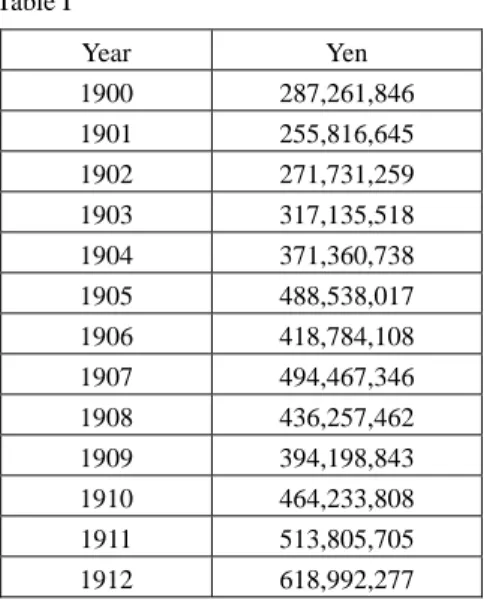
two countries enjoyed a situation of practically free trade (Kachi, 1957, 147). With a growing amount of trade business with Japan, it seems that the U.S. was deepening her trade ties and mutual reliance with Japan. There must have been benefits for both sides, for Japan and America renewed the Treaty of Commerce and Navigation in 1911.17 If it had not been for a great use for both nations, they would not have freshened up the treaty. Japan was a good customer for the U.S., because Japan needed to import raw materials for her industrial development and revitalization of her economy. Cotton, iron, steel, lumber and leather have formed the bulk of this trade, with raw cotton as the most important (Boddy, 1921, 48). Statistics of Japanese imports are given from the year 1900 to the end of 1912 in the following table:
Table I Year Yen 1900 287,261,846 1901 255,816,645 1902 271,731,259 1903 317,135,518 1904 371,360,738 1905 488,538,017 1906 418,784,108 1907 494,467,346 1908 436,257,462 1909 394,198,843 1910 464,233,808 1911 513,805,705 1912 618,992,277 Excerpt from Boddy, Japanese in America, 49.
From the Table I, it is obvious that Japanese imports were mostly increasing. We should pay attention to the trade relationships between Japan and the U.S. when we tackle immigration problems, for the Japanese trade formed a large part of America’s Oriental commerce, and had been constantly growing since the visit of Commodore
━━━━━━━━━━━━━━━━━━━━━━━━━━
Perry (Boddy, 1921, 49).We also need to know another reason for pro-Japanese news articles coming up in the local newspaper. Small businesses established and operated by Japanese immigrants began to emerge in Seattle in the 1900s.18 This was a characteristic phenomena of the Japanese immigrants compared with other ethnic groups settling down in America, and this had something to do with The Seattle Times news stories that praised the power of the Japanese economy as well as the favorable attitude toward the Japanese to a certain degree.
Murayama (1989, 128) shows us a change in job distribution of Japanese men in the State of Washington; from 432 Japanese entrepreneurs in 1903 to 1,034 Japanese business owners in 1913. It naturally entailed a great increase of income for Japanese immigrants, especially for self-established Japanese business owners. It is said that Japanese entrepreneurs earned an average income of a thousand and four hundred fifty-seven dollars a year, which was two or three times greater than the money Japanese wage earners earned for their manual work (Murayama, 1989, 130). This fact seems to have contributed to pro-Japanese articles appearing in The Seattle Times, for the Seattle society was participating in a budding phase of U.S.-Japan partnership in terms of economic activities going on in the State of Washington.
Considering the news report cited below, we gather that Seattle journalism paid a tribute to Kondo, president of Nippon Yusen Kaisha, as early as in 1900 when the first large anti-Japanese meetings took place in the spring of that year, on April 19 in Seattle and on May 7 in San Francisco (Daniels, 1988, 112). This news report is worth reading, because there seems to be a subtle nuance of welcome for a future Japanese import expansion:
(6)
“Guest of Seattle: President of Kondo of Nippon Yusen Kaisha Will Reach the City on the Flyer from Tacoma This Afternoon.”
“He comes up from California and will arrive here about 5 o’clock on the Flyer, from Tacoma. . . . The party has visited San Diego, San Francisco, spent yesterday in looking over the field at Portland, . . . He is dignified to a marked degree, and has the air of a man.” (The Seattle Times, May 19, 1900)
The news story above reads as being courteous, and it shows its consideration to a Japanese president of a shipping company, because The Seattle Times knew that Kondo, a Japanese dignitary, was in a position to bear the heavy responsibility of Japan-U.S. trade transactions and to wield his power in order to expand his business with the U.S. That is what the U.S. economic sector was most interested in because of the positive prospect of trade with Japan in the foreseeable future. That is also one of the reasons why a news reporter would have used words of praise for Kondo with his specific travel schedule. This is contrary to what we examined in the chapter two of this paper, where examples were shown of anti-Japanese feelings or political movements against Japanese immigrants in Seattle.
Herbert H. Gowen, who was a lecturer of University of Washington and was on the pro-Japanese side, voiced his own view on U.S.-Japan economic transactions among harsh opinions against Japanese immigrants at the time.19 He argued, “With our present lack of a merchant marine, it is wise to encourage the commercial enterprise of the Chinese and Japanese. Their countrymen help to keep up and develop trade.” We now know that U.S. foreign trade with Japan independently, or apart from blustering anti-Japanese demands, established its tight connection with the Japanese trade sector. The world of trade business between Japan and America seems to have built its close and crucial ties with each other, and we further see another type of pro-Japanese article stemming from favorable Japan-U.S. trade relationship in The Seattle Times:
(7)
On Saturday evening fifty business and professional men of Seattle responded to the invitation of Satokichi Hayashi—the gentleman who fills the office of Consul in the City of Seattle, . . . At the request of the Consul, Judge Thomas Burke acted as “toastmaster,” and during the hours which followed to the completion of the program, properly entertained the guests of the evening with a flow of oratory and wit hardly surpassed at any banquet which has been served in Seattle. (The Seattle Times, May 20, 1901)
The press reported the above story, describing that the relationship between Japan-U.S. was good and that both countries were developing their friendships with
━━━━━━━━━━━━━━━━━━━━━━━━━━
mutual understandings at the banquet. This type of news tended to be rather long, or else it was an analytic type of news story. This was because this type of news, unlike anti-Japanese straight news, was written with careful explanation of how the trade with Japan was going and how American economists were valuing the Japanese power of purchasing. The U.S. monetary profit gained by a foreign trade with Japan was a matter of course. The American business circles would have wanted to shun a bias or prejudice that could have adversely influenced promising Japan-U.S. trade, because trade increase with Japan means American producers' satisfaction. In addition to that the increase would not have raised antipathy against the Japanese, for American workers never felt immediate threat to their standard of living with the trade increase. Or it might be said that a favorable trade with Japan had nothing to do with Americans' employment issues.At another time The Seattle Times temporarily changed its way of writing from anti-Japanese to pro-Japanese. We see March 16, 1902 edition of The Seattle Times article that a news reporter called for the best hospitality Seattleites could offer to the Japanese dignitaries, who were to visit the city,20 in order to show America’s goodwill to a trade partner of a Far East country. It used the expression of “distinguished party of Japanese gentlemen,” or “give the visitors a most cordial reception and to impress on them the friendly feeling entertained by the people of this city.” These expressions provide further evidence that the U.S. foreign trade industry had a strategy of trade expansion with Japan. That is why we can find several pro-Japanese news reports among unfriendly ones in the newspaper.
Seattle Chamber of Commerce and Commercial Club decided that trade in the Pacific region would be the key to the economic expansion of the American Northwest, adding it wished to play a leading role for the U.S.-Japan goodwill (Nakashima, 1919, 16).21 It is no wonder that the amount of trade volume recorded by the Seattle Customs jumped from $52,748,666 in 1909 to $584,986,644 in 1918.22 It means that the Seattle customhouse experienced an enormous increase in trade during the 1910s decade in terms of the whole trade volume passing though its port, ten times as big as the whole trade transactions. When we scrutinize the U.S. trade exclusively with Japan through Seattle Customs in 1918, we see $183,345,383 exports to Japan, and $84,761,116 imports from Japan.
We can be sure that U.S. trade ties with Japan should not be ignored when we study the relationship between Japan and America, particularly as it was growing bigger and bigger in the 1900s in Seattle. We need to recognize that The Seattle Times wrote completely different news stories from those anti-Japanese feelings shared especially by working class people. It also wrote pro-Japanese articles that focused on the economy. Considering that a variety of events were transpiring in Seattle at the time when a number of different ethnic groups were contacting each other, the newspaper company seems to have tried not to bias its articles toward a one-sided position. It is assumed that a Seattle publisher of media was pressed by a number of different power groups attempting to force the media to report certain articles or anti-Japanese types of articles, and thereby might have lacked a balance or a neutrality in the opinions expressed in the newspaper.
How much biased The Seattle Times’ articles became depends upon a societal posture Seattleites adopted toward a particular race. In this sense The Seattle Times must have mirrored the society to which it belonged with anti- and pro-Japanese articles. It is true that anti-Japanese sentiments overshadowed the Seattleites’ minds, because there were more anti-Japanese news stories than pro-Japanese ones in The Seattle Times in the 1900s. However, it does not mean that there were no pro-Japanese news items, for we have demonstrated in this paper that there were pro-Japanese articles written in the 1900s. It is a matter of record, however, that anti-Japanese news appeared more frequently than pro-Japanese news in that newspaper during the time frame identified in this paper. Therefore the reality of the frequency of appearances is a fact that Gensaburo Ohashi (Seattle) lamented over when considering the plight of the Japanese immigrants around 1910, “Almost everyday at that time the newspaper carried anti-Japanese articles and, not satisfied with the word ‘Jap,’ reviled us by calling us ‘Dogfish (Ito, 1973, 95).’ ” We also see that Namiji Kodama comments on the Seattle situation, “I went to Seattle in 1905. There I scarcely felt any anti-Japanese atmosphere (Ito, 1973, 134).”
━━━━━━━━━━━━━━━━━━━━━━━━━━
4. Conclusion
Since we have examined news articles and other sources on Seattleites’ attitudes toward Japanese immigrants in the 1900s and 1910s, we know that, in the main, sentiment of local Seattleites was negative toward the Japanese and that the newspaper actively reflected these sentiments in its pages.
Scholars were also trying to argue a problem of Japanese immigrants, in academic publications, either on an exclusionist side or a pro-Japanese stance. When the author of this paper chose a given year of The Annals of the American Academy 1909, Vol. ⅩⅩⅩⅨ to see how the academic circle expressed themselves about Japanese immigrants, it became clear that majority of scholars backed a policy of excluding the Japanese from American soil, but a few of them strongly supported the way Japanese immigrants worked in the U.S. with a history of native culture and society. The number of papers concerning the Japanese immigration in The Annals 1909 is thirteen. Among them there are three pro-Japanese papers supporting the Japanese immigration, ten anti-Japanese types and one neutral one. The ratio of pro- and anti-Japanese articles in The Annals is almost the same as that of journalistic coverage. We should also note that newspaper articles of pro-Japanese type deal with business-related occasions between the Japanese trade industry and American business and professional circles. This trend is different from those news stories of the anti-Japanese type that were based mainly on individual antipathy.
The problem of Japanese immigration makes us think that there was a struggle of existence in each sector of American industries.23 Seattle industries with a great interest in Japan, may well have taken a hostile position or a cooperative stance with the Japanese immigrants. It was fairly natural for them to do. Therefore when we see how Japan-U.S. relationships in the 1900s were, even if those were labor-conflict types of trouble, we should never fail to take a closer look at media, or balanced news stories of the press, in order not to be buried under “a prejudiced and hostile American press campaign (Boddy, 1921, 69).” We should take heed of both anti- and pro-Japanese comments through journalistic publication, or we may easily come to a conclusion that a larger volume of opinion covered in newspapers
represent Seattle residents’ feelings and ideas. This paper has shown that this is not the case. Newspapers could have been a powerful source in driving out Japanese immigrants from America once the media decided to stand by exclusionists (Spickard, 1996, 28).24
Notes
──────────────
1 Kawakami asserts that journalism was finding itself to be accepted by capital and labor in
their community, and news media was also trying favor from labor unions with a spectacular propaganda against the Japanese. Kawakami, The Real Japanese Question, 88.
2 Takami (1998) says, “From their arrival in the United States, Japanese, like other Asians, on
the West Coast, faced blatant racial hatred and discrimination.” Takami, Divided Destiny, 23.
3 In its proper article The Seattle Times made its stance of pro-labor union and anti-Japanese
immigrants clear. The Seattle Times, June 7, 1900.
4 See the two different opinions in Ichioka, The Issei, 91.
5 Murayama (1984) shows us what job distribution of Japanese immigrants in the state of
Washington was; the biggest percentage is railroads. This applies to the state of Montana where most Japanese workers got a job at railroads. Murayama, Contractors, Collusion, 1984. 294. Railroads 3,008 23.5% Sawmills 2,111 16.5% Canneries 791 6.2% Domestic services 1,258 9.8% Agriculture 2,125 16.6% City business 3,521 27.4%
6 The Great Northern in this sentence means the Great Northern Railroad.
7 The San Francisco Chronicle accused Japanese immigrants of their work performances,
which was sponsored by the Japanese and Korean Exclusion League in 1905: “In the accompanying article the Chronicle begins a careful and conservative exposition of the problem which is no longer to be ignored—the Japanese question. It has been but slightly touched upon heretofore; now it is pressing upon California and upon the entire United States as heavily and contains as much of a menace as the matter of Chinese immigrant ever did, if, indeed, it is not more serious, socially, industrially and from an international standpoint.”
━━━━━━━━━━━━━━━━━━━━━━━━━━
Tupper also adds a note to the citation above as follows: “A group almost entirely composed of labor organizations which was formed in May, 1905, with the purpose of extending the Chinese Exclusion Law to the Japanese.” Tupper, Japan in American Public Opinion, 21.8 Wikipedia: http://en.wikipedia.org/wiki/Panama_Hotel_
9 While there are a number of lamentations Japanese Issei and Nisei uttered about their being
discriminated against around 1905, we can see the opposite opinion. Hideyoshi made it clear that Seattle was a peaceful place for the Japanese: “Exclusion was much more severe in San Francisco than in Seattle. Landing in San Francisco in December, 1905 via the ‘Korea Maru,’ after being a traveling salesman in various places, I went to Seattle. There I scarcely felt any anti-Japanese atmosphere.” Ito, Issei: A History of Japanese Immigrants, 134.
10 Kazuo Ito collects many examples of how the Japanese men were wanted on the workplaces
especially in Washington. Ito, Issei: A History of Japanese Immigrants, 308-11.
Harry A. Millis (1915) also writes about Japanese workers’ efficiency in the railroad section hands. It reads, “The Japanese found favor with the road masters and foremen because of their efficiency, and their good behavior in camp. On the whole they proved to be better workmen than any of the immigrant races.” Millis, The Japanese Problem, 34. Furthermore, The Seattle Times itself reported wants of laborers and publicized the need of Japanese workers: “In order to protect ourselves [the North Columbia Gold Mining Company] we were forced to hire Japanese and we will take thirty-five of the Asiatics from Vancouver, B. C. (The Seattle Times Apr. 4., 1907).”
11 Murayama (1989) elaborates on the American long-lasting economic boom in order to
explain a “pull factor” of immigration in the U.S. America experienced annual economic growth of more than five percent from 1897 through 1907, which surpassed four point five of GNP economic boom after the World War Ⅱ. Murayama, Amerika ni Ikita, 135.
12 Ichihashi (1932, 57) cites numbers of the Japanese who were admitted to enter the U.S.
1901 5,249 1902 14,455 1903 20,041 1904 14,382 1905 11,021 1906 14,243 1907 30,824 1908 16,418 1909 3,275 1910 2,798
13 The size of the photo is twenty-three by twenty centimeters. Those girls wearing Japanese
kimono look worried about their future life in America.
14 Kazuo Ito collects a lot of incidents of Japanese immigrants being attacked or bullied by the
local Americans in his book. See Ito, Issei: A History of Japanese Immigrants in North America, 92-97.
15 “We assume that racial prejudice is learned, and that it derives from multiple sources,
including individual, interpersonal, and societal factors. As with most attitudes, prejudice cannot be developed and maintained in isolation; therefore, the reinforcements provided by the social structures are critical.” Daniels and Kitano, American Racism, 19.
16 Ibid. 19.
17 The treaty was originally signed by Japan and America in 1894. This treaty provided that
the citizens of both countries would have full liberty to enter, travel or reside in any part of the territory of the other and enjoy protection for their property and persons. Both nations also conferred most favored nation status on one another. Niiya, Encyclopedia of Japanese American History, 392.
18 About small businesses in America established by Japanese immigrants, see Ichihashi,
Japanese in the United States, 116-36.
19 Gowen, “The Problem of Oriental Immigration in the State of Washington,” 1909, The
Annals of the American Academy, Vol. 34 No 2, 335.
20 The news report goes like this: “A distinguished party of Japanese gentlemen are due to
arrive in this city from the Orient about March 25 on the Nippon Yusen Kaisha steamer Kaga Maru. Arrangements are being made by the Chamber of Commerce to give the visitors a most cordial reception and to impress on them the friendly feeling entertained by the people of this city and of the United States towards the little island kingdom of the Far East. . . . The matter has been referred to the Chamber of Commerce committee on reception and entertainment, of which Josiah Collins is chairman. . . . It is probable that a banquet will be tendered the distinguished visitors.” The Seattle Times, March 16, 1902.
21 Katsuji Nakashima, a publisher and writer of this booklet Seattle, writes elaborate
introduction of Seattle with trade tables and data of various kinds in Japanese. Therefore the author of this paper translates passages of Nakashima’s explanation into English and incorporates some of them in this paper. This booklet was photocopied and given to the author by Wing Luke Museum of the Asian Pacific American Experience in Seattle in 2007.
22 Nakashima, Seattle, 1919, the introduction section.
23 Boddy argues, “The immense volume of propaganda that has been directed against the
Japanese, both as individuals and as a Nation, is certainly unequalled in American history. . . . For thirty years or more the Labor Unions have exercised an exceedingly strong influence politically,” Boddy, Japanese in American, 65-66.
24 Spickard writes, “The workers’ organizations were joined quickly by newspapers most
notably the influential San Francisco Chronicle. Chester H. Rowell, a Fresno editor and later a prominent Progressive, gave voice to a subtler source of opposition—fear of able and aggressive Japanese (Japanese Americans, 28).”
━━━━━━━━━━━━━━━━━━━━━━━━━━
ReferencesBoddy, E. Manchester. Japanese in America. San Francisco: R and E Research Associates, 1921.
Bonacich, Edna. The Economic Basis of Ethnic Solidarity: Small Business in the Japanese American Community. Berkeley: University of California Press, 1980. Daniels, Roger. Asian America: Chinese and Japanese in the United States since
1850. Seattle: University of Washington Press, 1988.
Daniels, Roger. Kitano H. L. Harry. American Racism: Exploration of the Nature of Prejudice. Englewood Cliffs: Prentice-Hall, Inc. 1970.
Gowen, H. Herbert. “The Problem of Oriental Immigration in the State of Washington,” The Annals of the American Academy, Vol. 34, No 2, 335. 1909. Ichihashi, Yamato. Japanese in the United States: A Critical Study of the Problems
of the Japanese Immigrants and Their Children. Stanford: Stanford University Press, 1932.
Ichioka, Yuji. The Issei: The World of the First Generation Japanese Immigrants 1885-1924. New York: The Free Press. 1988.
Ito, Kazuo. (trans. Shinichiro Nakamura and Jean S. Gerard) Issei: A History of Japanese Immigrants in North America. Seattle: Executive Committee for Publication of Issei, 1973.
Kachi, Teruko Okada. The Treaty of 1911 and the Immigration and Alien Land Law Issue Between the United States and Japan 1911-1913. New York: Arno Press Inc., 1978.
Kawakami, K. K. The Real Japanese Question. New York: The Macmillan Company, 1921.
Millis, Harry A. The Japanese Problem in the United States. New York: Arno Press, 1915.
Murayama, Yuzo. Amerika ni Ikita Nihonjin Imin. Tokyo: Toyo Keizai Shinposha, 1989.
Nakashima, Katsuji. Seattle. Seattle: Seattle Publisher, 1919.
Spickard, Paul R. Japanese Americans: The Formation and Transformations of an Ethnic Group. New York: Twayne Publishers. 1996.
Tupper, Eleanor. Japan in American Public Opinion. New York: The Macmillan Company, 1937.
━━━━━━━━━━━━━━━━━━━━━━━━━━
(Summary)This paper explores both anti- and pro-Japanese news coverage of Seattle in the 1900s. From those news articles we mainly see Americans'outcries that Japanese immigrants should be expelled from the U.S. Although there are many anti-Japanese types of news coverage in The Seattle Times, Seattle journalists also reported pro-Japanese types of news stories in the area of foreign trade and the American economy. When we study the relationship between Japan and America, especially through such mass media as a daily newspaper, we must not fail to follow both phenomena, that is, anti- and pro-Japanese news coverage resulting from the issues that prevailed at the time. In this paper the author made it clear that there were pro-Japanese articles based on the American economy and the trade relationship between Japan and the U.S. However, the number of those newspaper stories was relatively small compared with that of the anti-Japanese stories relating to immigrant laborers and employment issues. Through this research we can get an increased understanding of the subtle nuance of Japanese-exclusion movements observed in the West Coast states in the 1900s.