概要 現在ヨーロッパ諸国の国連平和維持活動に対する参加状況は、東西冷戦時代に彼らが一 貫して国連ミッションに貢献した「黄金期」と比較すると輝かしいものではない。ポスト 冷戦期においてヨーロッパ諸国は、国連ミッションよりはNATO(北大西洋条約機構)が 指揮を執るミッション、アフリカ諸国におけるヨーロッパ連合(EU)主導のミッション、 さらにはアフガニスタンの国際治安支援部隊(ISAF)のような非国連の大型ミッションに 多くの兵を送ることが多い。なぜならヨーロッパ諸国は、国連平和維持活動がミッション をより効果的に実行するためのコンセンサスを得ることが困難であり、よって複雑なミッ ションにおいてはそれを展開するうえでの十分な能力を国連は持ち合わせていないと認識 しているからである。現在ヨーロッパ諸国は、EU、NATO、あるいは国連主導のミッショ ンに大別して3種類の平和ミッションを選択することができる。 またアフリカにおける平和ミッションに関しては、多くのアフリカ諸国がAU主導の ミッションよりもむしろ国連ミッションにその兵を派遣する傾向にある。その結果アフリ カに駐留する多くの国連ミッションは、地元のアフリカ諸国の兵によって構成されてい る。ヨーロッパ諸国も近年フランスを除けば、アフリカ諸国そのものに対しての彼らの国 益の欠如によりアフリカの平和ミッションの参加に対しては消極的であった。 それにもかかわらず本論は、ヨーロッパ諸国は次の3つの理由で国連平和ミッションに 回帰すべきと提案する。まず第一の理由に現在の多くのEUミッションは、限定的であり、 規模や目的に関しても国連ミッションとは異なる。よってはヨーロッパ諸国は、EUと国 連のミッションを別個のものと考え、国連ミッションにもヨーロッパにとって需要がある ために参加すべきというものである。2番目にヨーロッパ諸国には国連ミッションに参加 すべき「正当性」が存在するということである。3番目には、技術面などを代表するよう な国連平和ミッションをヨーロッパ諸国が持ち合わせている「価値」の存在があげられる。 キーワード:ヨーロッパ諸国、国連平和維持活動、ヨーロッパ連合、正当性 ヨーロッパの国連平和維持活動への参加の歴史 −ヨーロッパ諸国は国連ミッションに回帰すべきか−
Should the European States Go back to UN Peacekeeping?
Katsumi ISHIZUKA
Abstract
It is difficult to mention that the European countries currently play a significant role in the UN peacekeeping operations, compared with their golden ages" as the consistent peace-keepers during the cold-war period. In the post-cold war period, the European countries are more willing to send their troops to NATO-commanded operations in Europe such as KFOR and IFOR, to small and short-term EU operations in Africa, and to large numbers of troops to ISAF in Afghanistan, than to UN peacekeeping. It is due to their recognition that UN peacekeeping has difficulty in building a consensus to make the mission effective, and therefore that it does not have sufficient capability to deal with complex missions. The Euro-pean countries are currently given the choice of theirs peacekeepers'" dispatching to EU-led, NATO-led or UN-led peacekeeping operations, or none of the above. In terms of peace-keeping operations in Africa, the African countries gave a shift of their troops' deployment from regional to UN peacekeeping. As a result, many UN peacekeeping operations in Africa largely consisted of African troops. Meanwhile, the involvement of European countries, ex-cept France, in African conflicts has been insignificant due to a lack of their national interest. However, this paper advocates that the Europeans should go back to UN peacekeeping for three reasons. First, many EU peace operations, which are very limited and specified in their size and goals, are very different from UN operations. Therefore, European states should be encouraged to participate in UN peacekeeping when their professionalism is demanded. Second, European participation in UN peacekeeping should be recommended by the factor of legitimacy. Third, Europeans are demanded to participate in UN peacekeeping operations because of the values which Europeans have in conducting UN peacekeeping operations.
Keywords: European states, UN Peacekeeping Operations, European Union, legitimacy
Content 1.Introduction
2.The History of the Contribution of European States to UN Peacekeeping Operations
3. Peacekeeping and peace-making by Regional Organizations and its Impact on European States' Commitment to UN Peacekeeping Operations
4. The Peacekeeping Strategies of European States in the post-ISAF Period: Should They Go back to UN Peacekeeping?
4-1 Anti-UN peacekeeping perspectives for Europeans 4-1-1 political realism
4-1-2 self-sufficiency
4-1-3 criticism of UN peacekeeping
4-2 Pro-UN peacekeeping perspectives for Europeans 4-2-1 (ir)relevance
4-2-2 legitimacy
4-2-3 (Europeans') value 5. Conclusion
1. Introduction
Currently, the performance of the European countries in the UN peacekeeping opera-tions is not significant, compared with their golden ages" as the consistent peacekeepers during the cold-war period. In the post-cold war period, the European countries are more willing to send their troops to NATO-commanded operations in Europe such as KFOR and IFOR, to many small and short-term EU operations in Africa, and to the massive troops to ISAF in Afghanistan, than to UN peacekeeping. Furthermore, ISAF might have been a good excuse" for their passive participation in UN peacekeeping. However, the mission of ISAF terminated at the end of 2014. Therefore, the European countries was given their choice of their peacekeepers' dispatch to EU-led, NATO-led or UN peacekeeping opera-tions, or none of the above. In reality, European troops are dispatched to the limited UN peacekeeping in the Middle East, namely, UNIFIL, and some other UN peacekeeping as a token" operation. The EU countries also dispatched their own small peacekeeping mis-sion with limited mandate for short terms. Meanwhile, in terms of peacekeeping opera-tions in Africa, the African countries gave a shift of their troops' deployment from regional to UN peacekeeping. As a result, many UN peacekeeping operations in Africa largely con-sisted of African troops. The involvement of European countries, except France, in African conflicts has been passive. Since the majority of UN peacekeeping operations is located in Africa, Europeans' commitment to UN peacekeeping has been significantly diminished. How can the diminished commitment for their participation in UN peacekeeping be ex-plained? Does it have legitimacy? Should they go back to UN peacekeeping? If so, why?
This paper will focus on European participation in UN peacekeeping operations, and will answer the above questions. First, this paper will refer to the history of their strong enthusiasm about UN peacekeeping dispatch. Then, this paper will focus on the advent of regional and non-UN peacekeeping operations and how European states were involved in
them. The last part of this paper will argue over whether European states should be re-committed to UN peacekeeping operations from various viewpoints.
2. The History of the Contribution of European States to UN Peacekeeping Operations During the cold-war period, many European states, especially West European states, were encouraged to participate in UN peacekeeping operations. Many western countries, except for two permanent members of UN Security Council, the UK and France, were the so-called middle powers", and became enthusiastic contributors to UN peacekeeping op-erations. When UN peacekeeping operations were established in 1948 and then gained in-ternational legitimacy during the cold-war period, many Asian and African states were still not independent or their national troops were still too immature in their military skills and equipment to be sent to UN peacekeeping.
In fact, the European middle powers were considered to be the ideal UN peacekeep-ers; on the one hand, in a peacekeeping role which mainly focuses on mediation and arbi-tration, the coercive nature of the great powers would make host states apprehensive; and on the other hand, peacekeeping is a para-military role which requires appropriate military equipment, mission skills, discipline of soldiers, and high morale amongst troops. Europe-an middle powers also provided logistical support capability, which is Europe-another importEurope-ant sector in peacekeeping missions. Therefore peacekeeping gave the middle powers a chance to have a leading role in international security issues, which restricted the super-powers' role. This intention was shared with most of the European middle power contribu-tions such as the Nordic States, Ireland, Portugal etc.
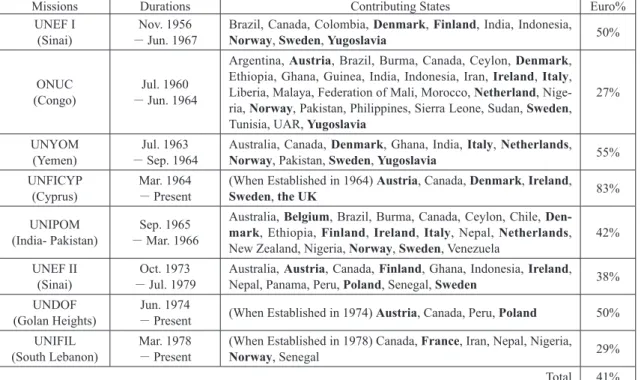
It is true that fear of starting World War III from the conflagration in the Middle East in 1956 and in 1973 encouraged European middle powers to be committed to peacekeep-ing operations, UNEF I and UNEF II, respectively. As can be seen from Table 1, the Euro-peans accounted for about 41 percent of the total contributing states in the major UN peacekeeping operations during the Cold-War period. Most of the European states in these figures are those of the middle European powers, with the exception for the cases of the UK in UNFYCIP and France in UNIFIL. Meanwhile, the contribution of the African states was very limited during this period. They accounted for 16 percent of the total contribut-ing states in the major UN peacekeepcontribut-ing operations, and the majority of them were dis-patched to the Congo in ONUC in the early 1960s to protect their own region. It was clear that Canada was the most consistent contributor, who indeed participated in all of the
ma-jor UN peacekeeping operations. Australia was also an enthusiastic contributor as well as the European states. In short, not only European middle powers but also the middle West-ern states" should be categorized as positive contributors to UN peacekeeping.
Table 1: Main UN Peacekeeping Operations and Contributing States during the Cold-War Period Missions Durations Contributing States Euro%
UNEF I
(Sinai) −Nov. 1956Jun. 1967 Brazil, Canada, Colombia, Denmark, Finland, India, Indonesia, Norway, Sweden, Yugoslavia 50% ONUC
(Congo) −Jul. 1960Jun. 1964
Argentina, Austria, Brazil, Burma, Canada, Ceylon, Denmark, Ethiopia, Ghana, Guinea, India, Indonesia, Iran, Ireland, Italy, Liberia, Malaya, Federation of Mali, Morocco, Netherland, Nige-ria, Norway, Pakistan, Philippines, Sierra Leone, Sudan, Sweden, Tunisia, UAR, Yugoslavia
27% UNYOM
(Yemen) −Jul. 1963Sep. 1964 Australia, Canada, Denmark, Ghana, India, Italy, Netherlands, Norway, Pakistan, Sweden, Yugoslavia 55% UNFICYP
(Cyprus) Mar. 1964−Present (When Established in 1964) Austria, Canada, Denmark, Ireland, Sweden, the UK 83% UNIPOM
(India- Pakistan) −Sep. 1965Mar. 1966
Australia, Belgium, Brazil, Burma, Canada, Ceylon, Chile, Den-mark, Ethiopia, Finland, Ireland, Italy, Nepal, Netherlands, New Zealand, Nigeria, Norway, Sweden, Venezuela 42% UNEF II
(Sinai) −Oct. 1973Jul. 1979 Australia, Austria, Canada, Finland, Ghana, Indonesia, Ireland, Nepal, Panama, Peru, Poland, Senegal, Sweden 38% UNDOF
(Golan Heights) −Jun. 1974Present (When Established in 1974) Austria, Canada, Peru, Poland 50% UNIFIL
(South Lebanon) Mar. 1978−Present (When Established in 1978) Canada, France, Iran, Nepal, Nigeria, Norway, Senegal 29% Total 41% Source: United Nations The Blue Helmets: A Review of United Nations Peace-keeping, Third Edition (New York: The
Unit-ed Nations Department of Public Information, 1996), William J. Durch (Unit-ed.) The Evolution of UN Peacekeeping: Case Studies and Comparative Analysis (New York: St. Martin's, 1993)
The end of the Cold War, which terminated the indiscriminate use of the veto by the permanent members of the UN Security Council, led to a significant increase in the quanti-ty of UN peacekeeping operations. For example, the number of UN peacekeeping opera-tions deployed was increased from 11 in January 1988 to 28 by December 1994. So was the number of states contributing to UN peacekeeping.
According to the author's statistics from The Blue Helmets: A Review of United Na-tions Peace-keeping, Third Edition (New York: The United NaNa-tions Department of Public Information, 1996), in total 112 states out of the whole 181 members of the UN participat-ed in at least one UN peacekeeping operation. The total number of contributing states to UN operations between 1948 and 1996 was 905 states. Therefore, the average number of peacekeeping operations per contributing state was 8.1 operations. Table 2 is a list of 27 states, which can be considered to be the positive contributors" to UN peacekeeping op-erations which contributed at least 15 UN opop-erations from 1948 to 1996.
Table 2: The Top 27 contributing states to UN peacekeeping from 1948 to 1996, by the number of operations where the states dispatched their contingents The Number of Operations Contributing States
33 Canada
26 Ireland, Sweden, Jordan
25 Norway
22 Argentina, Bangladesh 21 India, Pakistan
20 Austria, Netherland, Poland, Ghana,
19 Denmark, Finland, Indonesia, Malaysia, Nigeria 18 New Zealand,
17 France, Egypt
16 Russia, Australia, Brazil 15 Belgium, Italy, Kenya
Source: United Nations The Blue Helmets: A Review of United Nations Peace-keeping, Third
Edition (New York: The United Nations Department of Public Information, 1996)
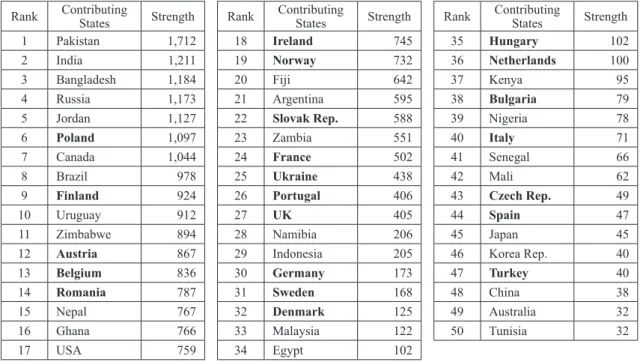
According to Table 2, the top 27 major contributing states dispatched their national contingents to in total 542 operations. Among them, the European states contributed to 256 operations, which accounted for 47 percent of the total operations. Meanwhile, the Af-rican states contributed to in total 71 operations, which accounted for 13 percent of the to-tal operations. In terms of the toto-tal number of military personnel of UN peacekeeping, at the end of 1996, the grand total number was 24,919. The number of European personnel was 9,379, which accounted for about 38% of the total UN personnel. (Table 3)
Table 3: The Top 50 Troop Contributing States to UN Peacekeeping Operations (December 1996) Rank ContributingStates Strength Rank ContributingStates Strength Rank ContributingStates Strength
1 Pakistan 1,712 18 Ireland 745 35 Hungary 102 2 India 1,211 19 Norway 732 36 Netherlands 100 3 Bangladesh 1,184 20 Fiji 642 37 Kenya 95 4 Russia 1,173 21 Argentina 595 38 Bulgaria 79 5 Jordan 1,127 22 Slovak Rep. 588 39 Nigeria 78
6 Poland 1,097 23 Zambia 551 40 Italy 71
7 Canada 1,044 24 France 502 41 Senegal 66 8 Brazil 978 25 Ukraine 438 42 Mali 62
9 Finland 924 26 Portugal 406 43 Czech Rep. 49
10 Uruguay 912 27 UK 405 44 Spain 47 11 Zimbabwe 894 28 Namibia 206 45 Japan 45
12 Austria 867 29 Indonesia 205 46 Korea Rep. 40
13 Belgium 836 30 Germany 173 47 Turkey 40
14 Romania 787 31 Sweden 168 48 China 38
15 Nepal 767 32 Denmark 125 49 Australia 32 16 Ghana 766 33 Malaysia 122 50 Tunisia 32 17 USA 759 34 Egypt 102
Source: The Monthly Summary of Troop Contributions to Peacekeeping Operations, as of 31 December 1996, Department of UN Peacekeeping Operations, NY
On the whole, the European states contribute to UN peacekeeping operations not only during the cold war period after its establishment in 1948, but also in the early post-cold war period, when the European states consistently met the increasing demand of UN oper-ations. It is to be noted that the European states contributed about 40 percent of the total contributing states as well as the total strength. This figure was significant even if one ac-cepted the relative superiority of economic and military strength which the European states had in the international community. In other words, the European states positively accepted the philosophy of the UN as multi-lateralism and put themselves in the frame-work in UN security system by participating in peacekeeping operations.
3. Peacekeeping and Peace-making by Regional Organizations and its Impact on Europe-an States Commitment to UN Peacekeeping Operations
In the post-cold war period, the international community became more insecure, the framework of conflict resolutions became more diverse and complex, and this tendency became more significant after the so-called 9.11" terrorist attack. This tendency brought about the proliferation of operations mandated and conducted by regional organizations such as AU, EU and NATO and coalitions of the willing.
In fact, the UN showed a positive stance towards its cooperative action with regional organizations. The Report of the Secretary-General's High-level Panel on Threat, Chal-lenges and Change, A More Secure World: Our Shared Responsibility" in 2004, accepted that there has been a trend towards a variety of regional- and sub-regional-based peace-keeping missions. On the one hand, Secretary-General Kofi Annan claimed that this trend held the promise of developing regional capacity to address shortfalls in the numbers of peacekeepers. On the other hand, he also considered that this posed a challenge for the Se-curity Council and regional organizations to work closely with each other and mutual sup-port of each other's effort to keep the peace and ensure that regional operations are ac-countable to universally accepted human rights standard.1 In 2005, Annan reaffirmed the
importance of complementary roles which the UN and regional organizations should play in facing the challenges to international peace and security. He also desired to introduce memoranda of understanding between the UN and regional organizations, governing the sharing of information, expertise and resources.2
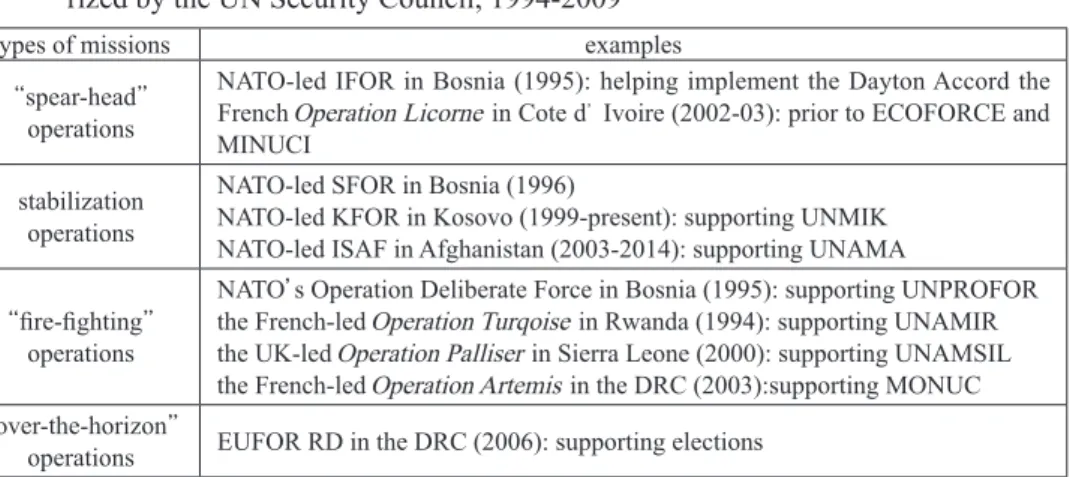
Table 4: Examples of Non-UN Peace Operations conducted by the European states, autho-rized by the UN Security Council, 1994-2009
types of missions examples “spear-head”
operations
NATO-led IFOR in Bosnia (1995): helping implement the Dayton Accord the French Operation Licorne in Cote d Ivoire (2002-03): prior to ECOFORCE and MINUCI
stabilization operations
NATO-led SFOR in Bosnia (1996)
NATO-led KFOR in Kosovo (1999-present): supporting UNMIK NATO-led ISAF in Afghanistan (2003-2014): supporting UNAMA “fire-fighting”
operations
NATO's Operation Deliberate Force in Bosnia (1995): supporting UNPROFOR the French-led Operation Turqoise in Rwanda (1994): supporting UNAMIR the UK-led Operation Palliser in Sierra Leone (2000): supporting UNAMSIL the French-led Operation Artemis in the DRC (2003):supporting MONUC “over-the-horizon”
operations EUFOR RD in the DRC (2006): supporting elections
Source: Alex J. Bellamy and Paul D. Williams, The West and Contemporary Peace Operations", Journal
of Peace Research, Vol. 46, No. 1, 2009, pp. 39-57
Table 4 gives the examples of non-UN peace operations conducted by the European states and authorized by the UN Security Council. They were in the framework of the EU and NATO and deployed by only a single great European power, the UK and France in 1994-2009. The EU's commitment to regional peacekeeping operations has been based on its Common Foreign and Security Policy (CFSP), which was created at the Amsterdam Treaty effective in May 1999. In fact, CFSP has several objectives in its policy. They in-clude not only to safeguard the common values and interests" and to strengthen the se-curity of the Union" but also to preserve peace and strengthen international security in accordance with the principles of the United Nations Charter."3 The High Representatives
of CFSP also claimed that the EU made further progress to enhance EU CSDP (Common Security Defense Policy) support to UN peacekeeping. This included the preparation of a clear house model to create a policy agreement on the EU facilitating coordinated Member States' contribution to UN operations.4 However, despite EU's ambition and goal to
con-tribute to international or regional security, there are few major peacekeeping operations with thousands of troops led by the EU.
Meanwhile, NATO is the most functional and effective military alliance in the world that can hardly be challenged in the technological and logistics realm of military missions. William Durch argued that several regional organization are building up their capability to provide such security but there are just two international organizations that can recruit, manage, and sustain peacekeeping forces in the more volatile of post-war settings: the UN and NATO.5 However, Durch also pointed out that there are several substantial differences
between the UN and NATO. First, the evolved purpose of the UN includes support for hu-man rights, national sovereignty, and self-determination, while the evolved purpose of
NATO is to promote military stability and political development in and around Europe. Second, the targets of the UN are bad governance and political instability, disease, fear, oppression, organized crime and terrorism, while NATO's targets include global terrorist organizations, fundamentalist tyranny, and aggressive hyper-nationalism.6 Therefore, there
should be the so-called division of labour" in peace operations between the UN and NATO. UN peace operations are more suitable and preferable for multi-functional mis-sions which focus on state-building. NATO peace operations are more suitable for coercive peace-making or stabilization missions, prior to comprehensive UN missions. In fact, as can be seen from Table 4, NATO conducted stabilization operations such as SFOR, KFOR and ISAF in Bosnia, and fire-fighting operations such as Operation Deliberate Force in Afghanistan.
Therefore, one question can be raised, To what extent have UN peacekeeping opera-tions been affected by European states' enthusiasm in their regional peacekeeping?" The most significant non-UN peace operation affecting European countries in the post 9.11 pe-riod was the International Security Assistance Force (ISAF) in Afghanistan. ISAF was cre-ated in accordance with the Bonn Conference in December 2001, in order to create a se-cure environment in and around Kabul by eliminating the Taliban regime and international terrorists and support the reconstruction of Afghanistan. ISAF was authorized by UNSC 1386 on 20 December 2001, and was initially commanded by a Coalition of the Willing", and on 11 August 2003, NATO assumed leadership of the ISAF operations. In October 2003, the UN, through UNSC 1510, extended ISAF's mandate to cover the whole of Af-ghanistan.
Table 5 refers to the commitment of the 22 positively contributing European states to UN peacekeeping in 1996 listed in Table 3, to UN peacekeeping and ISAF in January 2007 and October 2011. The total strength of ISAF in January 2007 was still modest, 35,460. Afterwards, the strength was significantly expanded to more than 130,000 (137,638) in October 2011. As shown in Table 5, in January 2007, one can see 16 out of 22 states decreasing the number of dispatched troop personnel to UN peacekeeping compared with the number in 1996. Furthermore, 15 out of the 16 states (excluding Ukraine), dis-patched their troop personnel to ISAF. Presumably, among the 15 states, the decision of their commitment to ISAF by 13 European states (excluding Ireland and Slovak Rep.) re-sulted in decrease of the number of troops dispatched to UN peacekeeping operations. Es-pecially, several East European states, which used to be the enemies of NATO, such as Ro-mania, Bulgaria and Czech Rep. expressed a significant shift of their security policy to the
NATO framework. They sent no troops to UN peacekeeping in January 2007, and they in-stead sent almost the same size of troops (or more) which they had sent to UN peacekeep-ing in 1996, to NATO-commanded ISAF in January 2007.
Table 5: The Number of the Dispatch of Troop Personnel of Main European States’ Contribution to UN Peacekeeping Operations and ISAF, 1996-2011
1996 Jan. 2007 Oct. 2011 Contributing
States UN PKO UN PKO UN missions deployed ISAF UN PKO UN missions deployed ISAF Poland 1,097 653↓ UNDOF344, UNIFIL319 160 0↓ 2,580 Finland 924 218↓ UNIFIL 213, UNMIL 3
UNMIS 2 70 2↓ UNIFIL 2 195 Austria 867 377↓ UNDOF 373, UNFYCIP 4 500 383→ UNDOF 377, UNFYCIP 4
UNIFIL 2 3 Belgium 836 361↓ UNIFIL 361 300 120↓ UNIFIL 98, MONUSCO 22 577
Romania 787 0↓ 750 0→ 1,947
Ireland 745 492↓ UNMIL 331, UNIFIL 161 10 453→ UNIFIL 453 7 Norway 732 139↓ UNIFIL 130, UNMIS 9 350 4↓ UNMISS 4 582 Slovak Rep. 588 292↓ UNFYCIP 196, UNDOF 96 50 159↓ UNFYCIP 159 326 France 502 1868↑ UNIFIL 1,680, UNOCI 185
MINUSTAH 2, UNMIL 1 1,000 1312↓ UNIFIL 1303, UNOCI 6MINUSTAH 2, UNMIL 1 3,932 Ukraine 438 300↓ UNMIL 300 0 277→ UNMIL 277 23 Portugal 406 146↓ UNIFIL 146 150 150→ UNIFIL 150 229 UK 405 276↓ UNFYCIP 270, UNMIL 3UNMIS 3 5,200 275→ UNFYCIP 271, UNISFA 2UNMISS 2 9,500 Germany 173 930↑ UNIFIL 913, UNMIL 12UNMIS 5 3,000 241↓ UNIFIL 234, UNMISS 4,UNAMID 3 5,150 Sweden 168 70↓ UNIFIL 68, UNMIS 2 180 2↓ UNMISS 2 614 Denmark 125 55↓ UNIFIL 48, UNMIS 6
MINURSO 1 400 149↑ UNIFIL 147, UNMIL 2 750 Hungary 102 88↓ UNFYCIP 84, UNIFIL 4 180 81→ UNFYCIP 77, UNIFIL 4 415 Netherlands 100 174↑ UNIFIL 171, UNMIS 3 2,200 1↓ UNAMID 1 183
Bulgaria 79 0↓ 100 0→ 597
Italy 71 2427↑ UNIFIL 2427 1,950 1811↓ UNIFIL 1810, UNMISS 1 4,213
Czech Rep. 49 0↓ 150 0→ 694
Spain 47 1108↑ UNIFIL 1108 550 1073→ UNIFIL 1073 1,526 Turkey 40 526↑ UNIFIL 522, UNMIS 4 800 361↓ UNIFIL 361 1,840 Source: Military Balance 2012, International Institute for Strategic Studies, The Monthly Summary of Troop Contributions
to Peacekeeping Operations, as of 31 December 1996, 31 January 2007, and 30 October 2011, Department of UN Peacekeeping Operations, NY
Meanwhile, six states, France, Germany, the Netherland, Italy, Spain, and Turkey, in-creased the number of UN peacekeeping dispatch in January 2007, in comparison with 1996. All of them are the large powers in Europe and the core members of NATO, and, therefore, all of them sent a significant size of troops to ISAF in 2007. Furthermore, it is to be noted that the main or only reason for the significant increase of their UN peacekeeping
dispatch in 2007 is participation in UNIFIL in South Lebanon. The strength of UNFIL was significantly expanded by UNSC 1701 in August 2006 when conflict between Israel and Hizbollah erupted and a heavy exchange of fire worsened the situation in South Lebanon. Therefore, the commitment of European great powers such as France and Germany to UNIFIL in 2006 and its aftermath was attributed to their geo-political interests in South Lebanon located in the Middle East. For example, Kai Michael Kenkel, the German expert on security, clearly said that Germany is more likely to contribute to UN peacekeeping in significant numbers where it is likely to be joined by its European allies and where there is an overlap with alliance interests. In fact, the preoccupation of the European states with UNFIL was remarkable in January 2007.7 UNIFIL accounted for 78.5% of the total troops
dispatched by 22 European states to UN peacekeeping operations.
The tendency of the departure of the European states from UN peacekeeping became more significant in October 2011, when only one state out of 22, Denmark, increased its troop personnel to UN peacekeeping operations, compared with January 2007. Ten states almost maintained their total troop strength to UN peacekeeping in 2011, and 11 states fur-ther decreased their total troop strength compared with 2007. The total troop strengths of 22 European states were reduced from 10,510 in January 2007 to 6,854 in October 2011. Again, UNIFIL accounted for 86 percent of the total European participation in UN peace-keeping. In terms of the figure of ISAF in 2011, indeed 20 out of 22 European states in-creased troop strength dispatched to ISAF. In particular, the enthusiasm and commitment of Poland, Romania, Sweden, Bulgaria, Czech Rep. and Turkey to NATO-led ISAF was remarkable.
Table 5 also indicated that while European states dispatched massive troops to UNI-FIL, they sent token troops", where states send less than ten troops, to a number of UN missions. The token troops were identified in UNMIS (Sudan), UNMISS (South Sudan), UNMIL (Liberia), MINUSTAH (Haiti) and UNOCI (Cote d'Ivore) etc, most of which are African UN missions. In reality, many contributing states have sent a small number of staff officers who work at the mission headquarters. In fact, Katharina Coleman argued that token troop contributions represent a deliberate strategy to spread state's military re-sources over more multilateral operations.8 Token contributors can get access to
operation-al and politicoperation-al information circulated within the mission and the right to attend UN meet-ings on the mission. This benefit can be provided with small cost and capability by sending a small number of staff officers in UN missions. In other words, European states made a clever policy to UN peacekeeping operations; they sent a small number of staff officers as
a token contribution to strategically less significant African UN missions, sent relatively large troops to UN peacekeeping in the Middle East, such as UNIFIL, and sent more mas-sive troop numbers to a more strategically important NATO mission, namely, ISAF. The policy of this division of labour was attributed to the reality that the capacity of states'
commitment to sending troops overseas has been mostly fixed and not significantly changed in a short term.
4. The Peacekeeping Strategies of European States in the post-ISAF Period: Should They Go back to UN Peacekeeping?
Departure of European states from UN peacekeeping became more noticeable after-wards. In September 2012 European countries (including non EU states) were contributing less than 5 per cent or 4,670 troops out of 97,199 in UN peacekeeping operations.9
Mean-while, ISAF terminated at the end of 2014. European states have had more of a tendency to join their peacekeeping missions within the framework of the EU than NATO and the UN.
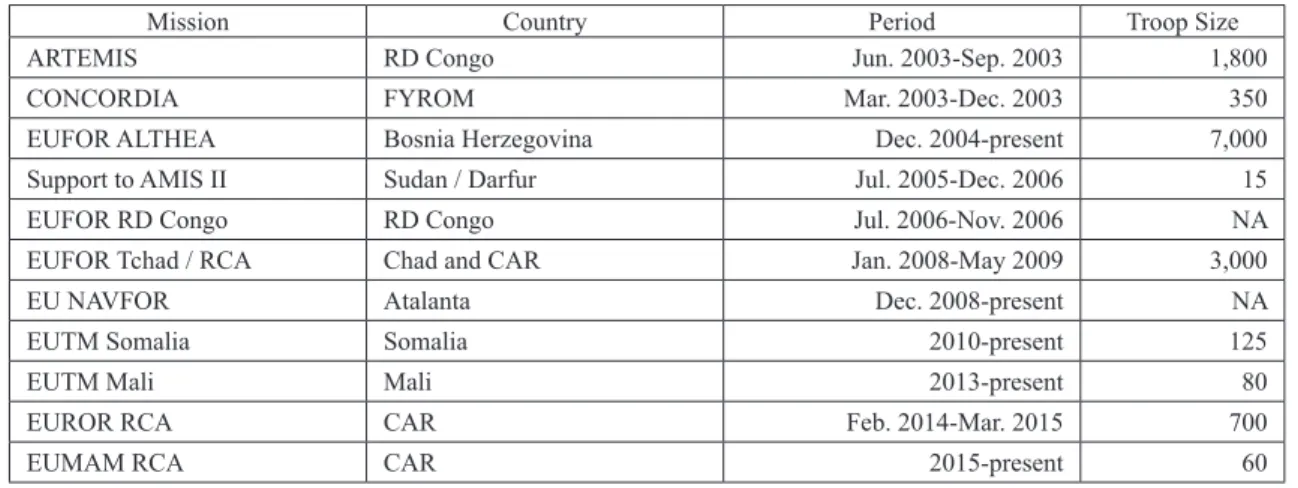
Table 6: EU Peace Operations (military operations) 2015
Mission Country Period Troop Size ARTEMIS RD Congo Jun. 2003-Sep. 2003 1,800 CONCORDIA FYROM Mar. 2003-Dec. 2003 350 EUFOR ALTHEA Bosnia Herzegovina Dec. 2004-present 7,000 Support to AMIS II Sudan / Darfur Jul. 2005-Dec. 2006 15 EUFOR RD Congo RD Congo Jul. 2006-Nov. 2006 NA EUFOR Tchad / RCA Chad and CAR Jan. 2008-May 2009 3,000 EU NAVFOR Atalanta Dec. 2008-present NA EUTM Somalia Somalia 2010-present 125
EUTM Mali Mali 2013-present 80
EUROR RCA CAR Feb. 2014-Mar. 2015 700
EUMAM RCA CAR 2015-present 60
Source: European External Action Service 2015.
http://eeas.europa.eu/csdp/missions-and-operations/index_en.htm.
As can be seen from Table 6, the EU has created 11 military peace operations. Fur-thermore, the EU has deployed 23 civilian missions.10 It must be disappointing for pro-UN
figures who expected that EU states would go back to UN peacekeeping operations after the termination of ISAF. One can now pose a simple question, Should the European states go back to UN peacekeeping operations?"
4-1 Anti-UN peacekeeping perspectives for Europeans
There are several reasons for a negative answer to the above question. Main reasons can be divided into three factors: they are the European states' policy of political realism, the principle of self-sufficiency, and European criticism of UN operations.
4-1-1 political realism
The first reason is based on the factor of political realism. Some claim that the coun-tries that financially support UN peacekeepers, including many European states, are usual-ly not the source for peacekeepers (Table 7). 11
Table 7: Top 5 countries financially contributing to the UN and the numbers of their personnel topartici-pating in UN peacekeeping operations (2014)
Country Share of financial contributionto the UN PKO (%) (2014) Number of personnel to UN peacekeeping (rank) (Dec. 2014)
1st US 28.3 127 (66th)
2nd Japan 10.8 271 (52nd)
3rd France 7.2 922 (32nd)
4th Germany 7.1 179 (59th)
5th UK 6.6 289 (51st)
Source: Ministry of Foreign Affairs of Japan http://www.mofa.go.jp/mofaj/gaiko/jp-un/pko-yosan.htmil United Nations Peacekeeping Operations http://www.un.org/en/peacekeeping/
One can also provide a geo-political reason due to the fact that non-UN operations spending has been concentrated in the Middle East and Central Asia and then East Asia and Pacific. Apparently, given oil interests in the Middle East and Central Asia, peace-keepers' economic interests can be behind this pattern. UN peacekeeping has been mainly concentrated in sub-Saharan Africa, where missions bolster a global public good, namely, international stability. Most countries show little interest in sub-Saharan Africa. The UN has no alternative to be put in place where most countries have little specific economic or strategic concerns.12 Therefore, the UN may not become a major player in peacekeeping.
In this sense, the presence of non-UN peacekeeping may discourage some contributing states to support UN peacekeeping. The UN Security Council, including the UK and France, may veto proposed UN missions for them to concentrate on non-UN peacekeep-ing.13
Having casualties of national peacekeepers is not compatible with Europeans' national interests, either. For example, during the debate in the run-up to the 2003 EU operation in the DRC, there was a widespread debate in Germany about whether German soldiers could and should be put in a position for this reason. Additionally, for European troops, the
traumatic effects of combat in Afghanistan on returning soldiers have become a recurring element of public discourse. This public attitude has discouraged European governments from sending their troops especially to robust UN peacekeeping operations.14
4-1-2 self-sufficiency
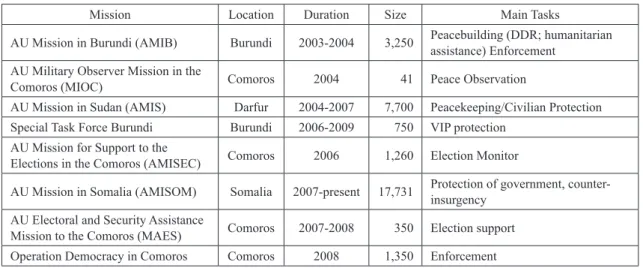
The second reason is based on the principle of self-sufficiency". For example, the slogan of African Solutions for African Problems" is the typical principle for this reason. This principle is compatible with other concepts and ideology including sustainable devel-opment, capacity-building, and even de-colonialization. This principle became more sig-nificant and noticeable especially in the post-cold war period when great and super powers had less motivation in domestic and regional matters in Asia and Africa. From another viewpoint, this principle has gained wide support from its advocates from the sectors of peace-building and state-building in the post-conflict situations after the civil wars in the 1990s and 2000s. Presumably, this principle and concept would also be a preferable factor to the departure of European states from UN peacekeeping, especially, from Africa. One of the typical reflections of African Solutions for African Problems" on military and conflict management is the advent of peacekeeping operations led by the African Union (AU). Since its establishment in 2002, the AU created eight peace operations, and their tasks var-ied, ranging from election monitoring to peace enforcement. (Table 8)
Table 8: African Union Peace Operations, 2003-2012
Mission Location Duration Size Main Tasks
AU Mission in Burundi (AMIB) Burundi 2003-2004 3,250 Peacebuilding (DDR; humanitarian assistance) Enforcement AU Military Observer Mission in the
Comoros (MIOC) Comoros 2004 41 Peace Observation
AU Mission in Sudan (AMIS) Darfur 2004-2007 7,700 Peacekeeping/Civilian Protection Special Task Force Burundi Burundi 2006-2009 750 VIP protection
AU Mission for Support to the
Elections in the Comoros (AMISEC) Comoros 2006 1,260 Election Monitor
AU Mission in Somalia (AMISOM) Somalia 2007-present 17,731 Protection of government, counter-insurgency AU Electoral and Security Assistance
Mission to the Comoros (MAES) Comoros 2007-2008 350 Election support Operation Democracy in Comoros Comoros 2008 1,350 Enforcement
Source: Arthur Boutellis and Paul D. Williams Peace Operations, the African Union, and the United Nations: Toward More Effective Partnerships", Working Paper, International Peace Institute, April 2013
The advantage of AU peacekeeping operations in Africa is that peacekeepers who are from neighboring countries are more familiar with each other's problems than outsiders. Neighbors usually have a fairly common culture, a common social identity, a common
his-tory, and similar experiences.15 The AU can deploy troops from neighboring countries
quicker and cheaper than the UN. There is a tendency that the latter deploys larger and more costly multidimensional operations than the former. Meanwhile, one can point out differences in peacekeeping doctrine between the AU and the UN. Instead of waiting for a peace to keep, they claimed that the AU views peacekeeping as an opportunity to establish peace before keeping it. In a similar context, AU troops can conduct peace enforcement tasks in contexts where the absence of a comprehensive ceasefire agreement or political settlement may prevent the UN from deploying a peacekeeping operation, and/or where UN troop-contributing countries would be more reluctant to send troops. Furthermore, they argued that the AU and African troops can sometimes add political legitimacy and le-verage to a peace operation, especially in contexts where the host government and/or sub-region may not welcome a UN presence.16 In short, European simply can leave the African
conflicts for Africans instead of putting their troops in UN or EU peacekeeping.
4-1-3 criticism of UN peacekeeping
The third reason is the criticism of UN peacekeeping and the preference of its own re-gional peacekeeping mechanism. It is generally agreed that the EU is more capable of rap-id force generation than the UN. In the case of UN peacekeeping operations, it sometimes takes months to recruit the sufficient size of peacekeeping forces after the adoptions of UN Security Council resolutions. European peacekeepers also consider that they have the ca-pabilities to deploy troops to difficult areas of operation more professionally than UN counterparts.17 Many European peacekeepers prefer their own countries' commanders who
are believed to have better skills in command and control than UN peacekeeping com-manders. For example, an Italian scholar stated that such integrated command and control mechanisms are more familiar to Italy through its participation in EU missions instead of the UN.18 Likewise, a French expert on peacekeeping argued that while France's White
Pa-per on Defence and National Security put the UN at the center of its international security architecture, the UN is still perceived as structurally ill-adapted to France's conception of military crisis management.19 Meanwhile, Paul Williams, a British scholar specializing in
peacekeeping and international security management, argued that many British political and military elites believe that the country's significant military power should not be con-sidered an ordinary UN contributor. They consider that British troops would be wasted as rank and file infantry in UN operations because other states can provide such forces more effectively and cheaply.20
4-2 Pro-UN peacekeeping perspectives for Europeans
In spite of the above negative factors, the necessity of the European states to deploy their troops in UN peacekeeping operations should be highly encouraged for the following three reasons: 1) the factor of (ir)relevance; 2) the factor of legitimacy; and 3) the factor of (European) value in UN peacekeeping.
4-2-1 (ir)relevance
The first argument is that regional peacekeeping cannot be a substitute for UN peace-keeping. Malte Brosig argues that most of the EU operations in Africa have been small in scale, focused on a limited number of policy goals, short term oriented and have operated in a limited geographical space.21 Calculating from Table 9, which refers to EU and UN
operations in 2013, there is a huge gap between UN and EU peace operations in the num-bers of military personnel per mission. (3,207 military personnel in UN peace operations and 170 personnel in EU) As can also be seen from Table 6, there are only three EU peace operations whose troop size exceeds 1,000; ARTEMIS, EUFOR ALTHEA, and EUFOR Tchad/RCA.
Table 9: EU and UN Peace Operations 2013 United Nations European Union Number of Missions 28 17 Deployed Personnel 112,291 5,014 Military 89,799 2,891
Police 14,165 932
Civilian 8,327 1,191
Source: Tobias Pietz The European Union and UN Peacekeeping: Half-time for the EU's Action Plan" Policy Briefing, the Center for International Peace Operations (ZIF), Berlin, October 2013)
Brosig also points out that a number of EU missions have been deployed in conjunc-tion with the UN. In such cases EU peacekeeping either plays a role of a bridging mission preparing the ground for the UN (e.g. in Chad and Central African Republic) or it filled in functional gaps, as for example in the DRC (where it provided specialized support for elections or police reform). In short, it is evident that EU peacekeeping is essentially pro-viding packaged support for existing missions run by the UN. In other words, in reality, EU peacekeeping cannot be a substitute for UN peacekeeping. Therefore, unless the Euro-pean states remain reluctant to send troops to UN peacekeeping, the UN operations would simply be the operations without European troops", and the troops from no other states can play a role and function replacing European troops. In sum, it is considered irrelevant
to compare between UN and EU peacekeeping operations on the same level.
4-2-2 legitimacy
The second argument is based on the factor of legitimacy. First, legitimacy in UN peacekeeping lies in its effectiveness of mechanism. While a number of scholars, experts and practitioners on UN peacekeeping have pointed out several concerns and even defects in UN peacekeeping mechanism, there has still been a number of positive supporters who asserted that UN peacekeeping operations work well". In fact, there have been a wide range of criticisms of UN peacekeeping in accordance with various research and the les-son-learned literature on UN peacekeeping. However, there have been very few experts who deny or negate UN peacekeeping itself. On the contrary, there are several significant researches which proved the positive effect of UN peacekeeping operations. For example, Alan James, a pioneer of UN peacekeeping research, conducted research almost all of the major conflicts in the world in the 20th century in Peacekeeping in International Politics
(London: Macmillan, 1990), and reached the conclusion that There can be little question that this device [international peacekeeping operations] has been of considerable assis-tance of international peace."22 Michael Doyle and Nicholas Sambanis, conducted research
of UN peace missions with extensive data, by referring to the extent of three conditions of peacekeeping success, declined hostility, local capacities and international assistance. They concluded in their book Making War and Building Peace (Princeton and Oxford: Princeton University Press, 2008) that UN missions that are properly matched to the ecology of conflict [and especially multidimensional peacekeeping operations] help foster positive peace and prevent the recurrence of war by building the local institution."23
Vir-ginia Page Forta, who also conducted extensive research of the effectiveness of interna-tional peacekeeping with data of case studies in her book Does Peacekeeping Work? (Princeton and Oxford: Princeton University Press, 2008) , argues having a peacekeeping mission present reduces the estimated risk of another war by about 70%-75%, while hav-ing had one in the past that has done its job and gone home cuts the hazard of another war by 87%-100%". Forta concluded in short, peacekeepers make an enormous difference to the prospects for peace, not only while they are present, nut even after they depart. They are extremely effective at helping belligerents to set up self-sustaining peace".24
Meanwhile, there has not been extensive research analyzing the effectiveness of re-gional or non-UN peacekeeping operations with a longer perspective. UN peacekeeping operations still have legitimacy in their effective mechanism to which European states should be committed for a longer period. On the contrary, the deployment of non-UN
peacekeeping forces would be disadvantageous for European great powers. The history of European colonization in Africa makes it more preferable for African states to accept Eu-ropean troops in the framework of UN peacekeeping as a legitimacy measure.
Alex Bellamy, Paul Williams and Stuart Griffin also points out several positive roles of peacekeeping operations by international organizations such as the UN, compared with regional peacekeeping or coalitions of the willing. For example, international organiza-tions help to set the rules for peacekeepers themselves. Contributing states must work within the organization's agreed rules and to the mandate it provides. International organi-zations provide greater accountability and transparency than coalitions of the willing orga-nized by pivotal states and often possess internal procedures for auditing operations.25 Another factor of legitimacy for UN peacekeeping operations is related to the value of multilateralism in the UN. Christine Gray argues that the reluctance of European states to participate in UN peacekeeping in Africa, and their apparent preference that regional orga-nizations should play the main role, leads on to questions about the duties of member states and the nature of multilateralism. Gray continues:
…[M]ember states on the UN have a duty to operate multilaterally. … Is there not an even stronger duty to contribute to UN operations when called on especially where they are designed to prevent genocide or other humanitarian disaster? .. Is there not a duty not only to act unilaterally but also to enable the UN to act effectively?. … In practical terms the rhetoric of partnership" and ownership", however attractive, is no substitute for multilateralism.26
The legitimacy issue in UN peacekeeping operations can be recognized in the UN Se-curity Council. Needless to say, the SeSe-curity Council should value the nature of UN peace-keeping operations, and is therefore required to make efforts to develop UN operations. Meanwhile, in reality, two out of five states of the Security Council from Europe, namely the UK and France, has been, however, reluctant to send their troops to UN peacekeeping. If the UK and France intend to maintain their policy of keeping distance from UN peace-keeping, they should positively reconsider opening the door of the UN Security Council reform so that more pro-UN peacekeeping states" could join the Security Council as per-manent members.
Legality is also seen as determining the legitimacy of UN peacekeeping operations. It is well-known that Chapter VIII of the UN Charter has been occasionally misled or
mar-ginalized by developed countries including some Europeans, for example, in the case of the NATO airstrikes in Serbia in 1995 and the Iraq War in 2003. One is wondering if the reliance by developed states on an increased role for regional and sub-regional organiza-tions in peacekeeping and peace enforcement has led to a change in the interpretation of Chapter VIII of the UN Charter on regional action. In other words, the question has ara-ised whether developed states including European states might intend to rewrite the Char-ter, specifically to accept a more flexible interpretation of Article 53 on regional action to allow regional organization greater autonomy and wider power to use force.27
4-2-3 (Europeans ) value
Thirdly, European states have the significant values for their participation in UN peacekeeping operations. It has been well known that many UN peacekeeping operations in the post-cold war are multi-functional, with the sectors of election-monitoring, human right protections, SSR, rule of law and justice etc. These sectors in UN peacekeeping have been based on the democratization process, modelled on the modern Western political sys-tem. Therefore, it should be recommended that European contingents participate in the current multi-functional UN peacekeeping countries in the developing countries in Asia and Africa.
European troops and their peacekeepers should also be valued in terms of morality and capability in operational areas in UN peacekeeping. For example, it has been well-known that some UN peacekeepers, especially from Africa, have been criticized for their non-humanitarian conduct such as the violation of human rights and sexual harassment. Other peacekeepers from developing countries have made use of the opportunities in their UN missions as a business chance.28
The report of the International Peace Institute (IPI) also clearly stated that even in many of its largest and most challenging missions, particularly in sub-Sahara Africa where there are few European UN peacekeepers, UN peacekeeping still lacks an array of critical enablers, which significantly limits its operational capabilities and negatively affects the implementation of mission mandates.29 European troops would definitely contribute to
im-proving morale and capability in UN peacekeeping in Africa.
In fact, according to the UN's Office of Military Affairs, many of the gaps in UN peacekeeping capabilities are in the areas of interoperability, intelligence-driven operations and more air assets.30 It is recommended that European contributors should be in a position
to provide air assets. According to research by New York University's Center on Interna-tional Cooperation (CIC), current UN force generation resources and mechanisms have
been unable to effectively meet requirements for military helicopters in UN peacekeeping operations. In fact, the UN anticipated a shortage of 56 out of 137 authorized helicopters in April 2011. This shortage has negatively impacted a peacekeeping force's operational mobility, deterrent credibility, and logistical functions, as well as other critical mission ca-pabilities such as medical and casualty evacuation.31 Therefore, the UN has sought to
strengthen the military component of its peacekeeping operations with force enablers" in-cluding helicopters. Table 10 shows helicopter contributing states to UN peacekeeping op-erations. Of the 13 states providing helicopters to UN peacekeeping operations, nine states32 were also among the top twenty troop countries. Utility helicopters are in general
used in the presence of national contingents on the ground to offer additional protection to these forces. Meanwhile, attack helicopters are used for enforcement actions by peace-keepers. In fact, the significant role of the UN Force Intervention Brigade (FIB) in the UN Stabilisation Mission in DRC (MONUSCO) defeating the local rebel group, the M23, was in part due to the offensive equipment including attack helicopters.33 However, Table 10
shows that Italy and Spain were the only European providers of helicopters. Since Europe-an states possess more sophisticated military equipment including utility Europe-and attack heli-copters than developing countries, they are recommended to participate in UN peacekeep-ing operations where they contribute to the issue of the shortage of helicopters.
Table 10: Helicopter Contributing States to UN Peacekeeping Operations (February 2011)
State HelicopterUtility HelicopterAttack Total
Commercial 111 0 111 India 10 4 14 Ukraine 8 3 11 Bangladesh 9 0 9 Russia 8 0 8 Pakistan 6 0 6 Argentina 5 0 5 Ethiopia 0 5 5 Chile 4 0 4 Italy 4 0 4 Ghana 3 0 3 South Africa 2 0 2 Spain 2 0 2 Uruguay 2 0 2 Total 174 12 186
Source: Department of Field Support, the United Nations. Quoted from Center on In-ternational Cooperation (CIC), Assessment of Helicopter Force Generation Challenges for United Nations Peacekeeping Operations", p. 3
5. Conclusion
This paper initially dealt with the glorious" history of European participation in UN peacekeeping operations. This tendency continued even for several years after the termina-tion of the cold war. However, afterwards European commitment to UN peacekeeping op-erations gradually faded out, when Europeans started experiencing European peace opera-tions organized by the EU, NATO or their own country. EU-led peace operaopera-tions were small, focused on limited terms and policy goals, and Europeans realized that thier own operations were efficient and effective compared with UN operations. Above all, their pol-icy change of the departure from UN peacekeeping was significantly influenced by their strong commitment to ISAF in Afghanistan. ISAF's total military strength of nearly 100,000 was almost the same as the total size of all of the UN peacekeeping operations, and most of the European elite" of UN peacekeepers had to dispatch massive troops to ISAF. ISAF terminated in December 2014.
Unfortunately, many European states did not return to UN peacekeeping, even though several Europeans powers such the UK, Germany, France, Italy, Poland and even Roma-nia, who sent thousands of troops to ISAF, indicated their quantitative capabilities to peace operations. Their diminished enthusiasm might have been partly due to so-called Afghan fatigue" and the following financial constraints in their defense budgets.34 Meanwhile, this
paper attributed the lack of their motivation to continue participating in UN peacekeeping to the states' strong policy of political realism, their subsequent reliance on AU peacekeep-ing operations in Africa, and the criticism of the UN operations themselves in terms of lack of rapid deployment capability and other professionalism. While the above arguments are reasonable and understandable, they are rather self-centered with narrow viewpoints.
Nevertheless, this paper also emphasized several significant arguments which recom-mended and necessitated a European return to UN peacekeeping operations. First, many EU peace operations, which are very limited and specific in their size and goals, are very different from UN operations. Therefore, European states should be encouraged to partici-pate in UN peacekeeping when their professionalism is demanded. Second, European par-ticipation in UN peacekeeping should be recommended by the factor of legitimacy. Some extensive research proved UN operations' high record of operational effectiveness. Anoth-er legitimacy issue concAnoth-erns the prefAnoth-erence of European involvement in peace opAnoth-eration within the framework of the UN because of their colonial history in their operational areas and the high degree of accountability and transparency in UN operations. Above all, the
legitimacy of European commitment to UN peacekeeping is due to the multilateralism of the UN, strongly requits in its Charter. Third, related to the first, Europeans are demanded to participate in UN peacekeeping operations because of the values which Europeans have in conducting UN peacekeeping operations. Europeans can instruct the Western-led hu-manitarian and democratization process, where some other contributing states are not de-veloped, in current multi-functional UN peacekeeping operations. Europeans should pro-vide their advanced technology demanded in current UN peacekeeping such as utility and attack helicopters. This paper recognizes the significance of these arguments and therefore supports Europeans' further commitment to UN peacekeeping operations as well as re-gional ones. European states are expected to play a more significant role as model UN peacekeepers again as the pioneers of UN peacekeeping operations.
1 Report of the Secretary-General’s High-level Panel on Threats, Challenges and Change A More Secure World: Our Shared Responsibility", UN Document A/59/565, 2 December 2004, para. 220
2 Report of the Secretary-General, In larger freedom: towards development, security and human rights for all", UN Document A/59/2005, 21 March 2005, para. 213
3 Patrick Keatinge European Security: Ireland’s Choice (Dublin: Institute of European Affairs, 1996), p. 43
4 Annual Report from the High Representative of the European Union for Foreign Affairs and Secu-rity Policy to the European Parliament, 2 December 2013, p. 158
5 William Durch, The United Nations and NATO: Comparing and Contrasting Styles and Capabili-ties in the Conduct of Peace Support Operations", in Jean-Jacque de dardel, Gustav Gustenau and Plamen Pantev (eds.) Post-Conflict Rehabilitation: Lessons from South East Europe and Strategic Consequences for the Euro-Atlantic Community, (Vienna and Sophia: Study Group Information,
2006), p. 25
6 Ibid. p. 27
7 Kai Michael Kenkel Contributor Profile: Germany" Providing for Peacekeeping, International Peace Institute, http://www.providingforpeacekeeping.org/profiles. accessed on 10 May 2015
8 Katharina P. Coleman Token Troop Contributions to United Nations Peacekeeping Operations in Alex J. Bellamy and Paul D. Williams Providing Peacekeepers: The Politics, Challenges, and
Fu-ture of United Nations Peacekeeping Contributions (Oxford: Oxford University Press, 2013), p. 50
9 Malte Brosig EU Peacekeeping in Africa: From Functional Niches to Interlocking Security",
In-ternational Peacekeeping, Vol. 21, No. 1, 2014, p. 79
10 European External Action Service 2015. http://eeas.europa.eu/csdp/missions-and-operations/index_ en.htm. Accessed on 5 May 2015
11 Khusrav Gaibulloev, Todd Sandler and Hirofumi Shimizu, Demand for UN and Non-UN Peace-keeping: Nonvoluntary versus Voluntary, Contribution to a Public Good, Journal of Conflict
Reso-lution, Vol. 53, No. 6, December 2009, p. 829
12 Ibid. p. 831 13 Ibid. p. 850
14 Kai Michael Kenkel Contributor Profile: Germany" Providing for Peacekeeping, International Peace Institute, http://www.providingforpeacekeeping.org/profiles. accessed on 10 May 2015. as-tian Giegerich Europe: Looking Near and Far", in Donald C. F. Daniel, Patricia Taft and Sharon Wiharta (eds.) Peace Operations: Trend, Progress, and Prospects (Washington D.C.: Georgetown
University Press, 2008), p. 129
15 Mark Malan Africa: Building Institutions on the Run", in Donald C. F. Daniel, Patricia Taft and Sharon Wiharta (eds.) Peace Operations: Trend, Progress, and Prospects (Washington D.C.: Georgetown University Press, 2008), p. 101
16 Arthur Boutellis and Paul D. Williams Peace Operations, the African Union, and the United Na-tions: Toward More Effective Partnerships", Working Paper, International Peace Institute, April 2013, pp. 8-12
17 Hylke Dijkstra The Military Operation of the EU in Chad and the Central African Republic: Good Policy, Bad Politics," nternational Peacekeeping, Vol. 17, No. 3, June 2010, p. 395
18 Alberto Cutillo Contributor Profile: Italy", Providing for Peacekeeping, International Peace Insti-tute, http://www.providingforpeacekeeping.org/profiles. accessed on 10 May 2015
19 Thierry Tardy Contributor Profile: France", Providing for Peacekeeping, International Peace nsti-tute, http://www.providingforpeacekeeping.org/profiles. accessed on 10 May 2015
20 Paul Williams Country Profile: the United Kingdom", Providing for Peacekeeping, International Peace Institute, http://www.providingforpeacekeeping.org/profiles. accessed on 10 May 201
21 Malte Brosig EU Peacekeeping in Africa: From Functional Niches to Interlocking Security",
In-ternational Peacekeeping, Vol. 21, No. 1, 2014, p. 84
22 Alan James Peacekeeping in International Politics (London: Macmillan, 1990), pp. 368-369. James continued, It has not served a primary role in this regard, as there is virtually no evidence to suggest that states are discouraged from warlike activity solely by the availability of peacekeeping bodies, or even by their presence. But if, for whatever reason, states are disposed towards peace, the implementation of that disposition can be considerable assisted by military personnel playing an untypical, peacekeeping role. In that secondary sense, peacekeeping deserves credit for its con-tribution towards making the twentieth century less battle-scarred than it might otherwise have been." Ibid. p. 369
23 Michael Doyle and Nicholas Sambanis Making War and Building Peace (Princeton and Oxford: Princeton University Press, 2008), p. 335
24 Virginia Page Forta Does Peacekeeping Work?: Shaping Belligerents’ Choice after Civil War (Princeton and Oxford: Princeton University Press, 2008), p. 113
25 Alex Bellamy, Paul Williams and Stuart Griffin, Understanding Peacekeeping (Cambridge: Polity, 2004), p. 41
26 Christine Gray Peacekeeping and enforcement action in Africa: the role of Europe and the obliga-tions of multilateralism", Review of International Studies, Vol. 31, 2005, pp. 222-223
27 Ibid. p. 221
28 For example, staff of UNHCR in the Democratic Republic of Congo witnessed that several military soldiers and officers from South African and Tanzania were clearly motivated to de deployed in MONUSCO as their business chance. Masako Yonekawa Challenges of Peace-building in Rwanda and Congo: Nature of the world’s most complex emergencies and the role of the UN", a presenta-tion paper at Global Peace-building Forum, Tokyo, 30 May 2015
29 International Peace Institute (IPI), Enhancing European Military and Police Contributions to UN Peacekeeping", IPI Working Paper, February 2013, p. 1
30 Ibid. p. 6
31 Center on International Cooperation (CIC), Assessment of Helicopter Force Generation Challeng-es for United Nations Peacekeeping Operations", Study, Workshop, and Consultations Report pre-pared by the Center on International Cooperation in partnership with the United States Global Peace Operation Initiative, December 2001, p. i
32 They were India, Bangladesh, Pakistan, Ethiopia, Italy, Ghana, South Africa, Spain, Uruguay. CIC,
Annual Review of Global Peace Operations 2011 (Boulder, CO: Lynn Reinner, 2011)
http://www.ip-snews.net/2013/11/u-n-peacekeeping-goes-on-the-offensive/ accessed on 5 June 2015
34 International Peace Institute (IPI), Enhancing European Military and Police Contributions to UN Peacekeeping", IPI Working Paper, February 2013, p. 3