Abstract
This study compared differential effects of Focus-on-Form (FonF) and Focus-on–FormS (FonFS) instruction with 5 production and 40 grammar questions through a pre-test, and immediate and delayed post-tests. The study investigated the effectiveness of learning the past perfect tense by 10th grade students in a Japanese high school. Three groups were assigned: one to FonF (n=69) using problem solving methods through communication, one to FonFS (n=66) using an explicit explanation of the rules, and one control group used the grammar-translation method. FonF results showed the effect of the acquisition of form in the long run, while FonFS results showed that there was a positive impact on short-term memory. FonF learners with high English input were able to obtain form successfully. Furthermore, FonF promotes secondary learning of other elements, not only principal learning of form, for example, promoting vocabulary, learning grammatical aspects naturally. FonF should be
その他
Differential Effectiveness of Focus–on-Form
and Focus-on-FormS by EFL Learners
incorporated into English classes under the current curriculum.
1. Introduction
For many years, English education in Japan has been conducted using the grammar-translation method to obtain knowledge about other countries by reading books written in English. However, since the communicative approach emerged in the field of English education in the 1970s, English education in Japan has gradually changed and the grammar-translation and communicative approaches now coexist.
The Japanese Ministry of Education, Culture, Sports, Science and Technology announced a new guideline for English education, which places more importance on communication at senior high schools in Japan. It suggests that English teachers adopt the communication-oriented method.
When we reflect on the history of second language acquisition research, this research started with “The Input Hypothesis” by Krashen (1982, 1985). It continued with “The Interaction Hypothesis” by Long (1983), “The Output Hypothesis” by Swain (1985, 1998, 2000) and “The Noticing Hypothesis” by Schmidt (1995). From a grammar-learning perspective, Celce-Murcia and Larsen-Freeman (1991, 1992, 1999) proposed that form-meaning-use mapping is very important to language acquisition. Furthermore, Long (1991), Williams (1999), and Norris & Ortega (2000, 2001) proposed that Focus-on-Form (FonF) through communication be implemented in the teaching of English. Specifically, Norris and Ortega investigated the effects of on-Form and Focus-on-FormS (FonFS) instruction through meta-analysis. The research concluded that the interventions of form-focused instruction (FFI) and
forms-focused instruction (FFSI) have equivalent and significant effects and FonF is more effective than FonFS, as the following passage illustrates:
Thus, although both FonF and FonFS instructional approaches result in large and probabilistically trustworthy gains over the course of an investigation, the magnitude of these gains differs very little between the two instructional categories. Finally, the order of effectiveness observed for more specific instructional types ( explicit FonF > explicit FonFS > implicit FonF > implicit FonFS) is suggestive of needed future research (2001, p. 202).
However, they had no consensus regarding the sustainability of the effects of second language instruction. So this study compared the effects of explicit FonF and explicit FonFS based on an experimental study and statistical data. The main aim of this research was to determine which instruction is more effective in the EFL context.
2. Research questions
This current study set the following two research questions to examine the effects of FonF and FonFS.
1. Which is more effective in making participants notice the target form, FonF or FonFS?
2. Which has great sustainability after approximately one month, FonF or FonFS ?
3. Method
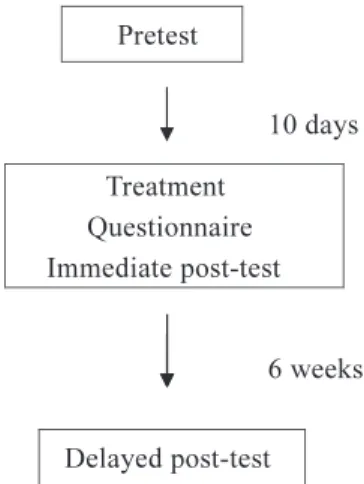
3.1 Research DesignAccuracy of past perfect tense use was measured over about three months by means of a pre-test, and immediate and delayed post-tests. Three groups of 10th graders in a Japanese high school participated in this research: two experimental groups and one control group. The FonF group engaged in a communicative activity through problem-solving in groups of three. The FonFS group received explicit grammar explanation, wrote five short sentences with the past perfect tense following the directions, and worked at exercises filling brackets with that applicable tense. The control group received a normal lesson using the grammar-translation method.
Ten days before the target lesson, the pretest was administered to all the participants to measure their grammatical knowledge of the past perfect tense. This test included five picture-description questions and forty grammar questions including such grammatical items as gerunds, infinitives, present/past particles, relative pronouns, and the past perfect tense. These items are frequently used in English textbooks and understanding these elements is necessary to the composition of English sentences. In addition, for non-native students, it is difficult for them to understand the differences between a gerund and a present particle, or between a gerund and an infinitive. What is most important is that the Japanese language does not have forms that correspond to the English relative pronoun and past perfect tense. Among these items, the past perfect tense is the target form in this research.
The participants were required to complete the questions in twenty minutes. About ten days later, the FonF and FonFS groups received the
target lesson. Three days after the lesson, the immediate post-test was administered, with a following questionnaire to obtain student impressions. Lastly, six weeks later, the delayed post-test was administered. The control group did not receive the target lesson but completed the three tests under the same timeline.
3.2 Participants
The participants were EFL students in the general course at a senior high school in Japan. All of them took the Computerized Assessment System for English Communication (CASEC) administered by The Japan Institute for Educational Measurement, Inc. to measure their initial level of proficiency. The experimental groups were divided into two sub-groups – FonF (n = 69) and FonFS (n= 66) – based on their CASEC scores. On the whole, the average score of both groups was statistically equal. The average scores of these experimental groups were 377 in the FonF group and 376 in the FonFS group, for which the
squared test showed no statistically significant difference. An additional control group (Control, n= 23) was formed to compare the effectiveness of the FonF and the FonFS methods of instruction.
3.3 Procedure
After reading the lesson with the past perfect tense, the FonF group carried out a communicative discussion activity in groups of three. Each member of each group received a card with only one part of a situational role-play. Each card showed a common problem written with the target feature - the past perfect tense - written in red. The role of each member was individually written on the card. The members were expected to negotiate to solve the common problem according to the instructions/solutions on the card. They were given 50 minutes to complete the activity (explicit FonF; see Appendix1).
The FonFS group received an explicit explanation of the grammar point, the past perfect tense, completed the situational composition exercises, and filled the brackets with the target feature (explicit FonFS; see Appendix 2). This activity also took 50 minutes. The control group received a regular English lesson using the grammar-translation method. 3.4. Instruments
The instruments consisted of two types of tasks: production and grammar. Each of the five parts of the production (writing) test required the participants to describe a picture. The participants were given ten minutes to write five sentences that included the target feature (see Appendix 3). Another ten minutes were provided to distinguish between forty sentences written using five items, including the target feature. It was a grammaticality judgment test (see Appendix 4). The
maximum attainable mark in all three tests was 65 points (25 points in production and 40 points in grammar). Strictly speaking, the grammar task contained five grammatical items, so each item had 8 questions (5 items × 8 questions). Only the past perfect tense item questions should be registered, therefore, the grammar questions measured in each test totaled 8 points (25 points in production and 8 points in grammar). All of the questions used in the three tests were different. Students in higher grades took the tests before they were administered to the Grade 10 students in order to verify the equality in the degree of difficulty. The three tests were adjusted for the difficulty. Table 1 summarizes the tests.
4. Results
4.1 Production testsTable 2 shows the results of the production test for all three groups. Figure 2 indicated a visual representation of the mean percentages for the three testing periods for the FonF, FonFS, and control groups. The percentage of questions answered correctly in the production pretest was 35% in the FonF group, 38% in the FonFS and 27% in the control group. At that time, none of the students had yet learned the target feature, so their mean scores showed low levels.
In the immediate post-test, all of the three groups showed great
Test Format Points Time
Production 5 Points × 5 Questions 10 Minutes
Grammar 1 Point × 8 Questions
(of 40 Questions) 10 Minutes
improvement, 61% in the FonF group, 56% in the FonFS group and 42% in the control group. Specifically, the improvement of the FonF group was remarkably high. Six weeks later, the delayed post-test was conducted to examine their acquisition of the target form. The percentage of correct answers to the production questions was 58% in the FonF group, 46% in the FonFS group and 41% in the control group. There had been a sharp rise in the FonF group in the percentage of correct answers in the immediate post-test, and after six weeks it remained at almost the same level. However, the FonFS group fell to 46%. This shows that while the FonFS group gained a short-term increase in knowledge, it did not last for very long. In the control group, student knowledge increased after the lesson, and was at approximately the same level by the time of the delayed post-test. (see Table 2 and Figure 2 ).
Figure 2. Percentage of correct answers in the pretest, immediate post-test, and delayed post-test in the partial translation as the production sections
Table 2. Percentage of correct answers in production tests
Percentage Delayed Immediate Tests 80 70 60 50 40 30 20 10 0 Pre CG FonFS FonF
4.2 Grammar tests
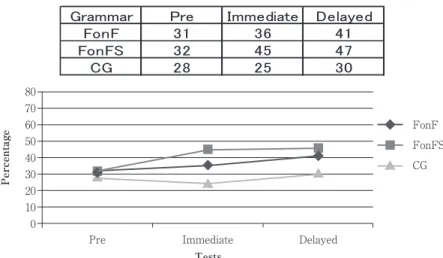
The grammar tests produced different results. In the pretest, as seen in the production tests, the mean percentages of the three groups were low because they hadn’t yet learned the target form. The FonF and FonFS groups scored almost equally, with 31% and 32% respectively, and the control group scored 28%. In the immediate post-test, the score of the FonF group increased from 31% to 36% and the score of the FonFS group increased rather drastically from 32% to 45%. However, the control group decreased from 28% to 25%. Even after instruction, there was no improvement in their grammar score. In the delayed post-test administered six weeks later, the score of the FonF group further increased to 41%. The results of the FonFS group also increased to 47%, but that increase was not as large as that of the FonF group. The score of the control group increased from 25% to 30%, closer to the pretest numbers. (see Table 3 and Figure 3 ).
Figure 3. Percentage of correct answers in the pretest, immediate post-test, and delayed post-test grammar sections
Table 3. Percentage of correct answers in the grammar tests
Percentage Delayed Immediate Tests 80 70 60 50 40 30 20 10 0 Pre CG FonFS FonF
4.3 Recognition of form in communicative contexts
Both FonF and FonFS groups filled out a questionnaire after the target lesson to be used in meta-analysis in order to summarize the findings from the experimental investigation. The question of whether or not they had noticed the target form in the lesson was asked. In spite of there having been no explicit explanation, 33.3% of the FonF group recognized the past perfect tense as the target form. The FonFS group had previously received an explicit explanation of the target form, therefore 81.8% of them recognized the form. Furthermore, one noticeable result from the FonF group was that 29% of them had no response. The learners had had a preconceived idea that grammatical lessons wouldn’t appear in communicative contexts (see Figure 4 ).
When they were asked whether they could use the form they had learned, 78% of the FonF group and 82% of the FonFS answered in the affirmative. Although their form of instruction had been quite different, they had almost the same rate of responses (see Figure 5 ).
Table 4. Descriptive statistics from the production and grammar tests for the FonF and FonFS groups
5. Discussion
The experimental results using the past perfect tense showed the stable and long-term effectiveness in the FonF method. The FonF group understood the usage of the past perfect tense more correctly than the FonFS group because they were able to understand the temporal relationship that governs its use. Some made a few mistakes with the past particle and others were not able to describe the past standard time. The FonFS group used the connection between the present perfect tense and the past, or ended up producing sentences which should have been written in the past tense. In addition, some of the descriptions
Figure 5. Percentage of learners in FonF and FonFS who responded that they could use the target form
82% 12% 22%
Figure 4. Recognizing form in FonF and FonFS target lessons
10.1% 10.1%
81.8% 9.1%
appeared unnatural in English. The control group did not recognize the temporal relationship that governs the past perfect tense, and the students were clearly confused about the passage of time. These results show that form should be acquired in accordance with meaning and function in a communicative context rather than by using independent sentences. Both FonF and FonFS contribute to the development of form of learners, but the FonF approach pushes learners to perceive the correct tense in context, while the FonFS approach is detached from context and learners seem to have a difficulty recognizing the passage of time (see Table 5).
Groups Examples of Grammatical mistakes
FonF
I had written a picture for a long time. → painted, /until last year etc.
It was rainy when I had walked to school. → had been / walked The picture had been there before I had come. → came
The panda had eaten lunch since ten minutes ago. → ten minutes before
FonFS
I had seen the picture since I was five. → have seen I had painted a picture two years ago. → painted They had sung a song until they have had money. → had I had just come home when it rains. → rained
It had been raining since last night. → has been raining.
Control
The man has open the umbrella since it began to rain. → had opened/ when
The panda had eatten when I come here. → eaten/ came
He had painted the picture when we come here yesterday. → came The musicians had sang before two hours. → had sung/two hours before
Note: The underlined parts are grammatical and lexical mistakes Table 5. Grammatical mistakes among the FonF, FonFS, and control groups in the production test of the immediate post-test
Larsen-Freeman and VanPatten state the importance in accordance with form, meaning and use.
Larsen-Freeman (1991) claims that:
We claim that linguistic accuracy is as much a part of communicative competence as being able to get one’s meaning across or to communicate in a sociolinguistically appropriate manner. Thus, a more satisfactory characterization of teaching grammar, harmonious with the above assumptions, is that teaching grammar means enabling language students to use linguistic forms accurately, meaningfully and appropriately (p. 280).
VanPatten (2004) also states:
To process a form means to connect that form with its meaning and/or its function. The position taken here is that because of the constraints on working memory, these connections may not happen (or may happen only under certain conditions). The learner may very well perceive the form and
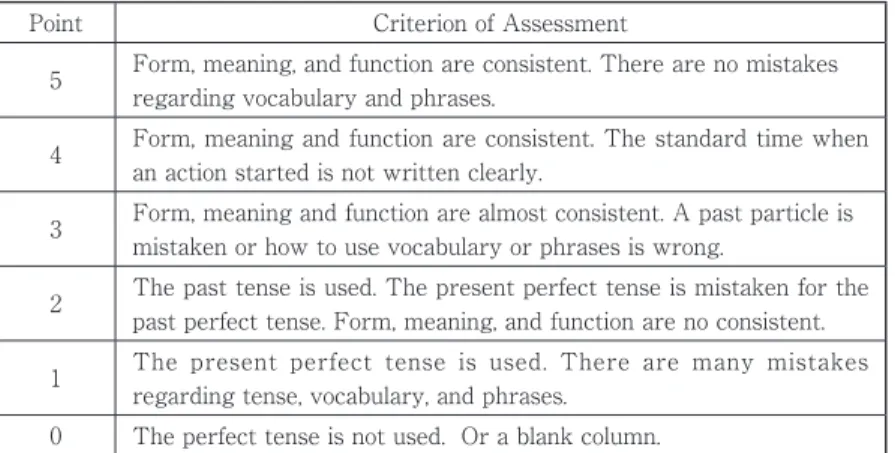
Point Criterion of Assessment
5 Form, meaning, and function are consistent. There are no mistakes
regarding vocabulary and phrases.
4 Form, meaning and function are consistent. The standard time when
an action started is not written clearly.
3 Form, meaning and function are almost consistent. A past particle ismistaken or how to use vocabulary or phrases is wrong.
2 The past tense is used. The present perfect tense is mistaken for the past perfect tense. Form, meaning, and function are no consistent.
1 The present perfect tense is used. There are many mistakes
regarding tense, vocabulary, and phrases.
0 The perfect tense is not used. Or a blank column.
notice it, but because no connection to meaning or function is made, the form is dropped from further processing (p. 9). In the questionnaire, the students were asked what they had learned during the lesson in addition to the target form. Sixty-seven percent (67%) of the FonF group stated that they had learned words and phrases in context, and 32% chose usage of form. On the otherhand, 36% of the FonFS chose “words and phrases”, while 38% chose only a grammatical form, and 38% chose how to use the form. (It was possible to select more than one answer. see Figure 6 ).
The student responses indicate that FonF also improves secondary learning of vocabulary in addition to the target form. Williams (1999) states that during communicative activities, learners need vocabulary to understand their interlocutors and continue interaction. Therefore, they are obliged to focus on vocabulary rather than form earlier in the communicative context. William states:
The strongest and clearest of all the results of this study demonstrates that learners focus, above all things, on words. Although focus on form as a pedagogical technique is more typically associated with increased accuracy in the use of grammatical features, research on input and negotiation in the classroom has long pointed to the strong tendency for learners to concentrate on lexical meaning rather than morphosyntactic features (p. 617).
6. Conclusion
On the whole, FonF motivates learners to acquire the target form more naturally than FonFS. FonF retains sustainability of the target form in the long term, while FonFS has a good impact on short-term retention of the target form. FonF also clarifies the secondary importance of promoting vocabulary acquisition and natural processing in context. In this research, FonF was found to be superior to FonFS in terms of the sustainability and accuracy of learning form. Furthermore, according to the results of the grammar test, FonF was proven to facilitate a gradually increased awareness of form even after the target lesson. Therefore, in conclusion, in terms of effective acquisition of the form of the past perfect tense FonF has a demonstrable advantage over FonFS.
This research suggests that English teachers should organize a Figure 6. Individual learning of items other than the target form.
Percentage of individual learning
teaching process which incorporates FonF into their classes. Students found increased motivation when learning through FonF, and as a result they were able to better learn form when engaging in communication activities. Another reason is that FonF greatly contributes to the accurate acquisition of form, and its effects were retained in the long term. FonF also promoted the learning of vocabulary to which students were exposed in the communicative context. Lastly, FonF promoted the natural acquisition of form because learners are exposed to many linguistic resources. They can acquire linguistic forms without L1 intervention. In other words, they notice the gaps between their target language and the interlanguage through negotiation with interlocutors. Therefore, FonF is worth introducing into class work under the current curriculum to help students acquire linguistic forms accurately, meaningfully and appropriately.
References
Celce-Murcia, M., & Larsen-Freeman, D. (1999). The grammar book: An ESL/EFL teacher’s course. (2nd. ed.), Boston, MA: Heinle & Heinle.
Krashen, S. (1982). Principles and practice in second language acquisition. Oxford, UK: Pergamon.
Krashen, S. D. (1985). The input hypothesis: Issues and implications. London, UK: Longman.
Larsen-Freeman, D. (1991). Teaching grammar. In M. Celce-Murcia (Ed.), Teaching English grammar as a second or foreign language (2nd ed., pp. 279-296). New York, NY: Newbury House /Harper Collins.
Larsen-Freeman, D. (1992). A nonhierarchical relationship between grammar and communication: Part Ⅰ : Theoretical and methodological considerations. In J. E. Alatis, (Ed.), Georgetown University Round Table on Languages and Linguistics, 158-165. Washington, D.C.: Georgetown University Press.
Long, M. (1983). Native speaker/non-native speaker conversation and the negotiation of comprehensible input. Applied Linguistics 4, 126-141.
Long, M. (1991). Focus on form: A design feature in language teaching methodology. In K. de Bot, C. Kramsch, & R. Ginsberb (Eds.), Foreign language research in cross-cultural perspective (pp. 39-52). Amsterdam: John Benjamins.
Norris, J. M., & Ortega, L. (2000). Effectiveness of L2 instruction: A research synthesis and quantitative meta-analysis. Language Learning, 50 (3), 417-528. Norris, J. M., & Ortega, L. (2001). Does type of instruction make a difference?
Substantive findings from a meta-analytic review. In R. Ellis (Ed.), Form-focused instruction and second language learning (pp. 157-213). Malden, MA: Blackwell Publisher.
Schmidt, R. (1995). Consciousness and foreign language learning: A tutorial on the role of attention and awareness in learning. In R. Schmidt (Ed.), Attention & awareness in foreign language learning (pp. 1-64). Hawaii: University Hawaii at Manoa.
Swain, M. (1985). Communicative competence: Some roles of comprehensible input and comprehensible output in its development. In S. Gass and C. Madden (Eds.), Input in second language acquisition (pp. 235-253). Rowley, MA: Newbury House. Swain, M. (1998). Focus on form through conscious reflection. In C. Doughty & J.
Williams (Eds.), Focus-on-form in classroom second language acquisition (pp. 64-81). Oxford, UK: Oxford University Press.
Swain, M. (2000). The output hypothesis and beyond: Mediating acquisition through collaborative dialogue. In J. P. Lantolf (Ed.), Sociocultural theory and second language learning (pp. 97-114). Oxford, UK: Oxford University Press.
VanPatten, B. (2004). Input processing in second language acquisition. In B. VanPatten (Ed.), Processing instruction: Theory, research, and commentary (pp. 5-31). Chicago, IL: University of Illinois.
Williams, J. (1999). Learner-generated attention to form. Language learning, 49 (4), 583-625.
Appendices
Appendix 1. A part of the task of Focus-on-Form (the past perfect tense)
Communication Task Situation
Tom
It was Mother’s 45th birthday. Kate secretly baked a birthday
cake for her mother after her mother had gone out. Kate put it into the fridge until the party began. Her two brothers, Tom and Huck
had gone out on that day as well. Tom had been in the library
to study for his university exams. Huck had gone fishing in the river with his friends. Kate planned a surprise party in the
evening. She was going to make a delicious dinner to celebrate her mother’s birthday.
You went to the library to study math and science because the entrance exams were coming nearer and nearer. You had stayed in the library until noon and you had had a light meal in the café before you came home. As soon as you came home, you took a nap on the sofa because you had been so tired after such a hard work. At 2 o’clock you woke up to find Huck watching TV next to you. When you asked him when he had come home and
if he had already eaten lunch, Huck said he wasn’t hungry. You felt strange because he had always
Huck
Kate
You went fishing in the river with your friends at nine o’clock. You couldn’t catch any fish by noon. You were disappointed and felt very tired when you went home at 12:30. You told your friends to come to your house to rest. As soon as you opened the fridge, you found a delicious cake. You also found Tom sleeping on the sofa. But you served it to your friends and all of you had eaten it up soon. At 2 o’clock, Tom woke up and asked you if you were hungry after your friends had come home. As you had already been full of cake, you told him you weren’t hungry.
You and Tom had watched TV and talked about their events until Kate came home.
In the afternoon you went shopping to buy some vegetables for dinner. When you came home at three o’clock, Tom and Huck had already got home and were watching TV together. You opened the fridge and were surprised to find the cake was not there. You asked your two brothers where the cake was. Both of them said to you,“We don’t know about it.” You were sure someone had eaten the cake during your absence. You were very worried about the birthday party for your mother. What can you do before the party begins? 1. make the boy who had eaten the cake buy another cake at the bakery.
2. make the boy who had eaten the cake help prepare a delicious dinner.
3. make them buy an expensive present for their mother instead because someone had eaten the birthday cake.
Appendix 2. A part of the Task of Focus-on-FormS (past perfect tense) Grammar Task ①現在完了:現在を基準にして、過去に生じた出来事と結び付けて述べる。 ②過去完了:過去のある一時点を基準にして、さらに以前のことを結びつ けて述べる。 have ( has ) + 過去分詞 現在までずっと〜している。
(継続)We have known each other for 5 years. 現在まで〜をしたことがある。
(経験)I have climbed Mt. Fuji several times. 〜したところだ、〜してしまったので ( 今は )…. だ。 (完了・結果)He has already had lunch.
had + 過去分詞 過去の一時点までずっと〜だった。
(継続)We had waited 2 hours before he turned up. 過去の一時点までに〜をしたことがあった。
(経験)He had never seen a musical until he visited New York. 過去の一時点に〜してしまっていた。〜したところだった。 (完了・結果)I had read only a few pages before I fell asleep. 過去の2つの出来事の前後関係を表わす。
I. Make a sentence with the past perfect tense and put it into Japanese. 1. She began to live in Yokohama 4 years ago. She graduated from
college in March.
2. He went to Australia this summer. He had no chance to see a koala before.
3. It began to snow. I just arrived home then.
4. She left a key on the table. He found the key on the table.
II. Change the verbs in the brackets into appropriate forms and put each sentence into Japanese.
1. The girls (never sleep) in a tent before then. 2. When Tom arrived home, Bill ( eat ) all the cake. 3. We lost the game as we ( not have ) enough practice. 4. The train ( leave ) by the time we reached the station. 5. He ( is ) ill for a week before he was sent to the hospital. Appendix 3. Examples of picture descriptive questions
Pretest
Ⅰ Write five sentences with the past perfect tense to describe five pictures below.
(5p × 5) A B
(The rest is omitted.)
Appendix 4. Examples of grammar tests
Pretest
Ⅱ When the underlined part is correct, write T in the answer column. When it is wrong, write a correct form in the answer column.
(1p × 40) 1. Harry overcame some difficulties before he became an excellent
magician.
2. That’s the boy who father is an astronaut. 3. She felt her heart beating wildly.
4. He went on a business trip when his wife came back home. 5. This is the bank in which he works.
(The rest is omitted.)