Characterization of Rice yellow mottle virus
in north-eastern Tanzania
By
Ayaka Uke*
†, Naswiru Tibanyendela**, Keiko T. Natsuaki*,
Nobuhito Sekiya*** and Nobuaki Oizumi****
(Received February 19, 2015/Accepted July 24, 2015)Summary:Rice (Oryza sativa L.) is an important cereal-grain in some African countries and known to be
attacked by Rice yellow mottle virus (RYMV). Rice plants with virus like symptoms were collected from lower Moshi and other areas in the north-eastern region of Tanzania. RYMV was detected by DAS-ELISA, RT-PCR and/or electron microscopy from almost all collected samples. Some RYMV isolates were sequenced and identified as strain S4. Also, three of them, Tz-12-20, Tz-12-22 and Tz-10-36, were clustered as a new group named S4-mk (Mt. Kilimanjaro). Cluster of S4-mk formed a monophyletic group of isolates in strain S4-lv reported from the Tanzanian side of the Lake Victoria. However, S4-mk and S4-lv lineages are separated from each other and S4-mk has the characteristic three amino acid substitutions. The isolates of S4-mk were also closely related to that of strain S4-mg. Amino acid sequences of the coat protein of the isolates in group S4-mk showed over 96% identity with those in other strain S4 varieties, S4-lv, S4-mg and S4-lm. The phylogenetic tree also indicated the possibility of strain S4-mk to have dispersed from south-western Kenya to north eastern Tanzania. As for the serotyping, followed by Fargette et al. (2002), these three isolates in S4-mk were classified into serotype 4.
Key words:Phylogenetic analysis, Rice, Rice yellow mottle virus (RYMV), Serotype, Tanzania
Introduction
Rice (Oryza sativa L.) is an important cereal crop and staple food at least in 17 countries in the Asia-Pacific Region and 8 countries in Africa, supplying about 20% of total calorie intake in developing countries1). The crop is
estimated to feed about 3.5 billion people maintaining their livelihood by rice farming and allied businesses2).
Rice blast caused by Pyricularia oryzae and rice yellow mottle disease (RYMD) caused by Rice yellow mottle virus (RYMV) are the most devastating diseases in sub Saharan Africa, presently3, 4). RYMV, in particular, poses
a serious threat due to its serious damage and rapid spread. RYMV is transmitted by insect vectors such as Chaetocnema and Chrysispa spp, via virus contaminated soil and water, and by contact with RYMV-infected rice plants5). Rice plants infected with RYMV suffer mottling,
yellowing and stunted growth and possible total yield loss depending on the cultivar, age of plant at the time of infection and rice growing ecosystems : paddy or upland6).
In Tanzania, RYMV was first reported in 19827). Since
then, surveys have been carried out throughout the country to explore distribution and characteristics of the virus8, 9). Upon these surveys, Tanzanian RYMV-isolates
were serologically characterized into two serotype (Ser)s : Ser 4 and Ser 5 by monoclonal antibodies. Later, the isolates were molecularly classified into three strains named S4, S5 and S6. The geographical distribution of Tanzanian RYMV serotypes and strains are documented by Kanyeka et al. (2007). Despite all the surveys already conducted, information regarding the prevalence, charac-teristics and epidemiology of RYMV is still needed for successful management of the virus, especially in recently infested areas such as the Lower Moshi irrigation scheme
* ** *** ****
†
Department of International Agricultural Development, Graduate School of Agriculture, Tokyo University of Agriculture Kilimanjaro Agricultural Training Centre, Moshi, Tanzania
Institute for Sustainable Agro-ecosystems Services, Graduate School of Agricultural and Life Sciences, The University of Tokyo Japan International Cooperation Agency
(LMIS), the most advanced and productive lowland rice production area in north-eastern Tanzania and neighboring area.
LMIS was established in 1987 mainly with a Japanese ODA loan. Regrettably, some of the rice production in Lower Moshi is now seriously threatened due to the emergence of a new disease that typically shows yellow-ing and stuntyellow-ing symptoms. Our preliminary study, Mgonja et al. (2010) identified the pathogen of this disease in this area as RYMV by RT-PCR.
In this study, further identification, serotyping and molecular characterization of RYMV in LMIS and other rice production areas of the north-east in Tanzania were conducted.
Materials and methods
Disease survey and sample collection
Three areas in LMIS (Upper Mabogini, Kikwateni and Rau Kati), four nearby areas (Mandaka, Kaloleni, Majani Mapana) and Kilimanjaro Agricultural Training Center in Lower Moshi were surveyed in 2010 and Lower Moshi and other five rice-production area (Musa Mwijanga, Ndungu, Mombo, Mhande and Leki Tatu) were surveyed in 2012. All of these areas surveyed in this study are located in north-eastern Tanzania. The areas represent irrigated-lowland ecology, which is more prone to RYMV infections compared to other ecosystems11). By the
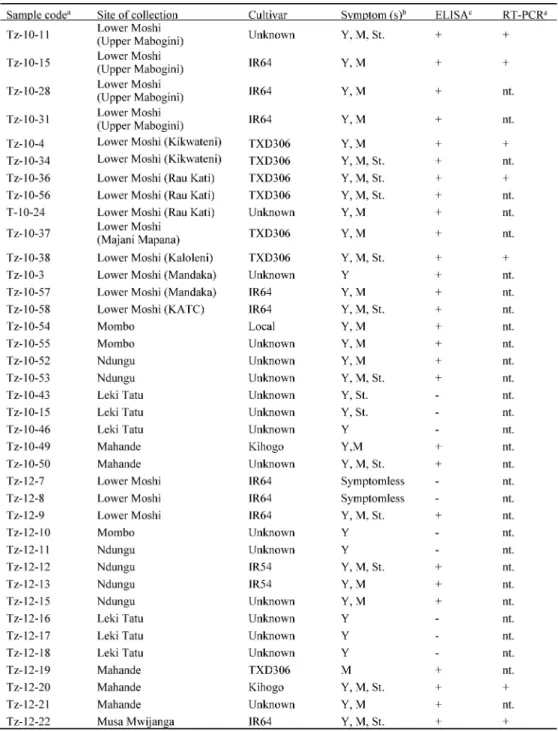
surveys guided by local rice producers, farmers and/or researchers, a total of 87 samples, mostly with RYMD symptoms, were collected and saved as dried or frozen leaves. Among them, 38 samples were further tested (Table 1).
Serological detection by ELISA using polyclonal antibody
Based on field observations and the preliminary results of inoculation experiment, Rice yellow mottle virus (RYMV) was suspected as the causal pathogen. Accord-ingly, DAS-ELISA was carried out on collected samples with antisera against RYMV in ELISA kit from NEOGEN Europe Ltd., Scotland, UK, following the company’s protocol. Test wells were observed for color changes at 60 and 120 minutes of incubation and absorbance at 405 nm was measured. Samples with absorbance value at least two times greater than that of corresponding negative control (healthy rice leaf) were considered positive.
Molecular detection and sequencing
RT-PCR was carried out on some selected samples for further confirmation of RYMV infection. Total RNA was extracted from fresh or frozen leaf samples using TRIzolⓇ
Reagent (Invitrogen, NY, USA). First-strand cDNA was
synthesized using ReverTra Ace-α-Ⓡ kit (TOYOBO,
Osaka, Japan) and specific reverse primer. After the reaction, the first-strand cDNA was amplified by PCR using TaKaRa ExTM kit (TaKaRa, Otsu, Japan) according
to the protocol. Primers : 3PRYF (A3) 5’-CAAGATGGC- CAGGAA-3’ and 3PRYR (B3) 5’-GTGGGTGCCATTCCCC- ACATGG-3’ that amplify the CP gene (720 bp) and 3’ untranslated region (3’UTR) of RYMV12) were used.
Although the 3PRYF primer is a CP forward primer, the 3PRYF primer’s sequence overlapped with RYMV coat protein (CP) gene, thus a new primer, A’3, 5’-GTTGTGG- TCAGACCTCGCG-3’, was designed. Amplification was performed under initial denaturation at 94℃ for 5 min, followed by 30 cycles of 94℃ for 1 min, 55℃ for 1 min and 72℃ for 1.5 min and then a final extension at 72℃ for 10 min. Some of the PCR products were purified and cloned into the plasmid. Recombinant plasmids were transformed into competent Escherichia coli strain DH5α cells (Invitrogen, NY, USA), and five clones of each of the isolates were sequenced.
Phylogenetic analysis
Nucleotides (720 bp) and their amino acid sequences of CP of 33 RYMV isolates presented in Table 2 were retrieved from the NCBI-GenBank.
Trees were constructed by Neighbor joining method. Confidence in clades from the resulting topology was tested by analyzing 1,000 bootstrap replications.
Serotype
RYMV amino acid sequences of 14 isolates representa-tive of the five serotypes were retrieved from GenBank provided by the NCBI. These sequences are the ones described by Fargette et al. (2002). Then, sequences were aligned together with three Tanzanian isolates in this study using Clustal W. Lastly, alignments were double checked by BioEdit software.
Electron microscopy
Transmission electron microscope (Hitachi E-102 TEM, Japan) was used to examine a leaf sample (Tz-10-36) for morphology of the pathogen by phosphate-tungstic acid (PTA) staining.
Results
Field observations
RYMD symptoms were observed in almost all sur-veyed areas in this study (Table 1), although the severity varied considerably among the schemes/fields in surveys in 2010 and 2012. In the second survey in 2012, the inci-dences of RYMD appeared to have intensified in Upper Mobogini and Duma areas of Lower Moshi and Mahande
irrigation schemes, compared to the situation in the first survey in 2010. On the other hand, Mombo appeared to have recovered from serious RYMD because no RYMD symptoms were observed during the second survey, although this area was found to be infested in the first survey (Table 1). Moreover the popular varieties in Lower Moshi, IR64 and TXD306, showed severe RYMD symptoms (data not shown).
Detection
By ELISA, RYMV was detected in 28 out of 38 tested
samples, confirming the virus incidence in five surveyd area excluding Leki Tatu. In addition, DNA of selected samples from Lower Moshi, including 10-15 and Tz-10-36 from Upper Mabogini and Rau Kati respectively, was amplified with the expected size of 1,400 bp by RT-PCR confirming the presence of CP gene and 3’UTR of RYMV genome in the samples. Electron microscopic observation of infected leaf-sap of a sample (Tz-10-36) revealed abundant spherical particles with a diameter of about 28 nm (data not shown).
Molecular analysis and topology
The PCR products of three isolates, Tz-12-20 from Mahande, Tz-12-22 from Musa Mwijanga and Tz-10-36 from Lower Moshi, which was collected 2 years earlier than above mentioned 2 isolates, were cloned and sequenced. Based on the molecular characterization of RYMV following Pinel et al. (2009), these three isolates were identified as strain S4 (Fig. 1). They appeared to belong to a monophyletic group of isolates different from isolates in S4-lv14) collected in the Lake Victoria area of
the Tanzanian side and named as S4-mk because they are from areas at the foot of Mt. Kilimanjaro. The isolates of mk were also closely related to those of S4-mg (Fig. 1). More precisely, three isolates representing
S4-mk, Tz-12-20, Tz-12-22 and Tz-10-36, have characteristic difference from S4-lv and another variant of the strain S4 : S4-mk with substitutions of I107→V, S161→N, and T164→L
(Fig. 2).
Molecular variability was assessed with amino acid se-quences since they are more conserved and hence highly informative about gene evolution than nucleotides15).
Accordingly, divergence between the isolates of S4-mk and other strain S4 groups : S4-lv, S4-mg (Madagascar) and S4-lm (Lake Malawi) were computed. The nucleotide sequences of the three isolates in S4-mk from Tanzania in this study showed high homology (99.1%~99.5%) (data not shown). Also, homology between the three isolates from Tanzania in this study and 37 isolates in strain S4
Fig. 1 Neighbor-joining (NJ) tree depicting the relationships of RYMV isolates collected from
Tanzania with 33 isolates reported in Africa constructed from the amino acid sequences of coat protein gene. S4-lv : S4 Lake Victoria, S4-mk : S4 Mount Kilimanjaro, S4-mg : S4 Madagascar, and S4-lm : S4 Lake Malawi. An isolate Tz18 of strain S5 was used as an out group. The tree shows S4-mk (in this study) the fourth sub-clade of S4 strain.
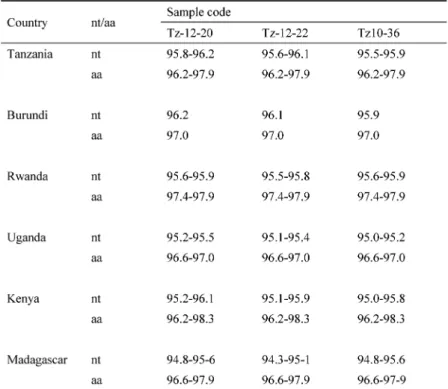
groups (Table 2) from GenBank was analyzed and it was found that Tz-10-36, Tz-12-20 and Tz-12-22 showed over 96% identity to the isolates of RYMV from other strain S4 groups at the amino acid (aa) level (Table 3). Further-more, the divergences among all S4-lv isolates were small (1.7% to 3.8%).
Serotype
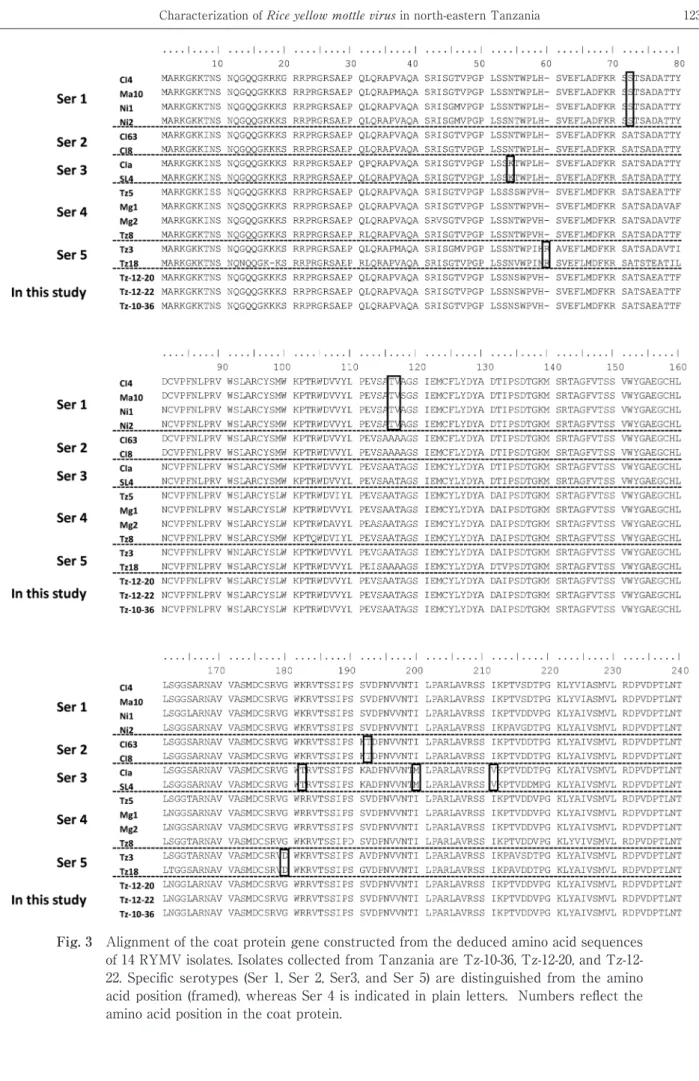
The comparison of amino acid sequences indicated that isolates Tz-10-36, Tz-12-20 and Tz-12-22 from Lower Moshi, Mhande and Musa Mwijanga respectively, belonged to serotype 4 (Ser 4) isolates described by Fargette et al. (2002) (Fig. 3). However, this is the first serotyping of isolates from the north-eastern region of Tanzania not by monoclonal antibodies but by amino acid sequences.
Discussion
The present study has revealed the disease by RYMV as a serious threat to rice production in Lower Moshi, the most advanced and productive lowland in Tanzania. This rice-disease, which has emerged as recently as 2008 by observation of farmers (Oizumi, unpublished data), is now seriously devastating in this area. Preliminary re-sults by one of the co-authors indicated that the disease is mechanically and contact transmissible to rice varieties of IR64 and TXD306, the widely cultivated varieties in Lower Moshi (Oizumi, unpublished data). In this study, the pathogen was confirmed as RYMV by a few different and reliable measures such as ELISA, RT-PCR and elec-tron microscopy firstly in this area.
So far, ELISA is the most reliable serological method for identification of plant viruses, and viral protein can be credibly detected through the assay using specific antibodies. With RYMV-antisera from NEOGEN, this test detected RYMV in almost all the Lower Moshi and north-eastern area samples tested. Likewise, PCR is now the most powerful molecular diagnostic method and RT-PCR tests amplified the DNA products of some RYMV isolates from Lower Moshi and north-eastern area to the expected 1,400 bp indicating that RYMV-genome was present in rice plants. As the conclusion, RYMV was present in Lower Moshi, Ndungu, Mombo, Mahande, and Musa Mwijanga, except Leki Tatu. This strongly sug-gests that RYMV control should be conducted in these promising rice production areas to combat further infec-tion. The abundance of rice-ratoons in Upper Mabogini, Mandaka and Kaloleni, especially during off seasons, may play a significant role in RYMV-epidemics in Lower Moshi. In these areas, paddy fields remain extremely wet during off seasons, mainly because of poor manage-ment of irrigation water. Such watery soil condition supports the growth of ratoons and ratoons may serve as a potential reservoir for RYMV and primary source of infections for the next crop.
Sarra (2005) and Traoré et al. (2006) demonstrated that transplanting RYMV-infected seedlings can considerably amplify the virus infections in the paddy fields. However, it has been a common practice in some parts of Lower Moshi to set up rice seedbed beside the paddy fields. This practice greatly exposes the seedlings to RYMV infections. This may be one of the reasons for serious
Fig. 2 Comparison of the amino acid sequences of S4 groups between S4-mk, plane box, and S4-lv, S4-lm, and S4 mg,
and sudden outbreaks of RYMV in Upper Mabogini, Mandaka, and Kaloleni because farmers have individual nurseries in their plots despite the high incidence of RYMV.
Phylogenetic analysis clarified the identity and prob-able source of RYMV that has emerged in north-eastern Tanzania. Trees constructed from 33 isolates of RYMV reported in Africa grouped Tz-10-36 from Lower Moshi,
Tz-12-20 from Mahande and Tz-12-22 from Musa Mwijanga as S4 with the rest of isolates in strain S4.
More importantly, the isolate of Lower Moshi, Mahande and Musa Mwijanga formed a distinct clade that was clearly separated from a monophyletic group of strain S4-lv. This suggests that the clade may be repre-senting a new distinguishable group of strain S4, which we named S4-mk (S4-Mt. Kilimanjaro). By phylogenetic
tree (Fig. 1) and the year of first RYMV reports, Kenya in 196624) and Tanzania in 19827), suggest that strain
S4-lv has dispersed from south-eastern Kenya to the Lake Victoria region in north-eastern Tanzania, leading to the current epidemics in some irrigated lowlands, including Lower Moshi. At the same time, the strain might have mutated to S4-mk because of changing ecology and this could have happened very recently as RYMV evolves rapidly according to Fargette et al. (2008).
Kenya is the probable source of S4-mk since Kenyan isolates (Ke1, Ke2, and Ke3) were genetically closest to that of S4-mk, among all 33 isolates analyzed, including many from Tanzania (Table 3). In fact, Ke1, Ke2, and Ke3 originate from the southern part of the country8, 18, 19).
The epidemics of RYMD are long known in this area24, 25)
and the area is very close to north-eastern Tanzania where we observed the outbreak of RYMV recently. Apparently, there is no large physical barrier in between, except the rift valley which is about 50-100 Km wide. Strain S4-lv, therefore, could easily move from one side to another by vectors or other ways. Contrary to the above hypothesis, strain S4 might have existed in north-eastern Tanzania for quite a long time. This is because all the natural means of RYMV transmission, especially
insect vectors, cannot move over a long distance26).
More-over, the virus is not seed borne in either cultivated27) or
wild rice species28). RYMV, therefore, is likely to have
been existing even in Lower Moshi for many years, be-fore the recent epidemics, but with extremely low inci-dence. The epidemics have been possibly triggered by the continuous cultivation of susceptible varieties (cvs. IR64 and TXD306) without dry spell gaps or rotation with non RYMV-host. This has now become the com-mon practice in some parts of Lower Moshi. Many experts, including Ochola and Tusiime29, 30), warn that
typical rice cultivation practices can activate devastating epidemics of RYMD. At the same time, field-studies need to be conducted to explore how the virus disperses over a long distance in Tanzania. Molecular epidemio-logical data, including that presented in this study, can be useful in such researches, leading to the successful management of RYMV, include the making of a resistant variety in the country.
Acknowledgment : We thank all members of TANRICE for
their strong support in our survey and Drs Y. Yaguchi and K. Motohashi, Tokyo University of Agriculture, for electron microscopy.
Table 3 Coat protein sequence identities (in percent) between RYMV
isolates collected from Tanzania (this study) and reported from African regions (Tanzania, Burundi, Rwanda, Uganda, Kenya, and Madagascar)
Fig. 3 Alignment of the coat protein gene constructed from the deduced amino acid sequences
of 14 RYMV isolates. Isolates collected from Tanzania are Tz-10-36, 20, and Tz-12-22. Specific serotypes (Ser 1, Ser 2, Ser3, and Ser 5) are distinguished from the amino acid position (framed), whereas Ser 4 is indicated in plain letters. Numbers reflect the amino acid position in the coat protein.
References
1) shigetomi S, kubo K, tsukada, K (2011) The World Food
Crisis and the Strategies of Asian Rice Exporters. Insti-tute of Development Economies, Spot Survey No. 32. 2) FAO (2004) International Year of Rice 2004 Fact Sheet No
3. Rome, Italy.
3) Association for International Cooperation of Agriculture and Forestry (AICAF), Japan (2001) : Rice Diseases and Insect Pests in the tropics. AICAF, pp. 36.
4) hull R, Fargette D (2005) Sobemovirus. In Virus Taxonomy :
Eighth Report of the International Committee on Taxonomy of Viruses Edited by Fauquet C, Mayo M A, Maniloff J, Desselberger U, Ball L A, CA. Elsevier Academic Press, San Diego pp. 885-890.
5) uke A, tibanyendela N, ikeda R, Fujiie A, natsuaki K T
(2014) Modes of transmission and stability of Rice yellow mottle virus. J. Plant Protec. Res. 54 : 363-366.
6) kouassi N K, N’guessan P, albar L, Fauquet C M, brugidou
C (2005) Distribution and characterization of Rice yellow mottle virus : A threat to African farmers. The American Phytopathol. Society. 89 : 124-133.
7) rossel H W, ayotade K A, thottapilly G, adeoti A A,
alluri K, alam M S, zan K (1982) A new record of Rice
yellow mottle virus disease in Badeggi, Nigeria. Int. Rice Comm. Newsl. 31 : 23-24.
8) abubakar Z, ali F, pinel A, Traoré O, N’guessan P,
notteghem J L, kimmins F, konate G, Fargette D (2003)
Phylogeography of Rice yellow mottle virus in Africa. J. Gen. Virol. 84 : 733-743.
9) kanyeka Z L, sangu E, Fargette D, pinel-galzi A, Hérbrard
E (2007) Distribution and diversity of local strains of Rice yellow mottle virus in Tanzania. Afr. Crop Sc. J. 15 : 201-209.
10) mgonja E M, goto A, sekiya N, Fujiie A. natsuaki K T
(2010) Occurrence and possible vectors of Rice yellow mottle virus in Tanzania and Uganda. Jpn. Soc. Trop. Agr. Res. Trop. Agr. 3 : 37-38.
11) sarra S (2005) Novel insights in the transmission of Rice
yellow mottle virus in irrigated rice. PhD thesis, University of Wageningen.
12) pinel A, N’guessan P, bousalem M, Fargette D (2000)
Molecular variability of geographically distinct isolates of Rice yellow mottle virus in Africa. Arch. Virol. 14 : 1621-1638.
13) Fargette D, pinel A, halimi H, brugidou C, Fauquet C,
Van M (2002) Comparison of molecular and immunological
typing of isolates of Rice yellow mottle virus. Arch. Virol.
147 : 583-596.
14) pinel A, mpunami A, sangu E, rakotomalala M, Traoré
O, Sérémé D, sorho F, Séré Y, kanyeka Z, Konaté G,
Fargette D (2009) Recombination, selection and clock-like
evolution of Rice yellow mottle virus. Virol. 394 : 164-172. 15) nei M, kumar S (2000) Molecular evolution and
phyloge-netics. Oxford : Oxford University Press, U. S. A.
16) Traoré O, Traoré M, Fargette D, Konaté G (2006) Rice
seedbed as a source of primary infection by Rice yellow mottle virus. Eur. J. Plant Pathol. 115 : 181-186.
17) ndikumana I, pinel-galzi A, negussie Z, N’chimbi M S, njau
P, kingh R K, choi I R, bigirimana J, Fargette D, Hébrard
E (2012) First report of Rice yellow mottle virus on rice in Burundi. Plant Dis. 96 : 1230.
18) Traoré O, sorho F, pinel A, abubakar Z, banwo O, maley
J, Hébrard E, winter S, Séré Y, Konaté G, Fargette D
(2005) Processes of diversification and dispersion of Rice yellow mottle virus inferred from large-scale and high-resolution phylogeographic studies. Mol. Ecol. 14 : 2097-2110.
19) Fargette D, pinel A, rakotomalala M, sangu E, Traoré
O, Sérémé D, sorho F, issaka S, Hébrard E, Séré Y,
kanyeka Z, Konaté G (2008) Rice yellow mottle virus, an
RNA plant virus, evolves as rapidly as most RNA animal viruses. J. Virol. 82 : 3584-3589.
20) Fargette D, pinel A (2004) Inferring the evolutionary
his-tory of Rice yellow mottle virus from genomic, phyloge-netic, and phylogeographic studies. J. Virol. 78 : 3252-3261. 21) ndikumana I, Gasoré R, issaka I, pinel-galzi A, onasanya
A, hassani-mehraban A, Fargette D, peters D, Sére Y
(2011) Rice yellow mottle virus in rice in Rwanda : first re-port and evidence of strain circulation. New Dis. Rep. 23 : 18.
22) Hébrard E, pinel A, catherinot V, labesse G, brugidou C,
Fargette D (2005) International point mutations of the
capsid modify the serotype of Rice yellow mottle virus. J. Virol. 79 : 4407-4414.
23) pinel A, Fargette D (2006) First report of Rice yellow
mottle virus in Uganda. Plant Dis. 90 : 683.
24) bakker W (1970) Rice yellow mottle, a mechanically
trans-missible virus disease of rice in Kenya. Neth. J. Plant Pathol. 76 : 53-63.
25) bakker W (1974) Characterization and ecological aspects
of Rice yellow mottle virus in Kenya. Agr. Res. Rep. 829 : 1-152.
26) Traoré O, pinel A, sorho F, sarra S, rakotomalala M,
sangu E, kanyeka Z, Séré Y, Konaté G, Fargette D (2009)
A reassessment of the epidemiology of Rice yellow mottle virus following recent advances in field and molecular studies. Virus Res. 14 : 258-267.
27) Konaté G, sarra S, Traoré O (2001) Rice yellow mottle is
seed borne but not seed transmitted in rice seeds. Eur. J. Plant Pathol. 107 : 361-364.
28) allarangaye M, Traoré O, Traoré E, millogo R, Konaté
G (2006) Evidence of non-transmission of Rice yellow mottle virus through seeds of wild host species. J. Plant Pathol. 88 : 309-315.
29) ochola D, tusiime G (2011a) Pathogenicity of Rice yellow
mottle virus and the potential sources of resistance against the disease in Eastern Uganda. Asian J. Plant Pathol. 5 : 1-15.
30) ochola D, tusiime G (2011b) Survey on incidences and
severity of Rice yellow mottle virus disease in Eastern Uganda. Int. J. Plant Pathol. 2 : 15-25.
タンザニア北東部産 Rice yellow mottle virus の解析
鵜家綾香*
†・Naswiru Tibanyendela**・夏秋啓子*・関谷信人***・大泉暢章****
(平成 27 年 2 月 19 日受付/平成 27 年 7 月 24 日受理)
要約:アフリカにおいて重要な穀物のひとつであるイネ(Oryza sativa L.)は,Rice yellow mottle virus に
よる重大な被害を受けており,タンザニアにも広がっている。水稲栽培の最も進んだ地域の一つであるロー ワーモシ灌漑地区を含む北東部で,ウイルス病様病徴の認められる灌漑水田において検体の採集を行った。 採集した試料は,電子顕微鏡を用いたウイルス粒子の観察,DAS-ELISA 法,PCR 法による検出を行ったと ころ,RYMV の感染が確認された。3 つの分離株 Tz-12-20,Tz12-22,Tz10-36 の PCR 産物については,遺 伝子解析を行い系統と血清型の判別を行った。その結果,S4 型(Pinel et al., 2009)分離株であることが示 され,また,系統解析から,ビクトリア湖周辺分離株である S4-lv や S4-lm, S4-mg とは異なる単一のクラ スターを形成し,新しいグループ(S4-mk)であると考えられた。さらに系統樹から,S4-mk 分離株はケニ アの西南地域からタンザニアの北東部において広がっている分離株であることを示した。系統樹において単 一のクラスターを形成した一方,S4-mk 分離株と他の S4 型分離株(S4-lv, S4-lm, S4-mg)間のアミノ酸配 列で,96% 以上の高い相同性を示した。また,アミノ酸配列から血清型の判別が可能(Fargette et al., 2002)であることから,タンザニア産 RYMV でこの手法を用いて血清型を検討したところ,類別可能な 5 種類の血清型のうち,Ser4 に分類された。
キーワード:イネ,系統解析,血清型,タンザニア,Rice yellow mottle virus(RYMV)
* ** *** **** † 東京農業大学大学院農学研究科国際農業開発学専攻 キリマンジャロ農業試験場,タンザニア 東京大学大学院農学生命科学研究科 JICA 国際協力機構