Japan Advanced Institute of Science and Technology
JAIST Repository
https://dspace.jaist.ac.jp/
Title
Electronic structure and magnetic properties of
small manganese oxide clusters
Author(s)
Joon Han, Myung; Ozaki, Hirokazu; Yu, Jaejun
Citation
Journal of Chemical Physics, 123(3):
034306-1-034306-5
Issue Date
2005-07-28
Type
Journal Article
Text version
publisher
URL
http://hdl.handle.net/10119/4547
Rights
Copyright 2005 American Institute of Physics.
This article may be downloaded for personal use
only. Any other use requires prior permission of
the author and the American Institute of Physics.
The following article appeared in M. J. Han, T.
Ozaki, and J. Yu, Journal of Chemical Physics,
123(3), 034306 (2005) and may be found at
http://link.aip.org/link/?JCPSA6/123/034306/1
Description
Electronic structure and magnetic properties of small manganese
oxide clusters
Myung Joon Han
School of Physics, Center for Strongly Correlated Materials Research, Seoul National University, Seoul 151-747, Korea
Taisuke Ozaki
Research Institute for Computational Sciences (RICS), National Institute of Advanced Industrial Science and Technology (AIST), 1-1-1 Umezono, Tsukuba, Ibaraki 305-8568, Japan
Jaejun Yua兲
School of Physics, Center for Strongly Correlated Materials Research, Seoul National University, Seoul 151-747, Korea
共Received 28 April 2005; accepted 23 May 2005; published online 28 July 2005兲
To investigate the electronic structure and magnetic properties of manganese oxide clusters, we carried out first-principles electronic structure calculations for small MnO clusters. Among various structural and magnetic configurations of the clusters, the bulklike关111兴-antiferromagnetic ordering is found to be favored energetically, while the surface atoms of the clusters exhibit interesting electronic and magnetic characteristics which are different from their bulk ones. The distinct features of the surface atoms are mainly attributed to the reduction of Mn coordination numbers and the bond-length contractions in the clusters, which may serve as a key factor for the understanding of physical and chemical properties of magnetic oxide nanoparticles. © 2005 American Institute of
Physics.关DOI: 10.1063/1.1953387兴
I. INTRODUCTION
Recently physical and chemical properties of nanometer-sized particles have attracted a lot of attention due to their scientific and technological importance. The nanometer-sized materials often exhibit intriguing electrical, magnetic, opti-cal, and chemical properties.1–3The magnetic nanoparticle is one of such subjects under intense investigations due to its potential application to ultrahigh-density storage devices4 and catalysis.5 There has been a great progress in the syn-thetic methodology and technique of magnetic oxide nano-particles so that the size control, shape control, and mass production of transition-metal-oxide nanoparticles6 can be-come possible.
Transition-metal-oxide clusters are expected to exhibit electronic, magnetic, and structural properties quite different from their “bulk” phase. Due to the presence of d electrons, the metal-oxide clusters often show unusual magnetic behav-iors. Several experiments have reported a ferromagnetic be-havior of nanosized MnO clusters contrary to its antiferro-magnetic phase of the bulk MnO,7–9 where the net magnetization was attributed to the spins at the surface of particles.7,8 Moreover a recent measurement of the size-dependent magnetic properties strongly supports the idea of surface spins.9 It was shown that MnO particles with the higher surface-to-volume ratio have the larger magnetic mo-ment, implying that the ferromagnetism in MnO nanopar-ticles may originate from the surface spins.9,10 Recently a density-functional study on 共MnO兲n clusters with n艋9 by
Nayak and Jena11,12 demonstrated that the small stoichio-metric MnO clusters may be ferromagnetic with a sizable magnetic moment per MnO, which seems to be compatible to the observed ferromagnetic behavior of the MnO nanopar-ticles. However, it is still not certain how the experimental observation of the weak ferromagnetic signals is related to the magnetic ordering, that is, the origin of nanoscale ferro-magnetism in the MnO clusters. To obtain a clear picture for the microscopic electronic structure and magnetic properties of MnO nanoparticles, we need to obtain more detailed in-formation on the structure, size, and magnetic configurations of the clusters.
In this paper, to elucidate the relation between the cluster size and the magnetic configuration of MnO clusters, we present the results of our first-principles calculations on the 共MnO兲N clusters 共N=6, 8, 9, 10, 12, and 15兲 with various
spin configurations: ferromagnetic 共FM兲 and 关100兴-, 关010兴-, 关001兴-, and 关111兴-antiferromagnetic 共AFM兲 orders mimick-ing the bulk-phase ordermimick-ings. From the total-energy results, it is found that the 关111兴-antiferromagnetic order, correspond-ing to the ordercorrespond-ing of its bulk phase, still survives even in the small clusters, thereby the magnetic moments of the clusters are diminishing. While the 关111兴 magnetic configuration is most stable energetically, the magnetic moments at the Mn site are found to depend on its coordination number.7–9We present the coordination-number dependence of the local electronic structure at Mn sites, where the contractions of the bond length are significant for the small size clusters and even a dangling-bond-like state appears at the corner Mn site with the threefold coordination.
a兲Author to whom correspondence should be addressed. Electronic mail: [email protected]
II. COMPUTATIONAL METHODS
We performed cluster calculations based on the density-functional theory 共DFT兲 within the local spin-density approximation13共LSDA兲 by employing a linear combination of localized pseudoatomic orbitals共LCPAOs兲 method.14The generalized gradient approximation15 共GGA兲 was also used for the purpose of confirming the results of LSDA. Double valence plus single polarization orbitals were used as a basis set, which are generated by a confinement potential scheme14 with the cutoff radii of 7.0 a.u. for Mn and 5.0 a.u. for O. Troullier-Martins-type pseudopotentials16 with a partial core correction17were used to replace the deep core potential by the norm-conserving soft potentials in a factorized separable form with the multiple projectors proposed by Blochl.18 In the pseudopotential generation, the 3p states of Mn atoms were included as valence states in order to take account of the contribution of the semicore states to the electronic struc-tures. Also the real-space grid techniques19 were used with the energy cutoff up to 100 Ry in numerical integrations and the solution of the Poisson equation using the fast Fourier transformation 共FFT兲 technique. All the DFT calculations were performed by using our code,OPENMX, which enables us to specify the initial spin configuration of individual atoms.20
III. RESULTS AND DISCUSSIONS
A. Equilibrium geometry and magnetic configuration
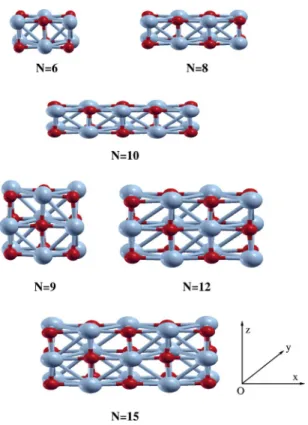
In search of the ground-state magnetic configuration of small MnO clusters, we consider rectilinearly stacked struc-tures of the 共MnO兲N clusters 共N=6, 8, 9, 10, 12, and 15兲,
which resembles a fragment of the bulk MnO. Among the different stackings of 共MnO兲 units, we determine the stable geometry of each共MnO兲Ncluster for a given number N. As
illustrated in Fig. 1, it is found that there are two kinds of stable cluster structures: the “cubane-chain” structure for 共MnO兲N with N = 6, 8, and 10 and the “stacked
cubane-chain” structure for共MnO兲Nwith N = 9, 12, and 15. The Mn
atoms in the former-type structures can be at most fourfold coordinated, while the latter can have up to fivefold-coordinated Mn atoms. Among the clusters which can form both the single cubane-chain and the stacked cubane-chain structures, we calculate the total energies of the two different stacked structures of 共MnO兲12 clusters, for an example, and found that the共MnO兲12cluster with the stacked cubane-chain structure is more stable by 0.829 eV in total energy for the same magnetic configuration. To determine the ground-state atomic structure of each cluster, we have carried out the totenergy calculations with full geometry optimization al-lowing the relaxation of all the atoms in the cluster. The geometry was optimized by the steepest descent 共SD兲 method with a variable prefactor for accelerating the conver-gence until the maximum magnitude of the calculated force becomes below 10−3Hartree/ Bohr. In addition, to investi-gate the magnetic properties of the 共MnO兲N clusters, we
probe several different spin configurations, which were im-posed as an initial condition of the self-consistent calculation procedure. Possible spin configurations considered in this work include共i兲 FM and AFM configurations with 共ii兲 关100兴,
共iii兲 关010兴, 共iv兲 关001兴, and 共v兲 关111兴 orders, where 关lmn兴 de-notes the direction of the alternating FM layers with respect to the Cartesian axes of the stacked geometry as shown in Fig. 1. It is noted that the关111兴-AFM ordered state is known to be the ground state of the bulk MnO. The 关100兴, 关010兴, and 关001兴 configurations, although they were equivalent in the cubic MnO bulk phase, become inequivalent in a finite-size cluster.
For each initial spin configuration, we obtained the fully relaxed structure and total energy of the 共MnO兲N cluster.
Overall the structural properties of these clusters are quite different from the bulk ones. First, the equilibrium geom-etries of the clusters are significantly distorted from the bulk cubic structure, i.e., the angles between Mn and O atoms range from 85° to 95°. Second, the Mn–O bond lengths in the cluster 共MnO兲N 共N=8–15兲 range from 1.9 to 2.0 Å,
which corresponds to about 10% contraction compared to the bulk bond length of 2.22 Å. The bond-length contraction found for these small共MnO兲Nclusters seems to be consistent
with previous studies on the structural relaxations of oxide surfaces and clusters.21 The total energy per共MnO兲 unit in Fig. 2 shows a systematic variation as a function of the clus-ter size N, demonstrating that the larger the clusclus-ter size is, the more stable it becomes. For a given N, the total energy per共MnO兲 unit also depends on its magnetic configurations. Among them, the FM state has the highest energy in most cases, implying that the fully FM-polarized clusters can hardly exist. On the other hand, the关111兴-AFM configuration is the most stable among all the clusters studied.
It is noted that our conclusion on the 关111兴-AFM con-figuration for the ground state of 共MnO兲N clusters is
appar-FIG. 1. 共Color online兲 Structures of 共MnO兲N clusters calculated in this
work. The dark共red兲 spheres represent Mn atoms and the bright 共blue兲 ones O. The structure plots were generated by using the XCRYSDEN package 共Ref. 24兲.
ently in contradiction to the prediction of the FM states for the small共MnO兲Ncluster共N⬍8兲 by Nayak and Jena in Refs.
11 and 12. Except for the different predictions on the mag-netic ground state, however, most of the results on the bond lengths and total energies of the rectilinearly stacked struc-tures of 共MnO兲Nare in good agreement. Since the
discrep-ancy in the magnetic ground state seems to be related to the use of different computational methods and the treatment of spin configurations, one needs to pursue the issue in future studies.
B. Coordination-number dependence of the local magnetic moment
While the关111兴-AFM ordered configuration is stable en-ergetically, the magnetic moment at each Mn site varies sig-nificantly from site to site. Taking the N = 12 cluster as an example, there are three distinct Mn sites with different co-ordination numbers, i.e., n = 3 – 5. Depending on the coordi-nation number n, the magnitudes of the magnetic moment at Mn changes significantly. Figures 3共a兲–3共c兲 show the ball-and-stick illustrations of the Mn–O bond lengths around the Mn atoms in the关111兴-AFM 共MnO兲12cluster for the
coordi-nation numbers, n = 3 – 5, respectively, while Fig. 3共d兲 shows the Mn atom in a bulk environment where the bond length between Mn and O is 2.22 Å. Our calculation result for the bulk case of Fig. 3共d兲 is in good agreement with the previous result in its bond length, i.e., d = 2.25 Å 共Refs. 11 and 12兲 as well as its magnetic moment.22 In oxides, since the metal-ion-oxygen bonds have a mixed character of ionic and cova-lent bonding, the nature of structural relaxations around the atoms with low coordination numbers is rather subtle. Indeed it is suggested that the total energy of the metal-ion-oxygen bond should have strong contributions from all the compo-nents: short-range repulsion, Madelung potential, and cova-lent interactions.21 Thus the competition between covalent and ionic interactions should play an important role in its structural distortions. The overall bond-length contractions by about 10% in our results are consistent with the previous works.11,12However, although the bond-length contraction of the rocksalt MgO is known to be larger around the atoms with a smaller coordination number,21 our results for the 共MnO兲12 cluster show a relatively small variation of the Mn–O bond lengths from n = 3 – 5. It may be due to the small size of the clusters which we study here, where the effect of long-range Coulomb interactions, which is crucial in the bulk system, are absent due to its small size of the clusters. There-fore, a shorter Mn–O bond length in the case of a small cluster may play an important role in the change of elec-tronic and magnetic structure at the surface, which will be discussed in Sec. III C.
It is interesting to note that the magnetic moment at the Mn site23 depends on its coordination number n. One can clearly see that the Mn atom with a smaller coordination number n carries a larger magnetic moment. When n = 3 and 4, Mn ion has the moments⬃4.5Band 4.4B, respectively,
which are comparable to the bulk magnetic moment of 4.51B 共marked by a horizontal dotted line in Fig. 4兲. It is
remarkable that the corner-Mn site 共n=3兲 has a larger mo-ment than the edge one 共n=4兲 by about 0.1B, while the
magnetic moment at the n = 5 site is notably smaller than others, n = 3, 4, and 6. The general tendency of the magnetic-moment dependence on the coordination number may be un-derstood by the change of the local electronic and magnetic structure.
C. Site-dependent electronic and magnetic structure
The bulk electronic and magnetic structure of the cubic MnO is well known. The formal valence of Mn ions in MnO FIG. 2. The calculated ground-state enegies for each spin configuration
as a function of the cluster size N. The total energy of共MnO兲6with the FM configuration is used as a reference and the total energy is in unit of eV/共MnO兲 unit.
FIG. 3. 共Color online兲 The coordination-number n dependence of bond lengths at selected Mn sites in共MnO兲12. The small dark共red兲 spheres rep-resent the Mn atoms and the bright共blue兲 ones O. The bond lengths are in Å unit. The structure plots were generated by using the XCRYSDENpackage 共Ref. 24兲.
FIG. 4. The dependence of the Mn magnetic moment on the coordination number n.
is 2+ so that the Mn ion has a high-spin d5 configuration. Due to the large exchange splitting, in spite of the shortcom-ings of LSDA in the description of the correlated transition-metal-oxide systems, the DFT calculations with LSDA pre-dicts at least a correct ground state with a reasonable magnetic moment and spin configuration for MnO. Contrary to the bulk electronic structure, there is no attempt so far to provide a detailed picture of the Mn electronic structure in 共MnO兲N clusters, which is crucial in understanding the
physical and chemical properties of MnO nanoparticles. Figure 5 shows the projected density of states 共pDOS兲 and the corresponding electronic states near the Fermi level at the Mn sites of the共MnO兲12 cluster with the coordination number n = 3 – 5, respectively. Depending on the local envi-ronment, i.e., the number of neighboring oxygen at each Mn site, the distributions of the Mn d states are quite different from each other. Not only the width of the Mn d levels but also the orbital characters near the Fermi level change sig-nificantly. For the Mn atom at the corner site, i.e., having only three neighboring oxygen共n=3兲 as shown in Figs. 5共a兲 and 5共b兲, the large exchange splitting in Mn-3d states gives rise to the magnetic moment of 4.55B, which is larger than
those of n = 4 and 5. It is interesting to note that the Mn-4s state forms a dangling-bond-like state located near the Fermi
level. The presence of the low-lying 4s state is attributed to the small coordination number of oxygen ions; due to the small number of negatively charged ions, the Coulomb pulsion energy for the 4s orbital becomes considerably re-duced, which results in a dangling-bond Mn-4s state pinned at the Fermi level. This explanation is consistent with the contour plot of the corresponding wave function in Fig. 5共b兲, demonstrating a large s-type lobe protruding toward the vacuum region. Consequently, the Mn-4s dangling-bond state at the corner site of the cluster is expected to become an active site participating in chemical bonding.
When n = 4, as shown in Figs. 5共c兲 and 5共d兲, all of the spin-down 3d states stay below the Fermi level just as when
n = 3. Thus its magnetic moment m = 4.43B becomes
com-parable to that of n = 3. Regarding the width of Mn-3d states, it is obvious from the comparison of Figs. 5共a兲 and 5共c兲 that the 3d width of n = 4 is much broader than that of n = 3, which is due to the increase of the coordination number and the Mn–O hybridization. The slight decrease of the local moment at the Mn site from m = 4.55B 共n=3兲 to m
= 4.43Bmay be attributed to the increase of the Mn d – O p
hybridization as well. Contrary to the presence of the Mn-4s dangling-bond state at the Fermi level for the n = 3 case, the n = 4 Mn site has a 共z2− r2/ 3兲-type 3d orbital state
FIG. 6. Schematic energy diagram illustrating the change of the Mn electronic structure as a function of coordination number.
FIG. 5. 共Color online兲 Projected density of states 共pDOS兲 and the electronic states near the Fermi level at the Mn sites with the coordination number n = 3 in共a兲 and 共b兲, n=4 in 共c兲 and 共d兲, and n=5 in 共e兲 and 共f兲, respectively. In the three-dimensional 共3D兲 contour plots共b兲, 共d兲, and 共f兲 of the electronic states, the dark 共red兲 and bright 共blue兲 colors represent the positive and negative phases of the wave function, respectively.
just below the Fermi level while the states with the Mn-4s character are pushed up by about 2 eV above the Fermi level.
As discussed in Sec. III B, the magnetic moment for
n = 5 is notably smaller compared to the other cases共n=3, 4,
and 6兲. One possible reason for the reduction is the shift of the 3d orbitals toward the Fermi level, as shown in Fig. 5共e兲. Due to the absence of an oxygen neighbor in the z direction and the short bond length, one of the Mn-3d state with 共x2− y2兲 character is located near the Fermi level, and the partially filled 3d orbital state contributes to the smaller mag-netic moment.
In Fig. 6, we draw a schematic energy diagram illustrat-ing the evolution of the local electronic structure at the Mn sites with the change of the coordination numbers. From n = 3 to n = 5, the width of the Mn 3d levels gets broader as n increases due to the Mn d – O p hybridization with increasing O neighbors. When n = 6, i.e., the bulk environment, the width becomes reduced and the eg and t2g separated pDOS features are recovered. The reduction of the width is due to the longer bond length than those of the clusters. It is re-markable that for the case of n = 3 the crystal-field splittings of the Mn 3d states are rather weak so the 3d pDOS width is relatively small. Further the dangling-bond-like Mn-4s state is pinned at the Fermi level. For n = 5, the 共x2− y2兲-type 3d level is at the Fermi level due to the short bond length of the cluster, resulting in the large Jahn–Teller-type splitting, and the pyramidal structure with only one negatively charged ion in the z direction.
IV. CONCLUSION
In summary, we have performed first-principles calcula-tions for the共MnO兲N共N=6–15兲 clusters with various
mag-netic configurations. The calculated total energies show that the bulklike 关111兴-AFM configuration is energetically most stable, implying that fully ordered FM clusters can hardly exist. The calculated magnetic moments as a function of co-ordination numbers strongly suggest the surface spin mo-ment can be enhanced significantly. From the electronic structure analysis we show that the surface magnetic struc-ture in nanoclusters can be quite different from the bulk one mainly due to the reduction of the coordination numbers and the bond-length contractions. As the coordination number n decreases from n = 5 to n = 3, the bandwidth of the Mn-3d level becomes smaller, whereas the Mn magnetic moment becomes enhanced. Our results are expected to provide a basic framework of understanding the magnetic oxide nano-particle in which the surface property rather than the bulk one is dominant.
ACKNOWLEDGMENTS
We are grateful to Professor T. Hyeon and Professor J.-G. Park for helpful discussions. This work was supported by the KOSEF through CSCMR and by the MOST through the NSTP共Grant No. M1-0213-04-0001兲. One of the authors 共T.O.兲 was partially supported by NEDO under the Nano-technology Materials Program, CREST under the Japan Sci-ence and Technology Agency, and NAREGI NanosciSci-ence Project, Ministry of Education, Culture, Sports, Science and Technology, Japan.
1S. A. Majetich and Y. Jin, Science 284, 470共1999兲.
2C. B. Murray, C. R. Kagan, and M. G. Bawendi, Science 270, 1335 共1995兲.
3A. J. Zarur and J. Y. Ying, Nature共London兲 403, 65 共2000兲.
4S. Sun, C. B. Murray, D. Weller, L. Folks, and A. Moser, Science 287, 1989 共2000兲; D. D. Awschalom and D. P. DiVincenzo, Phys. Today
48共4兲, 43 共1995兲; K. Raj and R. Moskowitz, J. Magn. Magn. Mater. 85,
233共1990兲; I. M. L. Billas, A. Chatelain, and W. A. de Heer, Science
265, 1682共1994兲.
5S.-W. Kim, M. Kim, W. Y. Lee, and T. Hyeon, J. Am. Chem. Soc. 124, 7642 共2002兲; S.-W. Kim, S. U. Son, S. S. Lee, T. Hyeon, and Y. K. Chung, Chem. Commun.共Cambridge兲 2001, 2212 共2001兲.
6T. Hyeon, Chem. Commun. 共Cambridge兲 2003, 927, and references therein.
7J. Li, Y. J. Wang, B. S. Zou, X. C. Wu, J. G. Lin, L. Guo, and Q. S. Li, Appl. Phys. Lett. 70, 3047共1997兲.
8G. H. Lee, S. H. Huh, J. W. Jeong, B. J. Choi, S. H. Kim, and H.-C. Ri, J. Am. Chem. Soc. 124, 12094共2002兲.
9W. S. Seo, H. H. Jo, K. Lee, B. Kim, S. J. Oh, and J. T. Park, Angew. Chem., Int. Ed. 43, 1115共2004兲.
10J. Park, E. Kang, C. J. Bae, J.-G. Park, H.-J. Noh, J.-Y. Kim, J.-H. Park, H. M. Park, and T. Hyeon, J. Phys. Chem. B 108, 13594共2004兲. 11S. K. Nayak and P. Jena, Phys. Rev. Lett. 81, 2970共1998兲. 12S. K. Nayak and P. Jena, J. Am. Chem. Soc. 121, 644共1999兲. 13D. M. Ceperley and B. J. Alder, Phys. Rev. Lett. 45, 566共1980兲; J. P.
Perdew and A. Zunger, Phys. Rev. B 23, 5048共1981兲.
14T. Ozaki, Phys. Rev. B 67, 155108共2003兲; T. Ozaki and H. Kino, ibid.
69, 195113 共2004兲; T. Ozaki and H. Kino, Phys. Rev. B 共to be
pub-lished兲.
15J. P. Perdew, K. Burke, and M. Ernzerhof, Phys. Rev. Lett. 77, 3865 共1996兲.
16N. Troullier and J. L. Martins, Phys. Rev. B 43, 1993共1991兲. 17S. G. Louie, S. Froyen, and M. L. Cohen, Phys. Rev. B 26, 1738共1982兲. 18P. E. Blochl, Phys. Rev. B 41, 5414共1990兲.
19J. Junquera, O. Paz, D. Sanchez-Portal, and E. Artacho, Phys. Rev. B 64, 235111共2001兲; J. M. Soler, E. Artacho, J. D. Gale, A. Garcia, J. Jun-quera, P. Ordejon, and D. Sanchez-Portal, J. Phys.: Condens. Matter 14, 2745共2002兲, and references therein.
20Our DFT code,
OPENMX, the primitive orbitals, and pseudopotentials ranging from H to Kr used in this study are available on a web site 共http://staff. aist.go.jp/t-ozaki/兲 in the constitution of the GNU General Public Licence.
21C. Noguera, Physics and Chemistry at Oxide Surfaces共Cambridge Uni-versity press, Cambridge, 1996兲, and references therein.
22A. K. Cheetham and D. A. O. Hope, Phys. Rev. B 27, 6964共1983兲; V. I. Anisimov, J. Zaanen, and O. K. Andersen, ibid. 44, 943共1991兲; M. Arai and T. Fujiwara, ibid. 51, 1477共1995兲.
23R. S. Mulliken, J. Chem. Phys. 23, 1833共1955兲.
24A. Kokalj, J. Mol. Graphics Modell. 17, 176 共1999兲; http:// www.xcrysden.org/