A
Time-dependent
Numerical
Algorithm
for
the
Helmholtz
Equation
Daisuke Koyama * $[\downarrow \mathrm{j}\backslash \ltimes r_{\sim^{\mathit{4}}}\mathfrak{s})$
Department of Computer Science
The University of Electro-Communications
Chofu, Tokyo 182-8585, Japan
1
Introduction
We consider the controllability method, which is proposed by $\mathrm{B}\mathrm{r}\mathrm{i}_{\mathrm{S}\mathrm{t}\mathrm{e}\mathrm{a}}\mathrm{u}-\mathrm{G}\mathrm{l}\mathrm{o}\mathrm{W}\mathrm{i}\mathrm{n}\mathrm{S}\mathrm{k}\mathrm{i}$ -P\’eriaux
[2], for computing numerical solutions of the exterior problem for the Helmholtz equation.
In the controllability method, we need to introduce an artificial boundary in order to
reduce thecomputationaldomaintoa bounded domain, and need to solve, in the bounded
computational domain, the wave equation and an elliptic problem iteratively. We first
introduce a new
artificial
boundary condition (ABC) for thewave
equation, which issuitable for the controllability method. Our ABC is constructed by using the
Dirichlet-to-Neumann $(\mathrm{D}\mathrm{t}\mathrm{N})$ operator associated with the Helmholtz equation. We next discuss
uniqueness for semi-discrete solution of the controllability method in the
case
when theartificial boundary is
a
circle. Thenwe
need spectral properties of the $\mathrm{D}\mathrm{t}\mathrm{N}$ operator,which
are
deduced fromsome
properties of the Hankel functions. We finally presentnurnerical examples, which show that numerical solutions obtained by using our ABC are
more accurate than those obtained by using another well-known ABC, and that by using
our ABC, accurate numerical solutions are obtained whether the artificial boundary is
large or small. These numerical results suggest that
by..,
using our ABC and by taking asmall artificial boundary, we can reduce the computational costs.
We consider the exterior problem for the Helmholtz equation:
$\{$
$-\triangle U-k^{2}U$ $=$ $0$ in $\Omega$,
$U$ $=$ $G$ on $\gamma$,
$\lim_{rarrow+\infty}r^{\frac{1}{2}}(\frac{\partial U}{\partial r}-ikU\mathrm{I}$ $=$ $0$ (outgoing radiation condition).
(1)
Here $k$ is
a
positive constant and $\Omega$ isan
unbounded domain of$R^{2}$ with boundary$\gamma$. We
assume that $\mathcal{O}=R^{2}\backslash \overline{\Omega}$ is a bounded open set. Further $G$ is a function on $\gamma$ and $r=|x|$
for $x\in R^{2}$. When computing numerical solutions of (1) by using the controllability method, we choose the artificial boundary as follows: $\Gamma_{a}=\{x\in R^{2}||x|=a\}$, where $a$ is
a positive number such that $\overline{O}\subset\{x\in R^{2}||x|<a\}$. Then the bounded computational
domain becomes
as
follows: $\Omega_{a}=\{x\in\Omega||x|<a\}$. In the controllability method,we
solve, in the bounded domain $\Omega_{a}$, the wave equation with an ABC. We propose a new
ABC for the
wave
equation as follows:$\frac{\partial u}{\partial n}+\frac{\partial u}{\partial t}=-Su-iku$ on $\Gamma_{a}$, (2)
where $n$ is the unit normal vector on $\Gamma_{a}$ being toward infinity and $S$ is the
Dirichlet-to-Neumann $(\mathrm{D}\mathrm{t}\mathrm{N})$ operator for the Helmholtz equation with the outgoing radiation
condi-tion (see Section 2). Bristeau et al. use the followingABC mainly:
$\frac{\partial u}{\partial n}+\frac{\partial u}{\partial t}=0$ on $\Gamma_{a}$, (3)
and do not mention our ABC (2).
Further we discuss the uniqueness for the solution of the semi-discrete problern of the
following problem: find $u=\{u_{0}, u_{1}\}\in E_{\mathit{9}}$ such that
$\{$
$u_{tt}-\triangle u$ $=$ $0$ in $\Omega_{a}\cross(0, T)$,
$u$ $=$ $g$ on $\gamma\cross(0, T)$,
$\frac{\partial u}{\partial n}+\frac{\partial u}{\partial t}$ $=$ -Su–iku on $\Gamma_{a}\cross(0, T)$, $u(x, 0)$ $=$ $u_{0}(x)$, $u_{t}(x, 0)=u_{1}(x)$ in $\Omega_{a}$,
$u(x, T)$ $=$ $u_{0}(x)$, $u_{t}(x, T)=u_{1}(x)$ in $\Omega_{a}$,
(4)
where $T=2\pi/k,$ $g(x, t)=G(x)e-ikt,$ $E_{g}=l/_{g}^{r}\cross L^{2}(\Omega_{a})$, and
$V_{g}=\{v\in H^{1}(\Omega_{a})|v=g(\mathrm{O})$ on $\gamma\}$ .
Bardos-Rauch [1] discuss uniqueness for the solution of the problem (4) in the case
when the ABC is replaced by the ABC (3). However, their analysis is not sufficient to
prove the uniqueness for the solution of (4), which is yet to be proved.
2
The
$\mathrm{D}\mathrm{t}\mathrm{N}$operator for the Helmholtz
equation
The $\mathrm{D}\mathrm{t}\mathrm{N}$ operator $S$ can be analytically represented as follows (see Grote-Keller [3]):
$SU(a, \theta)=\sum_{n=-\infty}^{\infty}-k\frac{H_{n}^{(1)’}(ka)}{H_{n}^{(1)}(ka)}U_{n}(a)Y_{n}(\theta)$, (5)
where $r,$ $\theta$ are the polar coordinates, $H_{n}^{(1)}$ are the cylindrical Hankel functions of the
first kind of order $n,$ $Y_{n}$ are the spherical harmonics defined by $Y_{n}(\theta)=e^{in\theta}/\sqrt{2\pi}$, and
3Uniqueness for the semi-discrete solution
We discretize the problem (4) by finite element method, and show that the obtained
semi-discrete problem has a unique solution under hypothesises described below. For this
purpose, we choose
a
finite dimensional subspace $W_{h}$ of $H^{1}(\Omega_{a})$, and define $V_{h}=\{v_{h}\in$$W_{h}|v_{h}=0$
on
$\gamma$}.
Let $\phi_{1},$ $\phi_{2},$ $\ldots$ , $\phi_{N}$ be abaseof$V_{h}$, and $\phi_{1},$ $\phi_{2},$$\ldots,$ $\phi_{N},$ $\phi_{N+1},$ $\ldots,$ $\phi_{N’}$
a
base of $W_{h}$. Then we mayassume
that $\phi_{1},$ $\phi_{2},$$\ldots$
,
$\phi_{N’}$are
real-valued functions. Thesemi-discrete problem of the problem (4)
can
be written as follows: find $\{\xi_{0}, \eta_{0}\}\in$$C^{N}\mathrm{x}C^{N}$ such that
$\{$
$B \frac{d^{2}\xi}{dt^{2}}(t)+C\frac{d\xi}{dt}(t)+(A+S+ikC)\xi(t)=e^{-ikt}f$ in $(0, T)$,
$\xi(0)=\xi_{0}$, $\xi_{t}(0)=\eta_{0}$,
$\xi(T)=\xi_{0}$, $\xi_{t}(T)=\eta_{0}$,
(6)
where $B,$ $C,$ $A$, and $S$
are
matrices defined as follows:$B$ $=$ $((\phi\downarrow, \phi_{j}))_{1\leq j,l\leq}N$ , $(u, v)= \int_{\Omega_{a}}u\overline{v}dx$,
$C$ $=$ $(\langle\phi_{l}, \phi_{j}\rangle)_{1\leq j,l\leq}N$ ’ $\langle u, v\rangle=\int_{\Gamma_{a}}u\overline{v}d\gamma$,
$A$ $=$ $(a(\phi_{l}, \phi_{j}))_{1\leq j,l\leq}N$’ $a(u, v)=I_{\Omega_{a}}^{\nabla}u\cdot\nabla\overline{v}dx$,
$S$ $=$ $(s(\phi_{l}, \phi_{j}))_{1\leq j,l\leq}N$
’ $s(u, v)= \int_{\Gamma_{a}}Su\overline{v}d\gamma$,
and $f$ is a vector defined as follows: $f$ $=$ $(f_{j})_{1\leq j\leq N}$ ,
$f_{j}$ $=$ $\sum_{l=N+1}^{N}[\prime k^{2}(\phi l, \phi_{j})+ik\langle\phi_{l}, \phi_{j}\rangle-a(\phi_{l}, \phi_{j})-S(\phi_{l}, \phi_{j})-ik\langle\phi_{l}, \phi_{j}\rangle]G_{j}$.
Here the non-homogeneous Dirichlet data $G$ is approximated by the following function:
$G_{h}=\Sigma_{jj}^{N’}=N+1jG\phi|_{\gamma}$, where $G_{j}\in C$ $(j=N+1, \ldots , N’)$.
Now we define a square matrix $A$ of order $2N$
as
follows:$A=$
,where $I$is the unit matrixoforder $N$. To show that the problem (6) has
a
uniquesolution,we
use
the following proposition:Proposition 1 The problem (6) has a unique solution
if
and onlyif
$ikl\not\in\sigma(A)$
for
all $l\in Z$, (7)where $\sigma(A)$ is the $\mathit{8}et$
of
all eigenvaluesof
the matrix$A$.We show that the problem (6) has aunique solutionunder two hypothesises described
Hypothesis 1 For a positive $\lambda$ and $u_{h}\in V_{h}$,
if
we have$a(u_{h}, v_{h})=\lambda(u_{h}, v_{h})$
for
all $v_{h}\in V_{h}$,and
if
we have $u_{h}=0$ on $\Gamma_{a}$, then we have $u_{h}=0$ in $\Omega_{a}$.Hypothesis 1
can
be interpretedas
follows. The discrete problems ofthe two $\mathrm{e}\mathrm{i}\mathrm{g}\mathrm{e}\mathrm{I}\mathrm{l}\mathrm{v}\mathrm{a}1_{\mathrm{U}\mathrm{e}}$ problems:$\{$
$-\triangle u$ $=$ $\lambda u$ in $\Omega_{a}$, $u$ $=$ $0$ on $\gamma$, $\frac{\partial u}{\partial n}$ $=$ $0$ on $\Gamma_{a}$ and $\{$
$-\triangle u$ $=$ $\lambda u$ in $\Omega_{a}$, $u$ $=$ $0$ on
$\gamma$, $u$ $=$ $0$ on $\Gamma_{a}$
have no
same
eigenpair.Hypothesis 2 For the wave number $k$, we take the radius
$a$
of
theartificial
boundarysuch that
${\rm Im} \{\frac{H_{0}^{(1)^{J}}(ka)}{H_{0}^{(1)}(ka)}\}<2$.
To explain Hypothesis 2, we here state the following lemma:
Lemma 1 ${\rm Im} \{\frac{H_{0}^{(1)’}(_{X})}{H_{0}^{(1)}(x)}\}$ is a decreasing
function
on $(0, \infty)$, andfurther
${\rm Im} \{\frac{H_{0}^{(1)’}(X)}{H_{0}^{(1)}(_{X)}}\}$ $arrow$ 1 $(xarrow+\infty)$,
${\rm Im} \{\frac{H_{0}^{(1)’}(X)}{H_{0}^{(1)}(x)}\}$ $arrow$ $+\infty$ $(xarrow+0)$.
By Lemma 1, there exists only one $\alpha>0$ such that
${\rm Im} \{\frac{H_{0^{1}}^{()^{l}}(\alpha)}{H_{0}^{(1)}(\alpha)}\}=2$.
If the radius $a$ of the artificial boundary is taken to satisfy $a>\alpha/k$, then Hypothesis 2 is
satisfied. Here
we
note that $\alpha\approx 0.088426$.Theorem 1 The problem (6) has a unique solution under Hypothesises 1 and 2.
Lemma 2 For all$x>0$ and
for
all $\nu\in R$,we
have${\rm Re} \{\frac{H_{\nu}^{(1)’}(x)}{H_{\nu}^{(1)}(_{X)}}\}<0$.
Lemma 3 For all$x>0$ and
for
all $\nu,$ $\nu’\in R$ satisfying $|\nu|>|\nu’|$, we have$0<{\rm Im} \{\frac{H_{\nu}^{(1)’}(x)}{H_{\nu}^{(1)}(_{X)}}\}<{\rm Im}\{\frac{H_{\nu^{\prime(x}}^{(1)’})}{H_{\nu}^{(1)}(_{X)}},\}$.
Proof of
Theorem 1: Because of Proposition 1,our
task isnow
to show that (7)holds. The proof is by contradiction. Assume that $ikl\in\sigma(A)(l\in Z)$. Then there is
$\xi(\neq \mathit{0})\in C^{N}$ such that
$A=ikl$
.
Then we have
$-(kl)^{2}B\xi+iklC\xi+(A+S+ikC)\xi=\mathit{0}$. (8)
Now
we
write$\xi=[\xi_{1}, \xi_{2}, \ldots , \xi_{N}]^{T}$and set $u_{h}= \sum_{j=1}^{N}\xi_{j}\phi_{j}$. Then (8) is writtenas
follows:for all $v_{h}\in V_{h}$,
$-(kl)^{2}(u_{h}, v_{h})+ikl\langle u_{h}, v_{h}\rangle+a(u_{h}, v_{h})+s(u_{h}, v_{h})+ik\langle u_{h}, v_{h}\rangle=0$. (9)
Here ifwe take $v_{h}=u_{h}$ in (9), then
we
obtain$-(kl)^{2}(u_{h}, u_{h})+ikl\langle u_{h}, u_{h}\rangle+a(u_{h}, u_{h})+s(u_{h}, u_{h})+ik\langle u_{h}, u_{h}\rangle=0$.
The real part of this identity is:
$a(u_{h}, u_{h})-(kl)^{2}(uh, u_{h})- \frac{k}{a}\sum_{\infty n=-}^{\infty}{\rm Re}\{\frac{H_{n}^{(1)’}(ka)}{H_{n}^{(1)}(ka)}\}|\langle u_{h},$$\frac{e^{in\theta}}{\sqrt{2\pi}}\rangle|^{2}=0$, (10)
and the imaginary part is:
$\frac{k}{a}\sum_{n=-\infty}^{\infty}[l+1-{\rm Im}\{\frac{H_{n}^{(1)^{l}}(ka)}{H_{n}^{(1)}(ka)}\}]|\langle u_{h},$ $\frac{e^{in\theta}}{\sqrt{2\pi}}\rangle|^{2}=0$. (11)
We here consider three different cases.
Case 1: When $l\leq-1$. By Lemma 3,
$l+1-{\rm Im} \{\frac{H_{n}^{(1)’}(ka)}{H_{n}^{(1)}(ka)}\}<0$ for all $n\in Z$,
and hence, by (11),
$\langle u_{h},$ $\frac{e^{in\theta}}{\sqrt{2\pi}}\rangle=0$ for all $n\in Z$.
This implies
From this identity and (9), we get
$a(u_{h}, v_{h})=(kl)^{2}(u_{h}, v_{h})$ for all $v_{h}\in \mathrm{I}_{h}^{\prime^{r}}$. (13)
From (12), (13), and Hypothesis 1, we have $u_{h}=0$ on $\Omega_{a}$, i.e., $\xi=\mathit{0}$. This contradicts
the assumption that $\xi\neq \mathit{0}$. Therefore we can see $ikl\not\in\sigma(A)$.
Case 2: When $l=0$. By (10), we obtain
$a(u_{h}, u_{h})- \frac{k}{a}\sum_{\infty n=-}\mathrm{R}\infty \mathrm{e}\{\frac{H_{n}^{(1)’}(ka)}{H_{n}^{(1)}(ka)}\}|\langle u_{h},$ $\frac{e^{in\theta}}{\sqrt{2\pi}}\rangle|^{2}=0$.
From this identity and Lemma 2, it follows that $u_{h}=0$ in $\Omega_{a}$. Therefore $\mathrm{O}\not\in\sigma(A)$.
Case 3: When $l\geq 1$. By Lemma 3 and Hypothesis 2, we have
$l+1-{\rm Im} \{\frac{H_{n}^{(1)’}(ka)}{H_{n}^{(1)}(ka)}\}>2-{\rm Im}\{\frac{H_{0}^{(1}()’ka)}{H_{0}^{(1)}(ka)}\}>0$ for all $n\in Z$.
By the same argument as Case 1, we can conclude that $ikl\not\in\sigma(A)$. $\blacksquare$
4
Numerical examples
4.1
Scattering
by
a
disk
We compare the accuracy of numerical solutions obtained by using our ABC (2) and the
ABC (3) via numerical experiments. We consider a test problem, where the obstacle
$O=\{x\in R^{2}||x|<1\}$, the wave number $k=1$, and the Dirichlet data $G$ is chosen as
the exact solution $U$ becomes as follows: $U(r, \theta)=H_{1}^{(1)}(r)\cos\theta$. We locate the artificial
boundary $\Gamma_{a}$ at $r=2$. We
use
the conforming finite element method using piecewiselinear elements. The triangulation has 2176 vertices and 4096 triangles. The length $h$ of
each side of every triangle satisfies $\lambda/129<h<\lambda/54$, where $\lambda$ is the wave length, i.e.,
$\lambda=2\pi/k$. To solve the wave equation numerically, we use explicit second order finite
difference centered scheme with the step size $\triangle t=T/200$, where $T=2\pi/k$. When we
use our ABC, we have to truncatethe infinite series of (5) at a finite value $N$. We denote
the truncated $\mathrm{D}\mathrm{t}\mathrm{N}$ operator by $S^{N}$. In this test problem, we choose $N=1$, and then we
note that $u=U(r, \theta)e^{-ikt}$ satisfies
$\frac{\partial u}{\partial n}+\frac{\partial u}{\partial t}=-s^{1}u-iku$ on $\Gamma_{a}$.
We show contour lines of the real part of the exact solution and the numerical solution
obtained by the ABC (3) in Figure 1, where solid lines display the numericalsolution, and
dotted lines the exact solution. We can see that the numerical solution is very different
from the exact solution. We show the exact solution and the numerical solution obtained
byour ABC in Figure 2, where the numerical solution is exactly coincident with the exact
solution. From these figures we can see that numerical solutions obtained by our ABC
Figure 1: Contour lines of the real part of the exact solution and of the real part of the
numerical solution obtained by using the ABC (3).
4.2
Scattering by
a
$\Pi$-shaped
open
resonator
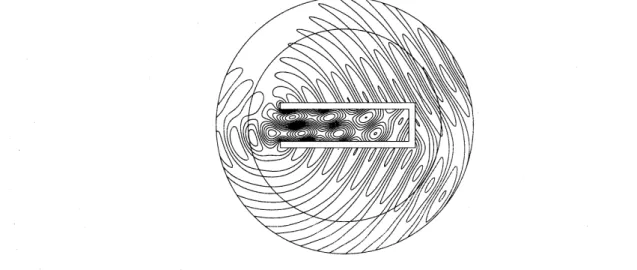
We computescatteringofanincident plane wave$\exp[ik(X1\cos\alpha+x2\sin\alpha)]$ byanobstacle,
where$\alpha$ isan incident angle. The wavenumber $k=8\pi$and thenthe wave length$\lambda=0.25$.
The obstacle is a $\Pi$-shaped open resonator. The size of its interior rectangle is $4\lambda\cross\lambda$,
and the thickness of the wall is $\lambda/5$. The incident angle $\alpha=30^{\mathrm{O}}$. First we choose the
radius of the artificial boundary $a=3\lambda$. Then the$\mathrm{D}\mathrm{t}\mathrm{N}$ operator is truncated at $N=135$,
and the triangulation has
42648
vertices and 83808 triangles. The length $h$ ofeach sideof every triangle satisfies $\lambda/51<h<\lambda/20$. We numerically solve the
wave
equation bythe explicit second order finite difference centered scheme with the step size $\triangle t=T/100$.
Next we choose the radius of the artificial boundary $a=4\lambda$. Then the $\mathrm{D}\mathrm{t}\mathrm{N}$ operator
is truncated at $N=150$, and the triangulation has
77808
vertices and 153888 triangles.The conditions of the mesh size $h$ and the time step size $\triangle t$
are
thesame as
above. InFigure 3, we display the contour lines of the real part of the numerical solutions in the
cases when $a=3\lambda$ and when $a=4\lambda$. Figure 3 shows good coincidenceofthose numerical
solutions, and suggests that ifwe
use our
ABC, we can get accurate numerical solutionswithout enlarging radius of the artificial boundary.
5
Acknowledgments
The author would like to thank Professor Takashi Kako for introducing the controllability
method to him, Professor Teruo Ushijima for advising him to prove the uniqueness for the
semi-discrete solution, and Mr. Yoshio Tsukuda for giving himasoftwarefortriangulation,
Figure 2: Contour lines of the real part of the exact solution and of the real part of the
numerical solution obtained by using our ABC (2).
Figure 3: Contour lines of the real part of the numerical solutions in the cases when
$a–3\lambda$ and when $a=4\lambda$.
References
[1] C. Bardos and J. Rauch. Variational algorithms for the helmholtz equation using time
evolution and artificial boundaries. Asymptotic Analysis, 9:101-117, 1994.
[2] M. O. Bristeau, R. Glowinski, and J. P\’eriaux. Controllability methods for the
com-putation of time-periodic solutions; application to scattering. J. Comput. Phys.,
$147(2):265-292$, 1998.
[3] M. J. Grote and J. B. Keller. On nonreflecting boundary conditions. J. Comput.