第 55 卷 第 4 期
2020 年 8 月
JOURNAL OF SOUTHWEST JIAOTONG UNIVERSITY
Vol. 55 No. 4
Aug. 2020
ISSN: 0258-2724 DOI:10.35741/issn.0258-2724.55.4.35
Research articleEnvironment Science
A
NAEROBIC
D
IGESTION
P
ROCESS FOR THE
T
REATMENT OF
S
ISDOLE
L
ANDFILL
L
EACHATE IN
N
EPAL
厌氧消化工艺处理尼泊尔西得乐填埋场渗滤液
Bikash Adhikaria, Shilpa KoiralabaKathmandu University, Dhulikhel, Kavre, Nepal bKathmandu University, Dhulikhel, Kavre, Nepal *Corresponding author Adhikari, email: [email protected]
Received: April 21, 2020 ▪ Review: June 15, 2020 ▪ Accepted: July 21, 2020
This article is an open access article distributed under the terms and conditions of the Creative Commons Attribution License (http://creativecommons.org/licenses/by/4.0)
Abstract
Along with the population, organic waste has been rising significantly in recent years. The resulting uncontrollable waste loads and conventional methods of waste treatment have begun to cause chaos at the landfill sites. This study evaluates the performance of an anaerobic digestion process using batch reactors for the treatment of landfill leachate collected from the Sisdole landfill site in Nuwakot, Nepal. A lab-scale anaerobic batch reactor was set up in Kathmandu University, Nepal. Using an anaerobic digestion process, COD values of the leachate decreased from 2230 mg/l to 1125 mg/l (removal efficiency of ~50%), whereas total solids concentration decreased from 1925 to 925 mg/L under a retention time of 10 days. In addition, Monod’s model was established to design an Anaerobic Sequential Batch Reactor to achieve better performance, resulting in 85% removal efficiency for the leachate treatment. Overall, this study analyzed the anaerobic digestion process on the landfill leachate of Sisdole, and modeled the process to identify the conditions required for increasing the efficiency of treatment of Sisdole landfill leachate.
Keywords:Anaerobic digestion, Batch reactor, Leachate, Monod equations
摘要 随着人口的增加,近年来有机废物已经大大增加。由此产生的不可控制的废物负荷和传统的 废物处理方法已开始在垃圾填埋场造成混乱。这项研究评估了使用间歇式反应器进行厌氧消化过 程处理从尼泊尔努瓦科特的西斯多尔垃圾填埋场收集的垃圾渗滤液的性能。尼泊尔加德满都大学 建立了实验室规模的厌氧间歇反应器。使用厌氧消化过程,在保留时间为 10 天的情况下,渗滤液 的 COD 值从 2230 mg / l 降低至 1125 mg / l(去除效率约为 50%),而总固体浓度从 1925 降低至
925 mg / L。 。此外,建立了 Monod 模型来设计厌氧顺序分批反应器以实现更好的性能,从而使 渗滤液处理效率达到 85%。总体而言,本研究分析了西斯多尔垃圾渗滤液的厌氧消化过程,并对 过程进行了建模,以确定提高西斯多尔垃圾渗滤液处理效率所需的条件。
关键词: 厌氧消化间歇式反应器渗滤液 Monod 方程
I. I
NTRODUCTIONSanitary landfilling is still a preferred method of solid waste management in most of the developing world. The byproducts of landfills (i.e. leachate and gas) pose threats to the environment. In particular, leachate, which is rich in inorganic constituents, biochemical oxygen demand (BOD5) and chemical oxygen demand (COD), has a huge impact on land and water in the vicinity of the landfill site. Heavily polluted leachates generated from sanitary landfills vary significantly in both volume and chemical concentration, and subsequently the process of treating it for safe disposal to the environment can vary according to the site conditions.
The Sisdole landfill site is of high significance, and was chosen as the study site as it serves a large population in the most dense and urban city of Nepal, Kathmandu. The high-strength municipal and landfill leachate from Sisdole landfill requires immediate attention in order to reduce the impact on the nearby surface and groundwater environment.
For BOD and COD greater than 1000 mg/L, a biological treatment plant is the best option [1]. Biological decomposition may take place either aerobically or anaerobically. Although both methods are important, anaerobic decomposition exerts the greater and longer-lasting influence in terms of associated landfill characteristics [2].
The present study aims to test the performance of anaerobic digestion of landfill leachate in the laboratory.
The Sisdole landfill site lies in Okharpauwa village, Ward No. 1 of Akani Rural Municipality, Nuwakot district, Province No. 3, which is situated at an altitude of 1,150 m above sea level and at a distance of 16 km from Kathmandu, the capital of Nepal (Figure 1). The population of Okharpauwa village is 7,901 [3]. The landfill site covers an area of 15 hectares. However, only 2 hectares are used as landfill. The design capacity of this landfill is 313 tonnes/day, but 500 tonnes/day of waste from Kathmandu metropolitan city (KMC) and Lalitpur metropolitan city (LMC) are transferred and disposed of at this site. The site has been operating since June 2005. ADB report data
analysis reveals waste composition of organic waste 66%, followed by plastics 12%, and paper and paper products 9%, according to Solid Waste Management and Technical Support Centre [4]. landfill site is located on the northern bank of Kolpu Khola, near the confluence of Thulo Khola and Kolpu Khola.
Figure 1.The Sisdole Landfill Site
In Nepal, due to load variations, landfills have installed Constructed Wetlands (CW) at the Pokhara landfill site, filtration with disinfection At the Dang landfill site, and a leachate collection pond with semi-aerobic recirculatory system and floating type slow speed surface aerator at Sisdole (Figure 2). It is noted that all of the available treatment technologies are biological and aerobic in nature, but are either partially functioning or completely nonfunctional.
Figure 2. Leachate collection pond with semi aerobic recirculatory system at the Sisdole landfill site.
Due to unmanaged and ever-growing waste levels (Figure 3), as well as the failure of previously installed treatment systems, more efficient technologies need to be explored, such as anaerobic digestion. A study has shown that in an anaerobic sequencing batch reactor, all the treatment phases and processes are combined into a single basin and removal efficiency is usually in the range of 66-85% [5]. Raw leachate has been successfully treated with chemical oxygen demand removal of 85% and the removed COD has been converted into methane gas [6]. This result shows the promising potential for leachate treatment via anaerobic digestion in landfill sites in Nepal.
Figure 3. Leachate leakage from Sisdole landfill site.
II. M
ETHODS/M
ATERIALSTable 1 illustrates the parameters for leachate characterization using various test methods for pH, Biological Oxygen Demand (BOD), Chemical Oxygen Demand (COD), Dissolved Oxygen (DO), Total Solids (TS), and Volatile Solids (VS). The laboratory analysis used Monod equations as bio-kinetic model to describe the work of the digester. This model describes the kinetic behavior of microorganisms in environmental systems and in engineered treatment processes.
Table1.
Experimental procedures and detail of instrument specification
Param
eter Test method
Instrument
specification/protocol
pH Digital pH meter Eco Sense pH10A pen-style digital pH meters BOD5 Winkler Azide modification 5210 B, American Public Health Association (dilution and seeding) (APHA), ISO 5815-1989 COD Potassium Dichromate Reflux (Open reflux) 5220 B, American Public Health Association (APHA), 2012 DO Digital DO meter
Max digital dissolved oxygen cum temperature. ME-981
TS Oven dried
2540 B, American Public Health Association (APHA)
VS Oven dried and muffle furnace
2540E, American Public Health Association (APHA)
A. Leachate Sample Collection
Samples were collected on June 16, 2019 from the Sisdole landfill site. Four sub-sites within the landfill were marked. Four 1-L samples were collected from four different sub-sites and were kept in plastic bottles. The sampling bottles were rinsed three times before the final sample was taken. The pH and DO were measured in the field. Leachate samples were collected from the base of the solid waste heaps (trenches) where the leachate was drained out by gravity. Precaution was taken to ensure that air bubbles were not trapped in the bottles during sample collection. Ten ml of Sulfuric acid (H2SO4) was added in order to inhibit the
biological activity in the sample. The samples were labelled at the site, which included the name and location of the sample and the date and time of sampling.
Thereafter, various physicochemical parameters were analyzed at the pollution control laboratory of Kathmandu University from June 17 to June 29, 2019. A laboratory scale digester was constructed in the pollution lab of Kathmandu University. Composite sampling to represent the sub-samples over a period of time was conducted. Three hundred mg of cow dung with a pH of 7.1 was used as an inoculum to seed the feedstock in anaerobic culture, due to its high buffering capacity and the presence of naturally occurring microbes responsible for anaerobic degradation [7]. Since it was a batch reactor, the substrate was fed to a 1-L capacity air-tight volumetric flask. Gas that emerged as a byproduct was passed through a pipe to the chemical container containing the sodium hydroxide to dissolve all
the carbon dioxide and hydrogen sulfide. A chemical container was further connected to a water container, where methane gas pushed the water out of the container to show the level of methane produced. Methane production was measured using the water displacement method. The reactor in the water bath was maintained at a
temperature of 35oC. Gas was collected in a glass cylinder, and for the measurements, the cylinder was lighted, and it burnt with a blue flame.
According to Biswas J (2006), seed culture using the pour plate method, dry weight, and microscopic analysis, the concentration of acidogenes and methanogenic bacterial consortia were determined to be 360 mg/L and 320 mg/L, respectively, at the initial condition of the experimental run in the inoculum. When only methanogens were considered, the initial concentration of biomass was 320 mg/L.
The initial value of BOD, COD, and TS after composite sampling prior to feeding to the batch reactor digestion process is provided in Table 2.
Table 2.
Initial value of parameters in the reactor
Parameter Value
Biological Oxygen Demand
(BOD) 1320 m/L
Chemical Oxygen Demand (COD) 2280 mg/L
Total Solids (TS) 1925 mg/L
pH 7.6
III. R
ESULTS ANDD
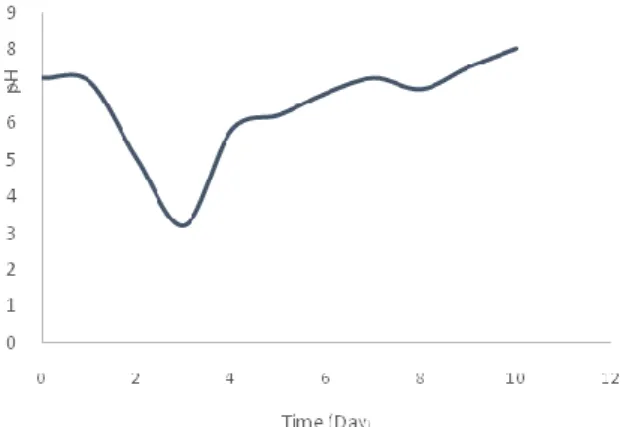
ISCUSSION A. pHMost anaerobic bacteria, including methanogens, show optimal microbial activity within a pH range of 6.8 to 7.2 [9]. The initial pH of 7.6 was maintained at a range of 7.2 to neutral or slightly alkaline after the addition of inoculum in the reactor.
Figure 4.pH variation according to different periods of time.
The pH of 7.2 was decreased to 3.2 on Day 3 due to the rise in volatile acids as byproducts (Figure 4). As acidogenesis bacteria were activated, the pH again rose mostly due to the growth in uptake of anions from the substrate and the accumulation of microbial metabolic products in the solution
.
1) COD and Total Solids
Figure 4.Total solids and COD concentration with respect to time in the batch reactor.
Figure 5 shows that at the end of Day 10, the COD concentration of the substrate was reduced from 2,280 mg/L to 1,125 mg/L (i.e. a 50% reduction). After Day 2, due to the acidogenesis
phase in the process, the acidogenesis
bacteria
were activated, and the substrate was highly induced by the bacteria to volatile fatty acids. It was clear that by the third day (Figure 5) almost half of COD 1,250 mg/L was treated and thereby increasing the concentration of the TS (i.e., 2,125 mg/L) due to the rise Volatile Fatty Acids (VFA). However, after Day 3, volatile fatty acids were consumed by the methanogens and again increased in terms of removal percentage. The 945-mg/L concentration of TS at Day 10 showed decreased value at post-treatment, which was mostly due the precipitation of the suspended solids as digester bottom sludge and consumption of suspended and dissolved solids by the microorganisms for their metabolic activities [10].a. Monod Equations
The variability of the kinetics was concentrated in the reaction rates. It was simplified, assuming that the reactor behaved like a perfectly mixed, steady-state condition tank, and the biomass was uniformly distributed within the reactor.
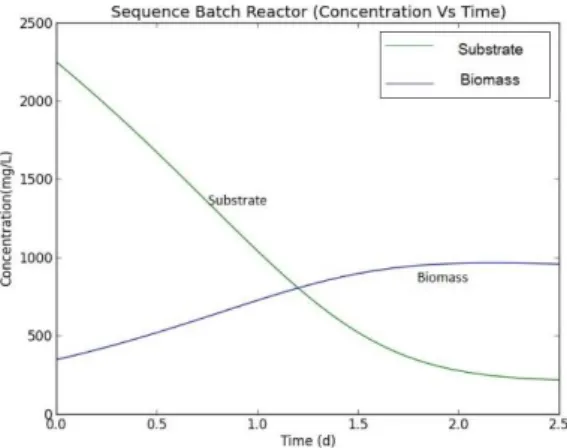
Monod equations provide helpful insight into digester microbial population dynamics and various inter-community and/or intra-community interactions that are observed at different stages of leachate digestion [11]. The initial values of selected variables and coefficients were based on grey literature. The depiction of the batch process within the substrate and biomass respective to time is shown in Figure 6:
Figure 5.Representation of the batch process biomass growth changes within substrate and biomass versus time
using Monod Equations.
= µX= rg *X-Kd*X (1)
(i.e., cell growth rate- cell decay rate)
rg= (2)
µ = -Kd (3)
= (4)
where, X = mass concentration of the active microorganism (mg/L), µ = net specific growth rate of cells per day; rg = cell growth rate coefficient; Kd = cell death rate coefficient per
day (here, 0.45 per day); S = substrate (mg/L);
Km = maximum specific substrate degradation
rate per day (here,1.7 per day); Ks = half-saturation constant (mg/L) (here, 800 mg/L); Y = cell yield coefficient (here, Ym = 0.20) [12]. These
equations determined the substrate degradation rate and the microorganism growth rate.
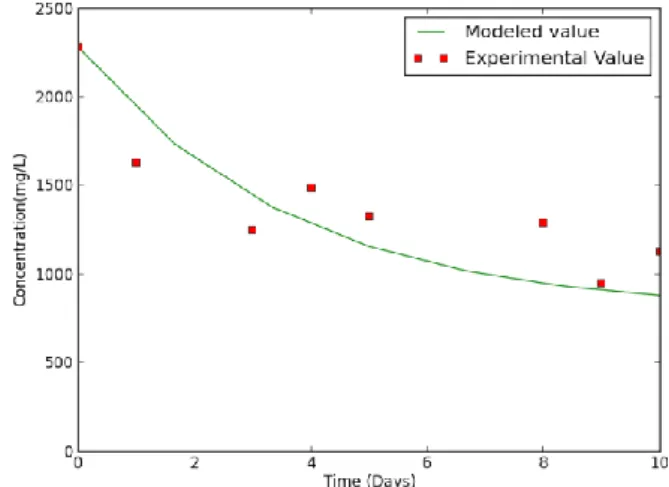
The curve of the substrate in a batch reactor depicted in Figure 7 shows the substrate consumption by bacteria, where initially the nutrients are present in excess as 2,280 mg/L, and a small population of biomass (i.e., 320 mg/L) is present. The model illustrates the simulated value of biomass decay after the tenth day of setup. An experiment [13] that was conducted in 2009 revealed that the nitrifying system was liable for activity decay and cell death in the reactor. It was found that the substrate, COD (mg/L), and microbial growth in the initial phase decreased linearly. The model values (Figure 7) illustrate that 1,000 mg/L concentration of COD could be achieve by tenth day, but the effluent of the experimental concentration was higher than the modeled value and also needed further treatment. The experimental values from the batch reactor exceeded the threshold concentration for the pollutants mentioned by the Guidelines for the
drinking water and waste water [14] (Table 3), and altenative sustainable biological treatment need to be sought for it.
Figure 6. Comparison of experimental and modeled values of COD concentration (Substrate) of the leachate.
Table 3.
Values from the batch reactor compared with the threshold given by GoN [14]
C. Design and Application
One of the benefits of the batch systems is that they can simply be reconciled for continuous variations of contaminant concentrations. High strength municipal landfill leachate can be treated by an anaerobic sequence batch reactor. A sequencing batch reactor (SBR) is a kind of biological treatment. SBRs combine all treatment phases and processes, which are then carried out in a single basin. The estimated parameters and values for design of a sequence batch reactor are illustrated in Table 4.
Table 4.
Design of a Sequence Batch Reactor
Parameter Value Source
Organic loading Rate (OLR) at 350
C
0.91 g/L/day
[5] Flow rate (Q) 45 m3/day [15]
Chemical Oxygen Demand (COD)
2280 mg/L (This study) COD removal at 350C <85% [5]
The SBR process was examined in [16], and it was found that it removes several pollutants and is effective in the removal of Biological Oxygen
S.N. Parameters Result from Batch reactor Concentration threshold for pollutants (GoN, 2013) for waste water 1. pH 8 6.5 – 8.5 2. BOD 425 mg/L < 100 3. COD 1125mg/L < 100
Demand (BOD5), Chemical Oxygen Demand
(COD), Total Kjeldahl Nitrogen TKN, Total Nitrogen (TN), and Total Phosphorus (TP) by 97.7%, 94.9%, 85.4%, 71.4%, and 55.9%, respectively. Anaerobic treatability of municipal landfill leachate was evaluated in [6] using lab-scale anaerobic sequencing batch reactors (ASBR) at 35o
C temperature and COD removal efficiencies, usually in the 66%–85% range. Figure 8 demonstrates that the effulent concentration of substrate after Day 2 in sequence batch reactor has decreased to <200 mg/L with a removal efficiency of 89%.
HRT= , Q= ,
where HRT = hydraulic retention time (days);
OLR = organic loading rate (kg-COD/L.day); COD in = influent COD (kg-COD/L); V =
working volume of the reactor, m3; HRT = (2–
2.5) days; and V = 112 m3.
Applying the values of the mentioned parameter in the mass balance equation:
(5) (6) where
Q = inlet flow rate, m3/hr; YB = conversion
efficiency; X = nutrient (substrate), g/m3; and B = biomass, g/g.
Figure 7. Modeled substrate and biomass concentration in the SBR for HRT of 2.5 days.
The performances of biomass and substrates shown in Figure 8 were analyzed through the mass balance consideration using assumed and experimental parameters (Refer to Table 2 and Table 4). The anaerobic SBR has the potential of achieving better performance, i.e., post-treatment concentration of <200 mg/L before Day 3 (Figure 8) by optimizing operational parameters.
This study presents the possibility of installing an anaerobic SBR upstream a reed bed treatment facility on the landfill site for increased efficiency in COD removal. The anaerobic digestion process can also be utilized as energy recovery due to the production of biogas from the anaerobic digestion process. Therefore, the anaerobic digestion process can potentially be considered as an effective treatment process for leachate in the case of the Sisdole Landfill.
IV. C
ONCLUSIONThe results obtained showed that anaerobic digestion for the treatment of leachate in a lab scale batch reactor was able to decrease the COD concentrations from 2230 to 1125 mg/L (~50%). Likewise, the concentration of total solids decreased from 1925 to 925 mg/L (~50% reduction). This study also indicated the possibility of biogas production from anaerobic digestion of landfill leachate. The value of BOD from the site was found to be 425 mg/L, which is still not on par with the standards set by the Government of Nepal (2013), i.e., <100 mg/L for effluent in the surface body. Although measures to collect and control leachate and protect water and aquatic life against the dumped waste and leachate before discharging it in a nearby river are in practice, a high level of purification has yet to be achieved. This study shows that an anaerobic treatment process, such as that used by the SBR, could overcome the inefficiencies of the conventional treatment methods at the Sisdole Landfill site.