Male students’ augmented underperformance
with teacher-perceived gender stereotypes as
score markers : natural experimental evidence
from rural Philippines
著者
Okabe Masayoshi
権利
Copyrights 日本貿易振興機構(ジェトロ)アジア
経済研究所 / Institute of Developing
Economies, Japan External Trade Organization
(IDE-JETRO) http://www.ide.go.jp
journal or
publication title
IDE Discussion Paper
volume
734
year
2019-01
INSTITUTE OF DEVELOPING ECONOMIES
IDE Discussion Papers are preliminary materials circulated
to stimulate discussions and critical comments
Keywords:
Male-effect Heterogeneity; Supply-side Bias; Test Scores; Human Capital; PhilippinesJEL classification:
D91; I21; I24; I25; I32; J16; O15; O53* Overseas Research Fellow (Manila) IDE; Visiting Research Fellow, School of Labor and Industrial Relaations, University of the Philippines Diliman ([email protected])
IDE DISCUSSION PAPER No. 734
Male Students’ Augmented Underperformance
with Teacher-Perceived Gender Stereotypes as
Score Markers: Natural Experimental
Evidence from Rural Philippines
MASAYOSHI OKABE*
January 2019
Abstract
Schoolboys in the Philippines are said to be underperforming in human capital accumulation, particularly education, compared to their female counterparts, especially in rural regions. Although existing literature has analyzed the sources of this bias, further research is required to understand its background. Thus, by combining our unique primary data from our own field survey using tailored questionnaires conducted in Marinduque Province and administrative data on the National Achievement Tests (NATs), we compare sources of the persistence of a negative male effect on test scores. We avail of the variations of blindness in rating systems between the NATs and teacher-rating report cards (RCs). Results of sensitivity analysis in regressions support the hypothesis that male students are systematically more likely to receive lower scores when they are evaluated in a non-blind rating system in which teachers know who the examinees are. The paper empirically presents an insightful perspective about Filipino schoolboys’ underperformance being further augmented through gender stereotypes perceived by the evaluators, in this case, the school teachers.
The Institute of Developing Economies (IDE) is a semigovernmental,
nonpartisan, nonprofit research institute, founded in 1958. The Institute merged
with the Japan External Trade Organization (JETRO) on July 1, 1998.
The
Institute conducts basic and comprehensive studies on economic and related
affairs in all developing countries and regions, including Asia, the Middle East,
Africa, Latin America, Oceania, and Eastern Europe.
The views expressed in this publication are those of the author(s). Publication does not imply endorsement by the Institute of Developing Economies of any of the views expressed within.
INSTITUTE OF DEVELOPING ECONOMIES (IDE), JETRO 3-2-2, WAKABA,MIHAMA-KU,CHIBA-SHI
CHIBA 261-8545, JAPAN
©2019 by Institute of Developing Economies, JETRO
No part of this publication may be reproduced without the prior permission of the
IDE-JETRO.
1
MALE STUDENTS’ AUGMENTED UNDERPERFORMANCE
WITH TEACHER-PERCEIVED GENDER STEREOTYPES AS
SCORE MARKERS: NATURAL EXPERIMENTAL EVIDENCE
FROM RURAL PHILIPPINES*
1Masayoshi OKABE**
Institute of Developing Economies, Japan External Trade Organization (IDE-JETRO), Chiba, Japan; University of the Philippines Diliman, Quezon City, Philippines
January 2019
Abstract:Schoolboys in the Philippines are said to be underperforming in human capital accumulation, particularly education, compared to their female counterparts, especially in rural regions. Although existing literature has analyzed the sources of this bias, further research is required to understand its background. Thus, by combining our unique primary data from our own field survey using tailored questionnaires conducted in Marinduque Province and administrative data on the National Achievement Tests (NATs), we compare sources of the persistence of a negative male effect on test scores. We avail of the variations of blindness in rating systems between the NATs and teacher-rating report cards (RCs). Results of sensitivity analysis in regressions support the hypothesis that male students are systematically more likely to receive lower scores when they are evaluated in a non-blind rating system in which teachers know who the examinees are. The paper empirically presents an insightful perspective about Filipino schoolboys’ underperformance being further augmented through gender stereotypes perceived by the evaluators, in this case, the school teachers.
Keywords: Male-effect Heterogeneity; Supply-side Bias; Test Scores; Human Capital;
Philippines
JEL classifications: D91; I21; I24; I25; I32; J16; O15; O53
* This paper is a part of the research output of the author’s current term of the overseas research fellowship in the Philippines.
** Masayoshi Okabe: Overseas Research Fellow (Manila), IDE-JETRO; Visiting Research Fellow, School of Labor and Industrial Relations/Senior Lecturer, College of Education, University of the Philippines, Diliman (concurrent positions).
2
ACKNOWLEDGMENT
I wish to express my appreciation to the 2016 research grant program (program ID: D16-R-0798) funded by the Toyota Foundation (Toyota Zaidan), Tokyo, Japan (Grantee: Masayoshi Okabe, with the accepted research title: “A Socioeconomic Analysis on Reversed Gender Disparity in Education from Development Studies Perspective: A case from the Philippines”) for much of my fieldwork activities. I am indebted to Yasuyuki Sawada, the Chief Economist and Director-General, Asian Development Bank and Professor, University of Tokyo, for his invaluable suggestions on the issue setting of the current study. It is under my terms as overseas and visiting research fellow that I have been able to commit long-term preparations and household survey in a rural area in the Philippines till now. I thank the faculty of the University of the Philippines Diliman’s School of Labor and Industrial Relations (UP-SOLAIR) for hosting me (among others, to Maragtas Amante, Ronahlee Asuncion, Emily Cabegin, and Rebecca Gaddi) and the IDE-JETRO (among others, to Takesi Aida for suggesting an empirical approach, Tomohiro Machikita for continuous advice, and Momoe Makino for insightful comments on time-allocation survey designs). In addition, I received invaluable cooperation from the local people of Marinduque Province in the Philippines (among others, Ms. Lolita Natal and Mr. Delfin Natal Jr). The administrative data of score information of the National Achievement Tests (NATs) was provided by the Bureau of Education Assessment (BEA), Department of Education (DepED). Special thanks go to the BEA-DepED (particularly its specialist Ann Legarte and its statistician Ricky Totañes). A part of this study was presented at the 4th Philippine Studies Conference in Japan, held at Hiroshima University, Japan, on November 18, 2018, and I thank Kim Allen, Takeshi Kawanaka, and other participants who gave me comments and suggestions. All possible and potential errors are solely on the author, and the contents and discussions in the current paper do not represent those of any third parties, including the author’s affiliations.
3
CONTENTS
I. INTRODUCTION ... 5
II. LITERATURE REVIEW ... 6
A. On Supply-side Attributes as a Source of Disparities in Education ... 6
B. Teachers’ Stereotypes or Bias that Teachers Have toward Some Students ... 8
C. Philippine Settings ... 9
D. Reinforcements by Local Representations through Field Observations ... 10
III. DATA ... 10
A. Research Site and Sampling ... 10
B. Collected Information ... 14
C. Information of Test Scores ... 16
IV. EMPIRICAL ANALYSES ... 18
A. Analytical Framework ... 18
B. Sensitivity Analysis in Benchmark Models ... 19
V. RESULTS ... 21
A. Benchmark Results ... 21
B. The Same-student Comparisons by Subtracting Blind and Non-blind Scores ... 24
C. What More Do We Need to Consider? ... 28
VI. CONCLUION ... 34
REFERENCE ... 36
APPENDIX I ... 40
4
TABLES
Table 1: Industrial Characteristics of Marinduque Province in Regional and National Contexts
(%, 2015)... 14
Table 2: Descriptive Statistics of z Scores on RC and NATs ... 17
Table 3: Single Regression of Male Effect on Scores by Test Type and Subject ... 20
Table 4: Results of Sensitivity Analysis (Covariates = Individual/household characteristics) ... 21
Table 5: Results of Sensitivity Analysis (Covariates = Individual and household characteristics + Region effect) ... 22
Table 6: Results of Sensitivity Analysis (Covariates = Individual and household characteristics + Region effect + School effect) ... 23
Table 7: Results of Sensitivity Analysis (Covariates = Individual and household characteristics + Region effect + School effect + Male-specific School effect) ... 24
Table 8: Descriptive Statistics of the Differences between the Two Scores by Subject ... 25
Table 9: Sensitivity Analysis of Differences between Scores on RC and on NAT by Subject ... 27
Table 10: Probit Analysis (Probability of the tracking scores on NATs) ... 28
Table 11: Sensitivity Analysis of Differences between Scores on RC and on NAT by Subjects (Covariates = Specification (5) in the Table 9 + Time-allocation Patterns) ... 31
Table 12: Teachers’ Gender Ratios by School Levels and Subjects (Sample Schools) ... 32
Table 13: Sensitivity Analysis, Difference Between Scores on RC and on NAT by Subject (Covariates = Specification (5) in Table 12 + TGRs of each school subject) ... 33
Table 14: Sensitivity Analysis, Difference between Scores on RC and on NAT by subject (Covariates = Specification (5) in Table 11 + Interaction term of male indicator with the TGRs of each own school subject) ... 34
FIGURES
Figure 1: Location of Marinduque Province on the National Map ... 11Figure 2: Provincial Map of Marinduque ... 12
Figure 3: Gender Disparities in Net Enrollment Rates at the Secondary Level ... 13
Figure 4: Response Rates of RC Scores (by subjects) and Tracking Rate of NATs Scores ... 16
5
I. INTRODUCTION
he long-standing significance of empowerment of females in developing countries is undoubtable, as women in these parts of the world have been lagging behind their male counterparts in reaping the benefits of human development. This global issue has continued to require the mobilization of human wisdom. However, in some developing countries, an issue has begun to remerge regarding boys’ underperformance in education2 compared to their female counterparts (UNGEI, 2012).
UNGEI (2012) directly highlights this issue with cases in four East and Southeast Asian countries: the Philippines, Thailand, Malaysia, and Mongolia. It determined boys’ underperformance from indices not only of access to education but also of quality or outcomes of education. Furthermore, Cambodia and Bangladesh, referred to as even lower income countries than UNGEI’s (2012) four countries, have also been reported as regions where females have started to overtake their male counterparts in education (Zimmermann and Williams, 2016; Asadullah and Chaudhury, 2009; Khandker et al., 2003).3
Outside the Asia and Pacific region, the same issue has been found in some Latin American countries (Kitamura, 2015). Surprisingly, though it is considered a patriarchal region, some Sub-Saharan African countries such as Lesotho and Malawi are reported to have experienced the same situation (Jha et al. 2012). These were reported with some sense of astonishment, whereas the school subject-based underperformance of one gender has been reported in developed countries (OECD, 2014).
If the boys’ underperformance in education merely meant the catch-ups of girls in those regions over time, we could interpret it as female outperformance of males, which is welcome. However, the situation is not that optimistic. Difficulties and barriers specific to male children have not been studied as much as in female cases (UNGEI, 2012). The literature dealing with boys’ issues is still developing, as the issues are “a more complex phenomenon than female disadvantages” in education because the male issue “coexists with higher social and economic positioning, and privileging within family” (Jha et al. 2012: 12). The issue leading to male underachievement in human capital accumulation processes, if it emerges more broadly, not only poses an obstacle to males’ own capability development but also can be of harm for women from a postfeminist perspective (Miralao, 2008).
2 In this paper the author uses the term “’boys’ underperformance’ in education.” The terms “underperform” and “boy” rather than “male” or “man” are derived from the terminology used by UNGEI (2012).
3 According to Asadullah and Chaudhury (2009) and Khandker et al. (2003), the Bangladeshi government introduced an affirmative action called the female secondary stipend (FSS) program in 1994, which has been reported to increase girls’ secondary education.
6
This paper attempts to explore the source and background of the phenomenon in the Philippines under conditions of poverty. This research idea serves to address why boys from poorer families are more underperforming in education. The Filipino boys’ case of underperformance in education is persistent (Torres, 2011; UNGEI, 2012). Considerable literature has approached the issue from socioeconomic (demand-side) aspects. Keeping attention on the socioeconomic circumstances of students, this paper employs our latest primary data collected in a rural area in the Philippines to intentionally focus on a supply-side bias to the students through school teachers’ perceived gender stereotypes. Thus far, gender disparity in education is regarded as being less serious in the Philippines (Fuwa, 2014). This paper, therefore, attempts at contributing to the literature by providing explanations of a supply-side factor in the case of a relatively and seemingly gender-neutral society and by presenting the complexity of this contentious issue as described in Jha et al. (2012).
II. LITERATURE REVIEW
This section reviews the related literature on the possibility of teacher-perceived gender stereotypes as one of the predictors of boys’ underperformance in education. First, to organize the issue, this section first reviews the previous literature that has worked on how teacher- and school-related supply-side factors influence the disparities in educational achievement and outcomes among students aside from the demand-side factors such as the socioeconomic status (SES) of the students’ households.
The bottom line from the literature first depends on whether the setting is a developed or developing country. In the latter, demand-side factors such as SES have been known as more explanatory of the disparities of educational achievement than supply-side factors. Of the supply-side factors, exceptions include teacher-related variables, which have more explanatory power than others (Hanushek and Woessmann, 2017).
Supply-side teachers’ factors, such as perceived stereotypes of a certain gender, if any, are therefore thought to be a heterogeneous bias on how they rate and evaluate students of each gender differently. Let us confirm the possibility in which the rated educational performances of students can be influenced differently based on their gender even if they are in the same school environment. Then, teacher-perceived stereotypes can also be classified as a sequence of the determinants of academic performance disparities.
A. On Supply-side Attributes as a Source of Disparities in Education
7
and educational outcomes across individuals is, not only limited to gender disparities but also in general. A dichotomy between demand and supply sides of education is a primary and straightforward framework. On one hand, it was believed that the school attributes as supply-side factors served as a key predictor of educational outcomes of students. Heyneman and Loxley (1983) argued that in developing countries, school- and teacher-related variables accounted for a greater proportion of variance of student achievements than demand-side (individual- and household-level) SES did. It was called the “HL effect” (Huang, 2010). This was offset by the so-called Coleman Report, which reported low explanation powers of school-resource attributes for educational outcomes of students in the United States (Coleman et al., 1966). Relationships between demand- and school-side factors on educational outcomes have then been a big issue in related fields (Baker et al., 2002; Bouhlila, 2015; White, 1982).4
Nonetheless, later literature seems to converge toward denial of the HL effect.5 It admits the demand-side SES in developing countries accounts for much more than the supply-side variables6 (Hanushek, 2006; Hanushek and Woessmann, 2017). The pros and cons of the HL effect have still been a central question in the fields of education and development because the supply-side variations are the (possibly only) policy variables on which governments can intervene directly by arranging educational improvement through public policies.7 A more recent study by Hanushek and Woessmann (2017) surveyed the
4 Some scholars do not sufficiently emphasize the supply side factors but place considerable importance in demand side factors. There emerged a controversy regarding Heyneman (1989) and Riddell (1989a and 1989b) in a developing country setting.
5 For example, Baker et al. (2002) conducted a comparative analysis of over 29 developing and developed countries using the Trends in International Mathematics and Science Study [TIMSS] ; Riddell (1997) for cases of Botswana, Brazil, Columbia, Egypt, Honduras, India, Jordan, Namibia, Pakistan, the Philippines, Thailand, and Zimbabwe; Huang (2010) for the Philippines; Bouhlila (2015) confirming Baker et al. (2002) for the TIMSS case in the Middle East and North African (MENA) countries. Meta-analysis covering 96 studies on the school-side effects on educational outcome found inconsistency in the explanation powers of the school-side variables in developing countries (Hanushek, 2006).
6 Regarding the background of a weakened and vanishing HL effect, Baker et al. (2002) interpreted that “[i]nvestment in mass schooling by nation-states and multilateral agencies, backed by an ideology of providing some minimum level of school quality throughout the nation, has shifted the potential toward greater direct family SES effects in the social stratification process,” “[t]he macroprocess of mass schooling across a large part of the world may have achieved a resource threshold in the quality of schooling,” and “[t]his is one very plausible explanation for a shifting HL effect over time” (Baker et al. 2002: 310).
7 I do not mean that demand-side–centered interventions of governments to livelihoods of poor students and families, e.g., school subsidy programs, are not a policy option to contribute to educational improvement. Here, it must be noted that the betterments of access to education and of quality of education differ from each other.
8
later literature and confirmed the same trends that the surveyed studies found regarding little significant explanatory power of the supply-side attributes, with exceptions such as the attributes of school teachers.
In the literature, variations of school-side factors have been gauged as overall effects that are homogeneous for male and female students. Yet, the supply-side factors can be transvalued if introducing the perspective of heterogeneity of the ways in which supply-side factors influence different groups of students. In the context of the current study, the interactions of gender-based stereotypes are thought to be one of such typical heterogeneous examples.
B. Teachers’ Stereotypes or Bias that Teachers Have toward Some Students
School teachers are almost always near their students. As confirmed in Subsection A of this section, teachers’ variations are said to be an exceptionally stronger predictor than other school-related inputs (Hanusheck and Woessmann, 2017). At the same time, teachers are also occasionally reported to perpetrate stereotyping, which in turn affects students’ educational outcomes (Lavy, 2008; Torres, 2011; UNGEI, 2012). Emerging literature by Lavy (2008) and its successors, such as Cornwell et al. (2013) and Lavy and Sand (2018), opened a new approach to empirically study the effect of teachers as a source of stereotypes perceived against some students. Teachers had already been thought by educational psychology to be the source of unfavorable stereotypes of female students in particular school subjects such as math (Dusek and Joseph, 1983; Riegle-Crumb and Humphries, 2012; Tiedemann, 2000; Tiedemann, 2002).
Lavy (2008) deals with an Israeli case and Cornwell et al. (2013) with a US case and find such teachers’ stereotypes treat male students more unfavorably than females. In turn, Lavy and Sand (2018) studied the same Israeli case by more directly focusing on the consequences of such stereotypes on female students’ progress in the advanced science track in senior high schools and find that there are unfavorable stereotypes for female progress to the advanced tracks. Unfavorable female stereotypes are also found consistently in a French case (Terrier, 2015) and an Italian case (Carlana, 2017). As every study states, the direction toward females is strongly observed on the science track since it has been believed that math and sciences are male-dominated subjects in general (OECD, 2014).
Yet, these studies tested cases mostly in developed countries.8 In developing
8 The term “developed countries” is gauged here as OECD member countries. Israel is one. Based on the literature survey by Lavy and Sand (2018), the applications of the initial study by Lavy (2008) range from teachers’ gendered stereotypes to racial discriminations in UK high schools
9
countries, there are few studies of the case. Data accessibility is possibly one of biggest obstacles because the documentation storage methods of schools and central governments differ greatly from those of developed countries. It can also fall afoul of privacy issues. However, given that the Philippines is one emerging country where boys’ underperformance is prevailing, it is highly relevant to study this by applying the aforementioned research framework to the country.
C. Philippine Settings
A desk review by Torres (2011) lists concerns regarding Filipino boys’ underperformance in education: higher dropout rates; earlier linkage to economic activities; lower functional literacy rates; and lower scores across subjects and on NATs. She also mentions that Filipino boys are prone to be victims of corporal punishment. Some mode like
hidden curriculum in classrooms can also unconsciously be exercised in an explicit curriculum
but can be perceived to be a certain mode of messages by learners like prejudicial.
According to the UNGEI (2012), teachers are described as a stereotyping factor. Torres (2011) warns that the school environment nature is not gender-neutral in the Philippines and stereotypes impede boys’ potential and achievement in education. She adds that the teachers’ perceived stereotypes in a school environment are often perpetuated by inadequate male role models and guidance process (e.g., due to lack of male teachers). However, what has been lacking is data, particularly data disaggregated by gender, regional and geographical locations, socioeconomic background, and ethnicity. Without this data, the existence of stereotypes and bias embedded in learning environment remains hardly tested. It is then good to question whether the stereotypes are a source of the Filipino boys’ persisting underperformance in education. In the HL effect literature, the country was not included in the developing countries that Heyneman and Loxley (1983) studied. Later, Riddell (1997) included the Philippines in her case studies and showed that the HL effect was not confirmed in the Philippine case along with cases of Botswana, Brazil, Columbia, Egypt, Honduras, India, Jordan, Namibia, Pakistan, Thailand, and Zimbabwe. Huang (2010) also denied the HL effect by employing the household survey that was conducted by the government in Cebu, Philippines, through closed analysis to Riddell (1989a). Yet, as said by Hanushek and Woessmann (2017), teachers are one exceptional variable in testing the HL effect.
(Burgess and Greaves, 2013), discriminatory influences on black students in Brazilian schools (Botelho et al.,2015), and foreign students in Swedish high schools (Björn et al. (2011)
10
D. Reinforcements by Local Representations through Field Observations
Our observations in the fields also confirm that some male youths can be stereotyped by adults including teachers (see also a Western Visayas case in Okabe, 2018). For example, the inclination of male youths to be lazy was often raised by local adults as a primary reason why they think male youths tend to lag behind their female counterparts in education. More surprisingly, not few mothers that we encountered in our current study area in Marinduque boldly stated that their sons had low IQs (intelligence quotients):
––“Oo naman, tamad nga kasi ang mga lalaki namen.” (Yeah certainly, because our boys are lazy.)
––“Mababa din kasi ang IQ nila.” (In addition, because their IQ is low.)
According to them, however, the sons’ IQs had not ever been actually measured. Our interviewees, public school teachers, added that male students were much more out of their control in classes. They described that some male students came to be much more violent as they grew.
By combining the above related perspectives from the literature and some local representations and observations, this study aims to fill the literature gap by working on the question on the gender-heterogenetic stereotypes from school teachers, which has not been satisfactorily addressed so far. The local representations provided an eloquently reinforced hypothesis that the adults’ perceptions can sometimes be a negative bias against youths. The structure of the paper is as follows: Section III provides the data, explaining the choice and characteristics of research site, the sampling technique, and the collected information. Section IV explains our analytical framework and empirical analysis. Section V shows the research results, by beginning with the benchmark results then reaching some additional analyses for robustness checks. Finally, Section VI spells out the conclusion and limitations for future study. Appendices I and II provide some supplementary information for the readers’ references.
III. DATA
A. Research Site and Sampling
The data employed in the current study comes from our tailor-made questionnaire-based household survey. The data collection was prepared from August 2017, and then the household survey was intensively conducted from January to March in 2018. Approximately
11
150 households with information of around 300 children were covered from nine barangays (the local government unit in the Philippines) in three municipalities, say, Boac, Gasan, and Buenavista, in the Province of Marinduque (see Fig. 1 and Fig. 2). The municipalities,
barangays, and households were randomly chosen through the stratified random sampling
technique based on the master list from the Community-based Monitoring System (CBMS) that the local government units provided.9
Figure 1: Location of Marinduque Province on the National Map
Source: Adapted from http://www.freemap.jp
9 In August 2017, the author paid courtesy calls to every municipality hall to see mayors/representative of three municipalities. In this occasion, the barangay lists were collected from the municipalities. The collection of CBMS information at a barangay level was also helped by the author’s local counterparts.
12
Figure 2: Provincial Map of Marinduque
Notes: The circles A–I represent the nine sampled barangays. Source: Hand-drawn by the author.
Marinduque Province belongs to the Region IV-B (MIMAROPA). Because Filipino male youths start to lag behind females typically in secondary-level education, one of the regions with the largest gender gap in access to secondary-level education was first chosen. It is the Region IV-B, called MIMAROPA Region (Fig. 3). According to Fig. 3, male youths lag behind their female counterparts more in rural regions outside of Luzon Island than regions on Luzon Island. The regions in MIMAROPA, Visayas, and Mindanao are opposition to Metro Manila and Central Luzon where boys’ underperformance is much less severe.
Region IV-B, MIMAROPA, used to be referred to as the Southern Tagalog Region. Marinduque Province is considered the geographical center of the Philippine archipelago; it is a heart-shaped island with a total land area of 952.58 square kilometers (Gaddi, 2018). The municipality Gasan is where purok Quatis in the barangay Masiga (the circle D in the Fig. 2) can be found.10 The purok Quatis has been the author’s research stronghold, whereby our preparatory fieldworks and observations and data collection works, including dry runs of questionnaire survey, have been spread to the other sites in order. There are no major cities
13
in Marinduque Province, which is comprised of only municipalities. Most of our study
barangays are remote from poblacion, referring to central and commercial zones, in each
municipality. Out of nine barangays, two barangays are classified as poblacion in two municipalities.
Figure 3: Gender Disparities in Net Enrollment Rates at the Secondary Level
Note: “(Female–Male)/Enrl(Male & Female)” means the proportion of differences of
female-to-male enrollment rates over the total enrollment rates. “Enrl(Male & Fefemale-to-male)” means the total enrollment rates of both males and females.
Source: FLEMSS 2013, PSA.
Marinduque’s regional economy depends on primary industries such as agriculture (mainly palay [paddy rice] and coconut), horticulture (vegetables), and fishery. It also depends on craftworks and micro-business. The province’s economy is outstanding in the regional and national contexts in terms of the dominance of self-employment (Table 1). According to Table 1, the occupational rate of self-employment is dominant, reaching 45.80% in Marinduque Province compared to 37.42% in the MIMAROPA Region and 32.94% on average nationally in rural areas. The province’s high self-employment rate comes at the expense of the rate of private establishment, which is much lower in the province at 26.72% than the regional and national rural averages of 34.24% and 38.11%, respectively. These imply that the private firm-driven sectors are, by and large, yet far from developing in the
0 10 20 30 40 50 60 70 80
Country’s Average Metro Manila (NCR) Illocos Region Cordillera Administrative Region Cagayan Valley Region Central Luzon Region CALABARZON Region MIMAROPA Region Bicol Region Western Visayas Region Central Visayas Region Zamboanga Peninsula Region Northern Mindanao Region
Davao Region SOCSARGEN Region Caraga Region Autonomous Region in Muslim Mindanao
14
province. In exchange of its underdeveloped private sector, the governmental (public) sector absorbs more workers than regional and national rural average.11
Table 1: Industrial Characteristics of Marinduque Province in Regional and National Contexts (%, 2015)
Occupation Categories National Region Province
Urban Rural Private household 6.66 4.38 4.43 4.58 Private establishment 53.30 38.11 34.24 26.72 Governmental corporation 9.38 8.62 9.62 12.21 Self-employed 23.08 32.94 37.42 45.80 Employer 2.64 4.73 4.31 1.53
With pay (family-owned business) 0.43 0.29 0.46 0.00 Without pay (family-owned business) 4.51 10.94 9.53 9.16 Number of observations (persons) 28,814 49,734 2,392 262
Note: Region = MIMAROPA region (Region IV-B); Province = Marinduque province. Source: LFS 2015, PSA.
B. Collected Information
Our intensive survey collected information in the three categories: (1) individual characteristics of the sampled children who are mainly teenaged/in high school, (2) schooling and education profiles of the children, (3) basic information about their families, and (4) time-allocation patterns of two selected children per household. (1), (2), and (4) were directly asked to the children (siblings), whereas (3) was asked to one of their parents or grandparents (adult guardians). In a few cases where the guardians were not available at the timing of our household survey, relatives (uncles/aunts or grandparents) responded on their behalf. A detailed summary of variables in the empirical analyses is presented in Appendix I.
The first category, children’s characteristics, is a set of data that includes names, sex, birthday, birth order, and number of siblings. The second category is regarding enrollment status and school-related information if enrolled or reasons for quitting schooling if not
11 In this sense, Marinduque Province is similar to Bukidnon Province (which Chapters 2 and 3 discuss) in terms of the nature of underdevelopment of private sectors within the provincial economy and in the correspondingly substituting role by the public sector.
15
enrolled. For the third category on basic family information, we collected the demographic, educational, working, and earning information of parents, including the home addresses. These deserve control variables and are reported in summary statistics in Appendix I.
The fourth category, a time-allocation survey, is a collection of the allocations of (1) home time and (2) working time, based on classifications of Lam and McHale (2015). It collected daily information for a week (7 days) to attempt to mitigate time-variant incidents and then collect information based on their usual (average) patterns of activities.12 The home time includes sleep/rest and leisure activities such as playing. The children’s working time in a day includes studying at home and laboring for family members (e.g., helping with parents’ work and household chores). Combining the classifications of activities by Lam and McHale (2015) in our own preliminary observations as to how the children spend their time every day, the questionnaire of daily activities (like a diary) was semi-structured, meaning that most of the questionnaire was structured while leaving an unstructured (free-style) part. In the structured part, the children were asked how much time (in minutes) they spent on the following activities: sleeping, schooling, helping their father and mother with their respective work, household chores, studying at home, playing outside/with friends, and going to a computer game shop. They were also asked the number of times they attended schooling in a week (namely, number of absences). In the unstructured part, we asked what other activities they did and for how long, if at all (free description).13 The questionnaires were self-administered. After collecting the filled questionnaires in 7 days, the author checked if there were unclear parts to modify. If critical contradictions and/or completely unclear answers were found, we did not allow the survey to be completed and asked the
12 Each set of questionnaire consists of seven sheets, from the first to the seventh day. Although the start date of the first day is not shared across individuals, the date of the first day was recorded in the questionnaire sheet to control for timing variations as well as to identify whether it was a working day or weekend/holidays and to note the day of week (e.g., Sunday, Monday, etc.). 13 As unstructured parts of activities, children could also report their extra activities such as
magsimba (going to church to attend a Christian Mass particularly on Sundays) and out-of-school
practices (e.g., group dance practices) and/or irregular events (e.g., funeral, marriage parties), if any. However, this information is not actually used for our quantitative analysis, because their answers seem to suffer from selection problem (a distinct difference between children who are providing detailed information and children who do not provide any information on these extra activities) and because interpretations of this information are difficult, both coming from the truncated response frequencies. The author checked and moved to the structured part if some of the activities reported in the free descriptions were indicated in structured parts. Nonetheless, there seems to have still remained an issue of selection. We lack judgment as to whether some children kept some activities reported and others unreported, but they actually did. Yet, the contents were very helpful to know and learn how and for what the youths in our sample spent their time qualitatively.
16
child to refill with the correct information. If minor errors were found, the author would manually check and correct these by contacting the children and conduct follow-up confirmations by additional contacts. The mean comparisons tell us that there are clearly gendered patterns in the time-allocation patterns (see Section D in Appendix I for details). C. Information of Test Scores
The test scores of students were collected via the following two channels: direct interviews and administrative data provided by the government. The sample children were asked their latest scores on the teacher-based report card (hereafter, scores on RC) regarding seven school subjects: national language (Filipino), math, English, science, social studies14, MAPEH (music, arts, physical education, and health), and TLE (technology and livelihood education). When asking about the RC scores, we carefully explained to each child using both an oral and written explanation that the collected information would be immediately encoded into numerical and anonymous data which would keep individuals unidentifiable, and their proper names would never appear in the analyses and results. This dedicated explanation let the respondents feel at ease to answer the questions and thus achieve high rates of response regarding RC scores (see Fig. 4).
Figure 4: Response Rates of RC Scores (by subjects) and Tracking Rate of NATs Scores
Note: The rate of scores on NATs is based on the number of students who are in
Grade 7 or above.
Source: Author’s own calculation.
In turn, the score information of NATs was provided as the administrative data by
14 It is locally called HeKaSi or Araling Panlipunan. The former initials the Heograpiya, Kasaysayan
at Sibika, meaning Geography, History, and Civics, and the latter means the social studies (aralin
means study, -(n)g serves as a linker connecting with another word, and panlipunan means social).
0.00% 20.00% 40.00% 60.00% 80.00% 100.00%
Filipino Math English Science Social Studies
MAPEH TLE NATs (5 subjects)
17
the national government (DepED) with respect to the same children in our sample who are in or above the seventh grade (students lower than grade 6 do not yet have their own NAT scores). The office in charge is the BEA in the DepED, and we made a formal request to the office for the NAT data. The BEA-DepED took a considerably long time to try tracing the sample students listed in the request before finally providing us with the NAT score data of 55% of the children from our sample children. The NAT is the Nationwide Achievement Test supervised by the DepED comprising five subjects: Filipino, English, math, science, and social studies (HeKaSi or Araling Panlipunan).
Table 2: Descriptive Statistics of z Scores on RC and NATs Non-blind score (RC) Filipino 275 0.34 -0.38 0.72 Math 274 0.26 -0.30 0.56 English 274 0.40 -0.47 0.87 Science 270 0.33 -0.39 0.72 Social Studies 259 0.34 -0.38 0.72 MAPEH 269 0.32 -0.38 0.71 TLE 240 0.28 -0.35 0.63
Blind score (NAT)
Filipino 135 0.00 0.00 0.00
Math 135 -0.01 0.02 -0.03
English 135 0.04 -0.06 0.10
Science 135 0.04 -0.07 0.11
Social Studies 135 0.06 -0.10 0.16
Scores and Subjects Obs Female (F) Male (M) Δ(F - M)
Notes: MAPEH = Music, Arts, Physical Education and Health; TLE = Technology and Livelihood
Education.
Source: Author’s own calculations.
Both RC and NAT scores are standardized into z scores: 𝑧𝑧𝑖𝑖𝑖𝑖= (𝑅𝑅𝑖𝑖𝑖𝑖− 𝑅𝑅𝑖𝑖���) 𝑠𝑠𝑖𝑖⁄ , where 𝑅𝑅𝑖𝑖𝑖𝑖 means the individual percentage scores of child 𝑖𝑖, the 𝑅𝑅𝑖𝑖��� is the mean score of the subject set 𝑆𝑆, and 𝑠𝑠𝑖𝑖 means the standard deviations of the subject set 𝑆𝑆. The raw scores on RC are rated as if they had the nonzero minimum score because they range mostly from 75 to 100, unlike the raw percentage scores on NATs that can range from 0 to 100, due to the education system of the Philippines. Scores on RC contain information through which teachers provide
18
evaluation, that is, “fail,” if under 75 or “pass,” if above 75. Those students who performed really poorly enough to be judged as “failure” (a factor to repetition) would get scores on RC lower than 75 (but this proportion is actually low). The standardization into z scores is useful in this sense that it will be more comparable across the scores from different tests and exams. Theoretically, the mean values of z scores take zero. The difference from zero is interpreted as a size of standard deviation (SD).
Table 2 shows the descriptive statistics of z scores on NATs and on RC by school subject. Obviously, male students receive lower scores on RC (non-blind scores) across all subjects. The gaps between male and female averages range from 0.56 SD for math to 0.87 SD for English. This means that even in math, which is generally assumed to be a subject that male students perform better at, male students are underperforming compared to their female counterparts.
Intriguingly, the scores on NATs show much smaller gender gaps in contrast to the RC scores. The gaps are largest in social studies with a 0.16 SD size and smallest (not detected) in Filipino with a 0.00 SD size. In math, the female students received slightly lower scores on average than their male counterparts. The mean comparisons deliver two key points: The gender gap is much more prominent on the non-blind scores than on the blind scores, and the subject-base variations are also large depending on the subject.
IV. EMPIRICAL ANALYSES
A. Analytical Framework
The rating system of NATs is conducted blindly and is done mechanically on the basis of numbers of questions correctly answered by external markers who do not know about the examinees. In contrast, the scores on RC are rated in a non-blind way by school teachers, who know about the evaluated (i.e., their students). The classification into “blind” and “non-blind” rating systems refers to what Lavy (2008) did. Applying the framework of Lavy (2008), who focused on the blind and non-blind rating settings of matriculation exams in Israeli public high schools, we hypothesize that the bias and perceptions of teachers toward some of their students, if any, will influence the rating of RC scores (non-blind scores) compared to NAT scores (blind scores). We also hypothesize that such stereotyping can be exercised even unconsciously and unintentionally by teachers. Lavy (2008) empirically regards the situation of having both blind and non-blind rating manners as a natural experimental setting where only the blindness in the evaluations changes and the blindness in the rating system is not a choice variable (i.e., examinees cannot choose or change the
19 blindness setting endogenously).
As expected, the mean comparisons shown in Table 2 exhibit larger gender gaps on RC scores but much smaller or insignificant gender gaps on NAT scores in the same school subject sets (Subsection C in Section III). Our research aims to examine the channel through which the boys’ persisting underperformance in education can be explained by their evaluators, namely, their school teachers.
B. Sensitivity Analysis in Benchmark Models
To test the bias and stereotype, we rely on the regression analysis, not merely on two-dimensional comparisons of mean values and descriptive statistics, because the effect of being male should be interpreted as a marginal effect or partial derivative, where other possible variables are controlled at constant (ceteris paribus).
In particular, we explore the sensitivity analysis by which we check the extent to which the effect of variable of interest is sensitive or stable through various specifications as other explanatory variables are included. This approach is relevant to a proposed method in recent works by Oster (2017) or in the original works by Altonji et al. (2005) and Bellows and Miguel (2009). Oster (2017) propounds exploring the sensitivity of coefficient stability when and after other controls are additionally included in regression equations and the transitive changes in R2, to examine the robustness of treatment effect in order to cope with the situation in which the observed variables do not fully capture the omitted unobserved characteristics. The discussions in Section II require incorporation of the SES variables as explanatory variables before supply-side factors. Therefore, by transitive changes from a very simple model to complex models where more SES-related covariates are controlled, our focus is on the persistence of the gender variable.
The econometric models are built as follows. To begin with, the simplest model is given by:
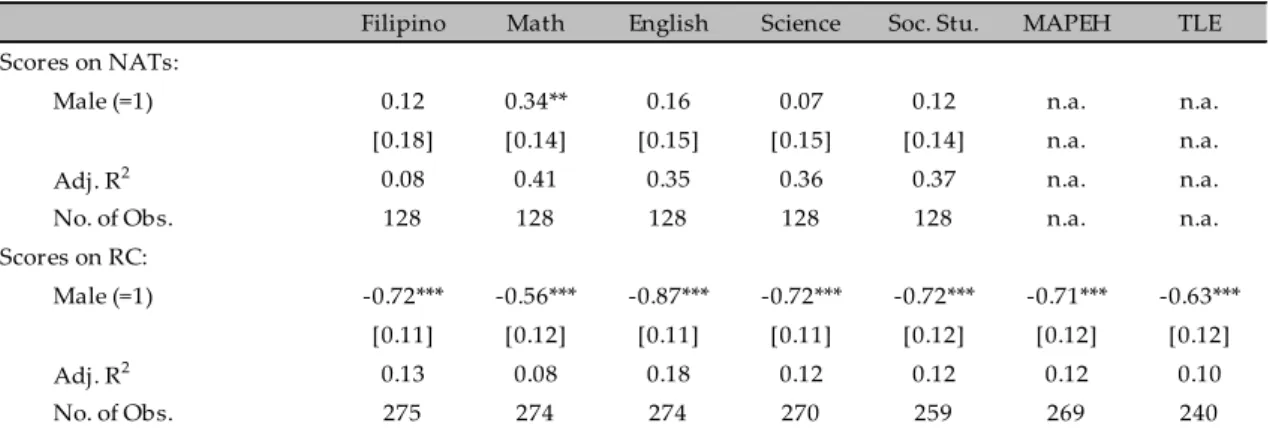
𝑆𝑆𝑖𝑖𝑖𝑖𝑖𝑖= 𝛼𝛼0𝑖𝑖𝑖𝑖+ 𝛼𝛼1𝑖𝑖𝑖𝑖𝑀𝑀𝑖𝑖+ 𝑒𝑒𝑖𝑖𝑖𝑖𝑖𝑖, (1) where the dependent variables 𝑆𝑆𝑖𝑖𝑖𝑖𝑖𝑖 are the standardized z scores of the student 𝑖𝑖, on the test type 𝑗𝑗 = {NATs, RC}, and the set of school subject areas 𝑠𝑠 = {Filipino, math, English, science, social studies, MAPEH, TLE}; 𝛼𝛼0 is the intercept; 𝑀𝑀𝑖𝑖 is the male indicator taking 1 if the individual 𝑖𝑖 is male and 0 otherwise. In Eq. (1), no covariates are controlled. 15 Table 3 shows the results. This simple regression reconfirms the results in Table 2.
20
Table 3: Single Regression of Male Effect on Scores by Test Type and Subject Filipino Math English Science Soc. Stu. MAPEH TLE Scores on NATs:
Male (=1) 0.12 0.34** 0.16 0.07 0.12 n.a. n.a.
[0.18] [0.14] [0.15] [0.15] [0.14] n.a. n.a.
Adj. R2 0.08 0.41 0.35 0.36 0.37 n.a. n.a.
No. of Obs. 128 128 128 128 128 n.a. n.a.
Scores on RC: Male (=1) -0.72*** -0.56*** -0.87*** -0.72*** -0.72*** -0.71*** -0.63*** [0.11] [0.12] [0.11] [0.11] [0.12] [0.12] [0.12] Adj. R2 0.13 0.08 0.18 0.12 0.12 0.12 0.10 No. of Obs. 275 274 274 270 259 269 240 *** 𝑝𝑝 < 0.01; ** 𝑝𝑝 < 0.05; * 𝑝𝑝 < 0.01.
Notes: 1. Soc. Stu. = Social Studies; MAPEH = Music, Arts, Physical Education and Health; TLE =
Technology and Livelihood Education.. Numbers in brackets are robust standard errors. 2. Coefficients of other covariates are omitted in this report for space and visual purposes.
Source: Authors’ own calculation.
Then, we need to put the vector 𝐗𝐗 containing individual characteristics and household-level SES. Appendix Table 1 provides the summary statistics of the dependent and independent variables, and Appendix I describes the variables that are used as covariates. Whereas these variables are gradually added as covariates into the regression models by specifications, the main part of this paper shall omit reporting the coefficients of the other covariates in the tables for the sake of space and visuality. The full report corresponding to the full model is available in Appendix II.
Next, we put some fixed effects in the models to further control for some unobservable factors: 𝜌𝜌 denotes the school year (SY) effect capturing difficulty levels of NATs in each SY that can vary in some SYs; 𝜔𝜔 denotes the region-specific effect to control for unobservable heterogeneity across the barangays; and 𝜑𝜑 denotes the school effect to control for unobservable heterogeneity in attributes of teachers and schools. Particularly, 𝜑𝜑 is decomposed into the overall part, 𝜑𝜑𝑎𝑎𝑎𝑎𝑎𝑎, and the male-specific part, 𝜑𝜑𝑀𝑀 (i.e., 𝜑𝜑 = 𝜑𝜑𝑎𝑎𝑎𝑎𝑎𝑎+ 𝜑𝜑𝑀𝑀). The model is now rewritten as:
𝑆𝑆𝑖𝑖𝑖𝑖𝑖𝑖= 𝛿𝛿𝑖𝑖𝑖𝑖𝑀𝑀𝑖𝑖+ 𝐗𝐗𝐢𝐢𝐢𝐢𝛃𝛃𝐢𝐢𝐣𝐣+ 𝜌𝜌 + 𝜔𝜔 + 𝜑𝜑 + 𝑢𝑢𝑖𝑖𝑖𝑖𝑖𝑖. (2) The idea of exploring sensitivity is like this: Expected signs of 𝛿𝛿s are negative, but when 𝛿𝛿s are negative, the extent of the persistence of 𝛿𝛿 is of our interest. If the individual characteristics and household-level SES already capture sufficiently the influences of being male, then the insignificant relation 𝛿𝛿 = 0 can no longer be rejected. If the added covariates
21
do not yet capture them, 𝛿𝛿 is still expected to be statistically significant and negative. In turn, if the sources of male effect mainly include regional heterogeneity, 𝛿𝛿 will be indistinguishable from taking zero once the region-specific effects are controlled for. Likewise, if the teachers’ in-school factors play highly as the source of male effect, here 𝛿𝛿 will be indistinguishable from taking zero once those school effects are controlled for. In sum, sensitive analysis allows to check the persistence of the male effect as other covariates and fixed effects are added in the specifications.
V. RESULTS
A. Benchmark Results
1. Male effect when other individual and household characteristics are controlled
To begin, Table 4 shows the result of regression analysis when individual and household characteristics are controlled as covariates. The male effects do not qualitatively change from the result of single regression in Table 3. The male effect is not detected on the scores on NATs, except for math where the male effect is positive, but it is robustly persistent on the scores on RC through all the subjects. Whereas male students perform well in math relative to their female counterparts on the blind scores, they underperform on the non-blind scores across all subjects including math, MAPEH, and TLE.
Table 4: Results of Sensitivity Analysis (Covariates = Individual/household characteristics)
Filipino Math English Science Soc. Stu. MAPEH TLE Scores on NATs:
Male (=1) 0.00 0.29* 0.05 0.02 0.08 n.a. n.a.
[0.19] [0.15] [0.15] [0.16] [0.16] n.a. n.a.
Adj. R2 0.23 0.49 0.46 0.44 0.47 n.a. n.a.
No. of Obs. 128 128 128 128 128 n.a. n.a.
Scores on RC: Male (=1) -0.69*** -0.66*** -0.86*** -0.85*** -0.59*** -0.62*** -0.68*** [0.17] [0.17] [0.15] [0.15] [0.18] [0.16] [0.17] Adj. R2 0.23 0.30 0.35 0.35 0.29 0.32 0.31 No. of Obs. 256 255 255 251 241 250 221 *** 𝑝𝑝 < 0.01; ** 𝑝𝑝 < 0.05; * 𝑝𝑝 < 0.01.
Notes: 1. Soc. Stu. = Social Studies; MAPEH = Music, Arts, Physical Education and Health; TLE =
Technology and Livelihood Education.. Numbers in brackets are robust standard errors. 2. Coefficients of other covariates are omitted in this report for space and visual purposes.
22
2. Male effect when the region effect is additionally controlled
Estimations in the results of Table 5 further add the barangay-level region effect to control for unobserved heterogeneity across the living places. The adjusted R2 increases in all the subjects in Table 4, and so the regional heterogeneity has some explanation power on the scores. Yet, the patterns of marginal effect of being male on both scores remain persistent and are qualitatively the same as in Table 4.
Table 5: Results of Sensitivity Analysis (Covariates = Individual and household characteristics + Region effect)
Filipino Math English Science Soc. Stu. MAPEH TLE Scores on NATs:
Male (=1) 0.00 0.29* 0.05 0.02 0.08 n.a. n.a.
[0.19] [0.15] [0.15] [0.16] [0.16] n.a. n.a.
Adj. R2 0.21 0.50 0.46 0.43 0.45 n.a. n.a.
No. of Obs. 128 128 128 128 128 n.a. n.a.
Scores on RC: Male (=1) -0.77*** -0.61*** -0.94*** -0.83*** -0.63*** -0.74*** -0.64*** [0.15] [0.13] [0.13] [0.13] [0.15] [0.14] [0.15] Adj. R2 0.25 0.35 0.37 0.38 0.33 0.31 0.30 No. of Obs. 256 255 255 251 241 250 221 *** 𝑝𝑝 < 0.01; ** 𝑝𝑝 < 0.05; * 𝑝𝑝 < 0.01.
Notes: 1. Soc. Stu. = Social Studies; MAPEH = Music, Arts, Physical Education and Health; TLE =
Technology and Livelihood Education.. Numbers in brackets are robust standard errors.
2. Coefficients of other covariates are omitted in this report for space and visual purposes.
Source: Authors’ own calculation.
3. Male effect when the school effect is additionally controlled
Next, estimations in the results of Table 6 further add the school effect to control for unobserved heterogeneity on school attributes. As compared to Table 5, the positive male effect on math on the blind scores turns out to be insignificant here. Yet, the male effect still remains persistently negative through all subjects on the non-blind scores.
4. Male effect when male-specific part of school effect is isolated and additionally controlled Furthermore, to isolate unobserved heterogeneity that can affect selectively on male students in schools, the male-specific part of school effect, 𝜑𝜑𝑀𝑀, is set apart and added in the
23
equation. The results are shown in Table 7. There are two noteworthy changes in Table 7. First, the male effect on NATs (blind scores) here becomes positive once again for math and positive recently for English and science (in the upper stage of Table 7). Second, the male effect is consistently negative so far, but vanishes on scores on RC regardless of the subject (in the lower stage of Table 7).
Initially, there was minor gender difference on the scores on NATs when comparing the mean values. This has remained even after other individual- and household-level characteristics, unobserved heterogeneities across living places and schools, and some school year-specific difficulty levels are controlled at constant. However, once 𝜑𝜑𝑀𝑀 is also controlled, the male effect becomes positive on math, English, and science in Table 7.
Table 7 shows that, if 𝜑𝜑𝑀𝑀, say, male-specific but directly unobserved environment for male students in schools, gets controlled at constant, being male alone would predict higher scores of math, English, and science on the NAT than their female counterparts. However, the estimation including 𝜑𝜑𝑀𝑀 indicated the “underestimation” of the male effect until the previous specifications without 𝜑𝜑𝑀𝑀 toward the direction to zero unless the former effect is controlled. Namely, some sort of within-school environment selectively to male students may be masking such potentiality of male students. In other words, the source of the considerable part of the negative male effect that has been persistently detected on the RC scores is in the schools.
Table 6: Results of Sensitivity Analysis (Covariates = Individual and household characteristics + Region effect + School effect)
Filipino Math English Science Soc. Stu. MAPEH TLE Scores on NATs:
Male (=1) -0.18 0.16 -0.07 -0.07 -0.01 n.a. n.a.
[0.20] [0.16] [0.17] [0.17] [0.15] n.a. n.a.
Adj. R2 0.29 0.57 0.53 0.49 0.51 n.a. n.a.
No. of Obs. 128 128 128 128 128 n.a. n.a.
Scores on RC: Male (=1) -0.69*** -0.66*** -0.86*** -0.85*** -0.59*** -0.62*** -0.68*** [0.17] [0.17] [0.15] [0.15] [0.18] [0.16] [0.17] Adj. R2 0.28 0.29 0.38 0.40 0.25 0.30 0.29 No. of Obs. 236 235 236 231 221 231 207 *** 𝑝𝑝 < 0.01; ** 𝑝𝑝 < 0.05; * 𝑝𝑝 < 0.01.
Notes: 1. Soc. Stu. = Social Studies; MAPEH = Music, Arts, Physical Education and Health; TLE =
Technology and Livelihood Education.. Numbers in brackets are robust standard errors.
2. Coefficients of other covariates are omitted in this report for space and visual purposes.
24
Table 7: Results of Sensitivity Analysis (Covariates = Individual and household characteristics + Region effect + School effect + Male-specific School effect)
Filipino Math English Science Soc. Stu. MAPEH TLE Scores on NATs:
Male (=1) 1.30 1.47*** 1.29* 1.23** 0.87 n.a. n.a.
[0.82] [0.55] [0.71] [0.49] [0.66] n.a. n.a.
Adj. R2 0.32 0.61 0.54 0.51 0.52 n.a. n.a.
No. of Obs. 128 128 128 128 128 n.a. n.a.
Scores on RC: Male (=1) 1.15 0.02 1.08 1.03 -0.77 0.39 0.14 [0.83] [0.92] [0.75] [0.78] [0.90] [0.99] [1.00] Adj. R2 0.24 0.26 0.37 0.41 0.22 0.27 0.25 No. of Obs. 236 235 236 231 221 231 207 *** 𝑝𝑝 < 0.01; ** 𝑝𝑝 < 0.05; * 𝑝𝑝 < 0.01.
Notes: 1. Soc. Stu. = Social Studies; MAPEH = Music, Arts, Physical Education and Health; TLE =
Technology and Livelihood Education.. Numbers in brackets are robust standard errors.
2. Coefficients of other covariates are omitted in this report for space and visual purposes.
Source: Authors’ own calculation.
Likewise, on the teacher-based scores on RC, being male alone would no longer predict a negative or a positive consequence when controls include 𝜑𝜑𝑀𝑀, regardless of the subject. Given the persistence of negative coefficients of being male until the previous specifications without 𝜑𝜑𝑀𝑀, the male effect alone, until the previous specification, has been “underestimated” toward a downward direction from zero to negative. Eventually, the results in Table 7 consistently explain that the male-specific part of school effect represents a considerable part of the 𝛿𝛿s, say, male effect that was estimated to be persistently negative until the last specification. This finding further supports that the male students are selectively facing some sort of unfavorable bias in schools.
B. The Same-student Comparisons by Subtracting Blind and Non-blind Scores
The benchmark analyses in the previous subsection yield the results that the male students are significantly underperforming in the non-blind scores but are not doing so in the blind scores with various specifications to put additional controls. The results come from the separate estimations of the scores on NATs and on RC, respectively. Whereas the separate estimations indicate the features of each score, it is more straightforward to directly look at the differences between the two score of the same individuals. To do so, by taking advantage of statistical properties of standardized z scores, we subtract the scores on RC from the scores on NATs to get the differences and directly use the variable for regression analysis. This
25
subsection further explores the robustness checks of additional possible arrangements to test whether the obtained results drastically change qualitatively. The model rewrites:
Δ𝑆𝑆𝑖𝑖𝑖𝑖 = 𝛿𝛿𝑖𝑖′𝑀𝑀𝑖𝑖+ 𝐗𝐗𝛃𝛃𝐣𝐣′ + 𝜌𝜌 + 𝜔𝜔 + 𝜑𝜑 + 𝑢𝑢𝑖𝑖𝑖𝑖′ . (3) where Δ𝑆𝑆𝑖𝑖𝑖𝑖 ≡ 𝑆𝑆𝑖𝑖,𝑅𝑅𝑅𝑅,𝑖𝑖− 𝑆𝑆𝑖𝑖,𝑁𝑁𝑁𝑁𝑁𝑁,𝑖𝑖. Each coefficient means:
𝛿𝛿𝑖𝑖′= 𝛿𝛿𝑅𝑅𝑅𝑅,𝑖𝑖− 𝛿𝛿𝑁𝑁𝑁𝑁𝑁𝑁,𝑖𝑖 and 𝛃𝛃𝐣𝐣′ = 𝛃𝛃𝐑𝐑𝐑𝐑,𝐣𝐣− 𝛃𝛃𝐍𝐍𝐍𝐍𝐍𝐍,𝐣𝐣, (4) where we are continuously interested in the significance and signs of 𝛿𝛿𝑖𝑖′. If 𝛿𝛿𝑖𝑖′⋚ 0, then
𝛿𝛿
𝑅𝑅𝑅𝑅,𝑖𝑖⋚𝛿𝛿
𝑁𝑁𝑁𝑁𝑁𝑁,𝑖𝑖.Table 8 summarizes the descriptive statistics of Δ𝑆𝑆, and the distributions of Δ𝑆𝑆 by school subjects are drawn in Fig. 5 for the visual information. The differences can only be calculated on the subsample whose scores on NATs were tracked. If Δ𝑆𝑆𝑖𝑖𝑖𝑖> 0, it means that the individual 𝑖𝑖 takes higher z score on RC on the subject 𝑆𝑆 than that on NATs, and if Δ𝑆𝑆𝑖𝑖𝑖𝑖< 0, it means vice versa. This Table 8 still shows that Δ𝑆𝑆 of female individuals are higher than Δ𝑆𝑆 of males across all five subjects.16 It should be noted here that the properties of Δ𝑆𝑆 are not totally the same as z scores because Δ𝑆𝑆𝑖𝑖𝑖𝑖 ≡ 𝑆𝑆𝑖𝑖,𝑅𝑅𝑅𝑅,𝑖𝑖− 𝑆𝑆𝑖𝑖,𝑁𝑁𝑁𝑁𝑁𝑁,𝑖𝑖, not necessarily guaranteeing that the means of Δ𝑆𝑆 become zero and SDs of Δ𝑆𝑆 become one.
Table 8: Descriptive Statistics of the Differences between the Two Scores by Subject Δ Score (RD - NAT) Filipino 125 0.35 -0.10 0.46 Math 123 0.30 -0.09 0.39 English 125 0.34 -0.12 0.46 Science 121 0.47 0.05 0.42 Social Studies 114 0.31 0.10 0.21
Scores and Subjects Obs Female (F) Male (M) Δ(F - M)
Source: Author’s own calculations.
Table 9 displays the results of estimating Δ𝑆𝑆 as dependent variables by specifications similar to the ones in the benchmark analyses: Specification (1) is the single
26
regression only with the male indicator, corresponding to Table 3. Specification (2) adds the individual and household characteristics as the covariates, corresponding to Table 4. Specification (3) further adds the region effect, corresponding to Table 5, and likewise, specification (4) additionally controls for the school effect, corresponding to Table 6. Finally, specification (5) adds the 𝜑𝜑𝑀𝑀, corresponding to Table 7.
Figure 5: Distributions of Differences Between the Two Scores by Subject
Source: Author’s own calculations.
Results in Table 9 show that the male effect in specifications (1) and (2) are significantly negative except for social studies. In turn, in specifications (3) and (4), the signs of male effect estimated remain significantly negative for English and science. Then, in specification (5), it is noteworthy that the male effects are detected as negative across all the subjects, including social studies.
Based on the logic in interpreting the transitive change from Table 6 to Table 7, the results from the benchmark analysis are qualitatively confirmed also by more straightforward estimations using the differences between the two scores and are the case for English and science. In contrast to the benchmark analyses of separate estimations, such
0 5 10 Frequency -2 0 2 4 RC - NAT (Filipino) Δ Filipino 0 5 10 Frequency -2 0 2 4 RC - NAT (Math) Δ Math 0 5 10 15 Frequency -4 -2 0 2 4 RC - NAT (English) Δ English 0 5 10 Frequency -2 -1 0 1 2 3 RC - NAT (Science) Δ Science 0 2 4 6 8 Frequency -2 -1 0 1 2 3 RC - NAT (Social Studies)
Δ Social Studies
27
unfavorable treatments against male students remain or become negative across all subjects even when 𝜑𝜑𝑀𝑀 is controlled for.
Table 9: Sensitivity Analysis of Differences between Scores on RC and on NAT by Subject
Filipino Math English Science Soc. Stu. (1) Covariates = None
Male (=1) -0.47** -0.40* -0.51*** -0.45** -0.28
[0.20] [0.22] [0.19] [0.19] [0.20]
Adj. R2 0.04 0.03 0.11 0.04 0.14
No. of Obs. 125 123 125 121 114
(2) Covariates = Individual, Household SES
Male (=1) -0.52* -0.50* -0.89*** -0.66*** -0.46
[0.27] [0.29] [0.23] [0.24] [0.28]
Adj. R2 0.17 0.19 0.22 0.17 0.22
No. of Obs. 118 116 118 114 107
(3) Covariates = (2) + Region effect
Male (=1) -0.43 -0.46 -0.87*** -0.64** -0.42
[0.30] [0.33] [0.25] [0.25] [0.30]
Adj. R2 0.16 0.14 0.20 0.17 0.21
No. of Obs. 118 116 118 114 107
(4) Covariates = (3) + School effect
Male (=1) -0.29 -0.40 -0.81*** -0.79*** -0.44
[0.31] [0.37] [0.28] [0.26] [0.33]
Adj. R2 0.27 0.23 0.27 0.25 0.20
No. of Obs. 118 116 118 114 107
(5) Covariates = (4) + Male-specific School effect
Male (=1) -1.32* -3.23*** -1.41** -1.95*** -2.24*** [0.76] [0.70] [0.69] [0.57] [0.66] Adj. R2 0.22 0.25 0.25 0.24 0.19 No. of Obs. 118 116 118 114 107 Specifications *** 𝑝𝑝 < 0.01; ** 𝑝𝑝 < 0.05; * 𝑝𝑝 < 0.01.
Notes: 1. Soc. Stu. = Social Studies. Numbers in brackets are robust standard errors.
2. Coefficients of other covariates are omitted in this report for space and visual purposes.
Source: Authors’ own calculation.
Unlike the separate estimations of blind scores and non-blind scores, the direct estimations of Δ𝑆𝑆 (or joint estimations of two scores by subtractions) now show that even an inclusion of 𝜑𝜑𝑀𝑀 does not sufficiently capture the male effect estimated to be negative. The two-score differences are assumed to more directly capture the effect brought by the score markers (teachers) who know who the evaluated are. In contrast to the results from the benchmark analyses, the results in Table 9 reinforce our hypothesis that male (female)
28
students are more likely to be treated relatively unfavorably (favorably) when students are rated in a non-blind rating system in which teachers know who the evaluated are.
C. What More Do We Need to Consider?
So far, the benchmark analyses and direct estimations of two-score differences imply supportive results of our hypothesis. This subsection explores and examines the obtained results from some critical perspectives, to ascertain the arguments. Let us specifically discuss the selection bias, the students’ studiousness, and the teachers’ genders as alternative factors.
Table 10: Probit Analysis (Probability of the tracking scores on NATs)
Independent Variables Coef.
Male (=1) 1.21 [1.54] Grade -0.08 [0.07] Male×Grade -0.08 [0.10] z score on RC, Filipino -0.07 [0.20]
Male×z score on RC, Filipino 0.01
[0.29]
z score on RC, math -0.14
[0.18]
Male×z score on RC, math -0.3
[0.29]
z score on RC, Englsih -0.48**
[0.24]
Male×z score on RC, English 0.89***
[0.34]
z score on RC, science 0.43*
[0.23]
Male×z score on RC, science -0.14
[0.35]
z score on RC, social studies 0.2
[0.21] Male×z score on RC, social studies 0.06
[0.30]
Intercept 1.5
[1.12]
Regional effect Yes
Pseudo R2 0.17
No. of Obs. 202
Note: Numbers in brackets are robust standard errors. Source: Author’s own calculation.
29 1. Would the tracking of scores on NATs matter?
In directly estimating the two-score differences, the subsample whose Δ𝑆𝑆 are observed is used. This subsample is the one whose scores on NATs were tracked. As in Section III, the scores on NATs were tracked by the BEA-DepED at their best efforts in correspondence with the author’s data request. Admittedly, when tracking students, the BEA-DepED had neither any intention nor incentive to omit and exclude specific students. In this sense, the success or failure of tracking the students is out of our control and choice. Nevertheless, the ex post outcome implies that the gender gaps (ΔF − M) get smaller in the Table 8 than those in Table 2. Possible reasons may include the following: (1) the non-tracked students recently migrated to our study areas in Marinduque Province as the tracking was done based on the individual names and current home address, or (2) some students did not take the NATs.
For (1), it is least possible according to our field observations. Our sampling framework was based on the master list information on the CBMS conducted in 2015, and our own household survey was conducted in 2018. We found only four households that were not listed in the CBMS out of all the sample households. Moreover, out of those four households, only one household’s children’s NAT scores were not tracked by the BEA-DepED. The migration profile is thus thought to be least associated with the tracking rates.
In turn, the possibility of (2) can be more considerable than (1). In principle, it is an obligation for every eligible student to take the NAT regardless if he/she is enrolled in a public or private school. In practice, however, some local teachers reported to the author that some students might not take the NAT because they were absent on the date of the examination. Teachers let the students take the NAT, but there is no explicit penalty even if a student did not take it.
Therefore, by probit analysis, the probability of the NAT scores being tracked is estimated. The male indicator is an independent variable. In addition, the score information on RC of the same school subject (Filipino, math, English, science, and social studies) is also used as independent variables to consider the possibility of associations with lower academic performances. Additionally, the interaction terms of male indicator with each score information on RC are also used in the independent variables.
Table 10 shows the results. They do not support that neither sex influences the probability of NAT scores being tracked, yet there is a gender-heterogenetic association in English performance. The scores on NATs of those male students better performing English are more likely to be tracked than the female students who perform similarly. For science performance, there is a gender-homogeneous association, as the scores on NATs of those