Diversities and Disparities among
Female-Headed Households in Rural Malawi
著者
Takane Tsutomu
権利
Copyrights 日本貿易振興機構(ジェトロ)アジア
経済研究所 / Institute of Developing
Economies, Japan External Trade Organization
(IDE-JETRO) http://www.ide.go.jp
journal or
publication title
IDE Discussion Paper
volume
124
year
2007-10-01
INSTITUTE OF DEVELOPING ECONOMIES
IDE Discussion Papers are preliminary materials circulated to stimulate discussions and critical comments
IDE DISCUSSION PAPER No. 124
Diversities and Disparities among
Female-Headed Households in Rural
Malawi
Tsutomu TAKANE*
October 2007
The Institute of Developing Economies (IDE) is a semigovernmental, nonpartisan, nonprofit research institute, founded in 1958. The Institute merged with the Japan External Trade Organization (JETRO) on July 1, 1998.
The Institute conducts basic and comprehensive studies on economic and related affairs in all developing countries and regions, including Asia, the Middle East, Africa, Latin America, Oceania, and Eastern Europe.
The views expressed in this publication are those of the author(s). Publication does not imply endorsement by the Institute of Developing Economies of any of the views expressed within.
* Senior Research Fellow, African Studies Group, IDE-JETRO
© 2007 by Institute of Developing Economies, JETRO INSTITUTE OF DEVELOPING ECONOMIES (IDE), JETRO 3-2-2, WAKABA,MIHAMA-KU,CHIBA-SHI
Abstract
Using data obtained from a survey carried out in six villages in various parts of rural Malawi, this paper examines some of the main characteristics of female-headed households. In the study villages, most female-headed households are in a disadvantageous position relative to their male counterparts in terms of labour endowment, farm size, and agricultural productivity. The high cost of inputs, especially of fertilizer, prevents resource-poor female-headed households from improving maize self-sufficiency through increased productivity and from engaging in high-return agriculture such as tobacco production. The paper also shows that there are marked disparities within the category of female-headed households. Factors that enable some female-headed households to achieve high income include the availability of high-return nonfarm income opportunities, use of social networks to obtain labour and income opportunities, land acquisition through flexible applications of inheritance rules, and the existence of informal tobacco marketing. Livelihood diversification is adopted by both male- and female-headed households, but many of the female-headed households engage in low-return and low-entry-barrier activities such as agricultural wage labour. On the other hand, the high off-farm income in the wealthier female-headed households enables them to purchase fertilizer for own-farm production, contributing to an improvement in productivity and resultant increases in their total income.
Keywords: gender, livelihoods, farm income, off-farm income, poverty, Malawi, Africa
Diversities and Disparities among Female-Headed Households
in Rural Malawi
Tsutomu Takane October 2007
INTRODUCTION
Malawi is a small, agriculture-dependent country whose population is predominantly rural. With a per capita gross domestic income of only 160 dollars in 2005, it is one of the poorest countries in the world (World Bank, 2007). According to a government report (Government of Malawi, 2000: 17-18), 25 per cent of the households in Malawi are headed by women, and 63.5 per cent of rural female-headed households live below the poverty line.
This paper examines some of the main characteristics of female-headed households in rural Malawi. The existing literature has pointed out that female-headed households in developing countries tended to be poorer than male-headed households (Buvinić and Gupta, 1997; Quisumbing et al., 2001), and a similar conclusion was drawn in the case of Malawi (Chipande, 1987). The present study, also, indicates that on average, female-headed households are in a disadvantageous position relative to their male counterparts in many respects. Nevertheless, as several scholars have pointed out (Jackson, 1996; O'Laughlin, 1998; Razavi, 1999; Chant, 2004), we need to go beyond the simple equation of female-headed households, or women, with the poor. The present study highlights the existence of a wide disparity within the category of female-headed households, with some households succeeding in improving their economic status. Rather than engaging in dualistic comparisons between male-headed and female-headed households and simply deciding which group is poorer, this paper provides a contextualized understanding of the reasons underlying such disparities and seeks to clarify the way in which some female heads have succeeded in evading poverty while others have failed.
economic liberalization.1 Since the 1990s, many studies have focused on the effects of structural adjustment programs and economic liberalization policies on women farmers in Africa (Afshar and Dennis, 1992; Gladwin, 1991; Palmer, 1991) and have pointed out that the benefits of liberalization have not reached rural women. For example, Due and Gladwin (1991) have argued that female farmers were unable to take advantage of liberalization because they had less access to land, labour, and modern inputs than their male counterparts. Moreover, the production of most export crops was in the hands of male farmers and the women were excluded from it. Drawing from detailed case studies, the present paper examines the relevance of these arguments for rural Malawi, and also expands the focus of the study to include the off-farm economic activities of rural women.
The paper is organized as follows. The next section briefly reviews the policy background relating to the smallholder sector in Malawi. Section three describes the method of fieldwork. Section four depicts some features of female-headed households by comparing the socio-economic characteristics of male- and female-headed households. This is followed by an examination of the methods by which land and labour are acquired by female-headed households. Sections six and seven focus respectively on tobacco production and the off-farm economic activities of female-headed households. The last section provides a conclusion.
POLICY BACKGROUND
Throughout the colonial and post-colonial periods until the 1980s, government policies in Malawi supported mainly large-estate agriculture at the expense of the smallholder sector. For example, in response to the rapid growth of smallholder tobacco production in the 1920s, the colonial government established the Native Tobacco Board (NTB). The NTB restricted smallholder production by registering African growers, limiting the size of their holdings, monopolizing the purchase of tobacco grown by Africans, and excluding smallholders from burley tobacco production. These restrictions discouraged smallholder tobacco production and in turn protected the vested interests of the European estates (McCracken, 1983). Furthermore, the establishment of the Maize Control Board in 1946 protected European settlers who produced export
1
Important village-level studies on the livelihoods of Malawian smallholder households in the era of liberalization include, among others, Ellis et al. (2003), Orr and Mwale (2001), Peters (2006). Whitehead and Kabeer (2001) provide a good review of gender and livelihoods in rural Africa.
crops. This was done by supplying relatively large amounts of food to Africans who worked on the large estates, and by discouraging surplus maize production by Africans, both of which policies ensured a stable supply of labour to the estates (Vaughan, 1987). The end of colonial occupation in 1964 did not change the government's discriminatory policies towards the smallholder sector. The independent government continued to support production by large estates owned by politically-connected Malawians, while imposing various restrictions on smallholders. Two major institutional arrangements that deterred the development of smallholder production were the Special Crops Act, which forbade the cultivation of major cash crops such as burley tobacco by smallholders, and the Agricultural Development and Marketing Corporation (ADMARC), which monopolized the inputs of smallholders and the marketing of their produce. These restrictions resulted in the stagnation of smallholder production and forced a large proportion of the rural population to become a cheap labour source for the estate sector (Kydd and Christiansen, 1982).
After the introduction of structural adjustment programs in the 1980s, the government implemented a series of reforms that brought about major changes in the smallholder sector. These included the deregulation of marketing activities, the reconstruction of input and output price regimes, and the restructuring of state marketing agencies (Chilowa, 1998; Harrigan, 2003). In the food crop sector, ADMARC ceased to be the sole marketing agent for smallholder produce once licensed private traders were allowed to enter the market in 1987. Although this liberalization merely formalized the informal activities of existing small traders, it also stimulated the emergence of new large-scale private companies in the market. By the mid-1990s, licensing was no longer required to handle the smallholder crops, and the maize price band was abandoned in 2000 (Devereux and Tiba, 2007; Mvula et al., 2003).
The liberalization of produce marketing was followed by further deregulation of agricultural inputs in the 1990s. The marketing of hybrid maize seeds was liberalized in 1993 and subsidies were removed in 1994. Similarly, private companies were allowed to market fertilizer after 1994 and subsidies were removed in 1995 (Smale and Phiri, 1998). The removal of subsidies together with the depreciation of the Malawi Kwacha in the 1990s resulted in sharp price increases for seeds and fertilizer, which adversely affected smallholders’ access to agricultural inputs.
Credit institutions for smallholder maize production were also changed. Until the early 1990s, most farmers received improved seeds and fertilizer on credit at subsidized prices and low interest rates from the Smallholder Agricultural Credit Administration (SACA), a governmental institution. Farmers received the inputs through ADMARC and repaid their loans when they delivered their outputs through ADMARC. After the
collapse of SACA credit institutions in 1994 due to low repayment rates, SACA was converted into the Malawi Rural Finance Company (MRFC), a limited liability finance company. The MRFC used market-determined interest rates and shifted their loan target to tobacco farmers. As a result, most smallholders faced difficulties in obtaining credit for maize production.
In the tobacco sector, major reforms occurred in the early 1990s when the Special Crops Act of 1972 was amended to allow smallholders to grow burley tobacco under a quota system.2 In 1990/1991, 7,600 smallholders were registered to grow burley tobacco on a pilot basis (Zeller et al., 1998). Initially, farmers were required to sell their tobacco to ADMARC, but later they were organized into clubs and given direct access to auction floors. In 1993/1994, more than 30,000 smallholders were organized under 1,318 clubs (Van Donge, 2002). Thereafter, the number of smallholder tobacco producers increased and smallholder tobacco production expanded dramatically in the 1990s. From 1992 through 1995, smallholders produced, on average, only 23% of the total tobacco crop in Malawi. The share reached 72% in the years 2001–2004.3 According to one estimate (Jaffee, 2003), there were 315,000 to 330,000 smallholders producing tobacco in the early 2000s.
FIELDWORK METHOD AND STUDY LOCATIONS
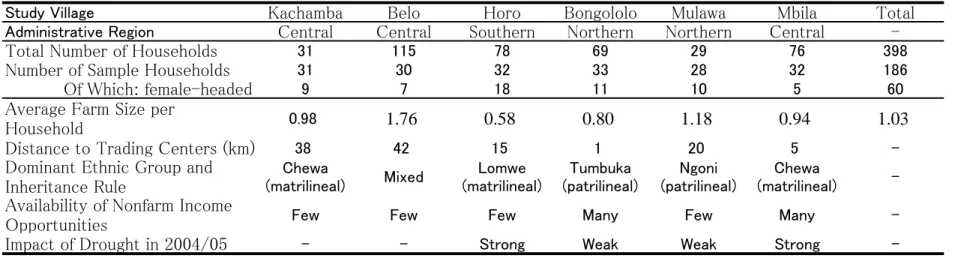
Fieldwork for this study was carried out in six villages in various parts of Malawi (Figure 1), namely Kachamba (Mchinji District), Belo (Mangochi District), Horo (Phalombe District), Bongololo (Rumphi District), Mulawa (Mzimba District), and Mbila (Kasungu District). Care was taken to choose villages that represented several socioeconomic characteristics, such as location, the predominant ethnic group, the degree of population pressure on the land, variations in access to nonfarm4 activities, and distance from trading centers. The aim of this selection procedure was to include various socioeconomic settings in which smallholder production is taking place, and to
2
The quota system was later abandoned in favor of full liberalization in 1996/1997.
3
The figures are calculated using the data derived from the Government of Malawi (various issues a; various issues b).
4
In this paper, 'farm income' refers to income generated from own-account farming (crop and livestock), while 'nonfarm income' refers to nonfarm wage or salary employment, nonfarm self employment income, rental income, and transfers and remittances. On the other hand, 'off-farm income' refers to income from all non-own-account farming sources including agricultural wage income.
provide a location- and context-specific understanding of livelihood circumstances in various areas of rural Malawi. No claim is made, therefore, that the results of this study represent national patterns in a statistical sense.
Fieldwork in Kachamba and Belo was undertaken between August and October 2004, and data were obtained for the 2003/2004 agricultural season, when agricultural production was normal. In the remaining four villages, data were collected between May and September 2005 for the 2004/05 agricultural season, when a severe crop failure occurred due to erratic rain. A structured questionnaire was used in the survey, and the author attended, recorded, and reviewed all interviews. In addition, farms operated by sample households were measured using global positioning systems to obtain accurate data on the size of the plots.
The sampling framework consisted of all the households in each village. The households were divided into two categories: those that had grown tobacco in the previous season and those that had not. Equal numbers of households were randomly selected from both groups. In Kachamba, however, all households were interviewed because the sample frame was small. For the same reason, all households in Mulawa, except one, were interviewed.5 In Bongololo, the number of sample households that grew tobacco exceeded those that did not, there being only six households that did not. The total sample size for all villages was 186 households, which comprised 116 tobacco-growing and 70 non-tobacco-growing households. There were 60 female-headed households in the sample, constituting 32 per cent of the total (Table 1).6 In all of the study villages, farmers gave priority to the production of maize, the staple food. It is estimated that 64 per cent of the total area farmed was allocated to maize production. The second most important crop in terms of allocated area was tobacco, which was estimated to occupy about 19 per cent of the total area farmed. The percentage of tobacco-growing households in the six villages was 59 per cent.
Average farm size varied greatly (Table 1). Households in Belo on average farmed 1.76 hectares, while those in Horo farmed only 0.58 of a hectare. The average for all households was 1.03 hectares. The differences stem from the unique history of each village and the resultant degree of population pressure on the land.
5
One household was not available for interview at the time of the survey.
6
In accordance with the major literature in this field (Dolan 2004; Peters 1995; Kennedy and Peters 1992), a female-headed household is defined here to include both a de jure
female-headed household in which a woman is widowed, unmarried, or divorced and has no legal male partner, and a de facto female-headed household in which a woman is married but her husband is mostly or permanently away.
CHARACTERISTICS OF FEMALE-HEADED HOUSEHOLDS
Differences Between Male- and Female-Headed Households
Table 2 shows the comparison of demographic characteristics, asset ownership, and own-farm production of male and female-headed households. In the table, 'FHH-(A)' represents all female-headed households in the sample, while 'FHH-(B)' excludes fourteen cases of households headed by elderly women whose children resided in the same village. The distinction is made because elderly women may be economically less active and earn less income, but their welfare is secure because they can receive support from mature children residing in the same village. Inclusion of households headed by elderly women therefore may distort the picture of younger female-headed households who cannot receive such support from mature children.
Several distinct features of female-headed households are apparent in Table 2. First, the average income per adult equivalent unit (AEU) of the female-headed households tends to be less than that of male-headed households. Male-headed households earned more income per AEU than their female counterparts in five villages, and the differences are statistically significant in three villages. The only exception is Bongololo, where female-headed households earned more income than male-headed households. This was because many female-headed households in the village earned a high income from nonfarm activities, a feature that will be discussed later.
Second, the female-headed households possess lower asset endowments than their male counterparts. For example, the numbers of household members who were 15 years old or older were fewer in the female-headed households than in their male-headed counterparts in each village. This was due to the absence of husbands in the female-headed households. As a result, the dependency ratios of the female-headed households in five villages were higher than those of the male-headed households, and the differences were statistically significant in two villages. A similar tendency can be observed in respect of access to land, as is apparent in Table 2, which indicates that male-headed households possessed larger landholdings than their female counterparts. The difference in livestock ownership is not statistically significant between male-headed households and FHH-(A), but it becomes significant after excluding households headed by elderly women. This is because the FHH-(A) sample includes an elderly woman who inherited six cattle from her late husband, increasing the overall average in the FHH-(A) category. On the other hand, the difference in education years is statistically significant between male-headed households and FHH-(A), but is insignificant between male-headed households and FHH-(B). This stems from the fact
that in the latter case, households headed by elderly women who hardly attended school are excluded. Overall, female-headed households faced more labour and land constraints, possessed fewer livestock, and (to a lesser extent) had less education than their male counterparts.7
Third, male and female-headed households differ as regards performance in agricultural production. Across the six villages, farm sizes of male-headed households are significantly larger than those of female-headed households. Better endowments of land and labour in the male-headed households may explain the difference in farm sizes. Tobacco production is more likely to be taken up by male-headed households than their female counterparts. Tobacco production requires more labour and working capital than the cultivation of other crops. In addition, the percentage of households growing tobacco increases as the landholdings become larger. This is because households give priority to maize over other crops in order to secure food for their own consumption. Therefore, those with insufficient land are unwilling to venture into tobacco production at the expense of maize production. As the female-headed households have less labour, land, and income per AEU, they encounter more entry barriers in tobacco production than their male counterparts. In addition, women tend to avoid labour-intensive crops such as tobacco because they face difficulties in combining productive and reproductive labour in circumstances where few economically active household members are available (Chipande, 1987). In our study, the exception was the case of Bongololo, where 89 per cent of the sample of female-headed households grew tobacco. This entry into tobacco cultivation was made possible by the availability of high-return nonfarm income in the village that enabled female farmers to employ hired labour to compensate for the lack of family labour, and by the high rate of formal credit use that provided sufficient ready cash to purchase expensive inputs.
By contrast with tobacco production with its high entry barriers, maize was grown by all sample households. However, the productivity and the degree of self-sufficiency of maize differed markedly between male-headed and female-headed households. Across the sample households, the difference in average maize production per hectare between the male-headed households (1,048 kilograms) and female-headed households (626 kilograms) is statistically significant. This may partly be explained by the difference in fertilizer application (100 kilograms per hectare for male-headed and 59 kilograms for female-headed households). The degree of maize self-sufficiency is also higher in the
7
Nevertheless, one should not jump to the conclusion that adjusting the gender distribution of resources will reduce the overall poverty in rural Africa. O'Laughlin (2007) provides a critique on such an oversimplified, yet influential, view on gender and development.
male-headed households, which produced 221 kilograms per AEU (a level that exceeded the minimum consumption requirement of about 200 kilograms per year), while female-headed households produced only 113 kilograms per AEU. Thus, female-headed households applied less fertilizer and had less yields in maize production, and achieved lower self-sufficiency in maize than their male counterparts.
Disparities Within the Female-Headed Households
In addition to the disparities between male-headed and female-headed households, important differences are found within the category of female-headed households. To examine the variability of household income among the female-headed households, we ranked all sample households in each study village according to income per AEU, divided them into four equal groups, and checked the distribution of female-headed households among the income quartiles (Table 3). The table indicates that although the majority of female-headed households are ranked in the lower quartiles (quartile 3 and 4), 40 per cent of them are in the upper quartiles (quartile 1 and 2). It is noteworthy that 18 per cent of female-headed households are in the top income quartile. A simple comparison of average income between male-headed and female-headed households may conceal these important differences within the category of female-headed households.
To examine the factors underlying the income disparities among the female-headed households, some examples of livelihood strategies adopted by the households in the top and bottom income quartiles are given below. Specifically, we look at the differences in own-farm production, labour deployment, social networks, and nonfarm income.
Case: Female-headed household in the bottom income quartile (1)
EM was a 60-year-old widow in Belo. EM and her husband had migrated to the village in 1993, but the husband died in 2001. Although EM had two mature sons, she lost contact with them after they left village some time ago. At the time of the survey, EM lived with four young grandchildren whose parents had died, and she had no relatives in the village. She did all the farm work on her own on her 1.55-hectare holding of maize, sorghum, and pigeon pea. No fertilizer was applied on the farm, and maize production per hectare on her farm was 161 kilograms, a level much lower than the village average of 485 kilograms. In order to supplement the low maize yield, she engaged in agricultural wage labour four times per year and was paid with maize. Her own-farm production and her agricultural wage income were her only sources of income, and the AEU income of the household was ranked 29th among the 30 samples in the
village.
Case: Female-headed household in the bottom income quartile (2)
The 44-year-old MP was a head of household whose per AEU income was the lowest among the Belo samples. She migrated to the village in 1987 with her husband, who later married another woman and left Belo. At the time of the survey, she managed a 0.72-hectare farm on which she grew maize and chili paper. As she applied no fertilizer, the maize yield per hectare from her farm (240 kilograms) was much lower than the village average. MP lived with her four children whose ages were between 7 and 16 years old. She had another daughter who married and put up a house next to MP's house. The daughter's household was relatively better-off and ranked in the income quartile 2. This was because they managed a relatively large farm of 1.9 hectares and the daughter's husband earned nonfarm income as a carpenter.
The two cases show some important similarities in the livelihood portfolios adopted by poorer female-headed households. Their income sources were restricted to own-farm production (mainly maize) and agricultural wage labour; no fertilizer was applied to own-farm production; and the female head was the only income earner in a household with many dependent members. These features in turn mean that the households lack the preconditions for upward wealth mobility, such as production of high-value crops, use of productivity-enhancing inputs, engagement in high-return nonfarm activities, and sufficient family labour.
On the other hand, the two cases showed a contrast so far as access to social networks was concerned. In the first case, the female head had no relatives in the village, and had lost contact with her two sons. This meant that the household could not expect any support based on familial ties. By contrast, the female head in the second case lived next to her married daughter's house, and thus had access to a social safety net that could be used in times of difficulty. Both female-headed households were poor in terms of household income levels, but the existence or non-existence of a social safety net represented a major difference in their vulnerability to shocks. This suggests that examining female-headed households in isolation from social ties by looking at their income levels alone may miss important information about the households’ degree of vulnerability.8
Next, we examine two cases of female-headed households that were ranked in the top income quartile. The purpose here is to understand what made them different from other
8
female-headed households and why they were able to achieve a high income.
Case: Female-headed household in the top income quartile (1)
TG was a 32-year-old divorced woman in Bongololo who lived with four young children. She earned a regular wage income by doing housework in a foreign volunteer's house in the neighbouring town. In addition, she sold cooked food in the town throughout a year. She also grew tobacco and maize on the 0.78-hectare holding that she inherited from her mother. The nonfarm income enabled her to use hired labour and purchase fertilizer for tobacco and maize cultivation. Her younger brothers, who lived in her house, also helped with the farm work, making it possible for her to concentrate on nonfarm activities.
Case: Female-headed household in the top income quartile (2)
The 30-year-old NP moved to Mulawa in 1994 when she married her husband. At the time of the survey, the husband worked in South Africa as a gardener and remitted 22,500 Kwacha to NP.9 NP managed tobacco, maize, and soybean cultivation on her husband's land in Mulawa. With the remittance from her husband, she was able to hire labour and purchase fertilizer for the maize and tobacco farms. She lived next to her husband's families' houses, and the wives of her husband's brothers helped NP with her farm work.
Common to these two examples of wealthier female-headed households is the importance of nonfarm income in improving household economic status. In the first case, the high income from non-agricultural wage employment and nonfarm self-employment augmented the total household income. The nonfarm income also enabled the households to use productivity-enhancing inputs (fertilizer) and hired labour for own-farm production. In the second case, remittances from the husband enabled the household to purchase fertilizer and to hire farm labourers.10 Social networks also played a role in both cases, as the brothers (in the first case) and the wives of husband's brothers (in the second case) provided labour for own-farm production, helping to make
9
Among the sampled households, this was the only case that received remittances from a person working abroad. Exchange rates in 2005 were between 115 and 121 Malawi
Kwacha (MK) per US dollar.
10
Kennedy and Peters (1992) reported that the de facto female-headed households in Malawi who received remittances from husbands working in South Africa were considerably better off than other households.
good the insufficiency of family labour caused by the absence of the husband.11
Overall, these four cases suggest that social networks, engagement in high-return nonfarm activities, and the achievement of better farm productivity by using fertilizer (an option that is possible thanks to high nonfarm income) play important roles in improving the welfare status of female-headed households.
ACQUISITION OF LAND AND LABOUR
This section examines the land and labour endowments of female-headed households. The aim here is to understand how they obtain the two basic assets - land and labour – that are needed for agricultural production.
Land Rights of Female-Headed Households
Table 4 summarizes the sources of land acquisition among the sample female-headed households. The table shows that differences in inheritance rules between matrilineal and patrilineal groups characterize the sources of land acquisition among the female-headed households. In matrilineal societies such as the Chewa in Kachamba and the Lomwe in Horo, land is passed down through matrilines, mostly to female heirs. Although sons also obtain land from their matrikin, the norm in matrilineal inheritance rules is that daughters have priority over land (Peters, 1997). As Table 4 indicates, most female-headed households in Kachamba and Horo obtained land from matrilineal kin members.12 Therefore, female-headed households in matrilineal societies have legitimate access to land and are not excluded from obtaining land under customary inheritance.13
On the other hand, inheritance rules of patrilineal societies in principle exclude women from having access to land rights. The norm in patrilineal societies is that land is passed down from fathers to sons. In Bongololo and Mulawa, however, we found some cases in which women obtained land rights (Table 4). One means for women to gain access to land was through widowhood. If the marriage is a legitimate one involving a
11
For a discussion on the effects of conjugal relations on food security and risk behaviour of women, see Jackson (2007).
12
A female head in Kachamba obtained land from her father. This father was the village head.
13
For the discussion on the possible effects of the proposed land tenure reform in Malawi on male and female landholders, see Peters (2007). Whitehead and Tsikata (2003) provide a useful discussion on the complex relations between land tenure reform, customary law and women's land rights in Sub-Saharan Africa.
bridewealth payment, a widowed wife may remain in the late husband's village with her children and continue cultivating the husband's land. This type of land transfer from husband to wife may be called 'inheritance' in a sense, but in fact the wife has no right to transfer the land to her patrilineal kin. The land right of a widowed wife in patrilineal societies is that of a custodian: she is expected to take care of the land until the legitimate heirs, her sons, grow up to take over the land. Although the widowed wife's rights to cultivate her late husband's land is guaranteed, landholding rights remain with the husband's patrikin and the wife has no right of land disposal. This temporal land right of a widowed wife is in accordance with patrilineal inheritance rules.
Other means for women to obtain land rights that were observed in the study villages did not follow patrilineal inheritance rules. There were examples in Bongololo and Mulawa of women obtaining land from their father, mother, a maternal uncle, a paternal uncle, and a brother. All of these women were household heads, and many of them were returnees from a husband's village after a divorce or a husband's death. Although patrilineal inheritance rules, if applied rigidly, would not allow these women to hold land, they managed to obtain land from one source or another. This suggests that customary inheritance rules can be flexible enough to accommodate individual situations.
Labour Use of Female-Headed Households
As has already been pointed out, female-headed households on average had fewer economically-active household members (Table 2) and were in a disadvantageous position relative to their male counterparts in deploying family labour for own-farm production. However, the amount of family labour used for own-farm production per hectare did not show a significant difference between male-headed and female-headed households. This was because the female household heads and their children spent more days on farm work than those in male-headed households. As Table 5 indicates, the labour input of the household heads in female-headed households was 41 per cent higher than that in male-headed households. In addition, female-headed households were more likely to use their children's labour for farm work, and the labour input of children was higher in female-headed households than in male-headed households. Thus, female-headed households coped with insufficient family labour by increasing the work days of household heads and children.
The availability of mature children's labour is particularly important for own-farm production in female-headed households. In the context of smallholder production in Malawi where farm mechanization is virtually nonexistent, the quantity of available family labour directly affects own-farm production. Household farm size and the
number of household members whose age was fifteen years old or over were positively correlated among the samples. Moreover, labour contributions from siblings and relatives were limited (Table 5), as farmers prefer working individually with their families to maximize their own production and profits (Davison, 1995). Under these circumstances, availability of mature children's labour in the household contributes to the expansion of farm sizes, as the following case illustrates.
Case:
The 44-year-old AB was a de facto female head of household in Belo, as her husband lived with another woman and made no financial or labour contribution to AB's household. She lived with nine children, among whom four were between 15 and 25 years old. With this abundant family labour, she was able to expand her farms to 5.42 hectares, the largest among the sample households. The land for additional cultivation was readily available, as she had been allocated a large tract of land in 1984 by her father who had been a village head. In addition, the abundant family labour enabled her to finish all the farm tasks without having to use hired labour.
However, not all female-headed households with mature children can expand their farms. In the above case, abundance of uncultivated land in Belo and the AB's familial ties (the fact that her father had been a village head is particularly significant) enabled her to expand operational sizes by establishing new cultivation on the hitherto unopened land. This land-abundant situation is not applicable to most rural areas in Malawi where worsening problems of land scarcity have left little uncultivated land (Peters, 2002). In fact an increase in the number of children in households under conditions of land scarcity (where household farm sizes are limited) may result in less own-farm production per capita. It may also lead in future to a further subdivision of the already small landholdings with the allocation to children of their allotted shares. Thus, the increased number of mature children in the female-headed households may contribute to farm expansion in a relatively land-abundant situation, but not in a land-scarce situation.
TOBACCO PRODUCTION AND FEMALE-HEADED HOUSEHOLDS
Tobacco cultivation requires more labour and capital than other types of crop production. Moreover, in the study villages, those who grew tobacco tended to have larger landholdings than those who did not. As discussed earlier, the female-headed households had less family labour, smaller landholdings, and less income than their male counterparts, which means that they were at a disadvantage so far as entry into
tobacco production was concerned. On the other hand, there were some female-headed households in the sample who grew tobacco and received a high income from its production. By looking at specific cases of female tobacco growers, this section examines how women obtained the land, labour and capital necessary for engaging in tobacco production. The cases will show that the factors that enabled female-headed households to grow tobacco were not always universal but village- and context-specific.
Belo: Abundant Land and Social Networks
In Belo, shortage of land was not an entry barrier for tobacco production because unopened land was still available at the time of the survey. However, only 2 out of 21 female-headed households in the village engaged in tobacco production. Lack of sufficient family labour to complete the labour-demanding work of producing tobacco and insufficiency of capital for purchasing the necessary inputs appeared to be the main constraints that female-headed households encountered. The following case offers an example of a female-headed household which overcame the constraints through the use of social networks.
Case:
ST, a 43-year-old divorced woman with no children, had six brothers in Belo who constructed independent houses next to each other. Their father migrated to Belo together with his children in 1989 and was allocated a large tract of land from the village head. ST was gifted a plot of land by her father and at the time of the survey was managing a 1.1-hectare holding of tobacco, maize, and legumes. At the beginning of the farming season, she borrowed 12,000 Kwacha from her brother, and used the money to purchase fertilizer and hired labour for land preparation, and for barn construction. Also, she and her brothers helped each other on their farm work. After she had harvested her tobacco, ST asked her brother, who was a member of tobacco club, to sell her tobacco to the auction floor on her behalf, as she was not a member of a tobacco club. Upon receiving the money from the sale of the tobacco, she paid back the 12,000 Kwacha to her brother with no interest. In this case, familial ties enabled ST to obtain working capital, labour, and access to marketing channels, making it possible for her to engage in tobacco production.
Horo: Informal Tobacco Trading
In contrast to the land-abundant situation in Belo, Horo represents the case of acute land shortages. The average farm size of the sample households in Horo was only 0.58 of a hectare, the smallest among the six study villages, and that of sample
female-headed households was even smaller (0.39 of a hectare). With this small farm size, it is usually difficult for female-headed households to achieve the minimum production level of one bale (about 100 kilograms) that is necessary to sell tobacco through the official marketing channel to the auction floor. This can constitute a major disincentive for them to engage in tobacco production. In reality, however, 47 per cent of the sample female-headed households grew tobacco in Horo. The percentage was the second-highest among the six villages.
Existence of widely practiced informal tobacco trading in Horo explains the relatively high percentage of tobacco-growing female-headed households in the village. Many traders engaged in private tobacco trading in Horo and the farmers were able to sell their tobacco at any quantity they chose. Thus, even those who produced small quantities of tobacco, such as the female-headed household illustrated below, could easily find a marketing channel for it.
Case:
At the time of the survey, LB was a 22-year-old female head of household who had divorced and was living with three young children. She earned her livelihood by making pods, engaging in agricultural wage labour, and managing a small farm (0.16 hectares) that she had inherited from her late mother. She grew tobacco on a very small plot of land (0.04 hectares) and sold the product at the weekly market in the neighbouring village, which brought her an income of 800 Kwacha. Her cash expenditure for tobacco production was only 100 Kwacha for chemicals, as she got free seedlings from her nephew, used no fertilizer or hired labour, and dried tobacco leaf in her house without constructing barns.
Bongololo: Nonfarm Income and Formal Credit
In Bongololo, 89 per cent of the sample female-headed households grew tobacco. The high percentage of tobacco producers among the female-headed households was the outcome of two factors. One was the availability of nonfarm income opportunities due to the village's proximity to a town, which enabled female-headed households to purchase inputs such as fertilizer. Another was the high rate of credit use through tobacco clubs in the village. The availability of credit reduced the capital constraints that hindered farmers from purchasing expensive fertilizer. The use of fertilizer in turn increased the productivity of tobacco, enabling female farmers with small farms to produce more than the minimum requirement of one bale to send to the auction. The following two cases illustrate the importance of nonfarm income and credit for tobacco-growing female-headed households in the village.
Case: Nonfarm income and tobacco production
SN was a widowed female head of household who lived with an unmarried grandson and a 20-year-old divorced granddaughter in Bongololo. The granddaughter engaged in beer brewing throughout the year and earned 14,000 Kwacha from it. This enabled the households to purchase fertilizer for their 0.19-hectare tobacco farm and to hire labourers for barn construction and harvesting of tobacco. Although their tobacco holding was small, fertilizer application increased the productivity of the land, enabling them to harvest two bales of tobacco (194 kilograms) that were sold to the auction floor.
Case: Use of credit and tobacco production
AK was a 35-year-old widow who lived with her three children (all of whom were teenagers) and her late husband's mother. After the death of her husband in 2000, AK continued cultivating her husband's land on which, at the time of the survey, she grew maize (0.44 hectares) and tobacco (0.31 hectares). All the farm tasks were done by AK and her children. She belonged to a tobacco club whose members were all women. She obtained credit through the club and purchased 200 kilograms of fertilizer for her farm. This enabled her to harvest six bales of tobacco.
As shown in the above discussion, several different factors enabled female-headed households to engage in tobacco production. The factors included availability of land, use of social networks, opportunities for nonfarm income, access to credit, and the existence of informal tobacco marketing channels. Some of the factors were village-specific, such as opportunities for obtaining nonfarm income that were only available in villages close to towns. Others were household-specific, such as social networks that enabled households to obtain labour and capital. Female-headed households that were not fortunate enough to be endowed with these factors could not engage in tobacco production.
OFF-FARM INCOME AND FEMALE-HEADED HOUSEHOLDS
This section examines the off-farm income of the female-headed households. The comparison of off-farm income as between male-headed and female-headed households indicates that both types of household earned a similar amount (5,356 Kwacha and 5,409 Kwacha, respectively). On the other hand, the income from own-farm production in female-headed households (1,616 Kwacha) was less than half of that in male-headed households (3,571 Kwacha). As a result, female-headed households derived a greater
percentage (77 per cent) of income from off-farm sources than their male counterparts (60 per cent).
Table 6 shows the percentage of male-headed and female-headed households that engaged in different off-farm economic activities. The table shows that, as regards off-farm activities, female-headed households were more likely to engage in agricultural wage labour than male-headed households. On the other hand, male-headed households were more likely to earn income from non-agricultural wage labour and nonfarm self-employment. An exception for this was Bongololo, where female-headed households showed a higher rate of engagement in off-farm economic activities than their male counterparts.
Female-headed households exhibited a much narrower range of off-farm economic activities than male-headed households. As Table 7 shows, off-farm activities in which female-headed households engaged concentrated on only a few types of activity, such as beer-brewing and pod-making. In contrast, male-headed households engaged in a wide range of activities. Engagement in skilled jobs, such as carpentry, and the activities that required initial capital, such as shop owning, were only found among the male-headed households. Moreover, those who earned income from regular-salaried jobs (such as teachers and civil servants) were mostly male-headed households. The only case of a female-headed household earning a regular wage income in the sample was a woman who engaged in unskilled employment as a waitress. Overall, female-headed households tended to engage in a limited range of unskilled, low-return, and low entry-barrier activities.
When we look at the percentage of engagement in different off-farm activities in male-headed and female-headed households by income quartile (Table 8), several points emerge. First, the percentage of female-headed households who engaged in agricultural wage labour increases as the income level decreases. This suggests that agricultural wage labour constitutes one of the major (though low-return) income sources for the poorer female-headed households.
Second, three female-headed households who had non-agricultural wage income were ranked in the upper quartiles (quartile 1 and 2). However, their jobs (construction work, waitress, and housework) cannot be regarded as high-return employment or skilled work. The contributions of non-agricultural wage income to total income in the three cases were 12 percent in the first two cases and 53 percent in the third case. The figures indicate that non-agricultural wage income played only a limited role in raising income in the female-headed households.
Third, brewing and the sale of beer constituted an important income source for female-headed households. Brewing and related activities were mostly in the hands of
women, and female heads of household as well as the wives of male-headed households engaged in the business. Brewing is a low entry-barrier activity that brings the women a relatively high income, provided that the demand for the beer is constant, as the following case in Bongololo illustrates.
Case:
BG was a 42-year-old widowed woman who, upon the death of her husband, returned with her two children to Bongololo in 1989. As a female returnee in a patrilineal society, she initially had no land to cultivate and earned her livelihood by brewing and selling beer. At the time of the survey, she brewed beer three times a week throughout a year and sold it in the neighbouring town. Her household was ranked in the top income quartile and most of the income was derived from beer brewing. She also had a 0.34-hectare maize farm inherited from her late father. BG did not work on the farm but concentrated on beer brewing, as the income from beer brewing enabled her to employ hired labour for undertaking the farm tasks.
As Table 9 shows, among the 27 cases of off-farm activities that brought the household more than 10,000 Kwacha, 10 were belonged to the beer brewing category. Among these ten cases, seven were ranked in the top income quartile, and three of the seven were female-headed households. For the female-headed households, the range of off-farm activities that earned more than 10,000 Kwacha was narrow and concentrated mainly on beer brewing. This contrasts with the male-headed households, which were characterized by a wide variety of high-return off-farm activities. The high-return self-employment activities engaged in by male-headed households included trading of agricultural produce, shop owning, and carpentry. For female-headed households, these activities all pose high entry-barriers because they either require initial capital (for example shop owning), are skilled work traditionally regarded as male employment (for example carpentry), or involve long-distance travel (trading, for instance) which women find it difficult to engage in because of the demands of childcare and other reproductive obligations. The fact is that brewing beer is one of the few high-return self-employment activities that are open to female-headed households.
CONCLUSION
This paper has examined several important characteristics of female-headed households in rural Malawi. The main findings of the analysis are threefold. First, female-headed households are in a disadvantageous position relative to their male
counterparts in terms of labour endowment, farm size, and agricultural productivity. The low productivity in own-farm cultivation among the female-headed households stemmed mainly from the low application of fertilizer, an input that was beyond the reach of the poorer households due to the price increases that occurred after liberalization in the 1990s. On the other hand, the new opportunity of burley tobacco production that was created by liberalization poses high entry barriers to female-headed households because of its labour- and capital-demanding nature. The high cost of inputs, especially of fertilizer, has prevented resource-poor female-headed households from improving maize self-sufficiency through increased productivity and from engaging in high-return agriculture such as tobacco production.
Second, although female-headed households, on average, appeared to have less income than their male counterparts, there are marked disparities within the category of female-headed households. Factors that enabled some female-headed households to achieve a high income include availability of high-return nonfarm income opportunities, use of social networks to obtain labour and income opportunities, land acquisition through flexible application of inheritance rules, and the existence of informal tobacco marketing. However, these factors are individual-specific and village-specific and are not easily replicable in other individual circumstances or in other villages.
Third, livelihood diversification was adopted by both male-headed and female-headed households, but the female-headed households rely more on off-farm income than their male counterparts. However, female-headed households exhibited a much narrower range of off-farm economic activities than male-headed households, and the types of activities that female-headed households engaged in greatly affected their income levels. Many of the female-headed households engage in low-return and low-entry-barrier activities such as agricultural wage labour and petty trading. On the other hand, some of them earned a high income from activities such as beer brewing. The high off-farm income in the wealthier female-headed households enabled them to purchase fertilizer and use hired labour for own-farm production. This enhanced the productivity of own-farm production, resulting in further increases in income levels.
REFERENCES
Afshar, H. and C. Dennis (eds) (1992) Women and Adjustment Policies in the Third Word, London: Macmillan.
Buvinić, M. and G. R. Gupta (1997) 'Female-Headed Households and Female-Maintained Families: Are They Worth Targeting to Reduce Poverty in
Developing Countries?' Economic Development and Cultural Change, 45(2): 259-280.
Chant, Sylvia (2004) 'Dangerous Equations? How Female-headed Households Became the Poorest of the Poor: Causes, Consequences and Cautions', IDS Bulletin, 35(4): 19-26.
Chilowa, Wycliffe (1998) 'The Impact of Agricultural Liberalisation on Food Security in Malawi', Food Policy, 23(6): 553-569.
Chipande, G. H. R. (1987) 'Innovation Adoption among Female-headed Households: The Case of Malawi', Development and Change, 18(2): 315-327.
Davison, Jean (1995) 'Must Women Work together? Development Agency Assumptions versus Changing Relations of Production in Southern Malawi Households', in D. F. Bryceson (ed.) Women Wielding the Hoe: Lessons from rural Africa for Feminist Theory and Development Practice, pp. 181-199. Oxford and Washington, D. C.: Berg Publishers.
Devereux, Stephen (1999) '"Making Less Last Longer": Informal Safety Nets in Malawi', IDS Discussion Paper No.373, Brighton: Institute of Development Studies. Devereux, S. and Z. Tiba (2007) 'Malawi's First Famine, 2001-2002', in S. Devereux
(ed.) The New Famines: Why Famines Persist in an Era of Globalization, pp.143-177. London and New York: Routledge.
van Donge, Jan Kees (2002) 'Disordering the Market: The Liberalisation of Burley Tobacco in Malawi in the 1990s', Journal of Southern African Studies, 28(1): 89-115. Dolan, Catherine S. (2004) '"I Sell My Labour Now": Gender and Livelihood
Diversification in Uganda', Canadian Journal of Development Studies, 25(4): 643-61.
Due, J, M. and C. H. Gladwin (1991) 'Impacts of Structural Adjustment Programs on African Women Farmers and Female-Headed Households', American Journal of Agricultural Economics, 73(5): 1431-1439.
Ellis, F., M. Kutengule and A. Nyasulu (2003) 'Livelihoods and Rural Poverty Reduction in Malawi', World Development, 31(9): 1495-1510.
Gladwin, C. H. (ed.) (1991) Structural Adjustment and African Women Farmers, Gainesville: University of Florida Press.
Government of Malawi (2000) Profile of Poverty in Malawi, 1998, Lilongwe: National Economic Council.
---- (various Issues a) Economic Report, Lilongwe: Ministry of Economic Planning and Development.
---- (various Issues b) Statistical Yearbook, Zomba: National Statistical Office.
in Malawi 1981-2000', World Development, 31(5): 847-863.
Jackson, Cecile (1996) 'Rescuing Gender From the Poverty Trap', World Development, 24(3): 489-504.
---- (2007) 'Resolving Risk? Marriage and Creative Conjugality', Development and Change, 38(1): 107-129.
Jaffee, Steven (2003) 'Malawi's Tobacco Sector: Standing on One Strong Leg is Better than on None', The World Bank Africa Region Working Paper No.55, Washington, D. C.: The World Bank.
Kennedy, E. and P. Peters (1992) 'Household Food Security and Child Nutrition: The Interaction of Income and Gender of Household Head', World Development, 20(8): 1077-1085.
Kydd, Jonathan and Robert Christiansen (1982) 'Structural Change in Malawi since Independence: Consequences of a Development Strategy Based on Large-scale Agriculture', World Development, 10(5): 355-375.
McCracken, John (1983) 'Planters, Peasants and the Colonial State: the Impact of the Native Tobacco Board in the Central Province of Malawi', Journal of Southern African Studies, 9(2): 172-192.
Mvula, P. M., E. W. Chirwa and J. Kadzandira (2003) 'Poverty and Social Impact Assessment in Malawi: Closure of ADMARC Markets', Report prepared for the World Bank.
O'Laughlin, Bridget (1998) 'Missing Men? The Debate Over Rural Poverty and Women-headed Households in Southern Africa', Journal of Peasant Studies, 25(2): 1-48.
---- (2007) 'A Bigger Piece of a Very Small Pie: Intrahousehold Resource Allocation and Poverty Reduction in Africa', Development and Change, 38(1): 21-44.
Orr, A. and B. Mwale (2001) 'Adapting to Adjustment: Smallholder Livelihood Strategies in Southern Malawi', World Development, 29(8): 1325-1343.
Palmer, Ingrid (1991) Gender and Population in the Adjustment of African Economies: Planning for Change, Geneva: ILO.
Peters, Pauline E. (1995) 'Uses and Abuses of the Concept of 'Female-headed Households' in Research on Agrarian Transformation and Policy', in D. F. Bryceson (ed.), Women Wielding the Hoe: Lessons from Rural Africa for Feminist Theory and Development Practice, pp. 93-108. Oxford: Berg.
---- (1997) 'Against the Odds: Matriliny, Land and Gender in the Shire Highlands of Malawi', Critique of Anthropology, 17(2): 7-26.
---- (2002) 'Bewitching Land: The Role of Land Disputes in Converting Kin to Strangers and in Class Formation in Malawi', Journal of Southern African Studies,
28(1): 155-178.
---- (2006) 'Rural Income and Poverty in a Time of Radical Change in Malawi', Journal of Development Studies, 42(2): 322-345.
---- (2007) 'Whose Security? Deepening Social Conflict Over 'Customary' Land in the Shadow of Land Tenure Reform in Malawi', Journal of Modern African Studies, 45 (3): 447-472
Quisumbing, A. R., L. Haddad, and C. Peña (2001) 'Are Women Overrepresented among the Poor? An Analysis of Poverty in 10 Developing Countries', Journal of Development Economics, 66(1): 225-269.
Razavi, Shahra (1999) 'Gendered Poverty and Well-being: Introduction', Development and Change, 30(3): 409-433.
Smale, Melinda and Alexander Phiri (1998) 'Institutional Change and Discontinuities in Farmers' Use of Hybrid Maize Seed and Fertilizer in Malawi: Findings from the 1996-97 CIMMYT/MoALD Survey', Mexico: CIMMYT (Economics Working Paper 98-01).
Vaughan, Megan (1987) The Story of an African famine: Gender and Famine in Twentieth-century Malawi, Cambridge: Cambridge University Press.
Whitehead, A. and N. Kabeer (2001) 'Living with Uncertainty: Gender, Livelihoods and Pro-Poor Growth in rural Sub-Saharan Africa', IDS Working Paper 134, Brighton: Institute of Development Studies.
Whitehead, A. and D. Tsikata (2003) 'Policy Discourses on Women's land Rights in Sub-Saharan Africa: The Implications of the Re-turn to the Customary', Journal of Agrarian Change, 3(1/2): 67-112.
World Bank (2007) World Development Indicators 2007, Washington, D. C.: The World Bank.
Zeller, M., A. Diagne, and C. Mataya (1998) 'Market Access by Smallholder Farmers in Malawi: Implications for Technology Adoption, Agricultural Productivity and Crop Income', Agricultural Economics, (19): 219-229.
Figure 1: Study Locations
Bongololo Mzuzu Mulawa Mbila Kachamba Lilongwe Belo Horo Blantyre Study Location Major CityTable 1. Summary of study villages and samples
Study Village Kachamba Belo Horo Bongololo Mulawa Mbila Total
Administrative Region Central Central Southern Northern Northern Central
-Total Number of Households 31 115 78 69 29 76 398
Number of Sample Households 31 30 32 33 28 32 186
Of Which: female-headed 9 7 18 11 10 5 60
Average Farm Size per
Household 0.98 1.76 0.58 0.80 1.18 0.94 1.03
Distance to Trading Centers (km) 38 42 15 1 20 5
-Dominant Ethnic Group and Inheritance Rule Chewa (matrilineal) Mixed Lomwe (matrilineal) Tumbuka (patrilineal) Ngoni (patrilineal) Chewa (matrilineal)
-Availability of Nonfarm Income
Opportunities Few Few Few Many Few Many
-Impact of Drought in 2004/05 - - Strong Weak Weak Strong
Table 2: Comparison of male- and female-headed households Male-headed household Female-headed household Male-headed household Female-headed household Male-headed household Female-headed household Male-headed household Female-headed household Male-headed household Female-headed household Male-headed household Female-headed household Male-headed household FHH-(A) FHH- (B) Number of samples 22 9 23 7 14 18 22 11 18 10 27 5 126 60 46 Income Household income per AEU
(Kwacha) 9,028* 4,146* 11,400 8,358 4,682* 1,626* 11,577 18,501 9,087 8,574 6,673** 1,431** 8,927 7,025 8,082 Share of own-farm income (% of
total income) 79% 41% 48% 68% -33% -64% 32% 17% 73% 40% 1% -77% 40% 23% 24% Share of off-farm income (% of
total income) 21% 59% 52% 32% 133% 164% 68% 83% 27% 60% 99% 177% 60% 77% 76% Household
demographyDependency ratio 0.81 0.89 1.01 1.47 0.64** 1.47** 1.31 0.79 1.39** 2.28** 1.19 1.43 1.08 1.39 1.33 Number of household members
15 years old or older 2.1 1.7 2.1 2.0 2.4*** 1.4*** 2.8 2.4 2.9*** 1.4*** 2.7 2.6 2.5*** 1.8*** 1.8*** Assets Landholding (ha) 1.016*** 0.456*** 1.639 1.458 0.776** 0.348** 0.769 0.573 1.202** 0.578** 1.070 0.831 1.098*** 0.614*** 0.606***
Value of livestock owned
(Kwacha) 5,310** 8** 5,384 3,643 2,454 7,768 40,964*** 4,341*** 31,961 9,780 3,606** 32,310** 14,673 7,875 4,860** Years of education (household
heads) 5.0*** 1.0*** 4.2 1.7 3.4 4.8 8.2 6.7 5.9 4.1 5.7*** 1.0*** 5.5*** 3.8*** 4.61 Own-farm
production
Farm areas (ha, including
rented-in land) 1.182*** 0.487*** 1.811 1.600 0.822*** 0.392*** 0.904** 0.587** 1.468*** 0.660*** 0.959 0.831 1.201*** 0.664*** 0.666*** Maize production per hectare
(kg/ha) 1,103 688 668*** 322*** 505*** 169*** 1,602 1,362 1,441 836 893 546 1,048*** 626*** 621*** Maize production per AEU (kg) 308* 123* 239 168 112* 26* 225 243 288** 112** 143*** 53*** 221*** 113*** 119*** Fertilizer application on maize
farm (kg/ha) 84*** 7*** 26** 0** 117 93 128** 39** 125 108 129 60 100** 59** 58** Percentage of households
growing tobacco (village total) 100% 11% 39% 10% 86% 47% 92% 89% 84% 40% 50% 36% 65% 42% -Own-farm income per hectare
(Kwacha/ha) 10,929 6,092 8,892 5,254 -2102 -6145 15124 14984 18346 10732 -649 -1512 8,420* 4,093* 4,621 (Note) Figures for Kachamba and Belo were converted to 2004/05 prices using rural CPI.
Exchange rates in 2005 were between 115 and 121 Malawi Kwacha (MK) per US dollar.
* indicates 10% significance level, ** indicates 5% significance level, and *** indicates 1% significance level with t-test.
Dependency ratio = (number of household members below 14 years old and over 64 years old)/(number of household members between 15 - 64 years old) Average landholding excludes unopened land.
"FHH-(A)" represents all female-headed households in the sample, while "FHH-(B)" excludes 14 cases of households headed by elderly women whose children resided in the same village.
Total Mulawa Mbila
Table 3: Distribution of female-headed households by income quartile
Kachamba Belo Horo Bongololo Mulawa Mbila Total
Number of female-headed
households in the sample 9 7 18 11 10 5 60
Quartile 1 (richest) 0% 14% 17% 36% 30% 0% 18%
Quartile 2 33% 29% 11% 27% 20% 20% 22%
Quartile 3 22% 14% 44% 27% 30% 40% 32%
Table 4: Sources and methods of land acquisition by female-headed households (number of cases)
Number of
cases Sources of gifting and inheritance
Kachamba Chewa
(matrilineal) 9 9
Relatives of first generation migrant, 4; Maternal grandmother,
Father, Uterine sibling, mother, Maternal aunt, 1 each 0 0 1
Belo Mixed 7 7 Allocation by chief, 3; Father, 2; Maternal uncle, Husband, 1 each 0 2 0
Horo Lomwe
(matrilineal) 18 16
Mother, 10; Father, 3; Mother in law, Maternal uncle, Maternal
grandmother, 1 each 4 2 2
Bongololo Tumbuka
(patrilineal) 11 11
Father, 3; Husband, 3; Mother, 2; Maternal uncle, Paternal uncle,
Sibling, 1 each 0 1 0
Mulawa Ngoni
(patrilineal) 10 4 Husband, 3; Father, 1 6 1 0
Mbila Chewa
(matrilineal) 5 4 Husband, 2; Father, Mother, 1 each 1 0 0
Total - 60 51 Mother, 14; Father, 11; Husband, 9; Other, 17 11 6 3
Note: Because a household may have acquired land from different sources with different methods, the total number of land acquisition cases may exceed the number of households.
Number of female-headed households
Methods of land acquisition
Use of absentee husbands' land Borrowed free of charge Rented Gifting and inheritance
Dominant Ethnic Group
and Inheritance
Table 5: Labor input on maize farm per hectare, by source of labor and type of household
Household
head Wife Offspring Sibling Relatives Other
Hired labor Total Average area of maize farm (ha)
Labor input (man days/ha) 64 58 27 1 4 1 24 179
Share of total labor input 36% 32% 15% 1% 2% 0% 13% 100%
Labor input (man days/ha) 90 - 47 4 9 8 6 163
Share of total labor input 55% - 29% 3% 5% 5% 3% 100%
Note: Children under 15 years old are counted as 0.5.
0.69 0.51 Male-headed households
Table 6: Engagement in off-farm activities, by village and type of household Male-headed household Female-headed household Male-headed household Female-headed household Male-headed household Female-headed household Male-headed household Female-headed household Male-headed household Female-headed household Male-headed household Female-headed household Male-headed household Female-headed household Number of samples 22 9 23 7 14 18 22 11 18 10 27 5 126 60
Agricultural wage labor 41% 67% 39% 71% 14% 78% 27% 36% 22% 30% 59% 40% 37% 57%
Non-agricultural wage labor 0% 0% 13% 0% 0% 6% 27% 18% 11% 0% 37% 0% 17% 5%
Nonfarm self-employment 59% 33% 48% 43% 57% 39% 45% 82% 50% 30% 70% 60% 56% 47%
Mulawa Mbila Total
Table 7: Engagement in nonfarm economic activities, by type of household and activity Non-agricultural wage labor
Male-headed household Female-headed household Regular wage income total 11 1
Civil servant 4 0
Teacher 3 0
Night watchman 3 0
Employee of private company 1 0
Waitress 0 1
Casual wage income total 10 2
Construction work 5 1 Housework 0 1 Other 5 0 Nonfarm self-employment Male-headed household Female-headed household Trading total 32 5 Fish trading 8 1
Wood/glass cutting and selling 8 1
Tobacco trading 5 1 Shop owning 2 0 Maize trading 1 0 Kerosene trading 1 0 Other trading 7 2 Manufacturing total 24 22
Brewing/selling local beer 15 14
Pod making 4 7
Bucket/pail making 1 0
Basket weaving 1 0
Shoe repairing 1 0
Tailoring 1 0
Cooked food selling 1 1 Construction total 30 2 Carpentry 12 0 Brick making 7 1 Stone cutting 5 0 Digging wells/toilets 3 1 Plastering 2 0
Making cattle enclosure 1 0
Others total 6 0
Hunting/fishing 2 0 Prescribing traditional medicine 2 0 Assisting chief on land allocation 1 0
Choir member 1 0
Note: Because a household may have engaged in more than one activity, the total number of cases may exceed the number of households.
Number of cases
Table 8: Engagement in off-farm economic activities, by type of household and income quartile Male-headed households Female-headed households Male-headed households Female-headed households Male-headed households Female-headed households Male-headed households Female-headed households Quartile 1 (richest) 34 11 21% 27% 21% 18% 65% 55% Quartile 2 33 13 33% 46% 12% 8% 61% 38% Quartile 3 29 18 62% 61% 21% 0% 59% 50% Quartile 4 30 18 37% 78% 13% 0% 37% 44% Total 126 60 37% 57% 17% 5% 56% 47% Non-agricultural wage labor
Number of samples Nonfarm
self-employment Agricultural wage labor
Table 9: Nonfarm income activities earning more than 10,000 Kwacha a year, by type of households and income quartile (number of cases)
Income quartile Activities
Male-headed household Female-headed household
Quartile 1 (richest) Brewing/selling local beer 4 3
Cooked food selling 0 1
Trading of agricultural produce 4 0
Shop owning 2 0
Prescription of traditional medicine 1 0
Carpentry 1 0
Brick making 0 1
Quartile 2 Trading of agricultural produce 3 0
Carpentry 2 0
Brewing/selling local beer 2 0
Brick making 1 0
Quartile 3 Brewing/selling local beer 0 1
Wood/glass cutting and selling 1 0
Quartile 4 (None)