The Technology Gap and the Growth of the Firm:
A Case Study of China's Mobile-phone Handset
Industry
著者
Kimura Koichiro
権利
Copyrights 日本貿易振興機構(ジェトロ)アジア
経済研究所 / Institute of Developing
Economies, Japan External Trade Organization
(IDE-JETRO) http://www.ide.go.jp
journal or
publication title
IDE Discussion Paper
volume
214
year
2009-08-01
INSTITUTE OF DEVELOPING ECONOMIES
IDE Discussion Papers are preliminary materials circulated to stimulate discussions and critical comments
IDE DISCUSSION PAPER No. 214
The Technology Gap and the Growth of
the Firm: A Case Study of China’s
Mobile-phone Handset Industry
Koichiro KIMURA*
August 2009
Abstract
We have examined the way in which local Chinese firms confronted with a technology gap have achieved growth, using the Chinese handset industry as a case study. Chinese local firms have lacked technology, and have therefore turned to outside firms for development, design, and manufacturing, while they themselves have focused on sales and marketing, using their advantage of familiarity with the Chinese market. Consequently, by establishing a growth condition in which their selection of boundaries counterbalances the technology gap they have been able to expand their market share in comparison with foreign firms.
Keywords: technology gap, boundaries of the firm, mobile-phone handset industry,
China
JEL classification: D23, F23, O12
The Institute of Developing Economies (IDE) is a semigovernmental, nonpartisan, nonprofit research institute, founded in 1958. The Institute merged with the Japan External Trade Organization (JETRO) on July 1, 1998.
The Institute conducts basic and comprehensive studies on economic and related affairs in all developing countries and regions, including Asia, the Middle East, Africa, Latin America, Oceania, and Eastern Europe.
The views expressed in this publication are those of the author(s). Publication does not imply endorsement by the Institute of Developing Economies of any of the views expressed within.
INSTITUTE OF DEVELOPING ECONOMIES (IDE), JETRO 3-2-2, WAKABA,MIHAMA-KU,CHIBA-SHI
CHIBA 261-8545, JAPAN
©2009 by Institute of Developing Economies, JETRO
No part of this publication may be reproduced without the prior permission of the IDE-JETRO.
1. Introduction
How do local firms in developing countries achieve growth when confronted by a technology gap between themselves and foreign firms from developed countries? We answer the question by examining the behaviour of China’s mobile-phone handset manufacturers, who have managed to compensate for their technology deficit by differentiating the organization of the firm. By examining this process, the paper casts light on the growth of local firms in a context of economic globalization.
It is tempting to assume that if there is a comprehensive and rapid diffusion of technology from foreign firms to local firms as a result of foreign direct investment (FDI), such diffusion should enable local firms to grow steadily by attracting FDI. However this is by no means always the case. Previous studies have shown that FDI has both positive and negative spillover effects on the growth of local firms. For example, Kokko (1994), using Mexican data, shows that FDI can have a positive effect. By contrast, Aitken and Harrison (1999) show that in Venezuela, FDI has had a negative spillover effect on the productivity of local firms. Djankov and Hoekman (2001) show that in the Czech Republic, FDI has had a negative impact on the sales growth of local firms. In addition, it also has become evident that in order to realize the potential possibilities of technological diffusion, local firms need to be equipped with the technological absorptive capacity to make the diffusion possible. Girma (2005) and Kinoshita (2001) show that FDI can increase the productivity of local firms, respectively when the technology gap is a small one, and when local firms also invest in R&D activities. To summarize, the existing literature shows that technology diffusion does not always occur. Recently, as in the case of analyses of absorptive capacity, studies have focussed on growth conditions by investigating circumstances inside local firms.
By examining the way in which indigenous Chinese firms compete with foreign firms, we can confirm the existence of a growth pattern relating to the organization of the firm. From investigating this pattern, we can extract another growth condition. Investigating indigenous Chinese firms in the electrical and electronics industry, Ohara (1998), Kimura (2006) and Marukawa (2007) have shown that, even though such firms have been confronted by a technology deficit, they have compensated for it by buying key components for products from other firms, and by focusing on sales and marketing, both of which are not directly related to product technology. For example, even though Haier lacked the technology needed to make compressors, which
are key components of air-conditioners, they succeeded in marinating their competitiveness by focussing their efforts on point-of-purchase and after-sales services (Ohara 1988). In other words, they have achieved growth by compensating for their technology deficit.
As shown above, although various aspects of growth have been studied thus far, the general decision-making process as exemplified by the make-or-buy policy followed by local firms has not been analyzed explicitly. In this paper, we investigate the decision-making characteristics of Chinese firms within a framework set by the limitations imposed by the technology gap, in order to see whether a growth condition can be identified. To do this, we take China’s handset industry as our case study. Although handset production calls for an advanced technological capability, local Chinese firms have grown successfully, especially since the end of 1990s. We hope that the case study will illustrate and clarify the behavior of indigenous Chinese firms that are confronted by a technology deficit.
As regards our methodology, we begin by examining the nature of the technology gap that sets the parameters within which the firm must operate. In the existing literature on technology diffusion, it has generally been assumed that manufacturing a product embodies a single technology, whereas in reality, several technologies are usually involved, and in many kinds of product manufacture, a whole hierarchical system of technologies can be employed. Firms in pursuit of product differentiation need to employ higher-level technology. However, to master higher-level technology and to come up with ideas for the essential product differentiation associated with higher-level technology, firms often need to accumulate, in the course of their development, sufficient experience and know-how in the use of lower-level technology. This means that it is difficult for latecomers, such as local firms who have little experience of development, to absorb all the available technologies in a short period of time. As will be shown below, the handset industry consists of technologies arranged in three levels, a feature that presents difficulties for local firms hoping to use technology as a means of achieving differentiation. This is far less of a problem for foreign firms, which have already accumulated sufficient experience.
We next go on to study boundaries selection. The theory of boundaries employed in this paper has been developed by Grossman and Hart (1986) and Hart and Moore (1990), who argue that to solve hold-up problems incurred by incomplete contracts, firms decide to internalize outside firms and maximize the increase in their productivity through investment in relation-specific human capital. Human capital
includes factors such as technology, knowledge, and accumulated experience, all of which increase the value of products and enhance the firms’ profits.
If we incorporate the existence of a technology gap into the theory of boundaries, decision-making among local firms can be generalized as follows. When local firms face a significant technology gap, they do not integrate the production process related with the technology, but instead of integration, they buy goods and services from outside firms. This is because, even if they intended to invest human capital in achieving a level of technology as high as that employed by foreign firms, their investment would not increase the value of the products because of their lack of experience in the use of the level technology. On the other hand, if there are production processes in which the investment in human capital by indigenous firms is substantially more effective than that by foreign firms, the indigenous firms tend to internalize the processes and make goods and provide services by themselves. In other words, the behavior of local firms maximizes the effects of human capital investment so as to compensate for the technology deficit. Consequently, a condition of growth is the extent to which indigenous firms facing a technology deficit can employ potential human capital in such a way that the investment effects of the capital become at least equal to the disadvantages of the deficit. Thus, growth depends on whether or not local firms can compensate for the technology deficit by differentiating the boundaries of the firm. In this regard, the findings of previous studies, that absorptive capacity brings growth, become relevant.
The remainder of the paper is organized as follows. In the next section, we review the growth pattern of indigenous firms by providing an introduction to the growth of the Chinese handset industry. In sections 3 and 4, we investigate the relationship between the technology gap and boundaries in two industrial development phases. The final section draws together our arguments into a conclusion.
2. Growth and Boundaries of Local Firms
In this chapter, for purposes of the main analysis, we review the relationship between the growth and boundaries of local firms on the one hand, and characteristics of the Chinese handset market on the other. The review of the relationship enables us to verify that growth corresponds to a specific selection of boundaries along with each industrial development phase. Although output, added value, and profits can be used as measures
of expansion, as an indicator of growth we here use the market share of local firms as opposed to that of foreign ones. We have chosen this indicator because in this paper, we are interested primarily in the growth of local firms in competition with foreign firms, and we wish to measure the growth of local firms against that of foreign ones in comparative perspective. Changes in market share suggest that the growth of local firms can be divided into three phases.
2.1. The First Phase
Although the market share of indigenous Chinese handset manufacturers has increased since 1999, during the first phase, which lasted until 1998, the market was almost entirely dominated by foreign companies. About 80 percent of the market was held by the three companies of Motorola (United States), Nokia (Finland), and Ericsson (Sweden, at present Britain in the form of Sony Ericsson). The remaining market share was accounted for by foreign firms such as Siemens (German), Royal Philips Electronics (the Netherlands), NEC (Japan) and Matsushita (Japan, at present in the form of Panasonic Mobile Communications).
Though the Chinese government and some local firms intended to manufacture handsets domestically, domestic production was not a commercial success. Some Chinese firms processed handsets through contract manufacturing from foreign firms, and the Chinese government also facilitated a nationalization project that involved some indigenous firms. However, between foreign and local firms, there were significant gaps in technology, and shortage of funds, in particular, meant that there was an absence of core component technology, a problem that resulted in increases in production costs (Xinxi Chanye Bu Jingji Tizhi Gaige yu Jingji Yunxing Si 2003). In short, local firms were prevented from expanding their market share by a persistent technology gap.
2. 2. The Second Phase
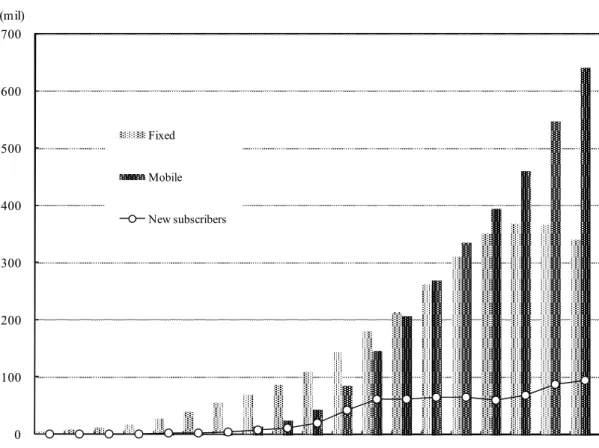
In the second phase of growth, from 1999 to 2003, local firms continuously expanded their market share, from 5.3% (in 1999) to 52.9% (in 2003 - see Figure 1). This expansion went hand-in-hand with a rapid increase in the number of subscribers.1 There
1 In China, the GSM, CDMA as 2G and TD-SCDMA as 3G channel access methods are in operation. We
have chosen GSM because it has the most subscribers, and unless otherwise stated, our remarks throughout the paper apply to GSM. CDMA is used by only 10% of Chinese subscribers, and use of
has been a sustained increase in the number of subscribers ever since the start of the mobile telephone service in China, and numbers have grown swiftly, especially since the late 1990s (see Figure 2). About 60 million people have subscribed since 2001 and in 2008, the total national number of subscribers amounted to more than 800 million people.
Figure 1: Share of local firms, 1999-2006
5.3 10.4 21.1 40.0 52.9 49.1 40.6 35.0 94.7 89.6 78.9 60.0 47.1 50.9 59.4 65.0 0 20 40 60 80 100 1999 2000 2001 2002 2003 2004 2005 2006 (%)
Local firms Foreign firms
Note: The share in 2005 is for January to September.
Sources: Data for 1999 to 2002 are from Ministry of Information Industry (2003). Zhongguo Dianzi Gongye Nianjian (2003)
[Yearbook of the Chinese Electronics Industry (2003)]. Beijing: Publishing House of Electronics Industry. Data for 2003 to 2004 are from CCID (China Center for Information Industry Development).
Data for 2005 are from Ministry of Information Industry (2006). "2005-nian Woguo Shouji Chanye Fazhan Pingshu [Commentary on Development of Our Country's Mobile-Phone Handsets Industry in 2005]." April 5, 2006, accessed at http://www.mii.gov.cn/ (in Chinese)
Data for 2006 are from Ministry of Information Industry (2007). 2007 Zhongguo Xinxi Chanye Nianjian (Dianzi Juan) [Yearbook of the Chinese Information Industry (Volume of Electronics)]. Beijing: Publishing House of Electronics Industry. (in Chinese)
TD-SCDMA has just begun, a test installation having gone into operation in April 2008. In addition to the carriers mentioned in the paper, there are two others, namely China Mobile and China Unicom. China Mobile operates the GSM and TD-SCDMA systems, while China Unicom uses GSM and CDMA.
Figure 2: The number of users, 1990-2008 0 100 200 300 400 500 600 700 1990 1991 1992 1993 1994 1995 1996 1997 1998 1999 2000 2001 2002 2003 2004 2005 2006 2007 2008 (mil) Fixed Mobile New subscribers
Note: Fixed telephone includes the Chinese PHS system.
Sources: Data for 1995 to 2007 are from National Bureau of Statistics (various years). Zhongguo Tongji Nianjian [Statistical
Yearbook of China]. Beijing: Zhongguo Tongji.
Data for 2008 are from Ministry of Industry and Information Techonology. June 24, 2009, accessed at http://www.miit.gov.cn/ (in Chinese)
What triggered the increase in subscribers was the adoption in 1999 of a new industrial policy that favored local firms. Concerned that local firms might fail to seize the opportunity offered by the expansion of demand, the Chinese government instituted a license system for entry (in effect a protective barrier), provided subsidies to local firms for research and development expenditure, and enacted local content legislation aimed at foreign firms. The license system had a particularly important effect, for it helped local firms to enter into the market in the early development phase by blocking the new entry of foreign firms. Licensing was eased in 2005 and finally abandoned in 2007.
While it was in operation, this protective policy led to an upsurge in the number of entries of local firms into the industry. The great majority of the new entrants,
however, did not have the technological capabilities or the experience necessary for success in the handset business. Although telecommunication equipment manufacturers, such as ZTE and Huawei, which were relatively well endowed with technological capabilities also entered, most of the new entrants came from the home electric appliance and consumer electronics sectors, neither of which were related to the manufacture of wireless communication devices. In this article, we pay attention to major firms such as Bird, TCL, Konka, and Lenovo, which became handset manufacturers during the early years of regulation of entry into the industry. In addition, along with this trend, firms from various origins, such as distributors, entered the industry one after the other, with the result that the market became more competitive, involving many local firms which lacked the technological ability and experience for entering the handset business. Moreover, the number of illegal handsets has been increasing in line with the growth of the market.2
After local firms entered, they expanded their market share (see Table 1). In this phase, a peculiarity of the local firms was that their boundaries were centered on sales. Lacking technological ability and experience, the major local firms bought handsets manufactured by companies in South Korea and Taiwan region and sold them in the protected Chinese domestic market. At the same time, they themselves focussed their activities on sales.
2 “Illegal handsets” means nonregistered handsets for gaining access to mobile networks, imitation
products and contraband sets. Before deregulation, handsets produced by manufacturers without the necessary license were also deemed to be illegal handsets.
Table 1: Market share by major firms, 1999-2008
(%) 1999 2000 2001 2002 2003 2004 2005 2006 2007* 2008**
Foreign firms
Nokia 32.3 25.1 22.3 18.2 11.1 15.0 23.8 33.6 28.9 37.2
Samsung n.a. n.a. n.a. n.a. n.a. 8.3 9.6 9.0 11.1 14.3
Motorola 39.4 35.4 29.3 28.5 9.3 8.9 13.3 24.1 18.8 8.6
Sony Ericsson*** 6.4 9.2 6.5 2.1 1.1 2.9 4.1 7.4 5.5 3.1
Philips n.a. n.a. n.a. n.a. n.a. 2.8 n.a. n.a. n.a. n.
Siemens 6.0 8.1 9.7 4.7 2.5 1.4 n.a. n.a. n.a. n.a.
Local firms
Tianyu n.a. n.a. n.a. n.a. n.a. n.a. n.a. n.a. 1.3 4.9
Lenovo n.a. n.a. n.a. n.a. n.a. n.a. n.a. 4.7 6.5 4.0
Amoi n.a. n.a. n.a. n.a. n.a. n.a. n.a. 4.1 3.2 2.7
Bird n.a. 3.2 6.4 9.9 14.2 10.2 6.1 4.1 4.3 2.5
Gionee n.a. n.a. n.a. n.a. n.a. n.a. n.a. n.a. 1.1 2.0
Konka n.a. n.a. n.a. n.a. 6.2 5.8 2.8 2.5 1.8 1.4
TCL n.a. 1.0 3.0 8.7 11.2 6.5 3.7 1.9 n.a. n.a.
a.
Note 1: * Data for 2007 are as of April, 2007.
2: ** Data for 2008 are for the first quarter of 2008.
3: *** The share given for Sony Ericsson before October, 2001, is for Ericsson.
Sources: Data for 1999 to 2004 are from the Ministry of Information Industry (various years). Zhongguo Dianzi Xinxi Chanye Tongji Nianjian [Statistical Yearbook of Chinese Electronics and Information Industry]. Beijing: Publishing House of
Electronics Industry.
Data for 2005 are from Norson Telecom Consulting. April 5, 2006, accessed at http://www.norson.com.cn/ Data for 2006 are from Analysys International. June 5, 2007, accessed at http://comm.ccidnet.com/(in Chinese)
Data for 2007 are from Imai, Kenichi, and Jingming Shiu (2009). “Mobile-Phone Industry [Keitai Denwa Sangyō]” in Junjiro Shintaku, and Tomofumi Amano (eds.) International Business Strategy of Manufacturing: Industrial Geography in Asia [Monodukuri no Kokusai Keiei Senryaku], Tokyo: Yuhikaku.
Data for 2008 are from Analysys International. July 28, 2008, accessed at http://www.analysys.com.cn
2. 3. The Third Phase
The third and latest stage of growth began after 2004. With tightening competition including the increasing availability of illegal handsets (which were not included in the official figures), local firms as a category dropped their market share to about 40%. Although Lenovo was also unable to keep expanding market share indefinitely, as Table 1 shows, they expanded their market share contrary to the contraction in market share experienced by local firms as a whole.
In this stage, although local firms continued to depend on outside firms for developing and designing new models, they intended to expand their production process so as to partially design and develop models themselves. While the technology deficit made it difficult for Lenovo to stay at the forefront of expansion, the firm achieved growth by incorporating a marketing model based on Chinese consumer preferences. In the following chapters, we analyze the decision-making of boundaries under the technology deficit in the second and third phases.
3. Analysis of the Second Phase
3.1. Product structure and technology deficit
In the Chinese handset industry, there is a technology deficit between local firms and foreign ones, though the situation is complicated by the fact that technology can reach maturity and the products structure has been simplified somewhat. The Global System for Mobile Communications (GSM), a second-generation mobile communications system (2G) that is prevalent in China, was taken up mainly by European countries in the mid-1990s and has now reached maturity, to the extent that some key components can be modularized. However the product structure is still complicated in comparison with other consumer electronics, and consequently the technology deficit is closely related with complexity of the composition of the product.
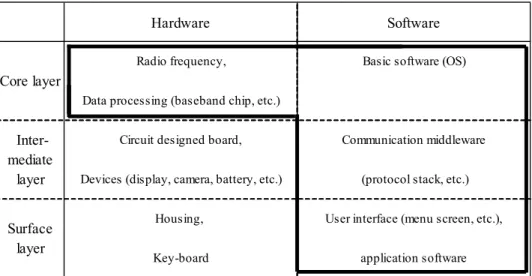
In terms of their structure, handsets are composed of hardware and software, each of which can be divided into three layers (see Figure 3). Hardware comprises the following layers: (1) the core layer, which contains mainly a radio frequency (RF) device for communication functions and information processing for processing signals; (2) the middle layer, which consists of a printed-circuit board (PCB) on which is mounted various import devices; and (3) the surface layer, which comprises the outer case of the handset and the keypad, both of which have to withstand frequent handling by users. Meanwhile the software comprises the following: (1) the core layer, which contains mainly the operating system (OS) for the basic software; (2) the middle layer, consisting of middleware for communication functions; and (3) the surface layer, which carries the user interface and various types of application software.
Figure 3: Product Structure
Hardware Software
Radio frequency, Basic software (OS)
Data processing (baseband chip, etc.)
Circuit designed board, Communication middleware
Devices (display, camera, battery, etc.) (protocol stack, etc.)
Housing, User interface (menu screen, etc.),
Key-board application software
Core layer Inter-mediate layer Surface layer
Source: The author's own creation according to various materials.
As we can see from Figure 3, the structure is a complicated one, but its intricacy has been simplified to some extent by partial modularization. The information processing element and the basic components of the OS and the middleware, all of which are contained within the bold line in the figure, have been modularized as platforms developed by major chip vendors such as Texas Instruments (United States). Major foreign firms also use platforms to develop and design new products. The handset manufacturers, therefore, do not need to independently develop key components for new-product development.
Thanks to the platforms, new entrants did not need to independently develop and design the more advanced technological content of the handsets, but they still needed sufficient development and design experience to have a good command of platform structure. The platforms developed by Texas Instruments demanded an advanced technological competence, and were not for inexperienced newcomers. Moreover, technical support is not always sufficient for their needs (an interview at Konka, July 26, 2006). In addition, the platforms are expensive and can be described as high-ends, whereas almost all of the local firms started out with units that were below the middle-end. In short, although ready-made platforms were available, they were not suitable for the limited technological capabilities of the local firms.
The situation of China’s handset industry in the 1990s was very much one that was dominated by lack of technological capabilities. As mentioned above, the Chinese government launched a nationalization project for the handset industry, but the initiative was not a commercial success. Moreover, some major local electronics firms tried to
enter the industry and expand their market share, but gained only a foothold, and were unable to achieve large-scale production.
3.2. Outsourcing
Lacking as they were in technological capability, local firms turned to outside firms for design and manufacturing, and bought handsets mainly from original equipment manufacturing (OEM), original design manufacturing (ODM) firms and design houses in Korea and Taiwan. For example, Bird bought from Pantech (Korea), Sewon Telecom (Korea), BenQ (Taiwan) and Quanta Computer (Taiwan), while TCL purchased from Pantech (Korea), LG Electronics (Korea) and Hon Hai Precision Industry (Taiwan). It is said that in 2003, two-thirds of the handsets marketed by indigenous Chinese firms originated in Taiwan. Korean and Taiwanese firms provided almost all of the finished products and the Chinese firms, protected by the government licensing system, sold them under their own-brand logos.
While the Chinese firms depended heavily on outside suppliers, their decision-making was shaped by two economic rationalities. Firstly, Korean and Taiwanese firms had already accumulated technology and know-how through orders from foreign firms and as a result of the stimulus provided by domestic competition. Although foreign firms which intended to enter the Chinese handset market were blocked by China’s protective industrial policy, they expanded their business through transactions with local firms.
Second, during this period, simple and low-cost handsets were in demand in the Chinese market, and Chinese firms had no need to offer a differentiated range of sophisticated handsets in these circumstances, simple basic specifications were enough to meet market demand from new subscribers. The basic specifications comprised phone call and SMS (short message service) functions. Simple and inexpensive handsets incorporating these two functions were important for new subscribers.
3.3. Internalization
Although local Chinese firms depended on Korean and Taiwanese suppliers, at the same time, they pursued a sales-and-marketing oriented strategy. For example, they focused on developing surface layers appropriate to the preferences of Chinese consumers. In addition, they launched major advertising campaigns, in particular via television, to
promote recognition of their new brands. Moreover, a distinguishing feature of the strategy of the local firms was that they independently constructed their own sales networks. Given the vast national land area of China, and the great distances involved in the transport of products, creative distribution policies were needed to expand sales.
Figure 4 shows in diagrammatic form the general distribution channels for GSM handsets in China, and columns (1) and (2) show the distribution channels followed by foreign and local firms, respectively. A significant difference can be seen between the distribution strategies of domestic and foreign firms. After dispatching the products to a small number of national-level distributors, foreign firms were in general not involved with distribution within China, and handsets produced by them flowed from national-level distributors and thence to province-level and prefecture-level distributors and retailers. The advantage of this distribution policy was that the foreign firms were relieved of having to follow cost controls over the distribution channels; the disadvantage was that the firms were unable to control the distribution margins, which tended to increase along with each of the distribution stages.
Figure 4: Distribution Channel
Retailers Users (1) (2) Sales subsidiaries Province-level distributors National-level distributors
Foreign firms Local firms
Prefecture-level distributors
Source: The author's own creation.
By contrast, major Chinese firms were closely involved with the distribution channels. They established sales subsidiaries at province level, and these subsidiaries carried out various sales policies, the details differing from one firm to another.
Generally, subsidiaries selected prefecture-level distributors and monitored the behavior of these distributors, especially as regards matters such as pricing and the choice of sales destinations. Moreover, subsidiaries sent sales promoters to retail shops to expand the sales of their own brand handsets. Bird in particular was strongly committed to this sales strategy and very substantially expanded its market share during this phase. For example in 2000, they set up 28 subsidiaries in provincial capitals and 300 offices in local major cities.
In constructing their own sales networks, firms were demonstrating a form of economic rationality. To increase their sales capabilities, firms needed to collect and analyze market information on each distribution stage, and to train salespersons and promoters. Foreign firms had already established close relationships with major distributors during a long period of transactions with them that began in the mid-1990s (Huang 2003), and this made it difficult for local firms to sell their products by way of the existing major distributors. Meanwhile for their part, the distributors were wary of devoting their human resources to transactions with specific local firms because of the uncertainty of the product volumes involved in the transactions. Consequently, local firms tended to be trapped inside a vicious circle in which their products were not taken up because of the expectation of poor sales, and it was to avoid this problem that major firms such as Bird and TCL, constructed their own sales networks to mobilize human resources for the expansion of sales.
This strategy enabled local firms to expand their market share, especially in small and medium local cities and in rural areas. Although during the 1990s handsets in China were expensive and mainly for business use, local firms sold simple functional ones through their own distribution channels and expanded their sales all over the country. The outcome was that the handset markets of the major cities were still largely dominated by foreign firms, whereas elsewhere in China, new subscribers welcomed the simple and low-cost handsets that were offered by the Chinese firms. In other words, local firms established their own presence by creating local and rural low-end markets.
4. Analysis of the Third Phase
4.1. Change in competition environment and technology deficit
differentiate their products, and this requirement again confronted them with the realities of the technology deficit.
The changes were caused by the following four trends, two of which were related to an increase in competitive pressures. First, foreign firms changed their strategies by developing new product lines that included low-end handsets, while altering their distribution channels so as to gain access to local markets. Second, a succession of new indigenous local firms entered the handset business following the easing and cancellation of the industrial policy that had been followed hitherto. In addition, illegal handsets began to be sold in high volumes in response to rapid market growth. The latter two trends were related to a weakening in the advantages hitherto enjoyed by local firms. First, as replacement demand began to increase, consumers’ tastes began to change and users started to demand more complicated and multi-functional models. In addition, chain retail stores (Gome, Suning, and so on) and new carriers entered the distribution business and in response to this, distribution channels diversified. The outcome was that local firms lost their advantages in business capability and were saddled with an excess of sales networks.
These changes in the competitive environment meant that the focus of competition shifted to product differentiation. Because each firm extended its product range in an attempt to improve its brand appeal, about 600 models were launched every year. In consequence, the product life cycle has become shorter, and the average volume of shipments has also contracted. The price range now extends from low-end products retailing at 1,500 yuan and below (100 yuan = 14.5 U.S. dollars); through middle-end products selling at1,500-2,500 yuan; to high-end handsets that command a price of 2,500 yuan and above. Models produced by the local firms are concentrated in the 1,000-1,500 yuan price range. In this latter category, there is fierce competition and firms are under strong pressure to develop differentiated models.
The differentiation requirement, however, has brought local firms face-to-face with the technology deficit. Following their entry, most local firms had concentrated their energies on the development of the sales-oriented strategy, therefore they accumulated little experience of technological development although platforms were available. Consequently there has been a significant gap in the accumulation of experience between the foreign and local firms, and this significant gap caused stagnation among the Chinese firms after 2003.
In fact some local firms left the industry altogether. It is clear, in other words, that many local firms have experienced the disadvantages of backwardness more than
the advantages.
4.2. Outsourcing
Many local firms decided to depend on outside firms for development (and manufacturing), because they did not have enough technological expertise to embark on production on their own account. Although dependence on outside firms remained in place, the partners changed. The increase in demand for handsets led to the emergence of local Chinese design houses, devoted to the development of handsets, and many local firms began to abandon transactions with the OEM/ODM firms and started to buy handsets from Chinese design houses instead. The local design houses provided design services and offered handsets at lower prices than those charged by the OEM/ODM firms in Korea and Taiwan.
Although the indigenous handset firms continued to depend on outsourcing, two new rationalities emerged. First, because design houses accepted orders from many local firms at the same time, there was a decrease in the average cost per model and firms began to accumulate experience for further technological development.
Second, because local firms were required to equal the functional complexity and design achieved by their rivals, they widened their product ranges with customers’ needs in mind. In this way, outsourcing was an efficient way in which to develop product ranges.
4.3. Internalization
While small and medium-sized local firms depended wholly on outsourcing, major local firms began to develop some new models by themselves. Although some firms did not succeed in developing new models, Lenovo expanded its market share by integrating a certain level of independent development capability with marketing ability. To accumulate a certain level of development capability, they made skilful use of easy-to-use platforms developed by the Taiwanese chip vendor, MediaTek (MTK).3
On the other hand, many major firms suffered setbacks in their attempts to accumulate a development capability. For example, although Bird agreed on the establishment of a fifty-fifty joint development base with Sagem (France), and TCL
virtually merged with the handset division of Alcatel (France) to enhance its development capability, management of joint ventures and M&A initiatives were never easy for inexperienced local firms to cope with. Consequently, many local firms were unable to improve their economic performance.
In response to this situation of stalemate, Taiwan’s MTK developed an easy-to-use platform for the Chinese handset industry. This platform includes a core hardware layer and almost all the software as circled with a bold line in Figure 5, and it has very much eased the difficulties of development. Although this simplification of product structure came at the expense of the potentialities for differentiation, the acceptance rate of MTK platforms among local firms jumped from 13 percent in 2004 to 71 percent in 2005, an increase that reflects the advantage offered by the platform in the development process. Many major local firms, such as Bird, TCL, and Lenovo, have accepted MTK platforms.
Figure 5: Product Structure (In the Case of Using the MTK Platform)
Hardware Software
Radio frequency, Basic software (OS)
Data processing (baseband chip, etc.)
Circuit designed board, Communication middleware
Devices (display, camera, battery, etc.) (protocol stack, etc.)
Housing, User interface (menu screen, etc.),
Key-board application software
Core layer Inter-mediate layer Surface layer
Source: The author's own creation.
Lenovo, in particular, grew by integrating a certain level of development capability with its own product policy at a time when other local firms were stagnating. Lenovo was one of the pioneers in the use of the MTK platform, and while other major local firms remained completely dependent on outside firms, Lenovo accumulated its own development experience. Because use of the MTK platform alone sacrificed potentialities for differentiation, Lenovo adopted a mix of MTK and various other platforms to retain dome of the potentialities (an interview at Lenovo, August 27, 2007). Exploiting its development capability with the MTK platform, Lenovo seized the
opportunity by launching a rapid succession of new products that suited the Chinese market. In 2004, for example, Lenovo changed its monochrome displays to color ones across its entire product range, and in 2005 the company launched handsets with an MP3 function at a time when this was becoming a popular feature.
To differentiate models, local firms needed to develop new models in the middle of their ranges to satisfy the market. However, design houses have no intention of devoting their human resources entirely to the requirements of specific local firms. As a result of this outlook, products developed by design houses have sometimes been inferior in quality. For this reason in particular, Lenovo decreased its dependency on outsourcing and began to develop its own models. They now market a range of models 90% of which have been designed by the company.
5. Concluding Remarks
In this paper, we have examined the way in which local Chinese firms confronted with a technology gap have achieved growth, using the Chinese handset industry as a case study. Chinese local firms have lacked technology, and have therefore turned to outside firms for development, design, and manufacturing, while they themselves have focused on sales and marketing, using their advantage of familiarity with the Chinese market. Consequently, by establishing a growth condition in which their selection of boundaries counterbalances the technology gap they have been able to expand their market share in comparison with foreign firms.
It follows that there is a possibility that local firms cannot achieve entry and growth in cases where there are few or no outside firms to turn to. For the Chinese local firms, the existence of the large Chinese market has worked well. The large market has provided opportunities for the entry of local design houses and has made it possible to launch easy-to-use platforms. In addition, the market has been big enough to provide room for the growth of local firms. In fact if the domestic market had not been so large, local firms might not have succeeded in achieving growth. Local firms operating in situations where market size is not as favorable as it is in China may need to utilize other advantages and characteristics peculiar to their own countries.
In cases in which local firms have achieved growth even though they have been confronted with a significant technology gap in competition with foreign firms, there are possibilities that boundaries of local firms have been diversified thanks to the
availability of advantages particular to each country and each industry. The growth process of the Chinese handset firms shows that local firms try to grow by a creative selection of boundaries. Globalization on its own does not guarantee the growth of local firms in developing countries nor does it necessarily impede such growth.
References
Aitken, Brian J., and Ann E. Harrison (1999). “Do Domestic Firms Benefit from Direct Foreign Investment? Evidence from Venezuela” American Economic Review, 89 (3): pp. 605-618.
Djankov, Simeon and Bernard Hoekman (2001). “Foreign Investment and Productivity Growth in Czech Enterprises” World Bank Economic Review, 14 (1): pp. 49-64. Girma, Sourafel (2005). “Absorptive Capacity and Productivity Spillovers from FDI: A
Threshold Regression Analysis,” Oxford Bulletin of Economics and Statistics, 67 (3): pp. 281-306.
Grossman, Sanford J., and Oliver D. Hart (1986). “The Costs and Benefits of Ownership: A Theory of Vertical and Lateral Integration” Journal of Political Economy, 94(4): pp.691-719.
Hart, Oliver D., and John Moore (1990). “Property Rights and the Nature of the Firm” Journal of Political Economy, 98(6): pp.1119-58.
Huang, Lin (2003). Strategies in Emerging Markets: Global Networks and Marketing Innovation [Shinko Shijo Senryaku Ron: Global Network to Marketing Innovation]. Tokyo: Chikura Publishing Co., Ltd. (in Japanese).
Kimura, Koichiro (2006). “Chūgoku Keitai Denwa Tanmatsu Sangyō no Hatten: Hanbai Jūshi no Senryaku to Sono Genkai [Development of China's Mobile Handset Industry: Marketing-oriented Strategy and Its Limitations].” In Kenichi Imai, and Momoko Kawakami, eds. Higashi Ajia no IT Kiki Sangyō: Bungyō, Kyōsō, Sumiwake no Dainamikusu [The Information Technology Equipment Industry in East Asia]. Chiba: Institute of Developing Economies (in Japanese).
Kinoshita, Yuko (2001). “R&D and Technology Spillovers via FDI: Innovation and Absorptive Capacity,” CEPR Discussion Paper, No. 2775.
Marukawa, Tomoo (2007). Gendai Chūgoku no Sangyō: Bokkō suru Chūgoku Kigyō no Tsuyosa to Yowasa [Modern Chinese Industries: The Strengths and Weaknesses of Rapidly Growing Chinese Firms]. Tokyo: Chūōkoron-Shinsha (in Japanese). Kokko, Ari (1994). “Technology, Market Characteristics, and Spillovers,” Journal of
Development Economics, 43: pp. 279-293.
Ohara, Moriki (1998). “Chūgoku Kaden Sangyō no Yuisei: Eakon Sangyō no Sangyō Soshiki to Haiaaru Gruupu no Jirei Kara [Advantages of China’s Home Appliance Industry: Industrial Organization in the Air Conditioner Industry and a Case Study of the Haier Group].” Ajiken World Trend, No. 36: 38-44 (in Japanese).
Shiu, Jingming and Kenichi Imai (2007). “A Divergent Path of Industrial Upgrading: Emergence and Evolution of the Mobile Handset Industry in China” IDE Discussion Paper, No.125.
Xinxi Chanye Bu Jingji Tizhi Gaige yu Jingji Yunxing Si (2003). Fazhanzhong de Woguo Shouji Chanye [Our Developing Mobile-phone Handset Industry], Beijing: Publishing of Electronics Industry (Chinese).