
完全独立全域木の十分条件について
6
0
0
全文
(2) 情報処理学会研究報告 IPSJ SIG Technical Report. Vol.2012-AL-140 No.5 2012/5/14. independent spanning trees in any 4-connected maximal planar graph, and a linear time algorithm for finding such. 2. Characterization. trees was proposed. Recently, in [4], it was shown that. In this section, we give a characterization for the exis-. there are two completely independent spanning trees in. tence of completely independent spanning trees. A charac-. the Cartesian product of two 2-connected graphs. From. terization for completely independent spanning trees was. these results, Hasunuma posed the following conjecture. shown as follows.. in [3].. Theorem 2.1 ( [2]). Let T1 , T2 , . . . , Tk be spanning trees. Conjecture 1.1. There are k completely independent. in G. T1 , T2 , . . . , Tk are pairwise completely independent. spanning trees in any 2k-connected graph.. if and only if they are edge-disjoint, and for any vertex v,. However, recently P´eterfalvi [5] proved a negative re-. there is at most one Ti such that degTi v > 1. The characterization says that every vertex of G is non-. sults against the conjecture as follows. Theorem 1.2. For any k ≥ 2, there exists a k-connected. leaf of at most one tree Ti . In other words, vertices of G. graph that does not contain two completely independent. can be colored with k colors in such a way that if a vertex. spanning trees.. is a non-leaf of Ti then its color is i. The vertices that. By Theorem 1.2, there is no direct relation between the. are leaves of each tree can be colored arbitrarily. Hence,. existence of completely independent spanning trees and. if G has two completely independent spanning trees T1. connectivity. In this paper, we try to provide other suffi-. and T2 , we obtain a partition of vertices V (G) = V1 ∪ V2. cient conditions for the existence of completely indepen-. such that Vi is the set of vertices with color i. Since Vi. dent spanning trees.. contains every non-leaf of Ti , the induced subgraph G[Vi ]. By simple observations, we can see that a graph has. is connected. By Theorem 2.1, vertices in V1 are leaves of. completely independent spanning trees if it has a large. T2 , and vertices in V2 are leaves of T1 . From this fact, we. number of edges, or the degree of its vertices are large,. introduce the following definition.. for example, complete graphs, complete bipartite graphs,. Let V (G) = V1 ∪ V2 be a partition of the vertex set. For. and so on. Hence we interested in relations between the. the partition, the bipartite graph B(V1 , V2 , G) has the bi-. existence of completely independent spanning trees and. partition V1 ∪V2 and has the edge set {uv | uv ∈ E(G), u ∈. the number of edges or the minimum degree of graphs.. V1 and v ∈ V2 }. A partition V (G) = V1 ∪ V2 is called a. In the history of graph theory, there are similar ap-. CIST-partition of G if it satisfies the following two con-. proach for sufficient conditions of Hamiltonian graphs.. ditions: (1) for i = 1, 2, the induced subgraph G[Vi ] is. One of the simplest condition is shown by Dirac in 1952. connected, and (2) the bipartite graph B(V1 , V2 , G) has. which gives a lower bound on the minimum degree.. no tree component, that is, every connected component. Theorem 1.3 (Dirac’s Theorem). If G is a graph of. H of B(V1 , V2 , G) satisfies |E(H)| ≥ |V (H)|.. n ≥ 3 vertices such that δ(G) ≥ n/2, then G is Hamilto-. Theorem 2.2. A connected graph G has two completely. nian.. independent spanning trees if and only if G has a CIST-. One of the purpose of this paper is to show that the de-. partition.. gree condition of Dirac’s Theorem is also a sufficient condition for the existence of completely independent spanning. Proof. Assume that G has two completely independent. trees.. spanning trees T1 and T2 . The vertices in G can be colored. Another sufficient condition of Hamiltonian graphs are. with two colors in such a way that if a vertex is an inner. known. For a graph G and k ≥ 1, the k-th power of G,. vertex of tree Ti then its color is i. The vertices that are. denoted by G , has vertex set V (G) and uv ∈ E(G ) if. leaves of both trees can be colored arbitrary. For i = 1, 2,. k. k. and only if distG (u, v) ≤ k. In particular, G2 is called the. define Vi as the set of vertices with color i. Then, V1 ∪ V2. square of G. In 1974, Fleischner verified the next theorem.. is a partition of V . Let B = B(V1 , V2 , G). Note that any. Recent proof of this theorem have been given by [1].. vertex x1 ∈ V1 is adjacent to at least one vertex of V2 since. Theorem 1.4 (Fleischner’s Theorem). If G is 2-. x1 is a leaf of T2 . Similarly, x2 ∈ V2 is adjacent to at least. connected, the square of G is Hamiltonian.. one vertex of V1 . Hence, for any connected component H. In Section 4, we show that the condition of Fleischner’s Theorem is also a condition for the existence of completely independent spanning trees. ⓒ2012 Information Processing Society of Japan. of B, the number of edges |E(H)| is at least |V (H)|. Next we assume that G has a CIST-partition V (G) = V1 ∪ V2 . Since the induced subgraphs G[Vi ] is connected,. 2.
(3) 情報処理学会研究報告 IPSJ SIG Technical Report. Vol.2012-AL-140 No.5 2012/5/14. it has a spanning tree Si for i = 1, 2. We color the edges. adjacent to every other vertices in V1 since degG x ≥ m.. of Si with color i. Let H be a connected component of. This property of a leaf of B will be used in the proofs of. B = B(V1 , V2 , G). By the definition of CIST-partition, we. this section. Note that, if n is odd, then V2 has (n − 1)/2. have |E(H)| ≥ |V (H)|. So, H has a connected spanning. vertices, and hence there are no leaf of B in V2 .. subgraph H ′ such that |E(H ′ )| = |V (H ′ )|, that is, H ′ is. Lemma 3.1. Suppose that n ≥ 8 and δ(G) ≥ n/2 and. a unicyclic graph. Since B (and also H) is bipartite, the. V (G) = V1 ∪ V2 is a partition such that |V1 | = m for m =. ′. unique cycle of H has even length. We assign two colors ′. ⌈n/2⌉. Assume that the induced subgraphs G1 = G[V1 ]. to the edges of H as follows: The edges of the unique cy-. and G2 = G[V2 ] are connected, and V1 has a leaf x of. cle are colored with color 1 and 2 alternately. The edges of. B = B(V1 , V2 , G) such that it is not a cut-vertex of G1. H ′ that are not in the cycle induces a forest. We consider. and is adjacent to non-leaf y ∈ V2 of B. Then, there are. a tree component of the forest is rooted at the vertex in. two completely independent spanning trees in G.. the unique cycle. So vertices in the forest has the unique parent. For an edge uv in the forest such that u is the parent of v, it is colored with i if u ∈ Vi . After this edge coloring is finished for every connected component H ′ of B, each vertex of V1 is incident with exactly one edge with color 2, and also each vertex of V2 is incident with exactly one edge with color 1. Let Ti be the subgraph induced by the edges whose color is i. Every vertex of V1 is contained in T1 . For a vertex u in V2 , it is adjacent to exactly one vertex of V1 because u is incident with exactly one edge whose color is 1. Thus T1 is a spanning tree of G. Similarly T2 is a spanning tree of G. For each vertex u of G, at most one of degT1 u or degT1 u is larger than 1. We can see easily that T1 and T2 are edge-disjoint. Hence, by Theorem 2.1, T1 and T2 are completely independent spanning trees.. Proof. If V (G) = V1 ∪ V2 is a CIST-partition, we are done.. Assume that it is not a CIST-partition.. Let. U1 = V1 \ {x} and U2 = V2 ∪ {x}. Since x is not a cutvertex of G1 , the induced subgraph G[U1 ] is connected. Also G[U2 ] is connected. If U1 ∪ U2 is a CIST-partition, then we are done. Assume that U1 ∪ U2 is not a CIST-partition, that is, BU = B(U1 , U2 , G) has a tree component. By assumption, x ∈ V1 is a leaf of B. Then x is adjacent to every vertex in U1 . Hence BU is a spanning tree of G. It is possible only when any vertex z ∈ V2 \ {y} is a leaf of B (and thus n is even). Since |V1 | = |V2 | = m, V1 has at most one non-leaf of B, and also V2 has exactly one non-leaf y of B. This means that the induced subgraphs G1 and G2 must be isomorphic to a complete graph Km . From the above discussion, G has a spanning subgraph that consists. Theorem 2.2 is generalized for the existence of k completely independent spanning trees. The proof of the following theorem is similar to Theorem 2.2, so we omit it. Theorem 2.3. A connected graph G has k completely independent spanning trees if and only if there is a partition V (G) = V1 ∪ V2 ∪ · · · ∪ Vk such that (1) for i = 1, 2, . . . , k, the induced subgraph G[Vi ] is connected, and (2) for any 1 ≤ i < j ≤ k, the bipartite graph B(Vi , Vj , G) has no tree component.. of two complete graphs Km and edges between them. For m ≥ 4 and two vertices v1 and v2 of Km , we can construct two completely spanning trees T1 and T2 in Km such that degTi vi ≥ 2. Let x1 x2 , y1 y2 be edges between V1 and V2 such that xi , yi ∈ Vi . We construct completely independent spanning trees Tx , Ty in G1 such that degTx x1 ≥ 2 and degTy y1 ≥ 2. Similarly, let Tx′ , Ty′ by two trees in G2 such that degTx′ x2 ≥ 2 and degTy′ y2 ≥ 2. Finally, let T1 = (Tx ∪ Tx′ ) + x1 x2 and T2 = (Ty ∪ Ty′ ) + y1 y2 . Then. T1 and T2 are completely independent spanning trees in. 3. Degree conditions In this section, we show that the condition of Dirac’s Theorem is also a sufficient condition for the existence of. G. Theorem 3.2. If δ(G) ≥ n/2, then G has two completely independent spanning trees.. completely independent spanning trees. In order to prove the theorem, we need next lemma.. Proof. By Dirac’s Theorem, G has a Hamiltonian cy-. Let G be a graph of n vertices and δ(G) ≥ n/2. Let. cle. Hence there is a partition V (G) = V1 ∪ V2 such. V (G) = V1 ∪ V2 , |V1 | = m for m = ⌈n/2⌉ be a partition. that |V1 | = m for m = ⌈n/2⌉ and the induced subgraphs. of vertex set. If V1 ∪ V2 is not a CIST-partition, by The-. G1 = G[V1 ] and G2 = G[V2 ] are connected. If the parti-. orem 2.2, the bipartite graph B = B(V1 , V2 , G) contains. tion V1 ∪ V2 is a CIST-partition, then we are done.. a tree component. Hence B has a leaf x. If x ∈ V1 , it is ⓒ2012 Information Processing Society of Japan. We assume that V1 ∪ V2 is not a CIST-partition. By. 3.
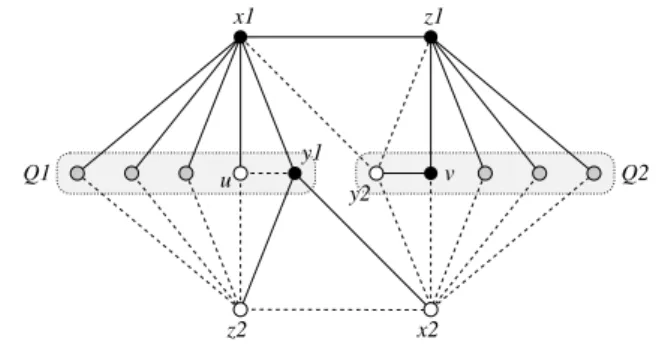
(4) 情報処理学会研究報告 IPSJ SIG Technical Report. Vol.2012-AL-140 No.5 2012/5/14. Theorem 2.2, the bipartite graph B = B(V1 , V2 , G) has a tree component T . Thus T (and also B) has at least two leaves. If x ∈ Vi is a leaf of B, then x is adjacent to every other vertices in Vi . (Case 1) There are two leaves x, y of T in V1 .. E(T1 ) = {x1 z1 , y1 x2 , y1 z2 , y2 v} ∪ {x1 p | p ∈ V (Q1 )} ∪ {z1 q | q ∈ V (Q2 ), q ̸= y2 }, E(T2 ) = {x2 z2 , y2 x1 , y2 z1 , y1 u} ∪ {x2 q | q ∈ V (Q2 )} ∪ {z2 p | p ∈ V (Q1 ), p ̸= y1 },. Since x and y are adjacent to every other vertices in V1 , each of these vertices is not a cut-vertex of G1 . Since T is a tree and x and y are members of same partite set of T ,. These trees T1 and T2 are illustrated in Fig. 1.. the vertex x is adjacent to a vertex of degree at least two. Hence, by Lemma 3.1, G has two completely independent spanning trees. (Case 2) For i = 1, 2, there is exactly one leaf xi of T in Vi , and xi is adjacent to a vertex of degree at least two of T. Since V2 contains a leaf of B, as mentioned earlier, n is even. Since T has exactly two leaves, it is a path of at least four vertices. By Lemma 3.1, we may assume that x1 and x2 are cut-vertices of G1 and G2 , respectively. Let. 図 1 Case 2: two completely independent spanning trees in G.. y1 ∈ V1 be a vertex adjacent to x2 and y2 ∈ V2 be a ver-. Edges of T1 are solid lines, and edges of T2 are dotted. tex adjacent to x1 . Assume that Q is the component of. lines.. G1 − x1 that contains y1 . Then (Case 3) For i = 1, 2, there is exactly one leaf xi of T in. n/2 ≤ degG y1 = degT y1 + degG1 y1. Vi , and x1 is adjacent to x2 .. ≤ 2 + (1 + degQ y1 ). In this case, for i = 1, 2, xi is adjacent to every vertex in Vi , and so G′ = G − {x1 , x2 } satisfies |V (G′ )| = n − 2. ≤ |V (Q)| + 2. (Note that y1 is adjacent to x1 .). Hence we obtain. |V (Q)| ≥ n/2 − 2. Since |V1 | = n/2 and G1 − x1 has at least two components, we have |V (Q)| = n/2 − 2. This means that G1 − x1 has two components, one is an isolated vertex z1 and the other component Q1 has n/2 − 2 vertices. Similarly, G2 − x2 has two components, one is an isolated vertex z2 and the other component Q2 has n/2 − 2 vertices. Furthermore, z1 (or z2 ) is not adjacent to vertices in Q1 (or Q2 ) and has degree at least n/2, it must be adjacent to every vertices in Q2 (or Q1 ). From the above discussion, G has a spanning subgraph H with edge set. and δ(G′ ) ≥ (n − 2)/2. By Dirac’s Theorem, G′ has a Hamiltonian cycle C. Let y1 and y2 be adjacent vertices in C such that x1 y1 , x2 y2 ∈ E(G). Then z1 and z2 be vertices such that y1 z1 , y2 z2 ∈ E(C). Since zi is a member of either V1 or V2 , there are four possibility for zi ’s, that is, (1) z1 , z2 ∈ V1 , (2) z1 ∈ V1 and z2 ∈ V2 , (3) z1 ∈ V2 and z2 ∈ V1 , and (4) z1 , z2 ∈ V2 . In this proof, we assume that z1 , z2 ∈ V1 . (The other cases can be proved similarly.) First we construct spanning tree T1 of G. We color vertices x1 , x2 , z1 and z2 with color 1, and color the following edges with color 1: • x1 x2 , x1 z1 , x1 z2 , y1 z1 , y2 z2 , • x1 v for v ∈ V1 , and x1 w for w ∈ V2 .. E(H) = {x1 y2 , x2 y1 } ∪ {x1 u | u ∈ V1 , u ̸= x1 } ∪ {x2 v | v ∈ V2 , v ̸= x2 } ∪ {y1 u | u ∈ V (Q1 ), u ̸= y1 }. Then we construct spanning tree T2 . Assign color 2 into n − 4 vertices that are not colored with 1. We color the following edges with color 2: every n − 4 edges on C except for y1 z1 and y2 z2 , and x1 y1 and x2 y2 . In addition, if. ∪ {y2 v | v ∈ V (Q2 ), v ̸= y2 }. either y1 or y2 is adjacent to a vertex w with color 2 and. ∪ {z1 v | v ∈ V (Q2 )} ∪ {z2 u | u ∈ V (Q1 )}.. w ̸∈ {y1 , y2 }, then we color edge yi w with color 2, where yi w ∈ E(G). Since x1 and x2 has no common adjacent. We can construct two completely independent spanning. vertex, there is such vertex w if degG y ≥ 5. Hence we con-. trees T1 and T2 in H as follows. We choose u ∈ V (Q1 ), u ̸=. sider the case that n = 8 and degG y1 = degG y2 = 4, and. y1 and v ∈ V (Q2 ), v ̸= y2 arbitrary.. NG (y1 ) = {x1 , y2 , z1 , z2 } and NG (y2 ) = {x2 , y1 , z1 , z2 }.. ⓒ2012 Information Processing Society of Japan. 4.
(5) 情報処理学会研究報告 IPSJ SIG Technical Report. Vol.2012-AL-140 No.5 2012/5/14. In this case, we exchange colors of y1 and z1 , and con-. Assume that there is adjacent vertices x and y of T such. struct new trees T1′ and T2′ by T1′ = T1 − x1 z1 + x1 y1 and. that x, y ∈ Vi . We may assume that x, y ∈ V1 . Then x. T2′ = T2 − x1 y1 + x1 z1 + z1 y2 . We can easily see that T1′. (and also y) is not a leaf and is not adjacent to a leaf of. and. T2′. T . Let Tx and Ty be two connected components of T − xy. are completely independent.. From Case 1 to Case 3, we show that G has two com-. such that Tx contains x and Ty contains y. Then Tx and Ty have vertices in V2 . Let x′ ∈ V (Tx ) and y ′ ∈ V (Ty ). pletely independent spanning trees. The bound described in Theorem 3.2 is tight. That is, there is a graph G such that δ(G) = (n − 1)/2 and G does not have two completely independent spanning trees. For example, a graph obtained by identifying a vertex of two complete graphs K(n+1)/2 . This graph cannot have two completely independent spanning trees because it has a cut-vertex.. be any vertex in V2 . However, dist(x′ , y ′ ) ≥ 3 in T , and hence T 2 [V2 ] cannot be connected. This is a contradiction. Therefore, any two vertices in Vi are not adjacent for i = 1, 2. This implies that V1 ∪V2 is equal to the bipartition of T . Hence the bipartite graph B = B(V1 , V2 , T 2 ) is a tree, and it contradicts the fact that V1 ∪ V2 is a CIST-partition. Hence there is no CIST-partition in T 2 for T ∈ T .. 4. Power of graphs. We state a characterization for a tree whose square has. One of the purpose of this section is to show that the. two completely independent spanning trees.. square of 2-connected graph has two completely indepen-. Theorem 4.3. Let T be a tree with at least four vertices.. dent spanning trees, which is similar to Theorem 1.4. First. The square T 2 has two completely independent spanning. we consider a condition for the square of trees to have two. trees if and only if T has a leaf that is adjacent to a vertex. completely independent spanning trees. Then the square. of degree at least 3, that is, T ̸∈ T .. of a 2-connected graph is considered. The next lemma is simple but useful property of bipartite graphs. It can be proved easily and hence we omit a proof of it. Lemma 4.1. Let G be a connected bipartite graph with bipartition V1 ∪ V2 . Then, in G2 , the induced subgraphs G2 [V1 ] and G2 [V2 ] are connected. The square of a path of n vertices cannot have two edge-disjoint spanning trees since it has only 2n − 3 edges. Hence there is a tree T such that T 2 does not have two completely independent spanning trees.. The following. lemma shows more general result. Let T be the family of trees such that it has at least four vertices and every leaf is adjacent to a vertex of degree 2. Lemma 4.2. For a tree T ∈ T , the square T 2 does not have two completely independent spanning trees.. Proof. If T ∈ T , then T 2 does not have two completely independent spanning trees by Lemma 4.2. Next we assume that T ̸∈ T . Hence T has a leaf x that is adjacent to y such that degT y ≥ 3. Let V1 ∪ V2 be the bipartition of T and we assume that y ∈ V1 and x ∈ V2 . We define U1 = V1 ∪ {x} and U2 = V2 \ {x}. We show that U1 ∪ U2 is a CIST-partition of T 2 . First we show that the induced subgraph T 2 [Ui ] is connected for i = 1, 2. For s, t ∈ U2 , there is a s-t path P in T . Since x is a leaf, the path P does not contain x. Hence there is a s-t path in P 2 through vertices of U2 , and thus T 2 [U2 ] is connected. By similar argument, there is a s-t path on T 2 [U1 ] if s ̸= x and t ̸= x. For any vertex s ∈ V1 , there is a path from s to y. Since v is adjacent to x, there is a path from s to x in T 2 [U1 ]. Next we show that the bipartite graph B = B(U1 , U2 , T 2 ) has no tree. Proof. Assume that, for a tree T ∈ T , there are two. component. By the definition of U1 and U2 , the edge set. completely independent spanning trees in T . Let V1 ∪ V2. of B is (E(T ) \ {xy}) ∪ {xw | yw ∈ E(T ), w ̸= x}. Since. 2. be a CIST-partition of T . Let v be a leaf of T , and. degT y ≥ 3, the bipartite graph B is connected and has at. vu, uw ∈ E(T ). (Note that the degree of u is 2.) In T ,. least |V (T )| + 1 edges. Hence B has no tree component.. 2. 2. the degree of v is 2 and vu, vw ∈ E(T ). Hence v is a 2. leaf in each of the two completely independent spanning trees. This means that u and w are in different subsets V1 or V2 . Furthermore, we may assume that v and w are in the same subset. As a result, for each leaf v and vertices u, w such that vu, uw ∈ E(T ), we have either v, w ∈ V1 and u ∈ V2 or v, w ∈ V2 and u ∈ V1 . ⓒ2012 Information Processing Society of Japan. Therefore, by Theorem 2.2, T 2 has two completely independent spanning trees. Next we focus on the square of 2-connected graphs. Lemma 4.4. For a cycle Cn , n ≥ 4, the square Cn2 has two completely independent spanning trees. Proof. Let v0 , v1 , . . . , vn−1 be the vertices of Cn and its. 5.
(6) 情報処理学会研究報告 IPSJ SIG Technical Report. Vol.2012-AL-140 No.5 2012/5/14. edges are vi vi+1 for 0 ≤ i ≤ n − 1 (additions are taken modulo n). If we take V1 = {v2i | 0 ≤ i ≤ ⌈n/2⌉ − 1} and V2 = {v2i+1 | 0 ≤ i ≤ ⌊n/2⌋ − 1}, then we can prove easily that V1 ∪ V2 is a CIST-partition. Theorem 4.5. For a 2-connected graph G of n ≥ 4 vertices, the square G2 has two completely independent spanning trees. Proof. If G is a cycle, the theorem follows from Lemma 4.4. We assume that G is not a cycle, that is, G has a vertex v of degree three or more. Let w be an adjacent vertex of v. Since G is 2-connected, G−w is connected and it has a spanning tree T such that degT v ≥ 2. Hence we obtain a spanning tree T ′ ̸∈ T of G by adding vertex w and edge vw with T . Hence, by Theorem 4.3, G2 has two completely independent spanning trees.. 5. Conclusion In this paper, we consider the problem of completely independent spanning tress. First we provided a characterization of two completely independent spanning trees. This characterization is different from one by Hasunuma given in [2]. Next we show some sufficient conditions for the existence of two completely independent spanning trees. It is interesting that well-known conditions for Hamiltonian graphs are also for completely independent spanning trees (Theorem 3.2 and 4.5). It is known that there are many sufficient conditions for Hamiltonian graphs. These conditions might help the researchers to consider problems of completely independent spanning trees.. Acknowledgments この研究は,科研費(No. 23500007)の助成を受けて いる. 参考文献 [1] [2]. [3]. [4] [5]. A. Georgakopoulos, A short proof of Fleischner’s theorem, Discrete Mathematics 309 (2009) 6632–6634. T. Hasunuma, Completely independent spanning trees in the underlying graph of a line digraph, Discrete Mathematics 234 (2001) 149–157. T. Hasunuma, Completely independent spanning trees in maximal planar graphs, in: Proceedings of WG2002, LNCS 2573, Springer-Verlag Berlin, 2002. T. Hasunuma, C. Morisaka, Completely independent spanning trees in torus networks, Networks, to appear. F. P´eterfalve, Two counterexamples on completely independent spanning trees, Discrete Mathematics 312 (2012) 808–810.. ⓒ2012 Information Processing Society of Japan. 6.
(7)
図
関連したドキュメント
Furthermore, we give a different proof of the Esteban-S´er´e minimax principle (see Theorem 2 in [13] and [9]) and prove an analogous result for two dimen- sional Dirac
Abstract. We study a Cauchy-Dirichlet problem with homogeneous bound- ary conditions on the parabolic boundary of a space-time cylinder for degen- erate porous medium type
We denote by Rec(Σ, S) (and budRec(Σ, S)) the class of tree series over Σ and S which are recognized by weighted tree automata (respectively, by bottom- up deterministic weighted
A bounded linear operator T ∈ L(X ) on a Banach space X is said to satisfy Browder’s theorem if two important spectra, originating from Fredholm theory, the Browder spectrum and
Szufla, Kneser’s theorem for weak solutions of an mth-order ordinary differential equation in Banach spaces,
We call such monad morphisms dense and give a characteriza- tion of them in the spirit of Beth’s definability theorem: α is a dense monad morphism if and only if every T -operation
In the second part the theorem is applied to show that interesting combinatorial sets related to a planar graph have lattice structure: Eulerian orientations, spanning trees
Some of the above approximation algorithms for the MSC include a proce- dure for partitioning a minimum spanning tree T ∗ of a given graph into k trees of the graph as uniformly
