I Introduction
The Riau Province, located in central Sumatra, became the frontier of development of such resources as land, timber, and minerals (oil and natural gas) after the independence of Indonesia. Especially in the era of the New Order, or Orde Baru (1968-1998), these developments were accelerated, causing enormous changes in Riau society. According to the data of the population census, the population of the Riau Province1) has increased from 956,018 in 1961 to 3,755,485 in 2000 by 3.9 times and to 5,538,367 in 2010 by 5.8 times. This article discusses the characteristics of Riau society that have these historical backgrounds by examining the social maps which were created originally using the data of the population census of 2000 and the registration of voters and residents
of 2004 from the viewpoint of its geographical configuration.
First, this article utilizes the statistical data by district (kecamatan) and by village / ward (desa / kelurahan). This enables us to look at the geographical configuration of Riau society more precisely, which is impossible when using only the data by province (provinsi) and by regency / city (kabupaten / kota). Secondly, the statistical data that this article deals with is from the early 2000s. This time period is very helpful in discussing the transformation of Indonesian society because the resignation of President Suharto in 1998 marked the shift from the New Order to the Reformation (Reformasi). The characteristics of Riau society clearly reflect the history of the Riau Province as the frontier of resources development up to the New Order. Further, this article reveals the
Social Map of Riau, Indonesia: Frontier Development and its Outcomes
NAGATA Junji*, ARAI W. Sachiho** and Gulat M. MANURUNG***
(*Department of Human Geography, the University of Tokyo, **Faculty of Agriculture, Tokyo University of Agriculture and Technology, ***Faculty of Agriculture, University of Riau)
Ⅰ Introduction Ⅱ Data and Mapping
Ⅲ Social Map of Riau Province by District (Kecamatan)
Ⅳ Social Map of Siak Regency by Village / Ward (Desa / Kelurahan) Ⅴ Concluding Remarks
conditions that had formed the starting line for the socioeconomic development of Riau society after entering the Reformation era.
II Data and Mapping
Since Indonesia's independence, the population census was conducted in 1961, 1971, 1980, 1990, 2000, and 2010. One of the data sets referenced in this article is that of the population census of 2000, the Sensus Penduduk 2000
(SP2000), which is ordered by district (kecamatan) in the Riau Province and by village / ward (desa
/ kelurahan) in the Siak Regency. This data set
is not published in book-form, and was acquired directly from the Statistics of Riau Province, or Badan Pusat Statistik (BPS) Provinsi Riau, a governmental institution. The data acquired does not cover all the items surveyed in the population census of 2000, but is confined to the specific items we had requested. Further, we have conducted a study on the dynamics of the oil palm plantation sector in the Riau Province (Nagata and Arai 2006; Nagata and Arai 2013). The data we requested is limited to the items that clearly describe the basic characteristics of Riau society and contribute to understanding the mutual effects of the oil palm plantation sector in the Riau Province and society. Among acquired items, this article deals with population by ethnicity, religion, and industry, as well as total population. The total number of population by ethnicity and religion is equal to the total population, and the total number of population by industry is equal to the working population over the age of 15.
The second data set this article references
is that of the registration of voters and residents of 2004, the Pendaftaran Pemilih dan Pendaftaran
Penduduk Berkelanjutan 2004 (P4B2004) which
is ordered by district (kecamatan) in the Riau Province and by village / ward (desa / kelurahan) in the Siak Regency. This data set is not published in book-form, and was also acquired directly from the Statistics of Riau Province. The registration of voters and residents in 2004 was conducted in a manner similar to that of the population census of 2000, and its data contains similar items. The data we requested and acquired covers the same items as the population census of 2000, and this study utilizes this requested data as a complement to the data of the population census of 2000. Among the items obtained, we take up only two items: total population and population by birthplace. The data of the population census of 2000 also includes population by birthplace, but this data is not sound as all of the birthplaces are exclusively assigned to the provinces in Sumatra.
In mapping the data of SP2000 and P4B2004 on a Geographic Information System (GIS), as to the boundary data of the Riau Province district (kecamatan), we originally created two sets of electronic data corresponding to SP2000 and P4B2004 using the various materials which were released by the governmental agencies, including print administrative maps. As to the boundary data of the Siak Regency village / ward (desa / kelurahan), we used the two sets of electronic data corresponding to SP2000 and P4B2004 which were provided by the Statistics of Riau Province.
III Social Map of Riau Province by District (Kecamatan)
southwest by the West Sumatra Province, and on the south by the Jambi Province. In the southeast, it faces the Riau Islands Province across the sea, and in the northeast, it faces Malaysia across the Straits of Malacca. The peripheral area along the provincial border from the northwest to the southwest is a hilly zone that is connected to the highlands of Sumatra. Between this hilly zone and the coastline spreads lowlands, though there are some hilly spots. Several large rivers (the Rokan, Siak, Kampar, and Indragiri, in order from north to south) cut across these lowlands (Figure 1).
Pekanbaru, the capital town of the Riau Province, is located in the middle of the Riau Province. From Pekanbaru, the road to Padang, the capital town of the West Sumatra Province, runs westward. The road that connects Pekanbaru to Medan, the capital town of the North Sumatra Province, and to Jambi, the capital town of the Jambi Province, runs down the province from the northwest to the southeast. From these main roads, the feeder roads to the capital towns of each regency and the Dumai City diverge (Figure 1). The population of the Riau Province is mainly distributed along these roads and in the coastal zone (Figure 3; Figure 28). The Riau Province has two cities: the Pekanbaru City, with a population of 897,767 (SP2010), and the Dumai City, with a population of 253,803 (SP2010).2) Dumai is the port and industrial town that fronts the waterway to the Straits of Malacca. Between Pekanbaru and Dumai, there is another large population concentration, which is called Duri Town (Figure 1) in Mandau District, Bengkalis Regency.
The primary feature of the population of Riau is that it consists of people with diverse ethnical, cultural, and socioeconomic backgrounds, reflecting the fact that it has historically been a premier area of resources development. Table 1 shows the ethnic composition of the Riau Province based on SP2000. There is no dominant ethnic group exceeding 50 percent. The most prominent of ethnic groups is the Malay (Melayu), but these only occupy about 40% (38.7%) of the population. The second most dominant ethnic group is the Javanese (Jawa), including the Sundanese (Sunda), who occupy about 30% (Total; 27.2%, Javanese; 25.8%, Sundanese; 1.5%). The Minangkabau (11.8%) and Batak (7.1%) occupy around 10% of
Ethnicity Population %
Malay (Melayu) 1,453,671 38.7
- Riau, Melayu Riau 1,177,117 31.3
- Melayu 260,588 6.9
- Others 15,966 0.4
Javanese (Jawa)
inc. Sundanese (Sunda) 1,022,993 27.2
- Javanese (Jawa) 968,259 25.8
- Sundanese (Sunda) 54,734 1.5
Minangkabau 442,609 11.8
Batak [Batak, Tapanuli] 266,862 7.1
Banjar [Banjar, Melayu Banjar] 172,407 4.6
Bugis [Bugis, Ugi] 86,019 2.3
Chinese (Cina) 84,252 2.2
Others 224,180 6.0
Foreign citizens 2,492 0.1
Total 3,755,485 100.0
Note:
* This table was prepared by us integrating the information from Statistics Indonesia (2001) and the data of SP2000 obtained from Statistics of Riau Province.
* The population in the territory of present-day Riau Islands Province was excluded.
the population. In addition to these, the Banjar (4.6%), Bugis (2.3%), and Chinese, or Cina (2.2%) occupy the population. Among these main ethnic groups in the Riau Province, with the exception of a substantial amount of the Malay, all are made up of immigrants and their descendants who arrived over the last 150 years or so. This article clarifies the geographical configuration of Riau society, discussing its origin and characteristics by examining the profile and the geographical configuration of each ethnic group.
The Malay are considered to make up the widely distributed ethnic group that represents the Riau Province (Figure 5). However, social and cultural backgrounds of the Malay in the Riau Province are far from uniform. The Malay are divided into two ethnic categories in Statistics Indonesia (2001): the "Riau, Melayu Riau" and "Melayu.” The population of each category is 1,177,117 and 260,588, respectively.3) It is important to note that the Malay are comprised of a number of people who did not declare themselves Malay although they self-identified as Riau natives. We can identify the concentrated areas of the Malay population in the coastal areas along the Straits of Malacca, and the riverine areas along the main rivers of the Riau Province (the Rokan, Siak, Kampar, and Indragiri Rivers). Especially in the upper river basin of the Kampar Kanan River (an upstream area of the Kampar River) in the Kampar Regency, and in the upper river basin of the Indragiri River in the Kuantan Singingi Regency, we can identify the highly concentrated areas of the Malay population which occupy around 70-90% of the total population of each district. The Malay people located in these river
basins have been engaged in rice farming, the main traditional subsistence activity. Most of the other Malay native to Riau have traditionally been engaged in subsistence-oriented agriculture and fishery.
Concerning the Malay in the Riau Province, it should also be noted that many relatively recent migrants from outside the Riau Province (for example, from the provinces in Sumatra Island such as North Sumatra, Jambi, and South Sumatra) are thought to be included. As will be revealed in the description on the Batak, the percentage of people who were born in the North Sumatra Province far exceeds the percentage of Batak in the Riau Province. Along with the Javanese, the Malay native to North Sumatra (for example, Melayu Deli) are considered a part of the recent migrants from the North Sumatra Province. In 2000, the Riau Islands Province had not yet separated from the Riau Province. With the development of Pekanbaru and other towns such as Dumai as administrative or economic centers, many Malay people native to the Riau Islands are also thought to migrate to mainland Riau.
The Javanese is an ethnic group that is rooted in the central and east parts of Jawa Island. In this article, the Sundanese, rooted in the west portion of Jawa Island, are included in the category of Javanese for descriptive purposes. The Sundanese population in Riau Province is 54,734, which comprises 5.4% of the category of Javanese. The Javanese are widely distributed throughout the Riau Province, regardless of whether in urban or rural areas, coastal or interior regions, or northern or southern parts of the province (Figure 6). The rural population of Javanese is
Perusahaan Inti Rakyat (PIR) projects. Under the PIR projects, both nucleus estates (inti) and surrounding smallholdings (plasma) were developed in an integrated manner. Most of the workers in nucleus estates are said to be Batak, but most of the plasma farmers are thought to be Javanese migrants.
The majority of the Javanese in rural areas of the Riau Province are supposed to be engaged in the plantation sector, especially the oil palm plantation sector. Indeed, in the rural areas in which the Javanese are concentrated, the number of people engaging in the plantation sector is also large (Figure 16). In some concentrated areas of PIR projects, the Javanese occupy around 50% (Figure 6). In such areas, the percentage of people who were born in Jawa Island tends to be high (Figure 23). However, if we consider the percentage of Javanese (27.2%) and the people who were born in Jawa Island (8.2%), only about 30% of the Javanese in the Riau Province were thought to be born in Jawa Island. It is presumed that the Javanese population in the Riau Province includes not only recent direct migrants from Jawa Island, but also several spontaneous migrants from Jawa Island from long ago and Javanese migrants from outside Jawa Islands, such as from the North Sumatra Province.
The Minangkabau is an ethnic group that is rooted in the West Sumatra Province. It is thought to have a high percentage of people who are engaged in the commercial sector. Indeed, the Minangkabau people tend to concentrate in urban areas with a high population rate in
Province: Pekanbaru, Dumai, and Duri (Figure7; Figure 18). In Pekanbaru, the capital town of Riau Province, the Minangkabau ranks highest in the ethnic composition (37.9%), considerably ahead of the Malay (26.7%). Although the southwestern part of the Riau Province borders the West Sumatra Province, the Minangkabau do not tend to concentrate in this area. Most of the people who were born in the West Sumatra Province are considered ethnically Minangkabau. Considering the percentage of Minangkabau (11.8%) and the people who were born in the West Sumatra Province (5.4%) (Figure 24), almost half of the Minangkabau in the Riau Province are thought to be born in the West Sumatra Province. It is estimated that there has been a huge migration of Minangkabau relatively recently.
The Batak is an ethnic group that is rooted in the North Sumatra Province. The Batak corresponds to the ethnic category "Batak, Tapanuli" in Statistics Indonesia (2001). The Batak should be considered as the collective name of several sub-ethnic groups native to North Sumatra. As in the case of the Minangkabau, many Batak people live in the three major towns in the Riau Province. They are thought to be engaged in miscellaneous jobs in urban areas. However, in contrast to the Minangkabau, many Batak people also live in the rural areas where the percentage of people engaging in the plantation sector is relatively high (Figure 16). They are said to be engaged in the oil palm plantation sector on a significant scale as estate workers, independent smallholders, and the like. They tend to reside
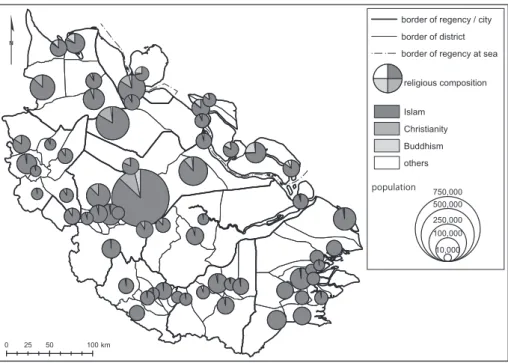
especially in the areas along the trunk route connecting Pekanbaru and Medan, the capital town of North Sumatra Province, and in the plantation areas in the northern half of the Riau Province, which is closer to the North Sumatra Province (Figure 8). The percentage of people who were born in the North Sumatra Province (11.0%) is much higher than the percentage of Batak (7.1%) in the Riau Province. This indicates that several non-Batak people, such as the Javanese or Malay, have migrated from the North Sumatra Province, and such massive migrations from the North Sumatra Province have occurred in relatively recent times. The people coming from the North Sumatra Province have a distribution in the Riau Province similar to that of Batak people (Figure 25). Among the main ethnic groups in the Riau Province only the Batak include a large Christian (Catholic and Protestant) population. Christians have the same distribution as Batak in the Riau Province (Figure 13).
The Banjar and Bugis are ethnic groups that are rooted in the southeastern part of Kalimantan Island and the southwestern part of Sulawesi Island, respectively. The Banjar here corresponds to the ethnic category "Banjar, Melayu Banjar," and the Bugis here corresponds to the ethnic category "Bugis, Ugi" in Statistics Indonesia (2001). These two ethnic groups are highly concentrated in specific areas of the Riau Province (Figure 9; Figure 10). The Banjar are distributed in the estuary region of the Indragiri River and its neighboring coastal area, and the Bugis are distributed in the southern coastal area of the Indragiri Hilir Regency. In Tembilahan, the capital town of Indragiri Hilir Regency, the
Banjar account for half of the population (50.3%). The areas in which the Banjar and Bugis are concentrated are the same areas with a high population in the plantation and agricultural sectors (Figure 16; Figure 17). Although there is a concentrated area of large-scale estates in the northern part of the Indragiri Hilir Regency, most of the Banjar and Bugis in this regency are considered to be engaged in traditional, small-scale agriculture, producing food and plantation crops such as coconuts or fishery. It is noteworthy that in the areas with high concentrations of the Banjar, the people who were born in the Riau Province were a majority (Figure 22). Considering the percentage of Banjar (4.6%) and the people who were born in Kalimantan Island (0.1%) in the Riau Province, there are remarkably few Banjar people coming from Kalimantan Island. This indicates it has been quite long since their migration occurred. If we look at the Bugis, considering their percentage (2.3%) and that of those who were born in Sulawesi Island (0.4%) in the Riau Province, nearly 20% of the Bugis were thought to be born in Sulawesi Island. The time of migration of the Bugis is considered to be more recent than that of the Banjar people.
Regarding the Chinese in the Riau Province, we were unable to obtain SP2000 data by district or village / ward. In order to examine the distribution of the Chinese population, we used the data of the Buddhist population instead. In SP2000, there is no other religious category related to the religious faith of the Chinese, such as Confucianism. Most of the Chinese in the Riau Province are typically considered to be Buddhist, and most of the Buddhists in the Riau Province
is far larger than the total population of Chinese in the Riau Province. This gap is probably ascribable to the fact that a substantial amount of the people of Chinese descent did not want to declare themselves as Chinese, or did not recognize themselves as Chinese.4) Other than the three major towns in the Riau Province, the distribution of Chinese (Buddhist) people in the Riau Province
addition to the commercial sector, many Chinese in this region are assumed to be engaged in fishery. It should be noted that in the coastal areas with a high Chinese population, the majority of people were born in the Riau Province (Figure 22). It is estimated that the Chinese have a fairly long history in the coastal area.
Duri Rengat Tembilahan Siak Sri Indrapura Indragiri Riv er Ka mpa r River Siak River Rokan River SIAK KAMPAR
PELALAWAN INDRAGIRI HILIR ROKAN HILIR BENGKALIS INDRAGIRI HULU ROKAN HULU KUANTAN SINGINGI PEKANBARU 0 25 50 100km
capital town of province capital town of regency / city other towns
road ferry river
border of regency / city border of regency at sea Bagansiapipi Bagansiapipi DUMAI DUMAI Dumai Dumai Bengkalis Bengkalis Pekanbaru Pekanbaru Pangkalan Kerinci Pangkalan Kerinci Bangkinang Bangkinang Teluk KuanianTeluk Kuantan Pasir Pegarayan Malaysia Straits of Malacca
Kampar Kanan river Kampar Kanan River To Madan
To Padang
To Jambi Figure 1. Riau Province
8 32 2 29 30 55 35 47 (28) 7 26 1 48 27 22 24 61 9 5 13 44 25 56 31 59 49 46 23 12 54 19 41 57 40 58 52 3 14 53 45 33 43 11 60 10 4 39 6 20 51 38 (17) 15 37 42 18 28 16 34 (52) 21 50 36 62 21 (17) (16) (28) SIAK KAMPAR PELALAWAN INDRAGIRI HILIR ROKAN HILIR BENGKALIS INDRAGIRI HULU ROKAN HULU DUMAI KUANTAN SINGINGI PEKANBARU 0 25 50 100km
border of regency / city border of regency at sea border of district
17 17
Regency / City
(Kabupaten / Kota) No District (Kecamatan)
Regency / City
(Kabupaten / Kota) No District (Kecamatan)
1 KUANTAN MUDIK 32 KAMPAR KIRI
2 SINGINGI 33 XIII KOTO KAMPAR
3 KUANTAN TENGAH 34 BANGKINANG BARAT
4 BENAI 35 TAPUNG
5 KUANTAN HILIR 36 BANGKINANG
6 CERENTI 37 KAMPAR
7 PERANAP 38 TAMBANG
8 SEBERIDA 39 SIAK HULU
9 KELAYANG 40 ROKAN IV KOTO
10 PASIR PENYU 41 TANDUN
11 RENGAT BARAT 42 RAMBAH SAMO
12 RENGAT 43 RAMBAH
13 KERITANG 44 TEMBUSAI
14 RETEH 45 KEPENUHAN
15 ENOK 46 KUNTODARUSSALAM
16 TANAH MERAH 47 MANDAU
17 KUALA INDRAGIRI 48 BUKIT BATU
18 TEMBILAHAN 49 RUPAT
19 TEMPULING 50 BENGKALIS
20 BATANG TUAKA 51 BANTAN
21 GAUNG ANAK SERKA 52 MERBAU
22 GAUNG 53 RANGSANG
23 MANDAH 54 TEBING TINGGI
24 KATEMAN 55 TANAH PUTIH
25 LANGGAM 56 BAGAN SINEMBAH
26 PANGKALAN KURAS 57 KUBU
27 BUNUT 58 BANGKO
28 KUALA KAMPAR 59 RIMBA MELINTANG
29 MINAS PEKANBARU 60 (PEKANBARU)
30 SIAK 61 BUKIT KAPUR
31 SUNGAI APIT 62 DUMAI BARAT + DUMAI TIMUR
SIAK DUMAI ROKAN HULU INDRAGIRI HILIR KAMPAR KUANTAN SINGINGI INDRAGIRI HULU BENGKALIS ROKAN HILIR PELALAWAN
0 25 50 100km population 10,000 500,000 250,000 750,000 100,000
Figure 3. Population (SP2000, Riau Province)
0 25 50 100km
border of regency / city border of district border of regency at sea
ethnic composition Malay Javanese Minangkabau Batak others population 10,000 500,000 250,000 750,000 100,000
0 25 50 100km
border of regency / city border of district border of regency at sea
ethnic composition Malay non Malay population 10,000 500,000 250,000 750,000 100,000
Figure 5. Ethnic composition (Malay) (SP2000, Riau Province)
0 25 50 100km
border of regency / city border of district border of regency at sea
ethnic composition Javanese non Javanese population 10,000 500,000 250,000 750,000 100,000
0 25 50 100km
border of regency / city border of district border of regency at sea
ethnic composition Batak non Batak population 10,000 500,000 250,000 750,000 100,000
Figure 7. Ethnic composition (Minangkabau) (SP2000, Riau Province)
Figure 8. Ethnic composition (Batak) (SP2000, Riau Province) 0 25 50 100km ethnic composition Minangkabau non Minangkabau population 10,000 500,000 250,000 750,000 100,000
0 25 50 100km
border of regency / city border of district border of regency at sea
ethnic composition Banjar non Banjar population 10,000 500,000 250,000 750,000 100,000 0 25 50 100km
border of regency / city border of district border of regency at sea
ethnic composition Bugis non Bugis population 10,000 500,000 250,000 750,000 100,000
Figure 9. Ethnic composition (Banjar) (SP2000, Riau Province)
0 25 50 100km religious composition Islam Christianity Buddhism others population 10,000 500,000 250,000 750,000 100,000 0 25 50 100km
border of regency / city border of district border of regency at sea
religious composition Islam non Islam population 10,000 500,000 250,000 750,000 100,000
Figure 11. Religious composition (SP2000, Riau Province)
0 25 50 100km
border of regency / city border of district border of regency at sea
religious composition Christianity non Christianity population 10,000 500,000 250,000 750,000 100,000 0 25 50 100km
border of regency / city border of district border of regency at sea
religious composition Buddhism non Buddhism population 10,000 500,000 250,000 750,000 100,000
Figure 13. Religious composition (Christianity) (SP2001, Riau Province)
0 25 50 100km composition of industry Plantation Agriculture other industries population 7,500 50,000 100,000 200,000 0 25 50 100km
border of regency / city border of district border of regency at sea
composition of industry Plantation non Plantation population 7,500 50,000 100,000 200,000
Figure 15. Composition of industry (SP2000, Riau Province)
0 25 50 100km
border of regency / city border of district border of regency at sea
composition of industry Agriculture non Agriculture population 7,500 50,000 100,000 200,000 0 25 50 100km
border of regency / city border of district border of regency at sea
composition of industry
other industries non other industries population
7,500 50,000 100,000 200,000
Figure 17. Composition of industry (Agriculture) (SP2000, Riau Province)
SIAK KAMPAR PELALAWAN INDRAGIRI HILIR ROKAN HULU BENGKALIS INDRAGIRI HULU KUANTAN SINGINGI PEKANBARU 79 48 80 1 33 4 49 63 5 34 57 55 90 78 58 60 50 93 13 91 42 30 39 45 41 16 69 21 76 85 23 17 62 51 47 6 44 53 22 24 54 88 77 59 20 68 70 15 81 38 75 100 64 36 7 86 32 25 89 67 43 2 31 18 66 52 10 61 (27) 94 71 37 92 103 72 46 26 19 3 87 40 35 (85) 102 83 14 9 101 8 99 84 73 56 65 74 28 29 105 32 (27) (26) (48) (47) (46) (35) 0 25 50 100km 11 11 12 12 27 27 Regency / City
(Kabupaten / Kota)No District (Kecamatan)
Regency / City
(Kabupaten / Kota) No District (Kecamatan)
Regency / City
(Kabupaten / Kota) No District (Kecamatan)
1 KUANTAN MUDIK 37 TELUK BELENGKONG 72 RAMBAH
2 HULU KUANTAN 38 PULAU BURUNG 73 RAMBAH HILIR
3 GUNUNG TOAR 39 LANGGAM 74 BANGUN PURBA
4 SINGINGI 40 PANGKALAN KERI 75 TEMBUSAI
5 SINGINGI HILIR 41 PANGKALAN KURAS 76 TEMBUSAI UTARA
6 KUANTAN TENGAH 42 UKUI 77 KEPENUHAN
7 BENAI 43 PANGKALAN LESU 78 KUNTODARUSSALAM
8 KUANTAN HILIR 44 BUNUT 79 MANDAU
9 PANGEAN 45 PELALAWAN 80 BUKIT BATU
10 LOGAS TANAH DARAT 46 KUALA KAMPAR 81 RUPAT
11 CERENTI 47 KERUMUTAN 82 RUPAT UTARA
12 INUMAN 48 TELUK MERANTI 83 BENGKALIS
13 PERANAP 49 MINAS (+ KANDIS) 84 BANTAN
14 SEBERIDA 50 SUNGAI MANDAU 85 MERBAU
15 BATANG CENAKU 51 SIAK 86 RANGSANG
16 BATANG GANSAL 87 RANGSANG BARAT
17 KELAYANG 88 TEBING TINGGI
18 PASIR PENYU 53 TUALANG (+ KOTO GASIB) 89 TEBING TINGGI BARAT
19 LIRIK 54 DAYUN 90 TANAH PUTIH
20 RENGAT BARAT 55 SUNGAI APIT 91 PUJUD
21 RENGAT 56 BUNGA RAYA
22 KERITANG 57 KAMPAR KIRI
23 KEMUNING 58 KAMPAR KIRI HULU 93 BAGAN SINEMBAH
24 RETEH 59 KAMPAR KIRI HILIR 94 SIMPANG KANAN
25 ENOK 60 XIII KOTO KAMPAR 95 KUBU
26 TANAH MERAH 61 BANGKINANG BARAT 96 PASIR LIMAU KAPAS
27 KUALA INDRAGIRI 62 TAPUNG 97 BANGKO
28 TEMBILAHAN 63 TAPUNG HULU 98 SENABOI
29 TEMBILAHAN HULU 64 TAPUNG HILIR 99 RIMBA MELINTANG
30 TEMPULING 65 BANGKINANG 100 BANGKO PUSAKO
31 BATANG TUAKA 66 KAMPAR PEKANBARU 101 (PEKANBARU)
32 GAUNG ANAK SERKA 67 TAMBANG 102 BUKIT KAPUR
33 GAUNG 68 SIAK HULU 103 MEDANG KAMPAI
34 MANDAH 69 ROKAN IV KOTO 104 SUNGAI SEMBILAN
35 KATEMAN 70 TANDUN
36 PELANGIRAN 71 RAMBAH SAMO
DUMAI BARAT + DUMAI TIMUR 105
TANAH PUTIH TANJUNG MELAWAN KUANTAN SINGINGI PELALAWAN INDRAGIRI HULU KAMPAR 92 INDRAGIRI HILIR INDRAGIRI HILIR ROKAN HULU BENGKALIS ROKAN HILIR DUMAI ROKAN HULU SIAK KERINCI KANAN (+ LUBUK DALAM) 52
border of regency / city border of regency at sea border of district 0 25 50 100km population 500,000 100,000 250,000 750,000 25,000
Figure 20. Population (P4B2004, Riau Province)
border of regency / city border of regency at sea border of district composition of birthplace Riau Jawa West Sumatra North Sumatra others 0 25 50 100km 500,000 100,000 250,000 750,000 25,000 population
composition of birthplace Riau non Riau 0 25 50 100km 500,000 100,000 250,000 750,000 25,000 population
Figure 22. Composition of birthplace (Riau) (P4B2004, Riau Province)
border of regency / city border of regency at sea border of district composition of birthplace Jawa non Jawa 0 25 50 100km 500,000 100,000 250,000 750,000 25,000 population
border of regency / city border of regency at sea border of district
composition of birthplace West Sumatra non West Sumatra
0 25 50 100km 500,000 100,000 250,000 750,000 25,000 population
Figure 24. Composition of birthplace (West Sumatra) (P4B2004, Riau Province)
border of regency / city border of regency at sea border of district
composition of birthplace North Sumatra non North Sumatra
0 25 50 100km 500,000 100,000 250,000 750,000 25,000 population
The Siak Regency is located in the middle of the Riau Province, and is bordered on the southwest by the Pekanbaru City. The Siak River runs down the regency from the southwest to the northeast (Figure 26). Most of the area of the Siak Regency is characterized by lowlands, but there are some hilly areas in the western and southern parts of the regency. The main road that connects Pekanbaru and Medan / Dumai cuts across the western part of the regency, and the main road that connects Pekanbaru and Jambi cuts across the southernmost part of the regency. Other than these, there are two main roads in the Siak Regency. The first is the road which connects the towns of Minas, Perawang, Siak Sri Indrapura, and Sungai Apit in the west-northeast direction. The other is the road that connects Pangkalan Kerinci, the capital town of Pelalawan Regency, and the Buatan Village in the north-south direction. From Pekanbaru to Siak Sri Indrapura, the capital town of Siak Regency, there are two routes to choose from: via the Minas town and via the junction near the Pangkalan Kerinci Town.
The population of the Siak Regency is mainly distributed along the Siak River, which runs along the main road connecting Pekanbaru and Medan / Dumai. The population is also mainly concentrated in the hilly area in the southern part of the regency. The largest concentration of population in the Siak Regency, which is called Perawang Town, is in the southwestern part of the regency along the upper reach of the Siak River (Figure 28; Figure 43).
its people. If we look at the ethnic composition of the Siak Regency based on SP2000, we can observe two major ethnic groups: the Javanese (Jawa), including the Sundanese (Sunda), at the top (Total; 36.9%, Javanese: 35.2%, Sundanese: 1.7%), and the Malay (Melayu) at second place (32.5%). The Batak (12.7%) and the Minangkabau (11.9%) follow, occupying little over 10 percent. The Banjar (0.2%) and the Bugis (0.1%) are very few. The Chinese (Cina) occupy about 2% if we consider the Buddhist population as the Chinese population.
The Malay are distributed throughout the Siak Regency, but the districts which have a high percentage of Malay people are lined up in the lower and middle Siak river region (Figure 30). Especially at the northeastern edge of the Siak Regency near the mouth of the Siak River, the districts where the Malay make up more than 90% are concentrated. This region has a high agricultural population (Figure 40), and it is presumed that agriculture is the main economic activity for the Malay in this region. By contrast, the southern and western parts of the regency along the main road connecting Pekanbaru and Medan / Dumai, where oil palm estates and smallholdings are concentrated and the percentage of population engaging in the plantation sector is relatively high (Figure 39), have a low percentage of Malay. Particularly in the southern part of the regency, there are many districts where the Malay make up less than 1 percent.
The Javanese are also widely distributed throughout the Siak Regency (Figure 31). One of the regions with a high percentage of Javanese is
the left bank of the lower Siak River region, where the settlements of transmigration projects are located. This region includes a district composed of almost 100% Javanese. In this region, large-scale estates have not been developed, and the percentage of agricultural population is relatively high (Figure 40). Many Javanese in this region are thought to be engaged in the agricultural sector, not the plantation sector. Another region with a high concentration of Javanese is the southern part of the regency, where oil palm estates and smallholdings were developed on a massive scale through a number of PIR projects. Most of the Javanese in this area are considered the settlers and their families who migrated from Jawa directly, and are engaged in oil palm production on their plasma smallholdings joining PIR projects. In this region, there are many districts with 80-90% Javanese population. In the western part of the regency, along the main road connecting Pekanbaru and Medan / Dumai, we can observe some districts where the Javanese occupy around 50 percent. It is noteworthy that this region has a much lower population who were born in Jawa to the total population of Javanese compared with the southern part of the regency (Figure 46). Many Javanese in this region are thought to be the migrants from the North Sumatra Province, engaged in oil palm production as independent smallholders (Figure 48).
The Minangkabau are highly concentrated in urban areas, especially in the Perawang and Minas Towns bordering Pekanbaru (Figure 32). The Batak are distributed mainly in two regions (Figure 33). The first is the western part of the regency along the main road connecting Pekanbaru
and Medan / Dumai and around the Perawang Town. In this region, the percentage of people who were born in the North Sumatra Province is relatively high (Figure 48), and there are a number of large-scale estates. Many Batak people migrated from the North Sumatra Province relatively recently and are engaged in oil palm production as estate workers or independent smallholders, or are engaged in miscellaneous jobs in urban areas. In the Kandis District, the Batak occupy nearly 60 percent. The second region is the southern part of the regency, where oil palm estates and smallholdings were developed through several PIR projects. In this region, there are many districts with a 10-20% Batak population. Whereas most of the Javanese in this region are plasma farmers and their families of PIR projects, most of the Batak in this region are workers and their families of nucleus estates of PIR projects or other large-scale estates.
If we regard the Buddhist population as the Chinese population, Chinese people are concentrated in some towns such as Siak Sri Indrapura and Perawang, and at the northeastern edge of the regency near the mouth of the Siak River (Figure 37). In Siak Sri Indrapura, the capital town of Siak Regency, and in Minas, the Chinese occupy more than 10% and are thought to be engaged in the commercial sector.
Duri
Perawang
Pekanbaru
Bengkalis
Pekanbaru
Bangkinang Pangkalan Kerinci Sungai
Apit
Minas
Sungai Apit
Siak Sri Indrapura
Siak River Manda
u River
Siakkecil River
Kampar Kanan River Kampar Kanan River PEKANBARU SIAK BENGKALIS KAMPAR PELALAWAN ROKAN HILIR PEKANBARU 0 10 20 40km other towns road ferry river lake
border of regency / city border of regency at sea border of district Siak regency
1 53 3 6 16 89 5 90 4 88 8 7 64 2 34 87 63 32 33 9 37 11 72 14 17 13 23 68 35 57 67 38 79 66 56 69 58 12 15 86 55 74 76 36 84 71 54 62 SIAK
MINAS SUNGAI APIT
53 37 65 38 46 43 48 23 49 29 17 51 27 47 45 52 44 19 41 (23) 28 42 22 21 24 31 39 40 30 67 25 26 20 (23) 50 18 68 87 88 53 72 71 57 64 79 56 69 86 55 58 74 76 85 84 61 82 54 83 77 73 75 62 60 70 78 80 81 59 border of district border of village / ward
0 10 20 40km 10 10 45 45 District (Kecamatan) No Village / Ward (Desa / Kelurahan) District (Kecamatan) No Village / Ward (Desa / Kelurahan) District (Kecamatan) No Village / Ward (Desa / Kelurahan) 1 SAM SAM 31 SIALANG BARU 60 KAMPUNG TENGAH
2 KANDIS 32 MEREDAN 61 SUNGAI MEMPURA
3 BELUTU 33 TUALANG 62 KAMPUNG REMPAK
4 LUBUK UMBUT 34 PINANG SEBATANG 63 TUMANG 5 MANDI ANGIN 35 KUALA GASIB 64 MEREMPAN 6 MINAS BARAT 36 TELUK RIMBA 65 SENGKEMANG 7 RANTAU BERTUAH 37 PANGKALAN PISANG 66 RANTAU PANJANG 8 MINAS TIMUR 38 LUBUK DALAM 67 BUATAN II 9 SUNGAI SELODANG 39 RAWANG KAO 68 BUATAN I 10 TELUK LANCANG 40 SRI GADING 69 JAYA PURA
11 OLAK 70 SUNGAI BERBARI
12 MUARA KELANTAN 71 SUNGAI LIMAU
13 LUBUK JERING 72 DOSAN
14 MUARA BUNGKAL 73 BENAYAH
15 BENCAH UMBAI 43 PANGKALAN MAKMUR 74 PEBADARAN 16 TASIK BETUNG 44 BANJAR SEMINAI 75 BUNGA RAYA 17 KERINCI KIRI 45 TELUK MERBAU 76 JATI BARU 18 MAKMUR 46 SAWIT PERMAI 77 DUSUN PUSAKA 19 BUKIT AGUNG 47 KERANJI GUGUH 78 PERINCIT 20 KUMBARA UTAMA 48 EMPANG PANDAN 79 TELUK MESJID 21 BUKIT HARAPAN 49 SIALANG SAKTI 80 PARITI/II 22 BUANA BHAKTI 50 MERANGKAI 81 SUNGAI APIT 23 KERINCI KANAN 51 BERUMBUNG BARU 82 BANDAR SUNGAI
52 LUBUK TILAM 83 REMPAK 53 DAYUN 84 TANJUNG KURAS 25 GABUNG MAKMUR 54 BENTENG HULU 85 SUNGAI KAYU ARA 26 JATI MULIA 55 BENTENG HILIR 86 LALANG 27 BUATAN BARU 56 PALUH 87 MENGKAPAN 28 SEMINAI 57 KOTA RINGIN 88 SUNGAI RAWA 29 EMPANG BARU 58 LANGKAI 89 PENYENGAT 30 SIALANG PALAS 59 KAMPUNG DALAM 90 TELUK LANUS Siak Minas SIMPANG PERAK JAYA 24 UPT XI.SP.XII / SUKA MULIA UPT XII.SP.XI / BUANA MAKMUR 41 42 Siak Sungai Apit Siak
0 10 20 40km population 50,000 2,500 10,000 25,000 75,000 0 10 20 40km border of district border of village / ward
ethnic composition Malay Javanese Minangkabau Batak others 50,000 1,000 10,000 25,000 75,000 population 0 10 20 40km border of district border of village / ward
50,000 1,000 10,000 25,000 75,000 population ethnic composition Malay non Malay
Figure 28. Population (SP2000, Siak Regency)
Figure 29. Ethnic composition (SP2000, Siak Regency)
0 10 20 40km
border of district
border of village / ward ethniccomposition Javanese non Javanese 50,000 1,000 10,000 25,000 75,000 population 0 10 20 40km border of district border of village / ward
50,000 1,000 10,000 25,000 75,000 population ethnic omposition Minangkabau non Minangkabau
Figure 31. Ethnic composition (Javanese) (SP2000, Siak Regency)
Figure 32. Ethnic composition (Minangkabau) (SP2000, Siak Regency)
0 10 20 40km
border of district
border of village / ward ethniccomposition Batak non Batak 50,000 1,000 10,000 25,000 75,000 population
0 10 20 40km Islam Christianity Buddhism others 50,000 1,000 10,000 25,000 75,000 population
Figure 34. Religious composition (SP2000, Siak Regency)
0 10 20 40km
border of district
border of village / ward religiouscomposition Islam non Islam 50,000 1,000 10,000 25,000 75,000 population
Figure 35. Religious composition (Islam) (SP2000, Siak Regency)
0 10 20 40km
border of district
border of village / ward religiouscomposition Christianity non Christianity 50,000 1,000 10,000 25,000 75,000 population
Figure 37. Religious composition (Buddhism) (SP2000, Siak Regency)
0 10 20 40km
border of district
border of village / ward religiouscomposition Buddhism non Buddhism 50,000 1,000 10,000 25,000 75,000 population 0 10 20 40km border of district
border of village / ward compositionof industry Plantation Agriculture other industries 50,000 2,500 10,000 25,000 Population
Figure 38. Composition of industry (SP2000, Siak Regency)
0 10 20 40km
border of district
border of village / ward compositionof industry Plantation non Plantation 50,000 2,500 10,000 25,000 Population
0 10 20 40km Agriculture non Agriculture 50,000 2,500 10,000 25,000 Population
Figure 40. Composition of industry (Agriculture) (SP2000, Siak Regency)
0 10 20 40km
border of district
border of village / ward compositionof industry other industries non other industries
50,000
2,500 10,000 25,000
Population
KANDIS DAYUN SIAK SUNGAI APIT MINAS SUNGAI MANDAU TUALANG KOTO GASIB BUNGA RAYA KERINCI KANAN LUBUK DALAM 62 16 2 14 88 1 20 89 6 87 3 9 86 30 4 44 7 32 71 5 12 33 11 77 45 24 31 76 75 15 49 23 48 50 10 22 70 19 9899 38 69 46 66 18 13 17 8 101 51 62 71 74 66 57 54 73 38 58 63 33 60 (38) 42 72 56 61 34 55 52 43 53 37 36 39 65 67 68 64 76 35 40 41 (38) 59 77 (34) 86 87 62 99 98 24 23 22 25 32 84 28 31 95 21 101 78 83 29 91 107 103 81 85 104 27 97 105 100 79 90 92 93 96 106 94 80 109 108 26 border of district border of village / ward
0 10 20 40km 82 82 56 56 102 102 47 47 District (Kecamatan) No Village / Ward (Desa / Kelurahan) District (Kecamatan) No Village / Ward (Desa / Kelurahan) District (Kecamatan) No Village / Ward (Desa / Kelurahan)
1 MANDI ANGIN 38 KERINCI KANAN 73 EMPANG PANDAN
2 MINAS BARAT 39 SIMPANG PERAK JAYA 74 SENGKEMANG
3 RANTAU BERTUAH 40 GABUNG MAKMUR 75 RANTAU PANJANG
4 MINAS TIMUR 41 JATI MULIA 76 BUATAN II
5 MINAS JAYA 42 BUATAN BARU 77 BUATAN I
6 LUBUK UMBUT 43 SEMINAI 78 TELUK MESJID
7 SUNGAI SELODANG 44 MEREDAN 79 PARITI/II
8 TELUK LANCANG 45 TUALANG 80 SUNGAI APIT
9 OLAK 46 PINANG SEBATANG 81 BANDAR SUNGAI
10 MUARA KELANTAN 47 MEREDAN BARAT 82 REMPAK
11 LUBUK JERING 48 PINANG SEBATANG BARAT 83 TANJUNG KURAS
12 MUARA BUNGKAL 49 PINANG SEBATANG TIMUR 84 SUNGAI KAYU ARA
13 BENCAH UMBAI 50 PERAWANG BARAT 85 LALANG
14 TASIK BETUNG 51 KELURAHAN PERAWANG 86 MENGKAPAN
15 KELURAHAN SAM SAM 87 SUNGAI RAWA
16 DESA SAM SAM 88 PENYENGAT
17 KELURAHAN KANDIS 89 TELUK LANUS
18 DESA KANDIS 90 HARAPAN
19 KELURAHAN BELUTU 54 PANGKALAN MAKMUR 91 SUNGAI TENGAH
20 DESA BELUTU 55 BANJAR SEMINAI 92 BELADING
21 BENTENG HULU 56 TELUK MERBAU 93 LAKSAMANA
22 BENTENG HILIR 57 SAWIT PERMAI 94 TELUK BATIL
23 PALUH 58 SIALANG SAKTI 95 BUNSUR
24 KOTA RINGIN 59 MERANGKAI 96 JAYA PURA
25 LANGKAI 60 BERUMBUNG BARU 97 SUNGAI BERBARI
26 KAMPUNG DALAM 61 LUBUK TILAM 98 SUNGAI LIMAU
27 KAMPUNG TENGAH 62 DAYUN 99 DOSAN
28 SUNGAI MEMPURA 63 EMPANG BARU 100 BENAYAH
29 KAMPUNG REMPAK 64 SIALANG PALAS 101 PEBADARAN
30 TUMANG 65 SIALANG BARU 102 BUNGA RAYA
31 MEREMPAN 66 LUBUK DALAM 103 JATI BARU
32 MEREMPAN HULU 67 RAWANG KAO 104 DUSUN PUSAKA
33 KERINCI KIRI 68 SRI GADING 105 PERINCIT
34 BUKIT AGUNG 69 KUALA GASIB 106 BUANTAN LESTARI
35 KUMBARA UTAMA 70 TELUK RIMBA 107 TUAH INDRAPURA
36 BUKIT HARAPAN 71 PANGKALAN PISANG 108 KEMUNING MUDA
37 BUANA BHAKTI 72 KERANJI GUGUH 109 LANGSAT PERMAI
MINAS SUNGAI MANDAU KANDIS SIAK KERINCI KANAN UPT XI.SP.XII / SUKA MULIA UPT XII.SP.XI / BUANA MAKMUR 52 53 KOTO GASIB SUNGAI APIT BUNGA RAYA KERINCI KANAN TUALANG DAYUN LUBUK DALAM KOTO GASIB
0 10 20 40km population 50,000 2,500 10,000 25,000
Figure 43. Population (P4B2004, Siak regency)
Figure 44. Composition of birthplace (P4B2004, Siak Regency)
0 10 20 40km
border of district
border of village / ward compositionof birthplace Riau Jawa West Sumatra North Sumatra others population 50,000 2,500 10,000 25,000 0 10 20 40km border of district
border of village / ward composition of birthplace Riau non Riau population 50,000 2,500 10,000 25,000
0 10 20 40km
border of district
border of village / ward composition
of birthplace Jawa non Jawa population 50,000 2,500 10,000 25,000 0 10 20 40km border of district
border of village / ward composition of birthplace West Sumatra non West Sumatra
population 50,000 2,500 10,000 25,000 0 10 20 40km border of district
border of village / ward composition of birthplace North Sumatra non North Sumatra
population
50,000
2,500 10,000 25,000
Figure 46. Composition of birthplace (Jawa) (P4B2004, Siak Regency)
Figure 47. Composition of birthplace (West Sumatra) (P4B2004, Siak Regency)
Over a long period of history, a massive wave of immigration rolled on the territory of the Riau Province repeatedly, forming the geographical configuration of Riau society today. From the highlands of the West Sumatra Province, probably before the colonial era, the people who are categorized as Malay in a broad sense in the present-day Riau society gradually moved down to the western part of the Riau Province. In the latter half of the colonial era, the spontaneous migrants from various regions of Sumatra and Java started to settle in the Riau Province. In the same period, the people from Kalimantan and ethnic Chinese settled in the coastal area.
After the independence of Indonesia, especially in the era of the New Order, with the acceleration of resources development, new massive waves of immigration rolled on the territory of the Riau Province and transformed the geographical configuration of Riau society. With the explosive expansion of the oil palm plantation sector, a large amount of people migrated from the North Sumatra Province as estate workers or smallholders. At the sites of transmigration or related PIR projects, many migrants came from Java, engaging in the plantation or agricultural sectors as smallholders. The rapid economic growth of the Riau Province associated with resources development including land, timber and minerals attracted people from outside the Riau Province on a massive scale to the various industrial sectors. From the West Sumatra Province, the Minangkabau flowed into the expanding commercial sector and came to make
era, migration to the Riau Province decreased in line with the disappearance of resources development. It is likely that the characteristics of Riau society from the viewpoint of its geographical configuration have essentially not changed since the early 2000s.
This article showed the geographical configuration of Riau society in the early 2000s by creating social maps and discussed its characteristics and historical backgrounds. The geographical configuration of a certain society at some point in time can be seen as the outcome of continuous changes, and at the same time, it sets preconditions for future social change. This article attempts to evoke interests in understanding the geographical configuration of society by creating social maps on detailed geographical scales in studying various aspects of social transformation in Indonesia.
Acknowledgements
We would like to thank the Statistics of Riau Province for providing us with the data of SP2000 and P4B2004. Our thanks are also due to Dr. Masashi Sato, Ms. Natsumi Akimoto, and Mr. Wataru Moriya for their assistance in mapping the data on a GIS. This research was supported by Grant-in-Aid for Scientific Research (B) 2012-2014, No. 24401008, “Changes of Expanding Process of Oil Palm Plantation in Indonesia: Indigenization, Internalization, and Social Differentiation” (Project Leader: Junji Nagata).
Notes
1) The former Riau Province was divided into the Riau Province and Riau Islands Province in 2002. This article covers only the territory of the current Riau Province. All of the statistics and information on the Riau Province that are referred to in this article have excluded the territory of the Riau Islands Province.
2) In mapping the data of SP2000 and P4B2004 on a GIS, all of the districts (kecamatan) in Pekanbaru City and the Dumai Barat and Dumai Timur Districts in Dumai City are combined to one district because these districts make up the consecutive urban area in each city.
3) Strictly speaking, the total of two ethnic categories, "Riau, Melayu Riau" and "Melayu" in Statistics Indonesia (2001) does not correspond to the number of Malay in the SP2000 data which we acquired. The difference is 15,966. As for the Malay (Melayu), 21 sub-categories such as "Riau, Melayu Riau" are provided in the population census of 2000 (Nagatsu 2012). Sub-categories of Malay other than "Riau, Melayu Riau" and "Melayu" are included in “others” in Statistics Indonesia (2001), and this accounts
for the difference (Table 1).
4) Ananta et al. (2008) carried out the demographic analysis of Chinese Indonesians by using the raw data of the population census of 2000.
References
Ananta, A., Evi Nurvidya Arifin, and Bakhtiar. 2008. Chinese Indonesians in Indonesia and the Province of Riau Archipelago: A demographic analysis. In Ethnic Chinese in contemporary Indonesia, ed. L. Suryadinata, 17-47. Singapore: Institute of Southeast Asian Studies. Nagata, J. and Arai, S. W. 2006. Sumatra chubu Riau shuu
ni okeru kinnen no nouen kaihatsu: kenkyuu no haikei to houhou / ronten (Recent development of plantation sector in Riau, Sumatra: Research perspectives and underlying issues). Komaba Studies in Human Geography 17: 51-60. (J)
Nagata, J. and Arai, S. W. 2013. Evolutionary change in the oil palm plantation sector in Riau Province, Sumatra. In The palm oil controversy in Southeast Asia: A transnational perspective, ed. O. Pye and J. Bhattacharya, 76-96. Singapore: Institute of Southeast Asian Studies. Nagatsu, K. 2012. Indonesia no 2000 nen sensasu to
minzokubetsu jinko (Population census of 2000 and the population by ethnicity in Indonesia). In Minzoku taikoku Indonesia, ed. H. Kagami, 37-48. Tokyo: Mokusei-sha. (J) Statistics Indonesia. 2001. Population of Riau: Results of the
2000 population census (Series: L2.2.4). Jakarta: Statistics Indonesia.