
Breadth-first Search Approach to Enumeration of Tree-like Chemical Compounds
6
0
0
全文
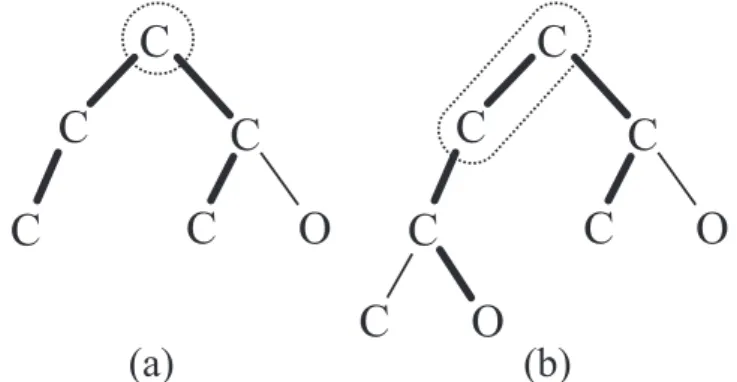
(2) Vol.2013-MPS-96 No.15 Vol.2013-BIO-36 No.15 2013/12/11. IPSJ SIG Technical Report. C O. OH. C. C. C. H. H. C. O. C. H. H. O. O. O. O. C. C HO. O O. H Fig. 1. that our methods are exact and more efficient than state-of-the-art ones. Although we focus on enumeration of tree-like chemical compounds in this technical report, there are substantial possibilities of extensions of the methods to deal with more general structures. In the conclusion section, we discuss these potential extensions of our algorithms for the future step.. 2. Preliminaries Chemical structures can be represented as molecular graphs whose vertices are labeled with the kinds of the corresponding atoms and edges are labeled with the types of bonds. In this section, we provide some elementary definitions that will be used later in our algorithms. 2.1 Molecular trees We call connected acyclic molecular graphs without multiedges simple trees that represent chemical compounds without multiple bonds. Conversely, multi-trees are allowed to have multi-edges. Let Σ = {l1 , l2 , . . . , l s } be the set of labels of atomic symbols. The degrees of vertices in such a molecular graph are restricted by a valence function val : Σ → Z + that links each li (li ∈ Σ) with a positive integer. It is noted that only double and triple bonds are taken into account in this study. Herein, we give the label set Σ an order so as to distinguish atoms with the same valence and to define a normal form for molecular trees. A rooted tree is defined as a tree with one vertex chosen as its root. Then, a molecular tree can be represented as a rooted ordered multi-tree T (V, E), where V is a nonempty finite set of vertices that correspond to atoms, E is a nonempty finite set of edges that correspond to bonds (see Fig. 1). Let num(li ) be the number of vertices labeled as li in T . Let height(T ) be the height of T , and maxpath(T ) be a set of the longest paths in T , respectively. Let T (v) denote the subtree rooted at vertex v in T . Let l(v), depth(v), degree(v) and parent(v) be the label, depth, degree and the parent vertex of vertex v in T , respectively. Let mul(u, v) be the multiplicity of edge (u, v), where u and v are distinct vertices in T . We define the tree-like compound enumeration problem as follows. Problem 1. Given a set Σ of s labels representing atoms, number ni of each label li , a valence function val : Σ → Z + , enumerate all molecular multi-trees T such that ni = num(li ) for all li in Σ and. c 2013 Information Processing Society of Japan ⃝. C. C. H. Example of transforming 2-oxo-glutarate into a rooted ordered multi-tree T . This transformed molecular tree has depth(T ) = 4, maxpath(T ) = {HOCCCCCOH} and label set {C, O, H}, where num(C) = 5, num(O) = 5 and num(H) = 6.. C. C O. C. C C. O. O. (a) Fig. 2. C. (b). Illustration of two kinds of center-rooted trees. The thick lines represent one of the longest paths, and the vertices in dotted circles represent the center.. degree(v) = val(l(v)) for all vertices v ∈ T . 2.2 Center-rooted We define a unique center to a rooted tree T as the center of any path in maxpath(T ), where such a center should be a single vertex (Fig. 2(a)) or an edge (Fig. 2(b)). It is obvious that such a center in T is unique regardless of the number of elements in maxpath(T ). Thus T is called center-rooted if its root is the center or one endpoint of the center. 2.3 Left-heavy We introduce two inequalities > s and >m for ordered simple and multi-trees, which are recursively defined as in Definitions 1 and 2, respectively. We say that T (u) is heavier than T (v) if T (u) > s T (v) or T (u) >m T (v). Definition 1 Let (u1 , u2 , . . . , uh ) and (v1 , v2 , . . . , vk ) be the children of u and v in simple or multi-tree T , respectively. We define T (u) > s T (v) if ( 1 ) l(u) > l(v), or ( 2 ) l(u) = l(v) ∃ i, ∀ j ≤ i T (u j ) = s T (v j ), and ( a ) i < min{h, k}, T (ui+1 ) > s T (vi+1 ), or ( b ) i = k < h. Specially, we define T (u) = s T (v) if l(u) = l(v) and T (u j ) = s T (v j ) for all j ≤ h = k. Definition 2 We define T (u) >m T (v) for multi-tree T if ( 1 ) T (u) > s T (v), or ( 2 ) T (u) = s T (v), and ∃i, (∀ j ≤ i) mul(e j ) = mul(e′j ) and mul(ei+1 ) > mul(e′i+1 ), where e1 , e2 , . . . , em (resp., e′1 , e′2 , . . . , e′m ) be all the edges in T (u) (resp., T (v)) in the BFS order. Specially, we define T (u) =m T (v) if T (u) = s T (v) and mul(e j ) = mul(e j ) for all j ≤ m. For reducing the search space in the generation process, we utilize the definition of left-heavy for rooted trees, where the definition is slightly modified from that by Fujiwara et al. [11] and Nakano and Uno [17]. Definition 3 A molecular tree T is left-heavy if T (vi ) ≥m T (vi+1 ) (i = 1, . . . , k − 1) holds for the children (v1 , . . . , vk ) of each vertex v in T . 2.4 Normal form In order to avoid duplications, we utilize a notion of normal 2.
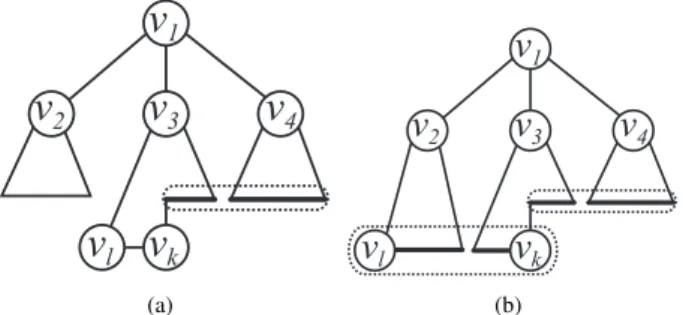
(3) Vol.2013-MPS-96 No.15 Vol.2013-BIO-36 No.15 2013/12/11. IPSJ SIG Technical Report. Tr(v) v. C r O. C C O. C Fig. 3. v2. v3. v1. v4. v2. C C. C. v1. Tv(r). Illustration of determining a normal form. Since the definition of normal form is based on the ideas of left heavy and center-rooted, the root is one endpoint of the center, further comparison is needed between subtree T r (v) and T v (r), only if r is the root and v is the other endpoint of the center. The given tree is determined as a normal tree because T r (v) >m T v (r).. vl vk (a). vl. v3. v4. vk (b). Fig. 4 Illustration for determining the possible positions (within the dotted curves) where a new leaf should be added to a current tree. (a) If the deepest leftmost vertex vl and the deepest rightmost vertex vk are in the same subtree, a new leaf can be added to only vertices from parent(vk ) to vl−1 . (b) If vl and vk are included in distinct subtrees, a new leaf can be added to vertices from parent(vk ) to vk .. 3. Methods form to molecular trees as formalized in Definition 4. The normal form includes the ideas of center-rooted and left-heavy. We call a tree in the normal form a normal tree. Definition 4 Let T be a left-heavy center-rooted ordered tree rooted at r. ( 1 ) If the center is a single vertex, then T is a normal tree. ( 2 ) If the center is an edge (r, v) and T r (v) ≥m T v (r), where T r (v) (T v (r)) denotes the subtree induced by v (r) and its descendants when r (v) is root, then T with root r is a normal tree (see also Fig. 3). 2.5 Family tree Our approach searches a special tree structure called family tree. Let Cn denote a set of left-heavy center-rooted simple trees ∑s with at most n vertices, where n = i=1 ni . Suppose that a tree T ∈ Cn has k vertices (0 < k ≤ n), numbered as (v1 , v2 , . . . , vk ) in BFS order. Let P(T ) be a tree generated from T by removing the last vertex vk of T . We call P(T ) the parent of T . Then, we can prove the following [16]. Theorem 1 If a given tree T is left-heavy center-rooted, then its parent P(T ) is left-heavy center-rooted as well. This implies that for any T ∈ Cn , its parent tree P(T ) belongs to Cn . Similarly, we can generate P(P(T )) by removing the vertex vk−1 , the deepest rightmost leaf of P(T ), from P(T ). Thus, a unique sequence T , P(T ), P(P(T )), P(P(P(T ))), . . . , ϕ of trees in Cn can be generated by repeatedly removing the deepest rightmost leaf for each T in Cn . A family tree of Cn , denoted by Fn , is defined by merging all these sequences. Obviously, each vertex in such Fn represents a tree in Cn . Furthermore, a family tree for molecular multi-trees can be similarly defined. Let Sm denote a set of left-heavy center-rooted multi-trees with at most m multi-edges. Suppose that a tree T belongs to Sm with h multi-edges (0 < h ≤ m), and (e1 , e2 , . . . , eh ) is a sequence of multi-edges of T in BFS order. A family tree of Sm , denoted by FmM , is similarly defined. Obviously, each vertex in FmM represents a tree in Sm and root of such FmM is a simple tree. It should be noted that both Fm and FmM are searched by DFS order.. c 2013 Information Processing Society of Japan ⃝. In this section, we propose BfsSimEnum and BfsMulEnum for enumerating molecular simple and multi-trees by breadth-first search order. As Ishida et al. [10] and Shimizu et al. [12] pointed out, the number of enumerated solutions exponentially increases with the increasing number of atoms. To reduce the large search space, concepts of center-rooted, left-heavy and normal form are taken in use as restrictions for avoiding duplicates. 3.1 BfsSimEnum for simple tree enumeration Given a molecular formula with valence function, while trying to enumerate all possible simple trees, BfsSimEnum searches a family tree that: each vertex is a left-heavy and center-rooted simple tree, and specially, each leaf is in normal form. Notice that each vertex in such a family tree represents a tree with at most n′ vertices, where n′ is the total number of atoms whose valences are greater than 1, since atoms with valence one such as hydrogen atoms can be easily added as leaves at last. This algorithm tries to search a family tree that starts with an empty tree, and grows up by repeatedly adding a new vertex to a current tree T in BFS order at every turn until all n′ vertices are added. Fig. 5 shows a pseudo code of BfsSimEnum (see also Fig. 7). Firstly, BfsSimEnum constructs a tree T with one single vertex whose valence is greater than 1. As an addition step, this algorithm repeatedly adds a new vertex to possible positions of T according to left-heavy and center-rooted to construct a new tree. BfsSimEnum outputs a generated tree if and only if n′ vertices are added and it is in normal form. The point of this algorithm is how to keep a new constructed tree left-heavy and center-rooted at an addition step. Let vk and vl be the deepest rightmost and leftmost vertices in T , respectively. To keep a new tree center-rooted, the candidate positions to be added are determined by confirming whether or not vertices vl and vk are in a subtree: (i) if they are in a subtree, a vertex can be added to only the positions ranging from parent(vk ) to vl−1 (see Fig. 4(a)); (ii) otherwise, a vertex can be added to the positions ranging from parent(vk ) to vk (see also Fig. 4(b)). To keep a new tree left-heavy, candidate labels for a new added vertex vk+1 are determined by confirming subtrees including vk+1 . Since the label 3.
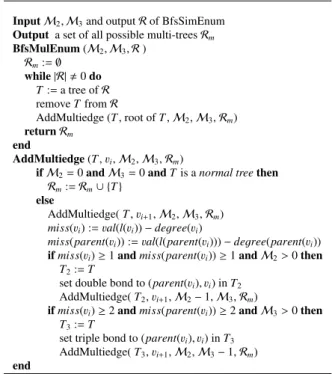
(4) Vol.2013-MPS-96 No.15 Vol.2013-BIO-36 No.15 2013/12/11. IPSJ SIG Technical Report. Input An ordered set of labels Σ = {l1 , . . . , l s }, where l1 > l2 . . . > l s , number n j of each label l j , a valence function val : Σ → Z + Output A set of all possible simple trees R which are normal trees BfsSimEnum(Σ, val, {ni }) R := ∅ for each l j ∈ Σ such that val(l j ) > 1 do T := a tree consisted of a root with l j AddNode(Σ, val, {n j }, T , R) return R end AddNode(Σ, val, {n j }, T , R) n′ := the number of given atoms whose valences are greater than 1 if |T | = n′ and T holds normal form then R := R ∪ {T } else vk , vl := the deepest rightmost and leftmost vertices in T , resp. if vk and vl are included in the same proper subtree then ve := vl−1 else ve := vk for each vi from parent(vk ) to ve in BFS order do if degree(vi ) < val(l(vi )) then lg := the largest possible label for vk+1 for each l j ∈ Σ such that l j ≤ lg and val(l j ) > 1 and num(l j ) < n j do T ′ := T add a new vertex with l j as the last child of vi in T ′ AddNode(Σ, val, {n j }, T ′ , R) end Fig. 5. Pseudo code of BfsSimEnum for simple tree enumeration.. set Σ is ordered as l1 > l2 > . . . > l s , our algorithm aims to seek the largest possible label for vk+1 such that all smaller ones are candidate labels for vk+1 . 3.2 BfsMulEnum for multi-tree enumeration We propose BfsMulEnum for multi-tree enumeration, which starts with an output of BfsSimEnum and repeatedly changes a single edge to a multi-edge in BFS order at every turn until all possible multi-edges are added. As mentioned before, only edges with multiplicity 2 or 3 are taken into account as multiple bonds. Let M2 and M3 denote the number of double bonds and triple bonds, respectively. M2 and M3 are computed so that they satisfy the following equation: 2M2 + 4M3 =. h ∑ i=1. ni · val(li ) − 2. h ∑ i=1. ni −. s ∑. n j + 2,. (1). j=h+1. where two sets of labels {l1 , . . . , lh } and {lh+1 , . . . , l s } represent atoms whose valences are greater than 1 and whose valences are 1, respectively. In the example in Fig. 7, as the molecular formula is given as C2 O2 H2 , feasible multiple bonds for M2 and M3 should satisfy that 2M2 +4M3 = 2·4+2·2−2·(2+2)−2+2 = 4, which means that target molecular trees of this example should have two double bonds or one triple bond such that (M2 , M3 ) = (2, 0), (0, 1). From the output of BfsSimEnum together with M2 and M3 determined as above, BfsMulEnum aims to construct a set of target multi-trees R M by BFS order, see also the details in Fig. 6. BfsMulEnum recursively sets a multi-edge to feasible positions of T according to normal form to construct a new tree. Only if all feasible multiple bonds are set, BfsMulEnum outputs such a new tree. Different from BfsSimEnum, at a setting step, BfsMulEnum needs to confirm whether or not a new tree is in normal. c 2013 Information Processing Society of Japan ⃝. Input M2 , M3 and output R of BfsSimEnum Output a set of all possible multi-trees Rm BfsMulEnum (M2 , M3 , R ) Rm := ∅ while |R| , 0 do T := a tree of R remove T from R AddMultiedge (T , root of T , M2 , M3 , Rm ) return Rm end AddMultiedge (T , vi , M2 , M3 , Rm ) if M2 = 0 and M3 = 0 and T is a normal tree then Rm := Rm ∪ {T } else AddMultiedge( T , vi+1 , M2 , M3 , Rm ) miss(vi ) := val(l(vi )) − degree(vi ) miss(parent(vi )) := val(l(parent(vi ))) − degree(parent(vi )) if miss(vi ) ≥ 1 and miss(parent(vi )) ≥ 1 and M2 > 0 then T 2 := T set double bond to (parent(vi ), vi ) in T 2 AddMultiedge( T 2 , vi+1 , M2 − 1, M3 , Rm ) if miss(vi ) ≥ 2 and miss(parent(vi )) ≥ 2 and M3 > 0 then T 3 := T set triple bond to (parent(vi ), vi ) in T 3 AddMultiedge( T 3 , vi+1 , M2 , M3 − 1, Rm ) end Fig. 6. Pseudo code of BfsMulEnum for multi-tree enumeration.. form by comparing the edge multiplicity together with confirming the feasibility of setting other multi-edges when generation for such a new tree is still continued. Although it consumes a little more computational expense for enumerating multi-tree structures than that for enumerating simple ones in this study, computation of BfsMulEnum is not complicated since it only deals with edges without any structural changes. Fig. 7 illustrates the process of both BfsSimEnum and BfsMulEnum.. 4. Results Computational experiments were performed on BfsSimEnum and BfsMulEnum using a PC with Xeon CPU 3.47GHz and 24GB memory. 4.1 Comparison with existing methods We assessed the computational performance by comparison with two state-of-the-art methods, MOLGEN (Version 3.5) and EnuMol, under the same computational environment. The results are shown in Table 1 and Table 2. Unlike existing approaches whose molecular structures are generated by DFS order, the results successfully show that generating a solution by BFS order also performs well or even better for tree-like molecular enumeration, since all of these solutions are proceeded by keeping balance. From Table 1, we can see that BfsSimEnum was faster than the other ones, which also implies that the employed and modified concepts of center rooted, left heavy and normal form are very useful for reducing the search space. From the computational time shown in Table 2, we can see that BfsMulEnum is slightly less advantageous than EnuMol when M2 + 2M3 < 6, which means that the number of double bonds is bounded by 5. As the number of multiple bonds increases (specially when M2 + 2M3 ≥ 6), BfsMulEnum outperforms Enu4.
(5) Vol.2013-MPS-96 No.15 Vol.2013-BIO-36 No.15 2013/12/11. IPSJ SIG Technical Report. pendent from BfsSimEnum. For this purpose, not only possible vertices but also possible multi-edges should be both taken into account when constructing intermediate trees. Such an extension can significantly reduce search space because we can decrease the possibility to expand simple trees which no longer can be replaced with multi-trees. Another extension to our methods is to deal with more complex ring structures such as naphthalenes. Our proposed methods are fast and fundamental for molecular enumeration that has many useful applications. Extensions toward enumerating general compounds and combination with biological properties should be interesting future work.. Acknowledgments This work was partially supported by Grants-in-Aid #22240009, #24500361, and #25-2920 from MEXT, Japan.. Appendix References [1] [2] [3]. Fig. 7 Illustration of BfsSimEnum and BfsMulEnum. BfsSimEnum is processed above the dot line; BfsMulEnum is processed below the dot line. Graphs in gray color are considered as invalid by the algorithms and thus are not stored or proceeded any more. It should be noted that hydrogen atoms are added as leaves at last.. [4] [5] [6]. Mol. The reason why BfsMulEnum is sometimes slower than EnuMol is its dependence on BfsSimEnum. Due to this reason, there might be a large amount of simple trees computed by BfsSimEnum that cannot be expanded to multi-trees. On the other hand, our multi-tree enumeration method is significantly faster than MOLGEN.. [7] [8] [9] [10]. 5. Conclusion In this technical report, we proposed BfsSimEnum and BfsMulEnum for enumerating tree-like compounds by firstly utilizing the breadth-first search order. Owing to the utilization of BFS order, both BfsSimEnum and BfsMulEnum only produce balanced intermediate trees during their search of a family tree without proceeding or storing any unbalanced ones, which can efficiently avoid duplicates. Together with the employed and modified concepts such as center-rooted, left-heavy and normal form, our proposed methods are successfully showed to be useful for reducing the large search space. The results of computational experiments indicate that our algorithms are exact and faster than state-of-the-art ones for simple tree enumeration. For multi-trees enumeration, however, BfsMulEnum is often outperformed by EnuMol only when M2 + 2M3 is bounded to 5. Although it is efficient for molecules which include large number of multiple bonds (M2 + 2M3 ≥ 6), BfsMulEnum is possible to get a further extension to make it inde-. c 2013 Information Processing Society of Japan ⃝. [11]. [12] [13] [14]. [15] [16]. [17]. Faulon, J. L. and Bender, A.: Handbook of Chemoinformatics Algorithms, CRC Press (2010). Pretsch, E., B¨uhlmann, P. and Badertscher, M.: Structure Determination of Organic Compounds, Springer-Verlag Berlin Heidelberg (2009). Deshpande, M., Kuramochi, M., Wale, N. and Karypis, G.: Frequent substructure-based approaches for classifying chemical compounds, IEEE Trans. Knowledge and Data Engineering, Vol. 17, pp. 1036– 1050 (2005). Horv´ath, T. and Ramon, J.: Efficient frequent connected subgraph mining in graphs of bounded tree-width, Theoretical Computer Science, Vol. 411, pp. 2784–2797 (2010). Jiang, C., Coenen, F. and Zito, M.: A survey of frequent subgraph mining algorithms, The Knowledge Enginering Review, Vol. 28, pp. 75–105 (2013). Rouvray, D. H.: The pioneering contributions of Cayley and Sylvester to the mathematical description of chemical structure, Journal of Molecular Structure, Vol. 1, p. 54 (1989). Faulon, J. L., D. P. Visco, J. and Rose, D.: Enumerating molecules, Reviews in Computational Chemistry, Vol. 21, pp. 209–286 (2005). Dobson, C. M.: Chemical space and biology, Nature, Vol. 432, pp. 824–828 (2004). Gugisch, R., Kerber, A., Kohnert, A., Laue, R., Meringer, M., Rucker, C. and Wassermann, A.: Molgen 5.0, a Molecular Structure Generator, Bentham Science Publishers Ltd. (2012). Ishida, Y., Kato, Y., Zhao, L., Nagamochi, H. and Akutsu, T.: Branchand-bound algorithms for enumerating treelike chemical graphs with given path frequency using detachment-cut, Journal of Chemical Information and Modeling, Vol. 50, No. 5, pp. 934–946 (2010). Fujiwara, H., Wang, J., Zhao, L., Nagamochi, H. and Akutsu, T.: Enumerating treelike chemical graphs with given path frequency, Journal of Chemical Information and Modeling, Vol. 48, No. 7, pp. 1345–1357 (2008). Shimizu, M., Nagamochi, H. and Akutsu, T.: Enumerating tree-like chemical graphs with given upper and lower bounds on path frequencies, BMC Bioinformatics, Vol. 12, No. Suppl 14, pp. 1–9 (2011). Akutsu, T. and Nagamochi, H.: Comparison and enumeration of chemical graphs, Computational and Structural Biotechnology Journal, Vol. 5, No. 6, p. e201302004 (2013). Imada, T., Ota, S., Nagamochi, H. and Akutsu, T.: Efficient enumeration of stereoisomers of outerplanar chemical graphs using dynamic programming, Journal of Chemical Information and Modeling, Vol. 51, pp. 2788–2807 (2011). Akutsu, T., Fukagawa, D., Jansson, J. and Sadakane, K.: Inferring a graph from path frequency, Discrete Applied Mathematics, Vol. 160, pp. 1416–1428 (2012). Zhao, Y., Hayashida, M., Jindalertudomdee, J., Nagamochi, H. and Akutsu, T.: Breadth-first search approach to enumeration of tree-like chemical compounds, Journal of Bioinformatics and Computational Biology (to appear). Nakano, S. and Uno, T.: Generating colored trees, Lecture Notes in Computer Science, Vol. 3787, pp. 249–260 (2005).. 5.
(6) Vol.2013-MPS-96 No.15 Vol.2013-BIO-36 No.15 2013/12/11. IPSJ SIG Technical Report. Table 1. Comparison of BfsSimEnum with existing methods.. # enumerated results 60523 148284 366319 2278658 14490245 93839412 772 2275 317677 3118708 278960984 2567668160 140014 82836 649970 2361374 893769 8373347 29105924 99494345. Molecular formula C18 H38 C19 H40 C20 H42 C22 H46 C24 H50 C26 H54 C6 O3 H14 C7 O3 H16 C10 O4 H22 C12 O4 H26 C16 O4 H34 C18 O4 H38 C6 N2 O3 H16 C7 N2 O2 H18 C7 N3 O2 H19 C8 N3 O2 H21 C9 N2 O2 H22 C9 N3 O2 H23 C10 N3 O2 H25 C11 N3 O2 H27. Computational time (sec.) BfsSimEnum MOLGEN EnuMol 0.016 3.04 0.025 0.036 5.93 0.060 0.086 8.18 0.15 0.53 79.80 0.939 3.284 733.12 6.153 21.361 7367.48 41.292 0.001 0.01 0.001 0.002 0.01 0.002 0.072 1.19 0.108 0.691 15.31 1.088 60.16 2272.55 101.69 533.84 − 965.4 0.031 0.36 0.049 0.019 0.17 0.029 0.135 1.48 0.216 0.485 6.24 0.81 0.188 2.59 0.309 1.683 25.52 2.839 5.887 93.94 10.303 20.110 367.72 35.139. Table 2 Comparison of BfsMulEnum with existing methods.. Molecular formula C18 H34 C19 H34 C20 H34 C20 H28 C22 H36 C22 H34 C22 H30 C10 O4 H16 C12 O4 H16 C12 O4 H10 C16 O2 H20 C16 O4 H30 C6 N2 O3 H14 C6 N2 O3 H10 C7 N2 O2 H10 C7 N2 O2 H6 C7 N3 O2 H9 C7 N3 O2 H7 C8 N3 O2 H11 C8 N3 O2 H9 C9 N2 O2 H10 C9 N2 O2 H8 C9 N3 O2 H11 C9 N3 O2 H9 C10 N3 O2 H11 C11 N3 O2 H21 C11 N3 OH15. c 2013 Information Processing Society of Japan ⃝. M2 + 2M3 2 3 4 6 5 6 8 3 5 8 7 2 1 3 4 6 5 6 5 6 6 7 6 7 7 3 6. # enumerated results 3218346 31503100 250132215 1185277179 5445565067 10198151506 19663780677 10003272 282338151 49498872 1996919931 12880695359 643197 1499019 1312737 257531 8360420 3282844 62066528 31421502 18780376 7205103 252761084 107205329 932854039 7268812476 956851032. Computational time (sec.) BfsMulEnum MOLGEN EnuMol 0.266 145.99 0.311 2.727 3753.04 2.7 23.689 98799.2 23.39 181.37 − 188.6 556.21 − 544.52 1185.27 − 1192.53 3255.08 − 3392.54 1.5 400.83 1.335 63.33 176186.1 56.352 78.91 1183717.4 90.82 467.48 − 470.21 1172.81 − 1137.07 0.1 5.13 0.1 0.345 44.01 0.307 0.360 83.95 0.317 0.380 329.75 0.41 3.932 1855.59 3.836 3.81 11166.89 4.21 20.931 16791.67 20.141 21.52 70591.54 23.36 10.038 15779.98 10.478 9.27 76774.18 11.33 119.06 288470.42 123.68 113.67 637866.1 138.33 637.2 − 715.99 802.67 − 774.56 247.52 − 250.02. 6.
(7)
図

+2

関連したドキュメント
The paper is organized as follows: in Section 2 is presented the necessary back- ground on fragmentation processes and real trees, culminating with Proposition 2.7, which gives a
Some of the above approximation algorithms for the MSC include a proce- dure for partitioning a minimum spanning tree T ∗ of a given graph into k trees of the graph as uniformly
The intention of this work is to generalise the limiting distribution results for the Steiner distance and for the ancestor-tree size that were obtained for the special case of
The operators considered in this work will satisfy the hypotheses of The- orem 2.2, and henceforth the domain of L will be extended so that L is self adjoint. Results similar to
The skeleton SK(T, M) of a non-trivial composed coloured tree (T, M) is the plane rooted tree with uncoloured vertices obtained by forgetting all colours and contracting all
Figure 3: A colored binary tree and its corresponding t 7 2 -avoiding ternary tree Note that any ternary tree that is produced by this algorithm certainly avoids t 7 2 since a
This property is a measure-theoretic analogue of the ergodic “mixing property.” Theorem 3.8 gives a graph-theoretic analogue of the Wallace theo- rem in which the horocycle flow on
Keywords: critical Galton–Watson tree; harmonic measure; Hausdorff dimension; invariant measure; simple random walk and Brownian motion on trees.. AMS MSC 2010: 60J80;
