
無線マルチホップアクセスネットワークのオンサイトの構成
6
0
0
全文
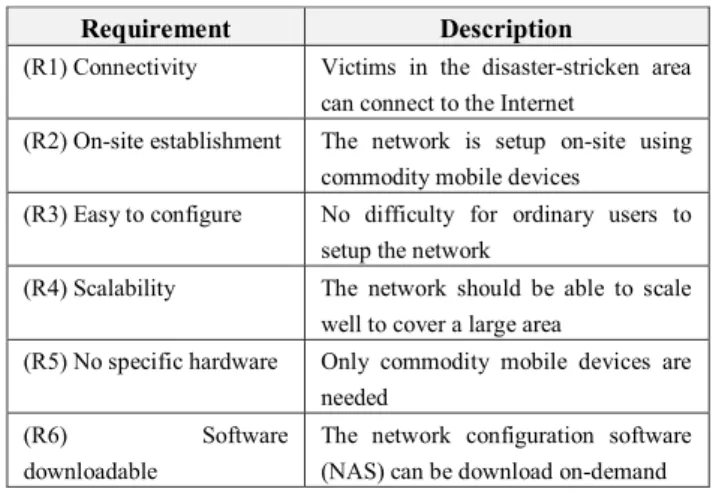
(2) IPSJ SIG Technical Report. money to recover such systems if they are damaged or malfunctioned by disasters. Wireless access networks including mobile ad-hoc network (MANET) [9], wireless mesh network (WMN) [10], disruption/delay tolerant network – DTN [11], [12] are theoretically suitable for severe disrupted environments such as in large-scale disasters. However, these technologies have not yet been commercialized nor actively supported by mobile carriers. One of the reasons is that access networks may not be good business models. Therefore, realizing access networks retains many research challenges. The conventional MANET exposes its disadvantages in performance (e.g. through put, packet loss, delay,…) in large-scale multi-hop communications [13]. It is reported that conventional MANET properly works only under a modest number of hops, namely smaller than 5. When the number of hops becomes larger, network performance significantly declines revealing infeasibility in real-world applications. In addition, network auto-configuration software (NAS) including routing protocols such as AODV [14], OLRS [15], etc., must be installed in each mobile node (MN) in advance to setup the MANETs. In some cases, multiple network interface cards (NICs) are required for setting up multihop communications. These requirements could not be satisfied in the actual disaster recovery situations. Wireless mesh network (WMN) is a special type of wireless ad-hoc network designed for large-scale outdoor communications which is suitable for disaster recovery [10]. It requires, however, mesh routers (MRs) to be deployed in advance at optimal fixed locations. This requirement cannot be satisfied in real disaster recovery since nobody knows where and when a disaster may occur. Meanwhile, it is impossible to install WMNs at every location. Several researches have proposed practical approaches by which WMNs can be setup quickly and on-demand when they are needed. However, in some cases people cannot reach the necessary locations in disaster areas. A series of studies from Niigata University proposed the so-called SkyMesh [16] which is a WMN on the sky for disaster recovery. In this work, MRs are attached on commercial balloons. The merit of the SkyMesh is that since the WMN is deployed on the sky, line-of-sight (LOS) between MRs can be easily achieved and transmission range is extended. It showed that the communication range between balloons is as large as 500m [16]. However, the SkyMesh is also stuck in the inherent issues rooted from the MWN technology: (a) the network must be established in advance at places where constructors can reach; (b) special devices like MRs and supplement equipments such as balloons in SkyMesh, etc., are required; and (c) it requires lots of manpower for real deployments. These requirements are unlikely to be satisfied in the actual disaster recovery. Another drawback revealed from MANET and WMN is that both of them require the availability of end-to-end (E2E) communication paths at any time. If a node moves out the transmission range of its counterpart, data will be dropped.. ⓒ2013 Information Processing Society of Japan. Vol.2013-MBL-67 No.3 Vol.2013-CDS-8 No.3 2013/9/12. Delay/disruption tolerance network (DTN) [11], [12] does not require E2E paths by providing in-network storage mechanisms. As a result, communications can tolerate with longer disconnections. Theoretically, DTN is more robust and flexibly adaptable to severe disrupted environments such as natural disasters. Unfortunately, DTN has not matured enough to be applied in real-world applications. Our work is completely different compared to the aforementioned technologies. In the proposed approach, multihop access networks can be established on-demand using on-site commodity mobile devices (without any special equipment).. 3. Resilience Requirement Obviously, people cannot wait for the backbone networks to be recovered, which may take several weeks, to conduct disaster responses/recoveries. Therefore, wireless access network is useful for short term fixing of Internet disconnection. To that end, wireless access networks must be easily setup using on-site commodity mobile devices (laptops, tablet PCs, smart phones,...). More concretely, ordinary users/victims in the disaster areas can transparently connect to the Internet, through the proposed networks, as easy as they are connecting to the conventional APs. This section clarifies requirements as well as evaluation metrics for a resilient wireless access network. 3.1 Requirements The US Department of Homeland Security's SAFECOM [17] program has issued a Statement of Requirements (SoR) for public safety wireless communication as follows: Integration services including voice and data communications Use of commercial off-the-shelf devices/equipments Support for mobility Security (privacy and access control) Immediate on-scene access Real-time information sharing Scalability TABLE I. REQUIREMENTS FOR RESILIENT DRAN S. Requirement. Description. (R1) Connectivity. Victims in the disaster-stricken area can connect to the Internet. (R2) On-site establishment. The network is setup on-site using commodity mobile devices. (R3) Easy to configure. No difficulty for ordinary users to setup the network. (R4) Scalability. The network should be able to scale well to cover a large area. (R5) No specific hardware. Only commodity mobile devices are needed. (R6) downloadable. The network configuration software (NAS) can be download on-demand. Software. In this work, this SoR has been clarified considering fundamental feasibilities of the desired networks for disaster recovery. Essential requirements for resilient disaster recovery. 2.
(3) IPSJ SIG Technical Report. Vol.2013-MBL-67 No.3 Vol.2013-CDS-8 No.3 2013/9/12. access networks (DRANs) are summarized in Table I and described as follows: Among the requirements presented in Table I, connectivity is the most important one. Obviously, right after a disaster occurs users need to connect to the Internet for updating evacuation instructions as well as sharing their safety status to their families. Common web-based applications such as web-mail, common websites, etc., must be available for the users. Metrics for evaluating the connectivity resilience of a disaster recovery access network will be presented in the next sub-section. Other requirements such as (R2) on-site configuration, (R3) easy to be configured, (R4) scalability, (R5) no requirement for special/additional hardware, and (R6) software downloadable are the fundamental considerations for the proposed approach. 3.2 Resilience metric As mentioned before, connectivity is the most important factor that represents the resilience of a disaster recovery network. The connectivity can be represented by availability and reliability. Availability is the readiness of the system when it is required. Reliability is the ability of the system to remain operable for a specific period of time. Obviously, these concepts are so general thus they need to be evaluated by a quantified metric. The basic measures of the system dependability (i.e. availability and reliability) are the mean time to failure (MTTF) and the mean time to repair (MTTR) [4]. The MTTF is the expected value of the failure density function while the MTTR is the expected values of the repair density function. In order to define the MTTF, we need to define the "failure" which may be varied from different types of applications. As mentioned before, the victims in a disaster need to access a web-site for checking evacuation information or sending an email. Therefore, failures in http connections are taken into consideration. More concretely, the http-based failure can be defined as follows. network _ complete _ disconnection (1) Failure 1 _ if _ RT http _ timeout Users cannot get the website's content if the network is completely disconnected or the webpage response time, denoted as RT in equation (1), is larger than the http default timeout which is set to 120s in this work. The MTTR is the average time needed to repair such a disconnection. The availability, denoted as A, scan be quantified in equation (2). In this equation, Q(t) is the failure cumulative distribution function (CDF) during a time period t. The value of t can be defined as a period of time that is necessary to complete a task in disaster situations. For example, less than 5 minutes is the time required for sending a short email notifying about the safety status. At this stage, the requirements and quantified criteria for a resilient disaster recovery access network (DRAN) have been clarified. The next section describes the proposed approach to on-site auto-configuration of DRANs using only commodity mobile devices.. 4. Proposed Approach 4.1 Wireless multihop virtualization In order to realize multihop communication, conventional access networks like MANET require complicated routing protocols such as AODV [14], OLSR [15] to be installed in each mobile device in advance. This requirement is impractical in actual disaster recovery. In order to overcome this difficulty, we proposed the concept of multihop virtualization whereby multihop is considered as a chain of single hops. Concretely, if single-hop connections can be chained, multihop communication is established. In this approach, any intermediate node must work in both modes, namely the common station (STA) mode to connect to the actual access point (AP) and the access point mode to provide connection means to the nearby nodes. Accordingly, after connecting to the network, a node transforms itself into a virtual access point (VAP) providing connection means to the nearby nodes. Obviously, since a node works in both modes concurrently, multiple network interface cards (NICs) are needed. However, this requirement could not be satisfied by commodity mobile devices. In this work, this issue is resolved by utilizing the wireless virtualization (WV) [18] mechanism. The WV abstracts a single NIC into two virtual NICs: one works as a common STA, and the other serves as a VAP. Consequently, instead of installing additional hardware (i.e. physical NIC) into a MN, the issue can be solved by a software solution. The network auto-configuration software (NAS) at each MN will conduct following tasks: - Transforms a single physical NIC into two virtual NICs, namely NIC0 and NIC1 - Changes the MAC addresses of the two abstracted NICs to assure that their MAC addresses are not conflict - Associates and connects to the nearby AP using NIC0. MTTF A MTTF MTTR. (2). The reliability, denoted as R(t), is the probability that a system works without fail in a specific period of time t. R(t) is defined in equation (3) R(t ) Pr(work _ properly_ in[0, t ]) 1 Q(t ). ⓒ2013 Information Processing Society of Japan. (3). - Transforms the MN into a VAP using NIC1. Network address translation (NAT) functionality and the dynamic host configuration protocol (DHCP) server will be installed in the VAP An emerging issue is that how to install the NAS in each MN when the network has not been established. It could not assume that the NAS is installed in each MN in advance as. 3.
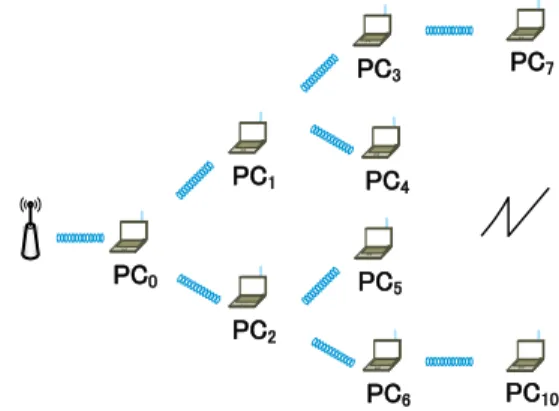
(4) IPSJ SIG Technical Report. Vol.2013-MBL-67 No.3 Vol.2013-CDS-8 No.3 2013/9/12. assumed in the conventional MANET. This difficulty will be addressed in the next sub-section.. 2 and Fig. 3, respectively. The distance between any pair of nodes in these two representative networks is 50m.. 4.2 Network configuration In order to overcome the aforementioned issue, the proposed network is initiated by the nodes which are close to a still alive Internet gateway (IGW) as shown in Fig. 1. Node 1 initiates the network configuration by simply associating to the IGW. The IGW assigns IP address to node 1 enabling it to access to the Internet. Once node 1 connects to the Internet (via the IGW) and open the Internet browser (e.g. IE, Firefox, Chrome,...), a special function installed on the IGW directs the connection to a special website. The user will be asked to click on a particular button which fires a trigger forcing the node to download the NAS from the Internet. When the NAS is completely downloaded and installed in the node, the node can access to any website as usual.. 2. 1. IGW. 6. 5 7 Figure 1.. Multihop wireless access network based on the multihop virtualization concept. The previously installed NAS transforms node 1 into a VAP which serves as a virtual IGW providing Internet connection means to the nearby nodes (e.g. nodes 2 and 6). This procedure is iterated when a node joins the network. Consequently, the network is incrementally extended as a tree-based network by contributions of users at disaster areas.. This section evaluates the feasibility as well as the effectiveness of the proposed approach. Firstly, the connectivity will be verified. After that, details about network performance will be analyzed. 5.1 Evaluation environment The proposed multihop wireless access networks are established using ASUS U24A-PX3210 laptop PCs with 4GB memory, corei5 2.5Ghz CPU, and Windows 7 OS.. ... AP. Figure 2.. PC0. PC0. PC1. PC2. PC10. A tandem network with 11 PCs. Several scenarios of the proposed wireless multihup access network were established using 11 laptop PCs. Two representative network topologies have been created: (a) a tandem network, and (b) a tree-based network as shown in Fig.. ⓒ2013 Information Processing Society of Japan. PC4. PC5 PC2 PC10. PC6 Figure 3.. A tree-based access network with 11 PCs. As expected, the network configuration procedure works correctly at each node. A single wireless NIC at each mobile node is abstracted into 2 virtual NICs which are assigned appropriate IP addresses, default IGWs, etc. Table II shows an example observed from the tandem network (Fig. 2). As a result, each node can smoothly access to the Internet. TABLE II.. IP ADDRESS IS AUTOMATICALLY ASSIGNED TO EACH NODE IN THE TANDEM NETWORK. Node PC0. 5. Evaluation. Internet. PC1. 5.2 Feasibility and effectiveness In the experiments we recorded that it took just only several seconds at each node to join the network and to transform itself into a VAP. This time is short enough in terms of establishing an alternative network in disaster recovery.. 3 4. PC7. PC3. STA IP Address (for vwlan0) 136.187.82.88. VAP IP Address (for vwlan1) 192.168.50.1 (default IGW for PC1). PC1. 192.168.50.50. 192.168.124.1. PC2. 192.168.124.50. 192.168.97.1. PC3. 192.168.97.50. 192.168.133.1. PC4. 192.168.133.50. 192.168.59.1. (default. IGW for PC2). .... Table III shows the services that we have checked at each node. As shown, both the networks work well with text-based webpage surfing and voice communication services. When the number of hops is large, such as 8 hops or larger in the tandem network, delay occurs revealing some jolts for video streams and video chat using Skype. However, the delay is acceptable, especially in the case of disaster recovery. For further evaluating of the network performance, round trip time (RTT) latency and jitter in multihop communications were recorded. As shown in Fig. 4, even the RTT increases when the number of hops increases, the average RTT still keeps in a low enough value. For example, the average RTT is around. 4.
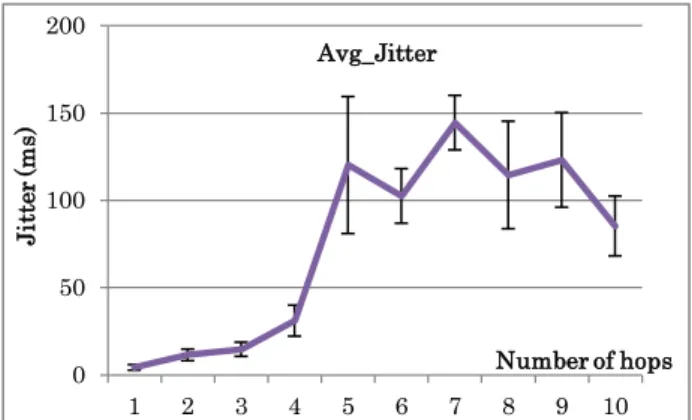
(5) IPSJ SIG Technical Report. Vol.2013-MBL-67 No.3 Vol.2013-CDS-8 No.3 2013/9/12. 200ms even at 10 hops. This RTT is qualified even for VoIP services and obviously it is quite good for http applications. EVALUATED APPLICATIONS AT DIFFERENT CONDITIONS. (NETWORK TOPOLOGIES AND NUMBER OF HOPS). Application. Capacity Tandem network. Tree-based network Text-based. Smoothly. 100 50. Smoothly. Number of hops. 0. website Online. video. Smoothly. Smoothly until PC7. From. (Youtube). PC8, acceptable delay occurs. Voice IP service and. Smoothly. Smoothly. video. with. communication.. From. voice PC8,. communications. video communications reveals. (Skype). some jolts. We also target on providing smooth VoIP services in multihop communications since in disaster users tend to call to their families for sharing their safety information. Besides RTT, jitter is an important factor that influences the quality of VoIP services. Figure 5 shows that the jitter increases when the number of hops increases. However, this increment is still acceptable. Moreover, as presented in Table III, as long as the number of hops is around 7 to 8 hops, user can experience smooth VoIP calls using Skype. This result reveals the feasibility of VoIP services in multihop communications deployed in our proposed approach. 350 Rountrip time (ms). Avg_Jitter. 150 Jitter (ms). TABLE III.. 200. Avg_Delay. 300 250 200 150 100. 50 0 1. 2. 3. 4. 5. 6. 7. 8 9 10 Number of hops. Figure 4. Round trip time latency in multihop communications. As a brief conclusion, the experiments, supported by tables II, III, and Figures 4, 5, confirm the feasibility as well as the effectiveness of the proposed approach. All requirements presented in section III have been satisfied. Concretely, connectivity (R1), on-site configuration (R2), easily to configure (R3), scalability (R4 - large number of hops, different topologies such as tree-based and tandem networks), no additional NIC (R5) and the ability of software auto-download (R6) have been satisfied by the proposed approach.. ⓒ2013 Information Processing Society of Japan. 1. 2. 3. 4. 5. 6. 7. 8. 9. 10. Figure 5. Jitter in the proposed multihop access network. 6. Concluding Remarks In this research a new concept, namely multihop virtualization has been proposed. Based on this concept, tree-based wireless access networks can be established on-site using commodity mobile devices. The network is completely transparent to users meaning that the ordinary users can easily connect to the Internet through the proposed network as if they are connected to the conventional access points. The real field experiments show the feasibility as well as the scalability of the proposed approach. Both the tandem network and the tree-based network have been successfully created with a large number of users (nodes) and a large number of hops. However, the tree-based nature of the network also reveals essential weakness. For example, the network is sensitive with failures at root nodes. If a root node dies, all the nodes in its sub-tree could not connect to the Internet. We are planning to investigate mechanism to improve the robustness of the network. One of the solutions is that if any up-link node dies, the child nodes try to bypass the failed node or find out alternative path to the destination (i.e. to the IGW). Another solution is to utilize the availability of multiple IGWs. That means multiple tree-based networks can be created. As a result, a particular node can connect to the Internet via several paths. In addition to improving the robustness of the proposed approach, more real-field experiments are needed to confirm the feasibility, the effectiveness as well as the scalability of the proposed scheme.. Acknowledgments: This research was supported in part by the JSPS (Japan Society for Promotion of Science) Grant-in-Aid for Young Scientist (B), No. 25730067 (FY. 2013 - 2014).. 5.
(6) IPSJ SIG Technical Report. Reference. Vol.2013-MBL-67 No.3 Vol.2013-CDS-8 No.3 2013/9/12 18) R. Chandra, P. Bahl, “MultiNet: Connecting to Multiple IEEE 802.11 Network Using a Single Wireless Card,” IEEE INFOCOM, pp. 882-893, Hong Kong, Mar. 2004.. 1) D. Endo, k. Sugita, “A study on Design of Disaster Information - A proposal of Coordinate System for Supply and Demand on Disaster Recovery,” P2P, Parallel, Grid, Cloud and Internet Computing, pp.303-306, Barcelona, Spain, Oct. 2011. 2) Tohoku Earthquake and Tsunami (Mar. 2011) "http://en.wikipedia.org/wiki/2011_T%C5%8Dhoku_earthquake_and_ts unami," Apr. 2013. 3) Y. N. Lien, T. C. Tsai, H. C. Jang, “A MANET Based Emergency Communication and Information System for Catastrophic Natural Disaster,” The 2nd International Workshop on Specialized Ad Hoc Networks and Systems, pp.412-417, Quebec, Canada, Jun. 2009. 4) J. P. G. Sterbenz, D. Hutchison, E. K. Cetinkaya, A. Jabbar, J. P. Rohrer, M. Scholler, and P. Smith, “Resilience and survivability in communication networks: Strategies, principles, and survey of disciplines," Computer Networks, Vol. 5, pp.1245-1265, 2010. 5) T.M. Quang, K. Nguyen, S. Yamada, “Virtualized Multihop Access Networks for Disaster Recovery,” The 5th International Workshop on Hot Topics in Mesh Networking (IEEE HOTMESH 2013) in conjunction with IEEE WoWMoM 2013, 4-7 June 2013, Madrid, Spain (flash disk edition). 6) A. Yarali, S. Rahman, M. Bwanga, "WiMAX: The Innovative Wireless Access Technology," Journal of Communication (JCM), Academy Publisher, pp. 53-63, Vol. 3, No. 2, 2008. 7) T. Doumi, M. F. Dolan, S. Tatesh., A. Casati, G. Tsirtsis, K. Anchan, D. Flore, "LTE for Public Safety Networks," IEEE Communications Magazine, pp. 106-112, Vol. 51, No. 2, 2013. 8) N. Uchida, K. Takahata, Y. Shibata, "Proposal of Never Die Network with the Combination of Cognitive Wireless Network and Satellite System," The 13th International Conference on Network-Based Information Systems (NBiS2010), pp. 365-370, Gifu, Japan, Sep. 2010. 9) Y. Shibata, H. Yuze, T. Hoshikawa, K. Takahata, N. Sawano "Large Scale Distributed Disaster Information System based on MANET and Overlay Network," The 27th International Conference on Distributed Computing Systems Workshop, Toronto, Canada, Jun. 2007 (CD edition). 10) M. Portmann, and A. A. Pirzada, “Wireless Mesh Networks for Public Safety and Crisis Management Applications,” IEEE Internet Computing, Vol 12. No.1, pp.18-25, 2008. 11) K. Fall, “A Delay-Tolerant Network Architecture for Challenged Internets,” in Proc. ACM SIGCOMM ’03, pp. 27–34, New York, NY, USA: ACM Press, 2003. 12) Mc. Alex, F. Stephen, “Delay- and Disruption-Tolerant Networking,” IEEE Internet Computing, Vol. 13, No. 6, pp.82-87, 2009. 13) N. C. Ping, L. C. Soung, “Throughput Analysis of IEEE 802.11 Multi-hop Ad hoc Network,” IEEE/ACM Transactions on Networking, Vol. 15, No. 2, pp.309-322, Apr. 2007. 14) E. C. Perkins, B. M. E. Royer, "Ad-hoc on-demand distance vector routing," Mobile Computing Systems and Applications, pp.90-100, New Orleans, USA., Feb. 1999. 15) R. Stephane, B. Farid, L. Damien, S. Laurent, "Overview and optimization of flooding techniques in OLSR," WoWMoM'11, pp.1-7, Lucca Italy, Jun. 2011. 16) H. Suzuki, Y. Kaneko, K. Mase, S. Yamazaki, H. Makino, "An Ad Hoc Network in the Sky, SKYMESH, for Large-scale Disaster Recovery," the 64th Vehicular Technology Conference, pp.1-5, Quebec, Canada, Sep. 2006. 17) SAFECOM Program, “Public Safety Statement of Requirements for Communications & Interoperability,” US Dept. of Homeland Security;http://www.safecomprogram.gov/library/lists/library/DispForm .aspx?ID=302, Accessed Apr. 2013.. ⓒ2013 Information Processing Society of Japan. 6.
(7)
図
関連したドキュメント
The (GA) performed just the random search ((GA)’s initial population giving the best solution), but even in this case it generated satisfactory results (the gap between the
The objective of this study is to address the aforementioned concerns of the urban multimodal network equilibrium issue, including 1 assigning traffic based on both user
By an inverse problem we mean the problem of parameter identification, that means we try to determine some of the unknown values of the model parameters according to measurements in
These authors make the following objection to the classical Cahn-Hilliard theory: it does not seem to arise from an exact macroscopic description of microscopic models of
These authors make the following objection to the classical Cahn-Hilliard theory: it does not seem to arise from an exact macroscopic description of microscopic models of
Kilbas; Conditions of the existence of a classical solution of a Cauchy type problem for the diffusion equation with the Riemann-Liouville partial derivative, Differential Equations,
In this work we give definitions of the notions of superior limit and inferior limit of a real distribution of n variables at a point of its domain and study some properties of
The main problem upon which most of the geometric topology is based is that of classifying and comparing the various supplementary structures that can be imposed on a
