Introducing Pattern Lattice Model as a Form of Extremely Usage-based Model
Kow Kuroda
National Institute of Information and Communication Technogies (NICT), Japan
1 Introduction
This paper presents a brief summary of a model of human linguistic knowledge and performance called Pattern Lat- tice Model (henceforth PLM) proposed and developed by Kuroda and his colleagues (Kuroda 2009;
黒田2009;
黒田and
長谷部2009;
吉川2010a;
吉川2010b). The purpose of this short paper is two-fold: the first aim is to clarify several points that makes PLM distinct. The second aim is to show that the basic tenets of Construction Grammar (henceforth, CG) (Croft 2000; Fillmore 1988; Goldberg 1995; Goldberg 2006) (e.g., priority of “constructional” meanings over “lex- ical” meanings) are natural consequences of an operation called Unification over Parallel Simulated Error Correc- tion (UPSEC) assumed under PLM and therefore CG can be safely replaced by PLM.
2 What is the Pattern Lattice Model?
PLM is a form of usage-based model (UBM) of lan- guage (Langacker 1988), but it is more than just yet an- other form of UBM. It is a radically new form of UBM and even provides a radical reformulation of it. In more ade- quate terms, PLM is a strongly example-based process- ing model of language, though it also has something to do with grammar equated with “knowledge” of language dis- tinguished from the processing mechanism of it. It is be- cause PLM narrows possible forms of grammar drastically.
I will return to this issue in § 3.2.
2.1 Strongly example-based processing
PLM implements the idea of strongly example-based lan- guage processing (SEBLP). Example-based processing is a special form of memory-based processing (MBP). A pro- cessing is example-based if processing of new input are carried out using examples stored in memory. How is an example-based language processing carried out? The an- swer is straightforward. It is carried out roughly in the fol- lowing way:
(1) Suppose E = { e
1, e
2, . . . , e
N} represents the set of all examples stored in memory. Given an input t,
a. find a set of examples E
′= { e
1, e
2, . . . , e
n} , a subset of E, that consists of all and only exam- ples similar to t with distance measure d . We say e
iis “close enough” to t if 0 ≤ d(t ,e
i) ≤ d
θwhere d
θis a parameter that specifies the thresh- old value. If the distance is standardized to “sim- ilarity” measure s(t,e
i), we have 0 ≤ s(t ,e
i) ≤ 1.
b. select E
′′= { e
′1,e
′2, . . . , e
′k} ( ∈ E
′) such that the semantics of e
′iand e
′jare compatible.
c. equate the semantics of t as the logical disjunc- tion (or average) over the semantics of E
′′. The degree of dependence on stored examples determines the strength of memory-basedness. A processing is strongly memory-based if processing of input depends on stored ex- amples more than abstract(ed) structures like schemas.
2.2 The full memory hypothesis
What makes PLM distinct from many other theories of lan- guage is the following hypothesis:
(2) The full memory hypothesis: A speaker of a lan- guage L commands a “full memory” of linguistic ex- perience (in implicit memory distinguished from “ex- plicit memory (Milner, Corkin, and Teuber 1968)) to process any expressions of L.
Admittedly, this is a controversial hypothesis. In fact, no theory of language accepted in linguistics seems to take this very seriously, but PLM dares to accept it, at least strategi- cally,
1)The reason is that, as I show, its acceptance offers theoretical linguistics more gains than losses.
2.3 How to deal with interpretation
One of the most serious challenges to strongly memory- based models like PLM is the seeming compositionality of natural language semantics. It is often claimed that it re- quires effective syntax and that memory-based models are too weak to provide it. Its intent is that such effective syntax is provided only by grammar.
The plausibility of this claim, however, can be illusion- ary. Such a claim can be invalidated only when memory- based models are shown to be able to deal with seeming compositionality of natural language semantics. Unifica- tion over Parallel Simulated Error Correction (UPSEC) was designed for this purpose. It determines the interpretation of input t roughly in the following way:
2)(3) a. If there is t
′stored in memory such that t = t
′, equate t’s semantics with t
′’s semantics.
1)The reason that PLM accepts the full memory hypothesis is that it was developed as a theoretical extension of Robert Port’sRich Phonology presented in Port (2007, 2010). See Kuroda (2009) for relevant discussion.
2)This paper only deals with its essential features. See Kuroda (2009) for more details of UPSEC.
Figure 1: Pattern lattice over the examples in (5).
b. If not, equate the semantics of t with the aver- age
3)of the semantics of E
′= { e
1, e
2, . . . , e
n} such that e
i∈ E is close enough to t.
under the following principle:
(4) Principle of distributed resource allocation: for every x
iof a given instance e = [x
1, x
2, . . . , x
n] consisting of n segments, identify resources r
1, r
2, . . . , r
nfor interpre- tation using patterns as close to e as possible and unify r
1, r
2, . . . , r
n.
The crucial point is how to calculate e
i’s closeness to target t, or how to define a similarity measure between a given pair of forms. A pattern lattice over instances defines a good metrics for this similarity measure.
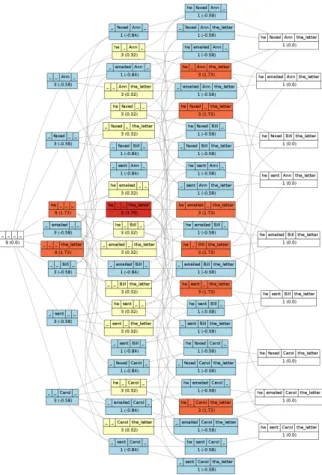
4)Figure 1 diagrams the lattice over the 9 examples in (5) which consists of examples matching pattern S V O
1O
2.
5)(5) (a) he faxed Ann the letter; (b) he emailed Ann the letter; (c) he sent Ann the letter; (d) he faxed Bill the letter; (e) he emailed Bill the letter; (f) he sent Bill the letter; (h) he faxed Carol the letter; (i) he emailed Carol the letter; (j) he sent Carol the letter
3)Traditional linguistics does tell us what the “average” of semantics is, but it can be easily specified as a logical disjunction if meanings are represented as feature vectors.
4)There are additional minor assumptions, however. It is assumed that each edit has the same amount of cost, which need not be generally true.
5)The diagram was generated bypattern lattice builderde- veloped by Yoichiro Hasebe (Doshisha University) and made freely avail- able athttp://www.kotonoba.net/rubyfca/pattern.
Every pattern in pattern lattice is assigned a “rank.”
Roughly, the rank of a pattern is equal to the number of lexically realized segments. Thus, the leftmost pattern, [ , , , ], is at rank 0. Patterns on the second column from left, [he, , , ], [ , faxed, , ], [ , emailed, , ], [ , sent, , ], [ , , Ann, ], [ , , Bill, ], [ , , Carol, ], and [ , , , the letter ], are at rank 1, and so on.
We always have only 1 pattern at rank 0, [ , , , ].
This is called the “top” ( ⊤ ) of the pattern lattice. The pat- tern at rank 0 encodes the co-occurrence information of a given set of instances in the most abstract way. Patterns with no lexical specification are called either “nonlexical pattern” or “abstract patterns.”
We have 9 patterns at rank 1, i.e., [he, , , ], [ , faxed, , ], [ , emailed, , ], [ , sent, , ], [ , , Ann, ], [ , , Bill, ], [ , , Carol, ] and [ , , , the letter ], are called “lexical patterns” in contrast with “superlexical patterns” defined below.
We have 22 patterns at rank 2 and 24 patterns at rank 3, respectively. At rank 3, we have: [he, faxed, , ], [he, emailed, , ], [he, sent, , ], . . . At rank 4, we have:
[he, faxed, Ann, ], [he, emailed, Ann, ], [he, sent, Ann, ], . . . . These patterns are called “superlexical/supralexical patterns” in contrast with “lexical patterns” defined above.
In a pattern lattice, a pattern at rank k is an abstraction over a set of either instances or patterns at rank k + 1. This holds for every k recursively. In general, patterns at rank k have k lexical items. Patterns at rank k for instances with n segments are called (i) nonlexical when k = 0; (ii) lexical when k = 1; and (iii) superlexical when 1 < k < n.
Note that a pattern lattice defined in this way specifies, in a natural and unambiguously way, the accessibility hi- erarchy for resources needed for interpretation. A nice thing about this is that it enables us to unify noncomposi- tional and compositional modes of interpretation. Purely compositional interpretation consists of the lexical seman- tics specified by lexical patterns at rank 1. They are more or less compositional because these patterns have just one lexical item and do not specify higher-order, co-variational semantics among multiple items. If the exploitation of pat- terns at rank k are, by definition, always less preferred by that of patterns at rank k +1, it follows that the semantics of lexical patterns are always the “last resort.” Clearly, this is a definition that unifies the compositional and noncomposi- tional modes of semantic interpretation.
2.4 How UPSEC works under PLM
It should be clear now that a pattern lattice is useful to deter- mine the set of similar instances. Suppose, for example, that (5b) = he emailed Ann the letter is a new input recognized for the first time. This means that no semantic information in the memory is available for its meaning. To construct it, the system does the following by accessing a set of exam- ples via four superlexical patterns at rank 3, i.e.,
(6) a. p1 = [ , emailed, Ann, the letter ],
b. p2 = [he, , Ann, the letter],
c. p3 = [he, emailed, , the letter], and
d. p4 = [he, emailed, Ann, ]
which are generated via SPEC. Assume additionally that p1, p3 and p4 have no other instances than (5b).
6)In this case, the only source available for approximation of the se- mantics of (5b) is to average the semantics of the instances of p2, i.e., [he, faxed, Ann, the letter] and [he, sent, Ann, the letter] which are at the leaves
7)of the lattice in Figure 1.
2.5 No need for constructions per se
In a narrow sense, PLM is a model of linguistic forms. PLM is not a self-contained theory of language in this specific sense. But it is quite straightforward to see how semantics works in PLM as far as we assume that every forms is stored in couple with its meaning.
8)Note that the PLM-based description of the interpretation of (5b) can replace what Goldberg (1995, 2006) purported to account for in terms of her “ditransitive construction.”
It is interesting to see that she tries to attribute construc- tional meaning to [ , , , ] at rank 0, corresponding to S V O
1O
2or NP V NP NP, which is more abstract than lexical patterns at rank 1. This is exactly why Goldber- gian account cannot be free from overgeneralizations.
By contrast, UPSEC describes the same set of phenom- ena without positing any constructions, and I claim that this is exactly what makes PLM more explanatory and CG. I want to discuss this issue in more detail.
CG is a linguistic theory that attracts many researchers.
One of its crucial assumptions is the independence of “con- structional” meanings from “lexical” meanings. But, as we saw in the presentation above, PLM accounts for the same phenomenon without positing constructions and the like.
All what PLM assumes for this is the following:
(7) a. Semantic interpretation of input t is determined either by a direct memory access to t’s meaning stored in memory or by a “transfer” from the se- mantics of examples similar enough to t.
b. A pattern lattice specifies the range of accessibil- ity required to determine what examples count as
“similar enough.”
So, we may ask, What relation can PLM have to CG?
Roughly speaking, there are three possibilities: (i) PLM is one of the garden variety of CG (PLM as a variation of CG), (ii) PLM and CG are different frameworks but they sup- plement each other’s weaknesses (PLM as a supplement to CG), and (iii) CG is a derivative of, if not a variant of, PLM that all stipulations and predictions from CG are derivable from PLM (PLM as a replacement to CG). I believe the ar- gument so far provided strong evidence for (iii).
In the view of PLM, constructions are best characterized as derivatives of a huge pattern lattice that is automatically and blindly constructed over a set of instances.
9)Note that a pattern lattice specifies all possibilities for schematic rep- resentations at all possible levels of abstractness. In short, PLM knows no distinction between constructions and
6)Note that this assumption is natural because it exactly corresponds to the fact thatemailwas never used in the ditransitive construction.
7)Usually, the bottom (⊥) of a pattern lattice is not drawn to save space.
8)In fact, it is unnatural to assume that a speaker stores a form and a meaning independently, without any interconnectedness, when he or she stores a piece of speechs.
9)This paper does not deal with the question what constructs a pattern lattice. This is an open question.
nonconstructions as far as forms are equated with their semantics. But does this mean that PLM is insufficient?
I argue not. First of all, what are constructions after all?
First of all, there is no known clear-cut boundary between constructions and nonconstructions. In a sense, identifica- tion of constructions is a matter of degree. If so, the real problem is how to measure the degrees of goodness for the identification of constructions. Note that this is exactly the same kind of problem that we have in the PLM. In other words, CG can never be better than PLM unless it has an explicit mechanism for automatic identification of construc- tions, which I claim is not satisfied with any version of CG.
If we assume PLM, some of the crucial tenets such as the following automatically follow:
(8) a. The crucial assumptions (e.g., independence of
“constructional” meanings to “lexical” mean- ings) and theoretical predictions (e.g., acceptabil- ity pattern accounted for in terms of particular constructions) that make CG explanatory and at- tractive to the linguistics community are plain consequences of PLM. This means that CG need not be assumed as far as we accepts PLM.
b. PLM makes nontrivial predications (e.g., that construction effects are distributed and you can not usually single out a construction that is solely responsible for a particular phenomenon, that different constructions have different degrees of
“constructionhood”) that are not directly avail- able in CG.
c. PLM can model several aspects of human lan- guage (e.g., formulaicness) that CG cannot.
In the view of PLM, constructions are part of side-effects of the USPEC under a pattern lattice. If the goal of linguis- tics is to identify “constructional meanings” as distinct from lexical meanings and describe them properly, UPSECP un- der PLM should suffice. In other words, linguists do not need to say explicitly that constructions (should) exist when they want to account for construction effects.
PLM does not say, however, that there are no construc- tions whatever. They should exist, but what is really chal- lenged by PLM account is how to identify constructions.
The point is that linguistics will never make any remarkable achievement if constructions are identified using linguists’
intuition alone.
3 Discussion
3.1 Limitations of PLM
No matter how many benefits are associated with it, PLM cannot be without limitations, if not shortcomings, of its own, at least in the current implementation. Let me specify a few of them.
First of all, PLM makes sense only when we accept the
full memory hypothesis. This position is rather costly be-
cause it is not so easy to defend such position, though
Kuroda (2010) offers several arguments for this. So, it
would be safer to admit that PLM can happen to rely on
a possibly unfalsifiable assumption. In fact, it is an open
question if all utterances perceived, rather than most of
them, are stored in (implicit) memory. The crucial point,
however, is that even if they are not all what people heard and understood, human linguistic performance is very likely to rely on a tremendous amount of exemplar mem- ory than most linguist are willing to admit, and that this requires human linguistic competence to take another form than generative linguists tend to (hastily) assume. This is what the full memory hypothesis really means.
10)Second, the full memory based modeling is, as ex- pected, computationally quite demanding. This is more se- rious about the number of segmentation. For example, the computational complexity increases exponentially with the number of segments. For example, when a pattern has more than 7 segments, the overall computational time gets nearly unacceptable. Compared to this, the impact of the number of instances is much milder. The increase of computational cost is just logarithmic. We must admit that it is an open question why search for examples can be so fast in human language processing.
Third, as stated above, no reliable statistical measure is developed to differentiate “good” patterns from “bad” pat- terns. In the current implementation, z-score is tentatively used for this purpose, but there are several problems asso- ciated with it. One of them is that rank-relative produc- tivities of patterns are not guaranteed to obey the Gaussian distribution. If this assumption is not met, it is inadequate to make use of z-score to represent rank-relative produc- tivity: z-score is used only because no better alternative is known. We will need to develop a sophisticated, probably more complex measure to achieve more natural results.
Another issue associated with this is that it is not fully accounted for what impact speech errors have on language processing. The full memory hypothesis forces us to as- sume that incorrect forms of utterance are stored in implicit memory as well as correct ones, but this sounds somewhat ridiculous. We will need to introduce a mechanism that guarantees incorrect forms of utterance cause as little harm as possible.
Finally, one of the most obvious limitations of PLM is that it provides no straightforward mechanism to deal with so-called syntactic alternations. Even simple alternations like question formation require certain tricks. To many lin- guists, this may look disappointing because they can be eas- ily captured with syntactic movements, but we have a trade- off and it is not easy to tell, at least for the moment, if this is really a bad thing.
3.2 PLM-compatible forms of grammar
PLM frees linguists from the burden for identification of constructions. It is suggested that constructions are epiphe- nomenal. By the same token, PLM places a far lesser ex- planatory importance to “schemas.” The reason is roughly that, under the full memory hypothesis, schemas are merely indices of instances stored in the memory. They do not
“sanction” or “license” any new instances. What they do is two-fold. For positive instances, they determine the sets of instances available for the calculation of the semantics of given inputs. For negative instances, schemas block their access to instances potentially available for the semantic computation.
10)Incidentally, a view on artificial intelligence and cognitive science fully compatible with this thesis is presented and compellingly argued for in works by Jeff Hawkins such as (2004).
What does this mean after all? To put it most crudely, schemas are not an explanatory concept any more, at least unless we already tell exactly what examples are in- stances of what schemas. I’m afraid this condition is not satisfied at all in the current situation of Cognitive Lin- guisitcs/Construction Grammar. I believe this is why it fails to replace Generative Linguistics.
References
Croft, W. (2000). Radical Construction Grammar. Oxford: Ox- ford University Press.
Fillmore, C. J. (1988). The mechanisms of ‘Construction Grammar’. In BLS, Volume 14, pp. 35–55. BLS.
Goldberg, A. D. (1995). Constructions: A Construction Gram- mar Approach to Argument Structure. Chicago, IL: Univer- sity of Chicago Press.
Goldberg, A. E. (2006). Constructions at Work: The Nature of Generalizations in Language. Oxford: Oxford University.
Hawkins, J. and S. Blakeslee (2004). On Intelligence: How a New Understanding of the Brain Will Lead to the Creation of Truly Intelligent Machines. Times Books; Adapted edi-
tion. [
邦訳『考える脳 考えるコンピューター』(
伊藤文英訳
).
ランダムハウス講談社.].
Kuroda, K. (2009). Pattern lattice as a model for lin- guistic knowledge and performance. In Proceedings of the 23rd PACLIC, Vol. 1, pp. 278–287.
http://clsl.hi.h.kyoto-u.ac.jp/˜kkuroda/
papers/kuroda-paclic23-paper.pdf.
Langacker, R. W. (1988). A usage-based model. In B. Rudzka- Ostyn (Ed.), ¨ Topics in Cognitive Linguistics, pp. 127–161.
Amsterdam/Philadelphia: John Benjamins.
Milner, B., S. Corkin, and H. L. Teuber (1968). Further analysis of the hippocampal amnesic syndrome: 14-year follow up study of H.M. Neuropsychologia 6.
Port, R. (2007). How are words stored in memory? beyond phones and phonemes. New Ideas in Psychology 25(2), 143–170.
Port, R. (2010). Rich memory and distributed phonology. Lan- guage Sciences 32(1), 43–55.
黒田 航
(2009).
パターンのラティス下での疑似並列エラー修復に基づく文意の構築
. In
日本認知科学会第26
回大 会発表論文集, pp. 236–237.
黒田 航
(2010).
超常記憶症候群の理論的含意. In
日本認知科学会第
27
回大会発表論文集.
黒田 航
and
長谷部 陽一郎(2009). Pattern Lattice
を使った(
ヒトの)
言語知識と処理のモデル化. In
言語処理学会第15
回大会発表論文集, pp. 670–673.
吉川 正人
(2010a).
「語」を越えた単位に基づくコーパス分 析に向けて:
パターンラティスモデル(plm)
とその有用 性.
藝文研究98, 221–207.
吉川 正人