A Theoretical Model for the Relationship between Thermal Expansion and Ionic Conduction
S Taniguchi, M Aniya
Department of Physics, Graduate School of Science and Technology, Kumamoto University, Kumamoto 860-8555, Japan
E-mail: [email protected]
Abstract. In complex perovskite oxides, it has been reported that the thermal expansion coefficient increases with the increase in the oxygen ionic conductivity. However, its theoretical background has not been clarified yet. In the present study, a model to understand the relationship is presented. By analyzing the experimental data using the theoretical expression derived, microscopic quantities related to ionic transport has been obtained.
1. Introduction
Superionic conductors are interesting materials that are used as solid electrolytes. A variety of such conductors have been found and applied for instance in fuel cells [1,2]. In order to understand the ion conduction mechanism in these solids, a number of experimental, theoretical and computational studies have been done and reported in the literature. Among the various compounds, the complex oxides form a class of promising materials which can combine the properties of electronics and solid electrolytes. They allow the synthesis of solid solutions containing various ions. Their properties can be modified in a wide range by controlling the defects generated by atomic substitution. For the development of a variety of power generation applications, a better understanding of the physical background is required. Although many studies concerning the effects of chemical composition, temperature, pressure and structure have been done in these oxides, the understanding of many properties from a fundamental point of view is not sufficient. For instance, it has been shown that the thermal expansion coefficient in perovskite-type oxides increases with the increase in the oxygen ionic conductivity [3]. However, its explanation has not been given yet. Recently, the above relation has been studied from a chemical bond point of view [4,5]. There, it was shown that the ionic conductivity and the thermal expansion coefficient in A
1-xA′
xB
1-yB′
yO
3-δcompounds vary systematically with the difference of the ionicity between A-O and B-O bonds. In the present report, the relation between the thermal expansion and ionic conduction is studied from another point of view.
The model is based on the fact that the thermal expansion and the ionic conduction are closely related to the interatomic potential. The activation energy for ion transport is written in terms of potential parameters. The obtained expression is applied to several compounds that exhibit ionic conduction. From the comparison of the theoretical expression with the experimental data, information on vibrational energy of the ions in the potential is obtained.
ICC3: Symposium 9B: Ceramics for Electricity, SOFC and Related Technologies IOP Publishing IOP Conf. Series: Materials Science and Engineering 18 (2011) 132016 doi:10.1088/1757-899X/18/13/132016
c 2011 Ceramic Society of Japan. 1 Published under licence by IOP Publishing Ltd
2. Model
According to the model proposed by Ruffa [6], the thermal expansion coefficient is described in terms of the interatomic potential parameters as
) 2 (
3
D 3
D 0
B
T g x
D r
b k ⎟⎟ ⎠
⎜⎜ ⎞
⎝
= ⎛
β θ . (1)
Here β is the liner thermal expansion coefficient, r
0is the position of the potential minimum, D and b are the depth and width of the potential well, g ( x
D) is the Debye function, θ
Dis the Debye temperature and k
Bis the Boltzmann constant. As expressed in equation (1), the thermal expansion coefficient is closely related with the form of the interatomic potential. The potential determines also the stability of the crystal, i.e., it is related with the activation energy of ionic conduction.
For the case of Morse potential, the vibrational energy is given by [7]
2 2
2 1 4
) ( 2
1 ⎟
⎠
⎜ ⎞
⎝ ⎛ +
⎭ ⎬
⎫
⎩ ⎨
− ⎧
⎟ ⎠
⎜ ⎞
⎝ ⎛ +
= n
D n h
h
E
nν ν , (2)
where n is the principal quantum number and h ν is the vibrational energy in the potential. The activation energy for ion migration can be described as the energy difference between the mean energy at the minimum of the potential E
0and the energy at the saddle point.
⎟ ⎠
⎜ ⎞
⎝ ⎛ −
=
−
= E E D
E
a n 0ε 1 ξ ε
0, (3)
where ε = nh ν , ε
0is the unit of vibrational energy and ξ is a numerical factor.
By using equation (1) and (3), the ionic conductivity σ = σ
0exp[ − E
ak
BT ] is rewritten as
β σ = A + B
log , (4)
where A and B are constants expressed as
T A k
B
log σ
0− ε
= , and
3 2
2
0 D
D B
0
) ( 6
) 1
( ⎟
⎠
⎜ ⎞
⎝ + ⎛
= k Tbg x T r n
B n ε θ
. (5)
3. Results and Discussion
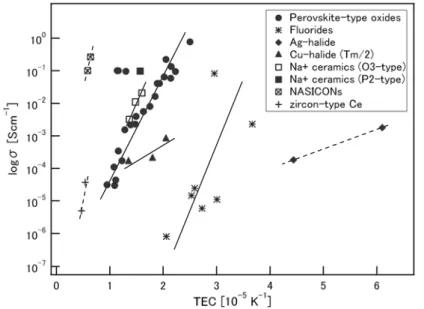
Figure 1 shows the relationship between the ionic conductivity and the thermal expansion coefficient in some ionic conductors. The lines in the figure are guides to the eyes. The data shown in figure 1 indicate a linear relation as described in equation (4). In particular, the behavior of complex perovskite oxides mentioned in the introduction is remarkable. The experimental data were taken form [3,8-14].
Although the number of data is limited, it is interesting to note that the slope of the lines of Ag- and Cu-halides are small when compared with other materials. This characteristic indicates that in these materials, the contribution of thermal expansion to the ionic conduction is relatively small.
ICC3: Symposium 9B: Ceramics for Electricity, SOFC and Related Technologies IOP Publishing IOP Conf. Series: Materials Science and Engineering 18 (2011) 132016 doi:10.1088/1757-899X/18/13/132016
2
Figure 1. Relationship between the ionic conductivity and the thermal expansion coefficient in some ionic conductors.
The analysis of the data in terms of the expression (4) indicates that the contribution of the first term, A to the ionic conductivity is much larger than the second term, B β . As given by equation (5), the quantity A depends on the vibration energy of the mobile ion. The value of ε can be estimated by analyzing the σ − β relation obtained experimentally. The result of the analysis is shown in Table 1.
Table 1. The values of the physical quantities obtained from the analysis of the experimental data.
System Temperature
[K]
ε [eV]
ε h
[Hz] E
aε Perovskite-type
Oxides 527 0.83 2.0×10
141.1
Na
+ceramics 573 0.40
0.44
9.6×10
131.1×10
140.9 1.0
Ag-halides 500 0.59 1.4×10
141.4
Fluorides 1200 1.75 4.2×10
141.0
It is interesting to note that the value of ε h is about 10 times larger than the magnitude of the optical phonon frequency in solids, and that the ratio E
aε is about 1. These results provide a hint to understand the ion transport mechanism. It could be interpreted as the number of quanta of phonons necessary for ion transport, or it could be related to the number of correlated ions involved in the ion
ICC3: Symposium 9B: Ceramics for Electricity, SOFC and Related Technologies IOP Publishing IOP Conf. Series: Materials Science and Engineering 18 (2011) 132016 doi:10.1088/1757-899X/18/13/1320163
transport. Further studies are necessary to clarify the true meaning of the result obtained.
4. Conclusion
In the present paper, a theoretical model for the relationship between thermal expansion and ionic conduction is presented. According to the model, the ionic conductivity σ is written as
β σ = A + B
log , where β is the thermal expansion coefficient and A and B are constants that depend on the parameters of the interatomic potential and other materials parameters. The obtained theoretical expression describes the experimental observation reported in ionic conductors. By analyzing the experimental data using the relation obtained, microscopic quantities related to ionic transport has been extracted.
Acknowledgment
S.T. acknowledges the GCOE program (Pulsed Power) of Kumamoto University for the financial support.
Reference
[1] Haile S M 2003 Acta Mater. 51 5981
[2] Yamamoto O 2000 Electrochim. Acta 45 2423
[3] Ullmann H, Trofimenko N, Tietz F, Stöver D and Ahmad-Khanlou A 2000 Solid State Ionics 138 79
[4] Taniguchi S and Aniya M 2010 J. Phys. Soc. Jpn. 79 Suppl. A 106 [5] Taniguchi S and Aniya M 2010 Adv. Sci. Technol. 72 343
[6] Ruffa A R 1980 J. Mater. Sci. 15 2258 [7] Ruffa A R 1977 Phys. Rev. B 16 2504
[8] Smirnova O A, Fuentes R O, Figueiredo F, Kharton V V and Marques F M B 2003 J.
Electroceram. 11 1792
[9] Lawn B R 1963 Acta Cryst. 16 1163
[10] Wakabayashi H 1962 J. Phys. Soc. Jpn. 17 292
[11] Boyce J B, Hayes T M and Mikkelsen J C, Jr 1981 Phys. Rev. B 23 2876 [12] Fouchaux R D and Simmons R O 1964 Phys. Rev. 136 A1664.
[13] Voronin B M and Volkov S V 2001 J. Phys. Chem. Solids 62 1349
[14] Neumann H, Kommichau G, Schmitz W and Schumann B 1986 J. Mater. Sci. Lett. 5 1131
ICC3: Symposium 9B: Ceramics for Electricity, SOFC and Related Technologies IOP Publishing IOP Conf. Series: Materials Science and Engineering 18 (2011) 132016 doi:10.1088/1757-899X/18/13/1320164