Investigation of Nanoparticles and Interface Effects on Organometal Halide Perovskite Solar Cells Fabricated by Wet Process
著者 モハマド シャヒドゥザマン
著者別表示 MD Shahiduzzaman journal or
publication title
博士論文要旨Abstract 学位授与番号 13301甲第4480号
学位名 博士(学術)
学位授与年月日 2016‑09‑26
URL http://hdl.handle.net/2297/46582
Creative Commons : 表示 ‑ 非営利 ‑ 改変禁止 http://creativecommons.org/licenses/by‑nc‑nd/3.0/deed.ja
INVESTIGATION OF NANOPARTICLES AND INTERFACE EFFECTS ON ORGANOMETAL HALIDE PEROVSKITE SOLAR CELLS
FABRICATED BY WET PROCESS
A DISSERTATION
SUBMITTED TO THE DIVISION OF MATERIAL SCIENCE IN PARTIAL FULFILLMENT OF THE REQUIREMENTS FOR THE
DEGREE OF DOCTORATE IN PHILOSOPHY
by
MD. SHAHIDUZZAMAN REGISTRATION NO.: 1323132008 ADVISOR: DR. TETSUYA TAIMA
GRADUATE SCHOOL OF NATURAL SCIENCE & TECHNOLOGY KANAZAWA UNIVERSITY
KAKUMA, KANAZAWA, JAPAN
SEPTEMBER, 2016
Abstract
Hybrid organometal halide perovskites such as methylammonium lead iodide (CH
3NH
3PbI
3) are attracting considerable attention as energy-efficient light absorber materials for photovoltaic applications owing to their solution processability, tunable bandgap, strong absorption coefficients and cost effectiveness. We, (Dr. Taima research group) developed nano-structured, and interlayer controlled method. This interlayer method, I applied to planar heterojunction (PHJ) perovskite solar cells. My thesis presented two different approaches that are aimed at contributing to the development of PHJ perovskite solar cells.
We prepared CH
3NH
3PbI
3nanoparticles (NPs) for the first time using a simple spin- coating method by incorporating a small amount (1~10 wt %) of an ionic liquid (IL) 1- hexyl-3-methylimidazolium chloride in 25 wt % solution of CH
3NH
3PbI
3in N,N- dimethylformamide (DMF) onto the compact-TiO
x/ITO substrates to control size and shape of NPs. Compact-TiO
xfilms were prepared by chemical bath deposition (CBD) according to the procedure described by Kuwabara et al. (Organic electronics 11, 2010, 1136). The CH
3NH
3PbI
3NP thin films were uniform and free of pin holes, and the excellent morphology was due to the addition of IL. The small-sized CH
3NH
3PbI
3NPs (~350 nm) with superior optical absorption properties have been obtained with 3 wt % of IL in the medium, as compared to the other compositions with wt % of 1, 7 and 10. As a result, a maximum power conversion efficiency (PCE) of 2.81% was obtained with the solar cell using 3 wt % of IL in a solution. The effect of viscosity of varying ILs have also been investigated. Low viscosity of ILs together with completely dissolve in CH
3NH
3PbI
3solution were playing a significant role in controlling the morphology of resulting NPs.
The preliminary results are promising for the fabrication of solar cells based on CH
3NH
3PbI
3NPs using a device configuration of ITO/TiO
x/ CH
3NH
3PbI
3NPs/ spiro- OMeTAD/Ag. We also expect that the results will open a pathway towards a better understanding for the fabrication, modification and enhancement of the performance of solar cells with CH
3NH
3PbI
3NPs. In the present case, we assume a hindering effect followed by impact on charge dissociation, transport, and/or recombination on the device performances due to the residual IL content remained on the CH
3NH
3PbI
3NP films.
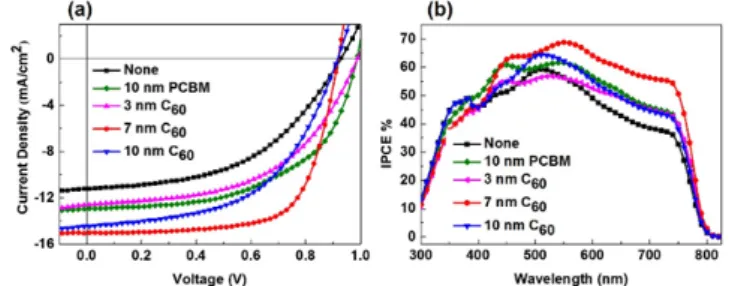
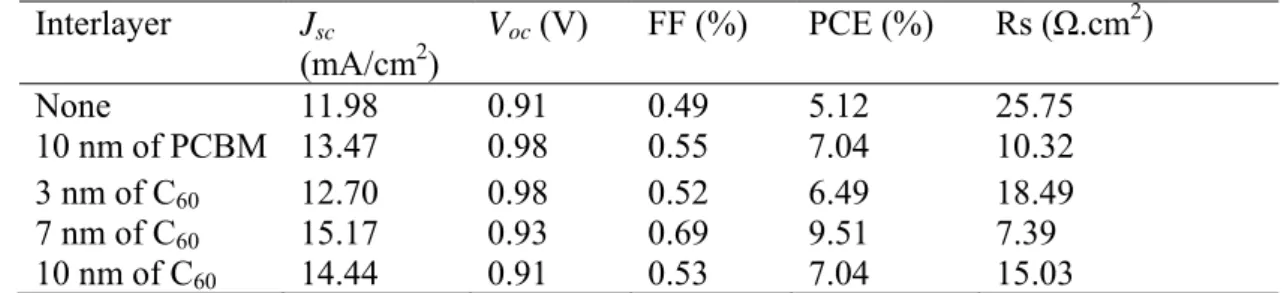
And, we fabricated PHJ type perovskite solar cells with enhanced efficiency by introducing fullerene (C
60) interlayers with thicknesses of 0, 3, 7 and 10 nm between air- stable amorphous compact TiO
xand CH
3NH
3PbI
3layers. The modified morphology obtained by inclusion of C
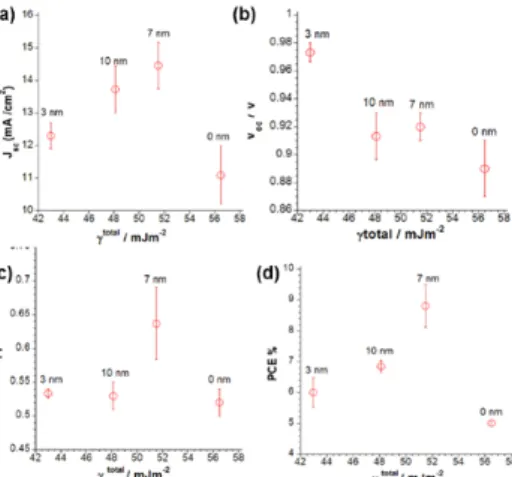
60improved the surface energy properties of the cells in terms of enhanced photocurrent. Atomic force microscopy verified the correlation between the surface energy and phase morphology of the PHJ solar cells. The introduction of a C
60interlayer between CH
3NH
3PbI
3and TiO
xlayers increased the content of photogenerated charge carrier sites, as well as lowering the accumulation and trapping of photogenerated charges at the TiO
xinterface. The optimum thickness of C
60interlayer was 7 nm, for which a maximum PCE of 9.51% was obtained.
Keywords: Nanoparticles; Ionic liquid; Spin-coating method; Organometal halide
perovskite; CH
3NH
3PbI
3; Interlayer; Fullerene (C
60).
Results and discussion
We introduced varying wt % of IL (chemical structure: Fig. 1a) as a morphology controlling additive with CH
3NH
3PbI
3in the DMF solution. We obtained a clear yellow- orange colored homogeneous solution having no aggregate or NPs (Fig. 1b).
Figure 1.1. (a) Chemical structure of 1-hexyl-3-methylimidazolium chloride (HMImCl), (b) Homogeneous mixture solution of CH
3NH
3PbI
3and IL.
CH
3NH
3PbI
3NPs having spherical morphology, was formed as shown in Fig. 1.2 (a, b and c), in the presence of 1, 3 and 7 wt % IL with respective diameters of 540, 350 and 600 nm. In contrary, the addition of high concentration of 10 wt % IL has resulted in irregular aggregation of CH
3NH
3PbI
3blocks as shown in Fig. 1.2d. We observed unchanged shapes but changed morphology of NPs with varying wt % of IL to the solution.
The observation was similar to a previous report by Duan et al.
1which confirms that the sizes and morphologies of the crystals depended on the concentration of the ionic liquid.
The observation was further confirmed by the AFM analysis. The AFM image (Fig.
1.3e-f), showed the aggregated morphology of NPs with non-uniform distribution for 7 and 10 wt % IL in solution, while the morphology was well developed for 1 and 3 wt % IL in solution as shown in Fig. 1.3c-d, respectively. The root-mean-square (RMS) roughness of the CH
3NH
3PbI
3films were respectively 21.19, 17.83, 71.25 and 121.29 nm at 1, 3, 7 and 10 wt % of IL. The RMS roughness was smoother with 3 wt % IL in solution as compared to the other compositions. Air stable amorphous compact-TiO
xlayer having smooth morphology of 30 nm thickness was achieved in one-time operation as shown in the AFM analysis (Fig. 1.3a). The RMS roughness value of the resulting film was 4.13 nm.
Figure 1.2. The SEM images of the CH
3NH
3PbI
3NPs prepared in the presence of varying
concentration of IL: (a) 1 wt %, (b) 3 wt %, (c) 7 wt %, and (d) 10 wt %.
Figure 1.3. The AFM images of (a) TiO
xfilm; (b) As-deposited CH
3NH
3PbI
3small clusters prepared at RT and CH
3NH
3PbI
3NPs with varying concentration of IL: (c) 1 wt %, (d) 3 wt %, (e) 7 wt %, and (f) 10 wt %.
The UV-Vis spectra of CH
3NH
3PbI
3films with varying wt % of IL cast on glass/ITO/
compact-TiO
xsubstrates are shown in Fig. 1.4. The absorption spectrum of DMF was discovered at around 263 nm (not shown in Figure), while it was at 340 nm for only IL.
The optical properties of CH
3NH
3PbI
3NPs depend on the size and the shape of the particles.
The absorption peaks were observed at around 493, 550, 520 and 525 nm in the system with 1, 3, 7 and 10 wt % IL, respectively, which corresponded to NPs, in accordance with the observation from Ayi, et al.
2The sharp absorption peaks for the spherical NPs also indicated a fairly uniform shape and size of NPs.
Figure 1.4. The UV-Vis spectra of the CH
3NH
3PbI
3films processed with varying wt % of IL as well as only IL. Inset photographs show CH
3NH
3PbI
3films prepared with varying concentration of IL: (a) 1 wt %, (b) 3 wt %, (c) 7 wt %, and (d) 10 wt %.
It was clear that the concentration of IL played a vital role on the sizes, shapes and
morphologies of the CH
3NH
3PbI
3NPs. A uniform CH
3NH
3PbI
3NPs with well-defined
morphologies have been obtained in the presence of a small amount of IL as additive
(Figure 1.2a-d). When the amount of the IL increased to 7 wt %, we obtained spherical
CH
3NH
3PbI
3NPs (Fig. 3.2c) having approximately 600 nm diameter. In contrast, 3 wt % of
IL was the optimum condition leading to the formation of uniform CH
3NH
3PbI
3NPs with a well-controlled spherical NPs with approximate diameter of 350 nm (Fig. 3.2b). However, when the amount of IL was increased to 10 wt %, we obtained amorphous CH
3NH
3PbI
3blocks formed by irregular aggregation of small particles (Fig. 1.2d). We attributed it to the viscosity of the IL-DMF medium. A similar observation for IL-water medium was reported by Wu et al.
3and the exponential expression used to express such characteristics were modified to fit into our system:
exp (1)
In Eq (1), is the mole fraction of DMF, is a characteristic constant of the mixture, and is the viscosity of the pure IL. The empirical equation point out that the viscosity of IL-DMF mixtures is increased exponentially when the mole fraction of DMF ( ) is decreased. When the amount of IL is increased, the viscosity of the system increases and the diffusion of the resulting complexes hindered. The resulting uniform thin film with good morphology was due to the presence of the IL.
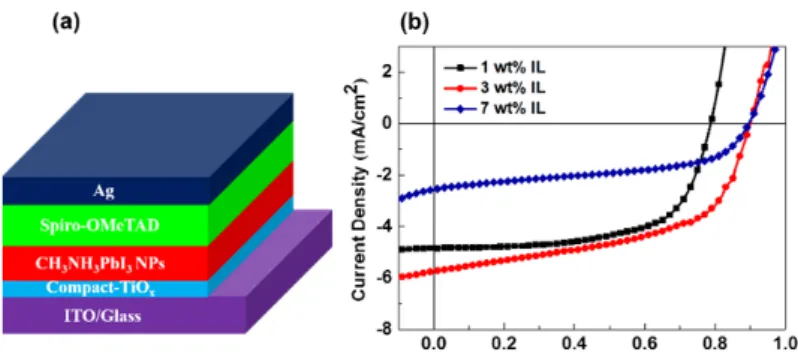
Figure 1.5a showed the device configuration of solar cells based on CH
3NH
3PbI
3NPs.
The current density versus voltage (J-V) characteristics of CH
3NH
3PbI
3NPs based solar cells as obtained by using the varying concentration of IL (1, 3 and 7 wt %) and were measured at AM 1.5G illuminations are shown in Figure 1.5b. The photovoltaic devices prepared with 1 wt % IL-doped CH
3NH
3PbI
3NPs showed a short-circuit current density (J
sc) of 4.84 mA/cm
2. An increase in the J
scvalue to 5.74 mA/cm
2was observed for the photovoltaic device prepared using 3 wt % IL-doped CH
3NH
3PbI
3NPs, while the J
scvalue is decreased to 2.56 mA/cm
2for 7 wt % doping of IL. The power conversion efficiency (PCE) is also followed the similar trend of the J
scvalues, showing a higher PCE of 2.81%
for the photovoltaic device of 3 wt % IL-doped CH
3NH
3PbI
3NPs. All the parameters measured to study the performances of solar cells are summarized in Table 1. Optimization of the concentration with the 3 wt % of IL, we achieved CH
3NH
3PbI
3NPs having more uniform shape, size, morphology which showed maximum PCE. Currently, we assume a hindering effect followed by the impact on charge dissociation, transport, and/or recombination on the device performances due to the residual IL content within the CH
3NH
3PbI
3NPs. Hence, performance improvement experiments are underway to ensure the complete removal of IL-contents from the CH
3NH
3PbI
3NPs films.
Table 1. Summary of cell performances of ITO/Compact-TiO
x/CH
3NH
3PbI
3NPs/Spiro- OMeTAD/Ag
Wt % of
IL J
sc/mAcm
-2