29
1 INTRODUCTION
In 1970, the World Health Association (WHA) made a global proclamation about the adverse effects of smok- ing
1). Previous reports showed smoking to be harmful to one's health
2,3). Smoking is one of the major risk factor associated not only with different type of cancers
2,3), but also for other chronic diseases such as coronary disease
4). According to the World Health Organization (WHO)
3), 4 million people die every year as a result of smoking which is more than the combined number of deaths caused by malaria, tuberculosis, AIDS, and several major maternal and childhood conditions. As adolescent smok- ing has increased worldwide
5), health education programs have been designed with the aim of prevention.
In Japan, pupils begin to learn the damage caused by cigarettes from the 5th grade of elementary school
6). Though smoking under 20 years old is prohibited by law in Japan, it is reported that many junior and senior high school students experience smoking
7,8). Dependency on nicotine from cigarettes develops very quickly, therefore educating students is very important to prevent smoking among adolescents. The present study was aimed at
investigating the factors related to early experiences of smoking among students.
2 METHODS 2.1 Subjects
Six university students in Japan helped to administer the study: students from 2 universities in Hokkaido, Japan, formerly of the school of medicine and dentistry before beginning professional training, and students from five other universities who were formerly students of non- medical courses in Hokkaido and Tokyo, Japan. We handed out a self-administered questionnaire to 449 stu- dents from December 2003 to March 2004, and 426 stu- dents (94.9%) answered the questionnaire. The students were 306 males (71.8%) and 120 females (28.2%) with a mean age ( ± standard deviation; SD) of 20.4 ( ± 2.1) years old. Current smokers included 74 students (17.4%).
2.2 Questionnaire
All students were questioned about their experiences regarding cigarette smoking and alcohol drinking in ele- mentary school, junior high school, senior high school,
ORIGINAL
Factors which influence pupils to smoke in Japan
Asae O URA
1), Masakazu W ASHIO
1), Shang E RHUA
1), Shuichi W ATANUKI
2), Mika I WATA
3), Mitsuru M ORI
1)1)
Department of Public Health, School of Medicine, Sapporo Medical University (Chief: Prof. M. Mori)
2)
Faculty of Science Division, Tokyo University of Science
3)
Human Development and Educational Practice, Graduate school of Education, Hokkaido University
ABSTRACT
The goal of the present study was to investigate the factors related to student tobacco smoking. From December 2003 to March 2004, 426 students (94.9% of those asked) answered a questionnaire. Adjusted for sex, department, and knowledge about smoking, students who had experiences with alcohol consumption were revealed to be at significant risk of experiencing smoking up to the 3rd grade of elementary school (OR=20.69), up to the 6th grade of elementary school (OR=3.88), up to the 3rd grade of junior high school (OR=5.57), and up to the 3rd grade of senior high school (OR=5.93). Adjusted for the same factors, those having a brother who smoked were revealed to be at a significant risk (OR=2.74) of smoking. Additionally, having a friend who smoked was revealed to be associated with significant risk of being introduced to smoking for first time up to the 3rd grade of elementary school (OR=16.35), from the 4th to 6th grades of elementary school (OR=9.00), throughout junior high school (OR=6.11), and throughout senior high school (OR=2.78). It is known that tobacco smoking is highly addictive, and therefore, the Japanese Government should intervene to find ways to help smokers quit smoking and additionally promote an anti-smoking education for pupils and students.
(Received September 15, 2006 and accepted October 19, 2006)
Key words: Smoking, Alcohol Drinking, Tobacco, Pupil, Child
and university as well as their current status. Other ques- tions included: who smokes at home, the smoking situa- tion of close friends pertaining to each school age, and personal knowledge about long-term effects of tobacco smoking.
2.3 Analysis
Statistical analyses were performed using the Statistical Package for Social Science (SPSS). The Chi- square test and Fisher's exact probability test were used to compare each group. The Odd ratios (OR) of smoking experience by school age and 95% confidence intervals (CIs) were estimated with logistic regression analysis. A level of 0.05 was determined to be the critical level of sig- nificance.
3 RESULTS
The rate of experience by school age and the rate of current smokers among university students are shown in Fig. 1. For male students, 131 (42.8%) had experienced smoking, including 64 (20.9%) current smokers. The rate of students who had experienced smoking increased as students advanced in grade: 9 students (2.9%) up to the
3rd grade of elementary school (up to 9 years old), 25 stu- dents (8.2%) up to the 6th grade of elementary school (up to 12 years old), 65 students (21.2%) up to the 3rd grade of junior high school (up to 15 years old), and 104 stu- dents (34.0%) up to the 3rd grade of senior high school (up to 18 years old). For female students, 23 (19.2%) had experienced smoking, including 10 (8.3%) current smok- ers. The rate of students who had the experience of smoking increased as students advanced in grade: 1 stu- dent (0.8%) up to the 3rd grade of elementary school, 1 student (0.8%) up to the 6th grade of elementary school, 5 students (4.2%) up to the 3rd grade of junior high school, and 15 students (12.5%) up to the 3rd grade of senior school. Male students who had experienced smok- ing were more prevalent up to the 6th grade of elementary school, the 3rd grade of junior high school, and up to the 3rd grade of senior school. Additionally, the study showed more males currently smoking than females. A result not shown in the table is that students who had stopped smoking experienced smoking for the first time as follows; 7 students (8.7%) up to the 3rd grade of ele- mentary school, 8 students (10.0%) from the 4th to 6th grade of elementary school, 19 students (23.8%) through-
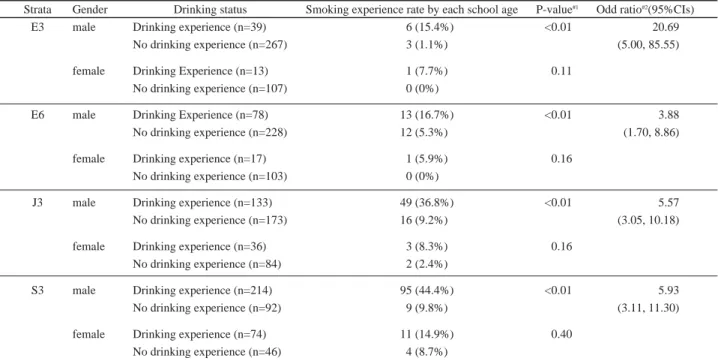
Table 1 Comparison between drinking experience and no drinking experience by each school age; smoking experience rate by each school age
#1: Chi-square test or Fisher's exact probability test
#2: adjusted for sex, department of medicine and dentistry, and knowledge about long-term effects of cigarette smoking E3: up to the 3rd grade of elementary school
E6: up to the 6th grade of elementary school J3: up to the 3rd grade of junior high school S3: up to the 3rd grade of senior high school
Strata E3
E6
J3
S3
Gender male
female
male
female
male
female
male
female
Drinking status Drinking experience (n=39) No drinking experience (n=267) Drinking Experience (n=13) No drinking experience (n=107) Drinking Experience (n=78) No drinking experience (n=228) Drinking experience (n=17) No drinking experience (n=103) Drinking experience (n=133) No drinking experience (n=173) Drinking experience (n=36) No drinking experience (n=84) Drinking experience (n=214) No drinking experience (n=92) Drinking experience (n=74) No drinking experience (n=46)
Smoking experience rate by each school age 6 (15.4%)
3 (1.1%) 1 (7.7%) 0 (0%) 13 (16.7%) 12 (5.3%)
1 (5.9%) 0 (0%) 49 (36.8%) 16 (9.2%)
3 (8.3%) 2 (2.4%) 95 (44.4%)
9 (9.8%) 11 (14.9%)
4 (8.7%)
P-value#1
<0.01
0.11
<0.01
0.16
<0.01
0.16
<0.01
0.40
Odd ratio#2(95%CIs) 20.69 (5.00, 85.55)
3.88 (1.70, 8.86)
5.57 (3.05, 10.18)
5.93 (3.11, 11.30)
out the entirety of junior high school, and 27 students (12.5%) throughout the entirety of senior high school.
Students who were still smoking experienced smoking for the first time as follows; 3 students (4.1%) up to the 3rd grade of elementary school, 8 students (11.0%) from the 4th to 6th grade of elementary school, 25 students (34.2%) throughout the entirety of junior high school, and 22 students (30.1%) throughout the entirety of senior high school. There was no significant relationship between students who stopped smoking and students who were still smoking in reference to age at the first time.
Table 1 presents a comparative analysis linking the rate of smoking experience with the rate of drinking expe- rience for each school age. For male students, experience with drinking alcohol was positively associated with smoking experience up to the 3rd grade of elementary school, the 6th grade of elementary school, the 3rd grade of junior high school, and up to 3rd grade of senior high school. Adjusted for sex, department, and knowledge about smoking, students who had experience with alcohol consumption were found to be at a significantly high risk of experiencing smoking up to the 3rd grade of elemen- tary school (OR=20.69, 95%CIs=(5.00,85.55)), the 6th grade of elementary school(OR=3.88, 95%CIs=(1.70,8.86)), the 3rd grade of junior high school (OR=5.57, 95%CIs=(3.05,10.18)), and the 3rd grade of senior high school (OR=5.93, 95%CIs=(3.11, 11.30)).
Table 2 shows the relationship between smoking experience of student and his/her family smoking. Male students who had experienced smoking were more likely to have a brother or sister who smoked than students who had no experience smoking. Female students who had experienced smoking were more likely to have a mother or brother who smoked than those without experience of smoking. Adjusted for sex, department, and knowledge about smoking, having a brother who smoked was posi-
Table 2 Comparison between having a family member who smoked and not; smoking experience rate
Fig1 The rate of smoking experience by school age and the rate of current smokers among university students
E3: up to the 3rd grade of elementary school E6: up to the 6th grade of elementary school J3: up to the 3rd grade of junior high school S3: up to the 3rd grade of senior high school E: smoking experience until now
C: current smoker
#1: Chi-square test, Fisher's exact probability test
#2: adjusted for sex, department of medicine and dentistry, and knowledge about long-term effects of cigarette smoking
RelationFather
Mother
Brother
Sister
Gender male
female
male
female
male
female
male
female
Smoking status of family member Smoked (n=133)
Did not smoke (n=173) Smoked (n=47) Did not smoke (n=73) Smoked (n=38) Did not smoke (n=268) Smoked (n=13) Did not smoke (n=107) Smoked (n=60) Did not smoke (n=246) Smoked (n=22) Did not smoke (n=98) Smoked (n=18) Did not smoke (n=288) Smoked (n=6) Did not smoke (n=114)
Smoking experience rate 52 (39.1%) 79 (45.7%) 8 (17.0%) 15 (20.5%) 15 (39.5%) 116 (43.3%) 6 (46.2%) 17 (5.6%) 38 (63.3%) 93 (37.8%) 8 (36.4%) 15 (15.3%) 12 (66.7%) 119 (52.2%) 1 (16.7%) 22 (19.3%)
P-value#1 0.25
0.81
0.66
0.02
<0.01
0.04
0.05
1.00
Odd ratio#2(95%CIs) 0.79 (0.52, 1.21)
1.43 (0.63, 2.69)
2.74 (1.61, 4.66)
2.17 (0.90, 5.21)
tively associated with a significant risk of experiencing smoking (OR=2.74, 95%CIs=(1.61, 4.66)).
Distribution of each school age in which students smoked for the first time, and the association with having a friend who smoked are shown in Table 3. Male students who had experienced smoking were more likely to have a friend who smoked up to the 3rd grade of elementary school, from the 4th to 6th grades of elementary school, and throughout the entirety of junior high school. Female students who had experienced smoking were more likely to have a friend who smoked during the subjects' tenure as a junior and senior high school student. Adjusted for sex, department, and knowledge about smoking, having a friend who smoked was positively associated with a sig- nificant risk of smoking for first time up to the 3rd grade of elementary school (OR=16.35, 95%CIs=(2.57,103.88)), from the 4th to 6th grades of elementary school (OR=9.00, 95%CIs=(3.07, 26.42)), throughout the entire- ty of junior high school (OR=6.11, 95%CIs=(2.11, 17.68)) and the entirety senior high school (OR=2.78, 95%CIs=(1.52, 5.07)).
4 DISCUSSION
In the present study, of the 426 students surveyed.
131 male students (42.8%) had experienced smoking and 23 female students (34.0%) had experienced smoking.
Nicotine dependency is known to occur as a result of cig- arette smoking, making it difficult to stop smoking once one begins. As defined by the International Classification of Diseases (ICD)-10, cigarette dependency is catego- rized in the same manner as dependency on drug or alco- hol. It is listed under the category of Mental and behavioral disorders due to psychoactive substance use . Since the 1960s in both Europe and the United States the negative health issues associated with cigarette smoking have been clearly defined, positive non-smoking support and education promoting the prevention of smoking have been performed, and the lung cancer death rates among young people have decreased
9). In Japan however also, the death rate associated with lung cancer has actually increased among those 55 years old and older
9). In the present study, 10 students (2.3%) had experienced smok- ing before reaching the 3rd grade of elementary school.
Thus, a health education program with the explicit aim of preventing smoking among elementary and junior high school students should be initiated immediately, as it may be too late to start anti-smoking education from the 5th grade of elementary school for many pupils.
Table 3 Comparison between having friends who smoked and not by each school age; smoking for first time by each school age
#1: Chi-square test or Fisher's exact probability test
#2: adjusted by sex, department of medicine and dentistry, and knowledge about long-term effects of cigarette smoking L_E3: before the 3rd grade of elementary school
E4_E6: from the 4th to 6th grades of elementary school J1_J3: from the 1st to 3rd grades of junior high school S1_S3: from the 1st to 3rd grades of senior high school
Strata L_E3
E4_E6
J1_J3
S1_S3
Gender male
female
male
female
Male
female
male
female
Smoking Status of a friend Had a friend who smoked (n=6)
Did not have a friend who smoked (n=300) Had a friend who smoked (n=1)
Did not have a friend who smoked (n=119) Had a friend who smoked (n=38) Did not have a friend who smoked (n=268) Had a friend who smoked (n=6)
Did not have a friend who smoked (n=114) Had a friend who smoked (n=203) Did not have a friend who smoked (n=103) Had a friend who smoked (n=50) Did not have a friend who smoked (n=70) Had a friend who smoked (n=237) Did not have a friend who smoked (n=69) Had a friend who smoked (n=78) Did not have a friend who smoked (n=42)
Smoking for the first time 2 (33.3%) 7 (2.3%) 0 (0%) 1 (0.8%) 8 (21.1%) 8 (3.0%) 0 (0%) 0 (0%) 36 (17.7%)
4 (3.9%) 4 (8.0%) 0 (0%) 34 (14.3%)
5 (7.2%) 10 (12.8%)
0 (0%)
P-value#1 0.01
1.00
<0.01
-
<0.01
0.03
0.15
0.01
Odd ratio#2(95%CIs) 16.35 (2.57, 103.88)
9.00 (3.07, 26.42)
6.11 (2.11, 17.68)
2.78 (1.52, 5.07)
Previous studies
8,10)have shown the connection between drinking and smoking among high school stu- dents, which supports the results of our study. Our previ- ous study
11)showed that students generally started drink- ing alcohol earlier than smoking and that smoking and drinking had some connection. In fact, the present study showed that for students of all school ages, drinking experience had a positive association with a significant risk of smoking experience. If adults adopt the notion that smoking is worse than drinking, as it pertains to their child's health, they are more prone to condone their child to drink. However, children who experience drinking are more likely to experience smoking. Thus, it is necessary to warn adults of the consequences of giving children the opportunity to drink.
The present study revealed a positive association between having a brother who smoked and being at sig- nificant risk (OR=2.74) of having a smoking experience.
Zhu et al
12)reported that having brother or sister who smoked was revealed as a positive association with being at risk of smoking. The result of the present study was consistent with those of the previous study. In the previ- ous study
13), a mother's smoking habit was found to influ- ence whether a child would have a smoking experience.
Although relevance was examined by analysis only for a female student in this study, after making adjustments, the relevance faded way. Smoking at home is not only a problem concerning passive smoking, but also affects the student's tendency to develop a smoking habit.
Those who had friends who smoked were more like- ly to experience smoking themselves. These findings may mirror those of the previous study
14). If a student declines the offer to smoke when offered a cigarette by a friend, he or she may be afraid of being rejected or alien- ated from the friend. Therefore, even if a student has no interest in smoking, they might be pressured into doing it by their peers. In future research we would like to inves- tigate the reasons that motivate a student to smoke for the first time. The percentage of senior high school students from countries around the world who partake in smoking have been reported as follows: 25.5% in Japan
15), 21.0%
in China
16), 28% in the USA
17), and 27% in Australia
18). It is evident that the Japanese Government should take more affirmative measures in promoting anti-tobacco cam- paigns, particularly targeting young students.
Certain limitations to our study should be disclosed.
First, the design of the present study was cross-sectional and therefore it was hard to understand the inter-relational factors in terms of cases or results. Second, this study
does not geographically represent the entirety of Japan.
Third, the number of subjects was insufficient.
5 CONCLUSION
Students who experienced smoking were more like- ly to have some experience drinking alcohol. Also, hav- ing a brother who smokes had some influence on whether the student sibling experienced smoking. Similarly, hav- ing a friend who smoked was also positively associated with whether a student experienced smoking.
Acknowledgments
The authors wish to acknowledge Hirofumi Tsukagoshi, Professor at the School of Dentistry, Health Science University of Hokkaido and Manabu Oura, Associate Professor at the Department of Mathematics, Faculty of Science, Kochi University, for facilitating the acquisition and management of data used in this study.
Reference
1 WHO. Limitation of smoking. 23rd WHA 1970; WHA 23/32.
2 Walley J, Wright J, Hubley J. Public Health: an action guide to improving health in developing countries. New York:
Oxford University Press; 2001.
3 Baron JA, Rohan TE. Tabacco. In: Schottenfeld D, Fraumeni JF Jr, editors. Cancer Epidemiology and preven- tion 2nd ed. New York: Oxford University Press; 1996. p.
269-289.
4 Critchley J, Liu J, Zhao D, Wei W, Capewell S. Explaining the increase in coronary heart disease mortality in Beijing between 1984 and 1999. Criculation 2004; 110: 1236-1244.
5 Gilpin EA, Choi WS, Berry C, Pierce JP. How many ado- lescents start smoking each day in the United States? J Adolesc Health 1999; 25: 248-255.
6 The Ministry of Education. Taiiku (Jpn: physical tranning), Syougakou Gakushu Shido Youryo Kaisetu (Jpn: A course of study commentary in Elementary school), Kyoto:
Higashiyama Shobo; 1999. P. 114-125.(in Japanese) 7 Osaki Y, Minowa M. Soutces of cigarettes and correlates
reported by current smokers among junior and senior high school students in Japan. Koushu Eisei Kenkyu (J Natl Inst Public Health) 1998; 47: 347-352.(in Japanese)
8 Washio M, Kiyohara C, Morioka S, Mori M. The experi-
ences of smoking in school children up to and including
high school ages and the current status of smoking habits; a
survey of male high school students in Japan. Asian Pac J
Cancer Prev. 2003; 4: 344-351.
9 Oshima A. Doctor and Tabacco control. Nihon Iji Sjinpo 2003; 4127: 11-15.(in Japanese)
10 Kawabata T, Orlandi MA, Takahashi H, Nishioka N, Okajima Y, Watanabe M, Takaishi M. Prediction of smok- ing behavior in Japanese young adults. Health Educ Res 1992; 7: 437-442.
11 Oura A, Wahio M, Morioka S, Mitsuru M. Family members smoking influence to young smoking; survey students in non-medical course. Hokkaido Koshu Eiseigaku Zasshi (Hokkaido J Pub Health) 2004; 17: 70-73.(in Japanese) 12 Zhu BP, Liu M, Shelton D, Liu S, Giovino GA. Cigarette
smoking and its risk factors among elementary school stu- dents in Beijing. Am J Public Health 1996; 86: 368-375.
13 Ogawa H, Tominaga S, Gellert G, Aoki K. Smoking among junior high school students in Nagoya, Japan. Int J Epidemiol 1988; 17: 814-820.
14 Kawabata T, Maruya N, Nakamura M, Oshima A, Hiyama T, Minagawa K, Nishioka N, Mochizuki Y, Okajima Y, Ichimura K, Okajima Y, Iwai K, Nozu Y, Watanabe M, Okada K, Takaishi M. Smoking and Alcohol drinking behavior among Japanese Adolescents; Results from Japan Know Your body study . Nippon Koshu Eisei Zasshi (Jpn J Public Health) 1991; 38: 885-899.(in
Japanese)
15 Osaki Y, Minowa M. Nationwide survey of smoking preva- lence among school students in Japan. Nippon Koshu Eisei Zasshi (Jpn J Public Health) 1993; 40: 39-47.(in Japanese) 16 Zhu BP, Liu M, Wang SQ, He GQ, Chen DH, Shi JH,
Shang JZ. Cigarette smoking among junior high school stu- dents in Beijing, China, 1988. Int J Epidemiol 1992; 21:
854-861.
17 Wakefield MA, Chaloupka FJ, Kaufman NJ, Orleans CT, Barker DC, Ruel EE. Effect of restrictions on smoking at home, at school, and in public places on teenage smoking:
cross sectional study. BMJ 2000; 321: 333-337.
18 Hill D, White V, Letcher T. Tobacco use among Australian secondary students in 1996. Aust NZ J Pulic Health 1999;
23: 252-259.
Correspondence:
Asae Oura
Department of Public Health, School of Medicine, Sapporo Medical University
Chuo-ku Minami-1 Nishi-17, Sapporo, Hokkaido, 060-8556,
Japan
青少年の喫煙行動に及ぼす関連要因
大 浦 麻 絵 1 ), 鷲 尾 昌 一 1 ), 尚 爾 華 1 ), 綿 貫 秀 一 2 ), 岩 田 美 香 3 ), 森 満 1 )
1)札幌医科大学医学部公衆衛生学(主任 森満 教授)
2)東京理科大学理学部教育学
3)北海道大学大学院教育学研究科
青少年の喫煙行動に関連する要因を明らかにする目的で,
2003
年12
月から2004
年1
月まで調査を行い,計426
人(
94.9
%)の大学生から回答を得た.性,医療系非医療系,喫煙に関する知識を補正した後,小学
3
年生まで,小学6
年生まで,中学校3
年まで,高校3
年までに飲酒を経験し ていた者はその学齢までに喫煙を経験していた者が多かっ た.各Odd
比は,小学3
年生まで(OR
=20.69
),小学 校6
年生まで(OR
=3.88
),中学校3
年まで(OR
=5.57
),高校3
年まで(OR
=5.93
)であった.同じ要因を補正後,兄弟が喫煙をしている者は喫煙経験をしている者 が多かった(
OR
=2.74
).同じ要因を補正後,各学齢時に 友人が喫煙している場合,その学齢時に初めての喫煙行動 をする者が多かった.各Odd
比は,小学校3
年まで(