⎇ⓥႎ๔㩷
1. Introduction
Water is as important as oxygen and we cannot exist without it. Therefore water is indispensable to life and a basic human right. Today, one in five people in the developing countries ̆ some 1.1 billion in all ̆ lacks access to adequate water sources
(1). In terms of this problem, some trace it to a problem of scarcity, and predict a future of water shortage due to rising population and expanding demands for water
(2). Some argue that there is more than enough water in the world for the purpose of domestic use (water for life), agriculture and industry (water for livelihoods), and the core of the water problem is rooted in power, poverty and inequality, not in physical amount
(3).
Bangladesh is one of the developing countries which face the water-for-life problems. In 1993, arsenic contamination of groundwater in Bangladesh was first reported by the Department of Public Health Engineering of Bangladesh
(4). It is estimated that 25% of 10 million tube wells are detected to be arsenic contaminated
(5), and
Received July 17, 2010
**Graduate School of Engineering and Resource Science, Akita University
more than 30 million people have been exposed to arsenic contamination by the use of untreated groundwater for drinking
(6). Table 1 shows the distribution of arsenic-contaminated groundwater, and the statistics of arsenic calamity is given in Table 2.
Bangladesh has the largest arsenic-risked population in the world. The groundwater in 92% of 64 districts is contaminated with arsenic and 75 million people are at risk (Table 2). The Government of Bangladesh adopted the guideline on arsenic alleviation policy in March 2004. However, the number of substitute water sources is limited and the supply of safe drinking-water still remains a crucial problem
(9).
In order to supply safe drinking-water to the poorest communities of Bangladesh, Grameen Bank, Nobel Peace Prize Laureate for 2006, and Veolia Water, the worldwide company of water and wastewater services, set up a joint company called Grameen Veolia Water Ltd in March 2008 as a social business and the operations of the first plant inaugurated in June 2009.
This paper first presents an overview of Grameen Veolia Water Ltd, and then, based on my fieldwork carried out in March 2010, examines how this water business is managed and finally explores how it contributes to people’s life.
Safe Drinking-Water for the Poor Initiative of Grameen Veolia Water Ltd
Abstract
Water is as important as oxygen and we cannot exist without it. Today, one in five people in the developing countries
̆some 1.1 billion in all
̆lacks access to adequate water sources.
Bangladesh is one of the developing countries which face the water-for-life problems. In 1993, arsenic contamination of groundwater in Bangladesh was first reported. It is estimated that 25% of 10 million tube wells are detected to be arsenic contaminated, and 30 million people have been exposed to arsenic contamination.
In order to supply safe drinking-water to the poorest communities of Bangladesh, Grameen Veolia Water Ltd was set up in March 2008 as a social business and the operation of the first plant was inaugurated in June 2009.
This paper first presents an overview of Grameen Veolia Water Ltd, and then, based on my fieldwork, examines how this water business is managed and finally explores how it contributes to people’s life.
Hiromi Tsuboi **
Table 2
Statistics of arsenic calamity in Bangladesh
(8). Total number of districts in Bangladesh
Total population of Bangladesh WHO arsenic drinking water standard Bangladesh arsenic drinking water standard
Number of districts surveyed for arsenic contamination
Number of districts having arsenic above 0.05mg/l in groundwater
Population at risk
Number of patients suffering from arsenic poisoning
64
125 million 0.01
mg/l0.05
mg/l64 59
75 million 8,500
2. Overview of Grameen Veolia Water Ltd 2.1 Social Business
In 2008, Grameen Veolia Water Ltd (hereinafter Grameen Veolia) was established as a social business
joint venture between Grameen Healthcare Services Ltd, a Grameen Bank’s subsidiary, and Veolia Water AMI (Africa, the Middle East and the Indian subcontinent), a Veolia Water’s subsidiary which supplied drinking water to eight million people in Africa and India in 2009
(10). This company belongs to the social business model advocated by Muhammad Yunus who is the founder of Grameen Bank and Nobel Peace Prize Laureate for 2006 along with Grameen Bank. His definition of a social business is that it is not a charity but a non-loss and non-dividend company designed to pursue specific social goals, and the profits are reinvested to expand the company’s reach and improve the product/service
(11). Figure 1 illustrates how a social business works. He also shows his idea of social business as having seven principles
(13)(Table 3).
Fig. 1 How does a social business work?
(12)Table 3 Seven principles
(13).
Business objective will be to overcome poverty, or one or more problems (such as education, health, technology access, and environment) which threaten people and society; not profit maximization
Financial and economic sustainability
Investors get back their investment amount only. No dividend is given beyond the invested money
When investment amount is paid back, company profit stays with the company for expansion and improvement
Environmentally conscious
Workforce gets market wage with better working conditions
Do it with joy Table 1 Percentage of groundwater surveyed in
1998 by the British Geological Survey with arsenic levels over 0.05 mg/l
(7).
District % of groundwater
surveyed
District % of groundwater
surveyed Bagerhat
Barisal Brahmanbaria Chandpur Chittagong Chuadanga Comilla Cox’s Bazar Dhaka Faridpur Feni Gopalganj Jessore Jhalakati Jhenaidah Khulna Kushtia Lakshmipur
66 63 38 96 20 44 65 3 37 66 39 94 51 14 26 32 28 68
Madaripur Magura Manikganj Meherpur Moulvibazar Munshiganj Narail Narayanganj Nawabganj Noakhali Pabna Pirojpur Rajbari Rajshahi Satkhira Shariatpur Syllhet
93 19 15 60 12 83 43 24 4 75 17 24 24 6 73 80 19
Investor
Investment
Product
Sales Net Profit
Initial Investment
Reinvestment Return of
investment
ᵱᶍᶁᶇᵿᶊᴾ ᶁᵿᶓᶑᶃᴾ
Social
need
2.2 Background
Bangladesh is a country with abundant fresh water.
Most of the rural population used to consume water from ponds and rivers. In the 1970’s and 80’s, nearly eight million tube wells were installed throughout Bangladesh, and people used groundwater pumped up from the tube wells, which now occupy almost 90% of the access to water
(14). However, for geological reasons, most of the groundwater has been reported to be contaminated with arsenic. Today, more than 30 million people face great danger of chronic arsenic poisoning and some have died.
In order to supply safe drinking-water to the poorest communities of Bangladesh, Grameen Veolia initiated a water business following the social business model as one of the solutions for the above arsenic problem. .
2.3 Operation
(15),(16)Grameen Veolia is a joint venture registered in Bangladesh and its ownership is 50-50 (between Grameen Healthcare Services Ltd and Veolia Water AMI). The initial plan is to build five water treatment plants by 2012 and to provide 100,000 local people in around five villages with drinkable water for their essential needs, that is, water for drinking and cooking, at an affordable price. The total investment for five plants is estimated at US$ 800,000, and this investment will be returned by water charges levied on consumers.
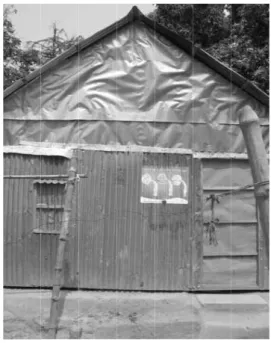
The first plant (Figure 2) was constructed in the poorest village of Goalmari Union in Daudkandi Upazila (sub-district), Comilla District, Chittagong Division, which is located 50km east of Dhaka (Figure 3). The government of Bangladesh reports that more than 80% of the groundwater from tube wells in the rural areas is contaminated with arsenic. Goalmari also has a number of arsenic-contaminated tube wells.
This first plant started working in April 2009. The equipment was manufactured locally with using the technical know-how transferred by Veolia side. Since the surface water is not contaminated with arsenic, the plant uses water from Meghna Gomti River. The water treated at the plant undergoes traditional antibacterial treatment through activated carbon filtration and chlorination. The process of water production is shown in Figure 4.
The capacity of the plant is 10 cubic meters per hour, and the water is distributed through 4km pipelines to 11 tap points (Figure 5). The plant intends to supply
water to approximately 25,000 inhabitants.
The water is produced according to the World Health Organization standards, and the water quality is regularly analyzed by both Grameen Veolia and external laboratories such as ICDDR, B (International Center for Diarrhoeal Diseases Research, Bangladesh) and BUET (Bangladesh University of Engineering and Technology).
Fig. 2 The first Grameen Veolia plant in Goalmari.
Fig. 3 Location of the first Grameen Veolia plant
(17).
Goalmari
Dhaka
India
Myanmar
Fig. 5 Tap point.
2.4 Enlightenment on safe drinking-water
In general, people in the rural areas of Bangladesh consider water to be free. The target consumers of Grameen Veoria in Goalmari have used groundwater and river surface water free of charge. They rarely or never buy bottled water, for example which costs 10-12 taka (about 13-16 yen) per 500ml. The government has recently installed the 800 feet (about 240m) tub wells there. People enjoy arsenic-free water without paying, though bacteria in the water are not removed properly.
Against this background, Grameen Veolia has introduced a marketing strategy tailor-made to the local context. Grameen Bank’s side provides its know-how and networks in order to create awareness of the value of Grameen Veolia’s water. Grameen informs Grameen Bank’s borrowers and other inhabitants about what
adequate water is and why it is essential for health through the workshops for the local people held by Grameen as well as Grameen Bank’s weekly meetings every Bank’s borrower is encouraged to attend.
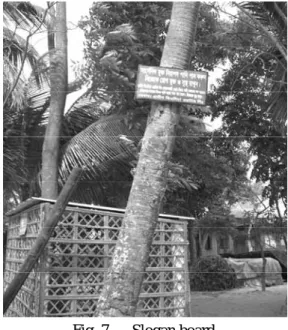
Moreover, Grameen puts up posters (Figure 6) and slogan boards (Figure 7) at conspicuous places in the villages. It also distributes school supplies (Figure 8) to pupils/students in order to raise their consciousness about health and encourage them to convey the importance of safe drinking-water to their guardians.
Fig. 6 Poster.
Water intake
Sedimentation Intermediate storage
Pump
Filtration
Chlorination with O
2Treated water storage
Tap point Pipelines
Fig. 4 Process of water production
(16).
River
Fig. 7 Slogan board.
Fig. 8 School supplies.
3. Impacts of safe drinking-water on the People Fieldwork was conducted at Grameen Veolia plant and Paschim para (section of a village) of Goalmari village in March 2010. Findings are as follows.
1) As of March 2010 (ten months after inauguration), 800 out of 3,500 inhabitants of Paschim para are supplied Grameen Veolia’s water.
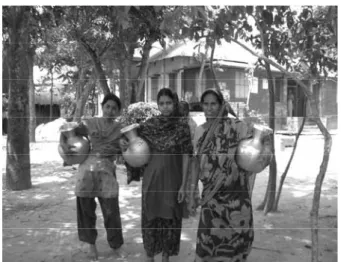
2) Water dealers, who are recommended by Grameen Bank, are recruited among Grameen Bank’s borrowers to supervise the tap points. Milon Begum is one of them (Figure 9). She is in her forties with two sons and two daughters. She has been a member of Grameen Bank for 20 years. She received a small loan from Grameen Bank to run an engine boat business, and now earns 8,000-10,000 taka (about 10,400-13,000 yen) a month.
Fig. 9 Water dealer.
Fig. 10 Token.
3) Water dealers undergo one-day-training to learn how to maintain a tap point and how to sell water.
4) Customers use tokens (Figure 10) instead of cash. The shapes of tokens are different according to the amount of water. For example, a token for five liters is round and a square token shows twelve liters. These different shapes help the illiterate people (adult literacy rate: 47.5%
(18)) to understand the price and amount of water with ease.
5) Water is sold for three taka (about four yen) per ten liters at the tap point, where people come to buy water (Figure 11).
6) Water dealers can get a commission of five paisa (0.05
taka) per liter. In Milon’s case, she gets 50-80 taka
(about 65-105 yen) per day as her commission. This
means that she sells 1,000-1,600 liters a day. The
difference of her commission shows that the sales amount of water changes a lot depending on seasons.
Water sells well in summer, but does not in winter.
Grameen Veolia estimated that the daily consumption for a family of six would be 30 liters per day
(19). Suppose this estimation was used, Molin would have more than 30 households per day as customers.
7) Milon sells water from eight a.m. to ten a.m. and five p.m. to eight p.m. every day. People, mainly women, gather around the water tap and enjoy chatting and exchange of information etc.
8) Some village women except Grameen Bank’s borrowers have been buying Grameen Veolia’s water since they listened to the quality of water from their children.
Fig. 11 People buying safe drinking-water.
4. Conclusion
The social business has attracted attention since the Millennium Development Goals were determined. The Grameen Group has played a leading role in solving social problems through their ongoing social businesses.
Grameen Veolia is in the Grameen network, and its goal is to build five water treatment plants by 2012 and to provide 100,000 local people in around five villages with drinkable water for their essential needs (water for drinking and cooking) at affordable prices. The analysis of the situation as of March 2010 is as follows.
(1) The equipment of the first plant with 4km pipelines was manufactured locally except pipes made in India,
and the plant is now in full operation.
(2) This plant has supplied drinking water complying with the WHO standards. The consumer target is 25,000 inhabitants.
(3) Grameen Veolia has been successful in creating awareness of the value of safe drinking-water among the local people.
(4) In rural Bangladesh, the majority of village people cannot afford to lay a water pipe inside a house by their own fund. Moreover the system of billing customers does not function. Therefore, the water-distribution system and the water-charge-collection system are tailored to the local context. Eleven tap points are equipped at a rather densely populated area, where water dealers sell water and people buy it with tokens.
(5) The water dealer is a new job created by Grameen Veolia, and Grameen Bank’s senior borrowers are allocated to this new job as a sideline. Their commission is five paisa (0.05 taka) per liter.
(6) The space around the water tap is an important place for women to get together. Women are building social networks there.
From the above, it is suggested that Grameen Veolia plays an important role in the aspect of health, economics, and social capital. However there are a lot of people who do not have access to Grameen Veolia (about 77% in Paschim para’s case). This implies that people still tend to drink the free groundwater, which is not contaminated with arsenic (Bangladesh arsenic drinking water standard, 0.05mg/l is used in this case.) but whose bacteria are not removed properly, rather than the fee-charging water complying with the WHO standards.
Moreover, according to the poverty line in 2005 based on
CBN (Cost of Basic Needs), 749 taka a month for each
person is the lower poverty line in rural areas of Comilla
District
(20).Since Grameen Veolia suggests a minimum
requirement of five liters a day per capita, the water
charge per month might cost 45 taka, which accounts for
six percent of the monthly expenditure. These
implications should be examined closely.
References
(1) UNDP (2006): Human Development Report 2006, UNDP, p. 22.
(2) UNDP (2006): Human Development Report 2006, UNDP, p. 2.
(3) UNDP (2006): Human Development Report 2006, UNDP, pp. 2-3.
(4) Mahfuzar Rahman (2006): International Research on Arsenic Contamination and Health, Journal of Health, Population and Nutrition, International Centre for Diarrhoeal Disease Research, Bangladesh, No. 24 (2), p. 123.
(5) JICA㧘ࡃࡦࠣ࠺ࠪࡘᜬ⛯⊛⎆⚛ᳪᨴኻ╷ࡊࡠࠫࠚ
ࠢ࠻,
http://www.jica.go.jp/project/bangladesh/0515032E0/07/01.ht ml (Retrieved on April 21, 2010).
(6) UNDP (2006): Human Development Report 2006, UNDP, pp. 40-41.
(7) Allan H. Smith, Elena O. Lingas, Mahfuzar Rahman, (2000): Contamination of drinking-water by arsenic in Bangladesh: a public health emergency, Bulletin of the World Health Organization, No. 78 (9), p. 1094.
(8) Md. Safiuddin, Md. Masud Karim (2001): Groundwater Arsenic Contamination in Bangladesh: Causes, Effects and Remediation, Proceedings of the 1st IEB (Institution of Engineers, Bangladesh) international conference, p. 3.
(9) JICA㧘ࡃࡦࠣ࠺ࠪࡘᜬ⛯⊛⎆⚛ᳪᨴኻ╷ࡊࡠࠫࠚ
ࠢ࠻ⷐ,
http://www.jica.go.jp/project/bangladesh/0515032E0/outline/in dex.html (Retrieved on April 21, 2010).
(10) Key figures concerning Veolia Water, http://www.veoliawater.com/veolia-water/key-figures/
(Retrieved on June 7, 2010).
(11) Yunus, Muhammad (2008): Creating a World without Poverty: Social Business and the Future of Capitalism, Subarna, pp.21-40.
(12) Internal materials offered by Nadina Perera, Assistant Program Officer, Yunus Centre on March 22, 2010.
(13) Yunus Centre,
http://www.muhammadyunus.org/Social-Business/grameen-ve olia-water-ltd/ (Retrieved on April 15, 2010).
(14) Samir Chowdhury, Olivier Gilbert (2008): Water treatment and cost recovery through social business of Grameen-Veolia Water Ltd in Bangladesh, p.2,
http://www.expozaragoza2008.es/ContenidosAgenda/tda/ST05 36.pdf (Retrieved on March 5, 2010).
(15) Samir Chowdhury, Olivier Gilbert (2008): Water
treatment and cost recovery through social business of Grameen-Veolia Water Ltd in Bangladesh, pp. 1-3.
http://www.expozaragoza2008.es/ContenidosAgenda/tda/ST05 36.pdf (Retrieved on March 5, 2010).
(16) Grameen Veolia Water Ltd. (leaflet).
(17) Bangladesh Map,
http://www.mofa.go.jp/mofaj/area/bangladesh/index.html (Retrieved on June 11, 2010).
(18) UNDP (2007): Human Development Report 2007/2008, UNDP, p.231.
(19) Samir Chowdhury, Olivier Gilbert (2008): Water treatment and cost recovery through social business of Grameen-Veolia Water Ltd in Bangladesh, p. 2,
http://www.expozaragoza2008.es/ContenidosAgenda/tda/ST05 36.pdf (Retrieved on March 5, 2010).
(20)
࿖㓙දജ㌁ⴕ㧔2007
㧕㧦ޟ⽺࿎ࡈࠔࠗ࡞ޠࡃࡦࠣ࠺ࠪࡘ࿖, p. 10,