有本 茂1*
Massoud Amini
2* 福田信幸3*Joseph E. LeBlanc
4* 村上達也5*成木勇夫6*
Mark Spivakovsky
7* 竹内 茂8*Keith F. Taylor
9* 山中 聡10*横谷正明11*
Peter Zizler
12*Mathematics and Chemistry
Interdisciplinary Joint Research and the Fukui Project XV
Shigeru ARIMOTO, Massoud AMINI, Nobuyuki FUKUDA, Joseph E. LEBLANC Tatsuya MURAKAMI, Isao NARUKI, Mark SPIVAKOVSKY, Shigeru TAKEUCHI Keith F. TAYLOR, Satoshi YAMANAKA, Masaaki YOKOTANI and Peter ZIZLER
This is the 15th part of the series of articles that records and further develops essentials of the Mathematics and Chemistry Interdisciplinary Symposium 2013 Tsuyama, whose main themes were symmetry, periodicity, and repetition.
The symposium was held on April 5th and 6th in Tsuyama city, Okayama, Japan, in conjunction with the Fukui Project and was devoted to the memory of the late Professor Kenichi Fukui (1981 Nobel Prize) who initiated the project. The present series also provides challenging cross-disciplinary problems which are directly related to the Fukui conjecture and to recent carbon nanotube research. Some of these problems are formulated using mathematical language not well known among chemists despite the importance of these notions in elucidating additivity and high-speed asymptotic phenomena in molecules having many repeating identical moieties. Some problems are formulated in terms of Fourier analysis connected to the theory of analytic curves, other problems are formulated in connection with the Science-Art Multi-angle Network (SAM Network) Project, which seeks to bridge Science and Art (visual, audial, and conceptual art) for a creative collaboration, and is an important part of the Fukui Project.
Key Words: the Fukui conjecture, Memoir of Prof. K. Fukui, Unique factorization domain (UFD), Carbon nanotube, Fourier analysis
I Introduction
5. Conjectures on subsequences of
N(T) and N(K)
Shigeru Arimoto, Masaaki Yokotani Nobuyuki Fukuda, Satoshi Yamanaka
Mark Spivakovsky, Isao Naruki
In this section, we first recall the real sequence N(T) defined and discussed in refs. 1)-3):
N(T) = EN(T) N.
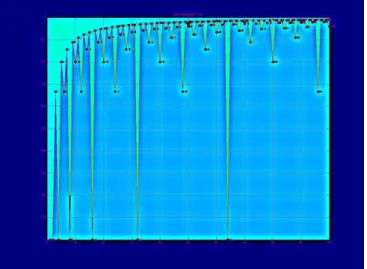
The reader is referred to the above references for detailed study on N(T) whose Matrix Art picture is reproduced below.
原稿受付 平成28年9月29日
1*, 10*, 11* 総合理工学科 3* 総合理工学科非常勤講師
2* Dept. of Math.Tarbiat Modares University, Iran
4* School of Integrated Studies, Pennsylvania College of Technology USA
5* 富山県立大学 工学部・生物工学科
6* 立命館大学 理工学部・数学物理学系・数理科学科 7* CNRS and Institute de Mathématiques de Toulouse, France 8* 岐阜大学 教育学部・数学科
9* Dept. of Math. and Stat., Dalhousie University, Canada
12* Dept. of Math., Phys., and Eng., Mount Royal University, Canada
Fig. 1. Matrix Art picture of the sequenceN( )T
Let N = 2n 1, and consider the subsequence 2n1(T) of odd terms of the original sequence N(T). Based on numerical calculations, we state:
Conjecture T1.
N(T) = 1
N for all positive odd integers N.
Since we know that E2N(T) = EN(T) + N for all N + and that 2N( )T = N( )T for all N +, the above conjecture implies that
2 (2k n1)
(T) = 1
2n 1
for all nonnegative integer k and all positive integers n. Now for each positive integer N, consider the factorization of N into primes and put N into the following unique form
N = 2k (odd number) and let
( )
w N := 2k.
Then, we see that the above conjecture implies that
N(T) = w N( )
N for all positive integers N and hence
1 N( )T 0
for all positive integers N.
There is a striking similarity between odd subsequences of N(T) and N(K). Based on numerical calculations, we provide:
Conjecture K1.
N(K) = 1
3N for all positive odd integers N.
Conjecture K2.
2N(K) = N(K) for all positive integers N.
We remark that in ref. 2), it was proved that
4N
(K) = N(K) for all positive integers N.
The Matrix Art picture of N(K) is given below.
Fig. 2. Matrix Art picture of the sequenceN( )K
We remark that the first author (S.A.) of this section noticed the regularity of odd subsequences of N (K) andN(T) after listening to the sound of sonification of the sequences N(K),N (T), N (T + K), and so on (cf.
sections (3) and (4) for details).
References
1) S. Arimoto, Proof of the Asymptotic Linearity Theorem Extension Conjecture (ALTEC),J. Math. Chem. 54 (2016) 72-84.
2)S. Arimoto, M. Amini, N. Fukuda, I. Morishima, T. Murakami, I. Naruki, K. Saito, M. Spivakovsky, S. Takeuchi, K.F. Taylor, S. Yamanaka, M.
Yokotani, and P. Zizler, "Mathematics and Chemistry Interdisciplinary Joint Research and the Fukui Project XIII", Bulletin of National Institute of Technology, Tsuyama College 57 (2015) 73-78.
3) S. Arimoto, M. Amini, N. Fukuda, I. Morishima, T. Murakami, I. Naruki, K. Saito, M. Spivakovsky, S. Takeuchi, K.F. Taylor, S. Yamanaka, M.
Yokotani, and P. Zizler, "Mathematics and Chemistry Interdisciplinary Joint Research and the Fukui Project XI", Bulletin of National Institute of Technology, Tsuyama College 57 (2015) 59-66.
6. Sonification of the Sequences
N(T), N(K),N(T + K), N(T K), N(G) and Other Similar Sequences Associated with Repeat Sequences
Shigeru Arimoto, Masaaki Yokotani Joseph E. LeBlanc
By using MATLAB, for each f = T, K, T + K, T K, we developed a set of programs capable of sonifying the sequence N(f) according to the following algorithm:
Let
m1 = min{N(f): N = 1, 2, 3, … 200}, m2 = max{N(f): N = 1, 2, 3, … 200}.
We divided the semi-open interval [m1, m2[ into 24 semi-open intervals of equal length as follows:
Let
Ij := [m1 + (m2 m1 )(j1)/24, m1 + (m2 m1 )j/24 [ so that we have
[m1, m2[ =
24
J1
Ij.
We then converted the sequence N(f) into an integer sequence by the following rule:
S(N(f)) = j if N(f) Ij. Note that S(N(f)) is a sequence of 24 integers from 1 to 24.
We then devised the following two methods:
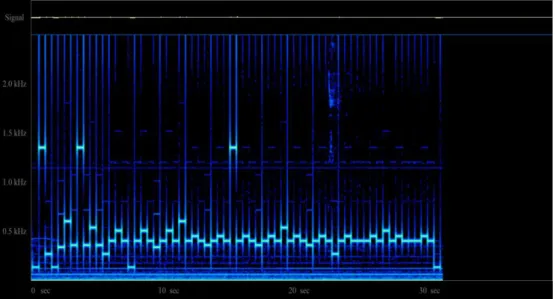
Method I: Using MATLAB we put the sequence S(N(f)) to 24 kinds of sounds whose frequency ranges over 2 octaves.
(See figs. 1, 2.)
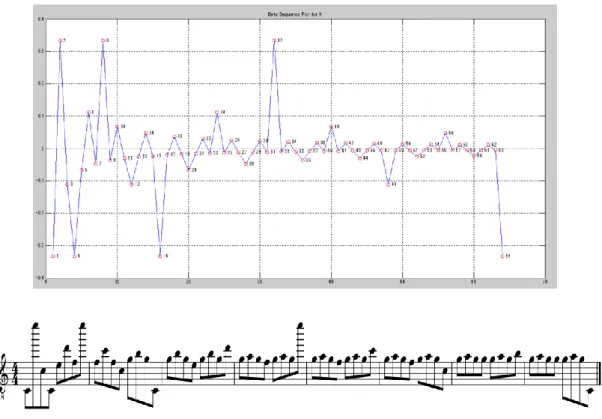
Method II: Using music composing software, we translated the sequence S(N(f)) to the sequence of 24 kinds of sounds via graphic piano keys given in the composing software.
(See figs. 3, 4.)
We also made variations of the above two prototypal methods and other similar sequences associated with repeat sequences, some of which shall be made public in the future through the web site called ‘Niagara’ (cf. Section (4)).
The figs. 1 and 2 were made using the software called
‘Spectrogram’. This software was used to analyze bio-electrical signals from muscle cells [cf. ref. 1)] using the discrete Fourier transform. The reader is also referred to Prof.
I. Morishima’s articles in refs. 2)-4). In these articles, he
reviewed NMR spectroscopy that involves the Fourier transform of nuclear spin signals.
To familiarize ourselves with discrete Fourier transforms of signals from the physico-chemical world, let us briefly review the Fourier analysis of signals from muscle cells.
Such signals are usually called the myoelectric signals (also called motor action potentials) generated by muscle cells.
One can perform Fourier analysis of myoelectric signals easily, by means of sonifying the signals with a loudspeaker.
The resulting sounds can be analyzed by ‘Spectrogram’ or similar software, just like the sound of musical instruments can be analyzed through this software. The following picture shows one example of such an analysis using the software
‘Spectrogram’ created by R. Horn (Many thanks to Mr.
Horn):
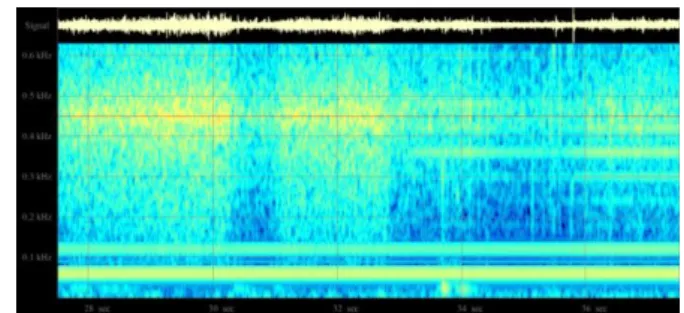
Fig. (1). Fourier analysis of myoelectric signals by using
‘Spectrogram’
The red vertical line in Fig. (1) shows the mean frequency of the signals, which is approximately 450 Hz. The bright yellowish regions around the red line indicate the time intervals (28 sec ~ 30.3 sec, 31 sec ~ 33 sec) when both fists are firmly clenched. The 60 Hz strong yellow band corresponds to the noise from the local power line which is 60 Hz in Western Japan, and the 120 Hz weak yellow band corresponds with its overtone. (In Eastern Japan, the local power line frequency is 50 Hz.)
Now, the following figures show the Fourier analysis of the sounds of a classical guitar via Method II generated according to musical notes created by using MATLAB for sequences S(N(T)) and S(N(K)).
Fig. (2). Fourier analysis ofBeta Sequence for Tby Method II
Fig. (3). Fourier analysis ofBeta Sequence for Kby Method II Similar analyses with different musical instruments produces too many overtones for observers to visually grasp meaningful patterns. Thus, from the sound spectral point of view, musical instruments seem to generally collapse or blur visual data of symbolic notes, which is quite different from the cases of MATLAB’s simple sound generation through Method I. However, to human ears, the sounds via Method II are often charming and suggestive. They are occasionally sensitizing and disturbing when we hear irregularities unexpectedly. In such cases, we feel oddness, just like when a native speaker hears a nonnative speaker utter a syntactically and/or grammatically wrong combination of words. It is striking that one can use Method II to unearth hitherto unknown patterns and internal relationships especially in spiky sequences likeN(T) and N(K).
The Matrix Art picture of fig. 2 in section (1), for example, happens to help us in detecting the regularity in the odd number subsequence. However, not all Matrix Art pictures reveal such relations. When one ‘listens’ to N(K) via Method II, one may become more sensitized at spiky jumps in N(K) than in seeing the simple plot of N(K) or in observing results of numerical calculations.
In scientific investigation, when one sees the same data like graphs or numerical tables many times, one may become desensitized and the fresh impressive power of the first exposure to the data may be lost. At such times, the techniques of art-associated sonification and visualization may provide refreshing insight into problems we are tackling.
It is true that some have ingenious gifts of finding hidden pattern, rhythms, and orders even in chaos. [Recall, for example, the late Prof. R. Woodward the ‘Supreme Patterner of Chaos, nicknamed by Prof. R. Hoffmann; cf. ref. 6).] This type of inborn nature may not be imitable or transferrable.
But, the heuristic and pedagogical techniques with which we are concerned and which we have been developing in the international, interdisciplinary and inter-generational Fukui Project, recently called the New Frontier Project, are essentially transferrable to almost anyone who is interested in crossing the traditional boundary between sciences and beyond.
Remarks. As indicated in section (1), after listening to
N(K), N(T) and other sounds via Method II, the first author (S.A.) got a clue to solving Challenging Problems III and IV given in ref. 5). By using this clue, he actually solved these two problems. The results will be published elsewhere.
References
1) S. Arimoto, M. Amini, M. Spivakovsky, J. LeBlanc, K.F. Taylor, T.
Yamabe, Repeat space theory applied to carbon nanotubes and Matrix Art, Bulletin of Tsuyama National College of Technology, 54 (2012) 31-38.
2) S. Arimoto, N. Fukuda, K, Hiroki, I. Morishima, T. Murakami, I. Naruki, K. Saito, S. Takeuchi, K.F. Taylor, M. Yokotani, and P. Zizler, "Mathematics and Chemistry Interdisciplinary Joint Research and the Fukui Project IV", Bulletin of National Institute of Technology, Tsuyama College 56 (2014) 17-24.
3) S. Arimoto, N. Fukuda, K, Hiroki, I. Morishima, T. Murakami, I. Naruki, K. Saito, S. Takeuchi, K.F. Taylor, M. Yokotani, and P. Zizler, "Mathematics and Chemistry Interdisciplinary Joint Research and the Fukui Project V", Bulletin of National Institute of Technology, Tsuyama College, 56 (2014) 25-32.
4) S. Arimoto, M. Amini, N. Fukuda, I. Morishima, T. Murakami, I. Naruki, K. Saito, M. Spivakovsky, S. Takeuchi, K.F. Taylor, S. Yamanaka, M.
Yokotani, and P. Zizler, "Mathematics and Chemistry Interdisciplinary Joint Research and the Fukui Project IX", Bulletin of National Institute of Technology, Tsuyama College 57 (2015) 45-49.
5) S. Arimoto, M. Amini, N. Fukuda, I. Morishima, T. Murakami, I. Naruki, K. Saito, M. Spivakovsky, S. Takeuchi, K.F. Taylor, S. Yamanaka, M.
Yokotani, and P. Zizler, "Mathematics and Chemistry Interdisciplinary Joint Research and the Fukui Project XII", Bulletin of National Institute of Technology, Tsuyama College 57 (2015) 67-72.
6) S. Arimoto, <Mathematics and Sciences> Fukui Conjecture and New Frontier Project Interdisciplinary Research (in Japanese), Sugaku (Mathematics, The Mathematical Society of Japan), 68-3 (2016) 293-309.
7. A Group Theoretical Approach to Conjectures T1 and K1, and Challenging Problems I and II
Shigeru Arimoto, Masaaki Yokotani Nobuyuki Fukuda, Satoshi Yamanaka
Mark Spivakovsky, Isao Naruki
While investigating Conjectures T1 and K1 given in section 5, we came to recognize that group theoretical considerations provide a powerful tool to understand the behavior of the sequences N (T) and N (K). As prototypal problems to which the group theoretical approach applies, we present here the following two challenging problems.
Challenging Problem I.
Let u: denote the function defined by u(x) = <x>(1 <x>), where <x> denote the decimal part of real number x:
<x> := x [x],
and where [x] denotes the integer part. Let H2(N) with positive integer N denote the real number sequence defined by
H2(N) = H’2(N) H’’2(N),
where H’2(N) and H’’2(N) are real number sequences defined as follows:
H’2(N) = 1 3 5 7
8 8 8 8
N N N N
u u u u ,
H’’2(N) = 2 4 6 8
8 8 8 8
N N N N
u u u u . Prove that H2(N) is constant is constant for odd N:
H2(1) = H2(3) = H2(5) = …. . Challenging Problem II.
Generalize the above argument so that the generalization helps understand the behavior of the sequences N(T) and
N(K).
Fig. 1. Frequency analysis of MATLAB sounds generated from S(N(T)) via method I
Fig. 2. Frequency analysis of MATLAB sounds generated from S(N(K)) via method I
Fig. 3. The sequence N(T) and musical notes generated from S(N(T)) via method II
Fig. 4. The sequence N(K) and musical notes generated from S(N(K)) via method I