Preservation of Indonesian Traditional Theater Art using 3DCG Animation Technology
3DCGアニメーション技術を利用したインドネシアの伝統的な演劇芸術の保存
by:
Banung Grahita
Presented to Division of Industrial Art Tokyo Metropolitan University
In partial fulfillment of requirement for degree of Doctor of Philosophy
Certified by Supervisor Professor Toshihiro Komma
Division of Industrial Art Graduate School of System Design
Tokyo Metropolitan University
2015
i
Abstract
There are various types of traditional theater art called Wayang in Indonesia. One of them is Wayang Beber of Pacitan, which originated in the 17th century and has a long history of over 400 years. Despite the precious value of these art works as cultural, historical, and religious heritage of Indonesia, their preservation is currently in a critical condition. Because of the humid climate of Indonesia it is hard to keep pictures in a good condition, and in addition, the country is experiencing a dramatic decrease in the number of artists to draw them, lack of budget for preservation, and lack of overall national interest in the preservation of Wayang Beber of Pacitan.
It is feared that without a quick action, Wayang Beber of Pacitan could be lost in the near future.
The purpose of this research is to preserve the Wayang Beber of Pacitan in a reasonable manner, so that Indonesian cultural heritage survives eternally.
In order to solve the problems, the author proposes an application of 3-Dimensional Computer Graphics (3DCG) technology as a tool to reproduce and save the art digitally. The author then develops a 3DCG system specifically to generate Wayang Beber of Pacitan art works. As an example, some digital art reproduction works of Wayang Beber of Pacitan are generated using the proposed system.
This thesis consists of 6 chapters:
Chapter 1 describes background, scope, and objectives of the research. This chapter also provides literature survey related to digital preservation of cultural heritage, and specific non- photorealistic CG techniques such as silhouette rendering, pattern generation.
Chapter 2 discusses the research to compile archives of Wayang Beber of Pacitan. This research is performed by surveying related research works, observing the actual artwork and gathering data from interviews. The results of this survey are used as a basis for analyzing the visual style of Wayang Beber. After the identification of characteristics of the visual style, details of the required method for converting the pictures into 3DCG animation are determined. The original Wayang Beber is composed of many parts. It is difficult to create parts one by one in 3DCG, therefore a method that can generate the picture semi-automatically is considered to be used.
Chapter 3 discusses the development of an outline shader. This shader is used to simulate outlines of Wayang Beber pictures on a 3DCG model. Outlines of Wayang Beber have some typical characteristics, such as expressive brushstrokes and variations in thicknesses. To produce an outline with these characteristics, a shader that incorporates object-based silhouette detection and a non-uniform point displacement algorithm is proposed.
Chapter 4 discusses the development of the shader to generate ornamentation for rendering Wayang Beber characters’ textiles patterns. The characters of Wayang Beber have many
ii characteristic patterns on their textiles. These patterns would require plenty of hard work during the 3DCG animation production of Wayang Beber. This research proposes a semi-automatic system utilizing a shader that uses procedural pattern generation based on shape grammars.
Using this system, artists can easily create and modify details of the pattern including shape, size, quantity, color, and arrangement.
Chapter 5 discusses key pose extraction and interpolation of in-between frames for animating CG characters made from Wayang Beber of Pacitan paintings. A Wayang Beber painting is a still image that does not have motion from it. Therefore, it appears that it would be very difficult to make a cartoon movie. However, P. Tabrani showed in his study that the essence of motion does exist in these historical paintings. In this research, a new technique was established using the theory developed in Tabrani’s study and the author have succeeded in extracting key poses from Wayang Beber of Pacitan works. Next, in-between frames are needed for the purpose of making a cartoon movie from the extracted key poses. The interpolation in this research is based on the principles of Wayang motion. The principles are derived from movements in other types of Wayang performances, such as Wayang Orang and Wayang Kulit. Using the method proposed in this research, the key frames and in-between frames for animating the characters are able to be provided adequately.
Chapter 6 contains the conclusion and the summary of this research. The quality of digital reproductions of traditional drawings using this 3DCG system and the usability of this system are checked and evaluated. Using the methods proposed in this research, it is possible to create 3DCG animations from other types of Wayang Beber. The author intends to propose this 3DCG system to the Indonesian government as a tool for the preservation of traditional theater art in order that this research can contribute to the survival of cultural heritages in Indonesia.
Keyword: Non-photorealistic animation, computer graphic, Wayang Beber, digital preservation of Indonesian heritage
iii
概要 概要 概要 概要
インドネシアにはワヤンと呼ばれる様々な種類の伝統的な演劇芸術がある。その中の1つが、絵巻 を用いたワヤンベベルである。ワヤンベベルは 17 世紀に発生し 400 年以上の長い歴史を持ってお り、インドネシアの文化的、歴史的、および宗教的遺産として大変貴重であるにもかかわらず、それ らの保存は現在、危機的な状態にある。インドネシアの高温かつ湿潤な気候のため、これらの絵画を 良好な状態で維持することは困難である。加えて、それらを修復・描画するための芸術家の数が劇的 に減少しており、保存のための予算も不足している。また、ワヤンベベルの保存に対する国全体の意 識の欠如もある。今、ワヤンベベルの保存に対する迅速な行動が行われなければ、近い将来にそれら が失われることが懸念されている。本研究の目的は、現実的な方法で、伝統的な演劇芸術を維持保存 することであり、その結果として、インドネシアの文化遺産を恒久的に存続させる事にある。
上記の課題を解決するために、本論文の著者は、ワヤンベベルの作品をデジタルアートとして保存 するためのツールとして3次元コンピュータグラフィックス(3DCG)技術の適用を提案し、具体的 に3DCGシステムの開発を行った。そして本研究の成果を検証するために、デジタルアートによる ワヤンベベルパチタンの再現作品を、上記の3DCGシステムを使用して生成した。
本博士論文は6章から構成されている。
第1章は、本研究の背景や目的について述べると共に、文化遺産のデジタルな保存、シルエットレ ンダリングやパターン生成といった非写実的表現のCG技術に関係する文献調査を行った。
第 2 章では、ワヤンべベルパチタンに関する資料収集について述べる。ここでは、ワヤンベベル に関する関連研究の調査、実際のアートワークの観察、パフォーマーからのインタビューデータの収 集などを実施した。この調査の結果は、ワヤンベベルのビジュアルなスタイルを分析するための基礎 として用いられた。ビジュアルなスタイルの特徴を抽出した後に、画像を3DCGアニメーションに 変換する手法の詳細を決定した。オリジナルのワヤンベベルは、多くのパーツにより構成されており、
3DCG ですべてのパーツを一つずつ作ることは難しいため、画像を半自動的に生成する手法を検討 した。
第 3 章は、輪郭線シェーダーの開発について述べる。このシェーダーは、ワヤンベベル画像の輪 郭線を 3DCGモデルによってシミュレーションするために使用される。ワヤンベベルの輪郭線は、
表現豊かな筆づかいや太さのバリエーションなど、いくつかの典型的な特徴を持っている。これらの 特徴を生かした輪郭線を生み出すために、オブジェクトベースのシルエット検出や、不均一なポイン トディスプレイスメントアルゴリズムを含んだシェーダーを構築した。
第 4 章は、ワヤンベベルのキャラクターがまとっている布地パターンを生成するためのシェーダ ーについて述べる。ワヤンベベルのキャラクターの着衣は多くのきわだったパターンを持つ。これら の装飾は、ワヤンベベルの3DCG アニメーション制作工程において、非常に多くの作業を必要とす
iv る。本研究では、形状の規則に基づいて手続き的にパターンを半自動で発生させるシェーダーシステ ムを提案した。本システムを使うことによって、アーティストは、形、サイズ、量、色、および配置 を含むパターンの詳細を簡単に生成し調整することができる。
第 5 章は、ワヤンベベルのCGキャラクターをアニメーション化するためのキーポーズ抽出と中 割補間について述べる。ワヤンべベルパチタンは静止画なので動きが無い。従って、アニメーション を作成することは非常に難しい作業となる。しかし、P. Tabraniはその研究の中で、古い絵画の中に は動きの成分が存在する事を明らかにした。本研究ではこの理論を元に手法を確立し、ワヤンべベル パチタンの中からキーポーズを抽出する事に成功した。次に、抽出されたキーポーズをアニメーショ ン化するためには、中割補間したフレームが必要となる。本研究における補間はワヤンの動きの原理 に基づいており、この原理はワヤンオランやワヤンクリットといった別のタイプのワヤンのパフォ ーマンスでの動きから導き出されている。本研究において提案された手法を使う事により、キャラク ターをアニメーション化するためのキーポーズ生成および中割補間が、適切に提供される。
第6章は、この研究の結論および要約である。本3DCGシステムを使用して、オリジナル画像か らデジタル作品を再現した場合のクォリティ、および本システムのユーザビリティについて確認と 評価がなされた。本研究で提案される手法は、他のタイプのワヤンベベルから 3DCGアニメーショ ンを作成することも可能である。著者は、本研究がインドネシアの文化的な遺産の保存作業に寄与で きるように、伝統的な演劇芸術の保存のためのツールとして、この 3DCGシステムをインドネシア 政府に提案することを計画している。
キーワード キーワード キーワード
キーワード::::ノンフォトリアリスティック・アニメーション,コンピュータグラフィックス,ワヤ ンベベル,インドネシア遺産のデジタル保存
v
Contents
Abstract ... i
Contents ... v
List of Figures ... vii
List of Table ... ix
1. Introduction ... 1
1. 1 Background ... 1
1.1.1 Wayang Beber of Pacitan ... 2
1.1.2 Importance of Wayang Beber of Pacitan ... 3
1.1.3 Preservation of Wayang Beber of Pacitan ... 4
1.1.4 Challenges for Wayang Beber of Pacitan Preservation ... 5
1.2 Review on Wayang Beber of Pacitan Art ... 9
1.3 Review on Digital Preservation of Cultural Heritage ... 10
1.4 Review on Non-photorealistic CG production ... 11
1.5 Scope of Thesis ... 17
1.6 Research Objectives ... 18
1.4 Layout of Thesis ... 19
2. Identification of the Character Figures’ Visual Style in Wayang Beber of Pacitan Painting ... 21
2.1 Overview ... 21
2.2 Origin and Transformation of Wayang Beber of Pacitan figure Visual Style ... 22
2.3 Features of the Wayang Beber of Pacitan Figures Visual Style ... 29
2.3.1 Outline Drawing ... 29
2.3.2 Polychromatic Color. ... 30
2.3.3 Ornamental Patterns ... 31
2.3.4 Distorted proportion ... 32
2.3.5 Stylized depiction ... 34
2.3.4.1 Angle of Depiction ... 34
2.3.4.2 Size of Depiction ... 35
2.3.4.3 Symbolic Depiction ... 35
2. 4 Concluding Remarks ... 40
3. Generating Wayang Beber of Pacitan Character’s Outline Using Renderman Interface ... 42
3.1. Overview ... 42
3.2. Features of Wayang Beber of Pacitan Outline ... 42
3.3. Related Works ... 45
3. 4. Generating The Wayang Beber of Pacitan Character’s Outline ... 46
3.4.1. ID Outline Algorithm ... 48
3.4.2. Creating Variations of Line Thickness ... 50
3.4.3. Creating Wiggliness ... 52
3.5. Evaluation ... 52
3.6. Concluding Remarks ... 58
4. Shader Based Generated Ornamentation for Rendering Wayang Beber of Pacitan Characters' Cloth Pattern ... 60
vi
4.1 Overview ... 60
4.2 Related works ... 61
4.3. Features of Wayang Beber of Pacitan Characters’ Cloth Pattern. ... 62
4.4. Developing the Procedural Pattern Shader ... 65
4.4.1 Generating Line Pattern ... 67
4.4.2 Generating Flower Pattern ... 68
4.4.3 Generating Vines Pattern ... 71
4.5 Result and Evaluation ... 74
4.6. Concluding Remarks ... 81
5. Key Pose Extraction for Animating CG Character of Wayang Beber of Pacitan Painting ... 83
5.1 Overview ... 83
5.2. Key Poses in Animation ... 84
5.3 Extracting Key Poses from Wayang Beber of Pacitan Painting ... 84
5.3.1 Tabrani’s Theory of Visual Language ... 85
5.3.2. Visual Language of Wayang Beber of Pacitan painting ... 86
5.3.3 Extracting Key Pose of Wayang Beber of Pacitan Character ... 90
5.4. Interpolation of In-Between Frames ... 91
5.4.1. Understanding Wayang storyteller’s work procedure ... 93
5.4.2 Character Movement in Wayang Kulit ... 93
5.4.3 Character movement in Wayang Orang ... 94
5.4.4 Movement Design Principles ... 95
5.4.5. Interpolation of In-Between Frames of Wayang Beber of Pacitan Character ... 100
5.5 Evaluation ... 103
5.6 Concluding Remarks ... 106
6. Conclusion and Recommendation ... 107
6.1 Conclusion ... 107
6.2 Recommendation ... 110
References ... 113
List of Publication ... 121
vii
List of Figures
Figure 1. Wayang Beber of Pacitan performance [2] ... 2
Figure 2. First Scroll of Wayang Beber of Pacitan [3] ... 3
Figure 3. Gooch’s definition of a silhouette [31] ... 12
Figure 4. Raskar and Cohen’s method. [39]. ... 14
Figure 5. Research Scheme ... 18
Figure 6. Relief on Panataran Temple [69] ... 24
Figure 7. Wayang Kulit Bali [70] ... 25
Figure 8. Wayang Kulit Purwa Puppet [71] ... 25
Figure 9. Wayang Beber of Pacitan Figures ... 27
Figure 10. Transformation of Wayang medium and visual style ... 28
Figure 11. Silhouette of Wayang Kulit puppets in a performance [81] ... 29
Figure 12.Lines features in Wayang Beber of Pacitan figure ... 30
Figure 13. Color feature in Wayang Beber of Pacitan figure ... 31
Figure 14. Patterns on Wayang Beber of Pacitan figure ... 32
Figure 15. Two Wayang Beber figures seem to communicate when they are facing each other ... 33
Figure 16. Comparison of Wayang Kulit puppet and Wayang Beber of Pacitan figure ... 34
Figure 17. Multiple views in Wayang Beber of Pacitan figure ... 35
Figure 18. Types of Wayang’s eye shape ... 36
Figure 19. Types of Wayang’s mouth shape ... 36
Figure 20. Types of Wayang’s tilt of head ... 37
Figure 21. Types of Wayang’s nose shape ... 37
Figure 22. The replica of the Wayang Beber of Pacitan painting [85] ... 43
Figure 23. Figure of Gandarepa ... 43
Figure 24. Outline of Gandarepa figure ... 44
Figure 25. Sample of hand drawn line. (a) Variation of thickness in hand drawn line, (b) wiggliness of hand drawn line ... 45
Figure 26. (a) Rendering result of Apocada and Gritz’s shader. (b) Rendering result of Ivan De Wolf ’s shader ... 46
Figure 27. Object B was placed inside object A after displacement ... 49
Figure 28. The front facing Polygon of object A is invisible; object B inside object A is visible ... 50
Figure 29. The New Vector ... 51
Figure 30. Displacement ramp ... 52
Figure 31. Rendering result of the proposed shader ... 53
Figure 32. Comparison of rendering result using different thickness parameter ... 54
Figure 33. Comparison of rendering result using different thickness variation parameter ... 54
Figure 34. Comparison of rendering result using different wiggliness parameter ... 55
Figure 35. Attributes of the image rendered with the proposed shader. ... 55
Figure 36. Comparison between the reference image (a) and the rendering result (b) ... 56
viii
Figure 37. Wayang figure’s head rendered using the proposed shader ... 56
Figure 38. Comparison between the reference image (a) and a Wayang figure rendered using the proposed shader (b)... 57
Figure 39. Comparison of rendering result using different shaders. (a),(b) Apocada and Gritz‟s shader, (c) ID outline shader, ... 58
Figure 40. Comparison of rendering result using different shaders. ... 58
Figure 41. Various patterns of Wayang Beber of Pacitan characters’ clothes ... 61
Figure 42. Line pattern on Wayang Beber of Pacitan’s cloth ... 63
Figure 43. Comparison between the pattern of Wayang Beber of Pacitan’s cloth and the pattern of batik clothes ... 64
Figure 44. (a).The composition of ceplok pattern. (b) sulur pattern on batik cloth ... 65
Figure 45. The elements of Wayang Beber of Pacitan’s cloth pattern. ... 66
Figure 46. Generated line pattern ... 68
Figure 47. Variation of line width ... 68
Figure 48. Flower pattern module ... 69
Figure 49. Iteration of flower pattern coloration ... 70
Figure 50. Generated flower pattern ... 70
Figure 51. Vines pattern module ... 71
Figure 52. Generated Vines Pattern ... 72
Figure 53. Comparison of rendering result using various pattern types and colors ... 75
Figure 54. Comparison of flower pattern rendered using various petal shapes, quantities, and colors ... 75
Figure 55. Comparison of rendering result using various pattern arrangements ... 76
Figure 56. Comparison of vines pattern rendered using various pattern sizes, and colors. ... 77
Figure 57. Comparison between the reference images and the generated patterns ... 78
Figure 58. Comparison between the generated line pattern and the reference image ... 79
Figure 59. Comparison between the generated flower pattern and the reference image ... 79
Figure 60. Comparison between the arrangement of the generated flower pattern and the reference image ... 79
Figure 61. Comparison between the generated vines pattern and the reference image ... 80
Figure 62. Comparison between the arrangement of the generated vines pattern and the reference image ... 80
Figure 63. Comparison of the reference image and the computer generated Wayang Beber of Pacitan scene ... 81
Figure 64. (a) Cave painting of Altamira [99], (b) Relief on Borobudur temple, Indonesia [100] ... 84
Figure 65. Multiple images depiction in Borobudur's panel [106] ... 86
Figure 66. (a) Multiple images grammar, (b) Expressive line grammar, (c) Additional line grammar, (d) distortion grammar, (e) Dynamic pose grammar ... 87
Figure 67. Outer grammar on Wayang Beber of Pacitan scroll ... 88
Figure 68. Inner grammar that shows important characters in a scene ... 89
Figure 69. Dynamic pose in Wayang Beber of Pacitan scene ... 89
Figure 70. Multiple layers of time in Wayang Beber Pacitan scene ... 90
Figure 71. Third scene of the fifth Wayang Beber of Pacitan scroll ... 91
Figure 72. Extracted Key poses ... 91
ix
Figure 73. Wayang Kulit Puppets [109] ... 92
Figure 74. Wayang Orang performance [110] ... 92
Figure 75. (A) Arm movement of Wayang Kulit, (B) whole figure movement of Wayang Kulit ... 94
Figure 76. Comparison of Wayang Kulit and Wayang Orang ... 94
Figure 77. Movement in Wayang Orang performance [112] ... 95
Figure 78. (A) and (B) Good silhouette pose in Wayang Orang, (C) Bad silhouette pose in Wayang Orang ... 96
Figure 79. Arm movement to signify character talking, (A) Polite talking movement, (B) aggressive talking movement ... 97
Figure 80. Arm movement to signify character expression, (A) sad expression, (B) angry expression ... 97
Figure 81. (A) Refined character walking, (B) gallant character walking ... 97
Figure 82. (A) Basic gesture of refined character in Wayang orang, ... 98
Figure 83. (A) Arm movement for a refined character (B) arm movement for a gallant character, (C) arm movement for a rude character ... 99
Figure 84. (A) Tilt limitation of a refined character head (B) Tilt limitation of a gallant character head, (c) Tilt limitation of a rude character head, ... 99
Figure 85. (A) Stance of a refined character (B) stance of a gallant and a rude character ... 99
Figure 86. Interpolated in-between frames ... 100
Figure 87. Sequence of interpolated in-between frames... 102
Figure 88. Frames of Character animation made using Autodesk MAYA ... 102
Figure 89. Users’ response regarding the ability of the animation to give an impression of traditional movement ... 103
Figure 90. Users’ response regarding their interest to an animated film made using the tehniques down in the animation sample ... 104
Figure 91. Users’ response regarding suitability of Wayang Beber of Pacitan visual style if it is applied in 3CG animation ... 104
Figure 92. Users’ response regarding suitability of Wayang Beber of Pacitan character design if it is applied in 3CG animation ... 105
List of Table
Table 1. Categorization of character in Wayang Beber of Pacitan………25Table 2. Categorization of character in Wayang Beber of Pacitan………38
Table 3. Iconographic features of figures in Wayang Beber of Pacitan………39
1
Chapter 1.
Introduction
1. 1 Background
The purpose of this thesis is to find methods for developing 3DCG animation, which will be used to preserve Indonesian traditional theater art. In this thesis, theater art is defined as a collaborative form of art that uses live performers to present an experience of a real or imagined event in front of live audiences in a specific place.
Theater art is a combination of several art forms such as performance art, visual art, and music. There are various types of traditional theater art in Indonesia. One of them is called Wayang. Wayang is a traditional theater art that incorporates particular visual media such as stone relief, painting, leather puppet, or human performance to convey stories.
Wayang can be found throughout Southeast Asian regions. In Indonesia, particularly in Java, various types of Wayang have existed for centuries. They are classified based on the media which are used in the performances. The most popular type of Wayang in Indonesia today is Wayang Kulit Purwa. Wayang Kulit Purwa is performed using an articulated leather puppet. In its performance, the puppets are shown as silhouettes, so that, it is often called as shadow puppets. Wayang Kulit Purwa is an example of a Wayang type that is preserved properly. New puppets are still produced and performances are held regularly. Regeneration of Wayang Kulit Purwa artists and storytellers goes very well.
Other types of Wayang have different conditions, for example, a type of Wayang called Wayang Beber which is almost neglected. Only a few people know about it.
Wayang Beber is a type of Wayang that is performed using a series of painted scrolls (see Figure 1). Nowadays, Wayang Beber performances are difficult to be found.
2 Only two sets of Wayang Beber paintings still exist and their condition is very poor.
Without a proper preservation effort, Wayang Beber will be lost in the near future.
The preservation of Wayang Beber should become a priority. The preservation of Wayang Beber is the purpose of this thesis. This thesis focuses on one type of Wayang Beber called Wayang Beber of Pacitan.
1.1.1 Wayang Beber of Pacitan
Wayang Beber of Pacitan is found in a town named Pacitan in East Java. The word Beber means unfold in English. In the performance, a storyteller unfolds painted scrolls one by one while narrating the story. As mentioned by Perwiranto [1], in a normal condition, a performance of Wayang Beber of Pacitan is about 90 minutes long. It is accompanied by a simple music arrangement using traditional musical instruments such as Gong, Kenong, Kendang dan Rebab.
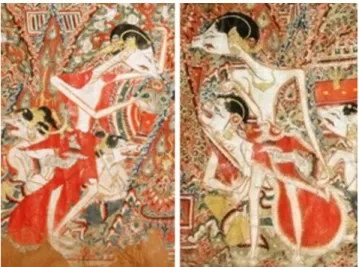
Wayang Beber of Pacitan tells a story of Jaka Kembang Kuning, which is a chronicle of a king and a warrior from ancient Javanese Kingdom of Kediri. The story is painted on six scrolls of a Javanese traditional paper called Daluang. The size of Wayang Beber of Pacitan scroll is 75cm x 380cm. Each scroll depicts four scenes of story (See Figure 2).
Figure 1. Wayang Beber performance1 [2]
1 ©Kassian Chepas, KITLV Press
Some images in this thesis are licensed under The Creative Common Attribution-Share Alike 3.0 Unported License. The images are free to be shared, copied, and distributed under the following conditions:
attribution –the work must be attributed in the manner specified by the author or licensor.
share alike – If the work is altered or transformed, the resulting work should be distributed only under the same or similar license to this one. [https://creativecommons.org/licenses/by-sa/3.0/deed.en. Accessed 20 July 20 2015 ]
3 Figure 2. First Scroll of Wayang Beber of Pacitan2 [3]
Wayang Beber of Pacitan painting has a distinctive visual style. Each scene has a complex composition with decorative patterns and polychromatic colors. The composition is flat and almost symmetrical without an empty space. The painting also has a typical way to depict a human figure. Most of the figures seem identical;
they have thin proportion with long limbs and a long neck.
Wayang Beber of Pacitan is kept and inherited by generations of storytellers in Pacitan. Currently it is kept by the 14th generation. Wayang Beber of Pacitan is seen as a sacred relic by the local communities and only performed in special occasions to pray for safety and prosperity [4]
1.1.2 Importance of Wayang Beber of Pacitan
Scholarly researches in the field have emphasized the importance of Wayang Beber of Pacitan for Indonesia. Warto asserted that there are three values of Wayang Beber of Pacitan [5]:
1. Wayang Beber is an important heritage for Indonesia. Its value has been recognized by UNESCO. In 2003 it was included as Indonesia’s intangible cultural heritage, so that its preservation should become a priority [6].
2. As an intangible cultural heritage, Wayang Beber of Pacitan embodies local wisdoms and knowledge. As stated by Koesoemadinata, Wayang arts carry multidimensional knowledge such as theatrical, literature, philosophy, moral education, visual arts, and crafts [7]. These are the important values of Wayang
2 ©Saji
4 Beber. The art, philosophy, and moral knowledge are significant factors to establish a cultural identity of Indonesian. As stated by UNESCO, the intangible cultural heritage is an important factor in maintaining cultural diversity in the face of growing globalization.
3. Wayang Beber of Pacitan has social and economic values. Wayang Beber of Pacitan is a valuable asset for Indonesian tourism. It is also a valuable source for Indonesian creative industry. The creative industry is considered as a booster of Indonesia economy in the future. In this industry, incorporating local content in a new product is important to create identity and unique selling point.
For Indonesia, the feasible sources for the local content are its cultural heritages.
The importance of Wayang Beber is also acknowledged in the field of media studies.
Wayang Beber is considered as an early visual media. As stated by Huhtamo [8], although there is no direct evidence, scholars such as Oliver Cook and Harold Foster considered that Wayang Beber has influenced Western moving image media in 19th century. Foster even categorized it as a primitive cinema.
1.1.3 Preservation of Wayang Beber of Pacitan
Wayang Beber can be considered as a rare traditional art form. There were six Wayang Beber in Java, but only two still exist, those are Wayang Beber of Pacitan and Wayang Beber of Wonosari. These days, both of them are unpopular. Unlike other types of Wayang, Wayang Beber is kept in rural areas of Java. They are only recognized by a small community there. The Wayang Museum in Jakarta, Indonesia has a set of Wayang Beber of Pacitan replicas. However the museum rarely holds performances. Without a performance, people cannot understand the true form of Wayang Beber of Pacitan.
As mentioned before, presently, the condition of Wayang Beber original paintings is very poor. Restoration of the painting is difficult to be done because Wayang Beber of Pacitan is still considered as a sacred relic which is not allowed to be taken out from Pacitan. In addition, the country is also experiencing a dramatic decrease in the number of artists to draw them. Without a quick action Wayang Beber of Pacitan can be lost in the near future. Preservation effort is urgently needed, although it will encounter some difficulties. One of them is the lack of interest of Indonesian young generations in Wayang. As described by Wardani and Widiastuti [9] several types of Wayang arts have been neglected and forgotten. Indonesian young generations often think of Wayang as performance arts for the old. The performances are often performed in unattractive places for them. Most of Wayang performances have a very long duration; they make young viewers feel bored. Moreover, there is lack of
5 support from the government for preserving and promoting Wayang.
Nevertheless, preservation of Wayang Beber of Pacitan has been done before. The first effort was done in the early 20th century. At that time, King Mangkunegaran VII ordered a painter named Widosupomo to create a replica of Wayang Beber of Pacitan paintings. Now the replica is kept in the Radyapustaka Museum at Surakarta City, Indonesia. Today Wayang Museum in Jakarta also has another replica of Wayang Beber of Pacitan paintings. It was made by Musyafik, a staff at East Java Regional Office of Departments of Education and Culture of Republic of Indonesia.
Preservation efforts have also been commenced by communities and academics. Lis [10] mentioned the existence of two artist communities in Surakarta, namely Wayang Beber Kota and Wayang Beber Welingan. Both communities have tried experimenting with Wayang Beber and presented it in a contemporary form. Similar attempt has also been done by Wayang Beber Metropolitan community in Jakarta, Indonesia. They often perform a new creation of Wayang Beber bringing up some social issues. In the academic field, preserving Wayang art has become a concern in researches such as those conducted by Aulian et al. [11] and Trihanondo et al. [12].
In those researches, the preservations are performed using new media. Aulian tried utilizing mobile device for introducing Wayang Kulit of Cirebon, while Trihanondo offered an adaptation for Wayang Golek puppets into game characters. Both researches made an effort to acquaint young generation of users with Wayang.
However, particularly for Wayang Beber of Pacitan such an approach has never been done.
1.1.4 Challenges for Wayang Beber of Pacitan Preservation
In this thesis, several challenges in the preservation of Wayang Beber of Pacitan have been identified. Those are:
1. Limited access to Wayang Beber of Pacitan
Until now, Wayang Beber of Pacitan is kept privately by the official storyteller in Pacitan town. It is difficult to be accessed by public. Since it is considered as a sacred object, it should be shown and performed only in special occasions.
2. Humid climate of Indonesia
In a humid climate, it is difficult to keep the paintings in a good condition. Humid climate not only gives bad effects for papers, but also encourages molds to grow on the paintings.
3. Characteristics of Wayang Beber of Pacitan as a theater art.
6 As a theater art, Wayang Beber of Pacitan is performed to deliver a story. The story is an important aspect of Wayang Beber of Pacitan. It contains local wisdoms and knowledge that have been passed down from generation to generation. Wayang Beber of Pacitan story and performance cannot be preserved only by using replication of its paintings.
4. Decrease number of Wayang Beber artists and storytellers
The last traditional Wayang Beber was made around the 17th century. Since then, a new type of Wayang Beber was never made. At the present, only a few self- taught artists dedicate themselves to make replicas of Wayang Beber paintings.
Most of these artists are old in age. They are the only source from whom to study the making of Wayang Beber of Pacitan painting.
Another problem is the lack number of Wayang Beber storytellers. Wayang Beber is a performance art that should be performed by trained storytellers. In the past, only a chosen man could become a Wayang Beber storyteller. He should be chosen and taught by the previous storyteller in order to become a successor of the storyteller. Today, officially there are only two Wayang Beber storytellers, one being storyteller of Wayang Beber of Pacitan and the other the storyteller of Wayang Beber of Wonosari. Because of this reason, Wayang Beber performance is difficult to be found.
5. Limitation of Wayang Beber of Pacitan as a narrative medium
Tabrani [13] inferred that the declining of Wayang Beber of Pacitan art is also caused by the limitation of its medium. Wayang Beber of Pacitan is static narrative media. In its performance, people only see sequences of still pictures narrated by the storyteller. It was popular before 15th century in Java. The emergence of more advanced Wayang types that have more dynamic performance made people start to leave Wayang Beber behind. Today only a few people have interest to study Wayang Beber art.
Based on these challenges, the problems for preservation effort can be elaborated.
Those problems are:
1. How to open the access of Wayang Beber of Pacitan to wider public?
2. How to create preservation medium that can sustain in a humid climate?
3. How to create medium that can be used to preserve Wayang Beber Pacitan story and performance?
4. How to perform the story of Wayang Beber of Pacitan without the presence of storyteller?
7 5. How to increase the public interest in Wayang Beber of Pacitan?
1.1.5 Incorporating 3DCG Animation for Preserving Wayang Beber of Pacitan In this thesis, 3DCG animation is proposed as a medium for preserving Wayang Beber of Pacitan. There are several reasons for using 3DCG animation:
1. 3DCG technology is able to digitalize Wayang Beber of Pacitan painting.
Theater art, such as Wayang Beber of Pacitan, is classified as an intangible cultural heritage. UNESCO defines the intangible cultural heritage as the practices, representations, expressions, as well as the knowledge and skills that communities, groups, and individuals recognize as part of their cultural heritage [14]. The purpose of preservation of an intangible cultural heritage is not only to keep the physical form of the heritage, but also to transmit the knowledge and skill that are embodied in the heritage to the next generation. There is a possibility that an original artefact of a heritage will be lost in the future, but if the knowledge and skill are preserved, the artefact can be re-created. For this reason, a digital archive and documentation are important for the intangible cultural heritage preservation.
3DCG can be used to document or simulate a heritage and store it as a digital archive. So that, in the future, the knowledge and skills related to the heritage can be studied from this digital archive. Digitalization makes the archive more durable. It is also easy to be disseminated.
2. 3DCG animation can be used as narrative media to tell story.
As mentioned before, the preservation of Wayang Beber of Pacitan has already begun with the replication of its paintings, yet replicas of the paintings are not enough to preserve Wayang Beber of Pacitan. Without performances, the story of Wayang Beber of Pacitan will be lost. Using 3DCG animation, the story can be preserved. It can be delivered without the presence of storyteller.
3. New possibilities of the non-photorealistic 3DCG.
The introduction of the non-photorealistic CG concept in 1994 opens new possibilities in a CG production. Since the beginning, CG productions have been dedicated to produce images which resemble a photograph by simulating physical processes of photography. Non-photorealistic CG seeks for another purpose. It tries to produce images that resemble human-drawn pictures [16]. Researches on non-photorealistic CG are dedicated to simulate artistic media and style. This technique can be used to simulate visual style of Wayang Beber of Pacitan in CG
8 animation.
Non-photorealistic rendering technique makes 3DCG animation more proper to be used as media for supporting Wayang Beber of Pacitan preservation. It can be used to preserve the story as well as to simulate the visual style of Wayang Beber of Pacitan paintings. The visual style is an important aspect in this preservation effort. As stated by Engel [15] without incorporating a relevant traditional visual style, many traditional Asian stories lose artistic connection with the story’s roots and relevance when it is translated into an animation. This problem occurs in many 3DCG animations from South East Asian countries. According to Rall [16], although those animations tell a traditional story, the style of American caricatured-realism is still chosen as preferable artistic style to ensure a commercial success. This style is used in various 3DCG animations made by Disney and Pixar studios. The style can be described as a caricatured figure depiction that is rendered with photorealistic technique.
4. The efficiency of 3DCG animation system production.
3DCG system has a digital skeleton feature that is very useful for animating a character. Using this feature, an animator only needs to pose the skeleton in several key frames, and then the software will automatically interpolate the in- between frames. The digital skeleton in 3DCG system is convenient and can be controlled easily.
In contrast, in 2DCG system there are two methods for animating a character:
animating frame by frame and using key frames. Animating a character frame by frame creates a more accurate movement than using the key frames. However it is difficult and takes a long production time. Animating character using key frames is more convenient. However, compared to 3DCG production it has disadvantages. Although 2DCG system also has a skeleton feature, its movement is limited, and it is more difficult to be controlled. Sometimes, the skeleton distorts the character’s figure. If this problem occurs, it needs more time to be fixed.
3DCG programs used in this research such as Autodesk MAYA, and Pixar Renderman, also provide many programmable functions. They can be used to develop a specific program that is useful for creating Wayang Beber animation.
In this research, a specific program is created to make a customable outline and pattern. Using this program, artists can create outlines and various patterns that they need for the animation production.
9 The 3DCG animation has advantages to be used as a media for supporting Wayang Beber of Pacitan preservation. In this thesis, non-photorealistic rendering techniques are applied to develop the animation. Nevertheless, non-photorealistic rendering is a broad term. Specific techniques are needed to meet this purpose. The required techniques can be known by following a procedure proposed by Curtis [17]. The procedure begins with stating a visual goal for the rendering. Visual goal is a clear mental image of what the finished product should look like, it must be able to describe the tiniest detail of desired image. This goal then should be clearly specified as an art direction. The art direction will determine the techniques which should be applied or developed in order to meet the goals.
In this thesis, the visual goal is obtained by analyzing Wayang Beber of Pacitan visual style. The complete report from the analysis can be read in chapter III of this thesis.
It is concluded that there are two required techniques: outline rendering, and pattern generation. Furthermore, rendering is just one stage of CG animation production. The animation process itself has its own problems. Similar to Chan and Chen’s project [18], this research intends to add the third dimension to a two-dimensional painting by using a computer technology. The painting has traditionally been restricted to two dimensions which do not have a movement. To animate a Wayang figure, a new movement design and certain key poses are needed. Based on these requirements, there are three technical issues which are examined in this thesis; those are outline rendering, pattern generation, and key pose extraction from Wayang Beber of Pacitan painting.
1.2 Review on Wayang Beber of Pacitan Art
There is limited information about techniques or procedure to create Wayang Beber of Pacitan painting. Research on Wayang Beber of Pacitan from the perspective of visual art is surely needed. However, only few researches have been conducted. Two notable researches were conducted by Tabrani [19] and Salim [20].
Tabrani analyzed Wayang Beber of Pacitan painting as a visual language. He proposed a theory explaining that the visual composition in Wayang Beber of Pacitan painting has certain grammar that is useful to convey a story. This grammar is included in a system which he called as a Space Time Plane (STP) system. STP system is defined as a depiction of different spaces and times within one single image. This system allows the image to represent a movement or sequence of stories.
There are two important concepts in the theory of visual language described as the
10 image and the grammar. The image always consists of two parts, the content of the image and the method to draw the image. The content of the image is an object that is represented by the image. The method to draw gives certain meanings to an image.
For instance, when an image is drawn bigger than the other, it means that image is important. Sometimes some images are drawn distorted. It probably means that they are moving.
Grammar is a set of rules to compose and read images. There are two types of grammars; the inner grammar and the outer grammar. The inner grammar is used to compose images in a single picture, while the outer grammar is used in sequential pictures. Wayang Beber of Pacitan has sequences of pictures, so that it has both the inner and the outer grammars.
The theory of visual language helps to understand the meanings of Wayang Beber of Pacitan painting, and clarifies the relation between the visual and its story.
However, this theory does not explain much about Wayang Beber of Pacitan visual style.
Another researcher named Salim did a study on the appearance of Wayang Beber of Pacitan paintings. He examined color, shape, and composition of the paintings. His study is based on the notion that Wayang Beber of Pacitan is made using a Javanese traditional painting technique called sungging. This technique is still widely used by traditional artisans to paint the puppets of Wayang Kulit Purwa. The procedures of the sungging technique in a production of Wayang Kulit Purwa were thoroughly discussed by Ahmadi [21], and Purbasari [22], and Sukir [23]. The procedures are strict. They have to be followed thoroughly by the artisans. The result of sungging technique is easily recognized since it produces a particular color composition and pattern. Each color composition and pattern has a specific name such as tlacapan, byor, cawi, bludiran, drenjeman, ulat-ulatan, and sembuliyan. Salim’s research tried to identify this particular color and pattern in Wayang Beber of Pacitan painting.
1.3 Review on Digital Preservation of Cultural Heritage
As mentioned by Rahaman [24], heritage refers to the study of human activity not only through the recovery of remains but also through tradition, art and cultural evidences and narratives. Smith [25] describes heritage as a process of engagement rather than a condition. As explained further by Graham [26], heritage is a medium of communication, a means of transmission of ideas, values, and knowledge. It includes the material, the intangible and the virtual object.
11 Now, there is a new approach to preserve a heritage. It uses digital heritage. Digital heritage is defined by UNESCO [27] as unique resources of human knowledge and expression which are created digitally or converted into a digital form from the existing analogue resources. Based on this definition a 3DCG animation simulating visual style of Wayang Beber of Pacitan could be categorized as a digital heritage.
Rahaman [24] stated three stages of digital heritage production: documentation, representation, and dissemination. Documentation consists of cultural values or knowledge from both tangible and intangible heritage. Representation is a digital content of such text, image, moving picture or digital virtual environments that possess the values. Dissemination is a process of transmitting digital contents to end users that involve media either in the form of hardware, software, or narrative. Researches on digital heritage deal with either two or three of these stages.
As an example, a research conducted by Azi [28], examined the practice of Afrimation (African Animation) in promoting African cultural heritages. This research focused on analyzing the impact of African animation for promoting African heritages, and proposed certain policy to optimize its extent. Another research by Duruaku [29]
accessed a possibility of using animated film to revitalize Igbo Heritage in Africa. This research brings out several recommendations for animation production regarding the method to deliver a traditional content and to approach a young generation of viewers.
Another approach is taken by Ghani [30]. He conducted a study of digital puppetry and computer graphic techniques to visualize Wayang Kulit of Kelantan. Such approach was also performed by Miyazaki et al. [31] who studied a technique to create a digital model of the Buddha statue as a heritage in Kamakura, Japan.
The first approach such as performed by Azi and Duruaku examines the representation and dissemination stages of digital heritage production. They tried to assess interaction between users and the digital contents. They measured effectiveness of the digital contents as a tool to convey values and knowledge to the users. These types of study intend to understand the interaction from the perspective of the users. The second approach used by Ghani and Miyazaki examines the documentation and representation stages of digital heritage production. They tried to examine technical feasibility to represent cultural values in digital media.
1.4 Review on Non-photorealistic CG production 1.4.1 Silhouette Rendering
Silhouette rendering is performed to obtain an outline or contour line of 3D model
12 in the rendered images. Silhouette rendering algorithm deals with two main problems: detection of silhouette edges, and determining the visibility subset of the silhouette edges. Gooch et al. [32] defined silhouette as the point on the surface where dot product between viewing direction vector and surface normal is equal to zero (0), or the angle between viewing direction vector and surface normal is 90 degrees (see Figure 3).
Figure 3. Gooch’s definition of a silhouette3 [32]
Isenberg et al. [33] classified the silhouette rendering algorithm as follows:
1. Image-based algorithm where silhouette is represented in an image buffer.
2. Object-based algorithm where silhouette is represented by description of silhouette edges of 3D objects.
3. Hybrid algorithm which combines the two previous algorithms.
Early application of image-based algorithm is proposed by Saito and Takahashi [34]. Their research provides data structure and algorithm that are required for drawing discontinuities, edges, contour lines, and curves hatching from image buffer. The advantages of this approach are algorithmic stability and independency from model surface representation. However the computed silhouette edge is not too accurate. Another research using image-based algorithm is done by Curtis [35].
He offered a method which uses image processing and a physical based particle system. As a result, stylized silhouette edges could be achieved. This method can be applied to create variety of line styles. However, it may not get all silhouettes and creases since it is computed based on the content of image buffer. In general, image-based algorithm is fast; nevertheless its result is less precise.
In object-based algorithm, the simplest method is to test every edge in the model.
A silhouette can only appear on an edge that is shared by front facing polygon and
3 ©Gooch, A K Peters
13 back facing polygon. However this method is inefficient, especially if it is applied in a large model. As an alternative, another method is proposed by Buchanan and Sousa [36]. They used edge buffer data structure to speed up the calculation of silhouette edge detection. In this data structure, they put additional data for each edge which corresponds to a front facing (F) or back facing (B) flag. When the polygon is rendered, each polygon is tested whether they are front or back facing.
The F and B field in edge buffer array is XOR by 1. XOR or “exclusive or” (exclusive disjunction) is a logical operation that the outputs true if both inputs are differ. As a result, if an edge is adjacent to a front facing and a back facing polygon, the F and B bits are 11. This method has disadvantage because it requires big memory and a long time to be performed since all polygons are calculated during rendering process. Another method is performed by Benichou [37], by applying projection face normal onto Gaussian sphere. Every edge of the mesh corresponds to the arc of the Gaussian sphere which connects the normal projection of its two adjacent polygons.
In orthographic projection, the view of the scene is equal to a plane which is through the origin of the sphere. Every arc which is intersected by this plane is a silhouette edge. Using this approach, there is no need to check each frame if every face is front facing or back facing. Similar method is also developed by Gooch et al.
[38]. Herztmann and Zorin [39] proposed a different method; they used a data structure based on dual representation. This method creates dual representation of mesh in 4D space build upon position and tangent plane of each vertex. To find a silhouette, this method uses the inverse: each plane in dual space corresponds to a point in the original 3D space. Object-based silhouette rendering is more accurate however; it usually needs more time to perform.
The third method is called hybrid algorithm. It combines image-based and object- based algorithm to increase efficiency. Example of this method is a work by Raskar and Cohen [40] in which they used a depth buffer to find a silhouette. The front and back facing face is rendered separately, the silhouette displayed by computing intersection of adjacent front facing and back facing layer in the image space (see Figure 4). The hybrid approach can also be used in silhouette artistic rendering.
This method was developed by Martin and Torres [41]. Using this method, they generated a virtual light which allows users to specify appearance of silhouette on the object.
14 Figure 4. Raskar and Cohen’s method. The first layer, PI, for scene (a) is made up of the parts of nearest front facing polygons (b), The second layer, P2, is made up of parts of back facing polygons
(c). The interesection of these two layers in image space creates silhouette edges (d)4 [40].
1.4.2 Art Pattern Generation
Art pattern can be defined as a repeating unit of shapes in an artwork. To get a better understanding of the art pattern generation, this chapter begins with a discussion about art pattern components. According to Lu et al. [42], there are four basic components, those are: graphic entities, layout, colors, and textures.
Graphical entities are considered as sub-art patterns. They contain a composition of geometric primitives such as points, lines, and faces. To create an art pattern, multiple graphical entities are arranged.
The second component is lay out. It is spatial relationships between graphical entities in an art pattern. The third component is colors. Basically viewers' perception of an art pattern is determined by colors. All shapes as a foreground or background object in art pattern can be distinguished by viewer because of color differences. The last component is the textures. It is a high level graphical primitive which has a highly coupled structure inside. The textures can be the background of art pattern or a special effect for the graphical entities.
As stated by Geng [43], there are four methods of pattern creation: art pattern creation by fractal, art pattern creation by shape grammars, layout based art pattern, and knowledge based art pattern. Currently, the first method is proposed as a new approach in Indonesian batik pattern creation such as performed in works by Hariadi [44] and Yulianto [45]. Batik is an Indonesian traditional art technique for creating pattern on textiles. Fractal such as used in Hariadi or Yulianto’s work offers a novel aesthetic style in Batik art.
The second method, the shape grammars, was proposed by Stiny [46]. He defined shape as a limited arrangement of straight lines in a Cartesian coordinate system with real axes and an associated Euclidian Metrics. The shape grammar method creates an art pattern by applying a set of rules to arrange a shape or shape formation. According to Tapia [47] this approach consists of three major phases,
4 ©Raskar and Cohen
15 namely: creating and modifying shape grammar, compiling the grammar, exploring the resulting art patterns defined by the grammar.
Third method is called layout-based pattern creation. Geng [43] summarized several approaches in this method, as follows: layout creation based on regular structures, layout creation integrated with the fabrication process, and an art pattern creation by stylized layout. The first approach which is based on regular structures is simple and convenient; however, the generated pattern has seems artificial. The second approach is integrated with fabrication of craft. It is able to create suppler and artistic shape; nevertheless it is still restricted on a regular layout structures. The third approach is stylized layout approach. Using this approach, users can use specific graphical entities such as texts or image to fill the layout. An xxample of this method is performed by Kaplan and Salesin [48] to create simulation of “Escherization”.
1.4.3 Evaluation of Non-Photorealistic Rendering
Geng [49] describes that photorealistic CG basically is used to imitate the eyes and mind of an artist or designer to view and create a graphical world. Based on this purpose, there are core problems in non-photorealistic CG:
1. How to create an art from a blank canvas.
2. How to convert source of images into pictures with a desirable visual effect.
3. How to generate artistic rendition from 3D.
4. How to synthesize expressive pictures from textual, graphical or pictorial data.
5. How to accelerate the production of cartoon animation sequences with temporal coherence.
These core problems show that Non-photorealistic CG mainly deals with a subjective matter such as aesthetic and artistic sense; therefore, as stated by Gooch [50] and Salesin [51], its result is difficult to be evaluated. Nevertheless, various evaluation methods have been developed.
Isenberg [52] describes that in general the evaluation process could be classified into two categories:
a. Qualitative evaluation, which tries to gain a richer understanding of the subject matter by taking a more holistic approach. It uses techniques like observation and interviewing
b. Quantitative evaluation, which focuses on hypotheses, measurable variables in controlled experiments, and a statistical analysis of the results
![Figure 1. Wayang Beber performance 1 [2]](https://thumb-ap.123doks.com/thumbv2/123deta/10132994.1966882/12.892.244.684.644.921/figure-wayang-beber-performance.webp)